No English? In the kitchen, it’s no problem

Great reminder that language is not necessarily everything to success by Meeru Dhalwala of Vij’s (great Vancouver Indian restaurant):

The way it works at Vij’s, Oguz and Vikram approve any changes in overall labour costs and can forbid raises if the costs are not in line with what they should be. We have had hours-long discussions and negotiations. One of my favourite meetings was years ago when a group of my kitchen staff met with Oguz and Vikram about raises and vacation allowances. Oguz went on about the financial logic as it pertains to the overall success of the company, and Vikram eventually lost his temper when my staff kept on persisting on the benefit. Amarjeet, my manager, turned to Oguz calmly and said, “Oguz, sorry but you will have to.” And then she turned to Vikram, “There is no reason to yell. We are all in this together.”

The confidence of my kitchen staff is also rooted in a shared responsibility for the long-term. When I first opened our Seattle restaurant, I was training an Ethiopian woman on the grill. This was her first job in the United States. Her English was not strong, but she asked me questions. “How much restaurant cost to build?” “Where you get money from?” “How long lease is?”

She did not like grilling, but I bribed her, suggesting that once she got the hang of it, I would give her a raise. A few weeks later, I offered her the raise. She took my hand, “No, Meeru. First you pay bills. I need job for long time and don’t want you close restaurant. Once you can pay bills, then you give me raise. “ She is now one of my managers in Seattle.

No English? In the kitchen, it’s no problem – The Globe and Mail.
Maytree Lessons for and from Toronto » Maytree

open-uri20140701-27920-t13my

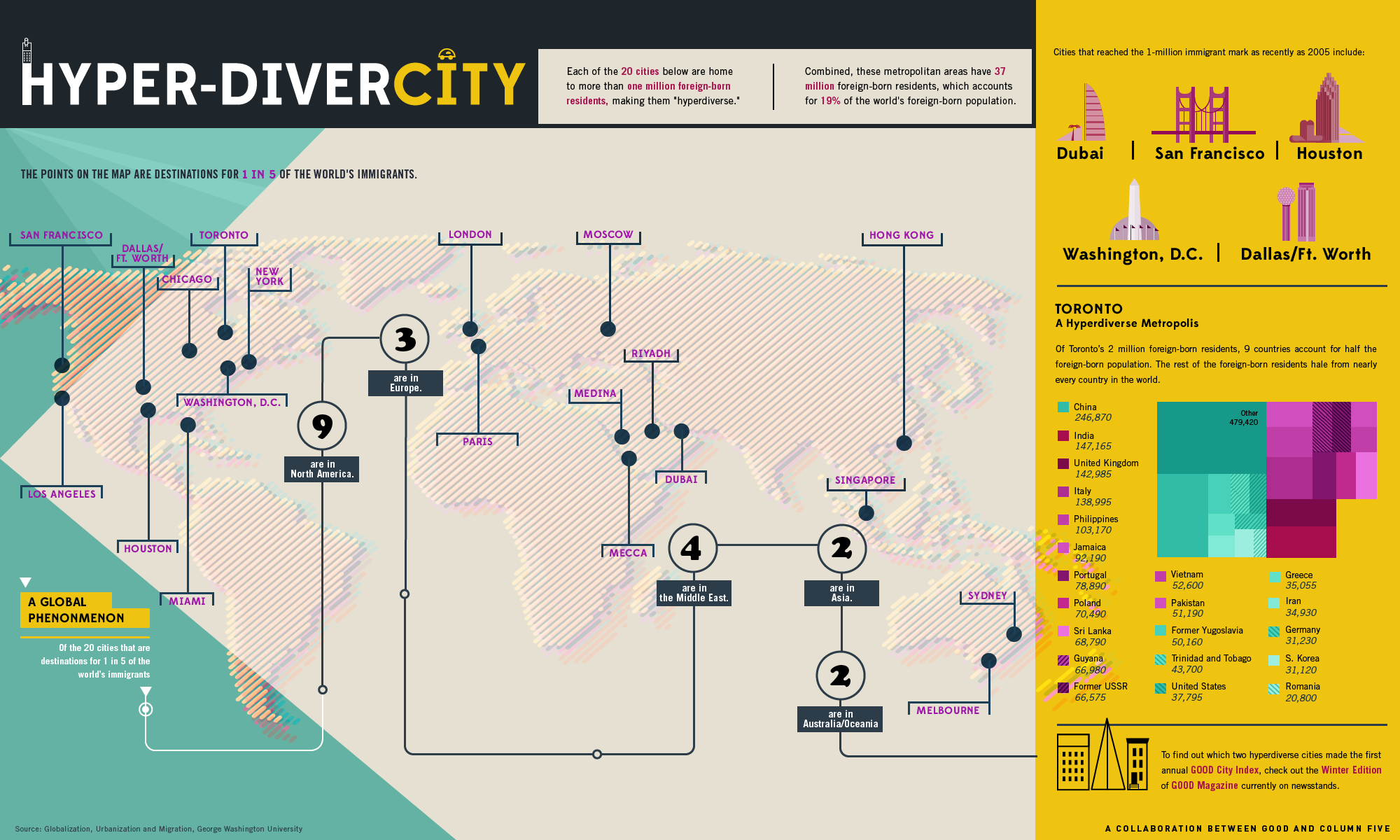
Graphic from Good Magazine

Ratna Omidvar’s report of the recent Cities of Migration Berlin conference. Worth reading:

For all the self-criticism that we Torontonians like to inflict on ourselves, we secretly know that our city is admired all over the world as a place that works well with its diversity. But lest we feel too smug, let’s remember that world leaders don’t keep their titles without continuous learning and innovation. They should, in the words of Hamburg Mayor Olaf Scholz, “Oppose the idea that there’s nothing to change any more.”

At the international Cities of Migration conference in Berlin convened by Maytree in June, practitioners, policy makers and private sector leaders shared lessons on good practice in immigrant inclusion from their own cities: Helsinki, Nashville, Tokyo, Lisbon, Auckland, Sao Paulo, Athens, and many more. From this global hub in Berlin come many ideas for and a few from Toronto.

One of the founding principles of Maytree’s Cities of Migration project is that good ideas can travel. That a smart policy working in Seattle can be tweaked to also work in Halifax. That a successful initiative from San Francisco can be replicated in London. This is because cities are often better placed to address immediate needs that are local in nature, such as employment, home ownership, success in school, and neighbourhood inclusion. As Khalid Koser of the Geneva Centre for Security Policy said in his keynote, “While states are building walls, cities are building bridges.”

Maytree Lessons for and from Toronto » Maytree.

‘Koreans not ready for multiculturalism’

Interesting story on increased diversity within South Korea, particularly through the offspring from mixed unions, and how that comes across in a country with a strong cultural and historical identity:

South Korea is quickly turning into a multicultural society with a growing number of biracial children, but the majority of Koreans are “not ready” for ethnic diversity, according to scholars and experts.

The number of biracial babies in the country increased dramatically, making up 4.7 percent of all newborns in 2012. In 2008, they accounted for 2.9 percent, and 4.3 percent in 2010. A total of 97,701 biracial children were born from 2008 to 2012, according to Statistics Korea.

However, Koreans tend to have racial and ethnic prejudice against immigrants based on their countries of origin, according to research by the Asan Institute for Policy Studies.

Canada’s figure for mixed unions nationally is 4.6 percent, no data that I have seen about the percentage of mixed union offspring.

‘Koreans not ready for multiculturalism’.

Diversity Hires Punished For Valuing Diversity « The Dish

Seems counter-intuitive but it does reinforce the difficulty in changing corporate and individual cultures. And of course, ambitious women and minorities will tend to adapt to the corporate culture, consciously or not, part of a normal and human integration process:

A woman who shepherds women up the ranks, for example, is perceived as less warm, while a non-white who promotes diversity is perceived as less competent. Both end up being rated less highly by their bosses, according to the paper, which is set to be presented at an Academy of Management conference next month. … Often, having women or minorities atop a company is perceived as a marker of progress for diversity efforts, but [David] Hekman’s research suggests their presence might not have a large impact on the rest of the organization. If they believe it’s too risky to advocate for their own groups, it makes sense that successful women and non-white leaders would end up surrounded by white males in the executive suite, he said.

Diversity Hires Punished For Valuing Diversity « The Dish.

Minister Kenney concludes successful trip to Lebanon – Canada News Centre

Interesting quote by Kenney on Lebanon’s “balanced partnership.” Not sure that I would characterize that way, given Lebanon’s past civil wars and that it is largely a country with parallel structures, rather than the more integrative model of multiculturalism in Canada:

Canada’s model of pluralism is profoundly relevant to Lebanon, the only Middle Eastern country built on a balanced partnership between religious and ethnic communities.

Minister Kenney concludes successful trip to Lebanon – Canada News Centre.

Editorial: Canada is leading the pack in mixed unions

Citizenship Fraud.021Further to my earlier post on the StatsCan study (Metro Vancouver has highest ratio of mixed couples in Canada), the Macleans editorial on what it may mean (I developed the chart above based on the study):

A couple of trends suggest the overall growth rate will move up in future, regardless of ethnicities involved. First, mixed unions tend to track the percentage of visible minorities in the greater Canadian populace. With visible minorities predicted to account for up to a third of the population by 2031, further growth will no doubt occur as the dating pool changes. Mixed unions are more common within younger age groups, as well, suggesting a gradual progression through society. Higher education is also correlated with mixed unions, as is urban living. Vancouver boasts the highest percentage of mixed unions, at nearly 10 per cent, followed by Toronto, Victoria, Ottawa and Calgary. As the number of mixed unions grows, so, too, will the offspring from these relationships. Whatever taboos may have existed for these children in the past, they’re being erased by sheer numbers.

Putting Canada’s record in global context is complicated by different definitions and the availability of data, but we appear to stand out for several reasons. European figures define mixed unions as between two people with different citizenship, a far lower standard of tolerance. Even so, the figures show no strong trend, with most countries no higher than Canada, despite a much broader definition of what “mixed” means. American research tends to focus solely on marriages, ignoring the prevalence of common-law relationships. When all couples are considered, Canadian figures are substantially above those in the U.S.

As for public attitudes, last year, a Gallup Poll announced that American approval of black-white marriage hit an all-time high of 87 per cent, up from four per cent in 1958. Yet Canadian sociologist Reginald Bibby points out that Canadian acceptance rates have long outstripped those in the U.S. A 2007 poll, for example, showed 92 per cent of Canadians approved of mixed marriages at a time when U.S. figures were 77 per cent. “There is probably no better index of racial and cultural integration than intermarriage,” Bibby writes. And Canada leads the pack in both performance and perspective.

Editorial: Canada is leading the pack in mixed unions.

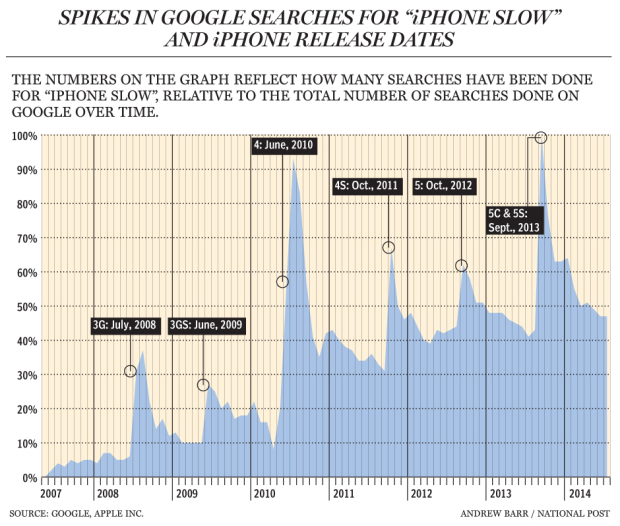
Professor goes to big data to figure out if Apple slows down old iPhones when new ones come out

Apple Slow iphones

A good illustration of the limits of big data and the risks of confusing correlation with causation. But bid data and correlation can help us ask more informed questions:

The important distinction is of intent. In the benign explanation, a slowdown of old phones is not a specific goal, but merely a side effect of optimizing the operating system for newer hardware. Data on search frequency would not allow us to infer intent. No matter how suggestive, this data alone doesn’t allow you to determine conclusively whether my phone is actually slower and, if so, why.

In this way, the whole exercise perfectly encapsulates the advantages and limitations of “big data.” First, 20 years ago, determining whether many people experienced a slowdown would have required an expensive survey to sample just a few hundred consumers. Now, data from Google Trends, if used correctly, allows us to see what hundreds of millions of users are searching for, and, in theory, what they are feeling or thinking. Twitter, Instagram and Facebook all create what is evocatively called the “digital exhaust,” allowing us to uncover macro patterns like this one.

Second, these new kinds of data create an intimacy between the individual and the collective. Even for our most idiosyncratic feelings, such data can help us see that we aren’t alone. In minutes, I could see that many shared my frustration. Even if you’ve never gathered the data yourself, you’ve probably sensed something similar when Google’s autocomplete feature automatically suggests the next few words you are going to type: “Oh, lots of people want to know that, too?”

Finally, we see a big limitation: This data reveals only correlations, not conclusions. We are left with at least two different interpretations of the sudden spike in “iPhone slow” queries, one conspiratorial and one benign. It is tempting to say, “See, this is why big data is useless.” But that is too trite. Correlations are what motivate us to look further. If all that big data does – and it surely does more – is to point out interesting correlations whose fundamental reasons we unpack in other ways, that already has immense value.

And if those correlations allow conspiracy theorists to become that much more smug, that’s a small price to pay.

Professor goes to big data to figure out if Apple slows down old iPhones when new ones come out

Vietnamese government fears Black April Day bill would open up old wounds

Vietnamese diaspora politics on how to commemorate the events following the fall of Saigon. Not surprisingly, the Conservatives favour an approach that links it to their general approach to events related to Communism; others favour an approach that focuses more on the Canadian story of welcoming Vietnamese refugees:

Conservative Senator Thanh Ngo sponsored the Black April Day Act, currently at second reading in the Senate.

“It has the general aim of bringing the attention of all Canadians to the events and suffering that followed the fall of Saigon after the Vietnam War in 1975. It would also shed light on the fundamental role that Canadians played in rescuing and welcoming thousands of Vietnamese refugees,” says a page on Mr. Ngo’s website that promotes the bill.

“Too little is known about the struggles and the atrocities that followed the devastating Vietnamese war,” Mr. Ngo told the Senate on April 30 of this year.

Too few Canadians are aware of Canada’s diplomatic work serving on international truce commissions during the Vietnam War, he said.

The war ended on April 30, 1975 with the fall of the then-southern capital, Saigon, to Northern forces. Mr. Ngo arrived in Canada as a refugee from Vietnam in 1975 after working as a diplomat for the government of South Vietnam prior to the fall of its capital. He was unavailable for an interview, spokesperson Tanya Wood wrote in an email.

Mr. Ngo’s experience contrasts with that of Mr. Vu, whose father and brother fought for the Communist forces that would prevail in the war.

Vietnamese loyal to the prevailing North suffered during the war as well, said Mr. Vu. He said an explosion killed his grandmother while she sat in an improvised bomb shelter during the Christmas bombing campaign in 1972.

“Everything was leveled, only a bomb crater was seen,” he said

If passed, the Black April Day Act would bring up bad blood remaining from the war among Vietnamese at home and abroad, he said.

“The war [gave] a lot of wounds to us, to Vietnam, and we have been trying to make every effort to heal the war wounds. So we think that opening up these wounds, that [does] not help, and it only causes continuing hatred and division from inside the country and outside,” he said.

Canada’s government has been supportive of Vietnamese reconciliation efforts in the years since the war, he said, something for which the government of Vietnam is grateful.

Vietnamese government fears Black April Day bill would open up old wounds | Embassy – Canada’s Foreign Policy Newspaper.

L’Écosse, une inspiration pour les indépendantistes, selon Drainville

Quite an amusing read, Drainville praising the approach of the Scottish nationalists in their referendum, given that it is based on a clear, short question, developed in cooperation with the national government, all anathema to the PQ:

L’ancien ministre responsable des Institutions démocratiques et «parrain» de la défunte Charte des valeurs a été charmé par la façon dont les Écossais mènent la campagne. Il a entre autres observé que les tenants du Oui dépassaient largement la base militante du Parti national écossais, la formation indépendantiste dirigée par le premier ministre Alex Salmond.

«La société civile a pris en main ce référendum, des groupes et des citoyens ont décidé de le prendre en main. La campagne du Oui est largement décentralisée, très terrain, très près des gens, cest ce que jai observé», a-t-il relaté.

Le processus référendaire écossais est aussi une affaire de collaboration entre le gouvernement central britannique et le Parlement dÉdimbourg.

…..La limpidité de la question référendaire et la transparence totale entourant la date de la consultation populaire devraient éclairer les débats au sein du mouvement souverainiste québécois, selon M. Drainville.

L’Écosse, une inspiration pour les indépendantistes, selon Drainville | Martin Ouellet | Politique québécoise.

Young Brits join the jihad in Syria

Good overview in Macleans of the UK “terror tourists” but situating this in the broader context of Mid-East societies:

Terrorism, however, has been a real threat in the U.K., with the “Troubles” in Northern Ireland in the latter half of the 20th century and, more recently, the 2005 attack in central London, where suicide bombers killed 52 people. That led to the creation of the 2006 Terrorism Act; a new offence concerned “preparatory acts” of terror.

The changes were controversial. Tayab Ali is a solicitor whose clients include a number of British citizens who have been accused of terrorism. He believes the 2006 legislation “has the tendency to prosecute people who might be angry and expressing strong political views, but who don’t have any real ambition of participating or supporting terrorism in any way.”

Barrett, the former MI6 officer, understands how bewildering it must be to young men who hear about the humanitarian crisis in Syria and want to act. In June, U.S. President Barack Obama proposed funding “moderate” Syrian rebels at the same time the U.S. and its allies were warning nationals not to join the same groups. “It’s very confusing indeed,” Barrett sighs. But, in the end, “the threat of the returning fighter is a small one, compared to the threat of a complete destabilization and destruction of social cohesion in the Middle East.”

Young Brits join the jihad in Syria.