Australian Race Discrimination Commissioner Tim Soutphommasane labels Hizb ut-Tahrir views ‘absurd’

A reminder that non-violent extremism can be equally dangerous to a country’s social fabric:

Australia’s race discrimination commissioner has slammed a controversial Islamic group over its claims “de-radicalisation” amounts to forced assimilation.

Hizb ut-Tahrir held a large conference at Bankstown in south-western Sydney on Sunday and told the more than 500 men, women and children who attended that Muslims were being demonised over their faith.

“Deradicalisation has come to mean making Muslims less Islamic, more Western, more secular, more submissive to secular, Liberal political … norms,” Hizb ut-Tahrir spokesman Uthman Badar said.

“It is nothing more than an agenda of forced assimilation justified by exaggerated fears of a security threat.”

But Race Discrimination Commissioner Tim Soutphommasane said this was “absurd”.

“Hizb ut-Tahrir’s views on citizenship are a rejection of our liberal democratic values and a denial of Australian multiculturalism,” he said.

“They further confirm this group’s extremist agenda.”

Dr Soutphommasane said that when migrants became citizens, they chose to become a part of the Australian community.

“There’s nothing oppressive about committing to our democracy, abiding by the law, and respecting the rights of others.

“Our multiculturalism means that everyone has a right to express their cultural heritage but also accepts the responsibilities of being an Australian citizen.”

Source: Race Discrimination Commissioner Tim Soutphommasane labels Hizb ut-Tahrir views ‘absurd’

UK Catholic schools to shun Islam in new GCSE courses 

Odd, given the common roots of Christianity, Judaism and Islam:

Catholic schools will no longer teach Islam as part of GCSE religious studies, but will be directed to teach Christianity and Judaism.

Changes to the new religious studies GCSE specification mean schools must teach two religions as part of the course, with each weighted equally in the exam.

The Bishops Conference has decreed that all Catholic secondary schools teach Judaism alongside Christianity at GCSE, regardless of whether teachers are trained to teach other religions, such as Islam.

The 2011 census shows that Judaism is the fifth most popular religion in England, with 0.5 per cent of the population saying that it is their faith. This compares with 5 per cent identifying themselves as Islamic.

A teacher at a Catholic secondary school, who wished to remain anonymous, told Schools Week the decision was made for purely “academic” reasons. “There is a real need for understanding of Islam, but . . . the argument coming from the dioceses is that we shouldn’t sway with the times.”

According to information on the Catholic Education Service (CES) website, the body overseeing all Catholic schools, 2,156 Catholic primary and secondary schools in England educate more than 800,000 pupils.

Approximately 30 per cent of children educated at the school are of no faith or other faiths.

The teacher continued: “The bishops say Judaism is an academic study of religion rather than a social study, however, we would argue that Islam is both.”

Source: Catholic schools to shun Islam in new GCSE courses | Schools Week

Multiculturalism in Canada: Evidence and Anecdote – Flash Sale 30 percent off

For those interested in the print version of Multiculturalism in Canada: Evidence and Anecdote or Policy Arrogance or Innocent Bias: Resetting Citizenship and Multiculturalism (topical again given the account of the transfer to CIC from Canadian Heritage in 2008, now reversed).

One of Lulu’s better sales, 30 percent off.

The direct link to my book page is: My Author Spotlight.

Lulu Flash Sale 10 Nov

Justin Trudeau joyfully mobbed by federal civil servants

PM Trudeau at the rebranded Global Affairs department. Unprofessional but understandable:

Suddenly there was a buzz and the crowd moved forward.

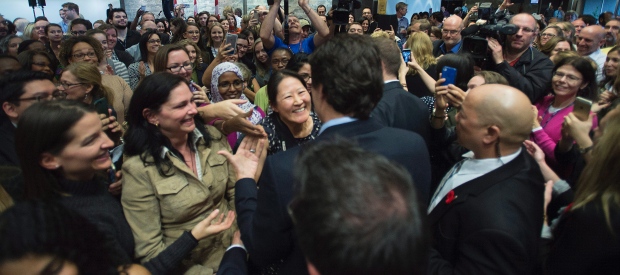
Trudeau appeared and began to make his way out of the building. He was swarmed. Many took photos and even selfies along the way.

Liberal Cabinet 20151106

Trudeau was mobbed as he tried to leave the Lester B. Pearson building Friday. He told the crowd his government would need the civil service’s absolute best. (Sean Kilpatrick/Canadian Press)

The prime minister was hugged. Cheers erupted. He smiled, waved and stopped by the door.

He thanked the crowd for supporting the members of his cabinet, who had just left.

Then he continued: “We’re going to need every single one of you to give us, as you always do, your absolute best.”

They applauded and cheered some more. Some yelled back: “You’ve got it.”

One longtime staffer nearby said he’d never seen anything like it. Not in all of his years.

And it might not be the only instance of a crowd forming to welcome a minister Friday.

On Facebook, a photo circulated of civil servants at another location waiting to greet Sajjan.

Source: Justin Trudeau joyfully mobbed by federal civil servants – Politics – CBC News

And Donald Savoie puts it into context:

Donald Savoie, a public administration expert at the University of Moncton, said public servants are gripped by “the euphoria” of working for a government that promises renewed respect.

He said many hope they are returning to their “days in the sun” when public servants worked on policy and were listened to. He likened it to when Pope John XXIII opened the Vatican and liberalized the Catholic Church.

As a result, bureaucrats’ heckling and cheering, and unions revelling in their political campaigns, may not be appropriate but isn’t unexpected.

“Don’t try to make sense of this. School’s out and people are beside themselves with joy,” Savoie said. “Stay tuned, it’s too fresh. Wait until things calm down in a few months.

“I wouldn’t get too worked up because what happened today doesn’t define the public service and its non-partisanship.”

Public servants shed cloak of impartiality – at least for the day

Kate Taylor: Canadian cop show Blood and Water puts #multiculturalism first

Makes the point about lack of meaningful diversity in most popular programming and an example of what can be done:

There’s a new Canadian police show making its debut Sunday night. It revolves around the murder of a junkie in a Vancouver park; his young widow is eight-months pregnant but his wealthy family wants nothing to do with her because they blame her for his drug use. Meanwhile, the female detective who is investigating has just been diagnosed with cancer.

If none of that drama sounds particularly remarkable for a TV cop show, get this: The characters in Blood and Water speak English, Mandarin or Cantonese, according to their situations, and the whole series, which airs on the Canadian multicultural channel OMNI, is subtitled for both English-language and Chinese-language viewers.

Here is a show in which various recognizable figures in Canadian society – a wealthy Chinese businessman, an old white cop, a younger Asian cop, a Downtown Eastside drug dealer – swim alongside each other in a realistic linguistic soup. Television’s pretense that North American cities are conveniently unilingual places is discarded.

Kudos to OMNI, on which original programming usually means cheapo talk shows, for commissioning the series from producer Breakthrough Entertainment. Multicultural television is the great missed opportunity of Canadian broadcasting, something that the unusualness of Blood and Water serves to underline.

This may be a country that prides itself on its multiculturalism but you wouldn’t know it by watching Canadian television, where content that is not in English or French is mainly ghettoized on OMNI or Telelatino and is mainly low-budget – unless it’s been imported from abroad. You can watch a current-affairs show in Punjabi or a documentary about Italian weddings, if you understand those languages, but you aren’t going to encounter much South Asian or Italian content if you only speak English or Cantonese. Small silos rather than broad cross-cultural dialogue is the norm.

Although the CBC has a mandate to reflect Canada’s multicultural nature, its onerous bilingual agenda – by law, it must strive to produce content of equal quality in the two official languages – plus the need for aboriginal-language programming trumps multiculturalism. The result is that the area has been left mainly to the commercial broadcasters – OMNI is owned by Rogers; Telelatino is partly owned by Corus Entertainment, which in turn is owned by Shaw Media – where the reality of serving multiple niche audiences on secondary cable channels has kept programming ambitions low.

Source: Kate Taylor: Canadian cop show Blood and Water puts multiculturalism first – The Globe and Mail

In praise of induction – The Washington Post

Another way at looking at the difference between evidence and anecdote, and the merits and utility of each, by Daniel W. Dresser of  the Fletcher School of Law and Diplomacy at Tufts University:

One of the tensions that explains the fraught relationship between politics and the academy is that academics are big fans of deductive thinking and politicians are not.

At the risk of exaggerating the gap, academics like to think deductively — i.e., start from theory and then test whether that theory explains parts of the real world. When I was in graduate school, my professors talked a lot about the perils of thinking inductively — i.e., building a general theory from looking at a particular case. The obvious danger was to build a theory from a particular case, and then use that case as evidence of the theory’s power — the very definition of a tautology.

Politicians preternaturally think in an inductive manner. They build from experience, narrative and analogy to articulate what they think matters in the world of policy. For politicians, this makes a great deal of sense, because they trust their own experiences far more than abstract data, and because they know that narratives resonate far more with voters and citizens than abstract theories. Consider, for example, Chris Christie’s moving discussion of how to treat drug addicts. It’s a brilliant demonstration of a politician using a particular narrative to make a deeper point on policy.

In splitting the world like this, I’m simplifying things a lot. One could argue that Barack Obama’s problem as a politician is that he is too abstract and not inductive enough. Similarly, most scholarship emerges from the interplay of deductive and inductive thinking. But still, I think there is some truth in this dichotomy.

My reason for bringing this up is to point out that my own tribe of academics still looks down on the inductive method of theorizing as a flawed approach that is prone to error. And those flaws are real. But I fear that this has blinded many academics to the virtues of induction, because they exist. Indeed, twice in the past week, it’s come up in policy debates.

Source: In praise of induction – The Washington Post

Why #Diversity Is Difficult | Re/code

An account by Leslie Miley on her challenges in increasing diversity at Twitter:

But then, in August 2015, Jack Dorsey returned to Twitter, and during a company meeting, responded to my question about committing Twitter to a measurable diversity goal. He publicly committed to diversity in front of every Twitter employee in attendance, and a few short weeks later, Twitter publishes this. And in a profoundly emotional moment, Jack Dorsey played the video seen below at the next company meeting:

This epitomizes the best of Twitter, and I left the meeting inspired and ready to drive the bus of diversity in engineering.

After several weeks of meetings and guidance acceptance from executive staff, I pitched a job proposal to focus on increasing diversity in engineering to the senior vice president of engineering. In the course of the meeting, he suggested that we begin tracking the ethnicity of potential candidates in the pipeline to understand better where candidates are falling out. I agreed that this is an important metric to track, and conveyed that the current data we had indicated that the problem is not just the pipeline. While ethnic and gender data early in the pipeline is incomplete, we do know that in 2013, 4.5 percent of computer science graduates from the top 25 schools were African-American, and 6.5 percent were Hispanic/Latino.

As we continued the discussion, he suggested that I create a tool to analyze candidates last names to classify their ethnicity. His rationale was to track candidates through the pipeline to understand where they were falling out. He made the argument that the last name “Nguyen,” for example, has an extremely high likelihood of being Vietnamese. As an engineer, I understand this suggestion, and why it may seem logical. However, classifying ethnicities by name is problematic, as evidenced by my name (Leslie Miley).


With my departure, Twitter no longer has any managers, directors, or VPs of color in engineering or product management. From this position, Twitter may find it difficult to make the changes to culture and product.


What I also found disconcerting is this otherwise highly sophisticated thinker could posit that an issue this complex could be addressed by name analysis. (For reference, here is a tool that attempts to do that. With Jewish or African/African Americans, this classifier scored 0 percent on identifying these groups in Twitter engineering). While not intentional, his idea underscored the unconscious tendency to ignore the complex forces of history, colonization, slavery and identity.

I left that meeting wondering how I could, in good conscience, continue to work in an organization where the senior vice president of engineering could see himself as a technology visionary and be so unaware of this blind spot in his understanding of diversity. Leadership keeps citing “the pipeline,” when the data does not support it. They continue to churn out ethnic and racial minorities and women, but still claim a commitment to diversity.

This is the last meeting of any consequence I had at Twitter. My time at Twitter is over. And I end it very conflicted. Twitter as a platform has empowered underserved and underrepresented people. It has fomented social movements and brought to the forefront of American media and politics issues that affect me personally and professionally.

Source: Why Diversity Is Difficult | Re/code

ICYMI: ‘Islam and the Future of Tolerance’ and ‘Not in God’s Name’ – The New York Times

Irshad Manji on the need for respectful discourse:

Enter Jonathan Sacks, a former chief rabbi of the British Commonwealth. In his sobering yet soul-stirring new book, “Not in God’s Name,” Sacks confronts “politicized religious extremism” and diagnoses that cancer crisply: “The 21st ­century has left us with a maximum of choice and a minimum of meaning. Religion has returned because it is hard to live without meaning.” Given that “no society has survived for long without either a religion or a substitute for religion,” and given that believers are proliferating, Sacks predicts that the next 100 years will be more religious than the last. Bottom line: Any cure for violence in God’s name will have to work with religion as a fact of life.

That is where Sacks’s brilliance as a theologian radiates. He thinks two matters need tackling. There is “identity without universality,” or solidarity only with one’s group. Then there is “universality without identity,” the unbearable lightness of humans in a transactional but not transcendent world. Sacks wants to preserve the joy of participating in something bigger than the self while averting the hostility to strangers that goes with tribal ­membership.

He attempts this balance through an ingenious rereading of Genesis. Sacks’ proposition: Genesis contains two covenants rather than one. The first focuses on justice, which is impartial and thus universal in application. The second covenant emphasizes love, which is exquisitely particular and personal. In a ­showdown, justice overrides love. Analyzing parables and sibling rivalries in the Bible, Sacks concludes that decency toward the misfit, even to the infidel, takes precedence over loyalty to your own.

This should hearten Sam Harris, who despises the tendency of Muslims (and others) to stick up for fellow believers, especially when they act like “psychopaths.” Still, I have to wonder if Harris and his disciples will put stock in any reinterpretation, no matter how learned. After all, Harris opines that to reform religion is to read scripture in “the most acrobatic” terms. Sacks turns the tables on such skepticism, observing that “fundamentalists and today’s atheists” both ignore “the single most important fact about a sacred text, namely that its meaning is not self-evident.”

My own skepticism is about whether reformist interpretations can outpace regressive readings that tap into primal fears and gain traction quickly. Sacks argues, “We must put the same long-term planning into strengthening religious freedom as was put into the spread of religious extremism.” That implies creating a matrix of schools, policies and campaigns to teach reformist perspectives. But as he admits early on, “decades of anti-racist legislation, interfaith dialogue and Holocaust education” have not prevented the mess we are in. Why would it be different now?

Here is why. The Islamic State’s savagery against Muslims offers hope for taking power politics out of Islam, eventually achieving the mosque-state separation that Nawaz views as central to reform. Sacks gives historical comparisons to justify his hope. Europe’s bloody Reformation wars showed that big religion could not be relied on to protect the religious: “Western Christianity had to learn what Jews had been forced to discover in antiquity: how to survive without power. . . . You do not learn to disbelieve in power when you are fighting an enemy, even when you lose. You do when, with a shock of recognition, you find yourself using it against the members of your own people.”

Meanwhile, back at liberal democracy’s ranch, we must “insist on the simplest moral principle of all. . . . If you seek respect, you must give respect.” This does not mean always having to agree, but it does mean viewing one another as worthy of candid, constructive engagement. On that front, Sam Harris and Maajid Nawaz are role models. The Lord works in mysterious, perhaps acrobatic, ways.

Source: ‘Islam and the Future of Tolerance’ and ‘Not in God’s Name’ – The New York Times

#Multiculturalism Transferred Back to Canadian Heritage: Impact

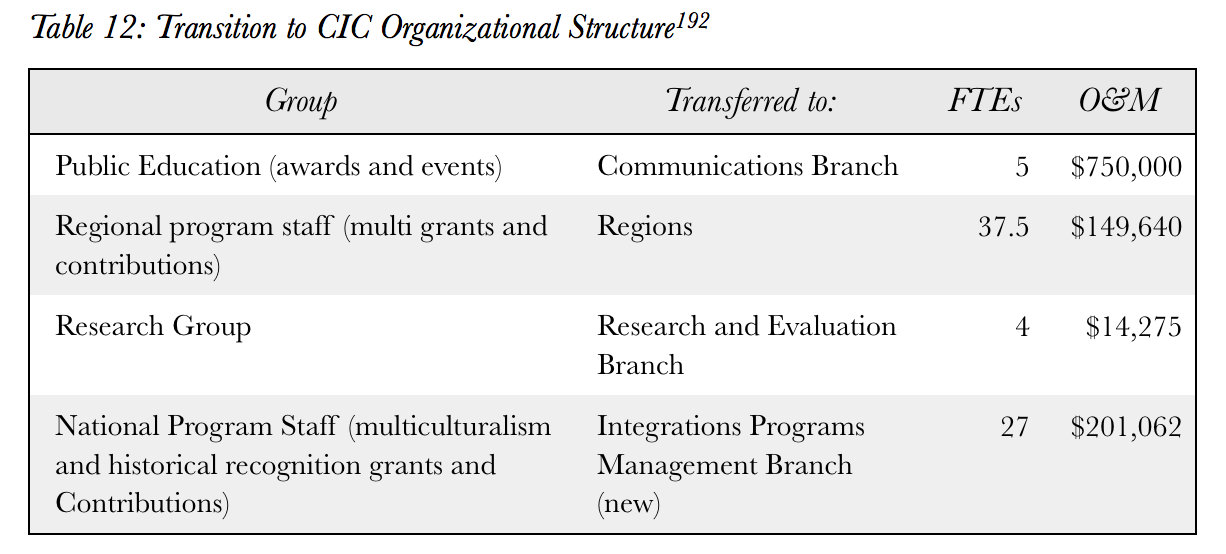
CM_Table_12_Transfer_to_CICThe Order in Council announcing the reversal of the 2008 transfer to CIC as part of then Minister Kenney’s Package:

His Excellency the Governor General in Council, on the recommendation of the Prime Minister, pursuant to paragraph 2(a) of the Public Service Rearrangement and Transfer of Duties Act, transfers, effective November 4, 2015,

(a) from the Department of Citizenship and Immigration to the Department of Canadian Heritage the control and supervision of those portions of the federal public administration in the Citizenship and Multiculturalism Branch within the Department of Citizenship and Immigration that relate to multiculturalism; and

(b) to the Minister of Canadian Heritage the powers, duties and functions of the Minister of Citizenship and Immigration relating to multiculturalism.

The PCO press release indicates that responsibility for the Canadian Race Relations Foundation is also transferred but makes no reference to either the Global Centre for Pluralism or the International Holocaust Remembrance Alliance (the previous government gave the head of the Office for Religious Freedom the lead responsibility).

Personally  interesting,  given that I managed the transfer to CIC in 2008, and have consistently written that multiculturalism was atrophying at CIC given its more operational focus on citizenship and immigration.

As I wrote two years ago in my conclusion to Policy Arrogance or Innocent Bias: Resetting Citizenship and Multiculturalism on the longer-term impact of CIC’s departmental structure and culture on the multiculturalism program:

A functional model like CIC has advantages in creating greater clarity between the policy and operational functions, but tends to reinforce the centre of gravity and allocate resources accordingly. A business line model like PCH provides more focused policy and program integration at the business line or program level, but increases rigidity and coordination issues between business lines. While the PAA structure acts as a counterweight, over time the centre of gravity will dominate. Arguably, for integration, citizenship and multiculturalism, the lines between pure policy and pure operations (e.g., citizenship ceremony design, G&C management) are less clear than for admissibility and immigration selection. Additionally, one of the legacies of the Cullen-Couture agreement transferring immigration selection and integration funding to Quebec meant CIC was largely uninterested in using the levers in citizenship and multiculturalism to highlight federal presence in Quebec. A sharp contrast to PCH which had, and viewed itself as having, a strong role in Quebec.

In many ways, the collective impact for multiculturalism will, over time, become closer to the original Reform Party objective of 1996-97 of abolishing multiculturalism and strengthening a strong, common narrative of citizenship. The Cabinet shuffle of July 2013 and the separation of the political function, which remained under Minister Kenney, from the departmental function, under Minister Alexander, is significant in that context. While political, community-based outreach is central to electoral strategies (the “fourth sister”), as evidenced by Minister Kenney’s ongoing responsibility for this critical outreach, the substantive policy and program focus on long-term integration issues will continue to decline. This is a legitimate policy choice but it is striking just how little debate this change has provoked.

The Liberal government’s decision to reverse the transfer and restore the broader Canadian Heritage identity mandate (and no longer have the file ‘travel’ with a minister), with a strong diversity and inclusion emphasis, will reinvigorate multiculturalism, both within the department and across government more generally.

However, given the dispersal of and reductions to multiculturalism resources at CIC (now IRC), considerable rebuilding will be required.

The above table highlights the FTEs and Operations and Maintennance resources transferred in 2008 (about $12 million in Grants & Contributions funding was also transferred).

Chapter 6 of my book describes the process, resource transfers and impact (available at Lulu.com, direct link My Author Spotlight).

Source: Orders in Council – Search – Privy Council Office

Why it’s not enough to simply restore the long-form census

Kevin Milligan on the longer term questions regarding how we should leverage more administrative data for future Censuses:

But how exactly should we go about repairing the damage? Census questionnaires need to be thoroughly tested, and then they must be printed. You can’t do this in a few months. According to the Huffington Post, for 2016 the government will use the already-tested questionnaire for the planned 2016 National Household Survey and simply make its completion mandatory rather than voluntary. While 33 per cent of Canadians were requested to fill in the 2011 NHS, apparently only 25 per cent will be asked in 2016. Still, if compliance rates go back to 2006 levels, this should yield a larger number of completed surveys. But much more importantly, the sample should be much cleaner because we won’t have the skewed non-completion problems that plagued the 2011 NHS.

This strategy strikes me as sensible battlefield medicine. Time is short, so the government is constrained in what can be achieved in the few short weeks before sending the census forms to the printer. Making the 2016 NHS mandatory solves the largest problem we had with the 2011 NHS. However, I hope this is just the beginning of a new conversation on the census—and data in general—rather than a one-off restoration of past practices.

In the United Kingdom in 2010, the newly-elected Conservative government also had some concerns about their census. But, instead of acting impetuously, they put in place a process to rethink how governments ought to be collecting data in the 21st Century. The initial report of this process came out in 2014, and a new “Census Transformation Programme” is at work on plans for the 2021 UK Census.

What should Canada do next? Well, the main recommendations of that 2014 UK report were to make greater use of existing data already being collected for administrative purposes and greater use of internet-based census forms. Canada was already doing both those things in 2006. But, I believe there is room for much more innovation.

I gave a guest lecture a year ago to a meeting of data librarians outlining my thoughts on the future of data in the social sciences, the notes from which can be found here. I remarked that we have more and more administrative data, such as tax, employment insurance and immigration records, at the same time as surveys (like the census) are becoming harder to conduct. If we move to greater use of administrative data, we need to be sure we properly balance privacy concerns, researcher access, cost, and data accuracy.

Restoring the mandatory basis for the 2016 survey was necessary, but also easy. The true test of the resolve of the new government on data will come in the actions they take as we begin to plan the 2021 census.

Source: Why it’s not enough to simply restore the long-form census