An Arab festival, a headless clown, a sword—cue the outrage

Martin Patriquin on the humour of the Festival du Monde Arabe de Montréal:

The festival team did so by adopting a particularly ballsy theme for this year’s festival. The FMA has never been particularly anodyne; last year’s theme was “Folies Métèques,” which translates roughly to “dirty immigrant follies.” This year’s theme goes further with  “Hilarus Delirus,” an apparent double entendre meaning either hilarious delirium or delirious slave (Hilarus was a gladiator owned by the Roman emperor Nero). The idea is that laughing  through anything—up to and including decapitation—is the best revenge against one’s decapitators, figurative or otherwise.

The festival itself further destroys the cliché that Arab culture is a desert of bloody austerity. If the headless clown wasn’t enough, consider the accompanying video by Lynda Thalie, a Montreal singer who originally hails from Algeria. It is a five-minute carnival of painted faces and naked flesh set to Arab strings­—a Muslim fundamentalist’s nightmare, performed by an Algerian woman. The lineup also includes Iraqi-Montrealer rapper Narcicyst, who is as outspoken about Islamic fundamentalist regimes as he is of what he sees as the West’s enabling of them.

The festival’s theme also exposes another unspoken truth: that the critiquing of religious fundamentalism is most visibly the domain of non-Arabs. It makes it all too easy for apologists of, say, the murder of Charlie Hebdo’s cartoonists to to wrap themselves in the veil of Muslim persecution. The FMA’s headless clown lays waste to this specious argument. It is heartening to see Arabs—namely, the Muslims, Berbers, Christians and Jews who comprise the FMA team—critique the very same fundamentalism. (An important aside: the clown bleeds words and musical notes, not blood.)

Quebec has had a tumultuous few years in regards to Muslims and other religious minorities. After the Parti Québécois’s electoral attempts to remove all religious symbols from the bodies of its public servantsin 2013, the newly elected Liberals went to another absurd extreme, by introducing a bill that many legal experts say would make it illegal to critique any organized religion. Both are shoddy in their own way. Thankfully, both failed to become law.

By laughing through his own misery, the headless clown is a reminder that the best line of attack against fundamentalism isn’t through laws or government decrees. It’s as simple as embracing the culture and deriding the extremists who would dare try to smother it.

Source: An Arab festival, a headless clown, a sword—cue the outrage
“Because It’s 2015” | Commentary magazine

The neocons at Commentary fret over ‘because it’s 2015’.

Wonder what they would have said if Lincoln had stated when slavery was abolished ‘because it’s 1865’?

On Wednesday in Ottawa, Justin Trudeau was sworn in as Canadian prime minister. He wasted no time in announcing his newly chosen cabinet of exactly 15 men and 15 women, which fulfilled a campaign pledge he’d made about gender equality. One reporter asked Trudeau why the perfect male-female split was so important to him. The prime minster’s response: “Because it’s 2015.”

It sure is. Back in the pre-identity Dark Ages, leaders of representative democracies felt obliged to cite principles or aims in explaining policy to citizens. Today they cite trends.

One problem with trends is that they go as quickly as they come. As Trudeau is sure to find out, his 50-50-gender cabinet is already passé. Where does it leave those Canadians who don’t identify as either male or female? Tell the prime minister the 1990s called. It wants its social justice back.

That’s only a practical challenge. Trudeau can pick up a full-time gendermetrician to carve up the grievance pie and reconfigure his cabinet with each newly pronounced identity.

There are deeper problems. “Because it’s 2015” kills debate, which is the lifeblood of free societies and, ironically, of social evolution. “Because it’s 2015” is a witless claim to absolute prerogative. It dresses up dogma in the finery of historical truth and casts off inquiry as another freshly uncovered offense against progress.

Source: Because It’s 2015 | commentary

How national multicultural legislation would strengthen Australian society

Andrew Jakubowicz, Professor of Sociology, University of Technology Sydney on the need for an Australian multiculturalism act:

Australians in general like the idea of a culturally diverse society. This is not surprising, given the high proportion of overseas-born Australians and their immediate descendants.

They recognise the creativity that comes from the interaction of different ideas and viewpoints. They are happy with individual cultural traditions being retained so long as the consequences do not breach social harmony. They really do not like inter-group vilification, though they want to affirm a common bond of fairness and respect – words Turnbull uses repeatedly.

When multiculturalism and these principles are marginalised as they were during the Howard, Abbott and Rudd years, social cohesion unwinds. When the allocated political champion of multiculturalism of the day has no legislative lever from which to shift prejudice and encourage engagement, society suffers.

Given the sustained avoidance of legislated multicultural goals and practices by governments and the evident consequences in pockets of alienation and fragmentation, it should be time for a debate on what form of legislative framework Australians would like to see in support of their desires for a fair and multicultural public sphere.

This means an Australian Multiculturalism Act, and a ministerial remit for the whole of government.

Source: How national multicultural legislation would strengthen Australian society

The Grits are back in charge, all’s right in Ottawa: Yakabuski

While there are elements of truth in Konrad Yakabuski’s piece (as I covered in Policy Arrogance or Innocent Bias: Resetting Citizenship and Multiculturalism), he over simplifies the reasons for the collective sigh of relief felt by the public service.

It is not driven by an incestuous ‘gene pool’ between Liberal politicians and public servants. It is more driven by education and related experience. We know from polling data that the university-educated are the group that supports the Conservatives the least (government policy analysts are all university-educated). And this support is driven more by small ‘l’ liberal values than big ‘L’ affiliation.

The sharper ideological edge of the Harper government compared to previous Conservative governments, along with a general distrust of evidence in favour of anecdotes and a general less inclusive approach, accentuated the tension between the government and public servants.

Greater alignment between the values of the Liberal government and the public service, along with the latter’s more inclusive approach and support for evidence-based policy, will make for a smoother relationship.

However, the public service needs to be more mindful of its own biases and values in its formulation of policy advice given that it will be less challenged than it was under the Conservatives:

Stephen Harper’s parting thank-you note to the bureaucrats – telling them in a Monday missive that he “will always be grateful for the support of Canada’s world-class public service” – was promptly used by its recipients to line the bird cages of the capital.

The civil servants are already banking on retrieving the sick days the Conservative government had tried to take away from them; the scientists are savouring the prospect of being free to speak out, even if it’s against government policy; the diplomats are yearning to show off a kinder, gentler foreign policy to a world that, Harper critics contend, has been wondering, “What happened to Canada?”

Among public servants, there is a natural preference for Liberal governance. It stems in part from previous long Liberal stints in power during which most of the senior bureaucracy moved up the ranks. In the tiny company town that is Ottawa, decades of intermarriage among bureaucrats, journalists, lobbyists and Parliament Hill staffers have left a gene pool that leans predominantly (L)iberal.

The Ottawa elites share a similar world view, one that squares with Prime Minister Justin Trudeau’s promise of activist government. They also share a bias, acknowledged or not, in favour of a government-driven economy. A bigger state and more regulation enhances the prestige, power and bank accounts of this cozy cohort of Ottawa insiders.

Mr. Harper was not the first outsider to see this. As a candidate for the Progressive Conservative leadership in 1983, Brian Mulroney vowed to hand out “pink slips and running shoes” to a bureaucracy he considered to be infested with Liberal sympathizers. But in Ottawa, he found he needed to get the bureaucracy onside to get anything done.

Though he purged Liberal appointees at government agencies and Crown corporations, Mr. Mulroney trusted, and in turn succeeded in winning the trust of, most of the senior bureaucrats he inherited. His one high-profile ouster of a senior mandarin (Ed Clark, an architect of Pierre Trudeau’s National Energy Program, who went on to become chief executive officer of TD Bank) was an exception to the rule.

Source: The Grits are back in charge, all’s right in Ottawa – The Globe and Mail

Americans Speak Over 350 Languages At Home, Census Data Shows | TIME

Comparative figures for Canada: Over 200 languages, 73 percent mother tongues other than English or French. Most common other languages: Chinese, Tagalog, Spanish, Punjabi, Arabic, Italian, German, Portuguese, Persian (Farsi) and Polish.

More than 60 million Americans over the age of five speak a language other than English in their home

Americans speak more than 350 languages in their homes according to data released Tuesday by the Census Bureau.

Findings from the 2009-2013 American Community Survey show more than 60 million Americans over the age of five speak a language other than English in their home. Spanish is by far the most common language and is spoken in the home by 37 million people.

Those who speak Spanish at home also tend to learn English, with more than half reporting they had learned the language. Speakers of Asian languages were less proficient in English: only 40 percent of the 1.4 million Vietnamese speakers and 44.7 percent of the 2.9 million Chinese-speakers speaking English “very well.”

The survey’s results show the nation’s largest metropolitan areas are also some of the most linguistically diverse. The Census reports 192 languages are spoken in New York and 54% of Los Angeles residents speak a language other than English at home. The data also shows there are more than 350,000 U.S. speakers of 150 different Native American dialects, such as Navajo, Apache, Dakota, Choctaw and Cherokee.

“While most of the U.S. population speaks only English at home or a handful of other languages like Spanish or Vietnamese, the American Community Survey reveals the wide-ranging language diversity of the United States,” said Erik Vickstrom, a Census Bureau statistician, in a Census press release. “Knowing the number of languages and how many speak these languages in a particular area provides valuable information to policymakers, planners and researchers.”

Source: Americans Speak Over 350 Languages At Home, Census Data Shows | TIME

US Supreme Court Takes On Racial Discrimination In Jury Selection

Interesting, and symptomatic of the situation in so many areas:

The U.S. Supreme Court wrestles Monday with a problem that has long plagued the criminal justice system: race discrimination in the selection of jurors.

“Numerous studies demonstrate that prosecutors use peremptory strikes to remove black jurors at significantly higher rates than white jurors.”

Those are not the words of the defense in the case. They come from a group of highly regarded prosecutors, Republican and Democrat, conservative and liberal, who have filed a friend-of-the-court brief siding with Timothy Foster, who was convicted and sentenced to death in the killing of an elderly white woman in Georgia.

It has been nearly 30 years since the Supreme Court sought to toughen the rules against racial discrimination in jury selection. But Foster’s lawyers argue that black jurors were systematically excluded from the jury at his trial in 1987, while judges at all levels looked the other way for nearly three decades thereafter.

Jury selection is done according to a set of rules. Prospective jurors are usually questioned by both prosecution and defense lawyers and then winnowed down in two different ways. First, the judge removes, “for cause,” those jurors deemed incapable of being impartial. Next, each side, prosecution and defense, has a set number of peremptory strikes, meaning that a certain number of prospective jurors can be eliminated without a stated reason, or for no reason at all.

In 1986, the Supreme Court added a third step in a case called Batson v. Kentucky. Under the Batson rules, if the defense could show a racial pattern in prosecution peremptory strikes, the prosecutor would have to justify each one by demonstrating a non-racial reason for eliminating the juror.

Still, prosecutors found ways to get around this new rule, as demonstrated by an infamous training video made in Philadelphia in the late 1980s after the court’s decision in Batson. The video features then Assistant District Attorney Jack McMahon advising trainees that “young black women are very bad, maybe because they’re downtrodden on two respects … they’re women and they’re blacks.”

He goes on to recommend avoiding older black women too, as well as young black men, and all smart, and well educated prospective jurors.

But, McMahon reminded the trainees that they had to come up with a non-racial reason for their strikes: “When you do have a black juror, you question them at length and on this little sheet that you have, mark something down that you can articulate at a later time if something happens,” he says.

Studies have shown that these proffered reasons are often a mere pretext for racial discrimination. A North Carolina study of jury selection in 173 death penalty cases found that black prospective jurors were more than twice as likely to be struck by the prosecution as similarly situated white jurors. A 2003 study of 390 felony jury trials prosecuted in Jefferson Parish, La. found that black prospective jurors were struck at three times the rate of whites. And in Houston County, Ala., prosecutors between 2005 and 2009 used their peremptory strikes to eliminate 80 percent of the blacks qualified for jury service in death penalty cases. The result was that half of these juries were all white, and the remainder had only a single black member, even though the county is 27 percent black.

Source: Supreme Court Takes On Racial Discrimination In Jury Selection : NPR

After attacks, France walks narrow line on Islam in schools

Secularism as religion – not providing pork alternatives:

This was the week that schoolchildren in one Paris suburb got a stark choice at the cafeteria: pork or nothing at all.

Chilly-Mazarin joined a handful of towns run by right-leaning mayors which have ended a practice of offering a substitute for students forbidden by their religion from eating pork.

The decisions have come amid increased discussions in France about its secularist ideals following the terror attacks in January that were blamed on French Islamic extremists — a discussion critics say has been hijacked by anti-Muslim forces on the far right.

On Wednesday, the Socialist government issued unusually direct criticism against the schools that have ended the pork substitutes as it was training dozens of appointees to mediate tense questions about the role of religion in schools and in public life.

In back-to-back speeches, the education and interior ministers walked the country’s increasingly narrow line on religion in schools, with the unspoken threat of Islamic extremism hovering over the auditorium in Paris’ tony 16th arrondissement.

Education Minister Najat Vallaud-Belkacem said teachers at schools have to impart the secularist ideal, but “not a secularism that is a declaration of war against a religion, as we see when a mayor here or there decides that in the name of a so-called secular ideal, children will be forced to eat pork or skip school lunch.”

France forbids “ostentatious” symbols of religion in schools and government buildings, a mandate generally interpreted to mean Muslim head scarves and one that includes parents who accompany school outings wearing them. Schools take seriously their mission to educate the next generation of secular French citizens, never more so than since the January terror attacks.

Source: After attacks, France walks narrow line on Islam in schools – US News

Immigration Minister John McCallum: 6 challenges he faces

Winnipeg-based immigration lawyer Reis Pagtakhan’s recommendations (for his testimony at the May 2014 Citizenship Act changes, see C-24 Citizenship Act Hearing – 14 May):

Syrian refugees

The Liberal promise to bring in 25,000 refugees by the end of the year will require a lot of work in processing, security screening and transporting them to Canada. However, these are the least complicated challenges the government will face….

Temporary foreign workers

Currently, the federal government only allows temporary foreign workers that are considered “high skilled” to apply for permanent residence. So-called “low skilled” temporary foreign workers do not have a pathway to permanent residence…

Prioritizing provincial nominees

Currently, the vast numbers of fast-tracked permanent resident applicants go through the federal government’s express entry system….

Changing family-based immigration

In the campaign, the Liberals promised to double the number of parents and grandparents who could be sponsored to Canada from 5,000 per year to 10,000 per year.

Revoking Canadian citizenship of terrorists

The government has also promised to overturn the law that strips citizenship from dual citizens convicted of terrorism.

Source: Immigration Minister John McCallum: 6 challenges he faces – Manitoba – CBC News

The New Cabinet: Diversity, inclusion and achieving parity

Election 2015 - VisMin and Foreign-Born MPs.002
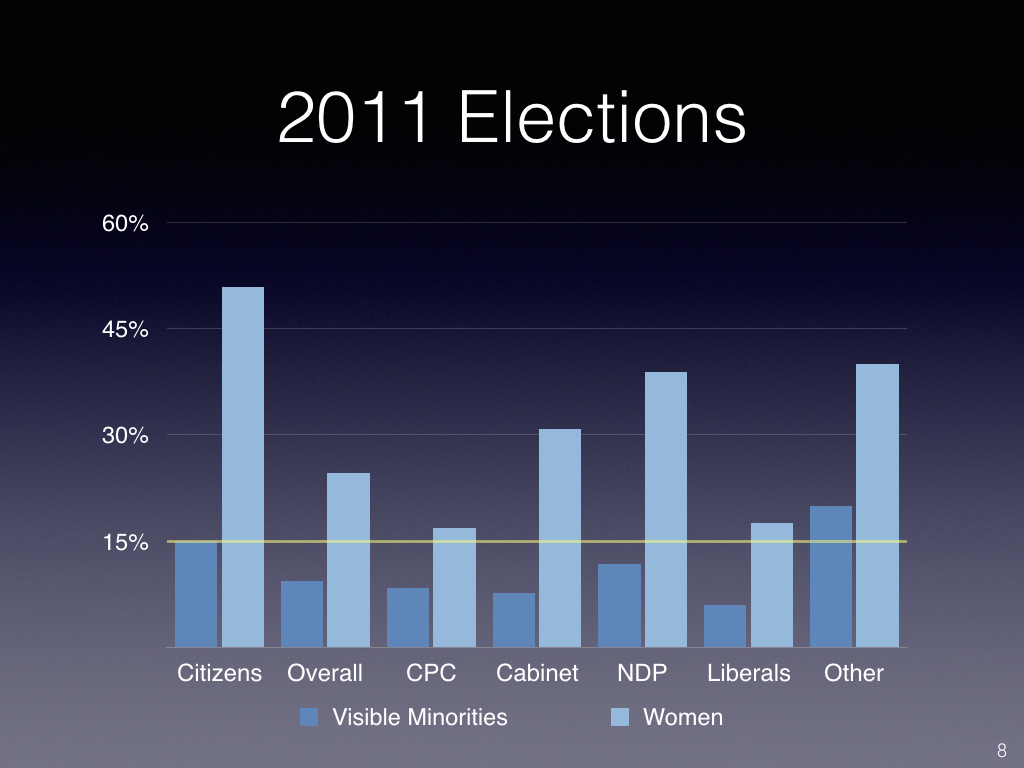
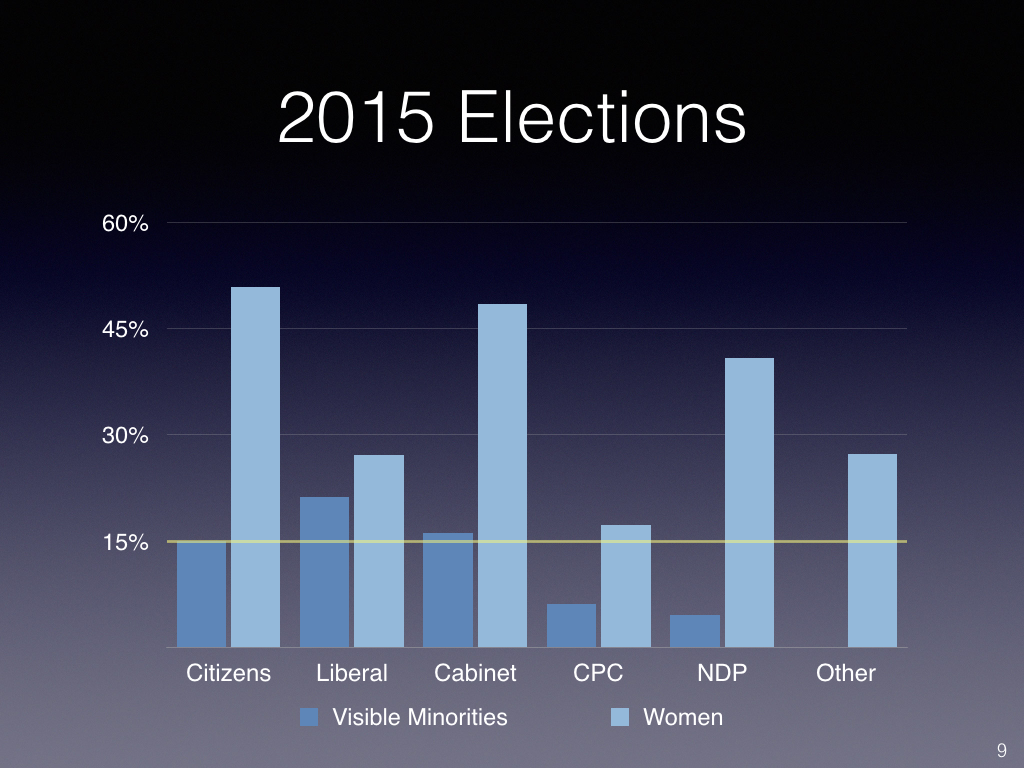
The chart shows the overall representation of Canada’s new Parliament (the 2011 Parliament equivalent is shown below).

Election 2015 - VisMin and Foreign-Born MPs.001

In addition to gender parity, visible minorities are slightly over-represented (16 percent) in relation to their share of the population who are Canadian citizens (15 percent).

However, Canadian Sikhs predominate as four out of the five visible minority ministers are Sikh: Navdeep Bains, Harjit Sajjan, Amarjeet Sohi and Bardish Chagger (the only non-Sikh is Maryam Monsef, an immigrant from Afghanistan). Likely that geographic factors played a role.

Two out of the five are women. Three are foreign-born.

Two have senior portfolios: Harjit Sajjan in Defence, Navdeep Bains in Innovation, Science and Economic Development (the rebranded Industry Canada).

The choice of John McCullum for the renamed Immigration, Refugees and Citizenship department suggests that an experience minister was wanted to move the priority files (in addition to his previous experience in a number of portfolios and was previously the Liberal critic for citizenship and immigration). So very likely that he will hit the ground running.

And the best illustration of how the overall philosophy and approach has changed can be seen in the creation of a Cabinet Committee on Diversity and Inclusion, with a mandate to:

Considers issues concerning the social fabric of Canada and the promotion of Canadian pluralism. Examines initiatives designed to strengthen the relationship with Indigenous Canadians, improve the economic performance of immigrants, and promote Canadian diversity, multiculturalism, and linguistic duality.

New Crop of Immigrants in Parliament Is Seen as Reflection of Canada – The New York Times

New York Times coverage of Canada’s many immigrant and visible minority MPs (and always nice to be quoted!):

Many factors contributed to the sweeping victory last month by the Liberals, whose leader, Justin Trudeau, will take office as prime minister on Wednesday. But several analysts said that one of the most important factors was the immigration and refugee policies of the losing Conservative government.

In a country that generally prizes immigrants as a source of economic growth and officially encourages newcomers to maintain their ethnic identities, the Conservatives and Prime Minister Stephen Harper were widely seen as anti-Muslim, especially after they made an issue of the face coverings worn by some Muslim women.

“The Conservative government tried to use wedge politics, but in the end, it backfired,” said Andrew Griffith, a former director general of the government office that oversees citizenship matters and the author of a book about multiculturalism in Canada. “It should give any political party in Canada food for thought, food for reflection.”

The move was uncharacteristic even for the Conservatives, who assiduously courted immigrant communities even before they first won power in 2006, particularly in two areas that often decide the balance of power in Parliament: the suburbs of Toronto and Vancouver, British Columbia. The Liberals and the New Democratic Party also seek support there, but the Conservatives often found that their more traditional approach to many social issues found an eager audience.

Canadian law makes it relatively easy to move from landed immigrant to citizen, and Mr. Griffith said that many newcomers became politically active once they could vote. Because Canada’s immigration rules favor well-educated and affluent migrants, ethic communities are also an important source of donations to political parties, not least because the country’s campaign finance laws ban contributions from corporations or unions and set a relatively low ceiling for individuals.

“It’s empowering in that there are groups that can no longer be ignored,” said Arif Virani, 43, a newly elected Liberal lawmaker from Toronto who came to Canada with his parents as an Ismaili Muslim refugee from Uganda in 1972. He noted that in some constituencies, all three major parties ran minority candidates.

At times over the past decade, Jason Kenney, a Conservative cabinet minister, seemed to be appearing at just about every ethnic celebration in the country — a butter-chicken circuit that appeared to take a toll on his waistline. But Mr. Kenney’s courtship of ethnic minorities, Mr. Griffith said, was undone when the Conservative government decided to make it harder for recent immigrants to bring in relatives, when it was slow to accept Syrian refugees and when it tried to ban the niqab, or face covering, during citizenship ceremonies. Mr. Harper’s use of the phrase “old-stock Canadians” on the campaign trail made matters worse.

Mr. Griffith reckons that there are 33 electoral districts where a majority of voters belong to what are known in Canada as visible minority groups — people who are not of white European extraction. All 33 districts are in the suburbs of Toronto or Vancouver, and many were held by Conservatives until last month, when Liberals won in all but three of them.

Canada first introduced a policy of official multiculturalism, recognizing the differences in Canadians’ heritage, in 1971 under Pierre Elliott Trudeau, a Liberal prime minister and the father of Justin Trudeau. Initially, the policy provided funds for programs like language classes, but it has since evolved into a broad legal protection of religious and ethnic differences.

Though it was contentious at first, the policy is now frequently cited by Canadians as a defining characteristic of their country — though both Mr. Griffith and Mr. Virani say it has limits.

Canadians tend to think that, where the United States assimilates immigrants’ cultures in a melting pot, Canada allows all cultures to flourish. But Mr. Virani said that the contrast was “a little bit more gray than that.”

Voters appeared to reject Mr. Harper’s plan to ban face coverings during citizenship ceremonies, but Mr. Griffith said there was still widespread unease about the practice of wearing them, which many Canadians believe limits the participation of Muslim women in society.

Still, despite the tenor of the Conservatives’ last campaign, all the major Canadian political parties favor encouraging immigration. New arrivals account for two-thirds of Canada’s population growth, an important factor in a country where there are now more citizens over 65 than under 15. Geography helps form that pro-immigration consensus by making it difficult to slip into the country as an illegal immigrant or a refugee.

“You can’t walk to Canada, apart from the U.S., so we don’t have a neighbor that generates a lot of refugees or immigrants coming across,” Mr. Griffith said. “That helps the discussion.”

Source: New Crop of Immigrants in Parliament Is Seen as Reflection of Canada – The New York Times