Spouses of Canadians to get permanent residency immediately

Another platform commitment being implemented, reflecting a preference to reduce the risk of spouses being trapped in abusive situations compared to the previous government’s preference for reducing marriage fraud and marriages of convenience:

Immigration Minister John McCallum says he’s planning on introducing changes in the “next couple of months” that will grant permanent resident status to the sponsored spouses of Canadians, immediately, upon arriving in Canada.

“When spouses come in now, they don’t immediately become permanent residents; there’s a two-year period where they are not yet permanent residents,” Mr. McCallum (Markham-Thornhill, Ont.) said in an interview with The Hill Times. “We said in our platform that we will end that so that they will become permanent residents on arrival.”

Currently, sponsored spouses of Canadians receive conditional permanent residency upon arrival in Canada and have to wait for two years to obtain permanent-resident status. If the relationship breaks down, the sponsored spouse’s permanent residency can be revoked. Spouses holding conditional permanent resident status enjoy the same rights and benefits as any other permanent resident.

The Conservatives introduced the conditional permanent-resident provision in 2012 to address the issue of marriage fraud.

Since becoming the immigration minister in November, a number of Liberal MPs in ridings with large visible-minority populations have been asking Mr. McCallum (Markham-Thornhill, Ont.) to take immediate measures to make the application processing time of family sponsorship applications faster. Most MPs representing major urban centres from all parties say that issues related to immigration, refugees and citizenship account for 70 to 80 per cent of their constituency work.

Mr. McCallum, whose riding has the third-highest percentage of visible minority population at 82 per cent, said that he finds it “abominable” that it takes almost two years for the spousal immigration applications to be processed, and after arriving in Canada, another two years to receive permanent-resident status. He said that his department is working on coming up with plans to speed up the application processing times. Mr. McCallum did not offer a specific target timeframe for reducing the application processing times, but said that it will be brought down “radically.”

Source: Spouses of Canadians to get permanent residency immediately: McCallum | hilltimes.com

Is Ottawa treating all refugees fairly?

The pressures are almost infinite, and the question of how many, and how to select becomes harder and harder.

We will see what the Government proposes in terms of overall immigration levels and for the different classes when it tables its immigration plan expected March 9:

Close to 59.5 million people worldwide are currently displaced by war and conflict, according to the United Nations High Commissioner for Refugees. Some would like to make their way to Canada and have family and sponsors here eager to help out. But it’s not that easy.

The problem for Teclehaimanot and others who would like to sponsor refugees who aren’t from Syria stems from a number of changes in immigration department procedures. A cap imposed on Canadian visa offices in Nairobi, Cairo, Pretoria, Dar es Salaam and Islamabad by Ottawa in 2011 has limited the number of refugees who can come to Canada, said Janet Dench, executive director of the Canadian Council for Refugees.

Similarly, she said, a cap on sponsorship agreement holders and the number of refugees they can sponsor also limits the flow of refugees to Canada.

Those restrictions, coupled with a backlog of 27,959 privately sponsored refugees, deep financial cuts to the department instituted by the former Conservative government and long processing times of up to 70 months for refugees from some countries, have made it difficult for those from many other regions.

Immigration spokesperson Lariviere said it would be “inappropriate to comment” on the issue of caps — either on Canadian visa offices or for sponsorship agreement holders — before the 2016 Immigration Levels Plan has been tabled in the House of Commons. That announcement is expected in coming weeks.

Teclehaimanot’s experience isn’t unusual. Every month, Canadians who want to sponsor family or friends in other parts of the world are turned away or told they have to wait.

“We have people here waiting year after year,” said Azaria Wolday, manager of the private sponsorship program for Northwood Neighbourhood Community Services. “We have at least 300 families in our books. We are not putting any more people on our waiting list.”

Last year, as many as 800 people approached Northwood about sponsoring Ethiopian, Eritrean, Sudanese and Afghan refugees. Wolday had to say no to most.

With that in mind he believes the federal government should take the lessons learned from dealing with Syrian refugees and apply them to other groups. “It is a matter of political will,” he said.

Similarly, at the refugee office for the Catholic Archdiocese of Toronto, organizers have turned away requests for sponsorship of refugees from Africa since September. There simply is no room to bring them in.

“Until 2011 we didn’t have any caps. In one year we backed 700 sponsorships. Next year we only did 200 because of the allocation given to us,” said Dr. Martin Mark, director of the Office for Refugees at the Archdiocese of Toronto.

“When we talk about refugees, half of the world’s refugee population in need of resettlement is in Africa,” said Mark. “We should have a significant number of spots for sub-Saharan Africans.”

To show the inequity, Mark says his organization was allowed 200 refugee spots through the Canadian visa office in Nairobi — but that covered refugee applications from not just Kenya but several other African countries.

He says his office has 200 African refugee submissions ready to go if spots become available. In contrast, he has unlimited spots for Syrians thanks to the government’s Syrian refugee program, he said.

He also believes processing of other refugee applications is slowing down because officers are concentrating on Syrian refugees.

It’s all tantamount to a kind of refugee roulette, with the winners coming from places like Syria and others being ignored or placed on a very long waiting list, said Teclehaimanot. “All applicants, all sponsors are complaining about the backlog,” he said. “The government knows there is a backlog. They need to spend money. They need to invest.”

Source: Is Ottawa treating all refugees fairly? | Toronto Star

Terrorist scumbag doesn’t deserve citizenship | Candace Malcolm | Toronto Sun

Expressed more simply but using the same strand of arguments as in John Ibbitson’s Dual nationals convicted of terrorism, high treason or spying don’t deserve to keep Canadian citizenship:

Now, the Liberal government is not only saying this man can stay in Canada, but they are also honouring him with citizenship.

Does the Trudeau government plan to send a citizenship judge into Amara’s prison cell to host a citizenship ceremony? Will he be asked to utter the oath of citizenship, and pledge allegiance to Canada and the Queen? Maybe Trudeau will show up for a selfie.

This is an absolute mockery of our citizenship. This scumbag does not deserve the privilege of being Canadian.

And yet, the Trudeau government is going out of its way to grant citizenship to a person who, judging by his actions, has a hatred for Canadians. We are bestowing the privilege and honour of Canadian citizenship upon a radicalized self-confessed Islamic terrorist who conspired to wage war against Canada.

Immigration minister John McCallum justified the move by saying, “Canadian citizens are equal under the law.”

That’s just not the case. In Canada, much like every other Western country, a person convicted of an indictable offence loses many of the rights and privileges that come along with citizenship. Serious criminals are no longer equal under the law.

Amara committed the modern day equivalent of high treason. He should not be treated equally to law-abiding Canadian citizens.

When Amara is released from prison, we should be showing him the door, not handing him Canadian citizenship papers.

Source: Terrorist scumbag doesn’t deserve citizenship | Malcolm | Columnists | Opinion |

Diversity on parliamentary committees: Does it matter? | My piece in The Hill Times

Diversity_on_parliamentary_committees__Does_it_matter____hilltimes_comMy piece in The Hill Times (excerpt):

If we look at the overall committee membership of 288 members in both the 25 House of Commons and three joint Senate-Commons committees (some MPs are members of more than one committee), only 21.2 per cent are women, significantly lower than the overall 26 per cent of women MPs.

For visible minorities, however, committee representation largely matches overall Commons representation at 14.6 per cent, just marginally under the number of visible minorities who are Canadian citizens. Indigenous peoples committee representation is less than their share of the population (3.1 compared to 4.3 per cent).

Looking at individual committees, only the Access to Information, Privacy and Ethics and Industry, Science and Technology committees have no women members. Veterans Affairs, Agriculture and Agri-Food, Environment and Sustainable Development, Fisheries and Oceans, Official Languages, National Defence, Physician-Assisted Dying have no visible minority members.

Women are predictably over-represented in Status of Women (nine out of 10 members) and visible minorities are similarly overly represented in Citizenship and Immigration (seven out of 10 members).

Source: Diversity on parliamentary committees: Does it matter? | hilltimes.com

Matt Gurney: If deportation is appropriate for war criminals, why not for terrorists?

Matt Gurney is unsatisfied with the principle, “a Canadian is a Canadian is a Canadian” as an explanation why we revoke citizenship for fraud and misrepresentation but not for terrorism:

After the Second World War, thousands of citizens of defeated enemy nations — Germany, Italy, Japan — moved to Canada. These immigrants included many who had served in the armed forces of those nations, and perhaps had even fought against Canadians. Mere military service in a once-hostile nation was not, and should not have been, found to be sufficient cause to deny them citizenship once the war was over. In some rare cases, however, Canada later discovered (or was told) that people living here as naturalized Canadians had been involved, for instance, in the Holocaust. These individuals, once convicted of their war crimes, had their citizenship taken away and were returned to their original countries of origin to face justice.

If that’s appropriate for war criminals, why not for terrorists?

The legal answer would be, of course, that these individuals weren’t stripped of their passports because they were terrible people who had done awful things, but because they’d lied about having done those terrible things. But while perhaps legally valid, the argument is morally and pragmatically absurd. We don’t exile liars, nor should fraud be somehow treated as a crime worse than, say, genocide. The legal circumstances provided an excuse to what’s really, and rightly, an exercise in morality — denying the honour of Canadian citizenship to those who do not deserve it.

If the Liberals wish to reverse parts of C-24, they of course have that right. They are the government. But concerned Canadians are owed more than slogans. The government should be clear why war criminals can be deported, but terrorists with dual nationalities can keep their passport forever. They may have an answer for it. If so, let’s hear it.

If I were writing the talking points:

  • There is a difference between one’s behaviour before one becomes a citizen and after one becomes Canadian
  • Before, all applicants must meet requirements (residency, language, knowledge etc) in order to take the oath and become citizens
  • Integrity is central to this process
  • Any misrepresentation or fraud, like any government program, means one loses the benefits of the particular program
  • After, all citizens must be treated equally before the law, whether Canadian-born or foreign-born, whether Canadian citizen only or dual-national
  • Current and past cases involve all of these variations, and should be subject to the same punishment. One should not have different punishments for the same crime

Responsive (if asked what about those lying when they take the oath)

  • There is no reliable way to test the sincerity of those taking the oath unlike the other, more easily verifiable, requirements

Comments or suggestions welcome …

Source: Matt Gurney: If deportation is appropriate for war criminals, why not for terrorists? | National Post

Dozens of ‘British home children’ lie forgotten in Etobicoke cemetery

One of the less known parts of our history that I learned about when working on citizenship and multiculturalism issues:

Charles Bradbury was still a child when his throat was slit with a razor on Feb. 1, 1897. His charred remains were found the same day in a burned-down barn near the Don River.

The live-in farm hand had quarreled with his landlord and employer before falling into a “sulky fit” and earning a “slight kick” from the plowman, a local newspaper reported two days later. The man was never prosecuted for his death, dubiously deemed a suicide.

Several news stories, a name and a number — 983 — scribbled onto a graveyard plot card are all that survive to mark the boy’s existence.

Charles is one of 75 children whose remains lie buried, unmarked and virtually forgotten in a pair of mass graves at an Etobicoke cemetery. They were drops in the wave of British home children, sent in droves from the U.K. to build a fresh life on Canadian soil.

Now a research group has dug up their identities, giving new life to youths all but anonymous in death. The revelation unfolded as part of an effort to reclaim the pasts of more than 115,000 children shipped across the Atlantic as indentured servants between 1869 and 1948.

“This thing at Park Lawn Cemetery was held under wraps for many years,” says Lori Oschefski, who heads the British Home Child Advocacy and Research Association.

Source: Dozens of ‘British home children’ lie forgotten in Etobicoke cemetery | Toronto Star

Asian sex abusers to be stripped of UK citizenship and deported

Implementation of the slippery-slope argument with respect to revocation in the UK (yes, these are horrific crimes, but very long jail time is the appropriate response):

Asian-born sex abusers will be stripped of their UK citizenship and deported at the end of their sentences under a new Home Office drive, The Independent can reveal.

Theresa May, the Home Secretary, is planning to significantly increase her department’s use of legal powers that allow serious criminals with dual nationality to have their British citizenship withdrawn, Whitehall sources say.

Until now, the powers have predominately been used to remove the UK passports of terrorists and terrorist sympathisers.

But senior department sources told The Independent that – in response to the series of Asian sex abuse gangs uncovered in towns across the country in recent years  – there is likely to be an “acceleration of passport strike-outs and potential deportations”.

British-Pakistani members of the gang of six men and women from Rotherham who were convicted on Wednesday of offences including rape, forced prostitution, indecent assault and  false imprisonment are expected to face action to strip them of their UK citizenship after they are sentenced today. Legal proceedings seeking their potential deportation to Pakistan are likely to follow.

The abuse of predominantly white girls by networks of Asian men has led to prosecutions across the North of England and the Midlands. More trials are imminent.

David Greenwood, head of the child abuse department at Switalskis solicitors in Sheffield, who represents almost 60 victims subjected to sexual abuse by the Rotherham gang between 1996 and 2012, said: “This trial is just the first of many and is the tip of a very big iceberg. From the work I have done, it appears that gangs of Asian men have been operating to sexually abuse young white girls in Rotherham, Oxford, Keighley, Bradford and Rochdale.”

Although amendments to British nationality laws in 2014 making it easier to strip dual nationals of citizenship were primarily aimed at terrorists who could undermine the UK’s security, the Home Office is now using the same legal sanctions to target serious crime, including sex abuse.

Source: Asian sex abusers to be stripped of UK citizenship and deported | Crime | News | The Independent

John Ivison: Jason Kenney’s newfound energy signals that the Tory leadership race has started in earnest

Good profile by John Ivison on Jason Kenney and his post-election reflections (I have great respect for former Minister Kenney from my time as former DG – Citizenship and Multiculturalism – as chronicled in my book, Policy Arrogance or Innocent Bias: Resetting Citizenship and Multiculturalism):

“The fatal flaw was our tone. It seemed too often the government went out of its way to make enemies, not friends, starting with the media,” he said.

“On identity questions, every public opinion poll demonstrated a super-majority of Canadians supporting the notion that the citizenship oath should be taken openly … So I think we were on the right side of those issues substantively and politically. But when dealing with sensitive issues you have to communicate with great nuance and subtlety. I accept that was not necessarily the case in our campaign.”

The received wisdom is that these mistakes led to a hemorrhaging of support from the loose coalition of new Canadians that Kenney, more than anyone else, had helped knit together. But he disputes there was a repudiation of the Conservative message among ethnic voters.

“We got 32 per cent of the new Canadian vote, down from the low 40s in 2011, which was proportionate to our popular vote. It’s encouraging that it is still a far higher percentage than the Conservative Party has attracted historically. The problem is our vote didn’t grow with the electorate, which was mostly an issue with the under-30s. The bottom line is we now have a competitive environment. It wasn’t catastrophic.”

What Kenney doesn’t say, is that while the Conservatives got 32 percent of the new Canadian vote, this was 20 points behind the Liberals in the 33 ridings where visible minorities are in the majority (905, BC’s lower mainland) – and where he personally invested considerable time in wooing those communities.

It was not only a question of tone in these ridings: a number of citizenship and immigration changes did not, in the end, go down well with many voters.

“Showing up” was not enough.

Source: John Ivison: Jason Kenney’s newfound energy signals that the Tory leadership race has started in earnest

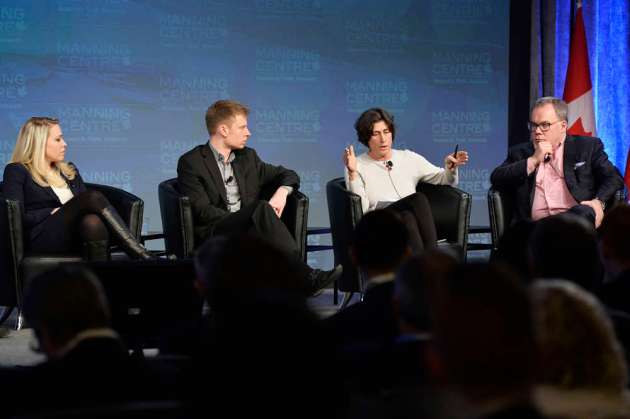
At the Manning conference, identity politics continue to torment the Conservatives

Interesting. Conservatives really need to come to terms with this given just how much their outreach strategy to ethnic voters collapsed in ridings with strong visible minority populations, as well, it appears, being offside mainstream Canadian values:

Toronto Star columnist Chantal Hébert was blunt about the mini existential crisis the conference was exposing.

CTV Journalist Mercedes Stephenson, Sun Media Journalist Anthony Furey, Journalist Chantal Hebert and MacleanÕs Journalist Paul Wells take part in a panel during the Manning Centre Conference in Ottawa on Friday, February 26, 2016. iPolitics/Matthew Usherwood

“Why did Justin Trudeau win the niqab debate on an issue he should’ve lost (according) to the polls? Because his stance on the niqab debate, which is a policy stance, goes to who the Liberals are. You could set your clock on Justin Trudeau saying what he said about the niqab,” she said.

“I look at your party and the niqab, and I don’t know who think you are. If you can, explain it….There are issues that brand a party beyond tone. And before you set out, you need to decide who you are.”

Back in the other room, where Scott-Marshall was explaining the results of their survey, she spoke of a type of free association exercise where participants were asked what words came to mind when they heard Conservative.

There were some positives, but also negative descriptors in line with what Weston had heard at peoples’ doors: “Old, outdated, and mean.”

When the survey drilled down further into how Canadians felt about common terms in the political vernacular — liberal, progressive, democrat, centre, independent, left-of-centre, socialist, conservative, libertarian, radical — they got a strong negative reaction to “conservative”.

“The most common negative reaction is to the word radical, not surprising probably. Although the second most common negative reaction is actually to the term conservative.” Scott-Marshall said.

“Just over a third of Canadians, 36 per cent, say they have a negative response to the term conservative when they hear it. And only 20 per cent say they have a positive response. Something to bare in mind just in terms of maybe negative…baggage that’s being associated with the term Conservative now.”

At the Manning conference, identity politics continue to torment the Conservatives

Multiculturalism ‘good for Australia’ say 85% of Australians

While the overall patterns are quite similar to Canada’s, one of the major differences is the degree to which our political systems are representative of diversity. In Australia, where 28 per cent of the population is foreign-born, only 9 per cent of MPs are, with only a handful being visible minorities. In Canada, 14 percent of MPs are from visible minorities:

The Scanlon Foundation has been looking at these perceptions over the past decade, and most recent research shows 85 per cent of Australians agree that multiculturalism has been good for the country.

The Scanlon Foundation’s Multiculturalism Discussion Paper has been tracking people’s views across more than a decade of surveys.

Data shows Australians are generally very accepting of cultural diversity and immigration, but the level of support varies across generations, geographical locations and demographic groups.

Research Professor at Monash University Andrew Markus says this report looks in detail at research that’s been going on over the past 30 years.

“There’s very high levels of support. 85 per cent of people think that multiculturalism is good for this country and those sort of high figures, people have been obtaining for 20 or more years but what is particularly interesting in the findings that we’re releasing now is that we look more closely at that proportion who say that it’s been good for Australia – we disaggregate those figures – we try to make sense of those figures in more detail.”

Professor Markus says the research shows current support for immigration is at relatively high levels, compared to 30 or 40 years ago.

“There does seem to be a pattern of greater support for immigration. When it comes to some other issues, such as different ethnic groups, at the level of the data that we have it’s more length of time in Australia and people are more positive towards people who’ve been here for 20 or 30 years and similarly amongst the immigrants themselves, there’s more differentiation among the recent arrivals in terms of the support that they’re looking for from government.”

Centres such as Sydney and Melbourne have the highest level of support for multiculturalism, with younger people also more inclined to be in favour.

But the research not only casts light on external perceptions, it also shows how recent migrants feel about settling in the country.

“What we find when we look at the most recent immigrants is high levels of engagement with Australia but also, and from other research, concerns at the present time about how difficult it is for people to get jobs in the areas they’ve been trained. So there’s certainly some important issues for government in terms of current immigration intake and capacity for people to find the sort of employment that they’re looking for.”

Scanlon Foundation CEO Anthea Hancocks says the paper sets out to explore the complexity of the issue, encourage debate and foster social cohesion.

Ms Hancocks says Australia’s diverse culture is one of the country’s most defining characteristics.

Source: Multiculturalism ‘good for Australia’ say 85% of Australians | SBS News