Religious Accommodation Still a Struggle in Quebec

Some insights from a recent Canadian Race Relations Foundation workshop on faith and social inclusion in Montreal:

There was consensus among the panelists that schools are the best place to be pro-active.

Gagnon gave credit to Quebec’s Spiritual and Community Animation program in elementary and secondary schools. As a former spiritual and community animator at the EMSB, he said focusing on spirituality rather than religion provides “a window to talk about what we have in common.”

The program was introduced after Bill 118 (2000) deconfessionalized public school boards and introduced a mandate to promote diversity and pluralism.

“There’s always this push and pull,” said Poupko. “I think it has do with asking what’s reasonable and expecting a common sense response.”

That’s the approach Cristina Bajenaru takes as Project Coordinator at the Centre d’Encadrement pour Jeunes Femmes Immigrantes, a community organization that helps young immigrant women integrate.

Bajenaru said her clientele comes from 60 countries so she has to take a common sense approach to accommodation. If her training workshops coincide with Muslim holidays, she explained, “I can’t tell them to come, but I can’t tell them not to come either.” She said she lets them decide, and roughly half the class ends up staying home.

Through community consultations, the CRRF compiled dozens of other real scenarios that have come up in workplaces across the country. These are included in the Faith and Belonging Toolkit, a resource for workshop participants to encourage discussion and develop appropriate responses to accommodation.

Using the resource, Gagnon said he was impressed at the ability of the group to come up with solutions to complex scenarios.

“Spirituality in the public sphere, in [the] workplace, in society, when we talk about it reasonably and calmly, we find solutions,” he said.

Source: Religious Accommodation Still a Struggle in Quebec – New Canadian Media

Conservative MP Deepak Obhrai: New Rules Turning Tories Into ‘Elitist And White-Only’ Club

Interesting – and a major risk for the party given the importance of new Canadian voters:

A longtime Conservative MP is blasting his own party for becoming an “elitist and white-only” club.

Calgary MP Deepak Obhrai, the dean of the Tory caucus, told The Huffington Post Canada he is deeply frustrated by new rules the party imposed earlier this year that raised the annual Conservative membership fee to $25 — “the highest of any party” — and set the entrance fees for leadership contestants at $100,000. 

deepak obhrai

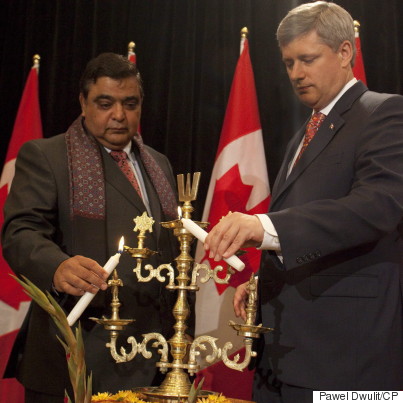
Deepak Obhrai and former prime minister Stephen Harper celebrate Diwali by lighting a candle on Parliament Hill on Oct. 8, 2009. (Photo: Pawel Dwulit/Canadian Press)

“Since we lost power in 2015, I have become very concerned about the direction my party has taken,” he told HuffPost over the phone on Thursday.

“These actions, in my view, have disenfranchised a vast majority of Canadians. Newcomers, immigrants, low-income Canadians, and those economically challenged will be turned off and walk away because they can’t afford these high fees…

“What is concerning me is that, unfortunately, [the Conservatives] will be seen as an elitist and white-only party,” he said.

Ethnic communities’ outreach

Since his election in 1997, Obhrai said he’s been working his “butt off” to bring immigrants to the party, a job that was subsequently taken on with great fanfare by former cabinet minister Jason Kenney. Success in connecting with ethnic communities culminated in the Tories’ majority election win in 2011, Obhrai said.

But that work has been dropped as a priority for the Conservatives under the leadership of party president John Walsh, Obhrai said. He added that the party has lost touch with grassroots members and pointed out that the caucus was not consulted.

“This party has become a party that is seen [to be only] for like rich people, I ask why? Why only for those who can afford it? Why the rich?

“For a family of four, it’s like asking them to give $100, and then also asking them to give through a credit card, which many don’t have. I have had these problems and my EDA [electoral district association] passed a motion telling the national council that we are unhappy with these rules,” the Calgary MP told HuffPost.

Source: Conservative MP Deepak Obhrai: New Rules Turning Tories Into ‘Elitist And White-Only’ Club

L’anglais mieux que le français pour les immigrants

More on language and immigration in Quebec.

No surprise that in Montreal, where most settle, only speaking French is a disadvantage. But the difference is significant, and overall, Quebec immigrant economic integration is the weakest of the larger provinces:

Les nouveaux arrivants qui ne parlent que le français éprouvent plus de difficulté à se dénicher un emploi au Québec que ceux qui ne connaissent que l’anglais. Le taux de chômage de ces immigrants francophones est de 40 % supérieur à celui de ces nouveaux arrivants anglophones.

C’est ce qui ressort de la compilation, obtenue par Le Devoir, que le ministère de l’Immigration, de la Diversité et de l’Inclusion (MIDI) a faite à partir de l’Enquête nationale auprès des ménages de Statistique Canada de 2011 et de 2006.
Ainsi, le taux de chômage des immigrants récents — ceux qui sont arrivés depuis cinq ans ou moins — qui ne parlent que l’anglais atteint 16 %, alors qu’il se gonfle à 23 % chez les mêmes immigrants récents qui ne parlent que le français, pour une différence d’un peu plus de 40 %.

Dans les premières années suivant leur arrivée, les unilingues francophones (comme leur langue maternelle n’est pas le français pour la plupart, ils sont en fait bilingues) sont affligés du même taux de chômage que les immigrants allophones qui ne connaissent ni le français ni l’anglais. En revanche, ces nouveaux arrivants allophones, souvent des femmes, participent peu au marché du travail.
De leur côté, les immigrants récents anglophones qui ne connaissent pas le français font aussi bien sur le marché du travail que les nouveaux arrivants qui connaissent les deux langues officielles du Canada.

Dans la région de Montréal, ces immigrants anglophones peuvent compter sur des entreprises prêtes à les accueillir. Vingt-huit pour cent des immigrants travaillent le plus souvent en anglais, note l’économiste Brahim Boudarbat, de l’Université de Montréal, un des auteurs avec Gilles Grenier, de l’Université d’Ottawa, du volumineux rapport remis au MIDI en novembre 2014 et intitulé L’impact de l’immigration sur la dynamique économique du Québec.

« Les immigrants qui ne parlent que le français n’ont accès qu’à 40 % des emplois » au Québec, relève Brahim Boudarbat.

Bilinguisme exigé

Une des raisons qui expliquent les difficultés dans le marché du travail des nouveaux arrivants francophones, c’est l’exigence généralisée du bilinguisme, surtout dans la région de Montréal. « C’est clair que c’est un problème », a signalé Michèle Vatz-Laaroussi, professeure en travail social à l’Université de Sherbrooke. « Les immigrants francophones qui arrivent n’ont pas cette qualification-là. » Les organismes en immigration réclament depuis longtemps des cours gratuits pour ces francophones, mentionne-t-elle.

Les employeurs ont souvent « la mauvaise habitude » d’exiger le bilinguisme « par automatisme », souligne Anait Aleksanian, directrice générale du Centre d’appui aux communautés immigrantes de Bordeaux-Cartierville (CACI). Il faut souvent « négocier » avec les employeurs afin qu’ils acceptent d’embaucher un immigrant qui ne parle pas anglais quand la connaissance de cette langue n’est pas nécessaire, relate-t-elle. L’organisme donne 43 classes de français par session et cinq classes d’anglais, toutes à temps partiel. Les cours de français sont gratuits, mais il y a des frais d’environ 100 $ par session pour les cours d’anglais.

Georgina Kokoun, coordonnatrice du Regroupement des organismes en francisation du Québec (ROFQ), constate que la plupart des offres d’emplois dans la région de Montréal mentionnent l’exigence du bilinguisme. « On voit rarement des postes où on demande juste le français. Il faut être bilingue. »

« J’ai une amie du Sénégal qui m’a dit : “L’immigration au Québec, c’est du dol, c’est comme une arnaque. On te dit que tu peux travailler au Québec en français comme tu le fais dans ton pays.” »

Discrimination

La discrimination est un autre facteur qui explique la situation. Dans une correspondance avec Le Devoir, le MIDI le reconnaît d’emblée.

Les immigrants francophones qui ne parlent pas anglais proviennent essentiellement du Maghreb ou de l’Afrique noire. « Ce sont des minorités visibles et on fait le lien entre Maghreb et musulmans, fait observer Michèle Vatz-Laaroussi. Il y a plusieurs études qui le démontrent : il y a vraiment un phénomène de discrimination [à l’endroit] de ces populations dans l’emploi. »
Source: L’anglais mieux que le français pour les immigrants | Le Devoir

The Issue With Malaysians Giving Up Their Citizenship, Here Are Their Real Stories

Some of the debates in Malaysia regarding expatriates:

The obvious reasons to migrate to another country includes better economic conditions abroad, specialised work opportunities as well as several social related reasons among many others, all of which is experienced by not just Malaysians but for people in other countries too.

Selective reporting of statistics often play up this lop-sided view of Malaysians abandoning their country. In March last year, it was widely reported that 93% of Malaysians would gladly leave the country if offered better job prospects and career advancement in a poll conducted by recruiting firm Hays.

What was not reported was that in the same poll, a whopping 97% of Singapore job seekers were willing to relocate overseas if job opportunities came along. According to the same poll, 96% of China’s citizens were willing to leave their country to work overseas while 94% of Hong Kong residents felt the same.

“The opportunity to gain highly valued international experience is the number one factor driving local talent overseas,” said Christine Wright, managing director of Hays in Asia commented on the poll results.

“These candidates want to gain a job overseas because employers increasingly value local talent with international experience and an international mindset.”

So instead of throwing around insults like ‘unpatriotic’ opportunists or our country treating some of its citizens unfairly, why not hear from our citizens who do end up spending probably most of their lifetime abroad.

Malaysian Digest approached several former Malaysians and also Malaysians currently living abroad to share with us their stories that go beyond stereotypical labels, discussing with us their experiences with maintaining Malaysian ties without being ‘technically’ Malaysian themselves.

Source: The Issue With Malaysians Giving Up Their Citizenship, Here Are Their Real Stories

The big reason why Brad Wall can’t be prime minister

Sums up one of the fundamental realities well but ignores that many new Canadians send their children to French immersion programs:

A paradox encompasses two mutually exclusive propositions that are nonetheless both true. Federal bilingualism is such a paradox.

It is right and proper that senior federal politicians and public servants must speak both English and French. English-speakers need only ask themselves how they would feel about a unilingual French cabinet minister or Supreme Court judge to understand that truth. Canada is a bilingual country. Ottawa must be bilingual. Case closed.

But the bilingualism requirement is also exclusionary, which government hiring practises should not be. Because only 17.5 per cent of Canadians are bilingual, it effectively prohibits four out of five of us from advancing in the federal public service or in federal politics. It discriminates against Western Canadians, people from Southern Ontario, Quebeckers who don’t live near the Ontario or New Brunswick borders (those two “bilingualism belts” are where most bilingual Canadians are to be found) and most Atlantic Canadians.

It similarly discriminates against most immigrants, who come from China, India, the Philippines and other countries where French isn’t spoken.

Such observations often provoke a retort from Graham Fraser, the Commissioner of Official Languages. But as Mr. Fraser himself recently observed: “Canada is a country with two unilingual majorities: Some 60 per cent of Francophones do not speak English, and some 90 per cent of Anglophones do not speak French.” Almost 50 years of official bilingualism haven’t changed that reality, and the next 50 years are unlikely to change it either.

The bilingual paradox inhibits the ability of political parties to renew. Mr. Wall and entrepreneur Kevin O’Leary have both been touted as possible leaders for the Conservative Party, but both have no hope of leading that party, because both are unilingual and Canada’s prime minister simply must be bilingual.

And the lost opportunities extend far beyond these two. We may never know what potential prime minister was lost to the country when, years ago, she decided not to run for Parliament because her second language is Mandarin, not French.

And please, let’s dispense with the idea that Mr. Wall or anyone like him could “pick up” French if they wanted to lead the Conservative Party. Middle-aged learners, unless they inherently gifted, do not “pick up” a second language well enough to joust in the House of Commons or take part in a national leaders’ debate. Stéphane Dion’s English is actually quite good – certainly better than Mr. Wall’s French would ever be – yet many English Canadians considered it inadequate when he was Liberal leader.

Brad Wall is a popular and effective premier who will never become prime minister because he can’t speak French. That’s the price of the paradox. And there really isn’t anything anyone can do about it.

Source: The big reason why Brad Wall can’t be prime minister – The Globe and Mail

ICYMI: Le Centre de prévention de la radicalisation fait l’objet de pressions

The Centre is off to a rocky start. There may be some lessons here for the planned federal Office of the Community Outreach and Counter-radicalization Coordinator:

Le Centre de prévention de la radicalisation menant à la violence de Montréal (CPRMV), créé il y a un an pour aider les proches et les personnes à risque d’être radicalisées, fait l’objet de pression et d’attaques cinglantes de la part de certains musulmans qui l’accusent d’être partial et de critiquer « sans ménagement la pensée islamique ».

Les critiques déposées par cette minorité à l’égard du CPRMV ne sont pas nouvelles, mais cette semaine, la vigueur de leurs attaques a redoublé d’ardeur, allant jusqu’à entraîner le départ d’une de ses chercheuses, accusée d’être « schizophrène » et d’« être tout sauf objective concernant la pensée et les courants religieux, musulmans, qu’elle dit étudier ».

Le site Muslim News a en effet mis en ligne jeudi après-midi un texte non signé, critiquant vertement le choix du CPRMV d’avoir recruté la chercheuse et spécialiste de la radicalisation Mounia Ait Kabboura, en février dernier. Le texte « Quelle mouche a piqué les anti-radicaux ? » est une salve virulente visant à miner la crédibilité de la nouvelle recrue.

Source: Le Centre de prévention de la radicalisation fait l’objet de pressions | Le Devoir

ICYMI: Anxiety in Vancouver over Hong Kong’s future

A different angle on diaspora politics:

Vancouver has long been intimately tied to this kind of soul-searching about the future of Hong Kong.

Hundreds of thousands of Hong Kong Chinese became Canadian citizens in the late 1980s and 1990s after the Tiananmen Square massacre in Beijing in 1989 and in the years leading up to 1997. But many later returned to work and live in Hong Kong as mainland China prospered economically.

At the same time, a generation of Chinese and non-Chinese Canadians from Vancouver also packed their bags and headed to Hong Kong seeking adventure, work and ties to their heritage as political fears gave way to the lure of interesting opportunities — often, again, tied to the rise of mainland China.

As such, both groups, especially those with more established business interests, are generally more constrained to speak up publicly for Hong Kong’s interests, though many will privately sigh.

“Concerns for Hong Kong go hand-in-hand with needing to also consider their beneficial relationship with China,” observes Helen Hok-Sze Leung, associate professor at Simon Fraser University, who grew up in Hong Kong.

Lam and others, however, are part of a younger generation in Vancouver who relate with peers in Hong Kong who have become more strident in identifying themselves as being part of a Hong Kong that is culturally separate from mainland China.

“It’s the city where I grew up so I have stronger ties and I naturally feel bad” about what is happening, says Lam.

“I go onto Twitter and Weibo and see Hong Kong young people writing (in the local dialect) of Cantonese and declaring themselves as Hong Kongers first,” says Leung. “This is a generation that was born under (mainland) Chinese rule and yet their sense of local (Hong Kong) identity and asserting that culture seems stronger than in my generation, and this percolates to migrants (who move to Vancouver).”

Lee, the lecturer, recently spoke about independent film Ten Years, which became an unexpected hit in Hong Kong when it was released in mid-December. The film consists of five ominous short stories hypothesizing what Hong Kong will be like 10 years from now. In one, cab drivers who speak Cantonese instead of Mandarin have their livelihoods clipped when they are prohibited from picking up certain passengers. In another, books are censored and banned ones are pulled off shelves.

According to Reuters, the film broke box office records in Hong Kong for attendance, but around a month later, after mainland Chinese state-controlled publication “denounced Ten Years in a January editorial,” the filmmakers were told by cinemas in Hong Kong they couldn’t continue showing it because of scheduling issues.

Source: Anxiety in Vancouver over Hong Kong’s future

Citizenship workshop @ImmigrationCBoC: Points of interest

Good workshop panel, with Charlie Foran and Arghavan Gerami joining me, with each of us covering different aspects.

Two points of interest for me that arose in the questions and discussion:

  • The impact of the physical presence requirement on internationally mobile professionals and business people. One CEO made the persuasive case that this requirement precluded citizenship for those based in Canada but whose frequent travel abroad meant they were not able to meet the minimum number of days in Canada requirement; and,
  • A former citizenship judge picking up on this point, noted the reduced role of judges in decision-making meant that the lack of days could not be balanced against the overall contribution such individuals made. The lack of discretion, introduced to provide greater consistency in decision-making (a valid policy and program objective), had consequences for this small but significant group.

Physical presence was introduced to address those who only had a legal residence or presence in Canada but who lived abroad, with the main examples being from Hong Kong and the Gulf countries.

Some early consultations and discussion on residency requirements suggested that making it four out of six years (being changed to three out of five years in C-6) would provide reasonable flexibility for those whose work took them outside Canada (e.g., truckers, pilots and a number of professions), while balancing the need to have the meaningful experience of Canada that came from living here.

I suspect that additional consultations and analysis would provide better data on how many people are affected, or potentially affected, with consequent reflection on whether policy and program adjustments are required.

Given the nature of the Conference Board audience, many of the plenary sessions focussed, directly or indirectly, on questions of business or investor immigration. Most of these speakers were advocates, given the nature of their organization or business, and largely ignored the body of evidence that previous programs had not generated significant economic returns.

One panelist even praised the Quebec model, despite the common knowledge that many if not most business investors in Quebec left, with Chinese investors in particular largely ending up in British Columbia, and who also advocated for a citizenship investor program similar to Malta and Cyprus.

Will be interesting to see if these comments on citizenship and business and investor immigration make it into the Conference Board’s immigration action plan and, if so, the precise nature of the recommendations.

Dans les coulisses de la francisation: Language and integration

Quebec debates over the francisation of immigrants and the number leaving Quebec (without asking why):

«Québec peine à franciser ses immigrants », apprenait-on il y a quelques mois. Le genre de manchettes qui donne froid dans le dos, vu l’importance de la chose pour l’avenir du Québec. Quand le français se porte mal, tout le monde se retrouve un peu amoché, car la langue est, jusqu’à nouvel ordre, notre seul projet de société. En même temps, la loi 101 n’a jamais été une baguette magique. La francisation est-elle vraiment plus difficile aujourd’hui ?

À en croire une femme qui en fait son pain et son beurre depuis sept ans, le diagnostic n’est pas du tout exagéré. « Tout a changé », dit-elle, se référant à la fois au nouveau programme du ministère (MIDI) et aux immigrants à qui elle enseigne. Cette femme — qui ne veut pas être identifiée « tellement tout est politique » — en a long à dire sur les coupes, mais aussi sur la nouvelle composition des classes. Depuis plus d’un an, 50 % des élèves sont iraniens, du jamais vu pour ce qui est d’une telle communauté.« On dépense une fortune pour des gens qui ont peu d’intérêt à apprendre le français », dit mon interlocutrice.

Les ressortissants iraniens, ainsi que chinois et indiens, sont les moins susceptibles de rester au Québec. Un sur deux quitte la province pour une autre quelques années après son arrivée. Le Québec a pourtant accueilli 6000 Iraniens en 2014, et plus de 3000 dans les neuf premiers mois de 2015, en première et deuxième position du palmarès des groupes reçus. Selon le MIDI, ce sont des immigrants qui auraient été refusés ailleurs au Canada après un changement de critères de sélection. Mais pourquoi accepterait-on des gens devenus inadmissibles au fédéral et qui sont, de plus, de moins bons candidats à la francisation ? « Les Latinos savent très bien où ils débarquent en arrivant ici, dit Mme F (pour francisation). Les Brésiliens et les Colombiens sont ceux qui semblent s’intégrer le mieux ; ils sont toujours une valeur ajoutée dans une classe. »

Les problèmes en francisation ne se limitent pas à la motivation de certains élèves. Le nouveau programme du MIDI fait aussi grincer des dents. D’abord, les établissements de francisation — des universités ou des cégeps très souvent — ne sont plus vus comme des « partenaires », mais plutôt des « mandataires », un peu comme nous ne sommes plus des « patients », mais des « clients » aux yeux du ministère de la Santé. Ensuite, les professeurs n’ont plus de pouvoir d’évaluation. Finis, les tests de classement et les notes en cours de route. À la manière Barrette, c’est le ministère qui décide désormais des niveaux de compétence (il y en a trois) et de l’évaluation finale. Résultats ? « On se retrouve avec des classes à deux, trois vitesses, et plus personne ne reprend une classe. Après le troisième niveau, ils sont souvent à peine capables de conjuguer un verbe », dit Mme F.

Source: Dans les coulisses de la francisation | Le Devoir

ICYMI: Ankara’s citizenship plan for Syrian refugees raises Kurdish worries

The politics of citizenship:

Turkey’s Kurdish lawmakers say the government’s decision to gradually grant citizenship to over 3 million Syrian refugees in the country’s Kurdish cities can disturb the population makeup of the area and incite ethnic tensions.

“We support efforts to embrace and help the refugees but the government’s plan is not assistance, it is part of a wider political game to strengthen its roots here,” said Mahmoud Togrul, a member of parliament from the pro-Kurdish Peoples’ Democratic Party (HDP) in the city of Entab.

Togrul believes Ankara is exploiting the refugee crisis, and by giving voting rights to the Syrian migrants it plans to secure votes ahead of the 2019 elections.

“Most of the Syrians will choose to stay in Turkey and that will be decisive in the coming elections,” he said.

According to the Turkish law, applicants will be granted citizenship after five years of residence in the country. This makes the bulk of the Syrian refugees eligible candidates for Turkish citizenship in the coming years, and able to vote in the next elections.

Official data also show that nearly 152,000 children have been born in Turkey whose parents came as refugees from Syria.

Ankara has said by getting citizenship, the refugees will have brighter prospects in the labor market and reduce the overall migration to Europe.

As part of an agreement with the European Union, called the Facility for Refugees in Turkey, Ankara will be receiving 6 billion euros over the next three years and resume the EU membership talks that stalled in late 2000.

Critics say giving millions of refugees citizen status will serve the strategic plans of the ruling Justice and Development Party (AKP).

“There will be over 1 million new voters in the 2019 elections if the government goes through with the proposal, which will in turn change the outcome of the elections,” said lawmaker Erdogan Toprak from the opposition Republican Peoples’ Party (CHP), quoted by Turkish daily Hurriyet.

Toprak said the government plans to create settlements for the refugees with the financial help it will receive from the EU, influencing the demographic development in the southeast where Kurds are in the majority.

The majority of the Syrian refugees in Turkey are of Arab origin, along with large numbers of Kurdish and Turkmen asylum seekers.

“What is strategically important for the government is the bordering areas connecting Kurdish lands in Syria, Iraq and Turkey, which Ankara wants to influence by placing the refugees’ families there,” said Kurdish author Fehim Ashiq.

Source: Ankara’s citizenship plan for Syrian refugees raises Kurdish wor