Identity 2016: ‘Global citizenship’ rising, poll suggests – BBC News

Identity_2016___Global_citizenship__rising__poll_suggests_-_BBC_NewsWhile the term “global citizenship” likely is interpreted differently, still an interesting divide between developed and developing countries:

People are increasingly identifying themselves as global rather than national citizens, according to a BBC World Service poll.

The trend is particularly marked in emerging economies, where people see themselves as outward looking and internationally minded.

However, in Germany fewer people say they feel like global citizens now, compared with 2001.

Pollsters GlobeScan questioned more than 20,000 people in 18 countries.

More than half of those asked (56%) in emerging economies saw themselves first and foremost as global citizens rather than national citizens.

In Nigeria (73%), China (71%), Peru (70%) and India (67%) the data is particularly marked.

By contrast, the trend in the industrialised nations seems to be heading in the opposite direction.

In these richer nations, the concept of global citizenship appears to have taken a serious hit after the financial crash of 2008. In Germany, for example, only 30% of respondents see themselves as global citizens.

Source: Identity 2016: ‘Global citizenship’ rising, poll suggests – BBC News

Muslim theology faculties develop an ‘Islam for Germany’ | Religion News Service

Placing Islam in the Western tradition of critical scholarship:

While Germany’s politicians are loudly debating whether Islam is compatible with democracy, five of its state universities are quietly developing pioneering new Islamic theology faculties to try to ensure that it is.

The five universities — in Muenster, Osnabrueck, Frankfurt, Tubingen and Erlangen-Nuremberg — recently passed their first official evaluations by Muslim and Christian experts and were granted 20 million euros (or $22 million) to continue for another five years.

The programs now have a total of over 1,800 students and plan to grow. The largest program, in Muenster, has 700 students in its three-year bachelor’s program and received more than double that number of applicants this academic year alone.

Their example has been such a success that Berlin decided to introduce Islamic theology at one of its universities, even though it will not get federal funds for it.

The practical approach these faculties have taken towards training Muslim religion teachers, conducting research into Islam and fostering interfaith dialogue contrasts sharply with the increasingly shrill declarations coming from Germany’s far-right, especially the Alternative for Germany party.

The party will hold a convention April 29-30 to agree on its new platform. Its deputy leader, Beatrix von Storch, said Islam violates Germany’s democratic constitution and its public symbols such as minarets, muezzins (people who call Muslims to prayer) and full-face veils should be banned.

Johanna Wanka, Germany’s federal minister for education and research, struck a different tone in January when she approved the renewed funding for the five theology centers.

“With these centers, the Muslim faith has found a home in Germany’s academic and theological debates,” she said. “This is an important contribution to interreligious dialogue.”

German state schools have religious education classes that students attend according to their beliefs. Instruction in the majority Protestant and Catholic faiths are available countrywide and a few areas also offer Jewish education.

With the growing number of Muslims in Germany, four states have introduced regular Islamic education for their Muslim public school students. The courses need university-trained teachers, so some universities had to start offering academic programs in Islam.

The faculties teach standard courses on the Quran, Islamic law and classic Muslim philosophy, as well as Arabic and pedagogy.

Marrying traditional Islamic learning with German academic standards has not been easy.

Muslim associations like DITIB, the local arm of Turkey’s Religious Affairs Department that runs mosques and employs imams around Germany, have a say in hiring professors. They have rejected or opposed some candidates they thought were too liberal.

But the universities insisted Islam had to be subject to the same critical approach as any other subject and academics must be able to do research and publish freely.

Conservative guardians of Muslim tradition have some reason to be wary.

German theologians developed the historical-critical method of biblical scholarship in the 18th and 19th centuries, an approach most Islamic scholars have resisted because they view such analytical methods as undermining the faith.

If Islamic theology faculties followed this example, some conservatives worried, they could become hotbeds of heresy spreading a reformist Islam unfit to teach to young Muslims.

In Muenster, Muslim groups led a bitter campaign against the faculty’s director Mouhanad Khorchide, who received several death threats and was given police protection. But the university stood by him and the criticism eventually ebbed.

The Lebanese-born son of Palestinian refugees, Khorchide, 44, has irritated conservative Muslims with popular books such as “Islam Is Mercy” and “God Believes in People,” and appearances on German talk shows where he is treated like the new spokesman for Islam.

He speaks out clearly against the ultra-conservative Salafi Muslims, who have a tiny but growing following among young German Muslims, and call for Shariah to be the law of the land.

“It is not the job of religions, including Islam, to pass laws,” Khorchide said. “The real concern of Islam is that people perfect themselves, both as individuals and as a society, in order to reach the community of God.”

Source: Muslim theology faculties develop an ‘Islam for Germany’ | Religion News Service

Le Québec peine à retenir ses immigrants anglophones

More on Quebec’s challenge in retaining skilled immigrants who are more mobile, given language and skills, than refugees:

Près de la moitié des immigrants choisis par le Québec pour répondre aux besoins du marché du travail partent pour d’autres cieux si, à leur arrivée, ils parlent l’anglais mais pas le français.

C’est ce que révèle une analyse, datée de juin 2015, de la Direction de la planification, de la recherche et des statistiques du ministère de l’Immigration, de la Diversité et de l’Inclusion (MIDI).

Ainsi, dans la catégorie de l’immigration économique, c’est-à-dire les candidats sélectionnés en raison de leurs qualifications professionnelles, 46 % des immigrants admis entre 2004 à 2013 et qui ne parlaient que l’anglais (en plus, souvent, de leur langue maternelle) avaient quitté le Québec en 2015.

À des fins de comparaison, 84 % des immigrants qui connaissaient le français mais pas l’anglais à leur arrivée restent au Québec. Ce pourcentage baisse à 73 % pour les immigrants qui parlent à la fois le français et l’anglais, et à 68 % pour les nouveaux arrivants qui ne connaissent ni l’une ni l’autre de ces langues.

Connaissance du français

Si on se fie à ses données, miser sur des immigrants dont les qualifications professionnelles sont élevées, mais qui ne connaissent pas le français, comme le souhaite le milieu des affaires, n’est peut-être pas une stratégie gagnante. Lors des consultations sur le projet de loi 77 sur l’immigration en février, le Conseil du patronat du Québec (CPQ), la Chambre de commerce du Montréal métropolitain (CCMM) et l’Association des manufacturiers et exportateurs du Québec (AMEQ) ont tous plaidé pour un allégement des exigences en matière de connaissance du français pour privilégier l’adéquation entre les compétences professionnelles des candidats et les besoins du milieu du travail. Ainsi, l’AMEQ a demandé qu’on permette aux employeurs d’embaucher des travailleurs immigrants qui ne connaissent pas le français afin de contrer les pénuries de main-d’oeuvre.

L’importance du pays d’origine

D’une façon globale, le quart des 50 000 immigrants qu’accueille le Québec — ou 12 500 personnes — choisit de partir, le plus souvent pour s’installer dans les autres provinces canadiennes. Paradoxalement, ce sont les immigrants sélectionnés par le MIDI qui sont les plus susceptibles de quitter le Québec — près de 30 % d’entre eux s’en vont — même si ce sont les mieux outillés pour se trouver un emploi. Les réfugiés, qui ne sont pas sélectionnés en fonction de leurs compétences professionnelles, mais pour des motifs humanitaires, sont plus nombreux en proportion à rester : 80 % d’entre eux le font.

La provenance des immigrants importe. Les deux tiers des immigrants sélectionnés en provenance du Pakistan s’en sont allés, le même pourcentage ou presque que celui des immigrants de l’Inde. Seulement la moitié des immigrants en provenance de Chine et d’Iran choisissent de s’établir ici.

Selon Stephan Reichold, de la Table de concertation des organismes au service des personnes réfugiées et immigrantes (TCRI), deux raisons peuvent expliquer que des immigrants admis au Québec décident de s’installer ailleurs au Canada. Ils peuvent avoir dans d’autres provinces de la famille et des amis qui les invitent à les rejoindre. Ou encore ce sont les circonstances économiques — le chômage — qui les incitent à partir. M. Reichold a cité l’exemple de réfugiés du Bhoutan, installés dans la région de Joliette, qui s’en sont allés faute d’emplois. « Ils ne sont pas partis de gaieté de coeur. Ils aimaient la qualité de vie au Québec », a-t-il relaté.

Source: Le Québec peine à retenir ses immigrants anglophones | Le Devoir

Muslim Canadians increasingly proud of and attached to Canada, survey suggests

Noteworthy that increased religiosity seems compatible with attachment to Canada, just as it is with other religions:

An overwhelming majority of Muslim Canadians have a strong attachment to their country and feel that Canada is heading in the right direction, according to a new survey.

But the survey also finds that young Muslims, a cohort that is increasingly devout, have more attachment to their religious identity than older Muslims and are more likely to be concerned and pessimistic about discrimination.

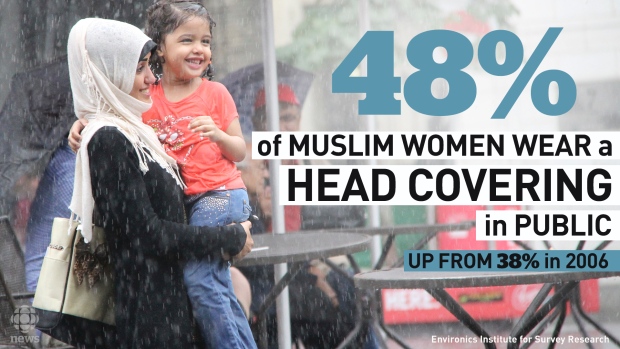
These are the findings of a survey of 600 Canadian Muslims conducted by the Environics Institute between November 2015 and January 2016. It follows up on a survey conducted 10 years ago and suggests that Muslim Canadians are becoming increasingly integrated into the broader Canadian society.

The survey began in the weeks following last fall’s federal election. A good chunk of that election’s campaign was dominated by the debate about Muslim women’s right to wear the niqab, a religious face covering, as well the Conservative proposal to establish a tip-line to report “barbaric cultural practices” that was widely seen as aimed at Muslims.

Strong sense of belonging

The survey found that 83 per cent of Muslims reported being “very proud” to be Canadian, an increase of 10 points since 2006. This was in contrast to non-Muslim Canadians — only 73 per cent of whom said they were “very proud” to be Canadian.

Fully 94 per cent of respondents said their sense of belonging to Canada was very or generally strong, and 58 per cent said their sense of belonging had become stronger over the last five years. Just five per cent said it was getting weaker.

Muslim survey graphic 4

An Environics survey says nearly half of Muslim Canadian women report wearing a head covering in public. (CBC)

Muslims reported that Canada’s freedom and democracy was their greatest source of pride (24 per cent), followed by the country’s multiculturalism and diversity (22 per cent). Younger and Canadian-born Muslims were much more likely to choose multiculturalism and diversity, compared to foreign-born Muslims, who valued freedom and democracy.

The biggest knock against Canada was the weather. Just under one-third of Muslims said that was what they liked least about Canada. Another nine per cent highlighted discrimination and the treatment of Muslims. One-in-five could not name anything they disliked about Canada.

Source: Muslim Canadians increasingly proud of and attached to Canada, survey suggests – Politics – CBC News

Jen Gerson: Eyeing the Conservative leadership, MP tiptoes away from barbaric cultural practices tipline

Gerson on Leitch’s non-apology:

The Conservatives’ earlier attempts had been more subtle, successful and, frankly, defensible. There were legitimate security and logistics concerns over the Liberals’ plans to bring in more Syrian refugees, for example.

The Conservatives’ much-derided support for the niqab ban actually is a contentious issue, particularly in parts of the country that pride themselves on secularism and female social inclusion.

But the barbaric cultural practices tipline? That was a desperate shark jump. To pretend that announcement wasn’t targeting Muslims is insulting. Even those who supported the hotline must find themselves reeling at that suggestion. This wasn’t a dog whistle, it was a bullhorn.

What we put forward that day, the message was lost and I take responsibility for that

Leitch could have admitted as much, offered an unequivocal apology and a promised to do better. Instead, she only took responsibility for the fact that she failed to convey her honest good wishes for women and children.

Her message was lost, she claims.

Her message wasn’t lost. It was perfectly clear. That was the problem.

People make mistakes. In the panicked days of an election campaign, directed by a deeply controlling central leadership, it becomes easier to follow orders and justify those actions after the fact.

But Leitch is neither dumb nor politically naive. She knew, or ought to have known, what she was doing when she fronted that announcement. She either agreed with the strategy, or lacked the backbone to refuse to support it. She’s still failing to own that mistake.

Canadians can forgive a contrite politician for doing something stupid. They can even give a pass to a well-intentioned politician who espouses bad policy honestly. But no one forgives a leader who’s weak.

Source: Jen Gerson: Eyeing the Conservative leadership, MP tiptoes away from barbaric cultural practices tipline | National Post

The Daily — Study: Educational and labour market outcomes of childhood immigrants by admission class, 1980 to 2000

Interesting that refugees tend to do better than family class immigrants:

The educational attainment and earnings of immigrants who arrived in Canada before age 18 differ considerably by admission class.

The new study, “Educational and Labour Market Outcomes of Childhood Immigrants by Admission Class,” examines the university completion rates and annual earnings of childhood immigrants when they were aged 25 to 44 in 2011. These individuals immigrated to Canada between 1980 and 2000.

Childhood immigrants who were aged 25 to 44 at the moment of the survey and whose parents were in the business or skilled-worker class had the highest rates of university completion, with 59% of those from the business class and 50% of those from the skilled-worker class obtaining a university degree. The corresponding rate among individuals born in Canada to two Canadian-born parents was 24%.

Among childhood immigrants who were aged 25 to 44 in 2011 and who were from the family class, 21% had obtained a university degree, compared with 19% of those from the live-in caregiver class. In turn, university completion rates among childhood immigrants were 29% for those whose parents were government-assisted refugees and 32% for those whose parents were privately sponsored refugees.

Differences in university completion rates across admission classes were largely associated with differences in parental education and source region. These two factors accounted for one-third of the difference observed between childhood immigrants from the family class and those from the skilled-worker class. They also accounted for almost one-half of the difference observed between childhood immigrants from the live-in caregiver class and those from the skilled-worker class.

Annual earnings also varied considerably among childhood immigrants who were aged 25 to 44 in 2011. Those from the business class and skilled-worker class had average earnings of about $46,000 that year, similar to the earnings of individuals born in Canada to two Canadian-born parents. In turn, childhood immigrants from the family class had average earnings of $39,000, while those from the live-in caregiver class had average earnings of $34,000. Childhood immigrants whose parents were government-assisted refugees earned an average of $41,000, while those whose parents were privately sponsored refugees had average earnings of $44,000.

Differences in educational attainment and occupation accounted almost entirely for earnings differences among admission classes. Childhood immigrants in the skilled-worker and business classes were concentrated in high-paying occupations, including managerial, finance, natural science, and social science occupations.

Source: The Daily — Study: Educational and labour market outcomes of childhood immigrants by admission class, 1980 to 2000

‘Widespread’ workplace abuse persists for Chinese restaurant workers | Toronto

Worth noting, including some of the methodological limitations:

Chinese workers in Greater Toronto restaurants face “widespread and persistent” workplace abuse, including being routinely denied minimum wage, overtime pay and vacation pay, according to a new report.

The report to be released Monday finds that some 43 per cent of Chinese workers earned less than the minimum wage, currently set at $11.25. Over half of the respondents reported working more than 40 hours a week, but only 11 per cent of those eligible for overtime pay said they received it.

The majority of workers were also cheated out of their statutory entitlements, the report shows: 61 per cent said their employers denied them public holidays, and 57 per cent said they did not receive vacation pay.

“The experience of Chinese restaurant workers stands out as a powerful illustration of the atrocities suffered by some of the most vulnerable workers in our economy, as well as a demonstration of the complete failure of the Ontario government to act on its legal obligation to protect workers,” says the Metro Toronto Chinese and Southeast Asian Legal Clinic report called “Sweet & Sour: The Struggle of Chinese Restaurant-workers.”

Avvy Go, director of the clinic, said the findings were no different from a similar survey it did almost three decades ago.

“Unfortunately, nothing has changed in the last 30 years. Our clients come to us asking for help on the same issues over their employment rights. They are still paid half in cash, half by cheque, with a pay stub,” Go said in an interview.

“We are still banging our heads against the same system over and over again. We call the report Sweet & Sour because it is a good deal for restaurant patrons and owners but sour for the workers.”

The clinic undertook the survey to identify the scale of workplace exploitation experienced by Chinese workers, after being contacted by more than 600 clients with complaints about employment standards violations over the past three years.

 Because the 184 workers surveyed were identified using the clinic’s client database and through other organizations working in the Chinese community, the report acknowledges that there is a “high probability” that participants with legal issues are over-represented in the data. The report argues that the consistency of responses across multiple workplaces suggest a general trend within the restaurant industry, rather than isolated incidents involving a “few bad apples.”

Source: ‘Widespread’ workplace abuse persists for Chinese restaurant workers | Toronto Star

Britain Grapples With Enduring Questions of Religion and Race – The New York Times

Good overview of the tone and substance of recent political discourse in Britain:

As Britain engages in fierce debates centered on national identity, it is also confronting challenges to traditional norms of political discourse, with issues of race and religion surfacing more overtly and provocatively.

The looming referendum on whether to leave the European Union, the place of Muslims in British society at a time when Islamic terrorists are targeting Europe, the broader question of the island nation’s openness to immigration and the Israeli-Palestinian conflict all have recently sparked controversy and heated commentary about discrimination and tolerance.

Like most European countries, many of which are facing growing populist movements on the far right, Britain has always grappled with a strain of racial and religious bias. But the political calendar and global events have combined to push the topic to center stage.

President Obama, during his three-day visit here that ended on Sunday, was the focus of an extraordinary squabble that centered on his Kenyan father and attitudes toward British imperialism.

Boris Johnson, the Conservative legislator, mayor of London and leader of the campaign against British membership in the European Union, responded to Mr. Obama’s robust call for Britain to stay in the bloc with an opinion piece centering around Mr. Obama’s removal of a bust of Winston Churchill from the Oval Office.

Mr. Johnson suggested that Mr. Obama may have been motivated by “the part-Kenyan president’s ancestral dislike of the British Empire, of which Churchill had been such a fervent defender.”

That comment provoked furious claims that Mr. Johnson, often mentioned as potential successor to Prime Minister David Cameron as leader of the Conservatives, was making a smear based on Mr. Obama’s race in order to undermine his arguments in favor of Britain remaining in the bloc.

Britain’s foreign secretary, Philip Hammond, told the Telegraph icily about Mr. Johnson: “People who aspire to hold offices of great responsibility do have to show that even under pressure they retain their cool and they don’t step over any red lines.”

Mr. Obama neatly parried the thrust without responding in kind, saying that he thought even Britons would understand that he might find it “appropriate” to have a bust of the Rev. Dr. Martin Luther King Jr. instead.

But the dispute touched deeper chords here about whether Britain can better control its borders and defend itself from terrorism from within or outside the European Union. Mr. Johnson argued that Mr. Obama is “hypocritical,” saying the United States would never cede such control over its sovereign borders to anyone.

Source: Britain Grapples With Enduring Questions of Religion and Race – The New York Times

Race and the Standardized Testing Wars – The New York Times

Without data, hard to know where the issues are and what to do about them:

As a counterexample, he pointed to Kaya Henderson, the chancellor of Washington’s public schools, who has made it a requirement that all second graders learn how to ride a bicycle.

Ms. Henderson, in an interview, said she believed that, in the transition to the Common Core learning standards, states and districts had not been “as aggressive as they need to be in terms of changing their curriculum and professionally developing teachers and principals to really understand how to teach differently.”

Her own district, she said, spent four years developing a curriculum in which students hone their reading and math skills while studying a wide variety of subjects, including science and social studies.

She added that it was the responsibility of state and district leaders to emphasize the importance of field trips and extracurricular activities and to tell principals that “holding kids back from those kinds of things doesn’t help them on the test.”

“I’ve had to at some points remind my principals that kids should have a well-rounded experience all throughout the year, and it’s not O.K. to say no field trips until after the test,” she added.

But she also said that doing away with the tests would be most damaging to black and Latino students and those with disabilities. “Before No Child Left Behind, there were lots of schools where parents thought their kids were going to great schools, but after you disaggregated the results, you figured out that black kids and Latino kids or special-ed kids were actually worse off” than similar students in less high-performing schools, she said. “We need to know that kind of information. I don’t ever want to go back to a time when we don’t know.”

Sonja Brookins Santelises, vice president of K-12 policy and practice at the Education Trust, an organization that advocates for high academic achievement for poor and minority students, said she had watched the video produced by the Baltimore Algebra Project and been shaken by the students’ disappointment in their education and feelings of marginalization.

She said it was educators’ responsibility to speak to students about testing in a positive way. Ms. Brookins Santelises recalled an experience from when she was a middle schoolteacher, when she showed a student named Tabitha her test scores and explained to her that she was significantly below grade level in reading.

“She said to me, ‘Oh, my God, nobody told me I couldn’t read,’ ” Ms. Brookins Santelises recalled. “I watched how she started to internalize it, and I immediately said, ‘Wait a minute, hold up, this test is not Tabitha. But what this says is we’ve got some real work to do, and I am here to help you.’ ”

If students are being made to feel inferior, she said, it is because educators — from teachers to district officials — aren’t taking responsibility for their own failures and instead are sending low-income students the message that their poor performance is their fault.

Source: Race and the Standardized Testing Wars – The New York Times

Supremacist attitudes are a universal enemy

Amira Elghawaby of the National Council of Canadian Muslims (NCCM) on the link to supremacist attitudes:

What we seem to miss while seeking to understand these senseless acts of violence committed in the name of any religion, or political ideology, is that this nihilistic hate is often based on supremacist attitudes.

Instead of constant condemnations of those who say they are fighting and killing in the name of Islam, we must universally condemn those who paint the world in the false dichotomy of black and white, good and evil, or right and wrong.

Anyone who implicitly or explicitly advocates the supremacy of a particular group over another should think twice about how this dehumanizes fellow human beings around the world.

We have to acknowledge that nationalism can also be used to create and bolster a sense of righteousness and dominance in the minds of some. That isn’t to say that being proud of one’s country, or fellow citizens, is blameworthy. But we should beware of how nationalism may disconnect us from others in the world, or even within our own communities, and how it can be manipulated by agenda-driven interests and metastasize into something more sinister as we witnessed in Brussels with the unwelcome appearance of neo-Nazis at a recent weekend memorial.

Consider what fuels those who support such attitudes, including what fuels them to support the likes of Donald Trump. The head of the U.S.-based National Policy Institute and a white nationalist, Richard Spencer, told VICE News last December that “[Trump’s] basically saying that if you are a nation, then at some point you have to say, ‘There is an ‘Us,’ and there is a ‘Them.’ Who are we? Are we a nation? In that sense, I think it’s really great.”

Supremacist attitudes are dangerous, not least because they also make it harder to engage in meaningful discourse around the drivers of violence. Our best chance of fighting extremist ideology is to find our common humanity and not simply reinforce false polarization within our societies. The doubling of hate crimes against Muslims over the past three years here in Canada speaks clearly to this.

Source: Supremacist attitudes are a universal enemy |