New archive highlights years of racism faced by Chinese Canadians | Toronto Star

A good reminder of our history:

Seventy-one years ago Mavis Chu Lew Garland and eight of her preschool classmates were photographed on the porch of the Chinese Canadian Institute on the corner of Dundas St. W. and University Ave.

Times were different, rather “extremely difficult,” she says, being born to a Chinese immigrant father and a white mother when interracial marriages were seen as unacceptable.

But now, at the age of 76, Garland and her classmates have come together to recreate a photo that was taken during a period of discrimination, and now represents a snapshot of Canadian immigrant history.

The photo, which Garland found while scrounging through old shoeboxes is just one of the artifacts donated to the Toronto Public Library as part of a three-year initiative, the Chinese Canadian archives, which opened on Tuesday at the Toronto Reference Library.

Since the announcement calling for donations in July, the library has received hundreds of articles to commemorate the historic voices of the Chinese people in Canada. Among the collection are old photographs of the city’s first Chinese restaurants, and businesses that once existed in the area where City Hall stands today.

But among the pieces of colourful memorabilia are documents highlighting a Canadian history of discrimination, including documentation on the racist Chinese head tax, showing how it rose from $50 in 1885 to $100 in 1900 and eventually to $500 in 1903 — at the time the price of buying two houses in Toronto.

Then there was the construction of the Canadian Pacific Railway in 1881, when an estimated 17,000 Chinese workers were brought to Canada and endured long working days, for around $1 a day. Due to the poor working conditions and illnesses, records estimated that they died in the thousands.

“All of them remained nameless in the history of Canada,” the monument standing just outside the Rogers Centre commemorating the Chinese CPR workers reads.

“I feel like a lot of the lives, work, and contributions of Chinese-Canadians have remained nameless,” 28-year-old Coly Chau told the Star.

Chau immigrated to Montreal from Hong Kong at the age of 5.

“Elementary and secondary education gave me very little exposure to the history of Chinese Canadians” Chau says.

After graduating high school, Chau said a lack of belonging pushed her to “dig deeper” to research and learn about her history.

“As an immigrant, my experiences have been greatly attributed to the contributions and experiences of those Chinese Canadians that came before my family and I,” Chau said. “There are instances of racism that I’ve experienced, or the feeling of being an outsider — but those that came before me worked very hard to dismantle a lot of it, and lessen it for us now.”

Source: New archive highlights years of racism faced by Chinese Canadians | Toronto Star
Despite uproar over Trinity Western, many B.C. Christian school policies bar LGBTQ teachers | National Post

Open question whether this form of discrimination in religious schools is compatible with continuing to receive public funding:

While the debate over Trinity Western University’s community covenant rages on through the courts and the media, many Christian elementary and high schools that receive B.C. government funding are quietly operating with similar policies that essentially bar gay and lesbian teachers from employment.

The independent schools all belong to the Society of Christian Schools in B.C. (SCSBC), which requires each of its 31 member schools to draft “community standards policies” for employees to follow. The suggested language includes refraining from all sexual activity outside of heterosexual marriage.

Several members of the society have posted policies that include these restrictions online, including schools in Abbotsford, Surrey, Langley, Nanaimo, and Houston. These policies also tend to include prohibitions on things like public drunkenness and watching porn.

“What a terrible message,” said former Vancouver school trustee Patti Bacchus. “Something like that, it just goes backwards. It’s flat-out discrimination and a violation of someone’s human rights.”

Ed Noot, the executive director of the SCSBC, is overseas and declined to answer questions by email.

Canadian legal precedent largely falls on the side of protecting the rights of religious schools to set their own policies, as long as they’re made in good faith and based on honestly-held religious beliefs. The defining Supreme Court of Canada case dates back to 1984, when the justices ruled in favour of a Vancouver Catholic school that fired a teacher after she married a divorced man.

The B.C. Court of Appeal followed that line of thinking when its panel of five judges ruled in favour of TWU establishing a law school, calling the B.C. Law Society’s attempt to deny the school accreditation on the basis of its discriminatory covenant a well-intentioned act carried out in an “intolerant and illiberal” manner.

That case will likely end up in the country’s highest court, and there are those who say it’s time for a change in direction.

Vancouver lawyer and queer activist Barbara Findlay believes that freedom of religion and freedom from discrimination are both essential rights, but she has strong feelings about how these rights should be balanced.

“I say that your right to freedom of religion ends where you want me to do something. My right to be free from discrimination can only exist if your right to freedom of religion is not allowed to trump it,” findlay said.

“I’m hoping that this question will be definitively settled in the Trinity Western case when it heads to the Supreme Court.”

This fall, Education Minister Mike Bernier announced that all public and private schools in B.C. would have to include protections for LGBTQ students in their anti-bullying policies, and choked up as he remembered the difficulties his lesbian daughter faced in school. Meanwhile, the province’s new curriculum asks teachers to ensure their lessons support inclusion and diversity, including “diversity in family compositions and gender orientation.”

In an emailed statement, the education ministry stressed that “We believe in safe, respecting and inclusive schools.” But the statement also pointed out that Canada’s Human Rights Act allows certain schools to discriminate if their primary purpose is promoting the interest of a religious group. Most independent school authorities in B.C. meet the requirements for that, according to the ministry.

Source: Despite uproar over Trinity Western, many B.C. Christian school policies bar LGBTQ teachers | National Post

Enclaves of Islam see UK as 75% Muslim | News | The Times & The Sunday Times

Failure of British integration and related programs. Some interesting observations at the end of the article about the risk of monocultural white schools and far right radicalization:

Some Muslims lead such separate lives that they believe Britain is an Islamic country where the majority of people share their faith, according to a report to be published this week.

Evidence gathered by Dame Louise Casey, the government’s community cohesion tsar, will lift the lid on how some Muslims are cut off from the rest of Britain with their own housing estates, schools and television channels.

Her report finds that thousands of people from all-Muslim enclaves in northern cities such as Bradford, Dewsbury and Blackburn seldom, if ever, leave their areas and have almost no idea of life outside.

A source who has read the report said: “Certain Muslims, because they are in these communities and go to Muslim schools, think Britain is a Muslim country. They think 75% of the country is Muslim.”

The correct figure, according to the 2011 census, is 4.8% of the population in England and Wales. Christians account for 59.3%.

Casey’s report will be embarrassing for ministers, and Theresa May in particular, because it will say the government does not have any serious integration strategy.

The report will criticise the Home Office, which May used to run, and other departments for not doing enough to manage the pace and consequences of mass immigration.

“It will say that nobody has been on it,” said a source familiar with the contents.

A source close to Casey said: “There is a desire [among policymakers] to tolerate such a level of significant difference that you have overcompensated and gone way too far.”

Those familiar with the report say Casey, who investigated failings by children’s services at Rotherham council after the child abuse scandal, has seen off attempts by the Home Office to water down her report. One described it as “full-fat Louise”.

The report will “send shock waves through the system”, a Whitehall source said, adding: “It’s going to be quite hard reading for some people.”

Casey will attack the police and other state bodies for “weakness” and pandering to false notions of what they think ethnic communities want — such as a police chief who said female officers could be allowed to wear the full veil.

“The report will say that we are in a vicious circle where some institutions are so wrongfully interpreting their version of political correctness that they are gifting the far right,” a source said.

Sir Michael Wilshaw, the departing chief inspector of schools, warns today that about 500 schools in England are either 100% white or 100% ethnic minority — and pupils in them are at risk of alienation and radicalisation.

Wilshaw told The Sunday Times that parallel communities were developing in Britain and children growing up in monocultural schools in these communities were in danger of being cut off from British values and vulnerable to either far-right or Islamist causes.

The chief inspector said that he was particularly worried about a cluster of 21 schools in Birmingham — many of them primaries with predominantly Muslim pupils — where there were no white pupils. Nearly half of the schools have been judged “less than good”.

“We have to make sure these schools are good schools so youngsters in them feel they are part of British society and they have to respect other people’s faiths and cultures,” Wilshaw said.

“In white-only schools the same thing applies. Though we might not be as concerned in white communities about radicalisation, certainly we are worried about alienation and the rise of the far right.

“If these children have not been well educated and cannot get jobs as a result that will feed into alienation and the espousal of right-wing ideologies.”

Casey has examined the social alienation felt by the white working class. Although her report will not dismiss the far right it will say that Islamist extremists pose a more serious threat.

The report will also attack the government for not doing enough to defend Prevent, its embattled counter-extremism policy, against misinformation put out by Islamist and far-left groups.

Source: Enclaves of Islam see UK as 75% Muslim | News | The Times & The Sunday Times

‘We won’t back down’: Young right-wing activists agitate across Europe for an idealized past – Canada – CBC News

Interesting profile of the white supremacist movement and key players in France, similar to the likes of Robert Spencer and the like in USA:

They are traditionalists with a YouTube channel, nostalgic nationalists who text and tweet.

Young, white and European, they call themselves Identitarians, right-wing activists agitating across the continent against immigration and Islam and for a future rooted deep in an idealized past.

“I’m a product of my time,” says Pierre Larti, a spokesman for Génération identitaire (GI), the French branch of the movement. “But I know the difference between what is good in this era and what isn’t.”

Larti is buff, squeaky clean and, at 27, already part of the old guard of the movement.

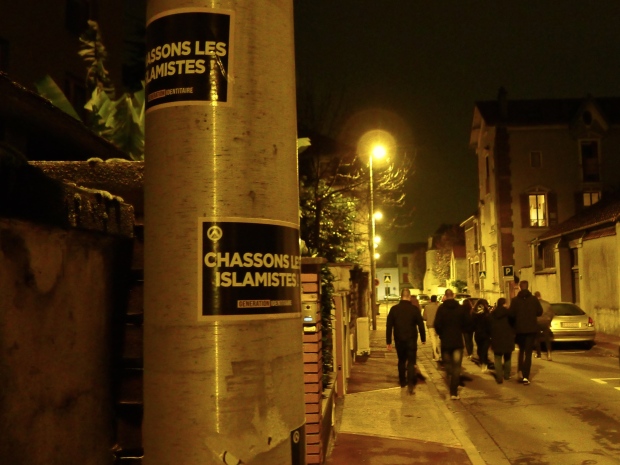
Issy stickering

Génération identitaire uses of range of strategies to get its message across, from Greenpeace-style shock tactics to postering and stickering in like-minded neighbourhoods. (Michelle Gagnon/CBC)

After a long day and a meeting that ran late — Larti works in HR at a yogurt factory — he travelled more than 50 kilometres to lead a low-tech, late-night postering and stickering campaign in Issy-les-Moulineaux, a suburb just outside Paris.

“I’ve lived in this multiethnic society and seen its ravages, the dangers it poses for us, for the French. We’ve become passive, too accepting,” Larti says.

“We accept the veil in the public square. We accept burkas. Little by little, we accept everything. We accept that France now has more than 2,500 mosques.

“We accept one or two attacks a year,” he pauses and then asserts: “I cannot accept that.”

Source: ‘We won’t back down’: Young right-wing activists agitate across Europe for an idealized past – Canada – CBC News

Trevor Noah defends controversial Tomi Lahren interview

Took a certain degree of courage on both their parts rather than remaining within the bubbles, despite the risks of “normalization.” And a much more serious exchange than the Mansbridge/Coulter interview:

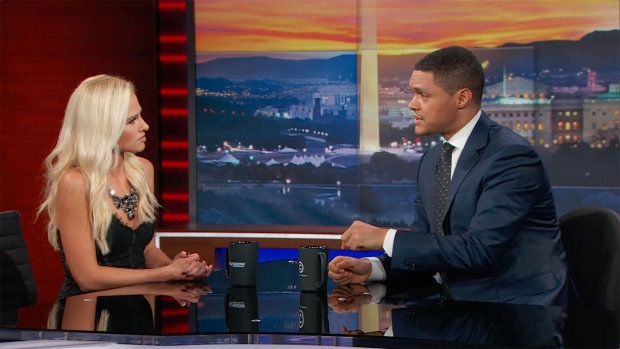
Trevor Noah said he invited right-wing pundit Tomi Lahren on his show because he believes Americans with different worldviews need to break out of their ideological bubbles and have conversations with each other.

The South African comedian who took the reins of Comedy Central’s news parody powerhouse The Daily Show when Jon Stewart retired last year has garnered both praise and scorn for his recent interview with Lahren, a hard-line commentator on The Blaze who has come under fire for comparing Black Lives Matter to the Ku Klux Klan.

Headlines labelled the interview a “showdown” and a “faceoff,” but the liberal-leaning Noah insisted it was a “conversation” free of the hatred and vitriol so common to U.S. politics.

Tomi_Invw

Trevor Noah went head-to-head with Tomi Lahren on a recent episode of The Daily Show, in an interview that’s been both praised and scorned. (The Comedy Network)

“The conversation everyone seems to be having is: Do we live in bubbles? Do we live in a space where we are unable to understand or acknowledge the fact there are people out there in the world who have views that are very different to us?” Noah told CBC’s The National.

“It seems fruitless to some, but … the other alternative is to stay in those bubbles that you talk about, so why not have a conversation?”

Source: Trevor Noah defends controversial Tomi Lahren interview – Entertainment – CBC News

More people should engage in politics so ‘no party gets to run against Muslim Canadians,’ Justin Trudeau says

Pitch perfect:

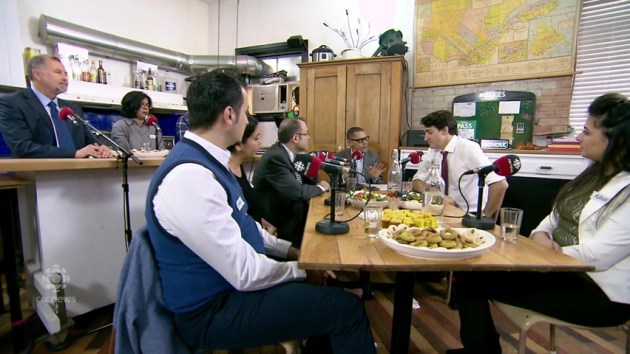
Galloway asked the prime minister for his reaction to the proposal to screen immigrants for “anti-Canadian values” put forward by federal Conservative leadership candidate Kellie Leitch.

Trudeau did not address Leitch by name. He said he told a group of Muslim-Canadians during a recent meeting that he was happy to have them as supporters. However, he said he suggested they encourage family members and friends to also get involved in politics, whether on behalf of the Liberals or another party that aligns with their values.

Media placeholder

“The other two political parties have leadership races on now. I’d like to see more Canadians of diverse backgrounds engaging with parties that line up with their convictions and ideologies to make sure that no party gets to run against Muslim Canadians or any other group of Canadians and demonize them,” Trudeau said.

“And I think the way we do that is getting involved in the whole breadth of the political spectrum in Canada. I’m happy when people decide they are more aligned with me and my party, but they should also think about being active and aligned with parties that disagree with me on certain issues.”

Galloway also asked the prime minister about how his policy, which has brought more than 35,000 Syrian refugees to Canada in just over a year, contrasts with that of U.S. president-elect Donald Trump and some politicians across Europe, who advocate for a more closed approach on refugees.

“I’m not going to answer whys,” he said. “I’m just going to continue to point out the facts that the way Canada is benefiting from welcoming in people who are so deeply committed to living up to the opportunity given to them.”

He added, “I challenge any one of those governments or those citizens to sit down around a table like this and break bread and not be afraid of the other.”

Source: More people should engage in politics so ‘no party gets to run against Muslim Canadians,’ Justin Trudeau says – CBC.ca | Metro Morning

Inside Quebec’s far right: Take a tour of La Meute, the secretive group with 43,000 members

Worrisome, even if numbers still small (and mainstream parties like the CAQ and PQ that pander to these fears and play identity politics, need to reflect on their impact):

La Meute’s leaders are now attempting to translate the group’s online popularity into concrete political influence.

They hope to become a lobby group of sorts, dedicated to making Quebecers aware of the threat posed by Islamic fundamentalism.

“I don’t have the desire to live under Shariah. I don’t want to live under a totalitarian Islamic regime,” said Eric Venne, one of the group’s founders, a veteran of the war in Afghanistan who goes by Corvus, after the genus of crows, ravens and rooks.

“But we are heading that way. It may not look like it in 2016. Tomorrow, people might go, ‘Oh.’ But by then it will be too late.”

Where others sputtered, La Meute surged

Corvus started La Meute with Patrick Beaudry, another former soldier, in the fall of 2015, just as the first of 25,000 Syrian refugees began arriving in Canada.

At a sugar shack in the Beauce, south of Quebec City, the pair drew up plans for a hierarchical organization modelled on their military background.

They gave it a name to invoke the sense of camaraderie they felt was needed in the face of what they considered a grave existential threat. In an early communiqué, Corvus described the influx of refugees as a “Trojan horse” for Islamic terrorists.

La Meute is among dozens of social media groups, blogs and websites that have popped up in recent years to give voice to concerns about Islam in Quebec.

But where other groups sputtered, La Meute surged.

The group’s activities were initially confined to its secret Facebook page. But as the group grew — it had more than 40,000 members by the start of the summer — it diversified.

A non-profit organization was registered to serve as La Meute’s fundraising arm, and fundraisers that each drew 150 people were held in Quebec City and the Saguenay.

By August, the group was distributing pamphlets around the province. Later that month, Corvus and several fellow members disrupted an information session near Quebec City organized by a group of volunteers trying to host a family of Syrian refugees.

Source: Inside Quebec’s far right: Take a tour of La Meute, the secretive group with 43,000 members – Montreal – CBC News

University class takes on case of B.C. woman stripped of citizenship [Lost Canadian]

Good learning exercise (unclear whether the the person in question applied for an exemption, the normal route in such cases, which on the facts presented in the article, would likely have been granted):

A group of university students in Squamish, B.C., is hoping their school work will help change the life of a woman whose Canadian citizenship was stripped under a little-known policy.

Leanne Roderick, an instructor at Quest University, wanted the 20 students in her democracy and justice class to meet someone who was really wrestling with representative democracy in Canada, so she introduced them to a local woman named Byrdie Funk.

Funk was born in Mexico to Canadian parents and moved to a small community in Manitoba when she was two months old. Though her upbringing was quintessentially Canadian, Funk learned earlier this year that her nationality had been revoked.

An unknown number of people born abroad to Canadian parents between 1977 and 1981 were stripped of their nationality because they were unaware of an obscure piece of legislation requiring them to apply to retain their citizenship before the age of 28.

The American election made immigration a popular topic of conversation, and Roderick wanted her students to see how a real person was impacted by government policy.

“To be able to sit down with someone and hear their story, a very real story, I just wanted to put a face on this big issue of citizenship in Canada,” she explained.

After Funk spoke to the class, Roderick tasked them with developing a policy brief advising government on how politicians could help so-called lost Canadians.

The results were surprising, the instructor said, with students delivering in-depth, well-researched plans that included suggestions of private members’ bills and amendments to the Citizenship Act.

“They really are passionate. I think that age range kind of gets a bad rap sometimes, but they really do care and they really do want to be politically engaged citizens,” Roderick said.

Several students forwarded their work to MPs and cabinet ministers, encouraging them to get involved in Funk’s case.

Third-year student Ellie Fraser sent her policy brief to four MPs, but said not one responded, even with a note thanking her for writing.

Source: University class takes on case of B.C. woman stripped of citizenship | CTV News

Tory leadership hopeful Chris Alexander mentions Rachel Notley at speech and crowd chants ‘lock her up

His political and personal judgement is in question.

Sharp contrast between John McCain showing leadership in 2008 when responding to a similar angry crowd by saying “I have to tell you. Sen. Obama is a decent person and a person you don’t have to be scared of as president of the United States.”

And the sheer hypocrisy, given his complaints about being subject to hateful tweets in last week’s CBC At Issue panel:

Federal Conservative leadership hopeful Chris Alexander says he didn’t stop a crowd calling for Alberta Premier Rachel Notley to be locked up because politicians need to listen to constituents.

The former immigration minister was speaking at a rally against the provincial NDPs’ planned carbon tax Saturday when protesters began the “Lock her up” chant popularized during president-elect Donald Trump’s campaign.

“I totally disapprove of that particular chant. I don’t think it’s fair. I don’t think it’s the right thing to say at a rally or elsewhere, and that’s why I didn’t join it,” Alexander said Sunday.

The Edmonton rally was organized by Rebel Media, an online news and right-wing opinion outlet, and video of the incident was posted on Twitter by the website’s Alberta bureau chief Sheila Gunn Reid.

The video shows the ralliers start by chanting “Vote her out,” but as they grow louder, the message changes.
As they chant “Lock her up,” Alexander smiles and appears to gesture in time with the chant, nodding along.

Someone can be heard shouting, “That’s enough! That’s enough!” in the background, and as Alexander smiles and nods, the camera turns to face the crowd.

At no point in the video does Alexander stop the protesters or say anything about their chant.

“You don’t pick it up in the video, but I started to say the words in time with them, ’Vote her out,’ and then the next point I made was about the ballot box,” he said. “I expressed my disapproval by talking about something completely different: voting. I think that was pretty clear.”

Source: Tory leadership hopeful Chris Alexander mentions Rachel Notley at speech and crowd chants ‘lock her up’ | National Post

The Scourge of Racial Bias in New York State’s Prisons – The New York Times

Good but disturbing investigative reporting:

Most forbidding are the maximum-security penitentiaries — Attica, Clinton, Great Meadow — in rural areas where the population is almost entirely white and nearly every officer is too. The guards who work these cellblocks rarely get to know a black person who is not behind bars.

Whether loud and vulgar or insinuated and masked, racial bias in the state prison system is a fact of life.

It is also measurable.

A review by The New York Times of tens of thousands of disciplinary cases against inmates in 2015, hundreds of pages of internal reports and three years of parole decisions found that racial disparities were embedded in the prison experience in New York.

In most prisons, blacks and Latinos were disciplined at higher rates than whites — in some cases twice as often, the analysis found. They were also sent to solitary confinement more frequently and for longer durations. At Clinton, a prison near the Canadian border where only one of the 998 guards is African-American, black inmates were nearly four times as likely to be sent to isolation as whites, and they were held there for an average of 125 days, compared with 90 days for whites.

A greater share of black inmates are in prison for violent offenses, and minority inmates are disproportionately younger, factors that could explain why an inmate would be more likely to break prison rules, state officials said. But even after accounting for these elements, the disparities in discipline persisted, The Times found.

The disparities were often greatest for infractions that gave discretion to officers, like disobeying a direct order. In these cases, the officer has a high degree of latitude to determine whether a rule is broken and does not need to produce physical evidence. The disparities were often smaller, according to the Times analysis, for violations that required physical evidence, like possession of contraband.

Blacks make up only 14 percent of the state’s population but almost half of its prisoners. Racial inequities at the front end of the criminal justice system — arrest, conviction and sentencing — have been well documented.

The degree of racial inequity and its impact in the prison system as documented by The Times have rarely, if ever, been investigated. Nor are these issues systematically tracked by state officials. But for black inmates, what happens inside can be profoundly damaging.

Bias in prison discipline has a ripple effect — it prevents access to jobs and to educational and therapeutic programs, diminishing an inmate’s chances of being paroled. And each denial is likely to mean two more years behind bars.

A Times analysis of first-time hearings before the State Board of Parole over a three-year period ending in May found that one in four white inmates were released but fewer than one in six black inmates were.

Source: The Scourge of Racial Bias in New York State’s Prisons – The New York Times