Citizenship Applications: Third Quarter Continues to Show Decline

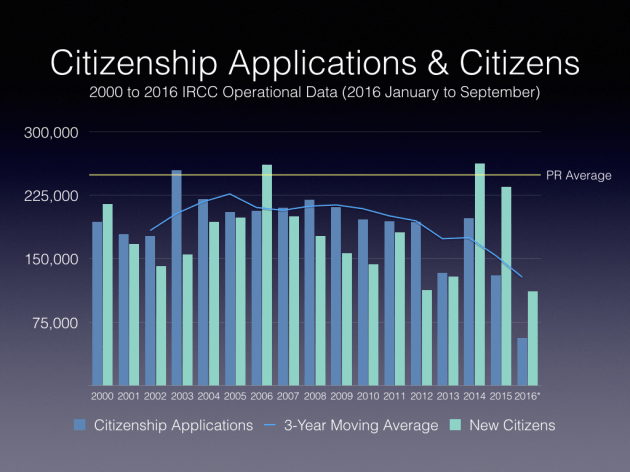
citizenship-data-slides-010Further to my earlier analysis of the half-year numbers showing a dramatic decline (The impact of citizenship fees on naturalization – Policy Options), the third quarter numbers issued this week confirm the overall trend: only some 56,000 applications were received, compared to 112,000 for the same period in 2015, just about half.

This quarter is the first quarter one year after minimum residency requirements were changed to four years from three and so one might have expected some increase. Indeed, the July-September numbers show an increase for the quarter from 12,000 in 2015 to 20,000 in 2016. But this does not change the overall picture: the total number of applications this year is likely to be around 75,000 compared to 130,000 in 2015, a drop of over 40 percent.

Nor does it change my overall argument that the likely major factor responsible for this decline was the steep increase in adult citizenship processing fees in 2015 to $530.

Of course, the one bright spot in this decline is that the backlog has been reduced: the current inventory is just over 55,000 compared to about 250,000 at the beginning of 2015. Processing time has also declined, from 21 months for the same period in 2015 to 16 months currently.

The most recent approval rate is 91 percent, slightly down from 93 percent.

But reducing the backlog and reducing processing times by reducing demand for citizenship through higher fees and other barriers runs against the government’s overall diversity and inclusion agenda.


‘We can’t abandon them’: Senators urge more language, mental health supports for Syrian refugees

Sensible set of recommendations:

One year after the first wave of Syrian refugees arrived in Canada, the Senate’s committee on human rights is urging the federal government to boost language training, mental health services and financial supports to ease the next phase of the resettlement process.

Releasing a report called “Finding Refuge in Canada: A Syrian Resettlement Story,” committee chair Jim Munson said while the program has been a Canadian success story, the government and citizens must not be complacent.

“We can’t abandon them. We can’t let indifference set in. We need to do more to help them in their next resettlement steps,” he said during a news conference in Ottawa Tuesday.

The report recommends:

  • The minister of immigration, refugees and citizenship set and meet specific standards for processing times.

  • Improving the flow of information to refugees on the status of applications.

  • Connecting refugees with networks of supportive individuals in their communities.

  • Ensuring the Canada Revenue Agency (CRA) maintain timely processing for disbursement of the Canada Child Benefit.

  • Replacing immigration loans for transportation expenses with a grant.

  • Increasing funds for language training, and providing accompanying child care to improve access for women.

  • Working with provinces, territories and community groups to enhance programming for youth.

  • Improving culturally appropriate mental health programs.

  • Identifying possible changes to facilitate timely family reunification.

Source: ‘We can’t abandon them’: Senators urge more language, mental health supports for Syrian refugees – Politics – CBC News

And The Globe has a good profile of how some schools are integrating Syrian refugee kids:

 Finding sanctuary: Why education is challenging but crucial for Syrian refugees 

Battle against religious persecution ‘diminished’ under Liberal government: ex-ambassador

Bennett’s comments are not surprising, as the intent of the merger into the human rights division was to encourage a more integrated approach to all rights, which ultimately means a lower profile for religious freedom than provided by a separate office.

Same thing happened when multiculturalism moved from Canadian Heritage to IRCC in 2008 under then Minister Kenney, where it withered away in terms of personnel, funding and importance, and has yet to recover despite its move back to Canadian Heritage:

I agree fully with his call for greater religious literacy among officials (not just diplomats), given the place that religion plays in many peoples lives:

Canada’s former ambassador for religious freedom launched thinly veiled criticisms at the new Office of Human Rights, Freedoms and Inclusion on Wednesday.

Speaking to the Senate’s human rights committee, Andrew Bennett, now a senior fellow with Christian think-tank Cardus, said the “ill-defined and thoroughly vague” concept of “inclusion” could muddy the water and distract from specific religious persecution issues faced by minorities abroad.

Bennett implied the Liberal government’s new office, which replaced his Office of Religious Freedom earlier this year, has a vaguer mandate less focused on specific issues of religious persecution than it did under the Conservatives.

He said more training is needed because there is a “relative ignorance” of religion in the public-service ranks and a “false understanding of separation of church and state” still seems prevalent. To ignore the fact that religion plays a role in public life is “out of step,” “historically inaccurate” and a “very serious diplomatic blind spot,” he said.

“Allies are wondering why there has been a diminishment in focus on religious freedom,” Bennett added, arguing that religious freedom is fundamental and that to prioritize it does not deny attention to other human rights.

“Certain human rights need to be brought to the floor and actively and persuasively championed when they’re most being challenged,” he said. His office could have been louder, Bennett noted, when it came to specific issues, such as the treatment of Falun Gong practitioners and Tibetan Buddhists in China, of Christians in Saudi Arabia and of Shia Muslims in Pakistan.

Bennett said he worked with the new office as part of a transition process, including extending his own network of contacts, until June. But, in the context of a question about the transition period, he said, “unfortunately I was never afforded the opportunity to brief the minister on the work of the Office of Religious Freedom.”

Foreign Affairs Minister Stéphane Dion’s press secretary, Chantal Gagnon, said however that the two had met earlier, on Feb. 10, when they “discussed the work of the office.”

In an emailed follow-up statement to the National Post, Bennett said the meeting was held with “no more than two hours’ notice” and that Dion requested “advice on the political sensitivities of the non-renewal of the office” and his relationship with the office’s External Advisory Committee. “But that was not a structured, formal briefing on the office itself.”

Angela Merkel faces party row over calls to scrap dual citizenship for children of immigrants 

Tough balancing act in overall European political context:

Angela Merkel was plunged into a new row over immigration on Wednesday when delegates at her party conference voted to end dual citizenship for the children of immigrants.

The German chancellor quickly disowned the decision by her Christian Democratic Union party (CDU), as her coalition partners said they would block it from becoming government policy.

The dispute, a day after Mrs Merkel was re-elected party leader and given an 11-minute standing ovation, threatened to mar the start of her campaign to win a historic fourth term as chancellor.

“There will be no change in the law in this parliament,” she said after the vote, in a clear rebuke to delegates. “I do not believe we should campaign on dual citizenship in the elections as we did in the past.”

In her speech to the conference on Tuesday, Mrs Merkel made a clear play for the party base who had been alienated by her “open-door” refugee policy, vowing never to repeat it and calling for a burka ban.

But the row over dual citizenship was a sign she may struggle to contain the demand for an anti-immigrant line on the party’s emboldened Right wing.

Dual citizenship is an incendiary issue in Germany, where it was not allowed until recent years, and even now is only available to citizens of other EU countries and the children of immigrants.

By a narrow majority of just over 51 per cent, CDU delegates voted to scrap laws introduced in 2014 under which the children of immigrants born in Germany are allowed to retain dual citizens as adults.

Source: Angela Merkel faces party row over calls to scrap dual citizenship for children of immigrants 

Le cours d’éthique et de culture religieuse jugé sexiste | Le Devoir

Should have seen this coming – the challenge of how to improve awareness of different religions and their beliefs, a desirable goal in a diverse society, while placing these in the context of gender and other rights:

Le Conseil du statut de la femme (CSF) reproche au cours d’éthique et de culture religieuse d’enseigner les religions sans critiquer leur contenu sexiste. Dans un nouvel avis, il recommande que l’enseignement des religions soit séparé de celui de l’éthique, et joint au cours d’histoire.

Le cours ne « remet pas en question les pratiques sexistes au sein des religions » et se contente de décrire les récits religieux sans offrir de mise en contexte critique, déplore le CSF.

On donne l’exemple du récit d’Abraham dans l’Ancien Testament et de ses rapports avec son épouse Sarah et la servante de qui il aura un enfant (Ismaël). Certains manuels, note le Conseil, rendent Sarah « responsable du viol » de la servante et« euphémisent » la violence sexuelle subie par cette dernière.
Les textes sur l’institution du mariage catholique posent le même problème, selon le CSF. On expliquera par exemple aux enfants que les interdits et les rites visent à mettre les femmes « au service de la communauté » en favorisant notamment la « stabilité de la famille ». Or, à nouveau, c’est décrit sans regard critique, plaide-t-on.
Même chose pour la pratique du « gèt » (acte de divorce) dans la religion juive qui est réservée aux hommes, ou des règles régissant l’habillement des femmes dans les religions musulmane ou hindoue.
« Aucun élément de contenu ne permet aux élèves de comprendre que les religions sont des institutions sociales certes significatives pour un grand nombre de personnes, mais qui ont été et demeurent responsables d’un grand nombre de violences envers les femmes, ainsi que du maintien de pratiques et de représentations inégalitaires. »
Le CSF propose donc que la religion soit enseignée dans le cadre du cours d’histoire plutôt que dans celui du cours d’éthique. L’éducation à l’égalité, à la citoyenneté et à la sexualité devrait quant à elle s’insérer dans le cours d’éthique durant tout le parcours primaire et secondaire.

L’avis s’en prend en outre au cours d’histoire, qui explique mal ou peu les luttes menées par les femmes. Ainsi, dans un manuel traitant de l’obtention du droit de vote en 1940, on écrit qu’Adélard Godbout leur a « accordé » sans expliquer qu’elles ont « lutté des années pour l’obtenir ». Certains efforts sont toutefois soulignés, tel l’ajout de personnages historiques féminins dans les manuels.

Des biais sexistes

L’organisme s’inquiète en outre de la persistance de certains biais sexistes chez les enseignants. On constate que ces derniers donnent trop de place aux stéréotypes selon lesquels les garçons sont meilleurs en mathématiques, plus physiques et ont plus besoin de bouger que les filles, alors que ces dernières seraient plus à l’aise dans le monde des sentiments, des émotions et de l’aide au prochain.
« Si le corps enseignant peut tenir compte de ces différences — dues à la socialisation différenciée des garçons et des filles —, il ne devrait pas les consolider, écrit le CSF. Au contraire, l’école devrait contribuer à contrecarrer les effets de la socialisation de genre en évitant de réserver certaines approches pédagogiques ou certaines activités aux filles et aux garçons. »
Pour l’affirmer, l’organisme s’appuie notamment sur un questionnaire mené auprès de 393 enseignants. Parmi les répondants, 80 % ont soutenu que les garçons avaient besoin de méthodes éducatives plus « dynamiques et actives ». Une enseignante du primaire citée dans l’avis raconte « qu’il y a des exemples qui parlent plus aux garçons (mise en situation parlant de hockey) et d’autres qui intéressent plus les filles (décoration pour traiter de l’aire par exemple). »

Cela pousse le Conseil à faire une série de recommandations, dont l’ajout à la formation des maîtres d’un cours obligatoire sur le thème des inégalités de sexe. Or, le milieu semble réticent. Mercredi, lors du dévoilement de l’avis à l’Université Laval, la vice-doyenne à la recherche Annie Pilote a expliqué qu’il n’y avait « pas de marge de manoeuvre » pour un tel ajout dans le programme et qu’il faudrait plutôt que cela s’insère dans la formation continue.

How to Know What Donald Trump Really Cares About: Look at What He’s Insulting – The New York Times

This is a truly remarkable analysis of social media and Donald Trump, rich in data and beautifully charted by Kevin Quealy and Jasmine Lee.

Well worth reading, both in terms of the specifics as well as a more general illustration of social media analysis:

Donald J. Trump’s tweets can be confounding for journalists and his political opponents. Many see them as a master class in diversion, shifting attention to minutiae – “Hamilton” and flag-burning, to name two recent examples – and away from his conflicts of interest and proposed policies. Our readers aren’t quite sure what to make of them, either.

For better or worse, I’ve developed a deep expertise of what he has tweeted about in the last two years. Over the last 11 months, my colleague Jasmine C. Lee and I have read, tagged and sorted more than 14,000 tweets. We’ve found that about one in every nine was an insult of some kind.

This work, mundane as it sometimes is, has helped reveal a clear pattern – one that has not changed much in the weeks since Mr. Trump’s victory.

First, Mr. Trump likes to identify a couple of chief enemies and attack them until they are no longer threatening enough to interest him. He hurls insults at these foils relentlessly, for sustained periods – weeks or months. Jeb Bush, Marco Rubio, Ted Cruz and Hillary Clinton have all held Mr. Trump’s attention in this way; nearly one in every three insults in the last two years has been directed at them.

If Mr. Trump continues to use Twitter as president the way he did as a candidate, we may see new chief antagonists: probably Democratic leaders, perhaps Republican leaders in Congress and possibly even foreign countries and their leaders. For now, the news media – like CNN and The New York Times – is starting to fill that role. The chart at the top of this page illustrates this story very clearly.

That’s not to say that the media is necessarily becoming his next full-time target. Rather, it suggests that one has not yet presented itself. The chart below, which shows the total number of insults per day, shows how these targets have come and gone in absolute terms. An increasing number of insults are indeed being directed at the media, but, for now, those insults are still at relatively normal levels.

Insults per day

Second, there’s a nearly constant stream of insults in the background directed at a wider range of subjects. These insults can be a response to a news event, unfavorable media coverage or criticism, or they can simply be a random thought. These subjects receive short bursts of attention, and inevitably Mr. Trump turns to other things in a day or two. Mr. Trump’s brief feuds with Macy’s, Elizabeth Warren, John McCain and The New Hampshire Union Leader fit this bucket well. The election has not changed this pattern either.

Evolving Standards of Dual Citizenship: Peter Spiro – Lawfare

Good long review of Peter Spiro’s book on dual citizenship:

In At Home in Two Countries, Peter Spiro provides a detailed account of the largely untold history of dual citizenship in the United States. The story is complex: laws, policies, and practices surrounding dual nationality have evolved inconsistently across various nations and legal systems; even today, dual citizenship is pervasive inside and outside the United States but largely hidden from careful accounting. Spiro deftly covers more than 150 years of development to the present day, interlacing legal history with political acts, court decisions, and powerful vignettes of dual citizens whose fate was often tied to more foundational understandings of citizenship well beyond their control. These biographical sketches provide the human side of a common and vital practice bereft of authoritative statistics. They resonate with some of the most shameful constitutional moments in our history, from the poor treatment of longtime U.S. residents accused of Communist Party affiliations validated by the Supreme Court in Shaughnessy v. Mezei to the internment of Japanese Americans during World War II that was ordered by President Roosevelt, ratified by Congress, and endorsed by the U.S. Supreme Court in Korematsu.

…While the notion of perpetual allegiance made sense for societies in which most citizens were bound to their land, Spiro describes that sovereigns began to loosen their jealous grip on their citizens when travel became more widespread.  Yet, even after feudal understandings dissipated, states still attempted to force a choice among homelands, either by finding that naturalization in a foreign state automatically resulted in the loss of citizenship, or by mandating a choice through a process known as “election.”  Meanwhile, the dueling theories of jus soli—that any child born within a state’s territory was a subject—and jus sanguinis—citizenship by parentage—resulted in conflicting outcomes during periods of mass immigration and international travel.

…Spiro documents how other countries gradually came to embrace dual citizenship, with Britain dropping restrictions on the practice in 1948, France in 1973, Canada in 1976, and Mexico in 1998. In the late 1990s and 2000s a number of other countries with extensive immigration ties to the United States followed suit, so that 19 out of the top 20 sending countries that are sources of U.S. immigration now either accept dual citizenship or do nothing to police it. Naturalization in a new country now adds to the count of dual citizens in the majority of cases (where expatriation had once been the norm). Spiro also mentions that a number of Americans, such as the foreign ministers of Armenia and Bosnia and the chief of the Estonian army, have even retained their U.S. citizenship while serving in foreign governmental posts. These developments reflect a newfound tolerance and acceptance of dual citizenship. Emigrating citizens once had to choose one country or another; today, no such ranking of preferences is required and citizens can maintain attachments to multiple countries at once.Not only are dual citizens spared from having to choose between one nationality and another, many individuals (including Spiro) pursue multiple passports for a host of educational and professional opportunities, immigration benefits, and additional advantages. In today’s global economy, people often seek out several passports for convenience or business purposes rather than out of fierce loyalty to a state. Indeed, several countries offer a range of immigration benefits, including citizenship, to those able to pay for it.  Even some athletes who failed to qualify for the Olympics in their native lands have acquired citizenship in a second country to compete under a different flag. This new conception of citizenship is undermining traditional state-based identities.

Spiro recognizes that dual citizenship still occupies a place of ambivalence in American law. But he argues that it should be embraced as serving both the national interest and the interests of dual citizens without significant social costs. Citizenship is an important part of identity, and dual citizens deserve opportunities to accentuate and cement their connections to their heritages and homelands, as worthy of protection as any other form of association or membership. Whether nationalizing through continual presence, blood ties, or marriage, Spiro argues that dual citizens enhance deliberative democracy while transmitting American ideals and concepts back to the states from which they emigrated. And sending states have begun to see emigrant communities as economic resources that provide benefits (especially financial ones) to their native homelands.  The result is that both sending states and receiving states have seen reason to liberalize their understanding and treatment of dual citizens. And while individuals cannot simply choose to acquire a second (or third, or fourth) citizenship without foundation, Spiro contends that those who obtain multiple nationalities should not be forced to choose among them.

As the availability of dual citizenship has evolved—providing key benefits to those fortunate enough to be in a position to claim them—the wealthy and connected have found ways of making use of dual citizenship that the poor cannot.  Spiro likens these benefits to a kind of “rich kid’s problem” that pales in comparison to those in poorer countries who would benefit enormously from a second citizenship in a wealthier one. In that sense, dual nationality tends to reflect the same inequities that separate haves from have-nots more generally. Taking these concerns seriously, Spiro wonders what can be done to address them, “given the improbability of states moving to suppress the status” on grounds of inequality.  Certainly, more stringent policing of dual citizenship is not the solution. From “a global perspective, what single citizenship you are born with has been among the best predictors of economic well-being.  Citizenship has long been an instrument of exclusion and a vehicle for inequality. In other words, dual citizenship isn’t the problem, citizenship is.”

While At Home in Two Countries is largely descriptive, covering more than 150 years of legal and historical development, it endorses dual citizenship as a net positive, reinforcing important associational values and critical bonds—emotional and otherwise—between citizens and their homelands. Spiro brings welcome wit and levity to these accounts, including his personal pursuit of a second, German citizenship for himself and his children to connect with their heritage and to experience the benefits of holding an EU passport. He concludes with an optimistic outlook on a world in which dual citizenship could rise to the level of a protected right that “shouldn’t have to be sacrificed at a false altar of exclusive national attachment.”

Of course, events occurring after the publication of the book—from the United Kingdom’s withdrawal from the European Union to the election of Donald Trump—could alter the next chapter of dual citizenship in unanticipated ways. While Brexit and Trumpism raise questions about the current appetite for globalization and cosmopolitanism, it is hard to fathom a retreat to the kind of tribalism that defined an earlier age given the long historical arc that has led us to tolerate, if not fully embrace, dual citizenship today. Overall, At Home in Two Countries is full of insights to those curious about the past, present and future of dual citizenship, and Spiro’s expert path through the jagged historical terrain and surrounding legal landscape makes a lasting contribution to the field.
Conservative MP seizes agenda from immigration minister at committee [over Vegreville closing]

I can understand the Conservative MP Shannon Stubb’s anger over the closing and the impact on Vegreville, which would be comparable if IRCC decided to shut down the Sydney citizenship processing centre on efficiency grounds.

However, interesting that the Conservatives chose to focus almost exclusively on this issue rather than challenging the immigration levels plan, both in terms of the overall increase to 300,000 as well as the break down between categories. But perhaps, all politics is local…:

Immigration Minister John McCallum appeared before a House of Commons committee Tuesday to answer questions on Canada’s plan to bring in 300,000 immigrants and refugees next year, but his time was cut short by a Conservative MP whose Alberta riding stands to lose 280 jobs due to a federal office closure.

MP Shannon Stubbs took the floor for more than an hour to read letters from residents about the impact of the planned closure of Immigration, Refugees and Citizenship Canada’s case processing centre in Vegreville, Alta.

Stubbs told McCallum she wanted an economic impact analysis of the decision that she said would be “complete devastation” for the town of 5,800. She broke down in tears as she read statements from employees, businesses and local residents who said it would ravage the local economy, sports teams and charities.

Stubbs added she was advocating for the community that is enduring “extreme anxiety and escalating stress.”

She said the closure, announced in October, is the equivalent of the loss of 290,000 jobs in Toronto. It would have a dramatic effect on the community’s youth, who look to the office as a future employer and an entry into the civil service.

“The impact on our youth population will be felt on locals schools, with up to 25 per cent of Vegreville students possibly having to leave our schools to relocate with their families,” she read from one letter.

Her office has received about 100 letters and more than 200 phone calls on the issue, she said.

McCallum defended the decision to move the centre to Edmonton, about 100 kilometres away, saying it would improve efficiency. He said the lease on the Vegreville building was up and that certain job vacancies were not being filled.

“It was felt there would be a much stronger performance in Edmonton and hence the decision was made,” he said.

Source: Conservative MP seizes agenda from immigration minister at committee – Politics – CBC News

Bowing to public pressure, Merkel calls for partial burka ban in Germany

Similar approach to Quebec’s law 62 focussing on the public sector. Hard to disagree with the sentiment that parallel societies are generally undesirable, whatever the religion, ethnicity or ideology from an integration and social cohesion/inclusion perspective. However, one can question whether a ban is the appropriate response, or only requiring the face to be revealed for identity authentication (e.g., identity cards, airport security):

For months, as the Western political establishment shook around her, German Chancellor Angela Merkel remained a stolid and increasingly lonely champion of liberal values. But on Tuesday, she joined those chipping at the idea of “live and let live” liberalism, embracing a populist call for a partial ban on the head-to-toe burka.

The proposed ban comes less than three weeks after Ms. Merkel announced she would seek a fourth term as Chancellor in parliamentary elections expected next September. It also comes days after Italian voters forced the resignation of their prime minister, and in the wake of both Donald Trump’s shocking run to the White House, and Britain’s unexpected vote to leave the European Union.

Speaking Tuesday to a conference of her centre-right Christian Democratic Union – which faces a threat on its right flank from the anti-immigrant Alternative for Germany (also known by its German acronym, AfD) – Ms. Merkel took aim at “parallel societies” that she said were forming in Germany. Borrowing from the rhetoric of the AfD and other populist parties on the rise around the continent, she said the full-face veil “should be banned wherever it is legally possible.”

“We do not want any parallel societies, and where they exist we have to tackle them,” she said to loud applause from party delegates gathered in the city of Essen. She specifically named sharia, an Islamic legal code based on a strict interpretation of the Koran. “Our laws have priority over honour codes, tribal and family rules, and over sharia. That has to be expressed very clearly.”

Ms. Merkel – who was re-elected as the CDU leader on Tuesday with just under 90-per-cent support – said the full-face veil inhibited “inter-human communication” and “was not appropriate” in Germany.

The remarks were a move away from the role many had hoped to see Ms. Merkel assume following Mr. Trump’s election win.

On a recent trip to Berlin, outgoing U.S. President Barack Obama hailed the German Chancellor as his “closest international partner,” leading to talk Ms. Merkel would – by default – become the voice and de facto leader of Western liberals.

The burka-ban proposal is a reminder that Ms. Merkel has always been a pragmatist first.

In reality, only a small minority of the estimated five million Muslims living in Germany wear the full burka. (A 2008 government-funded study found 28 per cent of German Muslims wore some kind of head covering; that figure includes those who wear the hijab, the much more common headscarf that covers the hair but not the face).

The proposed ban would likely only apply to schools, courts and other government buildings, as any wider restriction would seem to violate the country’s constitution.

The true aim of Ms. Merkel’s move against the burka is to soothe public anger over her decision last year to welcome into Germany hundreds of thousands of refugees from Syria, Iraq and other countries. The country has struggled – both culturally and bureaucratically – to process the new arrivals.

Source: Bowing to public pressure, Merkel calls for partial burka ban in Germany – The Globe and Mail

Canadian students are excelling: Don’t get complacent (OECD PISA)

Good overall assessment of the latest OECD PISA results and Canadian students and schools by Bonnie Schmidt and Andrew Parkin:

Canadians can be proud of our showing in the 2015 Programme for International Student Assessment report, released Tuesday. We are one of only a handful of countries that places in the top tier in the Organization for Economic Co-operation and Development in each of the three subjects tested: science, reading and math.

Canadian students not only exceeded the international average in science performance – they were among the best in the world in this subject. This is a positive result, given the diversity of our education systems and of our student population. Canada was also near the very top in reading, and remained in the top 10 in math. The OECD even singled Canada out for our ability to combine high achievement with a commitment to equity in education.

There is no gender gap in science performance in Canada, nor is there a gap between immigrant students and those born in Canada. Parents should welcome these findings.

Not only do Canadian students perform well in science, but they are also more likely than the OECD average to expect to have STEM careers (in science, technology, engineering and math) – 34 per cent of Canadian students have this expectation, compared with an international average of 25 per cent. This is good news for Canada and a testament to the many organizations across the country that help schools connect the dots between classroom science learning and the world of work.

But significant gender differences remain in terms of the specific types of STEM careers that boys and girls expect to have, with girls much more likely to expect careers in health sciences (29 per cent versus 10 per cent) and boys much more likely to expect careers in engineering (18 per cent versus 7 per cent) and information and communications technology (3.7 per cent in the ICT field versus 0.3 per cent).

While the PISA results do warrant celebration, we can’t become complacent. Challenges continue, not the least of which is figuring out how to continue evolving learning opportunities for Canadian youth so they can participate as citizens and in the labour market in a rapidly changing world.

And even though Canada stands out for its record in equity, some students still struggle to get the necessary attention. For example, PISA makes no reference to indigenous students. In addition, girls continue to significantly outperform boys in reading (though the gap narrows with digital reading) and, in some (but not all) provinces, boys outperform girls in math. Minority language classrooms (i.e. French learners outside Quebec and English learners in Quebec) also continue to lag behind.

Source: Canadian students are excelling: Don’t get complacent – The Globe and Mail