The Order of Canada and diversity

My latest, in Policy Options:

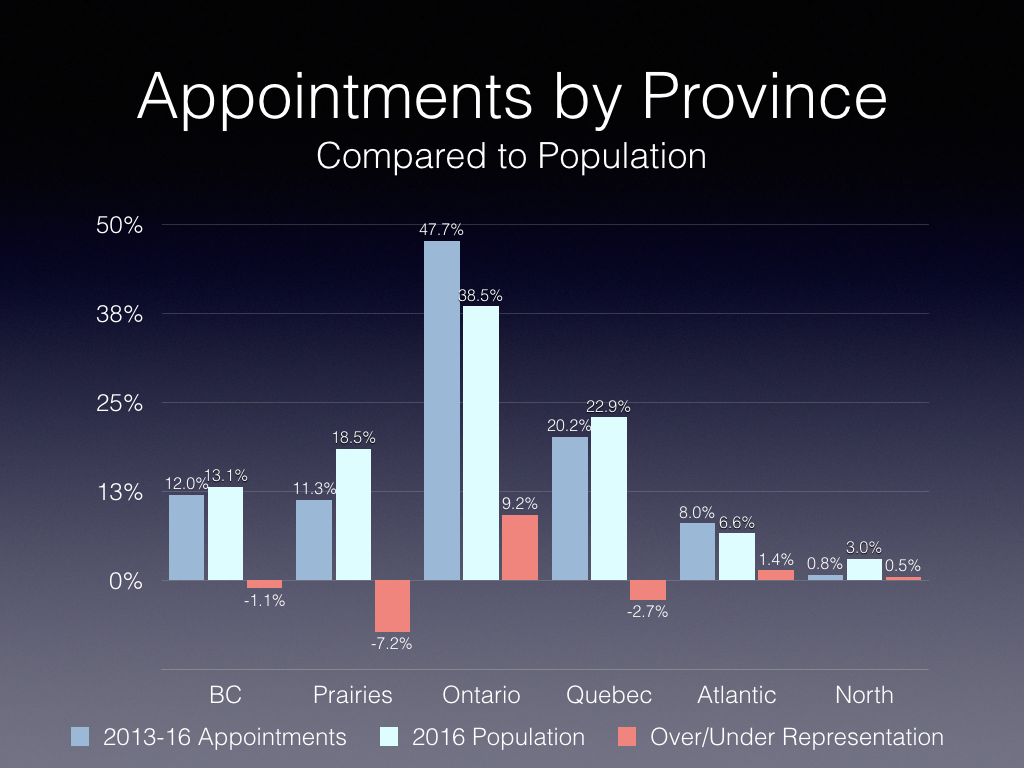
In Budget 2015, the then Conservative government announced additional funding of $13.4 million over five years and $2.8 million in ongoing funding for the Canadian Honours System. This aimed to “bring [honours] closer to all Canadians” by increasing the number of Order of Canada nominations from “under-represented sectors” (e.g. business) and regions (i.e. the West).

This was prompted by an Ottawa Citizen analysis that showed only 26 percent of recipients since the Order’s creation in 1967 came from the West, compared to the region’s 31 percent share of the population. In contrast, Atlantic Canada had 11 percent of recipients, about twice its share of the population. Moreover, the study showed an increasing percentage of awards had gone to those active in the arts while the share going to business people had declined.

Source: The Order of Canada and diversity (for complete article)

Senate proposes major amendment to Liberal citizenship legislation [C-6] : ‘It goes a long way’

As indicated during committee hearings, the amendment to restore procedural protections to those accused of fraud or misrepresentation was tabled in the Senate March 9:

The Liberal government’s update to immigration law is poised to be changed by the Senate after a major amendment was introduced Thursday.

Elaine McCoy, who acts as a “facilitator” for a de facto caucus of independent senators, tabled the amendment during debate over the third reading of Bill C-6.

If someone is served notice their citizenship is being revoked due to fraud or misrepresentation, the amendment requires the immigration minister to inform them of their right to appeal that decision in Federal Court.

Under Conservative legislation that took effect in May 2015 (referred to as Bill C-24), the process for citizenship revocation was significantly streamlined, and revocation notices have since ramped up significantly. The National Post reported last month that at least 236 people were served notice since the Liberals took power in November 2015.

Under the new process, people can submit written arguments as to why their citizenship should not be revoked, but there’s no clear option to have these arguments assessed by an independent judge.

It’s a loophole that many committee witnesses, in both the House of Commons and the Senate, argued should be fixed with the Liberal update. In the House, New Democrat MP Jenny Kwan attempted to move amendments but they were ruled out of scope at committee stage.

It’s in the Senate that proponents hoped to see the fix. Previous immigration minister John McCallum told senators he would “welcome” such an amendment, but new minister Ahmed Hussen said in Senate committee last week he would have to see the amendment before promising the government would commit to it — although “we are committed to procedural fairness.”

McCoy said the amendment is designed to give people “due process.” It puts decision-making back in the hands of the elected and accountable minister, she said, and allows the independent judiciary to review those decisions.

Drawing laughter from fellow senators, McCoy gave an example of how anonymous the revocation system has become. A revocation notice letter she obtained was signed with a citizenship analyst’s number rather than their name — “D 1816,” she said.

“This amendment is not going to fix everything, but it goes a long way,” McCoy said.

It’s been a “labour of many, many months,” the bill’s sponsor, Ratna Omidvar, added Thursday. The amendment is four pages long and determines exactly how the process would work — the “bare bones of due process,” Omidvar said, including a 60-day deadline for people to decide whether or not to take their appeal to court.

André Pratte, rose to support McCoy’s amendment. It addresses a “serious shortcoming,” he said, and will make the entire citizenship revocation process “much fairer.”

“Some will wonder why are we doing favours to people who have cheated the system. I would argue those are not favours, but fundamental human rights,” Pratte said.

Conservative senator Yonah Martin indicated Thursday she was concerned about the amendment being out of scope, and wondered why it wasn’t moved in committee. But McCoy said she was trying to be transparent by sharing the amendment with senators ahead of time and allowing it to be brought to the wider chamber.

Another Conservative senator, Daniel Lang, said he is concerned that some people could drag out the process over “years and years and years without any definitive decision being made.” Omidvar responded that court isn’t automatic. The amendment requires people to specifically ask for a court appeal in order for that appeal to be heard. Imposing a deadline on the court might not be possible, she added.

Debate was adjourned Thursday and the Senate now enters a two-week break, meaning votes on the amendment and the bill can’t happen until at least the week of March 28. If the Senate passes an amended version, the House of Commons will have to decide whether or not to accept the amendment before the bill can become law.

Source: Senate proposes major amendment to Liberal citizenship legislation: ‘It goes a long way’ | National Post

The text of the amendment can be found here: Motion in Amendment

Supreme Court judge [Justice Wagner] says Canadians shouldn’t worry about arrival of refugees, migrants 

Thoughtful and pertinent comments, particularly interesting his comments on identity:

Wagner said the notions of identity, human dignity and democratic values permeate the Charter and “lay the foundations for looking beyond our own borders.

“We can welcome refugees and migrants with the confidence that our society is able not only to manage our differences, but to thrive on them,” said Wagner.

Speaking to reporters later, Wagner acknowledged that, while his speech was delivered to a legal and academic audience, there was a message for Canadians concerned about the influx of refugees and migrants.

“We should, I think, welcome all those people and we should be willing to accommodate them and not change them,” he said.

“People should not be afraid of having migrants and refugees in their own countries. I think we’re strong enough and . . . we have strong moral values, and one of those values is the respect for human dignity. And, if we take our role seriously, we’ll look, we’ll adopt the perspective of the other, and it could only, I think, as far as I’m concerned, grow society much better in the future.”

Asked if that means there should be room for face veils and other individual expressions of religious identity, Wagner declined to answer, saying: “I don’t know if those cases will come before the court, so I don’t want to comment.”

Wagner holds one of the three high court seats reserved for Quebec. Quebec’s legislature is now studying a bill to require “religious neutrality” of those who deliver or receive public services, amid calls to ditch the bill in the wake of the slaying of six Muslims at a Quebec City mosque.

Wagner said judges have an “obligation” to try to understand the perspective of a person who says their equality rights are breached, but he added “that doesn’t mean that the claimant is right . . . that doesn’t mean that I would adopt his way, or his reasoning, or his opinion, or his end result.”

In his speech, Wagner admitted early approaches to how judges analyzed discrimination did not stand up to the task. He said Charter interpretation is still “a work in progress,” but, he added, over the past 150 years “the constitution has enabled us to navigate difficult questions of identity.

“Personal and group characteristics are the starting point of Charter equality jurisprudence, but identity is not about labels; it is a shorthand for how people see themselves, how others see them, and how those two things interact in people’s lives.”

Wagner said the Supreme Court looks to the context and experiences of a person claiming discrimination, and seeks to understand the person’s perspective, which is an especially important consideration in cases of aboriginal law or where there are overlapping characteristics of a person’s identity that influence how they experience discrimination.

Wagner said the experience of a woman who is part of a visible minority can be totally different from that of a young man who has the same characteristics. “If one of the two is not a citizen, or has a different sexual orientation, their experience could be even more different.”

“When the court eventually faces a question touching on trans-gender identity, these two propositions will provide essential frames of reference: that identity is not fixed, but changing, and that identity is not innate, but contextual,” he said.

Wagner predicted that, although the principle of “dignity” fell out of favour in judicial analyses of equality claims, it would find new traction in future Charter litigation. It is a crucial consideration when judges weigh whether a rights violation is reasonable and justified. “Equality infringements ought to be increasingly difficult to justify to the extent that it strikes at the heart of someone’s individual or group identity and, with it, their recognition as full participants in Canada’s ongoing democratic dialogue,” he said.

University of Ottawa law professor Errol Mendes said Wagner’s speech would please equality-seeking groups on the one hand, but he said Wagner also emphasized “democratic values” and “substantive” equality over any superficial concept of equality.

To Mendes, it was a signal from a judge who some suggest could one day become the chief justice of Canada, that the balance won’t always tip in favour of those who feel their rights are breached.

Helping Immigrant Students Catch Up, Fast — It Takes A Whole School : NPR

US example of how schools facilitate the integration process:

For many immigrant students, the trauma of crossing the border follows them into the classroom — affecting their performance and ability to learn. And that’s where Michelle’s school comes in.

At Langley Park, in Prince George’s County, Md., 87 percent of students are Spanish-speaking. Out of 176 students, 24 countries are represented and 15 languages are spoken at home, not including English.

The school started last fall. So far, the school sits in temporary buildings, but the kids don’t mind it too much — unless it’s raining.
Her school is part of a larger network across the country called Internationals Network For Public Schools. It serves English language learners, or ELLs, and recent immigrants.

For students like Michelle, the problem is two-fold: Not only are they dealing with trauma, but they also belong to one of the most marginalized student populations.

According to a recent Stanford study, the achievement gap between ELL-Hispanic and white students is the largest in the context of race and ethnicity. And, the average high school graduation rate of ELLs is 19 percentage points lower than the national rate, 63 percent compared to 82.

In 1985, the network opened its first school to address that long-standing disparity. Since then, it has grown to 27 schools in seven states, including Washington, D.C.

And, it seems to be working. Last year, ELLs who attended the network’s high schools in New York City graduated at a rate 16 percentage points higher than ELL students in the city’s public schools, the nation’s largest school district.

As for Langley Park, it hasn’t had a graduating class, yet — it opened last fall — but results so far look promising. In the first class of students, 98 percent showed improvement in their English language skills.

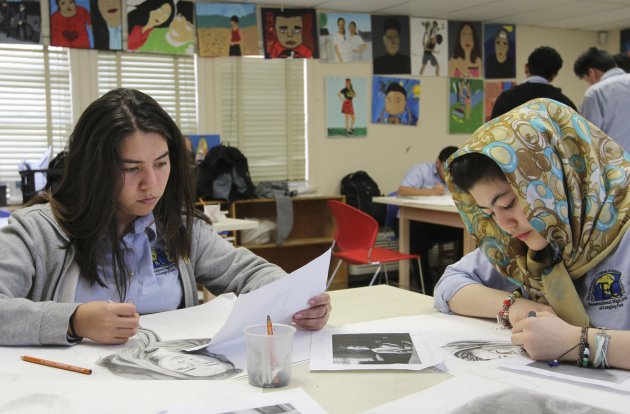
Two talented young artists — Stefany Novoa (left), 16, and Frishta Wassl, 14 — work on self-portraits in Christine Wilkin’s art class.

LA Johnson/NPR

How does the network do it when so many other schools struggle to educate ELLs? It seems to boil down to three simple things:

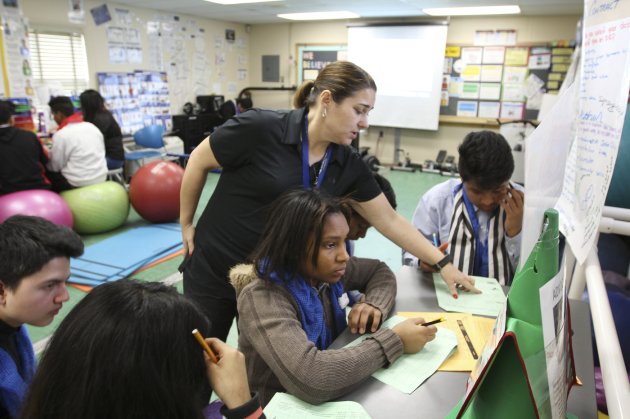
Every teacher is a language teacher. Tammy Tatro, who teaches technology, says implementing English-language instruction into her class curriculum is “really hard.” But she does it by repeating herself and using visual aids to get concepts across to students.

Second, one of the network’s vital principles is collaboration. That’s why the classes are a mix of students with varying English language skills.

“They all want to lift each other up,” Tatro says. “When one fails, especially if they’re working on a team project, then they all kind of fail. So, they have to help each other.”

A third key principle, Principal Carlos Beato says: the school’s partnerships.

Christine Gilliard, a phys ed teacher, used to teach at a large high school where she had “a two-story gym and two storage closets.” Now she teaches out of a trailer-sized temporary building. “We may not have the best of everything, but we have each other,” she says.

LA Johnson/NPR

CASA de Maryland, a Latino advocacy organization, is one of Langley Park’s partners. The organization offers legal advice for students and their families. Students can also take a social justice class from CASA to learn about advocacy and their rights, depending on their immigration status.

Partnerships like this are crucial, given the extra challenges many of these students face — homelessness, separation from their parents and, of course, the language barrier. Without tending to all of their social and emotional needs, Beato explains, “we wouldn’t be getting any of the academics done.”

Most of the network’s schools employ a full-time social worker. At Langley Park, that’s Lesly Lemus. Her job is to support students any way she can as they cope with life outside school, whether it’s connecting them to community resources or just listening.

Source: Helping Immigrant Students Catch Up, Fast — It Takes A Whole School : NPR Ed : NPR

ICYMI: 82 per cent of BC minorities have experienced racism, survey finds

Not surprising, and likely similar in other major centres. No gradation regarding the degree or seriousness of racism encountered. These regional studies, as useful as they are, suggest the need for a new Ethnic Diversity Survey (the last one was carried out in 2002):

As multicultural as Canada may be, it appears we are not immune to racism.

According to a new survey conducted in B.C., 82 per cent of visible minorities say they have experienced prejudice or some form of discrimination, while 56 per cent of all respondents reported having overheard racist comments.

Of those who identified themselves as visible minorities, 46 per cent said they believe they face social disadvantages because of their background, and 33 per cent said they have been a target of abuse. Another 29 per cent reported facing discrimination simply based on their name, while 10 per cent have dealt with disadvantages because of their religious beliefs.

And 11 per cent said their experiences with discrimination were traumatic enough to prompt thoughts of moving to a new location.

“The majority of British Columbians are welcoming and embrace multiculturalism. However, it’s clear that racism is alive and well in our communities and we need to call it out when we see it,” said Catherine Ludgate, a spokeswoman with Vancity. The report was commissioned by the credit union as part of its community investment efforts.

 Some 82 per cent of all those who responded said they felt multiculturalism has been “very good” or “good” for Canada, though three-quarters thought the population of immigrants should remain the same. Just over a quarter thought the population should increase.

…The numbers are from a new report released today, conducted in January by Insights West and is in anticipation of a community roundtable series to be launched by SUCCESS B.C., an immigrant assistance organization, and sponsored by Vancity.

Dates for the roundtable series have yet to be announced, but the series follows a forum on immigration hosted by SUCCESS in February.

Queenie Choo, CEO of SUCCESS BC. According to a new report conducted in B.C., 82 per cent of visible minorities have experienced prejudice or some form of discrimination, while 56 per cent of all respondents have overheard racist comments being made.“We didn’t want to host the forum and the forget about it,” said Queenie Choo, CEO of SUCCESS, who was quick to note that it’s important to continue discussing these issues lest history repeat itself.

Choo said the discussions would be a chance for immigrants to share their experiences with social groups and government, which in turn could help shape programs and policy. She also noted it’s important to ensure Canadians speak up for social justice in light of events taking place in the U.S.

“I truly believe that we (Canada and the U.S.) hold shared values of diversity and inclusion. If those are no longer our shared values, then there is a big question mark,” she said. “We need to make a stand. By not raising the issue and creating this opportunity (to discuss racism), it will signal to people that it’s acceptable.”

For every individual that joins Vancity between now and May 30 and sets up a pre-authorized payment or deposit, the credit union will donate $100 to the Vancity Humanitarian Fund to support refugee families. The donations are in addition to $100,000 already donated to the fund, part of which has already helped refugees settling in Victoria and Abbotsford.

Source: 82 per cent of BC minorities have experienced racism, survey finds | Vancouver Sun

How America’s Idea Of Illegal Immigration Doesn’t Always Match Reality : NPR

A very good analysis with sound data that provide context to US immigration debates and policies:

When you think of illegal immigration in the U.S., do you picture a border crosser or a visa overstayer? A family or a single person? A farmworker or a waiter?

People living in the U.S. without legal status are frequently invoked in American politics — especially in recent months. But the conversation is often short on facts about the millions of people who fall into this category.

There are, however, outdated beliefs: A Pew Research Center survey in 2015 found that very few Americans are aware of recent changes in immigration patterns.

Here’s a look at the actual statistics about people living in the U.S. illegally.

We should note that there are a few caveats about this data. Different research groups use different methodologies, and in some cases, they rely on estimates. We’ve included links to all our data sources so you can read about their methods in more detail.

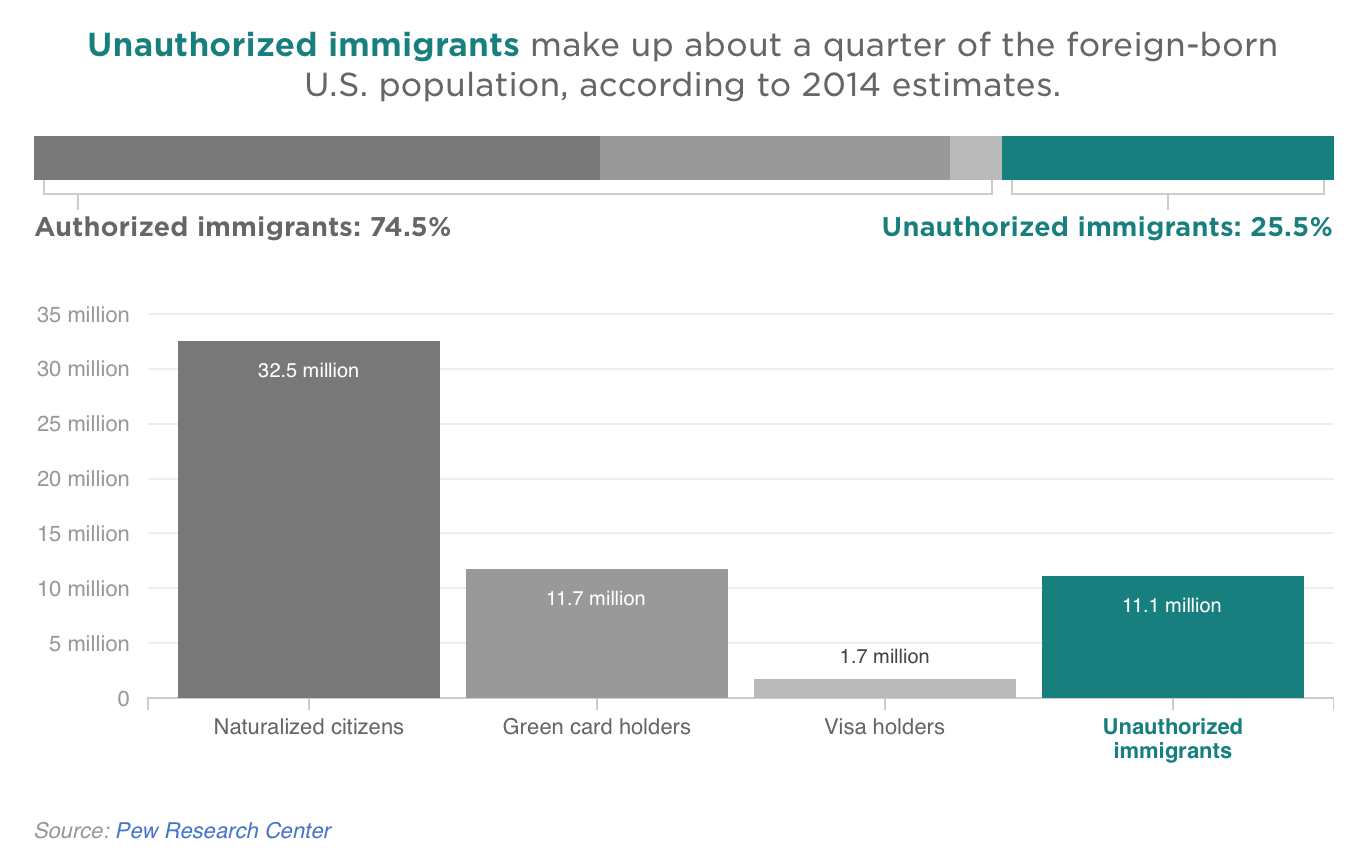
About 11 million people live in the U.S. without authorization

There are far more naturalized citizens than unauthorized immigrants in the U.S., and slightly more green card holders, according to the Pew Research Center.

The total number of people living in the country illegally — about 11 million — has made headlines recently, because immigration advocates suggest that under the Trump administration’s immigration enforcement policies, almost all of them could be targeted for deportation. (More than 700,000 “DREAMers” — immigrants who were brought into the U.S. illegally or overstayed their visas as children — are still temporarily protected from deportation through the Deferred Action for Childhood Arrivals, or DACA, program.)

Longtime residents outnumber new arrivals

A large majority of those people currently living in the U.S. illegally have been here for a decade or longer, which is a major shift from the situation at the turn of the millennium.

About two-thirds of unauthorized immigrants have lived in the U.S. for 10 years or more, Pew says. Only 14 percent arrived within the past five years.

In the late 1990s, the number of new arrivals was far higher, and the share of longtime residents far lower.

Mexicans make up a dominant — but declining — share of this population

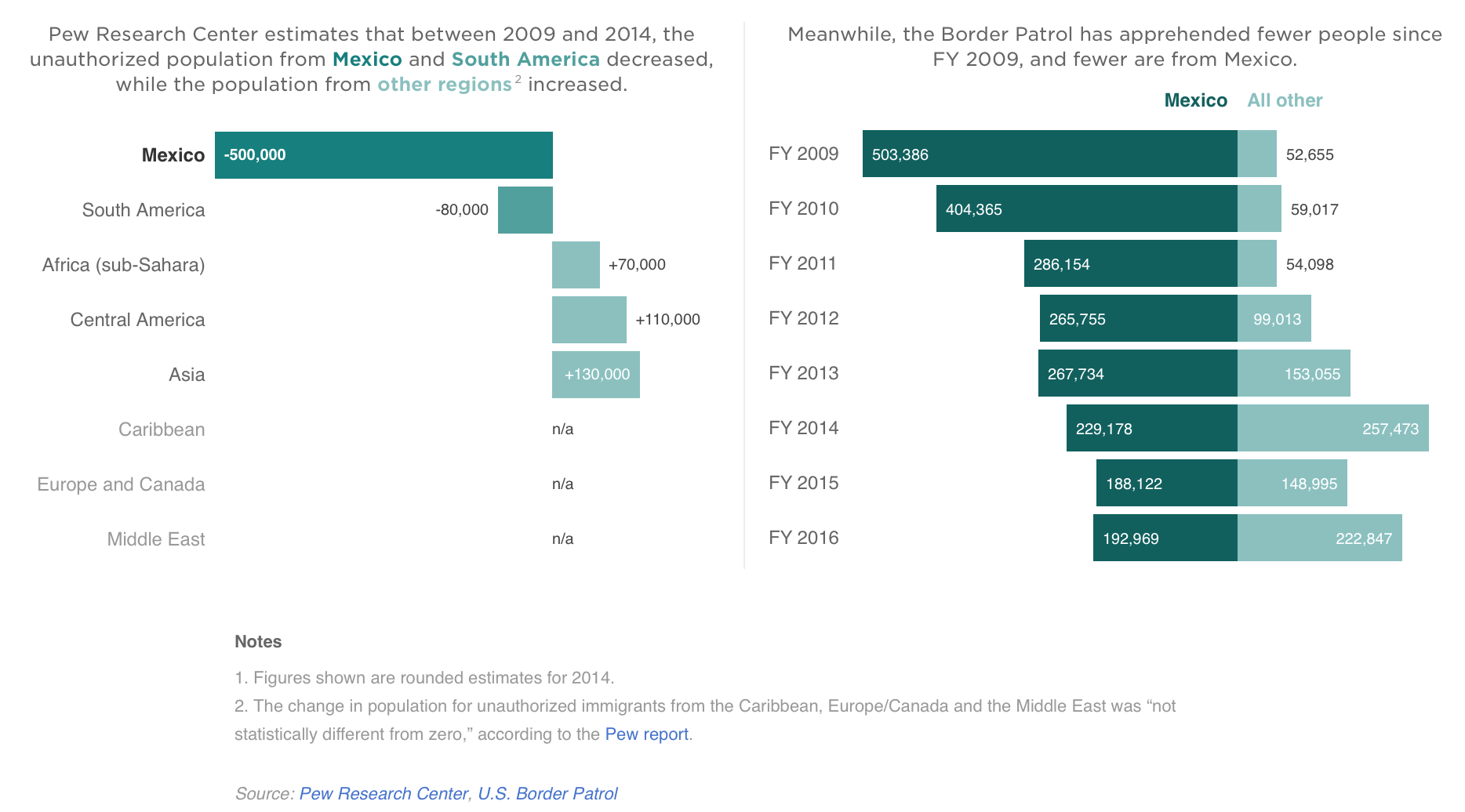
Mexico is “the leading nation of origin for U.S. unauthorized immigrants,” Pew writes, but the share of immigrants from Mexico is also declining.

That is to say, Mexican immigrants are a shrinking majority of the population living in the country through illegal immigration.

Of people living in the U.S. illegally, more than half are from Mexico. The population from that one country far outnumbers the population from entire continents. But there are fewer people of Mexican origin living in the U.S. now than there were a decade ago.

You can see the trend lines clearly if you look just at people arriving in the U.S. illegally, instead of the millions who live here. The percentage arriving from Mexico has dropped markedly, while more immigrants are coming from Africa, Central America and Asia.

The reasons for the shifting immigration patterns are complex. For Central American immigrants, conflicts in their home countries certainly play a role. The Migration Policy Institute suggests that there might be similar reasons for increased migration from Asia and Africa.

Source: How America’s Idea Of Illegal Immigration Doesn’t Always Match Reality : The Two-Way : NPR

Ottawa’s gender-based analysis was predestined to fail : Lynda Gullason

Hard hitting assessment (less of an issue with respect to employment equity in the public service, where regular tracking and data indicate overall progress, and more of an issue with policy and program design, where GBA – and broader diversity analysis – is rarely practiced):

But the gender-based analysis initiative is predestined – perhaps even predesigned – to fail.

Intended to assess the potential gender-specific impacts of policies, programs, legislation and services on women and men, its critical shortcomings severely limit its utility.

To start, there are no mandatory requirements for federal departments and agencies to conduct such analysis. Only 30 out of 110 departments are even signed on to the gender-based analysis action plan – 22 years after it was initially adopted.

There is no monitoring or evaluation or reporting of the implementation and outcomes by Status of Women Canada or by the departments and agencies themselves, although SWC was required to do so after the 2009 audit.

In fact, Status of Women Canada has no authority to enforce the application of gender-based analysis and there are no consequences for departments and agencies which do not conduct it.

There is no measurement of gender equity: no data collection to analyze and correct unfair practices and policies; no baselines or targets and no performance indicators to track progress.

Departments conducting gender-based analyses are required to, but do not, propose measures to address gender inequities. The Canadian Armed Forces, for example, which has set an employment target for women of 25 per cent, has developed no employment equity strategy to achieve that target, and its actual number remains unchanged at 14 per cent.

And so it follows, there are no consequences for departments and agencies which fail to ensure gender equity.

Auditor-General Michael Ferguson has expressed frustration with the federal government’s inability to address gender discrimination, which persists despite decades of audits. Fully half of the gender-based analyses conducted by the audited departments in his 2015 report were incomplete. Yet for the incomplete analyses, these departments “nevertheless concluded” that there were no gender-specific impacts, “and they provided these conclusions to decision-makers.” This is serious: because the conclusions were not supported by evidence, there is the question of “whether Cabinet had been adequately informed about existing and potential gender considerations.”

In response, Status of Women Canada has plans to “explore the development of gender equality indicators,” according to its statement to the Standing Committee on Status of Women last spring. “This is work that is just beginning in terms of how we are going to define success and how we are going to attract progress as we continue to monitor and report,” says Meena Ballantyne, the head of the agency, in her 2016 presentation to the Public Accounts Committee. Except that the agency neither monitors nor reports, and the work should not be “just beginning” some 20 years after the principle of gender-based analysis was first accepted.

When asked at a Status of Women committee meeting how gender-based analysis is measured and how we know whether it is actually implemented, the response of the agency’s gender-based analysis manager, Vaughn Charlton, was, astonishingly, “That is the million-dollar question.” Status of Women Canada, she said in a written reply to the same questions, “simply does not collect this type of information.”

Moreover, the agency’s plan to develop an evaluation strategy will actually measure and report on the agency’s progress in implementing gender-based analysis, rather than the progress made in correcting gender discrimination. And that evaluation of its own performance won’t even be completed until 2020, 25 years after such analysis was introduced.

The fundamental goal of gender-based analysis must actually be gender equity. And that is only achieved when discriminatory policies and practices are corrected.

Thirty-four years after Justice Rosalie Abella wrote in her 1984 Report of the Commission on Equality in Employment that, “Equality in employment will not happen unless we make it happen”; 22 years after gender-based analysis was first adopted by the Canadian government; eight years after the previous negative audit, and 18 months after the most recent one, there is, as the Auditor-General notes in his 2016 Fall Reports “no mandatory requirement subjecting policy, legislation and program decisions to gender-based analysis.”

A more ill-conceived approach to correcting gender discrimination is hard to imagine. No analysis, no monitoring, no evaluation, no enforcement, and no consequences: no surprise, really, that gender inequity will continue under the federal government’s gender-based analysis implementation plan.
Source: Ottawa’s gender-based analysis was predestined to fail – The Globe and Mail

ICYMI: We’re giving our babies distinctly Canadian names and impact of diversity

Another measure of increased diversity is the presence of ethnic names (end of excerpt):

Every year, another snooze-worthy report is published of the country’s most popular baby names—for the past decade, a sea of Emmas, Bens, Liams and Sophias. But this year, to further distinguish ourselves from our American neighbours perhaps, the creative brains at Canadian data journalism site the 10 and 3 (their mission: “to tell compelling and unusual stories about Canada through maps, interactive charts and other interesting visualizations”) decided to look past the Ethans and Isabellas and crunch some distinctly Canadian numbers.

What exactly makes a name more Canadian? “Firstly, it has to be relatively popular in Canada,” explains Arik Motskin, data scientist and founder of the10and3.com, “but more importantly, it has to be much more popular than however popular it was in the United States.” Take the name “Brody:” in 1990, 0.1% of Canadian baby boys were given it, compared to 0.01% of American babies, giving Brody a “Canadian Factor”—as the site calls it—of 10. “That means you’re ten times as likely to meet a Brody in Calgary than you are in Kansas City,” says Motskin. And now with a handy new mode of measurement, plus a century’s worth of data to explore, here are a few things the Canadian Factor has taught us.

Surprise! We love hockey players

A modern-day name with a top Canadian Factor is Linden, who scored a 20 and currently sits atop the scale, for former Vancouver Canucks hockey star (and current exec) Trevor Linden. “There are other hockey names, like Duncan and Darcy, but the Linden thing came out of nowhere for us,” says Motskin. Fittingly, it’s not only Trevor’s Linden’s prodigious sports skills that made his name, but also that he’s so well loved in Vancouver for being a nice guy (how Canadian is that?).

Sorry Pierre and Jean-Paul, name stats are an imperfect science

Name data, though it might seem straightforward enough, is actually notoriously difficult to find. “In Canada, name statistics are [kept] at the provincial level, but beyond the top 10, most provinces don’t provide more details—both for privacy reasons and because they just don’t have the manpower.” The 10 and 3 mostly lucked out across the country, but no dice in Quebec, which presented two problems: “We weren’t able to get data from Quebec, but even if we did, we’d have to crunch the numbers differently,” says Motskin. When French Canadian names showed nation-wide popularity, their Canadian Factor automatically spiked off the scale—like Josée in 1970s with a massive top score of 634. “Maybe French names should be compared to France,” says Motskin.

So long, stereotypes

Co-authored by Zack Gallinger and Neil Oman, Motskin’s piece is titled “Gord, Sheila, Graham and Beverley? The Most Distinctively Canadian Names Are Not What You’d Expect.” While Gordon makes a lot of sense—Downie, Howe, Lightfoot come right to mind—the others are, admittedly, inventions of the authors to make a point. “Everyone has their stereotypes, and these were just ours,” says Motskin. While some stereotypically Canadian-sounding names (looking at you, Nate and Duncan) definitely appear on each decade’s Top 10 list, names like Mohammad and Syed, with a Canadian Factor of 8.7 and 10.3 respectively, measure up equally Canadian.

…Of all Motskin’s number- and name-crunching, the most fascinating was abrupt cultural changes that arrived in distinct waves. The 1930s and 40s saw distinctly Anglo-Saxon monikers like Archibald and Angus for men, Catherine and Doreen for women, he notes, but “by the mid 20th century, suddenly there were a lot of Italian names like Giuseppe and Antonietta.” Immigrants often name their children traditional names, who in turn grow up more assimilated in Canada and look right back to the top 10. “I suspect in 20 years, those kids will have a lot of Emmas and Liams—or whatever’s popular then.”

Source: We’re giving our babies distinctly Canadian names – Macleans.ca

2016 Refugee Claim Data and IRB Member Recognition Rates | Canadian Council for Refugees

This is really an impressive analysis  suggesting (no surprise) that individual decision-makers are not as objective and consistent as desired (as Kahneman and others have demonstrated in different contexts). All Canadian government tribunals should conduct this kind of analysis to improve consistency in decision making:

The following note and the accompanying data are provided by Sean Rehaag, Associate Professor, Osgoode Hall Law School.

8 March 2017

Data obtained from the Immigration and Refugee Board (IRB) through an Access to Information Request reveals vast disparities in refugee claim recognition rates across decision-makers in 2016. This is consistent with similar findings from prior years for Canada’s previous and new refugee determination systems.

Refugee claims referred to the IRB after 15 December 2012 are subject to the new system, whereas claims referred to the IRB prior to that date are legacy cases that are decided under the old system. Legacy and new system cases are not only decided under different rules, but are also decided by different cohorts of decision-makers. Because of these important differences, the data on RPD decision-making for 2016 is separated into legacy cases and new system cases.

In 2016, some Refugee Protection Division (RPD) decision-makers granted refugee status in most of the cases they heard, including R. Tiwari (95.9%, 74 new system cases), I. Singh (92.5%, 53 new system cases) and K. Genjaga (91.8%, 85 new system cases). Others granted refugee protection much less frequently, including B. Lloyd (23.8%, 63 new system cases), R. Gibson (26.0%, 77 new system cases) and M. Beatty (29.8%, 57 new system cases).

Some of the recognition rate variation may be due to specialization in particular types of cases. For example, some decision-makers specialize in geographic regions with especially high or low refugee claim recognition rates. For further possible explanations for variations in recognition rates, please see an IRB explanatory note, which was provided with a response to an earlier Access to Information Request: http://ccrweb.ca/files/7.irb_explanatory_note-2012.pdf

Although some of the recognition rate variation can be explained by factors related to specialization, the tables below suggest that country of origin specialization alone fails to fully account for the variations. The tables show substantial variance for some decision-makers between the recognition rates that would be predicted based on the average recognition rates for the countries of origins in the cases they decided, and their actual recognition rates. For instance, in new system cases B. Lloyd (predicted 57.4%; actual 23.8%), R. Gibson (predicted 53.9%; actual 26.0%) and J. Daubney (predicted 59.7%; actual 32.3%) had much lower recognition rates than predicted, whereas R. Tiwari (predicted 62.6%, actual 95.9%), J. Eberhard (predicted 56.5%; actual 87.4%) and J. Bousfield (predicted 63.6%; actual: 89.3%) had much higher recognition rates than predicted.

This year’s data also includes information about outcomes on appeals at the IRB’s Refugee Appeal Division (RAD). As with RPD decision-making, outcomes at the RAD appear to vary greatly depending on who serves as the decision-maker. For example, in RAD cases decided on the merits, claimants were much more likely to succeed in their appeals before S.S. Kular (56.5%, 46 cases), R. Dhir (50.5%, 32 cases) or L.F. Agostinho (46.6%, 58 cases) than before L. Favreau (5.3%, 94 cases), Stephen Gallagher (17.1%, 35 cases) or D.E. Sokolyk (20.6%, 63 cases). Remarkably, claimants were more than 10 times as likely to succeed on appeals with S.S. Kular than with L. Favreau.

A few implications of this year’s data are worth highlighting:

  • Some countries that are designated as “safe” in Canada’s refugee determination system produced many positive refugee determinations in 2016. Consider for example, Hungary, which had a 66.9% recognition rate, and which produced 184 successful refugee decisions (involving 529 individual claimants) in the new system in 2016. It is difficult to understand how such countries can reasonably be designated as “safe” or what could justify limitations on procedural rights (e.g. expedited processes, limitations on pre-removal risk assessments) that come with such designations. For further analysis, see: http://ssrn.com/abstract=2588058
  • The persistence of unexplained variations in recognition rates across adjudicators in the new refugee determination system, combined with the devastating potential impact of false negative refugee decisions (i.e. refugees being returned to face persecution), make robust oversight mechanisms essential. Unfortunately, many refugee claimants continue to be denied access to the appeal at the Immigration and Refugee Board and are ineligible for automatic stays on removal pending judicial review at the Federal Court. This includes large numbers of claimants who transited to Canada via the United States – even though one’s route to Canada has little to do with whether one has a well-founded fear of persecution. For further analysis, see: http://ssrn.com/abstract=2647638
  • While substantial variation in recognition rates persist, it should be noted that no new system decision-makers in 2016 who made 20 or more decisions denied every single claim they heard. This is in contrast to the old refugee determination system (S. Roy in 2013: 0.0%, 23 decisions; D. McSweeney in 2011: 0.0%, 127 decisions; D. McBean in 2010: 0.0%, 62 decisions; D. McBean in 2009: 0.0%, 72 decisions). It is worth considering whether this change relates to the professionalization of refugee decision-making and the shift to civil servant decision-makers (rather than political appointees as was the case under the old system).
  • The overall success rates on RAD appeals are remarkably high. Indeed, appeals brought by claimants and decided on the merits were granted in almost one third of cases (33.1%). On the one hand, the fact that the RAD is correcting large numbers of claims that were wrongly denied at the RPD emphasizes the importance of this form of oversight. On the other hand, however, it also suggests that there is room for improvement in initial decision-making at the RPD.

For a discussion of the methodology used to obtain the data and to calculate the statistics, as well as an analysis of the implications of similar data for a previous year, see Sean Rehaag, “Troubling Patterns in Canadian Refugee Adjudication” (2008) 39 Ottawa Law Review 335. This article is available via links here: http://ssrn.com/author=404046

Source: 2016 Refugee Claim Data and IRB Member Recognition Rates | Canadian Council for Refugees

Canadians abroad have a right to vote too: Frank and O’Brien

The reply to Rob Vineberg and my earlier article (Canadian expats shouldn’t have unlimited voting rights – Bill C-33 critique). As behind paywall, sharing full draft.

Weak on numbers, just relying on APF overall numbers (which include children and permanent residents) and not acknowledging the range of government data available that captures to a greater extent the degree of connection (summarized in our article).

And their reference to s.3 of the Charter avoids the key question: can s. 1 “reasonable limitations” be invoked to restrict voting of non-resident Canadians to some extent. The Ontario Court of Appeal ruled that restrictions can be justified and the appeal to the Supreme Court was suspended pending C-33.

Our brief to the House committee will counter these arguments, as well as being data rich, unlike Frank and O’Brien who skirt the numbers and connection issue:

By GILLIAN FRANK, SHAUN O’BRIEN

PUBLISHED : Wednesday, March 8, 2017 12:00 AM

Bill C-33 recognizes the right to vote of Canadians living outside the country by removing the arbitrary limit for those abroad five years or more.

Contrary to the views in the recent Hill Times article “Canadian expats shouldn’t have unlimited voting rights,” by Andrew Griffith and Robert Vineberg, Canadians should view our citizens abroad as assets and ambassadors for our country, whose charter-enshrined right to vote must be protected.

The connections of and commitments to Canada of citizens living abroad should not be understated. In examining the right to vote of Canadians abroad, advocates have not used “a general estimate of over one million expatriates, without any assessment of the degree of connection that expatriates have with Canada.”

Rather, we have relied on comprehensive research by an independent think-tank (the Asia Pacific Foundation), which found that at the time of study, there were approximately 2.8 million Canadians abroad, the size of an average Canadian province. Approximately half of these Canadians have been abroad for five years or more and are of voting age, though some were not prohibited from voting by the five-year rule because of a number of exceptions to the prohibition.

Still, well over a million Canadians were prohibited from voting. There is no dispute that not all Canadians abroad will take up the right to vote. The evidence, though, is that many Canadians abroad have strong ties to and care deeply about Canada. Of Canadians abroad surveyed by the Asia Pacific Foundation, two-thirds had left Canada for work-related reasons, 94 per cent had visited Canada since moving abroad and 69 per cent planned to return to Canada in the near future. More than 60 per cent identified more closely with Canada than with their country of residence. Most were born in Canada and solely Canadian citizens. They currently have no right to vote anywhere.

Many non-residents pay taxes to Canada, including property taxes, taxes on Canadian source investment income and taxes on their pensions, among others. In 2009, non-resident individuals paid almost $900-million in taxes to Canada. That said, Canada long ago discarded the exclusionary notion of tying voting to property or wealth.

It also is not correct to say that Canadian citizens living abroad are not subject to or affected by Canadian laws. As a starting point, their very right to be abroad, on their Canadian passport, and their ability to obtain employment in another country, is based on Canadian laws and multilateral agreements (e.g. NAFTA). They are further affected by laws governing family members living in Canada. Importantly for the many who intend to return in the near future, they are affected by the short- and long-term direction the country is taking.

What is missing from an analysis that lays out a host of options for deciding which Canadians will be allowed to vote (those abroad for the first 10 years, those with a minimum residency requirement of three years or 25 years) is the critical point: the right to vote is not a matter of policy and it is not subject to popular sentiment. Rather, the right to vote is a fundamental democratic right enshrined in our Charter of Rights and Freedoms. Our charter guarantees that, “every citizen of Canada has the right to vote in an election of members of the House of Commons….” The right to vote is the cornerstone of our democracy and cannot be taken away at the whim of Parliament.

When Parliament tried to limit the right to vote for prisoners, the Supreme Court of Canada struck down the limits as breaching the charter right. If we protect the right to vote of individuals convicted of the most heinous crimes, why would we disenfranchise citizens who are passionate about Canada, many of whom are abroad for employment reasons and intend to return? If Canadians abroad make the effort to vote from abroad, they care deeply about this country. These are Canadians we should embrace, not reject.

There is simply no air of reality to Griffith and Vineberg’s unsupported claim that restoring voting rights to Canadians abroad can or will devalue the voting rights for resident Canadians. When it comes to the sacred voting rights of all Canadians, alarmist policy proposals, which are little more than flawed solutions chasing imaginary problems, do not deserve serious consideration.

Bill C-33 should pass in its current form. It is drafted to recognize the right to vote of all Canadian citizens. Indeed, the government should take a further step and discontinue its opposition to the legal challenge to the five-year prohibition. Canadians abroad are entitled to a legal acknowledgment that all Canadian citizens are guaranteed the right to vote and are not at the mercy of each new government’s legislative choices.

Source: Canadians abroad have a right to vote too – The Hill Times – The Hill Times