Why are so many Hungarians deported? A look at Canada’s ‘Unwelcome Index’ 

The Globe continues to impress me with some of its serious evidence-based reporting (e.g., unfounded sexual assault cases by police department) with this being another good example of reporting by obtaining and analyzing data and explaining what it means:

The U.S. government’s determined efforts to restrict immigration and the number of refugees entering the country has invited comparisons with Canada, heralded by some (including The Economist) as a last bastion of openness among Western countries. But Canada has its own apparatus for ejecting the unwelcome; the Canada Border Services Agency is charged with removing people who don’t meet entry requirements.

To understand who Canada deports, and why, The Globe and Mail requested data from CBSA showing total removals by year, broken out by citizenship, the destination to which the person was sent and justifications for these removals. The data shows Canada removed Hungarian citizens in disproportionate numbers over the past few years. The story of those thousands of unwelcome people contrasts with international perceptions of Canada’s warm embrace of foreigners.


The unwelcome

The CBSA ejects thousands of people annually. However, the data doesn’t reveal much about why those people were removed: By far the most common official justification was “non-compliance,” a sweeping category. Fewer than 10 per cent of removals cited criminality, the second most common justification.

A clearer picture emerges when one examines the citizenship of removed persons: Hungarians topped the removals list during the five-year period from 2012 to 2016.

It is perhaps unsurprising to discover large numbers of Americans and Chinese on the list: Both countries rank among the world’s most populous, and the United States and Canada share the world’s longest border between two countries. Mexico has been a major source of immigrants, and also refugee claimants: The government of prime minister Stephen Harper responded in the late 2000s by imposing new visa requirements on Mexican visitors; removals surged.

Hungary is less populous than those countries, and distant to boot. What gives?

Hungary stands out even more when one compares numbers of removals with numbers of people of the same citizenship accepted as permanent residents. The result is a crude sort of “Unwelcome Index.” Between 2011 and 2015, more than three removal orders were issued for every Hungarian granted permanent-resident status.


Backstory of an exodus

Most Hungarians removed during this period were Roma, explained Sean Rehaag, an associate professor at Osgoode Hall Law School in Toronto who specializes in immigration law. Studying a random sample of 96 decisions of the Immigration and Refugee Board between 2008 and 2012 involving Hungarian claimants, Mr. Rehaag and his colleagues found 85 per cent involved Roma.

Roma comprise Hungary’s largest ethnic minority. There, they encounter “discrimination and exclusion on a regular basis” concerning education, employment, housing, health and much else, according to a 2014 report by Harvard University’s François-Xavier Bagnoud Center for Health and Human Rights. The late 2000s witnessed the rise of right-wing political parties and paramilitaries, accompanied by increasing rhetoric, rallies and attacks directed at Roma. Many Roma sought asylum abroad; thousands arrived in Canada after it lifted visa requirements on Hungarians in 2008.

Gina Csanyi-Robah, a teacher and human-rights activist with Hungarian Roma roots met many applicants in her capacity as executive director of the Roma Community Centre in Toronto, and also at Toronto schools. They fled Hungary because they were “scared that their home was going to be burned down,” Ms. Csanyi-Robah said. “Tired of their children getting beaten up at school and put into segregated classes. Tired of being subjected to verbal, psychological, physical violence when they left their homes.”
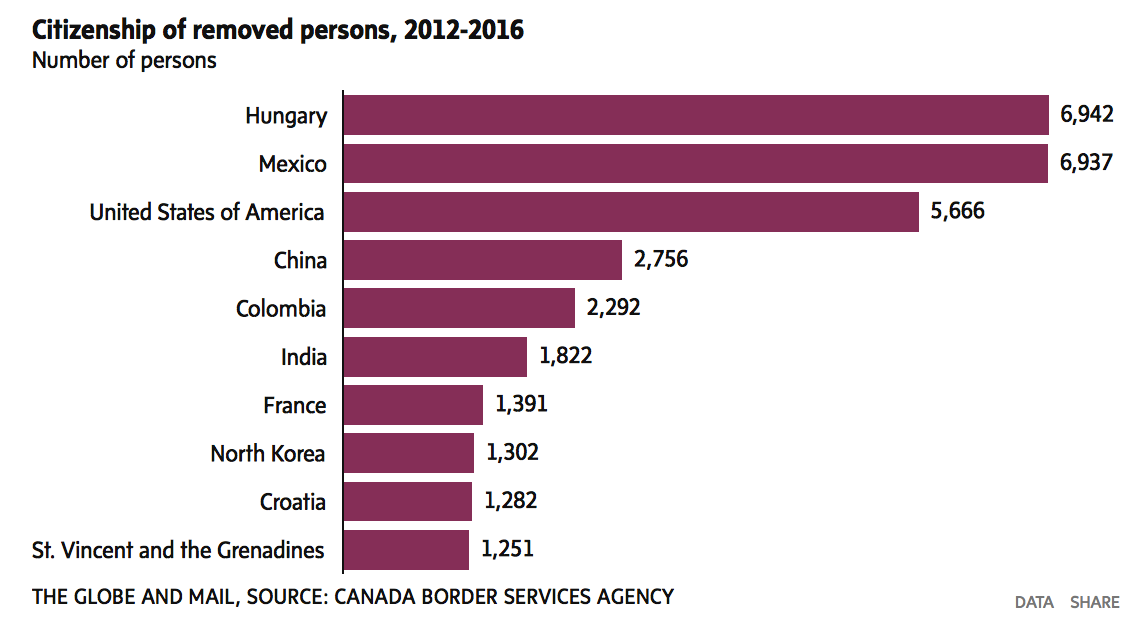
 Source: Why are so many Hungarians deported? A look at Canada’s ‘Unwelcome Index’ – The Globe and Mail

Add women, change budgets? Underused gender policy tool finds new fans in Trudeau’s cabinet

In contrast to the bleak assessment posted earlier (Ottawa’s gender-based analysis was predestined to fail : Lynda Gullason), there does appear to be some progress on GBA (requirement in MCs and TB submissions).

This not only sends a key signal but equally important requires background analysis in order to be mentioned in cabinet documents. We will only know how effective this requirement has been following the next OAG audit:

There’s a T-shirt for sale on the Liberal Party’s website that features the slogan “Add women… change politics.”

You can’t say self-described “feminist” Justin Trudeau isn’t trying.

First, he picked a half-female cabinet. Four of the five Liberal candidates in the by-elections now underway are women — including those in three ridings Liberals won in 2015 and look to win again.

But changing politics — or its politicians — is one thing. Changing policy is another.

That’s one of the reasons March 22’s federal budget will be worth watching.

The finance department will include something that’s never been offered before: a gender-based analysis for budget measures.

It’s the latest way Liberals are trying to walk the talk they campaigned on in the last election.

“We will consider the gender impacts of the decisions we make,” the Liberal platform promised. “Public policies affect women and men in different ways.”

Finance Minister Bill Morneau’s fall economic statement promised “more rigorous analysis” to “deliver real and meaningful change.”

But what does that mean?

Social Development Minister Jean-Yves Duclos offered reporters a preview last Friday. One of highest-profile things his government introduced so far is a good example of more gender-sensitive policy, he said.

The Canada Child Benefit (CCB) is helping lift about 200,000 parents out of poverty, and about 70 per cent of those are mothers, he said.

“Almost half of the children that are being lifted out of poverty because of the CCB are in single-parent families. And 90 per cent of these single-parent families are headed by women,” the minister said.

Not just about women

Trudeau’s team didn’t invent gender-based analysis.

Canada made a commitment at the 1995 United Nations conference on women to “ensure that before policy decisions are taken, an analysis of their impact on women and men, respectively, is carried out.”

But progress in the 22 years since has been slow.

The auditor general has scolded the government twice for its tepid embrace of gender analysis, most recently after an audit completed in the final year of the former Conservative government.

Among over 100 federal departments and agencies, only 30 had committed to it by early 2015, and six of those hadn’t fully implemented it.

Four departments that were doing gender analyses were examined by the auditor general, who in 2015 found incomplete work that lacked enough evidence for decision-makers.

The Liberal platform promised to do better. “We will also ensure that federal departments are conducting the gender-based impact analyses that have been required of them for the past 20 years,” it said.

It’s not only about advocating for women. Status of Women Canada says the government’s current requirements go beyond gender-based analysis: analyzing not just gender, but also age, education, language, geography, culture and income to find ways some aren’t equal to others.

“Have you or someone you know taken parental leave, been treated for heart disease or recently immigrated to Canada?” its website says, offering examples of policy shaped by studying inequalities.

Equality equals economic growth?

Officials admit things aren’t fully in place across every department this spring. But starting from the top and trickling down, it’s clear this way of thinking is the new intended normal.

The privy council office is asking for gender analysis when policy proposals are prepared for cabinet.

Duclos said gender parity among ministers making those decisions has already had “tremendous value.”

“It’s been extremely satisfying to see both the level of actions and the attitudes, how that changes,” he said.

Asked for examples of policy from his shop now shaped by gender analysis, Duclos names two areas: housing and child care.

The budget will offer more details, he said, following recent work with the provinces.

Duclos, an economist before entering politics, is on a pre-budget tour this week, putting down markers for how Morneau’s budget will promote economic growth.

He laid out three things Liberals are focusing on — innovation, public and private capital, and labour, or human capital.

Making it easier to start or return to work — offering training or child care, for example — improves labour force participation rates and in turn, overall productivity. And more people working improves economic growth.

“We’re sensitive to both economic inclusion and social inclusion,” he said. “It involves all characteristics beyond income that make it difficult sometimes for Canadians to feel included in our society. And gender is one.”

Spending proposals submitted to the Treasury Board now must include proof that gender was considered.

A form available online that civil servants use for Treasury Board submissions asks for evidence and data sources, as well as a plan for monitoring what happens after a program starts.

That fits with the Trudeau government’s affection for “deliverology” — measuring results, not just the initial splash of an announcement.

Widespread compliance with bureaucratic processes isn’t the end goal. Equal opportunities are.

Source: Add women, change budgets? Underused gender policy tool finds new fans in Trudeau’s cabinet – Politics – CBC News

Starbucks faces backlash over CEO’s vow to hire thousands of refugees

Not necessarily surprising but not clear whether those more opposed to the hiring of refugees were regular Starbucks customers (the “latte sipping elites” as some would portray them) or the broader population:

Starbucks Corp.’s vow to hire thousands of refugees after President Donald Trump’s first executive order that temporarily banned travel from seven mostly-Muslim nations appears to be hurting customer sentiment of the coffee chain.

Trump supporters have used Twitter, Facebook and other social media sites to call for a boycott since Jan. 29, when Starbucks chief executive Howard Schultz vowed to hire 10,000 refugees over five years in the countries where it does business.

Schultz in a letter to employees said the promise of the American Dream was “being called into question” and that “the civility and human rights we have all taken for granted for so long are under attack.”

YouGov BrandIndex, which tracks consumers’ sentiment toward companies and their willingness to purchase from those brands, noted that the data around this boycott is different because both measures are declining.

Starbucks’ consumer perception levels took an immediate hit as measured by YouGov BrandIndex’s Buzz score, falling by two-thirds between Jan. 29 and Feb. 13, and have not recovered.

Starbucks Buzz score fell to four from 12 during that time. Such scores can range from 100 to -100 and are compiled by subtracting negative feedback from positive. A zero score means equal positive and negative feedback.

Immediate drop

Prior to Schultz’s refugee comments, 30 per cent of consumers said they would consider buying from Starbucks the next time they made a coffee purchase, that fell to a low of 24 per cent and now stands at 26 per cent, according to a YouGov spokesman.

“Consumer perception dropped almost immediately,” said YouGov BrandIndex CEO Ted Marzilli, who added that the statistically significant drop in purchase consideration data showed that consumers became less keen to buy from Starbucks.

“That would indicate the announcement has had a negative impact on Starbucks, and might indicate a negative impact on sales in the near term,” he said.

Marzilli noted that the Starbucks holiday “red cup” controversy from November 2015 corresponded with an even larger drop in perception, but no real impact on purchase consideration scores.

Support for rival urged

Among other things, boycott supporters are urging like-minded friends to support Starbucks rival Dunkin’ Donuts . Representatives from Starbucks and Dunkin’ Donuts declined to comment on the surveys and the boycott’s impact on sales.

Source: Starbucks faces backlash over CEO’s vow to hire thousands of refugees – Business – CBC News

ICYMI: Government called ‘heartless’ for deporting 59-year-old bipolar man who came to Canada as baby

It is. Doesn’t acknowledge that Canada is responsible for him, not the Netherlands:

Immigration Minister Ahmed Hussen is facing calls to reverse the deportation of a 59-year-old man with bipolar disorder who lived in Canada since he was eight months old.

Len Van Heest of Courtenay, B.C., was deported to the Netherlands this week after a string of criminal convictions for uttering threats, mischief and assault that his lawyer says were linked to his mental illness.

His brother Daniel Van Heest expressed his anger at judges and immigration officials who allowed the deportation to happen. He said his brother is now in the care of family in the Netherlands with the help of the Salvation Army.

“Needless to say his mental faculties have been stressed to the max,” he said. “The system is skewed. Mentally ill people should never be deported. It is wrong.”

Lawyer Peter Golden said Van Heest’s parents didn’t seek citizenship for him. The last time he was in the Netherlands he was in diapers, he doesn’t speak Dutch and doesn’t know his relatives there.

“However kind and well-meaning they are, the stresses of this whole process of removal will be difficult for him. He hasn’t made connections with people very easily in the past.”

Van Heest was diagnosed with bipolar disorder when he was 16, said Golden. By the time he was old enough to seek citizenship for himself, he had a criminal record and could not apply.

His last conviction was in 2012. He has been ordered removed from Canada in the past but has previously won stays on deportation, Golden said.

In January, a Federal Court judge rejected Van Heest’s challenge of a Canada Border Services Agency officer refusing to defer his removal order. Last week he lost a last-ditch attempt for a stay, and on Monday he was deported to Amsterdam.

“It’s really an example of criminalization of mental illness,” said Golden. “The criminal justice system isn’t designed to deal with people like Len.”

He said Van Heest was ensnared by legislation introduced by the former Conservative government in 2012, which banned non-citizens from appealing deportation after being sentenced to six months in jail. Previously, people could appeal if they were sentenced to less than two years.

Immigration, Refugees and Citizenship Canada was unable to respond to questions Wednesday.

The man’s 81-year-old mother, Trixie Van Heest, who Golden said has a very close relationship with her son, sounded distraught when reached by phone. She said she could not talk about the matter anymore and hung up.

Source: Government called ‘heartless’ for deporting 59-year-old bipolar man who came to Canada as baby | National Post

Le rêve brisé de candidats à l’immigration – change in selection process

Understandable reaction, given retroactivity and that the fees will apparently not be reimbursed:

Rétroactives, les nouvelles règles du ministère de l’Immigration pour sélectionner les travailleurs qualifiés affecteront près de 30 000 dossiers, a appris Le Devoir. Dans le lot, les demandeurs qui ne se qualifieront plus en vertu de la nouvelle pondération de la grille de sélection seront rejetés, sans le remboursement des quelque 1000 dollars payés pour déposer une demande.

« C’est une façon inhumaine de traiter les gens. Ce n’est pas la première fois que le MIDI [ministère de l’Immigration, de la Diversité et de l’Inclusion] utilise cette tactique et qu’il change les règles du jeu. C’est désolant », s’est indigné Jean-Sébastien Boudreault, président de l’Association québécoise des avocats et des avocates en droit de l’immigration (AQAADI). « Ce qui est encore plus troublant et alarmant, c’est que ces gens-là se qualifiaient, ont payé des sommes importantes et ne seront pas remboursés. Ils se voient voler. »

Photo: David Afriat Le DevoirLa ministre de l’Immigration, Kathleen Weill

Sur des forums d’échanges, certains aspirants immigrants crient à la fraude. « Je trouve ça assez honteux de faire ça rétroactivement. Certains vont se retrouver en dessous du seuil et leur rêve et leur argent partiront en fumée… », peut-on lire sur Immigrer.com. « Difficile à avaler. Notre rêve du Québec s’éloigne. On était déjà juste… Alors avec ça… », écrit un Français ayant déposé une demande. « Il risque d’y avoir une ribambelle de rejets à la suite de la mise en place de cette grille. »

Pour l’heure, il est toutefois impossible de dire combien de demandes seront rejetées, faute d’un nombre suffisant de points. Mais selon Jean-Sébastien Boudreault, le ministère profite largement de cette situation. Si 10 000 demandes sont rejetées, le gouvernement aura encaissé « 10 millions sur le dos des immigrants, rien qu’en changeant les règles du jeu », déplore-t-il. L’avocat estime que ces dernières années, le ministère a refusé des « quantités astronomiques » de dossiers. « Ce sont des milliers de dossiers rejetés par année. Des gens voient leur dossier fermé pour des détails ou des changements de règles, dit-il. Ils n’ont aucun recours. »

Nouvelles règles

Ce qui choque tant les candidats à l’immigration dans ce changement de pointage, c’est qu’ils ont déposé et payé leur demande en ayant préalablement mesuré leurs chances d’être sélectionnés grâce à un formulaire d’« évaluation préliminaire » en ligne qui leur permet de calculer leurs points. Ensuite, le travailleur qualifié doit débourser 773 $ et 166 $ pour chaque membre de sa famille, conjoint(e) ou enfant. L’obtention du Certificat de sélection du Québec (CSQ) prend six mois au minimum, parfois plusieurs années.

En vertu des nouvelles règles en vigueur depuis mercredi, qui s’appliquent rétroactivement à toutes les demandes qui étaient en attente de traitement, le système de pointage a été ajusté pour donner plus de points à des personnes parlant le français. En revanche, on attribue moins de points dans certains domaines de formation et plus aucun point pour les candidats ayant un diplôme secondaire professionnel ou un diplôme postsecondaire technique et à ceux détenant une formation dans un domaine recherché au Québec.

Source: Le rêve brisé de candidats à l’immigration | Le Devoir

Statscan can’t afford for data access to play favourites

Former Chief Statistician Wayne Smith’s critique of Shared Services Canada may have some merit as this example illustrates:

There were some curious and intriguing details behind the headlines of Statistics Canada’s monthly employment report, as there always are. It’s a serious shame – and a serious problem – that almost no one could see them.

Again.

The national statistical agency’s website was out of commission since early Friday morning, before the 8:30 a.m. ET release of the February labour force survey. As of late afternoon, Statscan’s website remained dark; the details of one of the most important economic indicators of its monthly calendar were invisible to the Canadian public all day.

(By the way, the report showed that the Canadian economy added an estimated 15,000 net new jobs in February, a bit better than economists had expected, and the unemployment rate dropped to 6.6 per cent, matching an eight-year low.)

You might recall that something like this happened before, about eight months ago, when Statscan’s systems were down for more than seven hours on another jobs-report Friday. Not to mention the many, many occasions that Statscan’s website has fizzled out for much briefer periods shortly after the release of major economic indicators, during moments of peak traffic scrambling for the fresh data.

At the time of this writing, we don’t know what the problem was with Friday’s system failure. Neither Statscan nor Shared Services Canada, the agency that oversees e-mail, data and network services across the vast breadth of the federal public service, got back to us with an explanation. Certainly past snafus have been placed at the feet of Shared Services, the $1.9-billion brainchild of the previous Conservative government that was supposed to streamline Ottawa’s complex tangle of information technology, but has instead been blamed for everything from AWOL paycheques to RCMP systems failures.

The previous head of Statscan, Wayne Smith, resigned last September over Shared Services’ handling of Statscan’s information systems, which he said had not only become “disruptive, ineffective, slow and unaffordable,” but compromised the independence and confidentiality of the statistical agency’s data.

Now, I’m not here to point fingers. But the point is that these Statscan failures, while maybe not the same risk to public safety as the RCMP’s problems, are more than just a nuisance to the economists and journalists who wallow in these economic numbers.

The system problems, when they arise, create inequitable distribution of information that is relied on, and more to the point traded on, by financial markets. That’s a serious problem.

In the case of Friday’s jobs data, instead of every market participant being able to see the same data at the same time on the same website, each was left to his or her own devices (literally and figuratively). The lucky ones had access to Bloomberg data and news terminals, the expensive yet indispensable toys of professional trading operations, where at least the basic highlights of the report would have been fairly quickly disseminated. Others could have turned to media reports from the smattering of news organizations that attended Statscan’s pre-release lockup (in which reporters were given the release in advance but kept sequestered in a room, unable to communicate the information until the moment of the release time).

But if you were in need of the deeper statistical details below the surface of these quick-hit reports, good luck. Even the research departments of the big banks were scrambling, relying on friendly contacts at Statscan to e-mail to them whatever data they could.

All of which not only delayed the dissemination of this key economic data to the public and to financial markets, but also resulted in some very uneven distribution – in terms of both the timeliness and the amount of information that reached different sets of ears and eyes with an interest in the data.

And the employment data are very significant indeed to the bond and currency markets, especially now. It has become increasingly evident that the direction the Bank of Canada will take on interest rates hinges substantially on the evolution of the labour market. In its rate decision earlier this month, the central bank pointed specifically to “subdued growth in wages and hours” as key evidence of “persistent economic slack” in Canada.

And indeed, the February jobs report showed that despite the improvements in hiring and the unemployment rate, growth in wages and hours worked remained disappointing. Knowledge of this spoke volumes to any bond or currency trader placing bets on the timing of future Bank of Canada rate moves. And some traders had access to this information long before others.

That’s simply unacceptable.

As long as these technology problems persist, they undermine the integrity of an independent, impartial national statistics provider. Access to critical data can’t play favourites, even if it’s by accident.

Source: Statscan can’t afford for data access to play favourites – The Globe and Mail

More men moving into women-dominated fields of work: U.S. study

Important study that helps explain some of the political currents. Not sure if there has been equivalent research in Canada:

Even as women moved into men’s jobs, in fields like medicine, law and business, men did not flock to the lower-status jobs that women mostly did.

That’s changing. Over the past 15 years, according to a new study in the United States, men have been as likely to move into predominantly female jobs as the other way around – but not all men. It’s those who are already disadvantaged in the labor market: black, Hispanic, less educated, poor and immigrant men. While work done by women continues to be valued less, the study demonstrates, job opportunities divide not just along gender lines but also by race and class.

At the same time, the women who have continued to make inroads into more prestigious male-dominated professions in that period are likely to be white, educated, native-born and married, according to the research, which is not yet published.

“More privileged men can resist entry into predominantly female occupations more readily than their less privileged counterparts,” said Patricia A. Roos, a sociologist at Rutgers, who did the study with Lindsay M. Stevens, a sociology doctoral student there.

The gender composition of jobs matters for reasons of equality – fields with a majority of men pay 21 per cent more than those with mostly women. Also, the fastest-growing jobs are dominated by women, while the fastest-shrinking ones are predominantly male.

The jobs that have become more female are generally professional or managerial ones, the study found. Some examples of high-paying, high-status jobs done mostly by men in 2000 that had an increased share of women by 2014: supervisors of scientists, which had 19 per cent more women, podiatrists with 8 per cent more and chief executives with 5 per cent more.

Jobs that were mostly female in 2000 and have become more masculine are lower-status jobs. The share of women who work in stores selling products and answering customer questions fell 10 per cent; the share for crossing guards and counter clerks each fell 7 per cent, and for textile workers it fell 5 per cent.

Men are much less likely to have moved into the higher-status professions that are majority women, like nursing and high school teaching (they became more male by about 2 per cent between 2000 and 2014.) The share of women grew slightly in two female-dominated professions, social worker and librarian.

Race, ethnicity and gender have always contributed to who does what work. Women have typically entered occupations when men find better ones, and immigrants have filled the ones women left behind. In the 1800s, according to previous research by Roos and Barbara Reskin of the University of Washington, Irish men replaced native-born white women in textile mills. The women moved to middle-class jobs like teaching – which native-born white men were leaving.

The current patterns reflect widening inequality as a whole, said Leslie McCall, associate director of the Stone Center on Socioeconomic Inequality at CUNY, who was not involved in the new research but said it was consistent with past findings. She said it shows that policymakers who want to improve jobs should focus not on gender or race, but on general working conditions at the bottom of the income ladder.

“People are focusing too much on the white, male working class,” she said, “but if you look at the working class more broadly, the issues are quite similar across all groups: wages, economic security, employment support, training.”

The Rutgers researchers used census data to track 448 occupations. Occupations were considered male or female if they had more than 60 per cent of one sex in 2000, and they were considered to have masculinized or feminized if the percentage of men or women changed by at least 4 per cent by 2014. This happened in 27 per cent of occupations.

Health care showed some of the most striking changes: Every health care job except one is more female than in 2000. (The exception is radiation therapists: from 72 per cent female to 65 per cent.) The share of female dentists, optometrists and veterinarians each increased by more than 10 per cent. The majority of doctors are still men, but women have become the majority in some health care specialties, including pharmacists and veterinarians.

Men’s movement into low-skilled women’s jobs since 2000 is partly a result of the hollowing out of middle-skill jobs in fields like clerical and manufacturing work, which was described by economist David Autor. Women were hit harder – female employment in those jobs fell 16 per cent from 1979 to 2007, compared with 7 per cent for men. But women almost uniformly moved into high-skill jobs, while men were more likely to move into low-skill, low-paying jobs.

Other research has found that men resist so-called pink-collar work, and those who end up in the lowest-status of those jobs, like nurses’ aides who bathe patients and change bedding, are already disadvantaged in the labor market because of race and class.

Sociologists have described the phenomenon as a trap door; these men drop into less desirable jobs. At all levels of work, it seems, white Americans have more choices.

Source: More men moving into women-dominated fields of work: U.S. study – The Globe and Mail

How a Crazy Idea About Islam Went From the Fringe to the White House | Mother Jones

The Islamophobia ‘industry’ and its influence:

In 2011, shortly after the controversy over the so-called Ground Zero mosque and the spread of a conspiracy theory that Shariah was taking over America, the Center for American Progress published a lengthy report titled “Fear Inc.,” which documented what amounted to a cottage industry of Islamophobic misinformation. Prominent players include Act for America, a “national security” group that currently boasts Flynn as a board member. Another is Frank Gaffney, the founder of the Center for Security Policy, which has pushed the unlikely notion that Islamists are secretly trying to infiltrate the American government and prominent organizations—including the National Rifle Association—through a process he calls “civilization jihad.”

“These were people who were always on Fox News, being cited on Pamela Geller’s blog, who were always on Sean Hannity, the Christian Broadcast Network, the National Review, and others,” says Faiz Shakir, the national political director of the American Civil Liberties Union and one of the authors of the report. (Pamela Geller writes a prominent anti-Muslim blog.) “You had major political groups who were then taking this and getting it into the mouths of lawmakers. At that time it was Allen West, Herman Cain, and Michele Bachmann. We went through a period where we had really fought back and marginalized some of these voices,” says Shakir. “They lost some credibility and respect in Republican circles—until Donald Trump came around. He gave them the biggest platform they ever could have imagined.”

This network also had links with what would become Trump’s inner circle. Gaffney appeared on Bannon’s radio show 34 times. Gorka, a former Breitbart editor, has regularly appeared at Center for Security Policy events and on Gaffney’s own radio program. Gaffney once defended the disgraced former FBI agent turned anti-Muslim crusader John Guandolo—who has said that mosques in the United States “do not have a First Amendment right to anything” and has helped draft anti-Muslim legislation.

Trump himself has expressed some of the key tenets of the Islamophobic right. In late 2015, Trump proposed a total ban on Muslims entering the country, justifying the idea by citing a debunked survey commissioned by Gaffney’s Center for Security Policy and conducted by Kellyanne Conway, who would become Trump’s campaign manager. The survey claimed that 51 percent of those polled believe that Muslims in America should have the choice to be governed by Shariah, and a quarter agreed that violence against Americans in the United States “can be justified as part of the global jihad.” A few weeks earlier, he stated that the United States will have “absolutely no choice” but to shut down mosques because “some bad things are happening.”

There have already been previous efforts to prevent mosques from being built using the “Islam is not a religion” argument. “Those are all real efforts,” says Shakir. “They have been on the back burner and bubbling up for a long time, and now they have people in positions of power who can effectuate these radical ideologies that they’ve long held on to.” Until Trump provides some clarity on his true views, people on both sides of the issue may assume that he is unwilling to publicly state that Islam deserves the same legal status and protections as other religions.

Source: How a Crazy Idea About Islam Went From the Fringe to the White House | Mother Jones

The Trouble With India’s New Citizenship Bill | The Diplomat

Look forward to some comments from those more familiar with India and Indian politics than I:

Granting citizenship to Hindu refugees and making India “a natural home for persecuted Hindus” were among the promises made by Prime Minister Narendra Modi in his election manifesto. Modi, in a 2014 election rally, specifically promised citizenship to Hindu-Bangladeshis, saying that they would be removed from the migrant camps. Since then, the current government has taken many steps which may seem majoritarian and anti-Muslim.

Against this backdrop, the Citizenship (Amendment) Bill, 2016 seems to be aimed toward making India a haven for Hindus, Sikhs, Buddhists, Jains, Parsis, and Christians from neighboring countries such as Afghanistan, Bangladesh, and Pakistan. A closer look at the provisions indicates that the current government is attempting to increase its Hindu voter count. The BJP government’s website about Hindutva ideology clearly draws from Israel’s law of return and aims to do the same for Hindus in India. This policy in the Indian context would be contrary to the ideals of secularism and pluralism and thus unconstitutional.

The provisions of the bill would affect over 200,000 Hindus from Pakistan and Bangladesh and their migration into the border states of India would change the voter demographics in the region. The BJP government came to power in Assam in 2016, for the first time in 15 years, by using the agenda of ending illegal migration from Bangladesh. According to the Census of India (2011), 34.2 percent of Assam’s population is Muslim and the census shows that there has been a 4 percent rise in Muslim population over the past five years. The BJP government used the data as the basis of their campaign to gain votes in the region. If the Citizenship (Amendment) Bill is passed, in its current form, then the border regions would face an influx of Hindu migrants, which would change the voter demographics in the region.

The bill aims to save religious minorities from violence and blasphemy laws in Pakistan, Bangladesh, and Afghanistan. The rationale for selecting just these three countries, which are Muslim-dominated countries, is a cause for concern. The bill at first glance seems like a humanitarian effort to help persecuted minorities but it only seeks to help Hindus, Sikhs, Buddhists, Jains, Parsis, and Christians from the neighboring Muslim countries. Muslim minority communities facing oppression in other countries have been completely ignored. If the bill was really an attempt to provide a safe haven for minorities facing violence in their countries then it should also offer the same provisions to the minority Muslim communities in China and Myanmar as well. The Rohingya Muslims in Myanmar, Uyghur Muslims in China, and the Ahmaddiya Muslims in Pakistan and Bangladesh have been facing persecution for years. Further, Myanmar’s Hindus have also been ignored in the bill.

India is not a signatory of the United Nation Refugee Convention; therefore it is not required to provide safe haven to people seeking asylum from persecution in other countries. No attempts have been made by the government to debate the issue of joining the United Nation Refugee Convention. That would have been the natural step to take if the government was indeed interested in formulating a humanitarian refugee policy. Further, the provisions of refugee protection cater to all minorities fleeing countries due to a humanitarian crisis but, in this bill, India is offering citizenship based on religious predilections. The bill, if passed in its current form, seeks to give preference to Hindu refugees over Muslim refugees migrating to India, which is unconstitutional as, the preamble of the Constitution confirms India as a secular state.

The refugees who will actually benefit from this policy are living in abject poverty with no sanitation and infrastructure facilities. The government, instead of using a blanket refugee policy, has made this a communal issue with a veiled political agenda, which would be counterproductive to the seemingly humanitarian goal of the bill.

A member of the ruling Pakistan Muslim League-Nawaz (PML-N), Dr. Ramesh Kumar Vankwani, revealed in the National Assembly that around 5,000 Hindus migrate from Pakistan to India every year. In 2015, the BJP government approved citizenship for 4,230 Hindus and Sikhs from Pakistan and Afghanistan who sought refuge in India. The BJP had earlier claimed that they had granted Indian citizenship to 4,300 Pakistani nationals during 2014-15. However, a response to a query filed under the Right to Information by Seemant Lok Sanghthan showed that only 289 Pakistani Hindus were granted Indian citizenship in this period. This furthers the argument that the BJP’s political agenda supersedes its humanitarian goals.

It is also interesting to note that BJP’s stance on refugees has completely turned around in the last decade. In 2003 when 213 “Bangladeshi citizens” were stranded in the no man’s land between India and Bangladesh, neither country accepted them. Yet the BJP, in 2014, declared itself as a “natural home for persecuted Indians” and extended long-term visas in various states and provided citizenship to Hindus from Pakistan and Afghanistan. The constant emphasis on granting refuge on the basis of religion is in keeping with the Hindutva ideology popularly advocated by the current government.

The bill, if passed and made into an act, could be challenged and struck down by the judiciary later because of its unconstitutional nature — the provisions go against the secularism enshrined under the preamble. The government’s stance of helping refugees only if they fall under the category of persecuted religious minorities is heavily biased.

The Citizenship (Amendment) Bill 2016 may be presented as a move to protect the religious minorities in other countries from being persecuted but, the underlying issue clear: the bill is meant to address the BJP’s stated objective of making India the “Hindu Homeland.” The provisions blatantly ignore Muslims in the protection clauses and mention only religious minorities in Muslim-dominated countries. Further, the bill will change the demographics of the border states. The Bill adds to an ominous trend of a government which is not afraid of pushing a religious ideology, even when it is in contravention of the Constitution, in order to further its own political agenda.

Source: The Trouble With India’s New Citizenship Bill | The Diplomat

Keeping K2 (European Human Rights Court Decision on Citizenship-Stripping) in Perspective | Just Security

Good analysis of the impact of the recent ruling:

Strasbourg rejected as inadmissible an application by K2, a terror suspect born in Sudan but who acquired British citizenship by naturalization. At first glance this admissibility decision might seem to be of general significance but it is actually highly fact-specific and does not substantively address the single material general issue of principle raised by the applicant, i.e. the potentially discriminatory effect of the relevant citizenship-stripping laws. This is unsurprising since admissibility decisions – initial decisions about whether an application satisfies the stringent admissibility criteria and should proceed to be considered on its merits – are rarely of general significance, and this is especially so when, as in this case, the application is deemed inadmissible. It would be odd, therefore, if, as opined by the Guardian, the decision “is likely to encourage Home Office ministers to make greater use of their power to exclude terror suspects even if they are British citizens.”

Article 8

K2 complained that the Home Secretary’s decision to deprive him of his British citizenship violated his Article 8, ECHR right to respect for family and private life. The decision to deprive him of his citizenship was taken pursuant to the statutory power in section 40 (2) of the British Nationality Act 1981.

The ECtHR assessed this complaint by reference to established principles: by asking whether the revocation was arbitrary (i.e. was it in accordance with the law, was it accompanied by necessary procedural safeguards and did the authorities act diligently and swiftly) and by considering the consequences for the applicant.

The ECtHR held that the revocation was not arbitrary. The principal issue that it considered in this regard was the adequacy of procedural safeguards on the facts of the applicant’s case. The ECtHR also held that the consequences for the applicant did not violate his Article 8 rights because, for example, he was not rendered stateless by the deprivation of British citizenship (see here and here my 2014 posts on statelessness and citizenship stripping) and because his wife and child could visit him in Sudan or relocate there. The Article 8 claim regarding the decision to deprive K2 of his British citizenship was, therefore, held to be manifestly ill-founded. 

Similarly, the Article 8 claim regarding the Home Secretary’s decision to exclude him from the UK was manifestly ill-founded.

Article 14

K2 also complained that there had been a violation of the prohibition of discrimination in Article 14 (read together with Article 8). The ECtHR rejected this claim too.

It rejected K2’s claim that he had been treated differently from a non-national resident because he was denied an in-country right of appeal: the ECtHR held that the reason he had been denied the right of appeal was not because he was a British citizen but because he had chosen, voluntarily, to leave the UK.

More significantly, the ECtHR also rejected K2’s complaint that he had been treated differently from a British citizen considered a threat to national security but who did not hold a second nationality. However, the Court did not substantively address this complaint – essentially the only part of the case that could have been of general significance. The ECtHR rejected this complaint on the technical ground that K2 had not raised it before the domestic, English courts and he had, therefore, failed to exhaust domestic remedies (a pre-condition for a claim to be admissible before the ECtHR). Thus, the only material principled point in the case was not substantively decided.

Source: Keeping K2 (European Human Rights Court Decision on Citizenship-Stripping) in Perspective | Just Security