Holocaust Organizations, Scholars Slam Possible Defunding of Anti-Semitism Office

Will be surprising if the Trump administration pursues defunding as they should have learned from previous mistakes (i.e., not mentioning Jewish victims of the Holocaust, delayed condemnation of antisemitic acts and hate crimes). But who knows:

As President Donald Trump prepared to enter the White House, reports began to circulate about what his first budget proposal would look like. The day before his inauguration, The Hill reported on plans of the incoming administration to make drastic cuts in government spending, including the elimination of the National Endowment for the Arts and the National Endowment for the Humanities and reductions in funding and program eliminations within the Departments of Commerce, Energy, Transportation, Justice and State.

Within this last department, Bloomberg reported late last month, the administration was considering whether to eliminate several special envoys, including one on anti-Semitism. On Monday, more than 100 Holocaust organizations, educators and scholars released a statement in response, following similar efforts by the American Jewish Committee, the Simon Wiesenthal Center and U.S. Representative Chris Smith (R-N.J.). William L. Shulman, president of the Association of Holocaust Organizations, tells Newsweek it took the intervening time to put together the statement, edit it and circulate it for signatures.

“We are alarmed by reports that the President plans to defund the US State Department’s Office to Monitor and Combat Anti-Semitism, an office that tracks and counteracts anti-Semitism abroad,” the Association of Holocaust Organizations wrote. “We urge the U.S. government to maintain and strengthen the State Department’s Office to Monitor and Combat Anti-Semitism and to create a new office to address this urgent issue domestically.

The office in question was created via the Global Anti-Semitism Review Act of 2004, which expressed “the sense of Congress [that] the United States should continue to support efforts to combat anti-Semitism worldwide through bilateral relationships and interaction with international organizations such as the Organization for Security and Cooperation in Europe (OSCE)” and that “the Department of State should thoroughly document acts of anti-Semitism that occur around the world.” The act directed the Secretary of State to establish an Office to Monitor and Combat anti-Semitism, which would be headed by a special envoy, to take on the role of tracking, reporting on and combating anti-Semitism.

“Anti-Semitism is not only a Jewish problem,” Ira Forman, who served as the most recent Special Envoy to Monitor and Combat Anti-Semitism under former President Barack Obama, is quoted as saying in the release. “Jew-hatred—like other forms of religious and ethnic prejudice—is a threat to the very foundations of liberal democracies.” Speaking to Jewish Insider about the possible defunding, Forman said, “I can’t believe someone at the White House won’t have better sense than to realize that this is a disaster…. This is as bipartisan an issue as you can get, and I just hope folks at the White House come to their senses.”

Source: Holocaust Organizations, Scholars Slam Possible Defunding of Anti-Semitism Office

Multiculturalism in Sweden: an Indian’s perspective – The Local

Interesting piece by Joy Merwin Monteiro, a climate scientist, currently working as a post doc at Stockholm University [Indian multiculturalism or pluralism is “deep” with greater emphasis on communal rights]:

Why India? Well, one can provide any number of reasons, but I would prefer to make my point by way of examples from Indian history. Due to its geographical location at the centre of the Indian Ocean and its fabled wealth, India has attracted immigrants for millennia, as traders, conquerors and refugees. We have had Jewish refugee communities fleeing from Portugal and Spain, Zoroastrians fleeing the Islamisation of Iran, Buddhists (including the Dalai Lama) fleeing the annexation of Tibet and Muslimrefugees from Iran.

Communities of Chinese, East Africans and Armenians have lived in India for centuries. The above list does not even include the conquering peoples of Central Asian and Turkicorigin, followed by the more recent colonisation by European powers. In contemporary times, India has become a preferred destination for those I would term “spiritual refugees“. In terms of actual numbers, these communities may be small, but their influence in Indian society has been disproportionately large: To this day, the economic and cultural achievement of some of the communities listed above is a source of envy and respect for other Indians. Note that here I have not even considered the huge internal diversity within India, with its various communities, castes and creeds, which in itself is a daunting subject to explore.

So, do these various immigrant communities maintain their distinct identity? Yes, very proudly. Do they tend to live in areas dominated by their own kind? All the time. Do they marry outside their community? Hardly, if ever. Do they consider themselves Indians? Very much! To the Western observer, steeped in the notion of “one people, one state” – a modern notion, even in Europe: there are vineyards that predate the concept of the Nation-State by a century or two  – it must seem incredible that India can function as a modern democracy without much in terms of shared culture and values. In fact, most observers expected the Idea of India to collapse without British “stewardship”; Today, no one would dispute the fact that India is one of the most robust and politically energetic democracies to emerge from the ruins of the Second World War.

It is true however that almost all communities in India, immigrant or not, are wary of each other, and most don’t even like each other. However, they need each other to go about their daily life – most Hindus would prefer a Muslim butcher or mechanic over someone from their own community, I would bet my money on a Parsi businessman, and everyone wants to send their children to a Jesuit run school. You don’t have to like each other to respect each other; you don’t even have to respect each other to tolerate each other. If there is any such thing as a universal shared value in the hodge-podge of nations that make up India, it is tolerance. We even tolerate things that we should not – corruption, poverty and exploitation being prime examples. To my mind, these two aspects of Indian society – a dense network of interdependencies, and tolerance towards values utterly foreign to you – have not only kept us ticking, but have also provided the political stability required to build one of the fastest growing economies in the world.


Joy Merwin Monteiro, the author of this opinion piece. Photo: Private

There are two ways to integrate an immigrant: The American “Melting Pot” way, where the immigrant is expected to lose her personal value system in deference to the larger national value system, however defined, or the Indian “Mosaic” way, which allows her to retain her values, which adds to the larger set of national values, while emphasising tolerance as a way towards social stability. The “Mosaic” way was probably best summarised by M K Gandhi:

“I do not want my house to be walled in on all sides and my windows to be stuffed. I want the cultures of all lands to be blown about my house as freely as possible. But I refuse to be blown off my feet by any.”

These are troubled times in the world. Troubled times are also revelatory, since they provide us with an opportunity to look deep within, and decide who we really are. Sweden has been exemplary in its handling of environmental and humanistic issues; I wish the Swedes all the best in their journey ahead towards becoming a truly multi-cultural society.

Source: Multiculturalism in Sweden: an Indian’s perspective – The Local

Metropolis 2017 Conference

Participating in workshops on integration, citizenship and second-generation. Fewer posts this week.

Chris Selley: Most Canadians support ‘values screening’ — which is neither surprising nor concerning

Good observations by Selley:

Of course we can’t empirically test for violent tendencies, misogyny and indolence. There are many good practical reasons not to pursue these policies. The consensus among bien-pensant campaign watchers is that this is nothing more than a populist “dog whistle” appeal to nativists and xenophobes who believe immigrants are more likely to be violent, misogynist and indolent.

But most Canadians aren’t watching the campaign at all, and couldn’t pick Leitch out of a lineup. If you ask them whether Canada should screen immigrants for objectively undesirable traits, then of course most are going to say yes. It’s absurd to hold that up as evidence of a surge in anti-immigrant sentiment, especially when the poll in question provides plenty of evidence to the contrary: 78 per cent think immigration makes Canada a better place to live or makes little difference; 83 per cent think we have much to learn from other cultures; 79 per cent have no desire to see a Trump-style figure in Canadian politics.

If you were inclined to worry about anti-immigrant sentiment, there’s plenty you could latch on to in this 61-page poll that’s far more disquieting than support for “values screening.” But that’s the genius of a wedge issue like this: it provokes a level of outrage and condemnation that to those not following closely would seem unhinged, which in turn makes the policy and the candidate seem all the more reasonable by comparison.

“Leitch’s proposal to screen every immigrant and visitor is nothing but Donald Trump’s executive order, disguised as Canadian values, and crafted to keep Muslims out of Canada,” leadership candidate Deepak Obhrai said in a statement last week. He suggested it could incite racists to murder, such as in Kansas last month.

I’m disgusted by Leitch’s campaign and even I think that’s crazy. But more to the point, it won’t help. Fighting populism with hyperbole is like fighting fire with kerosene, and it’s strange how few anti-populists seem to realize this. If Leitch’s proposal weren’t surrounded by a bunch of exploding heads and people screaming “Trump! TRUMP!” at her, it would just be one silly, unpractical and unnecessary idea among dozens in play in this campaign.

At times Leitch’s campaign has seemed less like an actual leadership bid and more like a clinical trial of Trump-brand populism in the Canadian body politic. Perhaps it will yield useful data for its architects to use with a less terrible candidate in future. But moderate Conservatives and others arguing in good faith against her really need to up their anti-populist game. Leitch is an intensely unlikable and uninspiring campaign presence who will probably lose. But some day a populist candidate with an ounce of sincerity and charisma might come along with some truly dangerous ideas.

Source: Chris Selley: Most Canadians support ‘values screening’ — which is neither surprising nor concerning | National Post

How Indigenous people are rebranding Canada 150

Not particularly surprising that Vancouver is taking the lead here. Remember the 2010 Olympics Opening Ceremony which started with Indigenous dances and drums:

Believe it or not, Indigenous people are responsible for salvaging Vancouver’s sesquicentennial bash. For a time, the city considered boycotting Canada 150. Two years ago, when Ottawa put the squeeze on the city to sign on to the grand jubilee, city staff registered serious discomfort. Exalting Canada’s colonial past two years after the Truth and Reconciliation Commission delivered its calls to action seemed regressive, and potentially harmful to the city’s new relationship with local First Nations. Vancouver had recently designated itself a “City of Reconciliation,” 70,000 had marched in support of rapprochement and Deputy Mayor Andrea Reimer was learning Squamish. Staff came to her proposing the opt-out.

Reimer wasn’t opposed, but wanted input from the city’s Urban Aboriginal Peoples Advisory Committee first, she says. The nine-member panel, which advises city council on how to better include Indigenous people and perspectives in city life, came back with a different idea—one council unanimously approved: Why not celebrate the city’s Indigenous history and culture instead?

So Vancouver, whose Indigenous population of 53,000 ranks third-highest among Canadian metropolises—after Winnipeg (78,000) and Edmonton (62,000)— [note: in percentage terms much less] is doing just that, with a $7-million event it’s calling Canada 150+. The plus symbol—another Advisory Committee suggestion—was added partly to counter the enduring myth that Canada prior to contact was empty and in need of civilization.

So, far from being another hurrah for Canada, the event is deliberately challenging our collective amnesia. And it’s receiving federal funding to do so (costs are being split between the municipal and federal governments, as in other cities). Canada 150+ launches in English Bay on July 19 with a traditional canoe welcome, followed by a nine-day arts festival in Vancouver’s downtown. Nightly headliners include acts like Cree icon Buffy Sainte-Marie, but the focus is the history and culture of the Musqueam, Squamish and Tsleil-Waututh, the three Coast Salish nations on whose unceded territories Vancouver is built. They have been here longer than the English have been in England. Their culture was thriving when Dublin belonged to the Vikings and Sicily was ruled by Muslims.

“We are taking a huge risk—we don’t know how the public is going to react,” says Ginger Gosnell-Myers, the city’s first manager of Aboriginal relations. She is Nisga’a and Kwakwaka’wakw, a cousin of another Kwakwaka’wakw powerhouse, Justice Minister Jody Wilson-Raybould. Reimer, for her part, doesn’t seem to much care whether the event sparks controversy. Whether or not you have the compassion-based belief that Canada has a moral responsibility to change, she says, it’s clear the traumas of the past are crippling the present, financially and otherwise. “We need to start doing things differently.” And after all, Gosnell-Myers adds: “None of us is going anywhere. We have to learn to live together—in a respectful way, and in a truthful way.”

Underlying the work of the most expensive reconciliation project the city has ever undertaken is a multi-year attempt to re-root Vancouver in the culture of its earliest inhabitants. The next step, a process that could see key place names replaced with Indigenous ones, is potentially more controversial. “Bridges, streets and buildings” are all open to consideration, Reimer says. Emotions will run high, but many believe it’s time.

Vancouver sits near the heart of Canada’s pre-contact capital. By the 18th century, twice as many lived in thriving, well-fortified villages of fishers, tanners, potters and toy-makers surrounding the Georgia Strait as in the rest of Canada combined (more, even, than in New York). But while some 200 B.C. place names commemorate the voyages of Captains Cook and Vancouver, who arrived toward the end of that century, there isn’t even a plaque to commemorate a smallpox plague that wiped out all but 10 per cent of B.C.’s Indigenous inhabitants—arguably the most significant event in the province’s history.

No surprise, then, that Canada 150 is spurring a creative outpouring among Indigenous artists to shine light on some of these painful chapters. “Remember, Resist, Redraw,” a cross-country poster project led by the Graphic History Collective, is putting an Indigenous lens on key events in Canadian history. #Resist150, a multimedia project led by Metis artist Christi Belcourt, features poems, shared histories and other “acts of resistance,” like the 150 traditional tattoos Belcourt is aiming to ink over the coming year. And the year’s most talked-about art exhibit, Kent Monkman’s Shame and Prejudice: A Story of Resilience, which opened last month in Toronto, uses the sesquicentennial to ridicule and expand Canada’s rigid, national narrative.

Monkman, a Winnipeg-raised Cree artist, reimagines the grand chronicle, sometimes by inserting his flamboyant, drag queen alter ego, Miss Chief Eagle Testickle. You’ll find Miss Chief, lover of Louis Vuitton and pink heels, in, for example, a cheeky send-up of Robert Harris’s famed portrait of the Fathers of Confederation. She’s nude, seated facing them, her legs akimbo. The men look on in horror, and in lust. He called it The Daddies.

It’s not all fun and transgression, though. In The Scream, a visceral comment on residential schools, Mounties and Grey Nuns tear Indigenous children from their mothers’ arms. Five spectacularly large oil portraits depict all the ways Winnipeg’s colonial history is infecting its future—the racism, violence, alcohol, despair. To Monkman, apparently, the sesquicentennial is synonymous with all that has been lost.

But his art—gratifyingly—is no longer truly subversive. A truer, less simplistic Canadian narrative is finally starting to emerge. It rejects the idea of 1867 as a starting point, acknowledges the country’s many sins and returns the Indigenous perspective to where it belongs: front and centre, as the best and most enduring part of the Canadian story—a tale that stretches back not 150 years, but 12,000. That’s the version Vancouver is hoping to tell.

Andrew Coyne: Politicians need to forget about polls and do the right thing

Great column by Coyne “rather trust the data:”

Liberals used to take a dim view of this sort of perception-based decision-making. When the Harper government claimed it didn’t matter if the official statistics showed crime rates falling to their lowest levels in decades, because people felt as if crime was rising, Liberals rightly scoffed. Now a similar fact-free feeling — the middle class is getting nowhere — is the foundation of their whole economic platform.

Liberals are by no means the only ones playing this game. Rather than answer questions raised by her signature proposal to subject every refugee, immigrant or tourist to a quiz on their belief in “Canadian values” — questions such as why this is needed, what it would accomplish, and what it would cost — Kellie Leitch refers to polls showing sizeable majorities of Canadians support the idea.

Likewise, those raising the alarm over Motion 103, unable to answer how a parliamentary motion with no legal force or effect could restrict free speech, have lately taken to citing polling data showing a majority of Canadians with varying concerns about the motion.

It’s easy enough to gin up a poll in support of just about anything, of course, depending on how you ask the question. The people waving them about today are in many cases the same ones who not long ago were railing ago about all the pollsters who failed to call Donald Trump’s victory (in fact, they called the vote to within a percentage point: Clinton beat him by two points, instead of the three points in the consensus forecast).

But let’s suppose these polls are genuine reflections of current public opinion. That’s a good answer to the question: what does the public think on these issues? It’s no answer at all to the question: are they right to think so? Yet that is how they are invoked: if that’s how the public feels, it must be true.

Skeptics are challenged, in tones of indignation: what, so you’re saying that millions of Canadians … are wrong?

Well, yes. What of it?

“Millions of people” are quite capable of believing things that aren’t true, particularly on matters to which they have given very little thought and with which they have little personal experience. The political science literature is filled with examples of people cheerfully offering their opinions to pollsters on entirely fictional events and people. As Will Rogers used to say, “there’s lots of things that everybody knows that just ain’t so.”

Climate skeptics rightly make the point that the overwhelming consensus of expert opinion on global warming is not enough, in itself, to prove it is right. Science is not a popularity contest: throughout history, individuals have stood against conventional opinion, and been vindicated, But let 1,340 randomly selected Canadians have their dinner interrupted to answer a question from a telemarketer about a subject they’ve barely heard of, and suddenly it’s gospel.

Experts, it is true, can sometimes be mistaken. But if experts can get it wrong, the public is at least as capable of it. And yet these days we are enjoined to reflexively reject the former, and just as reflexively to believe the latter. Perhaps we should rather trust the data.

Immigration et religion: Lisée blâme l’inaction de Couillard

Lisée is like a gnat, buzzing around these issues and changing his positions regularly.

A bit rich to blame all Quebec’s integration challenges and issues on Liberal governments, given the role of the PQ in recent years of playing identity politics, one that Lisée has also participated in:

Le gouvernement Couillard est responsable de l’insatisfaction exprimée par plusieurs citoyens quant à l’intégration des immigrants et au port de signes religieux, estime le chef péquiste Jean-François Lisée.

Le chef du Parti québécois a été invité, lundi à Montréal, à commenter les résultats d’un sondage Crop réalisé pour le compte de Radio-Canada.

Ce sondage indique notamment qu’une majorité de gens pensent que le port de vêtements religieux devrait être interdit pour les éducateurs (66%), les personnes en autorité (76%) et les autres employés des services publics (67%).

De même, 57% des Québécois qui ont répondu au sondage jugent que les musulmans sont mal intégrés, soit 38% «plutôt mal» et 19% «très mal». Ils sont 7% à estimer qu’ils sont très bien intégrés et 35%, plutôt bien intégrés.

Interrogé à ce sujet lors d’une conférence de presse à Montréal, après son retour d’un voyage à saveur économique en Europe, M. Lisée a blâmé le gouvernement Couillard et les gouvernements libéraux précédents pour leur inaction en la matière depuis des années.

«Les Québécois sont impatients face à l’incapacité du gouvernement Couillard d’agir sur les signes religieux, sur les accommodements religieux», a conclu M. Lisée.

Il s’est par ailleurs dit heureux de constater que pour bien des questions du sondage, les Québécois ont offert des réponses similaires aux autres Canadiens.

Source: Immigration et religion: Lisée blâme l’inaction de Couillard | Lia Lévesque | Politique québécoise

Europe’s high court rules workplace headscarf ban is not ‘direct discrimination’

Hard to see how this policy helps integration. Not as neutral as the Court ruled given that main focus was with respect to the hijab.

Will companies now also police any employee wearing a small crucifix?:

Private businesses in Europe can forbid Muslim women in their employ from wearing headscarves if the ban is part of a policy of neutrality within the company and not a sign of prejudice against a particular religion, the European Court of Justice said Tuesday.

Such a ban doesn’t constitute what Europe’s high court calls “direct discrimination.”

The conclusion by the highest court in the 28-nation European Union was in response to two cases brought by a Belgian and a French woman, both fired for refusing to remove their headscarves. It clarifies a long-standing question about whether partial bans by some countries on religious symbols can include the workplace.

The court’s response fed right into the French presidential campaign, bolstering the platforms of far-right leader Marine Le Pen, a leading contender in the spring election who wants to do away with all “ostentatious” religious symbols in the name of secularism, and conservative François Fillon, who hailed the court’s decisions. France already bans headscarves and other religious symbols in classrooms as well as face-covering veils in streets.

However, critics quickly voiced fears that the decision risks becoming a setback to all working Muslim women.

“Today’s disappointing rulings … give greater leeway to employers to discriminate against women — and men — on the grounds of religious belief,” said a statement by Amnesty International. “At a time when identity and appearance has become a political battleground, people need more protection against prejudice, not less.”

The Open Society Justice Initiative, which submitted a brief supporting the women, expressed disappointment.

“The group’s policy officer, Maryam Hmadoum, contended that the decision “weakens the guarantee of equality that is at the heart of the EU’s antidiscrimination directive,” which the Court of Justice cited in weighing the cases.

The European Court of Justice made separate decisions on the cases, but linked them.

In the Belgian case, Samira Achbita, a receptionist at a security firm, was fired in June 2006 for wearing an Islamic headscarf, banned in a new set of internal rules by her company that prohibited visible signs of their political, religious or philosophical beliefs. Belgium’s Court of Cassation sought guidance from the Luxembourg-based European court which rules on cases involving EU law, which applies to all EU members.

While the cases were linked by the European court, the French case differs and offers Asma Bougnaoui a reason for optimism because the reasons for her dismissal as a design engineer were based, not on internal rules, but on the complaint of a customer unhappy with her Islamic headscarf.

The court said that an employer’s readiness to take into account the wishes of a customer, not internal policy, don’t qualify for the measure set out by the European Union: a “genuine and determining occupational requirement.”

Source: Europe’s high court rules workplace headscarf ban is not ‘direct discrimination’ | Toronto Star

Reevely: Massive collection of race-based data part of Ontario’s anti-racism strategy

It all starts with having more and better data and ensuring that the data is consistent and reliable.

While there will be differing interpretations of what the data means, without having good data, society is flying blind when dealing with complex issues. While data and evidence are never perfect, they do provide a sounder basis for policy choices and political discussion:

Ontario will start collecting masses of race-based data on the programs in its biggest ministries this year, hoping to use the information to find and help stamp out systemic racism.

That’s a big deal in the provincial government’s new anti-racism strategy, a three-year plan that took a year to create.

Much of the strategy is high-level stuff, scooping together things particular ministries were doing and calling it a plan. That includes a training program for staff in the courts system so they better understand aboriginal culture, trying to make the boards of Children’s Aid Societies more diverse and having the first black judge on the Ontario Court of Appeal assess the way police forces are overseen. All of it noble, some of it genuinely consequential, most of it already underway.

There’s also this: “To address racial inequities, we need better race-based disaggregated data — data that can be broken down so that we further understand whether specific segments of the population are experiencing adverse impacts of systemic racism,” the strategy says.

They’re going to start with health, primary and secondary education, justice and child welfare. That is, in the areas where government policy really makes and breaks lives.

The systems in those various ministries generate boatloads of data already, from wait times for surgeries to rates of readmission for patients in particular hospitals, from school occupancy numbers to results from Grade 6 math tests, from trial times to recidivism rates. “Disaggregating” that data means pulling apart the stats by race, routinely, in a way that typically raises more questions than it answers.

So if 15 per cent of the Queensway Carleton Hospital’s patients are back in hospital within 30 days of being discharged, we’ll monitor whether the stat is the same for members of different racial groups. If not, why is that?

Pulling all this together means devising a consistent approach so the information is collected, crunched and presented in a standard form, while protecting privacy. Which is hard enough, and that’s before we get to what we’ll do with the information.

This is, historically, very touchy. Systemic racism “can be unintentional, and doesn’t necessarily mean that people within an organization are racist,” the government says, but being accused of systemic racism sets off the same sorts of reactions as being accused of the traditional kind.

Here in Ottawa, the police spent two years tracking race-related data on their traffic stops, following a human rights complaint by a black teenager who said he’d been pulled over only because an officer was suspicious of him driving a Mercedes (which was his mother’s). When researchers managing the study released their findings last fall, they reported that drivers the police identified as black or Middle Eastern were stopped at rates many times their population shares.

A companion study found some officers deliberately misrecording the races of people they’d stopped, staying away from some parts of town and otherwise behaving differently to shift the stats so they’d suggest less racism. To whatever extent police officers changed their behaviour so as to actually behave less racistly when they knew their work was being measured, that’s a good thing in itself, of course.

Ontario’s chief human-rights commissioner Renu Mandhane argued the stats are consistent with racial profiling; Chief Charles Bordeleau of the police defended his officers, saying there’s nothing going on in the police force beyond what’s normal in society at large.

(Something similar happened when the Toronto police released statistics on the people they “carded” — stopped in the street to ask for their ID papers. Way more black and brown people than whites, for reasons that were argued about for years. Yasir Naqvi, the then-provincial minister responsible for policing, imposed new rules scaling the practice back.)

You can use such statistical findings in a lot of ways, including flatly racist ones. Maybe the police are irrationally suspicious of certain visible minority groups. Maybe certain visible minority groups are worse drivers. Maybe they’re more likely to be driving in areas patrolled by police — a possibility that opens whole vistas of speculation about why either of those things might happen. Maybe it’s a combination of things. Collecting the data doesn’t solve the problem.

We can argue about why people in different ethnic groups have different dealings with the authorities, and heaven knows we do. Sometimes to a fault. But at least with traffic stops and carding, nobody can say any longer that it doesn’t happen, and that’s a step forward.

Source: Reevely: Massive collection of race-based data part of Ontario’s anti-racism strategy | Ottawa Citizen

Anxious about immigration? Here’s some food for thought – Geddes

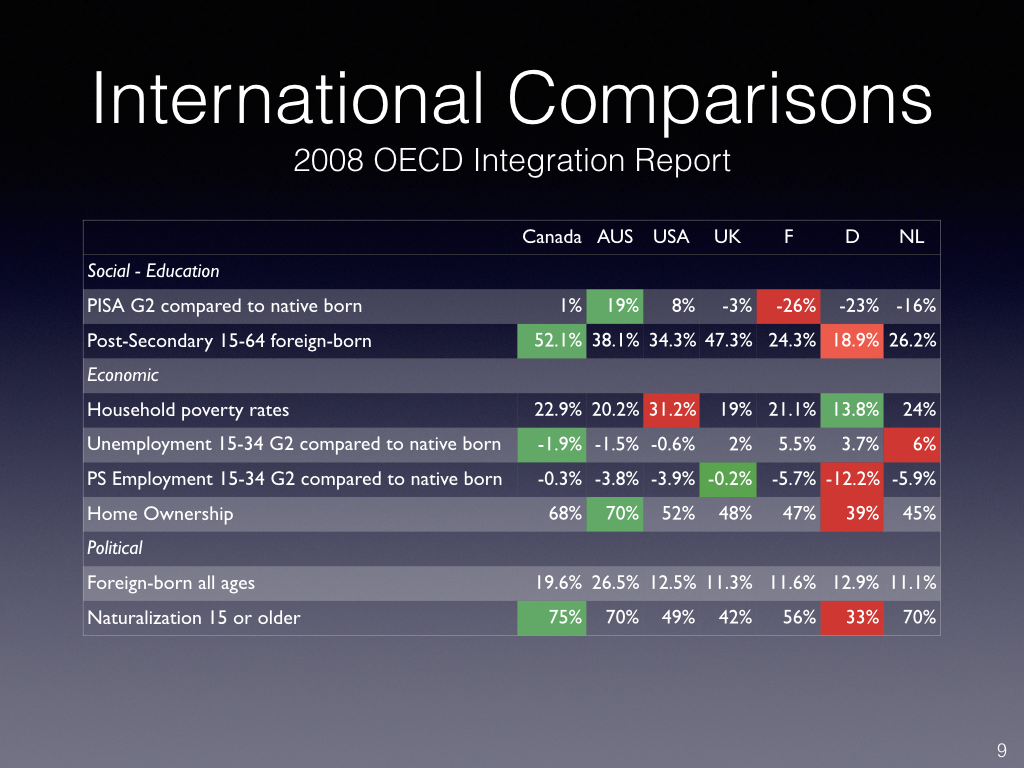
Another good piece by John Geddes, with this excellent summary of the data and evidence from the latest OECD immigrant indicators report.

I am a great fan of these reports (used it for the above summary table in Multiculturalism in Canada: Evidence and Anecdote) and am using it to prepare for an upcoming seminar in Copenhagen.

I generally find these data based comparisons more informative than the policy comparison indexes like MIPEX or the Multiculturalism Policy Index although both, of course, are helpful to understanding and discussion.

As with previous and other studies, the sharp contrast between immigration-based countries, particularly Canada, Australia, New Zealand and to a lesser extent, the USA, is striking:

All those images of border-crossing migrants, and swaggering tough talk about what to do about them from some federal Conservative leadership aspirants, have prompted a lot of discussion about how Canada absorbs newcomers, and if we do it differently, maybe better, than other countries.

My colleague Scott Gilmore warned here that we should brace for anti-immigrant populism to rise in Canada, as it has in other countries after the immigrant portion of their populations reached a certain level. I reported here on research that suggests that where immigrants tend to live in Canada, and how they vote, makes the path to political power steeper for right-leaning populists in this country than in the U.S. and Europe.

No matter how you see the issue, understanding how immigrants fare in Canada suddenly seems essential—if the debate is going to be about more than hunches. If you’re really gripped by the subject, you might want to take a look at “Indicators of Immigrant Integration 2015: Settling In,” by the Organization for Economic Cooperation and Development.” Here’s some of what jumped out at me from that study of the OECD’s 35 member countries [I have only listed the titles, the article has charts and narrative – well worth reviewing]:

  1. The Big Picture

  2. Recent Change and Stability

  3. Points of Origin Vary

  4. A Gender Gap

  5. Credentialed Newcomers

  6. Second-Generation Acceleration

  7. But Catching Up Isn’t Easy

  8. … And Some Will Stall

Source: Anxious about immigration? Here’s some food for thought – Macleans.ca