Universities need diversity plans or will lose research money, says council

Yet another illustration of how the government’s diversity and inclusion agenda is being implemented (gap is with respect to women, Indigenous peoples, and persons with disabilities, not with respect to visible minorities):

Universities have less than two years to find ways to recruit more women and minorities for Canada Research Chairs, or they won’t get any more positions funded by the federal government.

The Social Sciences and Humanities Research Council, which reviews and approves applications from universities for Canada Research Chair positions, issued that edict this week.

“We’ve been talking about this for some time, we’ve been monitoring progress to meet the targets,” said council president Ted Hewitt.

The move comes a week after Science Minister Kirsty Duncan told The Canadian Press that she was dismayed universities had not improved the rate at which they recruited women for the lucrative research jobs and was prepared to force their hand.

Hewitt said the change was in the works before Duncan’s remarks.

The council reviews the program every five years and last summer, when the preliminary results of a 15-year review came out, existing efforts to get more women, minorities, people with disabilities and indigenous people appointed to research chairs did not appear to be working.

“We said ‘OK, that’s it’ we have to think about what we can do here to speed up progress,” said Hewitt. “That was a very serious catalyst for us.”

Universities with at least five of the research positions will be required to submit an equity plan by Dec. 15 showing how they intend to meet the equity targets laid out by the granting council. They have until December 2019 to recruit and appoint enough researchers to meet their targets.

If their appointment applications do not match their equity targets by then, the council will withhold funding for new positions until they do.

Hewitt said universities submit twice as many male applicants as female applicants, so the council wants to find a way to force them to seek out more diverse applicants.

“At this pace, they’re never going to meet their targets,” he said.

Canada Research Chairs run for five or seven years and bring $100,000 or $200,000 in annual funding, depending on whether it’s a more experienced tier one position, or an emerging researcher, tier two position.

Universities cannot terminate positions early to open up spaces for more diverse applicants, which is why the council is giving them a deadline more than 18 months away.

The program provides $265 million a year to pay for up to 2,000 research positions in engineering, natural sciences, health sciences, humanities and social sciences.

As of this month, there are 1,615 positions filled, of which 30 per cent are held by women. Women account for just 17 per cent of the more lucrative tier one jobs and 37 per cent of the tier two jobs.

The program also wants to increase the presence of people with disabilities, visible minorities and indigenous people. In the 2015 to 2017 period, 15 per cent of researchers were from visible minorities, which met the target set by the council. However only one per cent of positions were filled by a researcher who had a disability, below the four per cent target. The universities had granted positions to about 16 indigenous researchers, which met the one per cent target.

Source: Universities need diversity plans or will lose research money, says council – Macleans.ca

Film And Food: Sharing The Stories Of Immigrants With Conservative America : NPR

I am a great fan of food and festivals to bring people together.

This project is particularly innovative in the way it tries to get outside the bubble and engage those with concerns or fears:

Like a lot of creatives distressed by the current political climate, filmmakers Daniel Klein and Mirra Fine want to tell stories that matter right now. They want to make a difference.

The husband-and-wife duo behind the Perennial Plate, a weekly web-based program showcasing sustainable food and farming practices, believe in the power of a meal combined with storytelling to bring people together.

Now, Perennial Plate wants to use its platform to spark a dialogue, particularly with conservative Americans, about immigrants and refugees in this country. Klein and Fine want to sow seeds for tolerance and acceptance — in contrast to fear and distrust. And they’re starting with five short films under the banner “Resistance Through Storytelling” about multi-generational immigrant families making a meal and gathering at the dinner table.

YouTube

“Food is as good a place as any to start a conversation. Food and family are the great connectors, something we all have in common,” Klein says. Each film will feature a compelling family who originally hailed from Africa, Asia, Europe, Latin America or the Middle East.

Klein and Fine have spent almost 10 years telling 160 such tales. They started locally, documenting the foodways of Minnesota, their home state. Then they set off around the country, before eventually circling the globe gathering footage and stitching together intimate portraits of the different ways people farm and cook. For example, the episode Our Heart Within Us recounts the story of Francisco and Lucia, Mayan refugees from Guatemala who came to Alamosa, Colo., in the 1980s. The couple grow plants indigenous to their country of origin in their adopted community; by doing so, they’ve held on to a piece of their homeland.

En route, the husband-and-wife team earned two James Beard Awards (they’re like the Oscars of the food world) and added another partner, fellow filmmaker Hunter Johnson, to the mix.

In an intriguing distribution approach, the filmmakers plan to use Facebook advertising, known as sponsored posts, to reach a wider audience and a different demographic than they have to date. They intend to target Americans whose social media preferences suggest they might not be sympathetic to the plight of newcomers to the United States. Sponsored posts can roll out in feeds in specific locations (such as swing states like Wisconsin) and cherry-pick people with particular interests (say John McCain and The Packers).

“We want to get outside of our liberal bubble,” says Klein. “We’re not interested in preaching to the choir.”

The unorthodox distribution model makes sense. These days, many Americans rely on Facebook as a source of news. And the newsfeed on anyone’s social network can create what Klein calls an echo chamber, where a user only sees posts from like-minded people and sources.

The best illustration of this stark division in the dissemination of political information: Perhaps The Wall Street Journal‘s “Blue Feed, Red Feed,”which includes an immigration category. Launched in May 2016, the tool is updated hourly. Even a cursory scroll through the side-by-side feeds reveal there’s nothing fake about the deep divide in news consumed in this country.

A woman in China’s Yunnan Province makes tofu in an episode of Perennial Plate called “Where The Water Settles.”

Courtesy of Perennial Plate

“My perspective on immigrants and refugees is entirely positive and based on personal experience,” says Klein.

But some of his family members and friends, who see posts in their newsfeeds from right-wing pundits and their ilk, are nervous and worried about immigrants and refugees, he says. Some of them don’t know any actual recent immigrants, which only adds to the disconnection.

“This doesn’t make them ‘bad,’ ” he says, “but I do think it’s time to get more positive stories of immigrants and refugees in front of audiences that don’t normally see that narrative.”

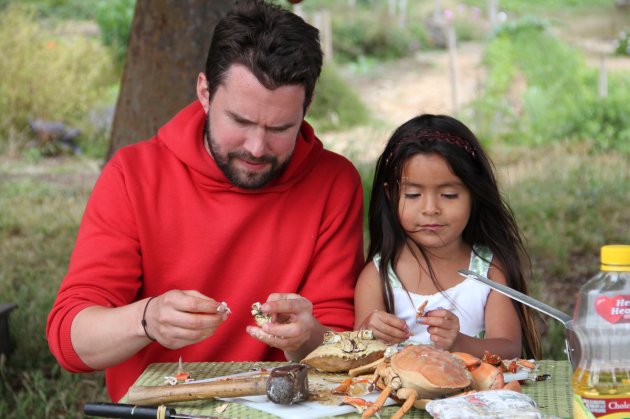
Daniel Klein picks meat from crabs with the young daughter of a former strawberry picker in Oxnard, Calif., for an episode called “A Day In The Life.”

Courtesy of Perennial Plate

It is widely documented, says Klein, that when a person knows someone of a different background or ethnicity, his or her perspective on that “group” changes. He points to a recent anecdotal story about a member of a mostly white, President Trump-supporting southern Illinois county who was detained by U.S. Immigration and Customs Enforcement. Its residents and elected officials rallied around Juan Carlos Hernandez Pacheco, a father, restaurant manager and longtime pillar of the community, who also happens to be an undocumented immigrant. Locals didn’t seem to care. They just wanted Carlos back home — in West Frankfort, Ill., that is, according to a New York Times account. He was released from immigration detention in March.

Source: Film And Food: Sharing The Stories Of Immigrants With Conservative America : The Salt : NPR

Canadian passport will have new marker for transgender travellers, justice minister says

As expected and good that this is being done government-wide to ensure consistency:

Transgender travellers will soon have another option to tick off on their passport other than “male” or “female.”

Justice Minister Jody Wilson-Raybould said the government is working to update its gender identity policies right across federal departments, and they will include a revamped travel document.

“The prime minister is very mindful of perhaps a third box or an ability to mark something other than male or female. This work is being undertaken at Passport Canada,” she said. “Individual ministers and (people) within their departments are recognizing that this bill has been introduced, that there is work that needs to continue to be taken.”

Wilson-Raybould was testifying before the Senate legal and constitutional affairs committee, which is studying government legislation to protect the human rights and security of Canadians based on gender identity and gender expression.

She said the government has much work to do to ensure its own policies accord with the intent of C-16, including a recognition that “simply ticking a box of male or female” doesn’t comply.

A sex field is mandatory for travel documents under International Civil Aviation Organization (ICAO) rules. ICAO allows one of three markers: F for female, M for male or X for “unspecified.”

Immigration, Refugees and Citizenship Canada has already removed a requirement for proof of sex reassignment surgery for persons requesting to change the sex marker on IRCC documents, and the department is taking further steps to change the sex marker on travel documents, citizenship certificates and documentation for temporary and permanent residents, according to a government official.

Prime Minister Justin Trudeau has pledged to make all government-issued documents more reflective of gender diversity.

Seven countries have issued identification documents, such as a passport, with a third-sex designation.

‘Where does that end?’

But Conservative Senator Don Plett said changing the passport could have implications on international travel.

“When you start putting other boxes in, where does that end? How many boxes are we going to put in? I don’t think it’s a workable solution,” he said.

Bill C-16 would update the Canadian Human Rights Act and the Criminal Code, making it illegal to discriminate based on gender identity or expression and extending hate speech laws to include the two terms. Under the legislation, judges would also consider it an aggravating factor in sentencing when someone has been targeted for a hate crime based on gender identity or expression.

Wilson-Raybould said the protections are “long overdue” to end discrimination, lift barriers to employment and fill an important gap in the Criminal Code.

The bill has been praised by human rights and transgender advocates, but some senators on the committee raised concerns that there is no definition of the term, leaving it too vague for clear interpretation. Plett said the word “gender expression” could refer to what a person wears or how they comb their hair.

He asked what would happen if a person simply does not recognize more than two genders.

Personal pronouns

“For personal, scientific or faith-based reasons, do you believe they should have to refer to a person by a personal pronoun and should failure to do so constitute discrimination?” he asked.

Wilson-Raybould said Canadians should rest assured the bill will not infringe on freedom of expression, or compel anyone to refer to an individual by a certain personal pronoun.

Source: Canadian passport will have new marker for transgender travellers, justice minister says – Politics – CBC News

Political activity audits of charities suspended by Liberals

A significant roll-back of the previous government’s approach:

The Liberal government is suspending the few remaining political activity audits of charities after an expert panel report recommended removing a political gag order imposed on them by the Conservatives five years ago.

As an immediate first step to respond to the panel’s recommendations, National Revenue Minister Diane Lebouthillier “has asked the CRA to suspend all action in relation to the remaining audits and objections that were part of the Political Activities Audit Program, initiated in 2012,” a release Thursday said.

The panel report, also released Thursday, and the suspension together appear to end a long chill for charities that began in 2012, when the Conservative government launched 60 political activity audits, starting with environmental groups that had criticized federal energy and pipeline policies.

A spokesperson for the minister, Chloe Luciani-Girouard, said Thursday’s suspension affects 12 audits, of which seven have resulted in an intention to revoke charitable status.

The program cost environmental, anti-poverty, human-rights and religious charities significant staff resources and legal fees, and brought an “advocacy chill” to the sector, with many groups self-censoring lest they be caught in the Canada Revenue Agency’s net or annoy their auditors.

The Liberal Party campaigned in the 2015 election to end the “political harassment” of charities, but once elected did not quite end the program. Instead, the new government cancelled six of the political activity audits that were yet to be launched, but allowed audits already underway to continue.

That left groups such as Environmental Defence and Canada Without Poverty, which were deemed too political by CRA, still under immediate threat of losing their charitable status. Thursday’s announcement lifts that threat, at least until the government responds to the panel recommendations.

The five-member panel, chaired by Marlene Deboisbriand on the board of Imagine Canada, says Canada’s charity law and regulations are too restrictive and vague. It calls for changes to the Income Tax Act to delete any reference to “political activities” with regard to charities.

Would change enforcement

The change would be “to explicitly allow charities to fully engage, without limitation, in non-partisan public policy dialogue and development, provided that it is subordinate to and furthers their charitable purposes.” The CRA would also dramatically change its enforcement activities.

The panel report, based on wide consultations last fall, also said there was broad consensus in the charity sector that partisan activities — endorsing particular candidates or parties — should remain forbidden.

The panel recommended that a charity’s political activities, whether pressing for a change in government policy or buttonholing a politician, be judged on whether they further the group’s charitable purpose.

The proposed changes would eliminate current rules that restrict a charity’s political activities to 10 per cent of their resources. Critics have argued the rules are unclear on definitions of what constitutes a political act.

Source: Political activity audits of charities suspended by Liberals – Politics – CBC News

Le PQ, la diversité et le nationalisme civique

Good overview by Robert Dutrisac of the ongoing challenge facing the PQ (and fussing on words doesn’t solve their existential question of who is “nous”):

On connaît la suite : Pauline Marois a amorcé un virage identitaire qui culminait dans la maladroite charte sur les valeurs dites « québécoises » — des valeurs, en réalité, occidentales, voire universelles. Le PQ réaffirmait tout de même le caractère pluraliste de la nation québécoise.

Avec cette concordance culturelle, Jean-François Lisée délaisse l’interculturalisme cher à Gérard Bouchard. Il juge que la notion officielle de l’interculturalisme, telle que définie par le gouvernement libéral, est trop molle puisqu’elle ne fait pas référence à un tronc commun bâti au Québec au fil de l’histoire. Pour certains d’ailleurs, dont Charles Taylor et Daniel Marc Weinstock, l’interculturalisme n’est qu’une version du multiculturalisme canadien.

Ce concept ressemble beaucoup à la « convergence culturelle » de Fernand Dumont qu’a reprise le PQ de René Lévesque en 1981. Cette politique, intitulée « Autant de façons d’être Québécois », avait pour objectif de rassembler les cultures ethniques sous l’égide de la majorité, ce qui peut se résumer par leur assimilation.

Selon Jean-François Lisée, la concordance culturelle n’a pas de visées assimilatrices, mais préconise plutôt « la formation d’une collectivité inclusive » dans laquelle « chaque citoyen et chaque génération effectue son parcours identitaire comme il ou elle l’entend ». Mais les Québécois de toutes origines sont appelés à partager « une différence vitale » caractérisée par la langue française et un récit historique singulier. À cela s’ajoutent des éléments civiques comme l’égalité entre les hommes et les femmes, la démocratie, la solidarité et un « cheminement vers un État laïque ».

Ce concept de concordance sera difficile à expliciter en campagne électorale ; il est heureusement associé à des mesures concrètes pour favoriser la réussite des immigrants en luttant, notamment, contre la discrimination à l’embauche et le racisme.

Ce n’est pas d’hier que le PQ a des relations ardues avec les communautés culturelles. Lors de la campagne référendaire de 1980, René Lévesque avait vexé des Italo-Québécois indépendantistes — c’est l’écrivain Marco Micone qui raconte l’anecdote — en déclarant : « La majorité francophone décidera elle-même de son avenir. »Évidemment, il y a eu par la suite « les votes ethniques » de Jacques Parizeau et ce « nous » qui avait voté à 60 % pour le Oui.

Le projet de nationalisme civique, qu’ont porté Gilles Duceppe au Bloc québécois et Gérald Larose, visait à éviter ces écueils. Mais le problème, c’est que le nationalisme civique au Québec ne veut pas dire grand-chose. La nation québécoise, au sein de l’ensemble canadien, n’a pas le monopole des principes démocratiques et des droits de la personne. Sans l’existence de cette majorité francophone au parcours historique singulier, le projet souverainiste perdrait toute pertinence.

Avec cette approche, le PQ a le mérite de la franchise. Pour rejoindre les communautés culturelles — et il doit s’y consacrer activement —, le mouvement souverainiste n’a d’autre choix que de se présenter tel qu’il est : un mouvement qui promeut un projet d’émancipation d’une nation pluraliste, auquel sont conviés tous les Québécois.

Source: Le PQ, la diversité et le nationalisme civique | Le Devoir

Liberal government to debate Senate amendments to long-delayed citizenship bill

It will be interesting to see whether the Liberal government accepts all three amendments and how quickly the House will deal with C-6.

I suspect that the government may accept the procedural protections amendment in the case of revocation for fraud and right of minors to apply independently of their parents or guardians, while rejecting the exemption for testing change to 60 from 55.

Personally, I favour accepting all three in the interests of getting C-6 implemented quickly. The age exemption issue – a difference of five years – has been largely an “evidence-free” zone:

While I expect the Liberal government to reject The Liberals’ long-delayed citizenship bill is finally moving ahead almost a year after the House of Commons passed it, but it’s not law yet.

The Senate voted Wednesday in favour of the bill that will revoke a Conservative policy to remove Canadian citizenship from dual citizens convicted of serious crimes such as terrorism and treason.

Three amendments were introduced, however, which means the bill gets sent back to the House of Commons, where Liberals will decide whether to accept the changes or not. If they don’t, it goes back to the Senate again. Government House leader Bardish Chagger’s office said Wednesday amendments will be brought to the floor for debate “in due course.”

The new law will also require prospective citizens to be in the country for three out of five years before their application, a change from the four out of six years that are currently required. Applicants will no longer need to declare an intent to reside in Canada.

Bill C-6, which fulfills a major election promise to repeal elements of Conservative legislation, has trudged slowly through the upper chamber since last June. After a spurt of opposition delay tactics, senators had made a backroom deal to have a final vote by Wednesday.

The bill’s sponsor, independent Sen. Ratna Omidvar, championed in particular an amendment, introduced by independent Sen. Elaine McCoy, that improves due process for people who are facing revocation of their citizenship due to fraud or misrepresentation.

After the Conservatives’ Bill C-24, revocation processes were streamlined such that people weren’t automatically granted a right to defend themselves if their citizenship was about to be taken away. The Liberal Bill C-6 didn’t reverse this change.

“Without this amendment,” said a statement from Omidvar’s office, “Canadians face an unjust administrative process and fewer safeguards than anyone wishing to challenge a parking ticket.”

Previous immigration minister John McCallum had told senators Liberals would “welcome” an amendment addressing this, but new minister Ahmed Hussen has not indicated support one way or the other.

Two other amendments were adopted. For older applicants, the law currently requires language proficiency in English or French up to the age of 64. The Liberal law proposed lowering this to 55, but senators decided to adopt Conservative Sen. Diane Griffin’s suggestion of a middle ground, setting it at age 60 instead. Another amendment, from Conservative Sen. Victor Oh, seeks to ensure minors can apply for citizenship separate from parents or guardians.

With physician-assisted dying legislation last summer, the House of Commons addressed Senate amendments right away (with the government rejecting most of them). On the other hand, the Senate is still waiting for the House of Commons to accept or reject an amendment on the RCMP union bill, C-7, which it adopted last June.

Source: Liberal government to debate Senate amendments to long-delayed citizenship bill | National Post

Hate Speech And The Misnomer Of ‘The Marketplace Of Ideas’ : NPR

Good long read by David Shih on some of the weaknesses in the free speech arguments:

Critical race theorists Richard Delgado and Jean Stefancic addressed this possibility in a 1992 Cornell Law Review article entitled “Images of the Outsider in American Law and Culture: Can Free Expression Remedy Systemic Social Ills.” They coin a term for the erroneous belief that “good” antiracist speech is the best remedy for “bad” racist speech: the “empathic fallacy.” The empathic fallacy is the conviction “that we can somehow control our consciousness despite limitations of time and positionality … and that we can enlarge our sympathies through linguistic means alone.”

In other words, the empathic fallacy leads us to believe that “good” speech begets racial justice and that we will be able to tell the difference between it and racist hate speech because we are distanced, objective arbiters…

In the meantime, racist hate speech flows unabated because of our faith in a flawed metaphor.

The marketplace is further gamed by “dog whistles” — code word replacements for overtly racist speech that still aim to stoke white resentment over the social mobility of people of color. When the sitting attorney general dismisses the ruling of a court because it resides on “an island in the Pacific,” he invents yet another way to signal which groups count in America and which ones don’t. And if a racist idea like this one ever flops in the marketplace, its author simply recalls it by saying he was joking.

A quarter-century ago when Delgado and Stefancic published their theory of the empathic fallacy, they speculated that the infamous Willie Horton ad tipped a presidential election because voters could not view the ad objectively. We now know that racism was the primary motivation for voters who put Donald Trump in the White House. We know that the best ideas of Gold Star father Khizr Khan at the Democratic National Convention were no match for fearmongering rumors about refugees from Syria and immigrants from Mexico. We know that after almost 100 days of Trump’s presidency, only two percent of those who voted for him regret it. This might mean they don’t see his speech as racist or don’t care if it is.

If we argue that racist hate speech must be protected, we have to account for the empathic fallacy.

We can start by admitting that this position is based on the troubling belief that it is one’s right to be hateful — and not on the comforting belief that hate is a catalyst for racial justice in a “marketplace of ideas.” Better than ever, we know how specious that logic is. We can understand that student protesters may not, in fact, long for their First Amendment rights should the tables turn on them. Law professor Charles Lawrence has argued that civil rights activists in the sixties achieved substantive gains only when they exceeded the acceptable bounds of the First Amendment, only when they disrupted “business as usual.”

Racist hate speech has come to emblemize free speech protections because the parties it injures lack social power. Students of color are expected to endure insults to their identities at the same time that celebrities win multi-million dollar defamation settlements and media companies scrupulously guard their intellectual property against plagiarism.

The belief that more speech is the remedy for “bad” speech can be a principled stance. But for the stance to be principled, it must account for why the target of racist hate speech is less deserving of exemption than, say, the millionaire with a reputation to protect from libel, or the community flooded with sexually-explicit material, or the deep state with a dark secret. Some exemptions make good sense. But does an obscene photograph of an adult that “lacks serious literary, artistic, political, or scientific value” (as defined in Miller v. California, the current law of the land regarding obscenity) really do more harm than a lecture promoting white supremacy?

American society fixates on antiracist protest when debating the First Amendment for the same reason it fixates on race when debating affirmative action: because of the perception that people of color are somehow undeserving of special privileges.

Yet it was supporting the rights of people of color that got Desiree Fairooz arrested in January for laughing during the Senate confirmation hearingof then-attorney general nominee Jeff Sessions. This week, the Department of Justice moved forward with her prosecution, along with those of two men who had mocked Sessions with fake Ku Klux Klan robes. In March, the Human Rights Council of the UN published a letter expressing alarm at the number of legislative efforts criminalizing peaceful assembly and expression in the US.

Powerful interests will find their way around the First Amendment to protect the status quo against antiracist protest. Asking student protesters to tolerate racist hate speech is to ask them to trust in free speech laws that have historically exempted the powerful and punished the vulnerable. When it comes to racism, the “marketplace of ideas” is not laissez-faire and never was.

Source: Hate Speech And The Misnomer Of ‘The Marketplace Of Ideas’ : Code Switch : NPR

Why Pope Francis’ approach to Islam breaks the mold of Benedict and previous popes | America Magazine

Interesting long read by Christopher Lamb on the contrast between Pope Francis and his predecessor in their efforts to engage Islam:

The global growth of Islam and in particular the rise of Islamic extremism have forced recent popes to set out, with increasing urgency, a strategy for engaging the religion.

As Pope Francis’ brief trip to Egypt over the weekend demonstrated, the most recent pontiffs have come up with starkly different approaches—though it’s not yet clear if one is better than the other, or if either will be effective.

When Pope Emeritus Benedict XVI addressed the question of Islamic extremism he did so during a speech at a university in his Bavarian homeland where, as a priest and professor, Joseph Ratzinger had worked decades earlier.

That 2006 address in Regensburg, Germany, was a theological master class on the relationship between faith and reason. But it also angered Muslims who object to Benedict citing a 14th-century Christian emperor who claimed that the Prophet Muhammad had only brought the world things that were “evil and inhuman.”

Moreover, Benedict also delivered his message to Islam from afar.

Francis, on the other hand, has made it his business to try to build bridges with the Muslim world with the energy of a missionary.

That approach was on display during his 27-hour trip to Egypt, viewed as the leader in the majority Sunni Islamic world, and a nation that is making a serious—though controversial—effort to crack down on extremist-inspired violence.

So important to Francis, in fact, is the “personal encounter” with Muslims that the pontiff put his own safety at risk by going to Cairo, a trip that took place less than three weeks after 45 worshippers were killed in bomb attacks on two Egyptian churches.

The pope even shunned a bulletproof vehicle and when he arrived at a sports stadium for an open-air Mass he greeted the crowds from an open-topped golf buggy.

“Whereas previous popes — even in more secure places — have ridden in bulletproof vehicles, Francis showed his courage in Egypt, and his will to be close to the people, by this simple gesture,” explained Gabriel Said Reynolds, a professor of Islamic studies at the University of Notre Dame.

Reynolds took part in a recent Vatican-Muslim forum at Cairo’s Al-Azhar university, a major center of Sunni-Islamic learning with global influence and expertise in interpreting the Quran. The dialogue that Reynolds is part of only restarted under Francis—who was elected in 2013—after relations had soured under Benedict.

Yet even as the current pope pushes for a personal encounter with Islam, his predecessor’s legacy of engaging Islam via a theological challenge to extremist elements among Muslims continues to hold some sway.

Indeed, just as Francis was heading to Egypt a letter appeared from the retired pope to the president of Poland in which Benedict accused “radical Islam” of creating an “explosive situation in Europe.”

Catholic defenders of Benedict’s Regensburg address insist that he correctly addressed some uncomfortable truths within Islam and they point out that the speech led 138 Islamic scholars to write to Benedict in 2007, a letter that paved the way for a new Catholic-Muslim dialogue initiative.

Yet while it was Muslims who approached Benedict a decade ago, under Francis things are the other way round.

Francis’ approach to Islam is characterized by a willingness to “cross over to the other side” — Egypt is the seventh Muslim majority country he has visited in his four years as pope. And a papal visit to Bangladesh, where almost 90 percent of the population are followers of Islam, is planned for later this year.

Francis’ approach to Islam is characterized by a willingness to “cross over to the other side”

In Egypt, this was symbolized by his embrace of Sheikh Ahmed el-Tayeb, the grand imam of Al-Azhar mosque, following the pope’s address to their peace conference.

It was a powerful image of Muslim and Christian fraternity that had echoes of St. Francis of Assisi’s mission to Islamic leader Sultan Al-Kamil 800 years ago.

This personal approach has been bolstered by Francis’ consistent refusal to link the Islamic faith per se to terrorism, and has made the Islamic world take notice.

It also meant that when Francis issued one of his strongest and most detailed condemnations of religious violence during his Al-Azhar address, his speech was welcomed and frequently interrupted with applause.

“He knows that the only effective way for his message of peace to touch the hearts of the larger global community is to speak together with leaders of other religious communities,” Reynolds explained.

“He is counting on the prestige of Al-Azhar and its grand imam in particular, to join with him in broadcasting this message.”

Source: Why Pope Francis’ approach to Islam breaks the mold of Benedict and previous popes | America Magazine

Des radicaux aussi chez les catholiques | Le Devoir

Indeed. Extremism and fundamentalism is not unique to any one religion:

« En ce qui concerne les morts, c’est 6 à 2 pour les intégristes catholiques », lance le sociologue Martin Geoffroy. C’est un drôle de décompte, convient ce professeur au cégep Édouard-Montpetit et directeur du Centre d’expertise et de formation sur les intégrismes religieux et la radicalisation (CEFIR). Mais il illustre bien que, malgré le fait que l’attentat de la mosquée de Québec a fait six morts, ceux reliés à l’islam radical jouissent encore d’une attention disproportionnée dans les médias et l’esprit des Québécois. « On n’hésite pas à associer les attentats terroristes au groupe État islamique et à l’intégrisme religieux, mais quand ça émane de notre propre culture, c’est plus difficile à reconnaître. »

Il rappelle que seulement deux attentats djihadistes, celui de Saint-Jean-sur-Richelieu et celui au parlement d’Ottawa, qui ont fait en tout deux morts, ont été perpétrés chez nous. Le fameux complot des Toronto 18 planifié en 2006 a quant à lui été déjoué, et les liens de ces terroristes avec al-Qaïda ne seraient pas prouvés.

Fort de 20 ans de recherche sur l’extrême droite, son postulat se confirme. « C’est toujours plus facile de blâmer la culture de l’autre plutôt que de regarder notre propre culture. Mais l’intégrisme catholique, tout comme l’intégrisme islamique, a aussi un rôle à jouer dans le terrorisme », dit M. Geoffroy, reconnaissant qu’il y a d’autres facteurs, notamment psychologiques, pour expliquer cette violence extrême.

Dans une conférence qu’il donnera dans le cadre du colloque international du Centre de recherche Société, Droit et Religions de l’Université de Sherbrooke (SoDRUS) sur le thème « Les racines religieuses de la radicalisation : fait ou fiction » (les 4, 5 et 6 mai), il défendra la thèse voulant qu’au Québec, les deux formes les plus habituelles d’intransigeance religieuse sont l’intégrisme catholique et le fondamentalisme protestant. Mieux ancrés dans notre société, ces intégrismes bien de chez nous passent sous le radar des médias alors qu’ils vont pourtant à l’encontre des valeurs de la société moderne. « La radicalisation des jeunes et le djihadisme sont dangereux, je ne veux pas le minimiser. Mais cela étant dit, il faut se préoccuper de nos propres affaires. Et il semble plus difficile de regarder le côté sombre de la force de notre propre culture. »

Intégrisme catholique

Martin Geoffroy se heurte d’ailleurs souvent à des regards surpris lorsqu’il rappelle qu’il existe encore plusieurs sectes catholiques, antisémites, anti-islam, anti-immigration. Ses plus récentes recherches l’amènent à conclure que ces groupes sont « complotistes, à base d’intégrisme religieux ou les deux », soutient le chercheur, qui rappelle que des députés conservateurs avaient des liens avec l’Opus dei et la Fraternité sacerdotale Saint-Pie-X. Cette société controversée de prêtres catholiques traditionalistes fondée en Europe, qui a des ramifications au Québec, avait été vue comme trop d’extrême droite par l’Église, qui avait notamment excommunié son fondateur, Mgr Marcel Lefebvre, en 1988.

La fraternité Saint-Pie-X est aussi dans la mire d’Atalante, a-t-il remarqué grâce à une veille de ces groupes sur Internet et les réseaux sociaux, où des vidéos ont clairement établi ces liens. La dimension religieuse, à tout le moins sacrée, est également présente chez les Soldats d’Odin, un groupe d’extrême droite d’origine finlandaise qui a rapidement pris de l’ampleur au Canada. « Dans les groupes suprémacistes blancs, il y a une adoration des dieux vikings, car ils sont blonds, etc. Et Odin, c’est le dieu principal de la mythologie nordique », rappelle le chercheur, qui entamera sous peu une collaboration avec le sociologue français Gérald Bronner, pour comparer les initiatives contre la radicalisation.

Le colloque du SoDRUS fera la part belle aux présentations sur la radicalisation au sein d’autres groupes religieux (bouddhistes, sikhs, anabaptistes, etc.). Martin Geoffroy s’étonne que certains doutent encore du lien entre la religion et l’extrême droite. La radicalisation et les actes terroristes des djihadistes sont automatiquement associés à la religion, alors que la majorité des djihadistes ne sont pas pratiquants mais plutôt convertis « à la version intégriste de l’islam, un islam pour les nuls », dit-il, pointant la thèse du politologue français Olivier Roi sur la déculturation du religieux. « Mais quand on parle de l’extrême droite chez nous, on ne parle pas nécessairement de la religion catholique. On dit que ça n’a pas de rapport, comme si on voulait déconnecter l’extrême droite de notre culture », dit-il. Or ce n’est pas parce que les gens ne sont pas pratiquants qu’ils ne sont pas croyants, rappelle-t-il, précisant que le taux de catholiques pratiquants (15-17 %) est presque aussi élevé que pour les musulmans (20 %).

Source: Des radicaux aussi chez les catholiques | Le Devoir

‘Profoundly unfair:’ Frustration mounts over immigration lottery to reunite families

No matter which system, there will always be more demand for family reunification that can be accommodated easily within the overall levels of immigration.

And kind of funny to hear Conservative critic Michelle Rempel arguing the government to use a “sober, management lens.” After all, when in power, the Conservative government reduced the levels for parents and grandparents as part of the relative shift to more economic class immigrants, thus creating a backlog even with the introduction of longer visitor visas to address the demand.

A valid policy choice, although one that was not necessarily popular with affected communities:

Hundreds of Canadians frustrated by the government’s shift to a lottery system to sponsor their parents and grandparents as immigrants to Canada are hoping to prompt change through an electronic petition.

Petition e-739, which closes for signatures this afternoon, calls on the Liberal government to take a phased-in approach and give priority to qualified sponsors who have made repeated applications.

This year the government moved from a first-come, first-served process to one where potential applicants were randomly selected by draw. The change was announced in December 2016 by then immigration minister John McCallum, just weeks before the deadline under the old system.

Brad Fach, a Cambridge, Ont., software engineer who launched the petition, was shocked to learn of the sudden change after he and his wife spent much time and money preparing the required forms and documentation to apply for her mother and father to emigrate from Belgium. He said the government has reduced a sensitive, emotional process to an undignified, “botched” system.

“I believe it mocks a very serious issue of family reunification, and is the wrong way to go,” he told CBC News.

Last week, the government announced that 95,000 people had filed an online form to win one of 10,000 spots to apply for sponsorship under the new lottery system. That put the chances at roughly one in 10.

Under the previous system, the first 10,000 completed applications turned in to the immigration processing office when it opened in January were accepted. The switch to a lottery system aimed to make it more fair and transparent, according to the government, as the old process favoured those who were geographically close to the centre or had the financial means to pay for couriers or legal representatives to help get them to the front of the queue.

Fach rejects that rationale. To qualify as a sponsor for parents or grandparents, he said, you must be in strong financial shape.

“You need money regardless, so you already have an advantage over the rest of the population. To claim that this somehow levels the playing field is complete crap,” he said.

Give ‘ray of hope’

Fach believes the new system is flawed because the online form to enter the lottery required only basic information, not details to ensure applicants were qualified and met financial requirements to sponsor their parents or grandparents.

If the government remains committed to the lottery, Fach said, it should at least devise a system that accounts for waiting time to give people a “ray of hope” they will eventually be invited to apply as sponsors.

Conservative immigration critic Michelle Rempel likened the lottery to an “abdication of responsibility,” leaving the system to chance instead of making improvements in a systemic, purposeful way.

“It almost seems like we’re giving up. We’re giving up on process efficiencies, and it’s luck of the draw on whether you get into Canada or not,” she said.

Rempel said Immigration Minister Ahmed Hussen must look through a “sober, management lens” to improve processes that match up with new legislation and immigration priorities.

“That’s going to be a tall order, because they’ve changed this so much and they’ve got so many problems now,” she said.

NDP immigration critic Jenny Kwan said the parent and grandparent program is the only immigration category where the fate of applicants is up to the “luck of the draw.”

“I think that is fundamentally wrong,” she said.

Source: ‘Profoundly unfair:’ Frustration mounts over immigration lottery to reunite families – Politics – CBC News