Canada can’t strip your citizenship without a trial, court rules – VICE News

Good ruling. Senate review of C-6 included restoration of procedural protections in case of revocation for fraud or misrepresentation (along with two other amendments) and still no sign from the government whether they intend to accept the one or more of the amendments:

A landmark ruling from the Federal Court means that Ottawa will no longer be able to strip Canadians of their

A landmark ruling from the Federal Court means that Ottawa will no longer be able to strip Canadians of their citizenship without a hearing.

In ruling on the case of a group of dual citizens who had their citizenship nullified because the Canadian government believed they obtained it through fraudulent means, the court found the government’s revocation powers unconstitutional.

Under the Citizenship Act, thanks to changes brought in by the previous government, the minister of immigration could revoke the Canadian citizenship of any dual resident who, they believe, obtained it through fraud or misrepresentation, or who has been convicted of a terrorist offence.

It was at the government’s discretion whether or not there would be a trial on the matter. Thanks to those streamlined rules, revocation could take place after merely sending a letter to the person affected.

Today, the court ruled that such a process ran afoul of the Bill of Rights, a rarely-used piece of the constitution and a precursor to the more widely-known Charter of Rights and Freedoms.

Those facing citizenship revocation “should be afforded an oral hearing before a court,” Justice Jocelyne Gagné wrote, adding that they deserve to be afforded “an opportunity to have their special circumstances considered when such circumstances exist.”

Today’s ruling means that all current citizenship revocation cases will be put on hold.

In some ways, these changes were inevitable.

Justin Trudeau’s Liberal government pushed forward legislation in early 2016 to make similar changes to the Citizenship Act, removing the government’s ability to strip the citizenship of terrorists, and to afford the right to a trial to all those facing revocation. That legislation has been making its way through Parliament for more than a year, and was most recently amended by the Senate earlier this month — meaning it now heads back to the House of Commons for another vote.

Despite that, the Canadian government has nevertheless pushed forward to strip the citizenship of an array of people across the country. The current Liberal government, who campaigned on repealing Harper’s changes, has revoked more citizenships in a year than the previous government did in seven years.

Previously, under both the Trudeau and Harper governments, the government has moved to take away citizenship from Canadians who obtained their citizenship as children.

Joel Sandaluk, a Toronto immigration lawyer, represents a client who got notice that Ottawa was moving to take away his citizenship as recently as last month.

“It’s always been kind of a mystery as to why the government was still pursuing revocation,” Sandaluk says, noting that the government was pursuing legislation to make that very change, and it knew that this case was to be decided imminently.

“It’s either very canny politics or it just kind of feels a little bit manipulative,” he says.

It’s quite possible that the Liberals will need to go back to their own legislation, which is currently making its way through the Senate, to make sure it complies with today’s ruling, Sandaluk says. That means Ottawa likely won’t bother appealing the decision.

Source: Canada can’t strip your citizenship without a trial, court rules – VICE News
Conference Board Immigration Summit: My Citizenship Presentation

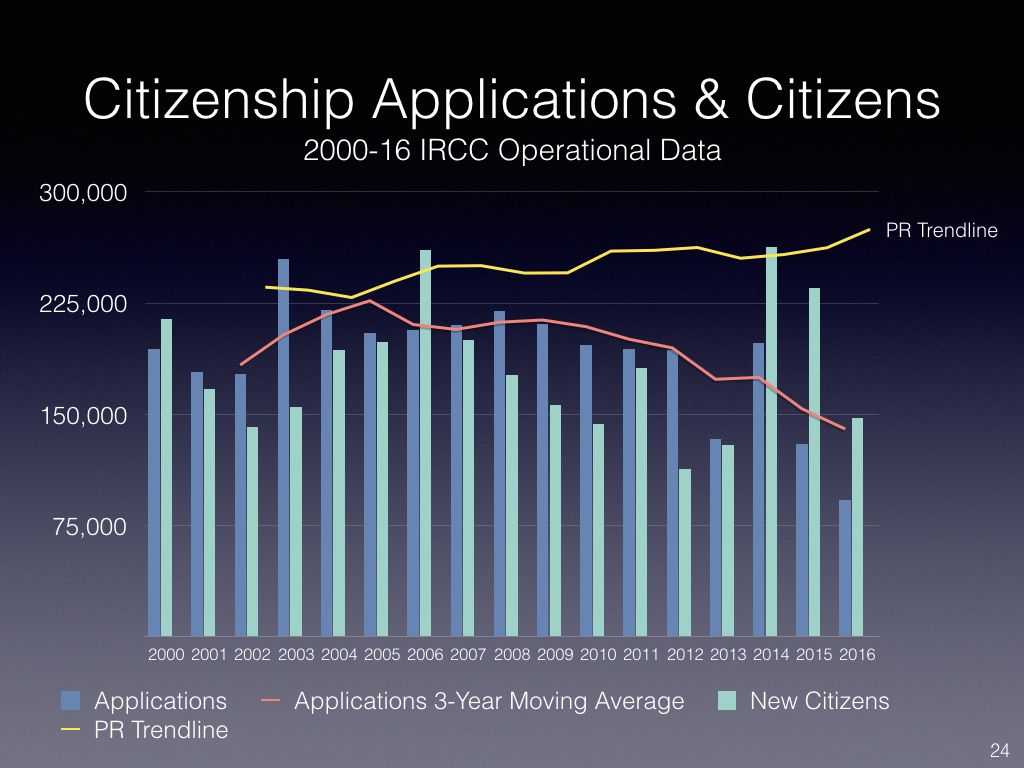
For those interested, this is the latest version of my citizenship deck, being delivered later today at the Conference Board Immigration Summit. A mix of 2016 and 2015 data as some of the specialized datasets have not yet been updated by IRCC.

Minister Hussen on citizenship #Immigration150 conference

Interesting insight at yesterday’s Conference Board of Canada Immigration Summit during the session with IRCC Minister Hussen.

In response to a broad question regarding multiculturalism from the moderator, CBoC Senior VP Craig Alexander, the Minister responded that the world has two choices: give into fear or make a “deliberate choice” to be open to people, skills and talent. This was not only “morally right” but also beneficial to economic development.

The Minister noted that when questioned in other countries about diversity, he replied that Canadian citizenship is based upon shared values, not on ethnicity, cultural origin or religion as in many other countries.

Canada’s ability to welcome all, whatever their origins, and integrate them well, is key to our success.

He noted that as Canadians, “we all assume that when people come as immigrants, they will become citizens” and that was not the case in many other countries.

He went on to emphasized that not becoming a citizen affects the ability to integrate and never becoming part of society and never able to contribute to their full potential. Canada does not that problem. Again, we assume that all immigrants will become Canadian.

Canada is unique in the regard. We take this for granted. It is our history of immigration that makes us open to immigration. By welcoming and including everyone, Canada can realize the potential of all and use the full resources of its population.

Powerful words, eloquently stated.

However, someone at IRCC should point out to him the recent data that show a dramatic drop citizenship applications – from 198,000 in 2014 to 92,000 in 2016 – and the increasing gap between new permanent residents and new citizens (296,000 compared to 148,000 in 2016, following the elimination of the backlog in 2014-15).

The key chart captures the trends.

So rather than assuming the immigrant-to-citizen path, we need to recognize the impact of previous changes and take steps to address this decline, starting with reviewing the steep fees as I have noted previously (and repeatedly).


Canadians still pro-immigration, but souring on United States: Environics survey 

Useful and encouraging post-Trump update of Focus Canada’s annual survey:

As debates rage through much of the developed world over whether to close doors to newcomers, Canadian attitudes toward immigration remain positive.

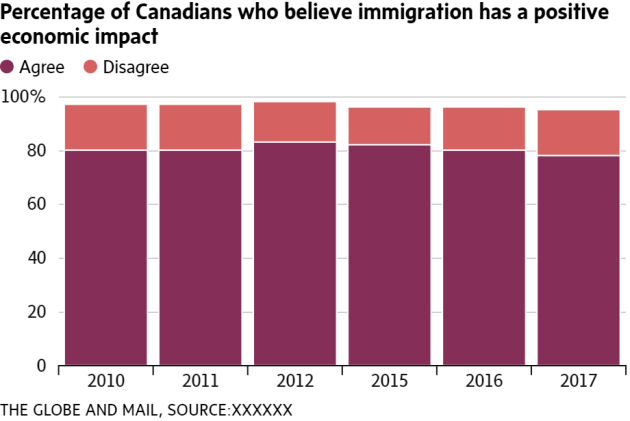
Canadians’ sentiment towards immigration hasn’t wavered in the past six months, with eight in 10 people still agreeing that immigrants benefit the economy, a national survey released exclusively to The Globe and Mail shows.

“Public opinion about immigration among Canadians generally has either remained stable or become even more positive” in the past half year, said Keith Neuman, executive director of the Environics Institute for Survey Research, which released the results publicly on Monday.

The survey was conducted last month as a follow up to a similar set of questions in October. It sought to gauge whether public sentiments have shifted since the election of Donald Trump in the United States, and amid intensifying public debate in the United States and Europe over whether to tighten immigration rules. It comes as France’s defeated presidential candidate, Marine Le Pen, campaigned on an anti-immigrant, anti-EU platform, and as Britain preps for Brexit while Mr. Trump remains intent on deportations and building a U.S.-Mexico border wall.

Some views in Canada have shifted, markedly. Attitudes towards the United States have soured, with fewer than half of Canadians now holding a favourable view of the United States – the lowest level since the survey started tracking this in 1982.

In opinions about the United States, “there’s been a dramatic change,” said Mr. Neuman. Nearly a fifth of respondents said they have already changed their travel plans for visiting the United States this year due to the current political climate there, and another 8 per cent are thinking about doing so.

On immigration, Canadians appear still supportive. When asked if there is too much immigration in Canada, more than six in 10 people disagreed, the highest level in nine years.

Nearly eight in 10 respondents said immigration has a positive impact on the economy, little changed from the previous survey and over the past 15 years. Young people are more likely to agree that immigration boosts the economy, along with those in Toronto, people born outside of Canada and those with higher levels of education and income.

Several reasons may explain why Canadians have not jumped on the nationalist, anti-immigrant bandwagon. Immigration is an integral part of this country’s recent history and most Canadians are themselves newcomers or children of immigrants; Canada does not have to contend with mass migration at its borders; and it “doesn’t have the same strong national identity as in many European countries,” Mr. Neuman said.

Canada’s “not perfect. We do have racism, and there are lots of challenges in terms of finding jobs – it’s hardly utopia. But compared to those other countries, it has been relatively smooth,” he said.

Census numbers last week show the pace of aging in Canada’s population is accelerating, with the share of the working-age shrinking. That demographic shift will put more fiscal pressure on governments and, some experts say, underscores the need for Canada to maintain or increase its immigration levels.

The numbers come as Canada has accepted 40,100 Syrian refugees since November, 2015, about half of whom are government assisted and 14,000 of whom are privately sponsored. In recent months, more asylum seekers have crossed the border from the United States to claim refugee status.

The survey showed a growing share of people now disagree that refugee claimants are not legitimate. In fact, disagreement with this statement is at its highest level since 1987.

Opinions are split on whether too many immigrants are not adopting Canadian values. Just over half of respondents agree with that statement, a level that’s unchanged from October, though still the lowest level recorded in more than two decades.

Respondents in Alberta were more cautious on immigration. The province “stands out as the one part of the country where attitudes have become more negative,” since October, the survey noted. This could stem from economic concerns and more vulnerability in the jobs market – Calgary continues to have the highest jobless rate in Canada, at 9.3 per cent.

Respondents are divided on whether anti-government populism, underway elsewhere, could happen in Canada, with nearly half saying it is somewhat or very likely in the next few years.

Attitudes towards immigration differ according to party lines. A separate online survey by Abacus Data, conducted last month of 1,500 Canadians, shows Liberal voters tend to see immigration as helping Canada’s future economic prospects; Conservatives see it as negative while New Democrats are evenly split. Those more likely to see immigration as beneficial are millennials and higher-income earners, it found. Its survey suggests a more divided opinion on immigration, with 53 per cent per cent saying it will help the economy and 47 per cent saying it is harmful.

The Environics survey is based on telephone interviews conducted with 2,002 Canadians between Apr. 3 and Apr. 15, and is considered accurate to within plus or minus 2.2 percentage points in 19 of 20 samples.

ICYMI – A bad trip: Legalizing pot is about race

Good piece by Evan Solomon:

Since 1908, when the Canadian government passed the Opium Act prohibiting the “importation, manufacture and sale of opium for other than medicinal purposes,” race has been a key aspect of Canada’s drug laws. It was impossible to separate the government’s thinly developed health concerns about opium from its much more deeply developed racist views on Chinese immigrants. Banning opium then was a part of the larger, shameful goal of preventing Chinese immigration. Fast-forward to 2017 and the Liberal government’s new Cannabis Act, which will legalize the recreational use of marijuana. Amidst the debate about production, distribution and criminalization, one dirty little secret remains: this is still about race.

“One of the great injustices in this country is the disparity and the disproportionality of the enforcement of these laws and the impact it has on minority communities, Aboriginal communities and those in our most vulnerable neighbourhoods,” said Bill Blair, the parliamentary secretary to the minister of justice said back in February of 2016. It was an astonishing admission. In outlining the rationale behind the government’s legalization plans, Blair made race a central issue. For a former police chief to suggest that minority groups have been unfairly hit by Canada’s pot laws was startling to some, and a long overdue admission to others. Has the criminalization of pot really masked a race issue that the legalization act will now fix? If Blair is right, the new act will, among other things, expose a nasty social injustice and deeply troubling issue for police. The trouble is, there is no systemic data available to support his claim.

I asked the minister of justice’s office to send me the statistics that supported Blair’s claim and got nothing in return. “Not going to be a lot of help to you on this one,” said David Taylor, the spokesperson for the minister. He asked around to see if any other department had an answer and found nothing. “What I am being told is that stats on race and ethnicity are not tracked at the police or court level, so we cannot determine whether or not Indigenous or black people have higher conviction rates due to cannabis,” he said. That’s odd, since Blair said the exact opposite. For a government that touts its commitment to evidence-based policy, where did his claim come from?

There is not one source, but a few reports suggest Blair is right. In 2013, Howard Sapers, then Canada’s federal correctional investigator, tabled a report on ethnicity in Canada’s prison system that revealed troubling data. “Over the past 10 years, the Aboriginal incarcerated population increased by 46.4 per cent while visible minority groups (e.g. Black, Asian, Hispanic) increased by almost 75 per cent,” he wrote. “During this same time period, the population of Caucasian inmates actually declined by 3 per cent.” As Sapers discovered, black and Aboriginal people in Canada are disproportionately represented in federal jails: “9.5 per cent of federal inmates today are Black (an increase of 80 per cent since 2003/04), yet Black Canadians account for less than 3 per cent of the total Canadian population. Aboriginal people represent a staggering 23 per cent of federal inmates yet comprise 4.3 per cent of the total Canadian population.” Sapers openly questioned the fairness of our justice system.

While that report opened a window on the race issue, it didn’t focus on drug arrests or specifically on cannabis. I went to the public safety minister to get more data on this, and his office simply sent me back to Justice. I was running in circles. Finally, after three days of asking, Correctional Services Canada sent me some data on the number of drug-related arrests as they correlate to race. In 2014, there were 2,177 inmates in federal prison for drug related reasons (Schedule 2). Close to 270 of those were black. About the same number were Indigenous. While the vast majority was Caucasian, 1,360, it still represents a significant overrepresentation of black and Aboriginal people relative to their share of the general population.

Solomon

These stats are revealing but still not specific about what kind of drug is at play. ”Canada does not collect this kind of data,” Neil Boyd, a professor at Simon Fraser University’s School of Criminology told me. “It’s fair to say that Indigenous Canadians are overrepresented with respect to almost all criminal arrests, convictions and sentences to imprisonment. Legalization of cannabis would, then, have a disproportionate impact on Indigenous Canadians.” But even he can’t say for sure by how much.

There have been other reports that fill some gaps. The results of the recent Traffic Stop Race Data Collection Project in Ottawa, in which a York University research team analyzed 81,902 traffic stops over a two-year period between 2013 and 2015, found that Black and Middle Eastern-looking people were stopped two to three times more frequently than Caucasian drivers. The police association argued this did not prove racial profiling, but it was hard to see it another way.

In 2002, the Toronto Star conducted its own analysis on the difference between how blacks and whites were treated by police regarding basic drug charges and they found a wide ranging disparity. “Black people, charged with simple drug possession, are taken to police stations more often than whites facing the same charge,” the Star found after using data from previously unseen police databases of more than 480,000 incidents. “Once at the station, accused blacks are held overnight, for a bail hearing, at twice the rate of whites.” The Star showed what many in the black community already felt: they were being unfairly targeted. “

Source: A bad trip: Legalizing pot is about race – Macleans.ca

ICYMI: In Indonesia, pious punks promote Islam | Reuters

Interesting mix of identities:

“Prophet Mohammad forever,” chant the young Indonesian Muslim musicians. But instead of a mosque, the men are singing at an outdoor concert with a mosh pit full of followers of the country’s first Islamic punk movement.

The movement is the first of its kind in the world’s largest Muslim-majority nation, and has hundreds of members in three of the country’s biggest cities – Jakarta, Surabaya, and Bandung.

Sporting mohawks, leather jackets and baggy jeans, members of the “Punk Muslim” group claim that they, like the original British punk rockers, are still defined by rebellion and an anti-establishment ideology. But they express it by singing about Islamic values, freedom for Palestine, and other social issues facing the global Muslim community.

Ahmad Zaki, one of the movement’s founders, believes the genre of punk is often associated with a “tendency towards misbehaviour” but he wants to change that.

“We can redirect ourselves to better, more positive things,” he said.

Many of the group’s members used to be street performers, and say they have changed drastically since joining the movement. They are now encouraged to form their own bands and write their own songs.

Reza Purnama, a member and a former alcoholic, says others like him are slowly quitting alcohol and their lyrics are becoming more positive.

“People aren’t looking down on us anymore,” he said, referring to a stigma against punks in Indonesia’s largely conservative society.

After every concert, the head-banging audience bow their heads in prayer and listen to sermons – something the movement’s founders hope will redirect their fans on to a more pious path.

Muslims make up nearly 90 percent of Indonesia’s 250 million people and the vast majority of them practise a moderate form of Islam.

Source: In Indonesia, pious punks promote Islam | Reuters

Sullivan: Why the Reactionary Right Must Be Taken Seriously

The conclusion of Andrew Sullivan’s exploration and conversations with some thinkers of the reactionary right. A good long and thoughtful read:

This, of course, is not to defend the neo-reactionary response. Their veiled racism is disturbing, and their pessimism a solipsistic pathology. When Anton finds nothing in modernity to celebrate but, as he put it to me, “nice restaurants, good wine, a high standard of living,” it comes off as a kind of pose, deliberately blind to all the constant renewals of life and culture around us. When Houellebecq has one of his characters sigh, “For a man to bring a child into the world now is meaningless,” I chortle. When Dreher hyperventilates that today’s youngsters “could be one of the last generations of this thing called Western civilization” and that American Christians today must “live lives prepared to suffer severe hardship, even death, for our faith,” I take my dogs for a walk. When Yarvin insists that “if the 20th century does not go down in history as the golden age of awful government, it is only because the future holds some fresher hell for us,” I check my Instagram account. There is something hysterical here, too manically certain, bleaker than any human being can bear for long.

And how can you seriously regard our political system and culture as worse than ever before in history? How self-centered do you have to be to dismiss the unprecedented freedom for women, racial minorities, and homosexuals? Or the increased security for the elderly and unemployed, and the greater access to health care by the poor and now the working poor? Compare the air we breathe today with that of the 1950s. Contrast the religious tolerance we take for granted today with the enmities of the past. Compare the racial integration of today, incomplete as it may be, with Jim Crow. Observe the historically low levels of crime compared with the recent past — and the absence of any world wars since 1945. Over the very long haul, too, scholars such as Steven Pinker have found convincing evidence that violence among humans is at the lowest levels since the species first emerged.

If the neo-reactionaries were entirely right, the collapse of our society would surely have happened long before now. But somehow, an historically unprecedented mix of races and cultures hasn’t led to civil war in the United States. In fact, majorities welcome immigration, and enjoy the new cultures that new immigrants bring. A majority backed Trump’s opponent last November. America has assimilated so many before, its culture churning into new forms, without crashing into incoherence. London may be 40 percent nonwhite and repellent to much of rural England — but it works, its inhabitants seem unfazed, its culture remains world-class. The European Union massively overreached by mandating a common currency and imposing brutal austerity, but its conflicts have not led to mass violence, its standard of living remains high, and its achievement of Continental peace is far preferable to the carnage that destroyed Europe in the last century. It may well stagger on, if it can only moderate itself.

It is also one thing to be vigilant about the power of the administrative state and to attempt to reform and modernize it; it is quite another to favor its abolition. The more complex modern society has become, the more expertise is needed to govern it — and where else is that expertise going to come from if not a professional elite? For that matter, the liberal media has nothing like the monopoly it once enjoyed. There are two “Cathedrals” in the 21st century — and only one has helped produce a conservative Supreme Court, a Republican Congress, a Republican president, and near-record Republican majorities in statehouses around the country. Non-leftist thought is suppressed in the academy and is currently subjected to extreme intolerance and even violence on many campuses. That has to change. But some ideas from the neo-reactionary underground — like the notion that carbon has little to do with rising world temperatures — are in the underground for a reason. And still, climate-change denial is the de facto policy of the American government.

Beyond all that, neo-reactionaries have a glaring problem, which is that their proposed solutions are so radical they have no chance whatsoever of coming into existence — and would be deeply reckless to attempt. Their rage eclipses their argument. The notion that public opinion could be marshaled to effect a total reset of American government in favor of a new form of monarchy, as Yarvin suggests, is, to be blunt, bonkers. And is America seriously going to remain a white-majority country? How, exactly? Can the U.S. economy suddenly unwind global manufacturing patterns? Can America simply abandon its global role and its long-standing commitments to allies?

Of course not. And the Trump administration is, day by day, proving this. An isolationist foreign policy collapsed at the first gust of reality. A thinly veiled Muslim immigration ban would have accomplished nothing — most Islamist terrorism is homegrown — and went nowhere. The communities that once thrived off manufacturing or coal mining are not coming back. Even the most draconian mass deportation of undocumented immigrants will not change the demographics of America — or suddenly raise wages for the working class. Global trade has become too entrenched to be reversed. The dismantling of Obamacare dismantled itself — not because of an elite plot but because, when confronted with its being taken away, a majority of Americans balked.

There is, perhaps, a way to use reactionary insights and still construct a feasible center-right agenda. Such a program would junk Reaganite economics as outdated but keep revenue-neutral tax reform, it could even favor redistribution to counter the deep risk to democracy that soaring inequality fosters, and it could fix Obamacare’s technical problems. You could add to this mix stronger border control, a reduction in legal immigration, a pause in free-trade expansion, a technological overhaul of the government bureaucracy, and a reassertion of Americanism over multiculturalism. This is not an impossible direction for the Republican Party to go — though it would have to abandon its know-nothing narcissist of a leader and its brain-dead congressional leaders. The left, for its part, must, it seems to me, escape its own bubble and confront the accelerating extremism of its identity politics and its disdain for millions of “deplorable” white Americans. You will not arrest the reactionary momentum by ignoring it or dismissing it entirely as a function of bigotry or stupidity. You’ll only defuse it by appreciating its insights and co-opting its appeal.

Reaction can be clarifying if it helps us better understand the huge challenges we now face. But reaction by itself cannot help us manage the world we live in today — which is the only place that matters. You start with where you are, not where you were or where you want to be. There are no utopias in the future or Gardens of Eden in our past. There is just now — in all its incoherent, groaning, volatile messiness. Our job, like everyone before us, is to keep our nerve and make the best of it.

Source: Sullivan: Why the Reactionary Right Must Be Taken Seriously

Trump Sets Up The Next Anti-Semitism Envoy For Failure – The Forward

Valid commentary by Shai Franklin who worked on antisemitism both with Europe and the Bush administration:

Responding to American Jewish anxieties, the Trump administration has indicated it will be filling the post of Special Envoy to Monitor and Combat Anti-Semitism (SEAS). Before popping Champagne corks, we should understand the severe limitations of such a role amid a retrenchment of U.S. diplomacy and serious challenges to civil rights by our own government.

If the President fills the SEAS slot, we can certainly work with his appointee and utilize those resources. And it is important that Congress not permit the budget for this post to be eliminated. But we must not ignore the obvious, unprecedented limitations and contradictions.
The entire SEAS cachet was predicated on U.S. moral leadership, as an example at home and a force for democracy abroad, applying over two centuries of painful lessons learned. At this time, the best channel for globally combating anti-Semitism is to insist that our government recommit to upholding minority rights domestically and to demanding other countries respect fundamental freedoms and civil society. Without that, SEAS won’t be much more than a trophy on a Trump donor’s shelf.

At a time when the Secretary of State is the only Presidential appointee in the State Department, when the only new U.S. Ambassador – to Israel – has yet to take up his post, with whom would an anti-Semitism envoy collaborate within the building or coordinate in the field? What follow-through can there be from a bureaucracy that’s being scaled back and dismantled?

When the Administration has dismissed all U.S. Attorneys around the country, without naming a single permanent replacement, how do we convince other countries to prosecute hate crimes against Jews or others?

What credibility will any U.S. diplomat have in urging other governments to take meaningful action, that the rights of Jews are integral to the concept of universal human rights – rights our own government no longer trumpets?

Beyond highlighting the plight of Christians in some Muslim-majority countries, the Trump administration has barely mentioned minority rights or human rights. Last month, President Trump first gave a warm Oval Office welcome to Egyptian President Abdel Fatah al-Sisi, whose ongoing military crackdown earns him the worst human rights records in the country’s modern history. The President then called to congratulate Turkish Prime Minister Recep Tayyep Erdogan for a referendum granting him sweeping powers to crack down on civil society and the rule of law.

Imagine a newly elected foreign leader who argues the Holocaust wasn’t specifically about Jews, who waits weeks before denouncing a nationwide vandalism wave against Jewish cemeteries, whose own spokesman insists Syria’s Bashar Assad is worse than Adolf Hitler? Now imagine that same leader brings in a leading white supremacist (recently sanitized to “Alt-Right”) bandleader as his policy chief.

How can any American reasonably admonish Hungary’s Prime Minister for feeding xenophobia and anti-immigrant hysteria, when President Trump’s counter-terror advisor appears to be a member in Hungary’s far right Vitezi Rend – in which case he shouldn’t even be allowed to be in the United States.

Across America, Jews and Muslims are finding common cause – defending each other’s institutions and proactively promoting mutual respect and cooperation. This is the best answer to those seeking to divide and isolate us as a nation and as a society.

A critical step 15 years ago in convincing European governments to join forces against anti-Semitism was the commitment of American Jewish organizations and the U.S. Government to also fighting Islamophobia. How will the concerns of a Trump envoy be received in any European capital, while our President and his administration are actively pushing to ban visitors from Muslim countries, to stop admitting all refugees? When our President uses his first Congressional address to demonize immigrants, when he wants to build a physical wall along our border and is sending immigration squads into urban neighborhoods, will it help Jews to be the only group with a special envoy?

The best way to stand up for Jews abroad is to embrace universal human rights in partnership with other minorities, to encourage rather than stifle international exchange and engagement, and to be as sensitive to Jewish fears at home as we demand of other countries. It also helps if the State Department’s diplomatic machinery and decision-making apparatus aren’t confined to a few period rooms on the seventh floor.

An anti-Semitism envoy can work effectively with other countries and within our own government to address the persistent and evolving challenges of anti-Semitism – if these logistical and thematic impediments are remedied. Even then, restoring the credibility and moral leadership of the United States could take decades, and every future U.S. envoy will probably have to walk a bit more humbly than before. Pretending otherwise would harm our own credibility as a Jewish community and undermine the legitimacy of our cause.

Source: Trump Sets Up The Next Anti-Semitism Envoy For Failure – The Forward

I Am Not Your Muslim : NPR

Valid points on pigeon-holing identities by Nesrine Malik:

But recent still-in-flux Muslim populations are being forced into an identity matrix that ends up serving the ultimate purpose of setting apart and alienating people in their own homes. Oxford-based freelance journalist Shaista Aziz said, “Younger Muslim women have said to me they feel under pressure to appear in an over styled, hypersexualized way in order to fit in — to wear flawless make up, a certain style of clothing and a certain style of hijab.” She said visibility for Muslim women is increasingly based on appearance. “The images are narrow and manipulated by a dominant media and commercial narrative. Muslim women who are given space to be visible in public spaces almost always have to be in hijabs? Why? All of this is dangerous and counterproductive.”

Today, Muslims are subjected to whatever the Muslim equivalent of “mansplaining” is. Non-Muslims tell us, with great certainty and in great detail, what Muslims are; or Muslims ventriloquizing on behalf of non-Muslims do the same, but not in a way that makes them consciously complicit.

Take the Khans of Hillary Clinton’s campaign for example. They are liberal America’s final answer to the right’s toxic messaging and Trump’s “Muslim ban” electioneering. Rather than countering simplistic and reductionist views of Muslims, they confirmed them — something that was not lost on many, despite how desperate the situation was. At the time, The New York Times reported that:

“The manner in which Mr. Khan was lionized in the American media also aroused discomfort and debate among other American Muslims. Some say it has resurrected the specter of the ‘good Muslim’ — the idea, born of the febrile post-2001 era, that Muslim-American patriotism can be measured only by the yardstick of terrorism and foreign policy. That raised a question: Did Mr. Khan’s testimony, determined and powerful as it was, show that it takes the death of a son, in a disputed war in a Muslim land, to prove you are a good American?”

As happened with the Khans, the identity matrix is a trap that presents itself as the answer to broad-brush generalizations about Muslims as terrorists or radicals, but actually ends up being similarly simplistic.

A whole cottage industry has taken root, one that presents different Muslim products, sometimes literally in a matrix. A popular video of different Muslims saying “I’m Muslim but I’m not [insert generically Muslim quality]” is a good example of this genre of well-intentioned efforts that legitimize all the questions hanging over Muslims. Hijabi women rap and pose on the cover of Playboy. Muslim reformers in hipster beards and skinny jeans are featured in magazines, reducing “empowerment” to lifestyle and perpetuating the trope of the good Muslim — a relatable, relatively affluent creature whose identity enables a non-Muslim to neatly annotate and categorize in a manner that does not challenge any latent prejudices or preconceptions.

Hijabi women for example, get most of the high profile exposure even though they are a minority within a minority. There are more Muslim women in hijab fronting social activism campaigns than there are that do not wear the headscarf. These are attractive strong women who are leaders in their fields, but part of their elevation is due to them making a more powerful point in their hijab, because it is the symbol most associated with Muslim subjugation of women.

Teen Vogue recently picked up a Webby award for a series “demolishing misconceptions about Muslim women.” Most of these women were in hijab, with a very distinct style image. Teen Vogue is indeed characterized by an aspirational lifestyle element, but it is part of a wider phenomenon and a continuation of the good Muslim trope. Those that adhere to the trend assume that an explanation of a certain point on the identity matrix where visibility and privilege intersect means that the entire scale of Muslim experience has been humanized.

However, to frame everything in terms of refutation is the opposite of empowerment.

Muslims genuinely trying to push back against negative stereotypes is no longer just a matter of representation, but survival. Liberal politicians and media are also keen to oppose right-wing views of Muslims, and the consumerist market in general sees Muslims as a new iteration of “behind the veil” tropes or Westernized “bad asses” (see Nike’s recent commercial starring Muslim women defying disapprovers as they sport their way to freedom). The commodification of Muslim identity is emerging as the most powerful influence in the process of identity formation. The interaction between the free market and the very narrow prism through which dominant establishment thinking is filtered has begun to treat Muslims like any other product.

This is not to suggest that Muslims have some innate authenticity that should transcend the inevitable and highly competitive market of merchandise whose subjects have very little say in what is amplified and what is not, but some refuse to resign themselves to it. The grotesque prejudice and violence against Muslims has created a counter push where only positive, stylized, aspirational, attractive, overly feminized, bourgeoisie Islam has flooded the zone. It is at once too much and not enough. An exercise in erasure.

If there were a James Baldwin of the Muslim diaspora, his rebuke to this race to the bottom would be “I am not your Muslim.”

Source: I Am Not Your Muslim : Code Switch : NPR

Roma say they’re being barred from flights to Canada

Not surprising given the overall emphasis of controlling and managing the number of in Canada claims:

Ottawa is being accused of preventing Roma travellers from boarding Canada-bound flights and denying them the possibility of seeking asylum here.

Since the end of last year, advocates and lawyers say a slew of Roma passengers from Hungary, the Czech Republic and Slovakia — all currently visa-exempted countries — have reported being stopped from boarding flights to Canada via transit points in England, Poland, Belgium and Germany.

The federal government denies that it is to blame. Ottawa says that while it provides assistance and advice to airlines, it’s ultimately up to the airlines themselves to decide who boards flights to Canada, and that all travellers coming to the country are subjected to scrutiny and can be denied entry.

Airlines found to have carried an improperly documented foreign national to Canada will be fined up to $3,200 per passenger and are liable for additional removal and medical costs, according to the government’s manual on the obligations of transporters.

“Ninety per cent of these travellers have valid plane tickets, the electronic travel authorization (eTA) issued by Canada and an invitation letter from their friends and relatives in Canada,” said Toronto settlement worker Paul St. Clair, who has helped many in the community write up their invitations.

“The interdiction is happening everywhere. I have had 50 Roma families in Toronto coming to us in the last six months, asking me what to do about it, how they can help their relatives come to visit.”

While advocates including St. Clair agree that many Roma, who were once known as Gypsies, may intend to come to Canada for asylum, they say Canada cannot stop legitimate refugees from travelling and accessing its asylum system if they have the proper documentation to visit the country and solid grounds to support their need for Canada’s protection.

Last year, asylum-seekers from three major source countries of Roma refugees in Canada all had acceptance rates over 50 per cent — Slovakia, 74.6 per cent; Hungary, 66.9 per cent; and the Czech Republic, 56.5 per cent, according to data from the Immigration and Refugee Board. The overall acceptance rate for refugees to Canada was 63 per cent.

“We had people already on the plane being taken off the plane and some were stopped at checkpoints. They are told Canada doesn’t want them,” said Toronto immigration lawyer George Kubes, who said he is aware of some 30 such cases in the past month from his former Roma clients in Toronto.

“They may end up filing a refugee claim here, but if they are real refugees, they have every right to make the claim when they get here.”

The accusation against Canadian border officials is not new. The Canadian Romani Alliance has complained about Roma travellers being denied since Canada lifted visa requirements against Hungary, Czech Republic and Slovakia, after which asylum claims soared.

Last week, Ottawa took its first step to ease the travel requirements for Romanians and Bulgarians. Both countries have large Roma populations.

Visitors from those two countries are now only required to obtain an electronic travel authorization online, instead of a visa, if they have held a Canadian visitor visa in the past decade or currently hold a valid United States visa. The visa requirement against them will be fully removed Dec. 1.

Gina Csanyi-Robah of the Canadian Romani Alliance said the problem of Roma travellers being prevented from coming to Canada seemed to have improved after media reports in 2015 highlighted the issue.

She wondered if the renewed reports from Roma travellers have anything to do with the planned removal of the visa requirement for Bulgaria and Romania.

“Screening passengers is one big way to stop refugees from coming,” said Csanyi-Roba. “If they won’t need a visa to come to Canada, I won’t be surprised many Roma will try to find safety here given the persecution they face in those countries. It is going to be a challenge in terms of how the Canadian government is going to address the situation.”

Source: Roma say they’re being barred from flights to Canada | Toronto Star