Ministry asks $30 per minute for data, despite Brison’s order to drop ATIP fees

As a reasonably heavy user of IRCC data, that released on Open Data as well as specific requests, I understand and appreciate both the cost recovery (takes time and resources) and public interest aspects (data helps inform discussion and debate).

But $30 per additional minute of search time? Hard to justify on cost recovery given it is only staff time that should be counted: $100 for the first 10 minutes and $30 per minute thereafter is $1,600 per hour!

The federal immigration ministry is asking up to $30 per minute to process a public request for immigration data, despite the Liberal government’s directive last year to waive extra fees for access to information requests and commitment to making government information open by default.

One advocate of government transparency said the $30-per-minute proposed charge thwarts the intent of Treasury Board President Scott Brison’s fee-waiving directive, and another said such fees could work as a “deterrent” to members of the public looking for government information.

The request related to information that factored into a change in the government’s visa policy that allowed the passage of Canada’s trade deal with Europe.

Immigration, Refugees, and Citizenship Canada officials initially declined to make public the rate at which visa applications from Bulgaria and Romania were refused, unless the requester—The Hill Times—agreed to pay $100 for a 10-minute search of the department’s records, plus $30 for each additional minute it would take IRCC employees to find the data.

Mr. Brison (Kings-Hants, N.S.) instructed all government entities last year to waive fees associated with access to information requests—used by businesses, media, and the general public to obtain government information—beyond an initial $5 filing fee, as part of the government’s transparency platform.

The Hill Times used the Access to Information Act to request the most recent three-year visa refusal rate for Romania, Bulgaria, and Mexico, countries for which the Liberal government has scrapped or has pledged to scrap visa requirements since it came to power in 2015. The government has been criticized, including by the opposition Conservatives, for deciding to drop those requirements to grease the wheels of international relations, despite evidence that in the months leading up to the visa-lifting decisions none of the three countries satisfied some of the government’s formal criteria for eliminating a visa, including high rates of refused visa and asylum claims.

The immigration ministry provided some data for Mexico, but none for Romania and Bulgaria, citing a clause in the Access to Information Act that says the access law does not apply to “material available for purchase by the public.” The ministry’s response also cited regulations, specific to that department, which allow it to charge large sums for “statistical data that have not been published by the department.”

In effect, the data—which should be at the fingertips of decision makers in IRCC—was considered to fall outside of the scope of the Access to Information Act because the Immigration and Refugee Protection Regulations allow the department to charge money for data searches.

“It’s obviously an illegitimate interpretation of the act,” said Toby Mendel, executive director of the Centre for Law and Democracy in Nova Scotia, and an advocate for government transparency.

The Access to Information Act clause excluding material available for purchase “means material that you are selling, like a book,” not government data, said Mr. Mendel, who called it a “dishonest” interpretation of the act by the department.

The three-year visa refusal rate is a key figure used by the government to decide whether or not citizens of a particular country need to apply for a visa before travelling to Canada. Canada decided last year to waive the visa requirement for Romania and Bulgaria by December 2017 as part of what is widely seen to be a quid-pro-quo for support from those two countries for supporting the Comprehensive Economic and Trade Agreement with Europe.

The government has not disclosed the latest visa refusal rate for those countries, but an April 2015 report from the European Commission, citing Canadian statistics, said the refusal rates in the first half of 2014 had been 16 per cent for Bulgaria and 13.8 per cent for Romania, which made hitting the target of four per cent over three years “quite difficult.”

…The fee starts at $100 for the first 10 minutes departmental employees spend searching for the requested information in their databases. After that, it increases to $30 per minute.

After being initially contacted by The Hill Times on April 20, the immigration department’s media relations team promised to provide the visa refusal rate for Romania and Bulgaria and respond to a series of questions about the fees charged under the Immigration and Refugee Protection Regulations in relation to requests under the Access to Information Act. The department had not responded by filing deadline May 2.

Source: Ministry asks $30 per minute for data, despite Brison’s order to drop ATIP fees – The Hill Times – The Hill Times

What an all-white roster of astronaut hopefuls says about our schools: Andray Domise

In Domise’s efforts to make valid points regarding Black Canadians and the school system, he misses the bigger picture: no visible minority candidates made it to the final 17, even from groups that whose university graduation numbers are better than non-visible minorities.

That being said, I would hesitate to compare astronaut selection to other selection processes given the nature of the requirements.

In the earlier stages of the selection process, there were five visible minorities out of 72 according to my rough count (no Black Canadians among them):

While parents do bear responsibility in raising bright, ambitious youth, their work can easily be undone by teachers and school administrators who hang their preconceptions around those children’s shoulders. Rachel Décoste, a software engineer and public speaker, told me a story about her sister, who sought the help of a high school guidance counsellor in planning a career as a doctor. “The guidance counsellor said, ‘Your grades are not good enough for even considering medical school. You should look at becoming a personal support worker, through community college.’ ” Décoste’s parents, furious at the counsellor’s obstruction, contacted the school principal and demanded another counsellor provide the information that was asked for. Décoste’s sister is now an anaesthesiologist.

For youth of colour—especially Black and Indigenous youth who are stigmatized by tropes on their intelligence and ambition—the soft bigotry of low expectations can have devastating effects on those young minds. A similar sentiment came up when I spoke with Kike Ojo, an organizational change consultant whose work includes addressing the alarming rates at which the Children’s Aid Society takes custody of Black and Indigenous youth. We discussed the matter of TDSB streaming, and the tendency of guidance counsellors to push certain students towards applied courses, even though a transcript filled with applied courses could disqualify those students from university acceptance. “It really is no wonder that we see this outcome over and over,” Ojo says. “[Parents] actually have to be aggressively involved. We want to believe that success is directly linked to effort and merit, but where race is a factor, it can override even class differences.”

On the bright side, there are examples where institutions have not only acknowledged, but undertaken the work to resolve this problem. Shareef Jackson, a data analyst in the U.S. and founder of the MathLooksGood tutoring program, explained that where public schools fall short, some outside help may be needed. “A lot of students don’t have the motivation to enter the programs, or even stay in the programs, because it doesn’t seem like a realistic goal.”

Jackson attributes his own educational success to an organization called New Jersey SEEDS, a nonprofit which works with bright students from low-income neighbourhoods in order to provide access to private schools and colleges where their aptitudes may be better encouraged. Jackson also mentioned the importance of NASA’s strategic diversity and inclusion plan, which received widespread exposure last year with the release of the film Hidden Figures.

According to Jackson, positive representation and teaching the history of people of colour in the STEM fields can create a positive feedback loop, one where careers in science, medicine, and even space travel occurs to young people of colour as not only a daydream, but a real, possible outcome of hard work. The logic makes sense; if Mae Jemison, the first Black woman astronaut, was inspired to her field by Nichelle Nichols’s portrayal of Lt. Uhura in the original Star Trek, then who knows how many future Katherine Johnsons might be made by NASA’s joint marketing efforts with Hidden Figures?

North of the border, the message seems to be getting through at the university level. Encouraging diversity in STEM fields has recently become a higher priority for institutions like Waterloo, Ryerson, and the University of British Columbia. At the University of Toronto, where Black enrolment in the medical program has historically been thin or nonexistent, only one Black student exists among the current first year medical cohort. In response, U of T launched the Black Student Application program, which aims to promote medicine as a career option among Black students, as well as increase the pool of candidates by boosting applications. All of this is encouraging, but the difference still needs to be made within the seedlot for future prodigies: our public schools.

With the first pair of Canadian astronauts set to be announced later this year, making it the first cohort since 2009, there is much to be excited about. After Cmdr. Chris Hadfield’s stellar performance and social media popularity, sending more Canadians into space will be an awesome feat, no matter their background. And while the Canadian Space Agency continues the winnowing process, hopefully our educators and counsellors across the country will take heed to the fact that science is not only cool again—it’s in drastic need of new faces.

Time to start looking for those future astronauts in your classrooms.

Source: What an all-white roster of astronaut hopefuls says about our schools – Macleans.ca

The Collapse of American Identity – The New York Times

Good summary of the increased divide in America and the ongoing political implications:

But recent survey data provides troubling evidence that a shared sense of national identity is unraveling, with two mutually exclusive narratives emerging along party lines. At the heart of this divide are opposing reactions to changing demographics and culture. The shock waves from these transformations — harnessed effectively by Donald Trump’s campaign — are reorienting the political parties from the more familiar liberal-versus-conservative alignment to new poles of cultural pluralism and monism.

An Associated Press-NORC poll found nearly mirror-opposite partisan reactions to the question of what kind of culture is important for American identity. Sixty-six percent of Democrats, compared with only 35 percent of Republicans, said the mixing of cultures and values from around the world was extremely or very important to American identity. Similarly, 64 percent of Republicans, compared with 32 percent of Democrats, saw a culture grounded in Christian religious beliefs as extremely or very important.

These divergent orientations can also be seen in a recent poll by P.R.R.I. that explored partisan perceptions of which groups are facing discrimination in the country. Like Americans overall, large majorities of Democrats believe minority groups such as African-Americans, immigrants, Muslims and gay and transgender people face a lot of discrimination in the country. Only about one in five Democrats say that majority groups such as Christians or whites face a lot of discrimination.

Republicans, on the other hand, are much less likely than Democrats to believe any minority group faces a lot of discrimination, and they believe Christians and whites face roughly as much discrimination as immigrants, Muslims and gay and transgender people. Moreover, only 27 percent of Republicans say blacks experience a lot of discrimination, while 43 percent say whites do and 48 percent say the same of Christians.

Taken as a whole, these partisan portraits highlight contrasting responses to the country’s changing demographics and culture, especially over the past decade as the country has ceased to be a majority white Christian nation — from 54 percent in 2008 to 43 percent today. Democrats — only 29 percent of whom are white and Christian — are embracing these changes as central to their vision of an evolving American identity that is strengthened and renewed by diversity. By contrast, Republicans — nearly three-quarters of whom identify as white and Christian — see these changes eroding a core white Christian American identity and perceive themselves to be under siege as the country changes around them.

These responses are shifting the political magnetic field that defines the parties. Republican leaders are finding strong support among their base for the Trump administration’s executive order barring travel to the United States from particular Muslim-majority countries. But their plan to repeal and replace the Affordable Care Act was dramatically derailed by factions within their own party.

Democrats, on the other hand, are enjoying energetic backing from their base for pro-immigration and pro-L.G.B.T. stances, but they are experiencing increasing opposition to their support for free trade.

There have been other times in our history when the fabric of American identity was stretched in similar ways — the Civil War, heightened levels of immigration at the turn of the 20th century and the cultural upheavals of the 1960s.

But during these eras, white Christians were still secure as a demographic and cultural majority in the nation. The question at stake was whether they were going to make room for new groups at a table they still owned. Typically, a group would gain its seat in exchange for assimilation to the majority culture. But as white Christians have slipped from the majority over the past decade, this familiar strategy is no longer viable.

White Christians are today struggling to face a new reality: the inevitable surrender of table ownership in exchange for an equal seat. And it’s this new higher-stakes challenge that is fueling the great partisan reorientation we are witnessing today.

The temptation for the Republican Party, especially with Donald Trump in the White House, is to double down on a form of white Christian nationalism, which treats racial and religious identity as tribal markers and defends a shrinking demographic with increasingly autocratic assertions of power.

For its part, the Democratic Party is contending with the difficulties of organizing its more diverse coalition while facing its own tribal temptations to embrace an identity politics that has room to celebrate every group except whites who strongly identify as Christian. If this realignment continues, left out of this opposition will be a significant number of whites who are both wary of white Christian nationalism and weary of feeling discounted in the context of identity politics.

This end is not inevitable, but if we are to continue to make one out of many, leaders of both parties will have to step back from the reactivity of the present and take up the more arduous task of weaving a new national narrative in which all Americans can see themselves.

Tenants’ religious rights violated by Brampton landlord who refused to remove shoes

Common courtesy should have avoided this having to go to the Human Rights Tribunal:

The Human Rights Tribunal of Ontario has awarded $12,000 to a Muslim couple, who claimed their landlord failed to accommodate their prayer times and notify the wife when she was home alone before bringing in prospective new tenants for apartment viewings.

“The respondent discriminated against the applicants by failing to accommodate their religious practices relating to prayer times by providing advance notice shortly before showing the apartment,” tribunal panel vice-chair Jo-Anne Pickel wrote in a recent 38-page decision.

“He also failed to accommodate their religious practices by refusing to remove his shoes when entering their apartment and especially their prayer space. Finally, he also harassed them, at least in part, because of their religiously-based accommodation requests.”

The decision is believed to be the first of its kind from the tribunal with respect to discrimination based on creed and housing.

The overall intake of human rights cases based on creed has been on the rise, up by 13 per cent to 837 last year compared to 741 in 2015. During the same period the number of inquiries specifically about Muslim identity went up by 39 per cent to 196 cases from 141, said the Human Rights Legal Support Centre.

Pickel rejected the landlord’s argument that the tenants were attempting to “impose their way of life” on others, ruling that there’s no evidence to support the claim.

“This claim by the respondent echoes arguments that have become common within public discourse. Unfortunately, attempts by Muslims to practice their faith have increasingly been interpreted as an attempt to impose their way of life on others,” wrote Pickel.

“Far from seeking to impose their way of life on anyone, the applicants were merely making simple requests for the accommodation of their religious practices.”

According to the tribunal, Walid Madkour and Heba Ismail, who immigrated to Canada from Egypt, moved into their Brampton apartment in December 2014 and agreed a month later to move out of the unit by Feb. 28, 2015 due to issues with the temperature of the apartment, the use of the internet and the request for a quiet environment at night.

The human rights complaint was based on the events and correspondence between the couple and the landlord when the landlord started planning viewings of the apartment to prospective tenants in late February 2015.

Despite repeated requests by Madkour for an additional five-minute warning so his wife had time to put on modest attire before the viewings, the landlord John Alabi — a Christian, according to the ruling — would only provide blocks of time that prospective tenants would be coming, with 24 hours’ notice.

The tribunal found Alabi discriminated against the couple when he failed to comply with their request that he remove his shoes when he entered their apartment and especially when he entered the prayer space in the bedroom, which must be kept “free of any contamination, including any discharge from humans or animals.”

Source: Tenants’ religious rights violated by Brampton landlord who refused to remove shoes | Toronto Star

B.C. was home to First World War internment camp for Europeans

One of the projects funded by the Canadian Historical Recognition Program endowment to the Canadian First World War Internment Recognition Fund – money well used:

Bill Doskoch was looking for work in Vancouver when he was arrested, for being Ukrainian.

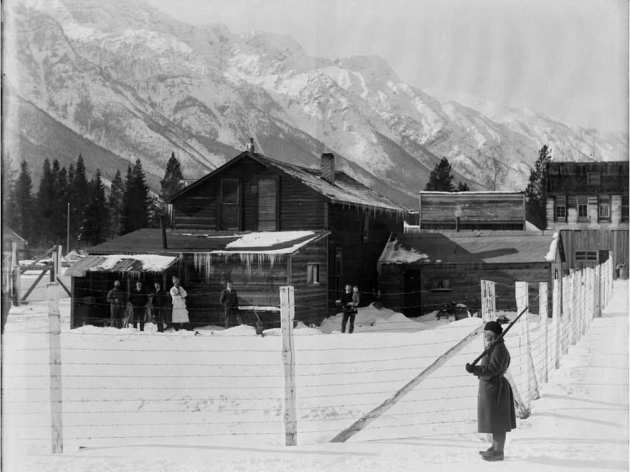
At the dawn of the First World War, the Canadian government rounded up more than 8,000 mostly single men of German, Austrian and Ukrainian ancestry, sending them to 24 concentration camps scattered across the country. One such camp was at Morrissey, not far from Fernie.

As a civilian prisoner of war, Doskoch was moved frequently, eventually incarcerated in five camps between 1914 and 1920 and only released after most others prisoners were long gone.

“He was quite a rabble-rouser apparently and refused to take internment lying down,” said Sarah Beaulieu, an archeology PhD candidate at Simon Fraser University. “He was very angry about being interned.”

Beaulieu is pursuing an excavation at the site of the Morrissey camp this summer. She has already detected an escape tunnel and recovered artifacts, including a barbed-wire crucifix.

Morrissey was regarded as a particularly barbaric experience, with abusive guards, solitary confinement and hard labour.

Bill Doskoch is one of the few prisoners from the Morrissey Internment Camp who talked about his experiences. Here, in 1918, Doskoch is in the back row, fourth from the left, with his collar turned up. FERNIE HISTORICAL SOCIETY / PNG

A report by Consul of Switzerland Samuel Gintzburger, from 1917, notes that prisoners were “absolutely destitute” and were subject to “physical coercion” at the hands of guards. Protests were frequent.

“It was notorious for mistreatment of prisoners,” Beaulieu said. “At the time it received several note verbales (diplomatic protests) from Germany threatening retaliation on Canadian and British prisoners of war should the conditions at Morrissey not improve.”

Beaulieu learned of Bill’s wartime adventures from his daughter, Anne Sadelein, who resides in Edmonton where Doskoch settled in the 1920s. He remained a union activist throughout his life.

“My father spent a lot of time in black holes for writing letters and inciting stop workages or being political,” said Sadelein.

Doskoch was often at the centre of disputes over prisoner labour in the camps.

The Canadian government misinterpreted a clause from the 1907 Hague Convention on the rules of war so that the civilian PoWs could be used as labourers building roads and parks.

Some archival records note that prisoners were paid 55 cents a day for voluntary labour, but that 30 cents a day was deducted to pay for their room and board in the camp.

When civilian internees became aware that the clause in The Hague Convention only applied to military PoWs, Doskoch copied out the entire convention by hand as a reminder of their rights, according to Sadelein.

“He knew that they had been illegally arrested and wanted to do something about it,” said Beaulieu. “Most of the prisoners were civilians with no military connections who had come to Canada to settle the Prairies.”

Morrissey had been a coal-mining camp between 1902 and 1904, but was a ghost town when the federal government converted it into a concentration camp on Sept. 28, 1915. The Canadian government would later use the term internment to avoid the association with German concentration camps after the Second World War.

“They were very badly fed: fat and potatoes,” said a female descendant of a Ukrainian Morrissey internee interviewed by Beaulieu. “No vegetables, fruit or milk and these were young men — a lot of them in their early 20s. They had to work very hard. Ten hours a day sometimes. I can’t say that it was a nice, kind camp.”

Beaulieu has the names and faces of a few prisoners. Unfortunately, in 1954, a lot of the archival material was destroyed by the Canadian government because they had no place to store it. So very little is known about the operations of these camps today.

“When I first came to do interviews people weren’t really aware of the camp at Morrissey and the few that did were under the impression that it had been a sanctuary for destitute foreigners during the First World War,” she said.

A guard watches the fence in winter at the Morrissey Internment Camp. LIBRARY AND ARCHIVES CANADA / PNG

The internees have largely stayed in the shadows, even after the government offered to pay them for their labours. Though prisoners were supposed to be paid for their labour on release, those monies were never given to them. Most were too afraid to fight at the time and were loathe to apply for it when it was available in 1929 because it would have revealed to their families that they had been prisoners.

Interviews and documents being collected by academics such as Beaulieu are being gathered and organized by the Canadian First World War Internment Recognition Fund, which is also funding her work in Morrissey.

Source: B.C. was home to First World War internment camp for Europeans | Vancouver Sun

The Modern Newsroom Is Stuck Behind The Gender And Color Line : NPR

Unfortunately, we do not appear to have comparable data regarding diversity in Canadian newsrooms, where likely many of the same concerns would apply:

In many of today’s newsrooms, women and journalists of color remain a sliver of those producing and reporting stories. According to studies from the American Society of News Editors, the Women’s Media Center and the advocacy group VIDA, gender and ethnic diversity in newsrooms have hardly improved in the last decade despite increasing demand for more inclusive journalism in the current round-the-clock news cycle.

Nationally, Hispanic, black and Asian women make up less than 5 percent of newsroom personnel at traditional print and online news publications, according to 2016 data from the American Society of News Editors. The organization stopped requiring that news outlets reveal their identities in an attempt to increase participation in the yearly census. Numbers from 433 news organizations that participated in 2015 and 2016 show a 5.6 percent increase in the minority workforce, now at 17 percent at print and online news sites. But the numbers lag far behind demographic shifts in a country where nearly 40 percent of Americans are part of a minority group. Around the country, local newsrooms remain largely white by most measures. (In the spirit of full disclosure, NPR’s latest diversity figures can be found here.)

In March, the Women’s Media Center released its annual report on gender representation in the media (print bylines, internet, broadcast and other outlets). The latest numbers show a tiny change — 37.7 percent of the news was credited to female journalists, according to an analysis of over 24,000 pieces of news content. Major national outlets continue to be dominated by men, and women actually lost representation in broadcast news television.

In a 2015 survey by the group VIDA: Women of the Literary Arts, magazines with a focus on news and culture, such as The New Yorker, The New Republic and Harper’s, don’t fare any better. VIDA’s numbers show that women of color (and minorities in general) are virtually absent from the political commentary and investigative journalism these magazines provide. Though nearly 20 percent of the country’s population is Hispanic, very few of these publications had a single VIDA respondent self-report as Hispanic.

The implications of this generalized absence are manifold, and begin at the storytelling level.

A September 2016 piece by Lonnae O’Neal in The Undefeated, a site that covers how sports, race and culture intersect, described how NFL Network reporter Steve Wyche — one of the country’s leading African American national sports reporters — covered the story of Colin Kaepernick’s refusal to stand for the national anthem as an act of protest. His refusal, Wyche learned, formed part of a larger outcry over police violence against black men and women. Initial reports by other outlets focused on Kaepernick as divisive and a potential distraction in the locker room. For O’Neal, who analyzed the coverage with a racial lens, the Kaepernick story raised questions “about why the country is more brown than ever but mainstream journalism is so white.”

O’Neal herself rose through the ranks as a Washington Post reporter and columnist for 24 years before joining The Undefeated. She sees her race as providing an added edge in stadiums filled with mostly black players. “Because I’m experienced, because I’m a woman, and because I’m African American, I can go right up to people and find an entry, a portal, a way to talk without layers and layers of translation,” she said. Her common background with her sources, the “cultural resonance” between them, won’t always carry the day, “but it goes a long way.”

For O’Neal, hiring women, minorities and generally journalists of diverse backgrounds is not a luxury or a matter of “different optics,” or political expedience, as recruiters typically approach the matter, but essential to the profession’s mission and longevity. A typical white, male-centric newsroom, means critical stories will continue to go unreported and news analysis will remain unbalanced.

“We need new and different lenses, people of different backgrounds thinking at the table. We’ll only be richer for having that. Why is it so hard to set as an intention? Because many folks are going to be uncomfortable with what that looks like,” O’Neal said.

In the meantime, old narratives about race and identity don’t change. Latinos are mostly U.S.-born and consist of dozens of sub-groups. But, says Dana Mastro, a professor in the department of communication at the University of California in Santa Barbara, they’re seen only in one frame — immigration.

“The idea that there are other narratives just doesn’t pan out,” said Mastro, who researches racial and ethnic stereotyping in the media with a particular interest in Latinos. “It’s immigration and almost entirely threat-driven,” she said. “You just don’t see other themes emerge, and Latinos are almost exclusively portrayed as undocumented Mexicans,” she added.

Source: The Modern Newsroom Is Stuck Behind The Gender And Color Line : Code Switch : NPR

How the alt-right weaponized free speech

Refreshing and needed historical perspective on the free-speech movement and its co-opting by the right:

Indeed, Berkeley’s far-right agitators routinely invoke the memory of activist Mario Savio, the standard-bearer of the FSM, going so far as to declare themselves “the new Free Speech Movement.” This, while boasting of the endorsement of America’s highest office: “The more abuse and harassment we suffer,” warned the Berkeley College Republicans in a joint op-ed following Yiannopoulos’s cancelled appearance, “the more controversial speakers we will invite to campus. We proceed fearlessly because we know we have the president of the United States on our side.”

Indeed, in February, President Trump implicitly threatened to withhold federal funds from the university for failing to cater to Yiannopoulos who, amid the renewed controversy involving Coulter, has announced a comeback, sensing an opportunity to regain status and rehabilitate his ego—not to mention, profit mightily.

“We will give out a new free speech prize—the Mario Savio Award—to the person we believe has done most to protect free expression at UC Berkeley and its surrounding area,” proclaimed Yiannopoulos in promoting Milo’s “Free Speech Week.” “Each day will be dedicated to a different enemy of free speech, including feminism, Black Lives Matter and Islam.”

This co-opting of Savio’s legacy is a calculated provocation, one that his son Daniel calls “some kind of sick joke.” Savio led the FSM to victory in ending all restrictions to political activity on campus, which included the rights of orators from all political perspectives. “Rather than ban speakers he disagreed with, Savio debated them, whether they were deans, faculty, the student-body president, or whoever,” wrote Robert Cohen, author of Freedom’s Orator: Mario Savio and the Radical Legacy of the 1960s. “And this was the spirit not only of Savio but of the FSM, which had an almost Gandhian faith that through open discourse anyone had the potential to be won over” to a cause.

Savio was a veteran of the civil-rights movement, and as Cohen details, “sought to convince the editors of the student newspaper there that their use of the term “n—-r” in the paper was hurtful and irresponsible … Savio did not deny students had the right to print what they chose, but asked that they reach out to their black classmates and reflect on whether in the future they could be more thoughtful about the impact their words had on the campus community.”

The FSM’s quest was decent and honest—it was about engaging in open, rigorous debate and the exchange of ideas, no matter how inflammatory or loathsome, with a goal of making progress. What’s happening now isn’t about discussion: it’s pure political tribalism. People like Coulter and Yiannopoulos aren’t brought to campus to contribute substance—hearing either speak for a few minutes quickly puts lie to claims of their brilliance. They are skilled antagonists who can reliably incite backlash from a perceived enemy; they are, as Dorian Lynskey of The Guardian describes, the “outcome of a grotesque convergence of politics, entertainment and the internet in which an empty vessel can thrive unchecked by turning hate speech into show business.”

Where trauma, real or perceived, has become a sort of morbid currency in some circles of the left, often used to justify unworkable demands of individuals and institutions, the self-described “politically incorrect”—adults who consider childlike behaviour to be heroically subversive—are in the grievance trade. Because each provocation inflates the value of a carefully-crafted persona, victimhood is actively—and ironically—sought; they prey on the vulnerable, ridicule targets of well-documented discrimination, then cry persecution when met with resistance.

While it’s vital to uphold and protect the right of all speech on campus—even the most abhorrent rhetoric from the ranks of the alt-right—it’s crucial to identify this new game being played and, as Savio desired, critically judge “whether the speech … is really free, or merely cant.”

And it matters that influential voices, while rightly demanding institutions uphold free speech norms, explicitly make that distinction.

Source: How the alt-right weaponized free speech – Macleans.ca

Indonesians Seek to Export a Modernized Vision of Islam – The New York Times

I think the notes of caution by the experts cited are valid.

That being said, this initiative will likely be useful in broadening the discussions and debates regarding religion and minority rights, and understanding of Islam.

But I am always cautious about “exporting” models. Each country’s geography, history, demographics is different, and thus policies and programs need to take these differences into account, but within an overall human rights perspective:

Leaders of Nahdlatul Ulama’s youth wing, known as Ansor, say that elements of Shariah, which Muslims consider divine law, are being manipulated by groups like the Islamic State and Al Qaeda to justify terrorist attacks around the world, invoked to rally fighters to battle in the Middle East and elsewhere, and distorted by movements that seek to turn Islam into a political weapon.

“The classical Islamic perspective is dominated by views that position non-Muslims as enemies or, at best, as suspicious figures not worthy of trust,” H. Yaqut Qoumas, Ansor’s chairman, said in an interview.

“Fiqh,” or the body of jurisprudence that applies Shariah to everyday life, “explicitly rejects the possibility of non-Muslims enjoying equal rights with Muslims in the public sphere, including the right to occupy certain positions,” he said. “This classical Islamic perspective continues to possess an extraordinarily powerful authority in the eyes of most Muslims, and is regarded as standard, orthodox Islam.”

Some interpretations of classical Islamic law teach that Muslims have a duty to seek out and fight Christians, Jews and followers of Zoroastrianism until they either convert to Islam or submit to its rule and pay a head tax.

These interpretations have been enthusiastically adopted by the Islamic State.

Also, some interpretations of classical Islamic law, and of certain passages in the Quran, forbid Muslims from having non-Muslim political leaders. Medieval Islamic jurisprudence, still regarded as valid by some, is used to justify slavery and the execution of prisoners.

Photo

A 2006 painting by the Dutch artist John van der Sterren depicts Indonesia’s founding leader, Sukarno, cradling an independence fighter in the 1940s. The rebel’s Christian cross has made the image a symbol of the drive to reinterpret Islamic law.CreditNahdlatul Ulama

Some predominantly Muslim countries have been moving to reinterpret Islamic law within their borders, with some sending delegations to a 2016 international conference of scholars, religious leaders and clergy members in Morocco on protecting the legal rights of religious minorities living among them.

The Indonesian initiative, however, aims to directly approach governments around the world, both Muslim-majority and otherwise, as well as at the United Nations, to achieve a global consensus on reforming what it views as archaic interpretations of Islam.

“The challenge we face is not confined to religious views that emerged through an intellectual process conducted a thousand years ago. We are also confronted by religious and political authorities whose institutions are deeply intertwined with these views, and thus continue to inculcate such teachings among each new generation of Muslims,” Mr. Yaqut said.

“There’s a whole library of interpretations of jihad — Muslims must fight non-Muslim states to expand territory, for example,” said Ruud Peters, an emeritus professor of Islamic law at the University of Amsterdam. “But since the 19th century, there have been interpretations followed by many Muslim states to only defend against attack from non-Muslim states.”

Another problem, scholars and experts said, is the cultural differences among predominantly Muslim countries in interpreting Islamic law. Indonesia, in Southeast Asia, for example, practices one of the most liberal forms of Islam in the world, while simultaneously having a secular government and Constitution, with full rights for Christians, Hindus, Buddhists and other religious minorities.

Saudi Arabia, in the Middle East, however, practices the conservative Wahhabi Islam, and its government does not officially recognize any of its citizens as being Christian.

“If you want to have only one universal interpretation, you have to deal with the cultural differences and also find an international central authority. This is impossible,” said Abdel Rahman El Haj, a professor at Ankara Social Sciences University in Turkey.

He added that while Indonesian Islamic leaders had good intentions, substantive changes would be successful only if support for them emerged within the Arab world.

The Ansor initiative is seen as another move by young Muslims in Indonesia, as well as Islamic clerics and other Muslim organizations in Europe and the Middle East, to push back against extreme, conservative interpretations of Islam.

“The general impression we sometimes get in the West about Islam is one of radicalization,” said Raphaël Lefèvre, a nonresident political Islam scholar at the Carnegie Middle East Center, “while an equally if not more important trend is the ongoing struggle by Muslim clerics to redefine what Islamic law has to say about society and politics in ways deemed more compatible with modern life.”

Diversity Dividend: Canada’s Global Advantage

The report by Bessma Momani and Jillian Stirk has now been posted on their website.

Their main recommendations, largely familiar, focus on domestic policies. Not much that is new, but nevertheless worth repeating and been given broader distribution.

They have been holding a series of cross-country roundtables and discussions to share the results and follow-up the earlier round of consultations that helped inform report.

Source: Diversity Dividend Report

Des Africains se disent exclus de l’enquête sur le racisme systémique | Le Devoir

I am not sure that the experiences with systemic racism of sub-Saharan Africans is that different from Haitians, although given that Haitians have been in Quebec longer, there may be a difference.

But the article’s reporting of the criticism focusses purely on the representation issue, with no examples of any substantive difference in lived experiences:

Des Québécois originaires de l’Afrique subsaharienne déplorent l’absence de membres de leur communauté au sein du comité-conseil sur le racisme et la discrimination systémique, créé il y a un mois par le ministère de l’Immigration. « Un manque flagrant », qui doit être corrigé, déplore le Comité d’initiative provisoire des Afro-Québécois (CIPAQ), qui signe une lettre ouverte pour réclamer que leur voix soit entendue dans une « étape aussi cruciale du processus. »

« C’est surprenant que la catégorie la plus touchée en matière d’intégration à l’emploi ne soit pas représentée à ce comité », s’étonne Doudou Sow, consultant formateur en intégration professionnelle et gestion de la diversité et membre du CIPAQ. Il fait ainsi référence à une étude publiée en 2012 par la Commission des droits de la personne qui révélait que, sur le marché du travail, les noms à consonance africaine étaient les plus discriminés (42 %), comparativement aux noms arabes (35 %) et latino-américains (28 %).

Présidé par Maryse Alcindor, première sous-ministre noire, le comité-conseil, qui se penchera sur les modalités de la consultation sur le racisme et la discrimination systémique, compte 14 membres, qui sont pour la plupart des universitaires haïtiens d’origine ou issus de la communauté arabo-musulmane. Tout en saluant l’initiative, certaines personnes nommées à ce comité ont néanmoins souligné le fait qu’il y ait effectivement beaucoup d’universitaires et aucun représentant des 85 organismes ayant réclamé un tel exercice, à part les quatre porte-parole qui en avaient fait publiquement la demande au début de l’année.

Basé sur l’« expertise »

Mise au fait de ces critiques, la ministre de l’Immigration a rappelé que le rôle du comité n’est pas de « lutter » contre le racisme et la discrimination, mais plutôt de « conseiller » le gouvernement sur la consultation prévue pour cet automne. « Le comité est composé notamment de chercheurs qui ont été choisis en fonction de leur expertise et de leur expérience », a indiqué l’attachée de presse de la ministre, Gabrielle Tellier. Les organismes seront plus tard invités à participer à la consultation elle-même, y compris des membres de la communauté subsaharienne.

Pour Doudou Sow, le fait que le ministère ait justifié que ses nominations ont été faites sur la base de « l’expertise » est un comble. « C’est l’arroseur arrosé. Le ministère met en place une commission qui prétend combattre, et à juste titre, les causes de la discrimination, mais tombe dans le même panneau. »

M. Sow est d’autant plus étonné qu’il est reconnu pour son expertise sur les questions de l’intégration au marché du travail — il travaille depuis longtemps sur le sujet et a écrit des livres — et qu’il avait même été pressenti par la ministre Kathleen Weil et sa garde rapprochée. « Je n’ai jamais eu de retour. Mais même si le gouvernement venait me voir demain pour m’inclure, je dirais non. Je ne veux pas que ce soit perçu comme un combat pour ma personne. Je le fais pour mes enfants et toute la prochaine génération. »

Paul Eid, sociologue spécialiste de l’immigration qui fait partie de ce comité-conseil, se veut rassurant. « Je ne travaille pas pour un groupe ou un autre. L’idée c’est de documenter les causes, et ça touche tous les groupes racisés », soutient-il. « Je crois que c’est la même chose pour tous les membres du groupe ».

Pas des Haïtiens

Mame Moussa Sy, du centre communautaire Bon courage de Place Benoit, est lui aussi déçu de la composition du comité-conseil. « Ça ne tient pas la route. Ça ne reflète pas la diversité », dit-il. Après avoir partagé son coup de gueule sur les réseaux sociaux, il a lancé une pétition qui a récolté environ 500 signatures jusqu’ici.

Certes, des Haïtiens siègent au comité-conseil, mais leur voix n’est pas celle des Africains subsahariens, explique-t-il. « Le scientifique, le professeur, l’intervenant haïtien qui est là, il sera toujours porté à prendre des exemples de son quotidien, de ce qu’il a vécu. Mais c’est très différent de ce qui se passe au Sénégal, au Congo », explique-t-il.

Source: Des Africains se disent exclus de l’enquête sur le racisme systémique | Le Devoir