Tillerson retreats from pledge to fill anti-Semitism envoy post | The Times of Israel

While I understand Tillerson’s arguments (Canada has had similar debates over special ambassadors/envoys in the past), the politics will be interesting to watch:

Secretary of State Rex Tillerson retreated from his department’s commitment to fill the post of envoy to combat anti-Semitism, saying the effort may be more effective without one.

“One of the questions I’ve asked is, if we’re really going to affect these areas, these special areas, don’t we have to affect it through the delivery on mission at every level at every country?” Tillerson said in testimony Wednesday to the foreign operations subcommittee of the US House of Representatives Appropriations Committee. “And by having a special envoy, one of my experiences is, mission then says, ‘oh, we’ve got somebody else that does,’ and then they stop doing it.”

Since Congress established the position with a 2004 law, the role of the envoy has been to train career State Department officers and diplomats in identifying and combating anti-Semitism and to encourage embassies and bureaus to more closely monitor anti-Semitism. The envoy has not functioned as a stand-alone entity but rather is part of the Bureau of Democracy, Human Rights and Labor, and supervises about five career State Department staffers.

European Jewish community officials have said that having an envoy has delivered a message to their governments that the United States is focused on anti-Semitism.

At the subcommittee hearing, Rep. Grace Meng, D-N.Y., asked Tillerson for a timeline for the hire. Earlier this year there were reports that the Trump administration, eyeing massive budget cuts to the State Department, planned to eliminate the role. National Jewish groups and Congress members expressed outrage, and in April a State Department spokesman told JTA that the department did not in fact plan to eliminate the position and was reviewing candidates to fill it.

Lawmakers have noted that because the role was created by statute, the Trump administration cannot eliminate the post. Tillerson said he would seek to persuade Congress to cut the position if he deems it necessary.

“Those that are mandated by statute, we will be back to talk with you about those as to whether we think it’s good to have it structured that way or whether we really think we can be effective on those issues in a different way,” he said at the hearing.

Rep. Nita Lowey, D-N.Y., the ranking Democrat on the foreign operations subcommittee, was appalled by the possibility of the position being eliminated.

“It is outrageous and offensive that Secretary Tillerson would even suggest appointing a Special Envoy for Monitoring and Combating Anti-Semitism is unnecessary, particularly given that his State Department committed to filling the post back in April,” she said in an email to JTA. “As reports of hate crimes against Jews continue to rise in the United States and around the world, it is essential that Secretary Tillerson fill the Special Envoy position immediately.”

Bipartisan legislation under consideration would enhance the position to ambassador level.

Source: Tillerson retreats from pledge to fill anti-Semitism envoy post | The Times of Israel

Australia: Coalition’s test likely to disadvantage those who need citizenship most | The Guardian

As the Australian government proceeds with its changes, the same issues raised by refugee advocates as in C-24:

Citizenship applicants will need to demonstrate a higher level of English proficiency if the government’s proposed changes to the Australian citizenship test go ahead.

Applicants will be required to reach the equivalent of Band 6 proficiency of the International English Language Testing System (IELTS).

To achieve Band 6, applicants must correctly answer 30 out of 40 questions in the reading paper, 23 out of 40 in the listening paper and the writing paper rewards language used “accurately and appropriately”. If a candidate’s writing has “frequent” inaccuracies in grammar and spelling, they cannot achieve Band 6.

Success in IELTS requires proficiency in both the English language and also understanding how to take – and pass – a test. The proposed changes will then make it harder for people with fragmented educational backgrounds to become citizens, such as many refugees.

How do the tests now work?

The current citizenship test consists of 20 multiple choice questions in English that ask about Australia’s political system, history and citizen responsibilities.

While the test does not require demonstration of English proficiency per se, it acts as an indirect assessment of language.

For example, the question “Which official symbol of Australia identifies commonwealth property?” demonstrates the level of linguistic complexity required.

The IELTS test is commonly taken for immigration purposes as a requirement for certain visa categories; however, the designer of the IELTS argues that it was never designed for this purpose. Researchers have argued that the growing strength of English as the language of politics and economics has resulted in its widespread use for immigration purposes.

Impact of proposed changes

English is undoubtedly important for participation in society but deciding citizenship based on a high-stakes language test could further marginalise community members, such as people with refugee backgrounds who have the greatest need for citizenship yet lack the formal educational background to navigate such tests.

The Refugee Council of Australia argues that adults with refugee backgrounds will be hardest hit by the proposed language test.

Data shows that refugees are both more likely to apply for citizenship and twice as likely as other migrant groups to have to retake the test.

Mismatched proficiency expectations

The adult migrant English program, where many adult refugees access English learning upon arrival, expects only a “functional” level of language proficiency.

For many adult refugees – who have minimal first language literacy, fragmented educational experiences and limited opportunities to gain feedback on their written English – “competency” may be prohibitive to gaining citizenship. This is also more likely to impact refugee women, who are less likely to have had formal schooling and more likely to assume caring duties.

Bar too high?

The challenges faced in resettlement, such as pressures of work and financial responsibilities to extended family, often combine to make learning a language difficult and, by extension, prevent refugees from completing the citizenship test.

Similar patterns are evident with the IELTS. Nearly half of Arabic speakers who took the IELTS in 2015 scored lower than Band 6.

There are a number of questions to clarify regarding the proposed language proficiency test:

  • Will those dealing with trauma-related experiences gain exemption from a high-stakes, time-pressured examination?
  • What support will be provided to help applicants study for the test?
  • Will financially disadvantaged members of the community be expected to pay for classes and materials to prepare for the citizenship test?
  • The IELTS test costs $330, with no subsidies available. Will the IELTS-based citizenship/language test attract similar fees?

There are also questions about the fairness of requiring applicants to demonstrate a specific type and level of English under examination conditions that is not required of all citizens. Those born in Australia are not required to pass an academic test of language to retain their citizenship.

Recognising diversity of experiences

There are a few things the government should consider before introducing a language test:

1. Community consultation is essential. Input from community/migrant groups, educators and language assessment specialists will ensure that the test functions as a valid evaluation of progression towards English language proficiency. The government is now calling for submissionsrelated to the new citizenship test.

2. Design the test to value different forms and varieties of English that demonstrate progression in learning rather than adherence to prescriptive standards.

3. Provide educational opportunities that build on existing linguistic strengths that help people to prepare for the test.

Equating a particular type of language proficiency with a commitment to Australian citizenship is a complex and ideologically loaded notion. The government must engage in careful consideration before potentially further disadvantaging those most in need of citizenship.

Source: Coalition’s test likely to disadvantage those who need citizenship most | Sally Baker and Rachel Burke | Australia news | The Guardian

In Defense of Cultural Appropriation: Malik – The New York Times

Good piece by Kenan Malik, particularly this point:

“The accusation of cultural appropriation is a secular version of the charge of blasphemy. It’s the insistence that certain beliefs and images are so important to particular cultures that they may not appropriated by others.”:

Critics of cultural appropriation insist that they are opposed not to cultural engagement, but to racism. They want to protect marginalized cultures and ensure that such cultures speak for themselves, not simply be seen through the eyes of more privileged groups.

Certainly, cultural engagement does not take place on a level playing field. Racism and inequality shape the ways in which people imagine others. Yet it is difficult to see how creating gated cultures helps promote social justice.

There are few figures more important to the development of rock ’n’ roll than Chuck Berry (who died in March). In the 1950s, white radio stations refused to play his songs, categorizing them as “race music.” Then came Elvis Presley. A white boy playing the same tunes was cool. Elvis was feted, Mr. Berry and other black pioneers largely ignored. Racism defined who became the cultural icon.

But imagine that Elvis had been prevented from appropriating so-called black music. Would that have challenged racism, or eradicated Jim Crow laws? Clearly not. It took a social struggle — the civil rights movement — to bring about change. That struggle was built not on cultural separation, but on the demand for equal rights and universal values.

Campaigns against cultural appropriation reveal the changing meaning of what it is to challenge racism. Once, it was a demand for equal treatment for all. Now it calls for cultures to be walled off and boundaries to be policed.

But who does the policing? Every society has its gatekeepers, whose role is to protect certain institutions, maintain the privileges of particular groups and cordon off some beliefs from challenge. Such gatekeepers protect not the marginalized but the powerful. Racism itself is a form of gatekeeping, a means of denying racialized groups equal rights, access and opportunities.

In minority communities, the gatekeepers are usually self-appointed guardians whose power rests on their ability to define what is acceptable and what is beyond the bounds. They appropriate for themselves the authority to license certain forms of cultural engagement, and in doing so, entrench their power.

The most potent form of gatekeeping is religion. When certain beliefs are deemed sacred, they are put beyond questioning. To challenge such beliefs is to commit blasphemy.

The accusation of cultural appropriation is a secular version of the charge of blasphemy. It’s the insistence that certain beliefs and images are so important to particular cultures that they may not appropriated by others. This is most clearly seen in the debate about Ms. Schutz’s painting “Open Casket.”

In 1955, Emmett Till’s mother urged the publication of photographs of her son’s mutilated body as it lay in its coffin. Till’s murder, and the photographs, played a major role in shaping the civil rights movement and have acquired an almost sacred quality. It was from those photos that Ms. Schutz began her painting.

To suggest that she, as a white painter, should not depict images of black suffering is as troubling as the demand by some Muslims that Salman Rushdie’s novel “The Satanic Verses” should be censored because of supposed blasphemies in its depiction of Islam. In fact, it’s more troubling because, as the critic Adam Shatz has observed, the campaign against Ms. Schutz’s work contains an “implicit disavowal that acts of radical sympathy, and imaginative identification, are possible across racial lines.”

Seventy years ago, racist radio stations refused to play “race music” for a white audience. Today, antiracist activists insist that white painters should not portray black subjects. To appropriate a phrase from a culture not my own: Plus ça change, plus c’est la même chose.

A closer look at the rise in hate crimes in Canada

Good to see wide coverage of the latest hate crimes report. Of interest are the comments of NCCM on the increase in the number of hate crimes against Canadian Muslims (Muslim group urges Ottawa to speed up release of hate-crime statistics):

The National Council of Canadian Muslims connected the anti-Muslim bias to a backlash over two terror attacks in Paris in 2015. But the group also singled out Conservative Party election campaigning under former Prime Minister Stephen Harper.

“The Canadian Muslim community bore the brunt of sinister political rhetoric surrounding the federal election, which painted Muslims as terrorists or terrorist sympathizers, as well as being anti-woman,” council vice-chairman Khalid Elgazzar said at a press conference on Parliament Hill.

In an interview, Mr. Elgazzar referred to Conservative pitches in favour of “snitch lines” for so-called barbaric cultural practices, as well as a ban on face veils at citizenship ceremonies.

“Words matter and those words had an impact,” he said. “There was an immediate uptick in terms of incidents of hate being reported to us.”

The Statscan data indicate that hate crimes targeting Muslims in Canada rose to 159 incidents, a 61-per-cent spike over 2014. Jewish people remain the most targeted religious minority in Canada, though reported anti-Semitic incidents declined in 2015 over the previous year, the federal agency said.

Meanwhile, the percentage of women targeted by violent hate crimes increased because of a hike in the number of victimized women in the Jewish and Muslim communities. Over all, the sharpest rise in hate crimes was in Alberta, where officials have already noted an increase in total crime due to the province’s economic downturn.

Still, the true picture of hate in Canada is probably darker than the numbers released on Tuesday suggest. Statscan said the figures “likely undercounts” the real extent of hate crime in Canada because not all crimes are reported to police.

The two-year lag in releasing the figures is problematic at a time when Muslims feel the effects of turmoil linked to global radicalization, the presence of far-right groups in the West and the anti-Muslim rhetoric adopted by U.S. President Donald Trump.

Mr. Elgazzar’s organization has received an influx of complaints about anti-Muslim incidents this year, but they won’t be reflected by Statscan until 2019, he said. The data released on Tuesday are already two years old.

“You can’t build a case without evidence, and the evidence we have is stale,” he said. “It’s 2017 and I’ll tell you we’re having a pretty rough year. But we’re only going to hear about it in 2019.”

I suspect that international news events were a more important factor than the previous government’s playing identity politics (no excuse). Another possible factor, hard if not impossible to measure, is the degree to which Canadian Muslims are more willing to report hate crimes to the police, which has been an issue in the past. Higher numbers may reflect in part better Muslim-police relations.

In terms of timelines required to produce these reports, it would be nice, and should be possible, to have a one-year time lag rather than 18 months as at present, while ensuring the necessary data integrity and consistency.

One of the better overviews, with the relevant charts (just comparing the past two years compared to my eight year comparison The Daily — Police-reported hate crimes, 2015 (with annual 2008-15 data)):

The number of hate crimes in Canada jumped five per cent in 2015 from the year before, according to a Statistic Canada report released Tuesday.

The report looked at a variety of hate-crime statistics—from crime motivations and violations to the demographics of victims and the accused.

In total, 1,362 hate-crimes were reported across the country that year. To put that in perspective, there were nearly two million criminal incidents reported to police in the same year.

An increase in hate-crimes based on religion and race

Two major factor explain the increase—an uptick in religiously-based and race-based hate crimes. Nearly 50 per cent of all hate crimes reported in Canada in 2015 were motivated by hatred of race or ethnicity.

The largest increase in religiously-based hate crimes was against Muslims (an increase of 61 per cent to 159 incidents) and Catholics (a 57 per cent increase to 55 incidents). Jewish people faced the highest level of religiously motivated hate crimes (178 incidents) despite seeing a 16 per cent drop over the two years.

Hate crimes targeting Blacks were still the highest of all racially or ethnically motivated crimes in 2015 (224 incidents), though that was down slightly from the year before.

Hate crimes targeting sexual orientation fell by nine per cent between 2014 and 2015.

Violent hate crimes also increased

Violent hate crimes increased 15 per cent from 2014 to 2015, accounting for more than two-thirds all police-reported hate crimes. The most common types of violent hate-based crimes were assaults, which jumped13 per cent from the year before, and uttering threats, up 22 per cent.

Most victims younger than 35 years old

Nearly 60 per cent of hate crime victims in 2015 were younger than 35 years old, according to the report—a similar percentage as in 2014.

When it comes to victims of hate crimes motivated by religion, however, victims were younger than the year before—people under 35 accounted for nearly 60 per cent of victims in 2015, up from around two-thirds the year before.

FINAL---Characteristics-of-hate-crime-victims,-Canada,-2015-(%)

People accused of religious hate crimes are most likely to be under 18 years old

In more than 22 per cent of religious hate crime incidents, young people aged 12 to 17 years old were the perpetrators. Meanwhile people under the age of 24 were responsible for slightly more than half of hate crimes that targeted sexual orientation.

FINAL---age-distribution-of-persons-accused-of-hate-crimes-nationally,-2015--ungrouped

In its report, StatsCan suggested that the actual number of hate crimes could be considerably higher than what it found. It estimated that in two thirds of cases of hate crime, victims don’t file complaints with police. The agency also cautioned that the reporting rates can also vary by the targeted population—for example, some demographic groups might be more willing to report than others.

Source: A closer look at the rise in hate crimes in Canada – Macleans.ca

Services d’immigration: hausse importante des vérifications policières | Montréal

The limits to the “sanctuary city” designations:

Malgré la désignation récente de Montréal à titre de «ville sanctuaire», les contacts des policiers avec les autorités fédérales pour vérifier le statut d’immigration de personnes interceptées pour diverses infractions ont augmenté de façon marquée depuis le début de l’année, et de 67% en moyenne depuis 2014.

Au cours de la même période, les policiers de Toronto ont réduit de 20% leurs vérifications auprès de l’Agence des services frontaliers du Canada (ASFC), tandis qu’elles ont été à peu près stables à Vancouver, révèlent des documents obtenus par La Presse en vertu de la Loi sur l’accès à l’information.

Selon l’assistant-directeur du Service de police de la Ville de Montréal, Daniel Touchette, cette hausse est due à l’amélioration des communications avec l’Agence des services frontaliers du Canada, notamment grâce à l’implantation d’une ligne téléphonique directe, dans le but de mieux combattre la criminalité ayant des ramifications internationales.

Même en cas de délit mineur, comme traverser la rue à un endroit interdit ou prendre le métro sans payer, ces vérifications peuvent entraîner l’arrestation d’un individu, sa détention et parfois son expulsion, si les policiers constatent qu’il se trouve au Canada illégalement. Il sera alors remis aux autorités frontalières.

Des victimes d’actes criminels qui font appel à la police pour être protégées peuvent elles-mêmes être arrêtées si les agents découvrent, en contrôlant leur identité, que leur statut n’est pas en règle, indique Daniel Touchette, confirmant ainsi ce que dénoncent les organismes qui viennent en aide aux sans-papiers.

Quelle protection offre la «ville sanctuaire»?

Cette question est au coeur des débats entourant la décision de Montréal de se donner le statut de «ville sanctuaire», en février dernier. Ce statut est censé permettre aux immigrants sans statut légal d’obtenir n’importe quel service municipal, incluant l’aide des policiers, sans crainte d’être dénoncés aux autorités frontalières.

Les policiers ne devraient jamais s’enquérir du statut d’immigration de qui que ce soit, sauf en cas d’infraction criminelle, selon les organisations qui travaillent avec les personnes sans papiers.

«On ne fait aucune vérification aléatoire de statut d’immigration, répond Daniel Touchette. Mais l’ASFC peut être un outil pour nous permettre de vérifier l’identité d’une personne. Et si on voit un mandat d’arrestation dans la banque de données, on a une obligation légale d’appliquer.»

Pourtant, l’Association canadienne des chefs de police (ACCP) affirme que les policiers ne se préoccupent pas du statut d’immigration, sauf en cas d’infraction criminelle ou autre raison valable. L’ACCP reconnaît que «les victimes, témoins et plaignants cherchent l’assurance que s’ils doivent faire appel aux services policiers, leur statut d’immigration ne sera pas une préoccupation», a-t-elle fait savoir dans une déclaration envoyée par courriel, tout en précisant ne pas avoir de position officielle sur la question des villes sanctuaires.

Source: Services d’immigration: hausse importante des vérifications policières | Isabelle Ducas | Montréal

Stereotypes hurting millennials’ chances of finding work in the public service, says report

Interesting report with reasonably practical recommendations. Government context requires innovation has to be balanced with accountability and stewardship, not to mention the political/PS interface which the recommendations largely acknowledge:

One of the most significant issues with the public sector’s “millennial problem” is the perception that young people don’t want to work in government, according to the report. In fact, says Deloitte, a consulting firm, the public service is attractive to those born between 1980 to 1995: there’s job stability and an opportunity for a work-life balance.

“Research instead shows that, as a whole, millennials want the same things and value the same things as other generations. Where they differ is in the ways they go about achieving their goals,” the report says.

Retaining millennials is also not a problem for the public service. The report found that from 2007-2014, the number of millennials leaving stayed consistently low. People aged 35 and younger were actually more likely to stay in the federal government than leave, according to the numbers.

That’s if, however, they can get hired.

Since the 2008 recession, the government’s Deficit Reduction Action Plan has lowered the number of people hired overall. “The number of external jobs posted in 2008 was about 5,000, but that number dropped to around 2,700 in 2016,” the report said.

Only about 3.5 per cent of applicants were hired during the Recruitment of Policy Leaders initiative which focuses on hiring young top talent into mid and senior level policy roles. In 2016, those who applied through the government’s post-secondary recruitment program had a one-per-cent success rate.

“Recruitment is so selective, the federal government accepts a lower share of applicants than elite Ivy League institutions like Harvard University,” says the report, which points out Harvard’s most recent academic year’s acceptance rate was 5.2 per cent.

The report also raises other issues affecting the hiring of young people, including the older generation in government jobs who are delaying retirement, as well as the length of time it takes to go through the hiring process and the lack of career growth. Younger generations tend to have more debt because of student loans and cannot afford to wait several months to be hired, says the report.

Solutions

The report offered several recommendations to address these issues.

* Streamline the hiring processes: Use more technology for online application forms to reduce printing and scanning, use electronic signatures for online forms and also create an easier process for security clearance.

* Recruitment: Make the hiring process more dynamic and prioritize different skill-sets that may be outside of the usual boxes ticked on application forms. Find new ways to identify top talent, which includes predictive analytics that determine what existing and future skills an applicant meets.

* Mobilizing jobs: Career growth and internal mobility is something millennials want, so offer several different job opportunities within the same organization across different sectors.

* Think outside the cubicle: Break down the barriers that isolate employees in the office to enhance communication, and enhance employees’ overall well-being. Create more dynamic workspaces that include options to work remotely.

* Incentivize innovation: Recognizing and encouraging innovation will benefit the public service. Teams that encouraged diverse perspectives often performed better, says the report. Feeling that creative ideas were recognized and welcomed was important to “would-be innovators.”

Several changes to attract millennials to the public sector are already underway or are being tested in pilot programs, according to the report.

Source: Stereotypes hurting millennials’ chances of finding work in the public service, says report | Ottawa Citizen

Cultural appropriation: Make it illegal worldwide, Indigenous advocates say

The pace of global negotiations is always slow but surprised that Canadian Indigenous peoples do not appear to have been consulted and are not in attendance:

Indigenous advocates from around the world are calling on a UN committee to ban the appropriation of Indigenous cultures — and to do it quickly.

Delegates from 189 countries, including Canada, are in Geneva this week as part of a specialized international committee within the World Intellectual Property Organization (WIPO), a United Nations agency.

Since it began in 2001, the committee has been working on creating and finishing three pieces of international law that would expand intellectual-property regulations to protect things like Indigenous designs, dances, words and traditional medicines.

The meeting takes place as concern grows worldwide about the rights of cultures to control their own materials. In the U.S. this week, designer Tory Burch agreed to change the description of one of her coats for women after Romanians protested that it had been described as African-inspired when it actually appropriated a traditional Romanian garment.

Speaking to the committee Monday, James Anaya, dean of law at the University of Colorado, said the UN’s negotiated document should “obligate states to create effective criminal and civil enforcement procedures to recognize and prevent the non-consensual taking and illegitimate possession, sale and export of traditional cultural expressions.”

Anaya said the document should also look at products that are falsely advertised as Indigenous-made or endorsed by Indigenous groups.

That would mean products like those in U.S.-based retailer Urban Outfitters “Navajo” line, Anaya said, including “Navajo hipster panties,” a “peace treaty feather necklace” and a “Navajo print flask.”

The Navajo Nation launched a legal battle against the company for trademark infringement in 2012. The case was settled out of court late last year.

Anaya is one of several Indigenous leaders at this round of negotiations who are questioning just how seriously some member states are taking the negotiations.

The committee has been working on three draft documents for 16 years, and member states are now going through them line by line.

It is a painstaking, slow process, and some Indigenous leaders say they are frustrated and disenchanted about the committee’s future.

“We are only halfway through 2017 and yet the number of occurrences of misappropriation happening to Indigenous Peoples in all regions of the world seems relentless with no relief in sight,” said Aroha Te Pareake Mead, a member of the Ngati Awa and Ngati Porou tribes in Wellington, New Zealand.

“We asked the international community to help deal with a problem that traverses international boundaries and are still waiting.”

Low participation

Mead said part of the problem is that Indigenous groups around the world have no idea about the committee’s work and often aren’t being consulted by member states.

“People at a national level don’t know what’s going on, and there aren’t many processes where you can get information about this or contribute to the positions that are being taken here.”

Mead also noted that WIPO has what she called “one of the lowest” rates of Indigenous participation.

“The issues being discussed at the [Intergovernmental Committee] are also being discussed in Indigenous organizations and communities all around the world on a regular basis. So why are there not more Indigenous representatives here?”

Indigenous participation ‘crucial’

There are Indigenous groups from around the world taking part in this round of negotiations, including groups from New Zealand, Kenya, Mexico, Colombia and the United States.

There is no Indigenous representation in the Canadian delegation.

Officials with Global Affairs Canada, Innovation, Science and Economic Development Canada and Canadian Heritage are taking part in this round of negotiations, but the lack of Canadian Indigenous representatives is drawing criticism from the Assembly of First Nations.

“The elders and knowledge keepers are the authorities who should oversee the creation of guidelines and a process for utilizing Indigenous knowledge in any activities,” Assembly of First Nations National Chief Perry Bellegarde told CBC in a written statement.

“We welcome the investigation of such topics on an international stage like the United Nations, but it’s crucial that Indigenous knowledge keepers are part of the dialogue.”

Source: Cultural appropriation: Make it illegal worldwide, Indigenous advocates say – North – CBC News

The Daily — Police-reported hate crimes, 2015 (with annual 2008-15 data)

The annual Statistics Canada hate crimes report. Three charts to summarize the latest report in comparison with previous years. The first chart shows the total number by category:

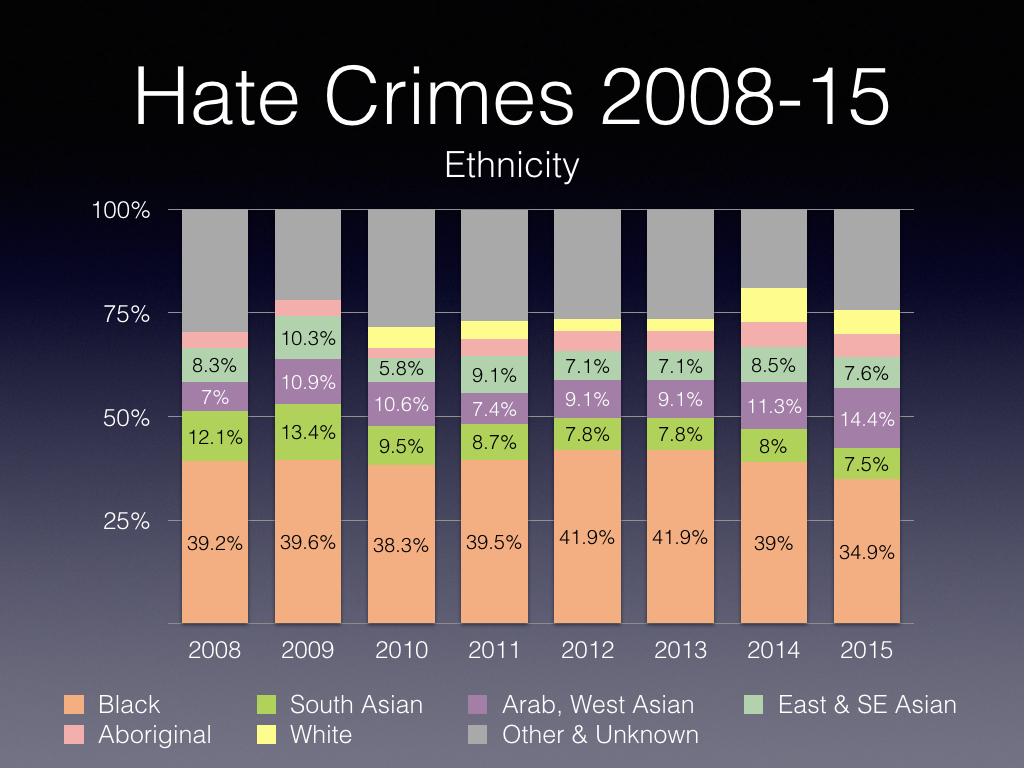
The second shows how the percentage of hate crimes against ethnic groups has shifted over time:

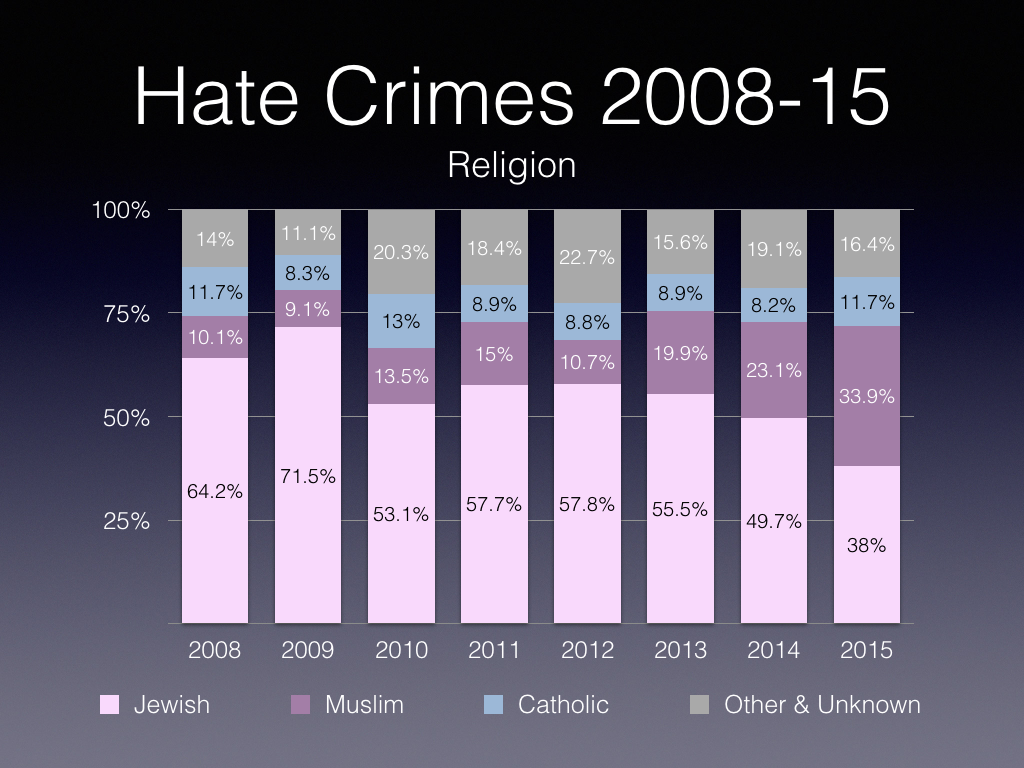
Lastly, this chart shows how religiously-motivate hate crimes have shifted, with the increase of hate crimes against Muslims notable:

Hate crimes rose by 5% in Canada in 2015, largely due to an increase in incidents targeting certain religious and ethno-cultural groups, specifically the Muslim population and Arabs or West Asians. For the year, police reported 1,362 criminal incidents that were motivated by hate in Canada, 67 more than the previous year.

These findings are included in the new Juristat article “Police-reported hate crime in Canada, 2015” released today.

Police-reported hate crimes refer to criminal incidents that, upon investigation by police, are found to have been motivated by hatred toward an identifiable group, as defined in subparagraph 718.2(a)(i) of the Criminal Code of Canada. An incident may be against a person or property and may target race, colour, national or ethnic origin, religion, sexual orientation, language, sex, age, mental or physical disability, among other factors. In addition, there are four specific offences listed as hate propaganda offences or hate crimes in the Criminal Code of Canada: advocating genocide, public incitement of hatred, willful promotion of hatred, and mischief motivated by hate in relation to religious property. Police determine whether or not a crime was motivated by hatred based on information gathered during the investigation and common national guidelines for record classification.

Overall, police reported 469 Criminal Code incidents in 2015 that were motivated by hatred of a religion, 40 more incidents than the previous year. These accounted for 35% of hate-motivated crimes reported in 2015.

Police-reported hate crimes targeting the Muslim population increased from 99 incidents in 2014 to 159 incidents in 2015, an increase of 61%. At the same time, the number of police-reported crimes targeting the Jewish population declined from 213 in 2014 to 178 in 2015. Hate crimes targeting the Jewish population accounted for 13% of all hate crimes, followed closely by hate crimes targeting the Muslim population (12%).

Approximately 10% of the population in Canada were part of a non-Christian religion in 2016. According to recent projections by Statistics Canada, the number of people in Canada with a non-Christian religion could almost double by 2036. Within this group, the Muslim, Hindu and Sikh faiths would see the number of their followers grow more quickly, although still representing a small portion of the population overall. In 2015, a number of police services increased outreach to ethnic groups, including Muslim communities. In addition, the National Council of Canadian Muslims made efforts to encourage reporting of hate crimes to police.

Increase in hate crimes against Arab and West Asian populations

From 2014 to 2015, the number of police-reported crimes motivated by hatred of a race or ethnicity increased 5%. Much of this increase was a result of more hate crimes targeting Arab and West Asian populations (+33%). Although down in 2015, crimes targeting Black populations remained the most common type of hate crime related to race or ethnicity (17% of all hate crimes). Overall, 48% of all police-reported hate crimes in 2015 were motivated by hatred of a race or ethnicity.

National increase in hate crimes driven by more incidents being reported by police in Alberta

In all, 8 of 10 provinces reported an increase in the number of police-reported hate crimes from 2014 to 2015. The increase was most pronounced in Alberta, where police reported 193 hate crimes compared with 139 the year before (+39%). This increase was primarily driven by a higher number of police-reported crimes motivated by hatred against the Muslim population (+12 incidents), Arab or West Asian populations (+10), Black populations (+9), and the Jewish population (+8). It should be noted that Alberta also reported an overall increase in their 2015 crime statistics.

In contrast, in Ontario, which historically records close to half the total number of hate crimes in Canada (46%), the number of police-reported hate crimes declined by 5% from 2014. The decrease in Ontario was primarily driven by fewer police-reported hate crimes motivated by hatred against the Jewish religion (-30 incidents) and against the Black population (-19).

From 2014 to 2015, police-reported crime motivated by hatred against the Muslim population increased in all provinces except Newfoundland and Labrador, Prince Edward Island, and Saskatchewan and Manitoba, where the totals remained virtually the same.

Number of hate crime incidents grows in four of Canada’s ten largest census metropolitan areas

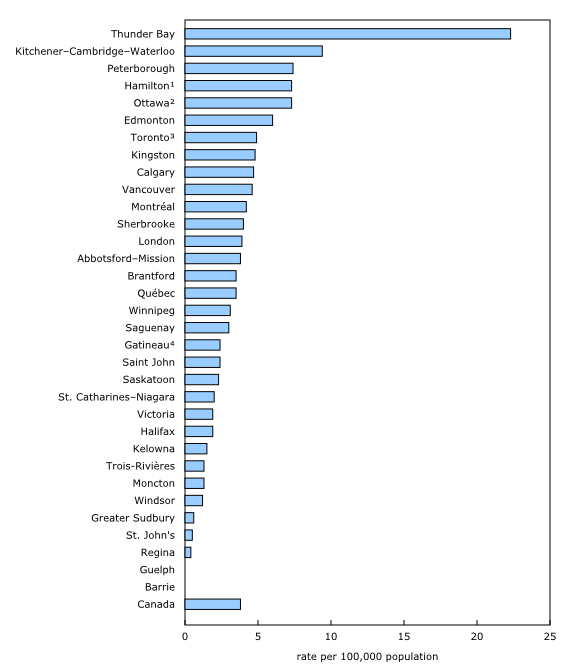
Chart 1  Chart 1: Police-reported hate crimes, by census metropolitan area, 2015
Police-reported hate crimes, by census metropolitan area, 2015

Chart 1: Police-reported hate crimes, by census metropolitan area, 2015

More than 80% of police-reported hate crimes in Canada occurred in census metropolitan areas (CMAs). The 10 largest CMAs in Canada, home to over half of Canada’s population, accounted for 71% of hate crimes in 2015. The three most populous CMAs of Toronto, Montréal and Vancouver together accounted for 43% of police-reported incidents in 2015.

Of the 10 largest CMAs in Canada, 4 reported more hate crimes in 2015 compared with the previous year, while 5 reported fewer such crimes. Vancouver reported the same number of incidents in 2015 as in 2014. The largest increases in hate crime incidents were reported in Edmonton (+45 incidents), Montréal (+39) and Kitchener–Waterloo–Cambridge (+23).

The increase in the Edmonton CMA was driven by more reported hate crime incidents against a race or ethnicity (+25) and against a religion (+17), mainly targeting the Muslim (+8) and Jewish (+7) populations. The number of hate crimes in Montréal was attributable to 33 more reported incidents targeting a religion. Of the additional incidents, 20 of these targeted the Muslim population. In the CMA of Kitchener–Waterloo–Cambridge, counts were primarily driven by more incidents targeting different races or ethnicities (+12) and religions (+10).

Increase reported in number of female victims of violent hate crimes

Females were more likely to be victims in incidents targeting a religion, and the presence of female victims in violent crimes motivated by hatred of a religion increased in 2015. That year, 53% of these victims were female, compared with 40% in 2014. The increase in female victims of religious hate crimes is attributed to an increase in female victims for Jewish and Muslim hate crimes from 2014 to 2015.

Victims of hate crimes targeting a sexual orientation are most likely to sustain an injury and know the accused

Police-reported hate crimes targeting sexual orientation declined 9% for the year, down from 155 incidents in 2014 to 141 incidents in 2015. They accounted for 11% of the hate crimes reported in 2015.

Unlike other types of hate crimes, almost 6 in 10 of reported crimes motivated by hatred of a sexual orientation were violent. This compares with 45% of anti-race or ethnicity offences, and 24% of anti-religion hate crimes. Just over 4 in 10 victims of hate crimes targeting a sexual orientation (42%) reported an injury, compared with victims of violent crimes motivated by hatred of a race or ethnicity (29%) and of a religion (12%).

Victims of violent hate crimes targeting sexual orientation were more likely to list the relationship as acquaintance or family member (47%). This compares with victims of violent crimes motivated by hatred of a race or ethnicity (36%) and of a religion (26%).

Violent hate crimes increase in 2015, but still account for less than half of hate crimes

Violent offences accounted for 38% of police-reported hate crimes in 2015. Violent offences included such things as assault, uttering threats, and criminal harassment. Overall, the number of violent hate crimes increased 15% from the previous year, driven by increases in common assault and uttering threats.

From 2014 to 2015, the total number of non-violent hate crime incidents increased by 5%. Mischief, which includes vandalism and graffiti, was the most commonly reported offence among police-reported hate crimes, accounting for 44% of all hate crime incidents in 2015.

Source: The Daily — Police-reported hate crimes, 2015

Australia: Labor disputes Peter Dutton’s claim party was briefed on citizenship changes

The politics are fascinating (policy not so much).

Not releasing the results of the consultations (Australia: Feedback on controversial citizenship changes to be kept secret) and now Labour contesting the degree of consultations …:

The shadow minister for citizenship, Tony Burke, has accused Peter Dutton of misleading journalists about having properly briefed Labor on the government’s proposed changes to citizenship laws.

Dutton, the immigration minister, announced on Sunday he would introduce legislation to parliament this week that made it harder to get Australian citizenship.

He said the Turnbull government wanted to toughen English language competencies, introduce a values test, extend the amount of time before permanent residents could apply for citizenship, and require people to demonstrate they had integrated into Australian society.

He called on Labor to support the legislation, and said Labor had been briefed on the bill.

“The Labor party will receive a copy of the bill this week,” he said on Sunday. “They’ve already had a briefing in relation to the bill.”

On Monday, Dutton then announced the legislation would give him power to overrule decisions by the Administrative Appeal Tribunalon citizenship applications that he didn’t think were in Australia’s national interest.

He called on Labor to support the bill again.

“It won’t pass through the Senate unless we can get Labor’s support, so that’s the key objective for this week, to speak with the Labor party,” he told Sky News.

“They’ve already had a briefing in relation to many of these matters and once they’ve seen the legislation this week they can ask questions.”

Labour response

But Burke said on Tuesday that Labor hadn’t been briefed on the policy details that appeared in media reports over the last couple of days.

He said the last briefing Labor received was before the 9 May budget, over a month ago.

“I was given a briefing on the 8th of May,” Burke said. “Was I briefed on the issues of the citizenship changes that were in the papers on the weekend? No, not at all. That’s all new. None of that existed as part of the proposal at the time of the briefing.

“[During that briefing], when I asked which parts of what I was being briefed on the government was committed to, the answer was none.

“When I asked, on the English-language test, how many people who currently apply for citizenship would pass the test, the government didn’t know.

“When I asked how many Australians would pass the test at a university level, the government didn’t know.

“Today I see in the papers, a claim that it is somehow linked to national security … once again, we’ve got changes here that have appeared in the paper that weren’t part of the briefing, that weren’t part of the government’s original proposal,” he said.

ICYMI – Enquête: le Montréal des sans-papiers

One of the relatively rare articles that I have seen regarding sans-papiers. And being undocumented, we have no good data on how many there are:

Nous les croisons sans les voir dans les rues de Montréal. Ils font le tri de nos rebuts, récurent les toilettes de nos cliniques médicales, passent l’aspirateur, la nuit, dans les couloirs de nos bureaux. Ils sont des dizaines de milliers, mais ils sont invisibles. Sans eux, l’économie de la ville subirait un dur coup, puisque ces travailleurs de l’ombre occupent les emplois dont personne ne veut. Sans le moindre filet de sécurité. Bienvenue dans le monde occulte des sans-papiers de Montréal.

Les travailleurs invisibles

Alors qu’un flot de demandeurs d’asile, apeurés par le national-populisme de Donald Trump, déferle à la frontière canado-américaine, alors que Denis Coderre déclare Montréal «ville sanctuaire», nous avons voulu mettre en lumière le quotidien des sans-papiers. Nous avons découvert que Montréal est encore loin d’être la terre d’asile proclamée par le maire. À bien des égards, elle est moins hospitalière que des métropoles américaines comme Los Angeles et New York, qui ont depuis longtemps adopté des politiques concrètes pour soutenir les sans-papiers sur leur territoire.

Montréal suivra bientôt les traces de ces villes américaines en offrant divers services et, surtout, en limitant au maximum la collaboration de ses policiers avec les agents d’immigration, a assuré le maire Coderre.

Mais ce n’est encore qu’un projet. Pour le moment, 70% des sans-papiers de la métropole n’arrivent peu ou pas à satisfaire leurs besoins personnels ou ceux de leur famille, révèlent les données préliminaires d’une étude menée par l’Institut de recherche en santé publique de Montréal. Près de la moitié d’entre eux manque carrément de nourriture. Et 40% craignent d’être déportés s’ils tentent d’obtenir des services publics.

Cette crainte pesante, omniprésente, les pousse à tolérer les abus de ceux qui profitent de leur vulnérabilité, en sachant parfaitement qu’ils n’ont pas le loisir de se plaindre.

Source: Enquête: le Montréal des sans-papiers | Isabelle Hachey | Enquêtes