Australia: Dumped Abbott-era changes resurface in Turnbull government’s citizenship bill

I had always thought that Australia granted birthright citizenship but apparently it does not, with these further restrictions moving it more distinct than the Canadian approach. Also surprised that citizenship had been granted to children of diplomats – not the case in Canada:

A crackdown on citizenship rights for children of migrants and foreign diplomats is among a number of dumped Tony Abbott-era proposals to have resurfaced in the Turnbull government’s citizenship revamp.

The government says the restrictions are necessary to stop parents using their children’s citizenship “as an anchor for family migration” or to win sympathy in their own migration disputes.

Under the proposed changes, children will no longer become citizens on their 10th birthday if, at any point, they were present in Australia unlawfully or re-entered Australia without a valid visa.

The same will also apply if a child’s parent lacked a “substantive” visa at the time of the child’s birth and was present in Australia unlawfully prior to the birth. That means a child born to parents on bridging visas would not automatically acquire citizenship.

And children born to foreign diplomats will no longer gain Australian citizenship on their 10th birthday.

However, the immigration department confirmed to Fairfax Media that in each case, if one of the child’s parents was an Australian citizen or permanent resident, the child would acquire citizenship in the normal way.

Source: Dumped Abbott-era changes resurface in Turnbull government’s citizenship bill

IRCC Datasets: What they say about government priorities

While preparing a presentation on how immigration, settlement, citizenship and multiculturalism worked together to facilitate integration, I accessed a broad range of the IRCC operational datasets on the government’s Open Data website. Intrigued by what was available and what was not, I reviewed all  227 unique datasets.

IRCC has, to its credit, invested considerable resources in these datasets for both internal and external use, having the fifth largest number of datasets on Open Data (excluding Statistics Canada). Moreover, these datasets are among the most widely used: 11 of the top 25 government datasets downloaded are from IRCC (April 2017).

IRCC demonstrated considerable flexibility and agility in the creation of datasets with respect to the recent wave of Syrian refugees, and the introduction of monthly operational statistics for key programs.

Part of my motivation was to assess the long-standing weaknesses in citizenship datasets, reflecting the relative lower priority of the citizenship program, and make recommendations for improvements.

Not surprisingly, the datasets reflect IRCC’s overall management emphasis on immigration as well as stakeholder demand: permanent and temporary resident datasets are 93.5 percent of the total. The datasets include:

  • Permanent residents (immigrants: economic, family and refugee classes): 110 datasets of 47.6 percent of the total.
  • Temporary residents (Temporary Foreign Worker Program: includes agricultural workers, live-in caregivers and others; International Mobility Program: includes those admitted under international services agreements like NAFTA, those under “Canadian Interests,” primarily under youth work exchange program and spousal employment; international students): 106 datasets or 45.9 percent.
  • Citizenship and passport: Six datasets or 2.6 percent.
  • Settlement services: Nine datasets or 3.9 percent.

IRCC datasets can be divided into four categories: ongoing and published on a regular basis (80.5 percent), archived or historical datasets (16.5 percent) and specialized datasets pertaining to international students (2.2 percent).

The majority are updated annually (54.1 percent), followed by the recent introduction of monthly reports (21.6 percent), quarterly (9.1 percent) and other (15.2 percent). Monthly and quarterly reports focus on operational data: the number of applications, approvals, approval rate and inventory.

Permanent and Temporary Residents

The comprehensive datasets for permanent and temporary residents include information regarding program and category, country of origin (whether processing source area, country of citizenship or country of birth), gender and age. Table 1 summarizes this information with most datasets having several variables (e.g., gender and age).Given the shared federal-provincial jurisdiction for immigration, and the increased and active role of the provinces in selection (i.e., the Provincial Nominee Program), it is no surprise that the majority of permanent resident datasets are broken down by province (52.7 percent), with 31.8 percent at the national level. To assist the planning and programmes of municipalities and service provider organizations for settlement services (integration), ten percent are at the Census Metropolitan Area (CMA) level, with a further 4.5 percent at the Census District (CD) level.

In terms of immigration class, over one-quarter are for refugees (27.3 percent), 21.8 percent for economic class, and 1.8 percent for family class, with 49.1 pertaining to all classes.

For temporary residents, who cannot access settlement services, the majority (60.4 percent) are at the national level, 34 percent at the provincial level, and 4.7 percent at the CMA level.

By program, datasets for international students form 23.6 percent, IMP and TFWP each at 21.8 percent and other ten percent, with 22.7 percent pertaining to all programs.

By and large, these datasets are coherent and consistent, with any variation reflecting program needs and a balance between the overall picture and greater detail (e.g., top 10 for refugees, top 20 for IMP or top 50 for students or all (various) countries of birth or citizenship).

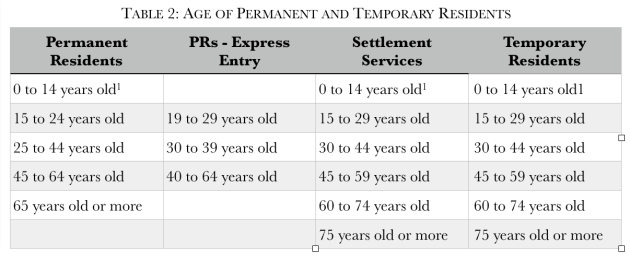
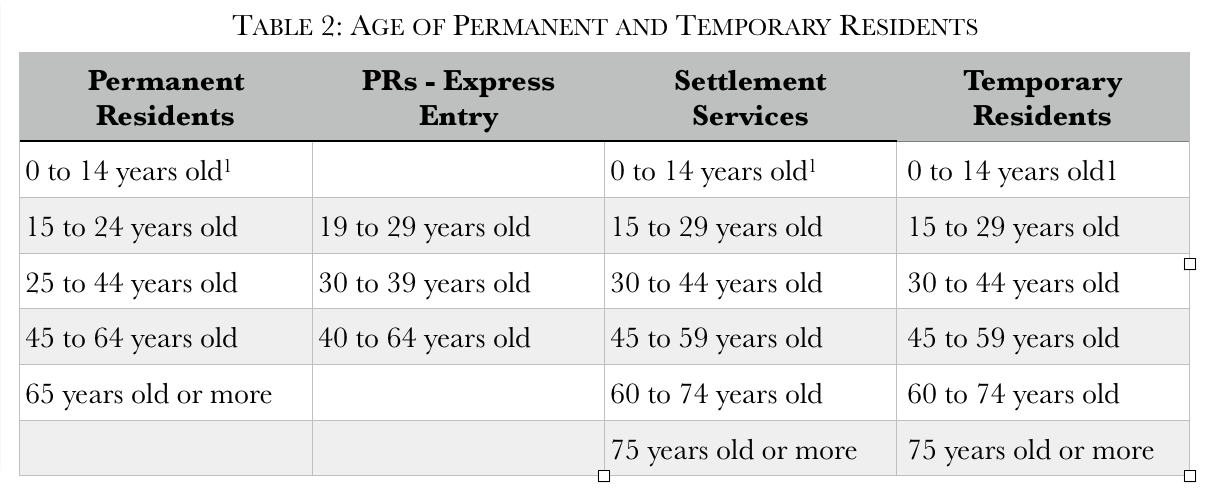
However, as shown in Table 2, the main difference concerns age data, with permanent residents focused more on younger immigrants, compared to temporary residents with a relatively greater focus on older workers. The difference in age cohorts between all permanent residents and those admitted under Express Entry likely has a policy justification. However, it is hard to understand the policy rationale for settlement services using the temporary resident breakdown given that only permanent residents can access these services. IRCC may wish to review whether there is a need for greater consistency and coherence regarding the age cohorts.
Citizenship, Passport and Settlement Services

There are only six datasets for citizenship (including one for passport) and nine for settlement services (three general, six for refugees). This reflects a number of reasons:

  • Citizenship has always been a secondary priority for IRCC at both the political and official levels. The program is under-funded and under-managed, as seen in the large and repeated fluctuations in the number of applications and new citizens, in sharp contrast to the number of new permanent residents which is more tightly managed to deliver on the annual levels plan (Chart 1);
  • The provinces have no role in citizenship and thus no data demands. Immigration stakeholders have limited interest in citizenship as they focus on immigration and refugee issues;
  • Passport is a new program to IRCC (previously was with Global Affairs Canada), with similarly low interest with outside stakeholders beyond basic operational data; and,
  • Service provider organizations (SPOs) and others that are interested is settlement services data have a wide range of useful permanent resident data that assists them in planning and operations. IRCC has responded to the needs of SPOs by providing general refugee settlement datasets as well as specific ones for Syrian refugees.

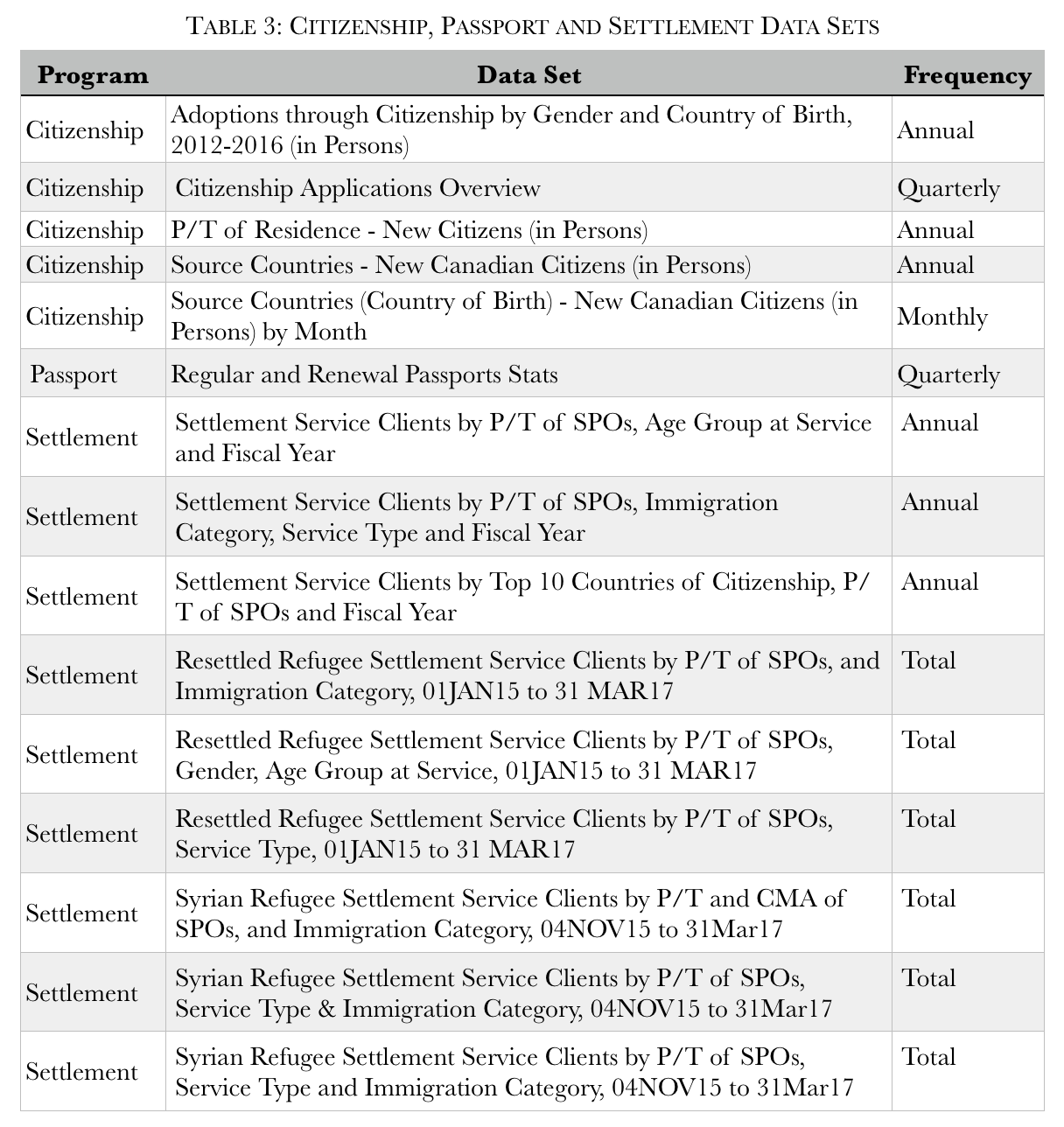
Table 3 lists these datasets:
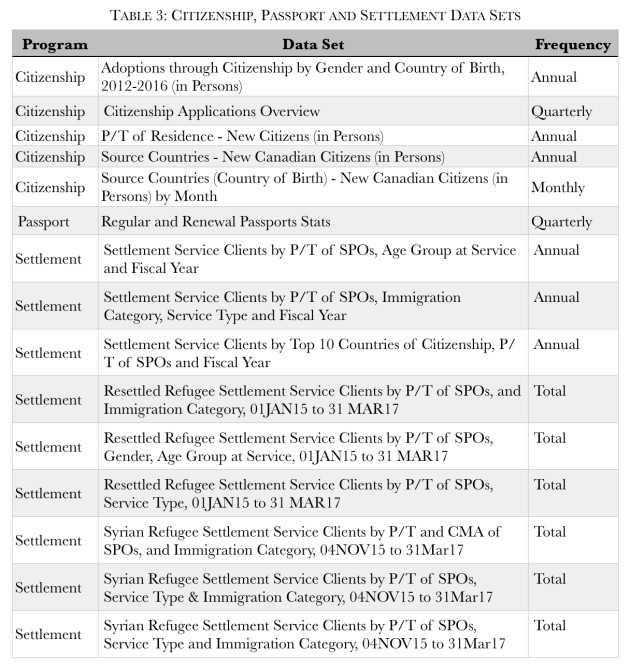
Moreover, these are more limited than other datasets. Annual permanent and temporary resident provide ten year data, adequate to assess trends and changes. In contrast, annual citizenship data covers only five years, settlement services data only two years and passport processing data is not even presented on a full-year basis, making it impossible to assess trends and the impact of policy and program changes. Citizenship datasets are even more limited with no gender and age breakdowns.

They are also updated less frequently than other datasets. Monthly datasets for permanent and temporary residents and settlement services include April 2017 at the time of writing (14 June); citizenship only until February 2017, and passport until December 2016.

Concluding observations

As noted, IRCC has invested considerable resources in developing and maintaining these datasets. In doing so, it has naturally enough reinforced its main focus on immigration statistics, responding to overall stakeholder interests, with minimal attention to citizenship.

The datasets appear to have grown organically as program changes created needs for new datasets. There appears to be potential to review the number and type to see if some datasets are no longer needed or duplicative (e.g., the introduction of monthly datasets may make quarterly ones necessary, are csv versions needed in addition to xls?).

Another area for improvement with respect to provincial datasets is to ensure that these all include national totals by program, as there is currently some inconsistency (e.g., Transition from Temporary Resident to Permanent Resident Status – Quarterly IRCC Updates tables versus the “Facts and Figures” series for both permanent and temporary residents).

Other areas for improvement at the Open Data level include, particularly those that are likely within IRCC control:

  • Order the dataset groupings alphabetically as it currently appears random, with related sets not grouped together;
  • Review grouping titles for clarity, particularly “Quarterly Updates” as the vast majority of datasets listed are a mix of annual and quarterly data;
  • Review all data set titles for consistency (e.g., temporary resident facts and figures are numbered, permanent residents are not; set a standard sequence: program/category then geography, then specific variables such as gender, age, education etc.; inclusion or not of ‘Canada’ in title; indicate specific immigration class if appropriate);
  • Advocate with other departments for a wider field for data set descriptions (appears to be only 37 characters) to make these more readable and shorten the wasted space of the titles for other fields (type, format, language, links);
  • Advocate for more than 10 dataset groupings per web page to minimize clicks.

My particular focus, however, is with respect to citizenship.

The lack of attention to citizenship, seen operationally in the wide swings of application and new citizens, requires greater management focus and attention. While IRCC has been very helpful in the provision of special runs, more comprehensive citizenship datasets on Open Data are needed. IRCC should ensure a minimum degree of consistency with permanent and temporary resident datasets that would help flag operational and policy concerns. For citizenship, passport, and settlement services, these would include:

  • 10-year time series data for citizenship and settlement services;
  • 1947-2016 long-term citizenship data (new citizens);
  • gender breakdown for citizenship (not just for adoptions), passport and settlement services (not just for refugees);
  • age breakdown for citizenship and passport, using the permanent resident age groups; and,
  • monthly citizenship applications by country of birth, not just monthly number of new citizens.

Should resources permit, a number of additional citizenship datasets should be considered to provide a more comprehensive understanding of how well the program is working with respect to integration and reinforcing the immigrant-to-citizen transition:

  • Annual data on the number and percentage of immigrants who have taken up citizenship within six years of landing in order to assess the recent naturalization rate, not the overall one that IRCC cites in its performance reports and elsewhere. While a target of 70 percent naturalization within six years of landing is proposed, more analysis might suggest a different target. Having this data collected and reported would inform the establishment of a meaningful performance standard; and,
  • Annual breakdown by immigration class of new citizens and approval rates by gender to assess the impact on each class of citizenship policies.

Given the importance of immigration, settlement, citizenship and multiculturalism to integration of newcomers and their children, good and comprehensive data is central to evidence-based policy making. IRCC has again commendably invested in such data with respect to immigration data but should address the above mentioned gaps in citizenship data to strengthen the management and oversight of the citizenship program.

What ‘Little Mosque on the Prairie’ Would Be Like Today: Zarqa Nawaz

Interesting reflections:

In 2007, with Muslim-Canadians still coming to terms with the changing cultural landscape after 9/11, writer Zarqa Nawaz invited audiences to visit a little mosque on the prairie—and a decade later, the messages in the famed CBC show still ring true.

“The content of Little Mosque on the Prairie is just as relevant as it was 10 years ago,” says Nawaz. “It’s just if I was going to make a show today I would have to take into consideration everything that’s happened since then and I would definitely have a show with a different tone and sense of comedy.”

That change is directly connected to the shift in how Muslims are being treated in Canada. Statistics Canada recently released a study showing a dramatic rise in hate crimes, particularly those against Muslims. Between 2014 and 2015, police reported a 61-percent increase in crimes specifically targeting Muslims.

…Nawaz says that the anti-immigrant, anti-refugee and anti-Muslim sentiments were happening when Little Mosque on the Prairie was in production and became part of the show. For instance, in reaction to sports leagues banning hijabs from the soccer pitch, the show created an episode where one of the main characters is not allowed to participate in a curling match because of her headscarf.

“We were sort of mimicking what was happening around us at the time, like the fear of ‘The Other,’ and trying to break it down through story,” says Nawaz.

A picture of the Muslim crowd sitting on the ground at the mosque from Little Mosque on the Prairie

(PHOTO: CBC STILL PHOTO COLLECTION/WESTWIND PRODUCTIONS)

If Little Mosque aired today, she says the same approach would apply, but the overall feel would need to be different, largely because of the way social media has changed how people talk about and react to the news.

“Things are moving fast, people react faster, people get angrier faster and you would have to have sort of that pace and that tone and the energy in that show,” she says, adding that thanks to how connected the world has become, Little Mosque is still being discovered by new communities around the world and particularly by those in Muslim-majority countries.

One scene that Nawaz would’ve wanted to dig into if Little Mosque was still on the air would be, of course, the U.S. election. When Stephen Harper was campaigning for prime minister, Nawaz says she remembers seeing her community become far more politically active “because they realized that their survival was at stake and they couldn’t just sit back on the sidelines and be spectators, they had to become involved.” What that meant was engaging with other minority groups who had a stake in the election, such as First Nations communities. If she was to create an episode that dealt with the recent U.S. election of president Donald Trump, she says she would show a similar sense of different minority communities coming together. She would also add in new characters.

“I mean the show would be more about people who are politically engaged,” she says. “I think that those stories would probably dominate and the stories about the rise of these fascist, racist groups in Canada and the United States would have to be part of it, and maybe even a character who’s part of that.”

Nawaz says that she would also include scenes where in reaction to the growing Islamophobia, the mosque community would participate in more civic engagement. In her local community in Regina, Sask., she’s seen this in action and calls it the “silver lining” to a very dark cloud. For instance, in Ontario, Mississauga’s Muslim community recently invited the public to join them for Ramadan Iftar, the breaking of the sacred fast. This level of engagement in the local community and outreach is a new drive, according to Nawaz, in an effort to counter people’s misperceptions and fear of Muslims.

“I feel that there’s much more, we have to go out, we have to participate and we have to be seen as people who care,” she says.

If Little Mosque aired today, it would also require a shift from what Nawaz describes as a “gentle” comedy with no swearing or racy scenes to something a bit grittier because of the recent shooting at Centre Culturel Islamique de Quebec, a tragedy she says shows that Canada is not immune to the repercussions of President Donald Trump and anti-Islam sentiments.

“If I was to do it again, it would have to be much more cutting, much more deliberate,” she says, adding that she would create episodes that deal with the anger on both sides of the divide. “I would have to deal with overt racism in a much more direct fashion because that’s what’s happened.”

However—though times have certainly changed—at its core, Nawaz says Little Mosque would remain a show less about religion and more about people. “I remember kind of realizing that after a while because I was struggling to find Muslim-related topics and it was getting harder and harder with every season cause you kind of exhaust all that and then you realize, it’s just a story about relationships between human beings who happen to be Muslim.”

Source: What ‘Little Mosque on the Prairie’ Would Be Like Today – FLARE

Uber: Diversity Chief Bernard Coleman Speaks in Interview | Time.com

Not the easiest job in the world:

Bernard Coleman jokes that his first week on the job at Uber was all he got as a “honeymoon period.”

He had logged little time as the company’s new head of diversity this January — the same job he did for Hillary Clinton’s presidential campaign — before the hashtag #DeleteUber began trending. But while that PR firestorm (related to Trump’s controversial immigration order) was the start of months of tumult for the company, it was also proof to Coleman that he had chosen the right gig following an intense election. “The only difference between Uber and a campaign is campaigns end,” he says.

TIME spoke to Coleman in late May for a feature on diversity and inclusion in Silicon Valley, and while he declined to comment on the investigation into Uber’s workplace practices being carried out by former Attorney General Eric Holder’s law firm, he did talk about his own assessments of the company. Though Uber has acknowledged, repeatedly, that parts of its culture are “broken,” Coleman says the culture isn’t as “toxic” as it often appears in the media: “I don’t think could get this big or survive if it were so toxic. It would destroy itself.”

…Do you think the amount of scrutiny that Uber has been getting for diversity issues is fair?

No. … On the campaign, we had to contend with [scrutiny]. As we’d scale, people would say, ‘Look at them, they didn’t move the needle at all.’ It’s like, if you look at how we’re scaling and how difficult it is to even maintain your diversity numbers, let alone increase them … It can be disingenuous, in terms of understanding.

So moving the percentages becomes difficult.

More and more difficult. I wish people would call that out. But I understand we should do better, and Silicon Valley has been known for not doing so well. Working here at Uber, I think we can do better.

The industry as a whole has gotten a lot of scrutiny on diversity and inclusion issues. Why do you think that is?

For one, you have these talented and smart people and they’re solving all these other things and creating these wonderful innovations, products. You would think they could solve for this, if they put some of their effort into it … And I really do think it’s about scale. You start off with a small thing where you’re working on a product and that’s where all your focus is … If we need to get this thing launched or hit this city, that’s the priority. If my thoughts are on that, those other things fall by the wayside … You think of it as — I’ll get to that, I’ll get to that. And next thing you know, it’s a much bigger thing than you could have anticipated. And I don’t think it’s unique to Uber or Silicon Valley. I think it’s a general problem.

….One thing some tech companies have struggled with is that, inadvertently or not, they’ve turned out to be places where young white males have a better chance of success. Has Uber’s culture been that way?

If it’s built that way, in the beginning, if you’re a venture capitalist, and you’re a small group, then you suffer from culture myopia. You can’t see it. [Unless] you expand your circles, you’re not going to understand or fully appreciate how that culture is impacting others … That is why Silicon Valley is structured that way, just because when it first starts, maybe that core group is not extremely diverse. So we’re all sharing the same world view, and I’m not going to see the issues a black person or a woman might encounter, because it’s just not my reality.

….In terms of Uber’s first diversity report, released in March, what did you see as the most promising numbers and the most troubling numbers?

I was surprised that our women levels were that high … It’s 36.1%. We’ve got 13.9% to get to at least parity. So obviously there’s way more to do, but that was a happy surprise. Then our diversity numbers were like 50% people of color. Even though it’s over-indexed in some areas, that still was very surprising. Another one was our African-American numbers were actually much higher than [other companies in the tech industry] … I would like to see more women and people of color in leadership. That’s one thing that’s critically important, trying to build leadership pipelines to help folks.

Based on your assessments so far, what are the biggest challenges for women working at Uber?

Just feeling safe and supported. You want to know there are opportunities. You want to know you’re going to invest in me. You want to make sure I’m advancing. It’s called promotional velocity, that I’m getting promoted at the same rate as others, so that when I look to my left and my right at my peers, we’re in the hunt. … I don’t think [it’s any different for women than for men]. I just think it’s different levels and intensity. People of color, same things. Everyone’s feeling the same things.

Source: Uber: Diversity Chief Bernard Coleman Speaks in Interview | Time.com

Toronto: Gender, racial diversity part of city’s tech push

Interesting approach that sends a message:

Mayor John Tory says he and other Toronto city officials are less likely to attend tech and innovation events if they feature all-man panels and programming with little ethnic diversity.

Tory made the pledge Thursday at the “Women founders and leaders in technology” event, part of the #MoveTheDial initiative aimed at increasing female participation and leadership in Canadian tech.

“Our city is home to a diverse array of talent that must be represented in the events and programming we put on for each other and for the world. . . ,” Tory said. “Diversity and inclusion are a huge part of our value proposition and I will be supporting and championing those events that help build that reputation at home and globally.”

In written responses to the Star after the event, Tory said he, his “advocate for the innovation economy” Councillor Michelle Holland, economic development chair Councillor Michael Thompson and others at the city will “prioritize” the many events they attend based on the gender and ethnic balance of people being presented.

He said he came up with the idea himself after observing many such events and speaking with people including Jodi Kovitz, founder of #MoveTheDial who was part of his trade delegation last fall to Israel.

“Many rooms contain almost all men in large crowds,” Tory said. “We will try to look at diversity overall in our selection of events with an emphasis on gender since that seems to be the bigger challenge.

“By doing this we are asking everyone to be intentional about the public face we put on our events and our conversations about tech. Our city is diverse and that should be reflected.”

California’s Silicon Valley in particular has been criticized for a “tech bro” culture populated by male, mostly white coders who, when they strike it rich, invest in other startups run by people who look mostly like them.

Source: Gender, racial diversity part of city’s tech push | Toronto Star

As homelands devastated, Indonesian tribe turns to Islam – The Jakarta Post

Parallels with Canadian Indigenous peoples and Christianity?

Indonesian tribesman Muhammad Yusuf believes his conversion from animism to Islam in a government-supported program will eventually make his life easier.

“Thank God, the government now pays attention to us; before our conversion they didn’t care,” says Yusuf, the Islamic name he has adopted.

Yusuf is a member of the “Orang Rimba” tribe. His small community now gathers around a stilt-mounted wooden hut, while children inside wearing Islamic skullcaps and hijabs enthusiastically recite the Koran.

Not far away, other members of the tribe who remain faithful to the old ways stalk through palm oil trees in a desperate hunt for prey in an area that was once lush Sumatran rainforest.

Stick-thin and wearing only loincloths over their weather-beaten skin, they brandish homemade rifles as they search for their next meal.

Yusuf’s group converted to Islam, the predominant faith in Indonesia, and gave up their nomadic ways in January in a bid to improve livelihoods that have been devastated by the expansion of palm oil plantations and coal mines into their forest homelands.

Authorities insist the move is positive but critics say it amounts to a last throw of the dice for indigenous groups driven to desperation by the government’s failure to properly defend their rights against rapid commercial expansion.

Indonesia is home to an estimated 70 million tribespeople, more than a quarter of the total 255-million population, from the heavily tattooed Dayaks of Borneo island to the Mentawai who are famed for sharpening their teeth as they believe it makes them more beautiful.

But as a nomadic group, the Orang Rimba — whose name translates as “jungle people” — are a rarity.

Source: As homelands devastated, Indonesian tribe turns to Islam – National – The Jakarta Post

A whole lot of people owe Kellie Leitch an apology | Furey

Anthony Furey defends Kellie Leitch and wants her back in the limelight? Suspect most conservatives do not:

So keep an eye on Scheer’s secret agenda. Those are the pearls they’ve instructed us to clutch as we head out to the summer BBQ circuit. Good to know.

However, I can’t help but feel that one poor soul has been badly served by this shift in the liberal media narrative.

I mean, here’s Scheer getting front-page headlines as public enemy number one and, all of a sudden, former leadership candidate Kellie Leitch is persona non grata.

All during the leadership race, the Ontario MP and revered surgeon was getting constant attention from the media elites as a big threat to Canada, and now she’s not even worth a mention.

Last year, Leitch advocated screening prospective immigrants for “Canadian values”. She made clear from day one what she meant by this was that Canadian pluralism means respect for women’s rights, gay rights, ethnic and religious diversity and other such progressive notions.

Not a bad idea, I thought. A sizable majority of Canadians across the political spectrum liked it too, polls showed.

We welcome thousands of people to Canada every year that come from cultures that have very different social norms, such as the criminalizing of homosexuality.

It’s just common sense to tell them how things work here. Northern European countries already do this and Australia is expanding its own values test.

Yet somehow my colleagues in the liberal consensus media could see into Leitch’s soul and knew her true intentions were the exact opposite of her words.

Even though Leitch said, for example, that diversity was important, she actually meant, they assured us, the opposite.

Now I get that Leitch lost, but it’s still odd that she’s completely disappeared from the liberal media hit list and now the previously harmless Scheer has taken her spot as top ogre.

Maybe the liberal-friendly media never truly believed the, er, psychic insights they discerned about Leitch and spoon fed to their audience.

Maybe it was just because they always need to find a conservative to cast as an evil villain, regardless of the facts.

And if that’s true, a whole hell of a lot of people in the liberal media owe Kellie Leitch a very big apology for playing this dirty game on her.

Source: A whole lot of people owe Kellie Leitch an apology | FUREY | Columnists | Opinio

When equality feels like discrimination: Nightingale

Great piece by Johnathan Nightingale on the lack of merit in merit arguments:

You can’t run a modern business with a mindset from the Dark Ages.

The idea that there is a war against merit feels like one plucked out of time, full of arguments that have been obliterated for decades. But the unfortunate truth is that many leaders in business today still cling to the same dated ideas. Are you one of them? If you find yourself agreeing that there is such a thing as “reverse discrimination,” understand that you –  and your business –  are at risk of becoming obsolete.

There are no meritocracies

Merit is a funny thing. We all like the sound of a meritocracy. It ought to be the case that a person succeeds based on their hard work, evaluated fairly. There was a time when I believed in it myself.

But your business is made of people, and people are never objective. We do such a bad job of judging merit that we don’t even see our own mistakes. We score the merit of a résumé differently based on how white the name sounds. We assess the merit of computer code differently when we know a woman wrote it. Professional symphony musicians can’t even hear music objectively when they know who’s playing.

Does merit explain your own company’s gender or racial distribution? Are you sure? Bias is like a leaky pipe. It’s tempting to ignore it, and scary to wonder how much damage it’s doing. But eventually you have to confront it, otherwise it can bring your whole house down. Once you start to recognize that we’re all fallible on this stuff, instead of pretending it doesn’t happen, you can start to make repairs.

The ability to see bias is a skill that you can develop. It’s an incredible tool for improving your business, and will allow you to see opportunities everywhere. Some solutions are clear, like using blind résumé screens to avoid up-front biases in hiring. Some take more work to see, and some require creative thinking to undo. But if you’re paying attention  –  if you get curious about where your business has bias leaks  –  you’ll race ahead of the people still crowing about their commitment to meritocracy.

Equality can feel like discrimination

Many business leaders also push back against equality efforts by labelling them “reverse discrimination.” It’s easy to understand why. A program that takes opportunities away from men by imposing a quota of women to be hired sure feels discriminatory.

It’s a silly argument. In science, tech, and business, men have maintained the advantaged position for generations. (White men in particular, and straight white men most particularly.) If we are all interested in building fairer and more just companies, and a better world, we’re going to need to get everyone else caught up. That’s not discrimination, that’s moving towards equality. But equality feels very different when it means giving up an unfair advantage.

In your own company, as Saadia Muzaffar says, “Ask yourself who’s not at the table.” If you can’t stomach the idea of quotas and preferential hiring, can you at least start by looking for representation? Ask yourself where you are missing perspective because of gaps in your hiring and act to fix it. And no, you don’t get to blame a lack of applicants.

Modern employees demand modern employers

Tech is a young industry, and that means we’re often the first to see new employment trends emerge. What we’re seeing right now is a generation of employees who care deeply about the values of the companies they work for. They expect transparency and accountability from their leaders in a way that feels new. They are digital natives, educated and connected. They are very able to walk away when they sense that their employer doesn’t get it.

This is a thing you can either fear or embrace. If you don’t know how to build a more equitable workplace, the onus is on you to get educated first. Once you start taking those steps, you’ll find that this is a generation that understands and respects that work. Don’t ask them to do it for you  –  change in the equality of your company needs to come from the top  –  but they will stick with you and work hard for you when they believe that your efforts are sincere.

It’s tempting, when there are so many frustrations involved in trying to build your business, to see equality work as yet another pain in the behind. I get that. It can be comfortable to roll your eyes at it as more runaway political correctness. But it’s a trap. It stops you from doing the hard work required to understand your own biases, confront them, and be better.

The next time you hear yourself saying “I support diversity, but ….” Pause for a moment. Ask why you’re taking that position, and what fear or discomfort is behind it. And then ask yourself how much better your world would be if you dropped the “but.”

Source: When equality feels like discrimination – The Globe and Mail

The Universal Phenomenon of Men Interrupting Women – The New York Times

Less of an issue in government now given the high percentage of women (about 40 percent) at the DM and ADM level? Comments appreciated!

For women in business and beyond, it was an I-told-you-so day.

The twin spectacles Tuesday — an Uber board member’s wisecrackabout women talking too much, and Senator Kamala Harris, Democrat of California, being interrupted for the second time in a week by her male colleagues — triggered an outpouring of recognition and what has become almost ritual social-media outrage.

Academic studies and countless anecdotes make it clear that being interrupted, talked over, shut down or penalized for speaking out is nearly a universal experience for women when they are outnumbered by men.

A few statistics show that the questions directed at Uber about how women fare in the workplace extend beyond one company, and indeed beyond Silicon Valley. Women make up 6.4 percent of Fortune 500 chief executive officers and 19.4 percent of Congress this year. About a fifth of board members in Fortune 500 companies in 2016 were women, according to research conducted by Deloitte and the Alliance for Board Diversity.

After Arianna Huffington, an Uber director, spoke of how important it was to increase the number of women on the board, David Bondermansaid that would mean more talking. He soon resigned from the board. Even in companies without notorious bro-cultures, however, women have had to struggle to feel heard and, as the numbers make clear, to advance to the top.

“I think every woman who has any degree of power and those who don’t knows how it feels to experience what Kamala Harris experienced yesterday,” said Laura R. Walker, the president and chief executive of New York Public Radio. “To be in a situation where you’re trying to do your job and you’re either cut off or ignored.”

Senator Harris, a former prosecutor, assertively questioned Attorney General Jeff Sessions during his testimony before the Senate Intelligence Committee. Senator John McCain, Republican of Arizona, interrupted and chided her to let Mr. Sessions answer her questions. Soon after that, Senator Richard Burr, Republican of North Carolina and the committee chairman, cut her off, saying her time had elapsed.

…A ream of studies affirm such anecdotes. Researchers consistently find that women are interrupted more and that men dominate conversations and decision-making, in corporate offices, town meetings, school boards and the United States Senate.

Victoria L. Brescoll, associate professor of organizational behavior at the Yale School of Management, published a paper in 2012 showing that men with power talked more in the Senate, which was not the case for women. Another study, “Can an Angry Woman Get Ahead?” concluded that men who became angry were rewarded, but that angry women were seen as incompetent and unworthy of power in the workplace.

“The fact that women are outnumbered in every room puts them in a position where they’re often coming up against gender-based stereotypes,” said Deborah Gillis, president and chief executive of Catalyst, which works for women’s advancement in business. “Women are too hard, too soft, but never just right. What that means is that women are seen as either competent or liked but not both.”

Some women are working to subvert these gender imbalances in their own organizations.

Ms. Walker, of New York Public Radio, said she pressed for more women at its senior level and on its board. “I think this not only empowers women throughout our organization, it also makes for better discussions,” she said. She is also pushing to increase the number of women who host podcasts.

Jacqueline Hinman, chairman and C.E.O. of CH2M Hill Companies, a Colorado-based engineering company that manages projects including light rail in Toronto and Olympic facilities in London, works in a field where women have typically been scarce. Now, however, women make up 30 to 40 percent of her board and are well represented in senior positions.

“Men who come to our companies from competitors are astounded by the number of women everywhere,’’ she said, adding, “They love it.”

It took years of work to get to that point, Ms. Hinman said — and part of the push came from clients, increasingly women, who wanted to see diverse engineering teams. She said she made it clear to subordinates they will be judged partly on how many women and minorities they advance.

Asylum claim wait times could hit over 11 years: federal analysis

Appears problem will likely get worse before it gets better (current number of IRB vacancies is 39):

An increase in asylum claims in Canada could eventually mean a staggering 11-year wait for a hearing and $2.97 billion in federal social supports for claimants in the meantime, an internal government analysis has concluded.

The Immigration and Refugee Board is already trying to whittle down its current backlog, but received no new money in the latest federal budget.

With 2017 application numbers expected to far exceed earlier projections, the board simply can’t keep up, says the memo, obtained by The Canadian Press under the Access to Information Act.

The Immigration Department memorandum was drawn up this spring amid a flood of people illegally crossing into Canada from the U.S. to claim asylum, dominating headlines and raising pointed House of Commons questions about the integrity of Canada’s borders and immigration system.

The department was asked to explore estimated backlogs at the Immigration and Refugee Board and the associated wait times under different scenarios, following a meeting about the U.S. border-crosser issue in March.

Since January, at least 2,700 people have been intercepted by the RCMP between legal border points; most went on to file claims. The memo does not directly address the impact of the border crossers, though certain sections were redacted.

But those numbers are only part of the mix.

Asylum claims have been steadily rising since 2015; that year, there were 16,115, and in 2016 there were 23,895. As of April this year, the last month for which data is publicly available, there were already 12,040 claims in the system.

The memo projects that claim levels will hit 36,000 this year and could continue to increase after that.

“This scenario best reflects current concerns around increased volumes of claimants observed to date in 2017, and takes into account overall increases in asylum intake from 2015 to 2016,” it says.

The memo goes on to say that by the end of 2021, the new system inventory would grow to approximately 192,700 claims, equivalent to 133 months’ worth of output from the board, or a wait time of approximately 11 years.

The social support costs for claimants were $600 a month each in 2016-17, the memo said. At that claim volume, those costs could climb to $2.97 billion from 2017 through 2021.

The other two scenarios examined were what would happen if intake for 2017 remained at the originally projected number of 28,000 claims, or what would happen if there was 36,000 claims with no growth after that.

In the first scenario, wait times would be between four to five years; in the second, around six years.

The IRB has been sounding the alarm for months over its ability to keep pace with the rising numbers.

They cite a number of factors, including dozens of vacancies for decision-maker positions and also a legislative regime that requires hearings to be scheduled within certain timelines.

A backlog has arisen, the note explains, because hearings need to be scheduled as soon as the claims are filed, and the board simply can’t keep up with the pace.

The time required to actually make a decision on the claims has remained relatively stable at about five months; the challenge is getting them heard in the first place.

The board has tried to deal with the backlog on its own by, among other things, redeploying half its capacity to address backlogged claims. Repeated pleas for more money, however, have only been met by the immigration minister’s insistence that the board find ways to be more efficient.

That might not be enough, says the analysis.

“The rate of backlog growth presented in these scenarios could be mitigated in part by these efficiencies, but not avoided altogether,” the note said.

Last Friday, Immigration Minister Ahmed Hussen announced a wide-ranging review of the IRB, bringing in a former deputy minister in the department to study the system and report back by the summer of 2018.

“Canada’s asylum system must strike a balance between providing protection to those fleeing persecution and ensuring that the system is not misused by those who do not need Canada’s protection,” he said.

A budget for the program has not been established, but a spokesperson for the department said it will be paid for by them and the IRB.

Source: Asylum claim wait times could hit over 11 years: federal analysis – The Globe and Mail