Interesting example of how Islam can evolve in the West:
Inside the red-brick building that now houses the German capital’s newest and perhaps most unusual mosque, Seyran Ates is staging a feminist revolution of the Muslim faith.
“Allahu akbar,” chanted a female voice, uttering the Arabic expression “God is great,” as a woman with two-toned hair issued the Muslim call to prayer. In another major break with tradition, men and women — typically segregated during worship — heeded the call by sitting side by side on the carpeted floor.
Ates, a self-proclaimed Muslim feminist and founder of the new mosque, then stepped onto the cream-colored carpet and delivered a stirring sermon. Two imams — a woman and a man — later took turns leading the Friday prayers in Arabic. The service ended with the congregation joining two visiting rabbis in singing a Hebrew song of friendship.
And just like that, the inaugural Friday prayers at Berlin’s Ibn Rushd-Goethe Mosque came to a close — offering a different vision of Islam on a continent that is locked in a bitter culture war over how and whether to welcome the faith. Toxic ills like radicalization, Ates and her supporters argue, have a potentially easy fix: the introduction of a more progressive, even feminist brand of the faith.
“The intention is to give liberal Islam a sacred space,” Ates said. “I feel very discriminated by regular mosques where women have to pray in ugly backrooms.”
Seyran Ates introduces the first Friday prayers, on June 16, 2017, at Berlin’s Ibn Rushd-Goethe Mosque, which she helped to establish. (Sean Gallup/Getty Images)
The subject of withering criticism as well as hopeful support, the house of worship is part of a small but growing number of liberal mosques founded all or in part by women.
Seen by their backers as an antidote to gender bias that often leaves Muslim women praying in smaller spaces, the new kind of “feminist mosques” amount to a rallying cry for change, observers say.
In London, for instance, the female-founded Inclusive Mosque Initiative opened its doors in 2012. Female imams routinely lead prayers in spaces that welcome male and female Muslims of any sect — gays and lesbians included. More recently, mixed-gender or all-female prayers have spread to boutique mosques from California to Switzerland to Denmark.
Women and men traditionally pray separately in mosques for reasons of modesty. Some argue that the Koran does not explicitly call for separation, but others say that female voices should not be heard during prayer.
There is space and a need for critiques of Canadian immigration and related policies as part of political and policy discussion, and this can be done (and should be) without xenophobia:
In reality, Collacott nostalgically yearns for an imagined homogenous past that only ever existed in the minds of the province’s most obstinate white supremacists. His admonition emulates precisely the words of B.C.’s one-time Minister of Finance and Agriculture, Francis Carter-Cotton. In the midst of a concerted provincial campaign to exclude Asian immigrants in 1899, Carter-Cotton defended the idea that British Columbia “should be occupied by a large and thoroughly British population rather than by one in which the number of aliens largely predominated and many of the distinctive features of a settled British community were lacking.”
Collacott claims, as others once did, that his angst is rooted in social, economic, cultural, and political concerns. Stevens made a similar claim at Vancouver’s Dominion Hall in 1914. Like Collacott, he insisted that defending the whiteness of British Columbia “is not a case of racial pride. It is a case of actual social and economic conditions in our country, which it is impossible to maintain with two systems of living in our country which cannot be successfully assimilated.” Nevertheless, that evasion could not even withstand his next utterance: “I intend to stand absolutely on all occasions on this one great principle of a white country and a white British Columbia.”
In reality, Collacott’s commentary squarely reiterates these previous champions of white supremacy. They, too, essentialized Asian immigrants as hyper-competitive and economically rapacious interlopers, or as culturally alien intruders. Those ideas rested then, as now, on fundamentally racist notions of immutable racial characteristics that preclude assimilation and spell only disaster for Canada. Whether couched in a century-old language of civilizational decline, racial degeneration, and economic competition, or camouflaged in the alt-right’s semantic contortions of white nationalism, ethno-states, and identitarianism, these are profoundly dangerous ideas that undermine the very foundation of modern Canadian society.
Conservative MP Kellie Leitch is facing new criticism after she issued a tweet portraying the legacy of the Liberals’ Syrian refugee program as a lone domestic violence case involving a Syrian refugee in Fredericton.
Social media erupted after Ms. Leitch tweeted Sunday: “A battered wife and a bloodied hockey stick. That’s the legacy of Trudeau’s Syrian refugee program,” quoting and including a link to a Toronto Sun column about a Syrian refugee in Fredericton who beat his wife with a hockey stick. Immigration Minister Ahmed Hussen said Ms. Leitch’s tweet is as disgraceful as domestic violence itself.
“It’s [domestic violence] clearly something that we abhor and we condemn. What Ms. Leitch is doing is equally reprehensible because she’s tying in a problem that exists everywhere – both in refugee communities and in … our society. This is a problem that many societies grapple with. She’s tying that in with our refugee policy,” Ms. Hussen said in an interview with The Globe and Mail on Monday.
The column, written by Candice Malcolm last Friday, attempts to make the case for Ms. Leitch’s Canadian values test, saying it would have “gone a long way” in the case of Mohamad Rafia, who told the court he didn’t know it was against Canadian law to beat his wife. The Syrian refugee, who arrived in Canada 14 months ago, was sentenced to one year probation, according to a report by The Daily Gleaner on June 8.
Ms. Leitch’s proposed “Canadian values test” was a key part of her recent Conservative leadership campaign. The test would make newcomers go through face-to-face interviews with trained immigration officers to screen for Canadian values such as freedom, tolerance and generosity.
Ms. Leitch lost last month’s Conservative leadership vote, dropping off the ballot at the ninth of thirteen rounds with 7.95 per cent of the vote. Andrew Scheer won the race and now leads the Conservative Party in the House of Commons, where Ms. Leitch sits on his front bench.
When contacted by The Globe Monday, Ms. Leitch’s phone line went dead. Follow-up calls were not answered.
Asked about Ms. Leitch’s tweet, Conservative immigration critic Michelle Rempel said she would not speak on behalf of her colleague.
“I’m not going to speak on behalf of one member of our party. I’m going to speak on behalf of the record of our former government and the very positive and assertive position that we’ve taken as a party since the last election on a Conservative vision for helping the world’s most vulnerable, including refugees.”
While these may appear to be two strands of extremism, one Islamist and the other far right, ostensibly posed against one another, any up-close examination of their opinions and rhetoric reveals that they have the same view of the world, the same mirror-image political goals, and now the same tactics.
One of the first to mention this similarity Monday was Brendan Cox, the husband of Ms. Cox, the slain MP, in a message he posted: “Far right fascists & Islamist terrorists are driven by same hatred of difference, same ideology & use same tactics. We’ll defeat both.”
That view was picked up by Prime Minister Theresa May, who had been criticized previously for turning a blind eye to her country’s right-wing terrorism problem. On Monday morning, she denounced it as an equally serious threat, calling this attack “every bit as sickening as those which have come before… an attack that once again targeted the ordinary and the innocent going about their daily lives … There is no place for this hatred in our country today.”
The parallels between these two extremisms had long been visible on Seven Sisters Road.
At some points, especially in the late 1990s and early 2000s, the angry guys on the street would be yelling Islamic stuff. The Finsbury Park Mosque, around the corner from Monday’s attack, had been taken over by a one-armed former Afghan Mujahadeen fighter who called himself Abu Hamza, known in the tabloids as “hooky mullah.” After the congregation banned him in 2002, he would stand on the street outside the mosque just off Seven Sisters Road, gather a small crowd, and shout wild-eyed speeches calling for the death of infidels and praising terrorists.
The multi-hued congregants seemed relieved when Abu Hamza was arrested in 2004 on charges related to organizing terrorism. (He is currently serving a life sentence in the United States). Their mosque is now a moderate place with an explicitly anti-extremist message.
But, in part because of the mosque (and the soccer stadium), the area would often attract far-right extremists from the British National Party, the National Front and other such movements – often linking their anti-Muslim message to the mounting anti-European Union “Brexit” campaign they backed.
They often seemed hard to distinguish from the jihadis in their strident tone, their belief that the world is divided into incompatible civilizations, and their intolerance of the plural and diverse life of modern Europe that is so abundantly visible on Seven Sisters Road. On Monday, the two groups showed themselves to be identical in every imaginable way, including the worst – and we can hope that Britain will now turn against both equally.
Daily Australian citizenship debate news following Labor’s refusal to back the proposed changes:
Labor has accused the immigration minister, Peter Dutton, of using changes to Australia’s citizenship laws as a campaign for the Liberal leadership and has confirmed it will oppose the package.
The Labor caucus on Tuesday morning signed off on a recommendation to block the government’s citizenship changes, which the shadow minister for citizenship and multiculturalism, Tony Burke, described as a “massive overreach”.
Burke told reporters the government’s legislation took some steps, “which, put simply, Australia should never take – and are inconsistent with who we are as a country”.
Labor’s decision to reject the package followed the ventilation of strong concerns internally from MPs from both the right and left factions about core elements of the changes, including the new English language test and residency requirements.
The government, which has attempted to elevate the proposed changes to a national security issue, leapt on Labor’s opposition.
The prime minister, Malcolm Turnbull, declared Labor “does not value Australian citizenship enough to say, as we do, that it must be more than simply the outcome of an administrative tick and flick form-filling process”.
Turnbull said the title, and the role of Australian citizen, “is the most important in our democracy”.
“Surely we care enough about our democracy, about citizenship, to say that it should be given, granted to people who make a commitment to our nation and share our values”.
“This demonstrates to all Australians that Labor is completely divided on the citizenship bill.”
He said would-be citizens needed to “abide by Australian laws, to abide by Australian values”.
Burke said Labor had taken the decision to reject the proposal unanimously because core elements of the package were deeply unacceptable.
He said the proposed language test required a university level grasp of English and “what sort of snobbery leads a government to say, unless you reach a university level of English, we’d rather you weren’t here?”
Burke said if there was “a national security problem” for people in the country already living as permanent residents, “then why on earth does the government have them already living here permanently?”
“It is a leadership campaign for Peter Dutton,” Burke said Tuesday. “It is a very silly game, and a very dangerous game, because he is not just playing with some random law here or there, he is talking about the thing that defines who we are as a nation.
“You don’t play games with that”.
The government will now have to rely on crossbench votes to pursue the citizenship package and Dutton told parliament the government did not intend to “back down”.
The proposal the government is seeking to legislate extends permanent residency requirements from one year to “at least four years” before someone can apply for citizenship and requires most applicants to provide evidence of “competent” English-language proficiency before they can become a citizen.
It would also give the immigration minister power to overrule decisions on citizenship applications by the Administrative Appeals Tribunal if the minister doesn’t think the decisions are in the national interest, and also give the minister power to decide whether or not the applicant has integrated into the Australian community.
Labor proposes to send the legislation to a Senate inquiry.
Burke said on Tuesday if that inquiry threw up “sensible changes”, which could be considered calmly, then the government could bring forward a new package and Labor would look at it.
Useful backgrounder on the changes in Bill C-6 and the coming into force provisions.
Short summary for the key changes: repeal of revocation in cases of terror or treason and the intent to reside provision immediately, changes to residency, pre-Permanent Resident time partial credit, and age requirements for language and knowledge assessment this fall. Changes to the revocation procedures in cases of fraud or misrepresentation expected early 2018.
Bill C-6, an Act to amend the Citizenship Act and make consequential amendments to another Act, received Royal Assent on June 16, 2017. This chart explains the changes that have been made to the Citizenship Act and indicates when these changes are expected to come into force.
Follow-up interview to CBS’s 60 Minute exposé of citizenship-by-investment schemes. Long article but interviews revealing:
It’s provided St. Kitts and Nevis with hundreds of millions of dollars for infrastructure projects, private development, and tourism but a lot of the money is unaccounted for. More than 10,000 people have purchased citizenship here, but it’s almost impossible to tell who they are because the information is not public. Chris Kalin doesn’t like the words citizenship for cash, or any suggestion that all you need is money to get a passport.
Chris Kalin: You have to go through a process. You have to apply. And you have to answer a million questions. And you have to undergo a background verification. And you have, at least in the properly run programs, you have to be a reputable person. And that’s checked.
But evidently, not that carefully. About the only way to identify people who have purchased St. Kitts citizenship is if they’ve happened to turn up on a list of international fugitives or gotten in trouble with the law, and St. Kitts and Nevis has had more than its share for two sleepy, little islands. Its passport holders have included a Canadian penny stock manipulator… a Russian wanted for bribery… a Kazak wanted for embezzlement… two Ukrainians suspected of bribing a U.N. official… and two Chinese women wanted for financial crimes.
Chris Kalin: I think it’s no secret that these islands have made decisions that are not always optimal.
Steve Kroft: They’ve taken some bozos, as you would call them?
Chris Kalin: Yes, exactly.
Steve Kroft: What about crooks?
Chris Kalin: Yes. It’s goes all the way down to crooks, yeah, absolutely. And it tended for some time to attract quite a few people that I would never let into the country. But I’m not the government of St. Kitts and Nevis.
Steve Kroft: But you set up their program.
Chris Kalin: We helped to set up the program. But, you know, as it is, advisers advise, ministers decide.
The island nation drew the ire of the U.S. Treasury Department three years ago after three suspected Iranian operatives were caught using their St. Kitts passports to launder money for banks in Tehran in violation of U.S. sanctions. It also had to recall more than 5,000 passports because they either didn’t include a place of birth or were issued to people who had changed their names. Since then a number of reforms have been made, but questions remain.
Peter Vincent: They’re not transparent programs. There are not safeguards in place.
Until 2014, Peter Vincent was the top legal adviser for U.S. Immigration and Customs Enforcement, part of the department of Homeland Security, which he says is well aware of all the vulnerabilities. In fact, before General John F. Kelly became secretary of the Department of Homeland Security, he expressed concern in a 2015 report that “cash for passport programs could be exploited by criminals, terrorists or other nefarious actors.”
Steve Kroft: Does that present a security threat, do you think?
Peter Vincent: It does. In my opinion, the global community has established a very effective global security architecture to prevent terrorist attacks. I see these cash for citizenship programs as a gaping hole in that security architecture.
Government of Antigua and Barbuda’s Citizenship by Investment Unit
CBS NEWS
But it’s not stopped the programs from multiplying across the Caribbean…Dominica, Grenada, St. Lucia, and Antigua are all competing with St. Kitts now for customers and badly needed cash.
Gaston Browne: So what are we supposed to do? Sit back and do nothing? You tell me.
Gaston Browne, the prime minister of Antigua and Barbuda, says the revenue from its four-year-old program has kept the government from defaulting on its international loans and has turned the economy around. Antigua also claims to have among the strictest programs in the Caribbean. You actually have to show up here to get citizenship, albeit very briefly.
Gaston Browne: Our law provides them to spend at least five days here.
Steve Kroft: That sounds like a vacation.
Gaston Browne: Yes. I understand. But however, we have made sure that at least there must be some face-to-face contact so we know who these people are.
Steve Kroft: For five days.
Gaston Browne: Minimum.
Steve Kroft: What kinda people are you looking for?
Gaston Browne: We’re lookin’ for high net worth individuals. People who are established business people. Who are well-known. And to make sure that we get the crème de la crème.
If so, they are recruiting them in some odd places. Last summer, Antigua announced it was opening an embassy in Baghdad hoping to sell passports to Iraqis. It didn’t work out. But it’s doing better next door in Syria after hiring a relative of President Bashar Al-Assad to represent them.
Steve Kroft: Have you had any applications from Syria?
Gaston Browne: Yes. We have had applications from Syria.
Steve Kroft: And you’ve approved them.
Gaston Browne: Syria is one of the areas in which we have had some concerns but did not place it on a restricted list.
Prime Minister Browne told us instability breeds opportunity. Besides Syria, Antigua has sold citizenship to Iranians, Libyans, Pakistanis, and the people who brought condos in this half-built complex in the desert outside Dubai, 7,300 miles away from Antigua. Its website advertised, “Buy a villa in the UAE and get citizenship of Antigua.”
Steve Kroft: I mean, you said that you were looking for the crème de la crème.
Gaston Browne: Crème de la crème.
Steve Kroft: I mean, there’s a developer in Dubai.
Gaston Browne: Yes.
Steve Kroft: Sweet Homes.
Gaston Browne: Yes.
Steve Kroft: Who is advertising that he’s giving away passports to anyone who buys a condominium there.
Gaston Browne: You don’t believe that, right?
Steve Kroft: Like you open a bank account, you get a free toaster.
Gaston Browne: That is not so.
Browne dismissed the sweet homes ads as advertising hype, saying the citizenship is not free or guaranteed. Somebody has to come up with $250,000 for Antigua and condo buyers must pass a background check.
Gaston Browne: You have to go through all of the due diligence.
Steve Kroft: What kinda due diligence do you do?
Gaston Browne: Well, and that is where the crux of the matter lies.
A diplomatic passport from Dominica
CBS NEWS
The prime minister claimed that the names of all applicants for Antiguan citizenship are screened by American intelligence and law enforcement agencies, and generally speaking due diligence in the Caribbean has improved substantially since the scandals in St. Kitts. The small island offices with a few people are now backed up by international firms that take the screening to a higher level. But ultimately it’s up to each country to decide who gets a passport, and the Caribbean has a rich history of turning a blind eye to official corruption. It’s affected the way the way passports are handed out, especially diplomatic passports, that entitle the bearer to all sorts of special privileges, which Peter Vincent says represents a much more serious security threat.
Peter Vincent: The border officials at the receiving country, even without a visa, almost always admit an individual carrying a diplomatic passport. In addition, border forces are not entitled to search the luggage of diplomats like they are for regular tourists. They simply wave them through.
The sale of diplomatic passports is not part of the citizenship by investment program, but it’s gone on under the table, according to U.S. authorities, in places like Dominica, which has had a lot of dodgy diplomats.
Lennox Linton: We had a diplomatic passport in the hands of Francesco Corallo, who, at the time, was on INTERPOL’s list of most-wanted criminals.
Lennox Linton, who heads the opposition in Parliament, says no one in Dominica had ever heard of Corallo until he was stopped by authorities in Italy.
Lennox Linton: He said, “You can’t detain me. I’m a diplomat.” They said, “Diplomat? Diplomat of where?” He said, “Dominica.”
Then there’s Dominican diplomat Alison Madueke, a former Nigerian oil minister charged with bribery and money laundering. And Rudolph King, a Bahamian fugitive from U.S. justice, who presented himself as Dominica’s special envoy to Bahrain.
Lennox Linton: What we were doing with an ambassador in Bahrain, I don’t quite know. But they seem to think that there was some benefit in there for us.
Steve Kroft: I assume that you’ve asked the prime minister…
Lennox Linton: Yes.
Steve Kroft: How he ended up appointing these people, diplomats.
Lennox Linton: Yes.
Steve Kroft: And what was the answer?
Lennox Linton: The prime minister doesn’t answer those questions.
With vast sums of money flowing into these island nations, and more and more countries selling their citizenship, there is consensus that still more oversight and transparency is needed. But privacy and secrecy have always been a major selling point for people buying multiple passports, including Chris Kalin, the man who invented the business plan.
Steve Kroft: How many do you have?
Chris Kalin: I have multiple.
Steve Kroft: So you don’t wanna tell us how many you have?
Chris Kalin: There’s a few things in my life that, that I don’t talk openly about. And I keep for myself. But I am Swiss originally and many people think I’m very Swiss and so I’ll leave it at that.
Our report in January sparked a flurry of reaction in the Caribbean. In Dominica, there were riots demanding the resignation of Prime Minister Roosevelt Skerrit for his handling of diplomatic passports. He denies any improprieties. The St. Kitts government deactivated more than 15,000 passports, including 91 diplomatic passports. And Antigua’s program — singled out by the U.S. State Department as “among the most lax in the world” — has also recalled many of its diplomatic passports.
Good summary of Keith Banting’s talk at the recent Conference Board of Canada’s Immigration Summit (and his earlier talk on the Hill), although with more of a pessimistic spin than Banting:
We may think most Canadians support the federal government’s wide-open immigration policy, which has made Canada a beacon of tolerance in this increasingly intolerant world, but the reality is more worrying.
Support for immigration in Canada is soft and vulnerable. Governments must act to strengthen it, if this country is to avoid the polarization and conflict afflicting the United States and much of Europe.
These are the findings of Keith Banting, who researches public policy at Queen’s University. Prof. Banting and I each gave a talk on immigration policy at a recent gathering sponsored by the Conference Board of Canada. This column is based on his remarks, which were much more interesting than mine.
Six out of 10 Canadians support the federal government’s target of accepting 300,000 immigrants a year, the highest intake per capita of any country in the developed world, according to a 2016 Environics poll. But four in 10 do not, and almost six in 10 believe that “too many immigrants do not adopt Canadian values.” Support for both immigration and multiculturalism – which welcomes diverse cultures within the Canadian mosaic – is far from universal.
Canadians, Prof. Banting believes, are every bit as susceptible as Americans or Britons or Poles to a lethal combination of economic insecurity and cultural anxiety. Many of us fear we may lose our job to a machine or to a foreigner in an overseas factory, even as the 1 per cent accrue more and more of the common wealth.
And some descendants of Canada’s settler culture fear that their Christian, European heritage is being overwhelmed by new arrivals from developing countries.
Meanwhile, a string of terrorist attacks in Europe and elsewhere contributes to the fear that some newcomers or their descendants seek to do us harm.
Drawing on attitudinal research by former graduate students and the Queen’s University Multicultural Policy Index (http://www.queensu.ca/mcp), Prof. Banting paints a much more ambiguous picture of support for multiculturalism in Canada.
“The population could roughly be divided three ways,” he argues. “One third of Canadians really don’t support multiculturalism. One third are enthusiastic multiculturalists. And one third are what you could call ‘soft multiculturalists’: They support the current policies, but with reservations. And that support could change.”
Canadians living outside Quebec roughly correspond with Americans when asked whether they support such policies as allowing religious headgear for police officers and members of the military (about six in 10 oppose), requiring employers to make a special effort to hire minorities and immigrants (about four in 10 oppose), being allowed to wear a hijab (the Muslim head scarf) while walking down the street (about two in 10 oppose) and other markers of multicultural tolerance.
In responding to many of the questions, people in Quebec showed less multicultural tolerance than either Americans or Canadians outside Quebec.
Could such ambiguous support for multiculturalism lead to the creation of a populist, nationalist, anti-immigrant political party in Canada? Not immediately, Prof. Banting believes. For one thing, most Canadians who confess to economic insecurity do not blame immigrants for that insecurity. Eight Canadians in 10 agree with the statement: “The economic impact of immigrants is positive.”
As well, Prof. Banting refers to what has been called the “populist paradox.” There are so many immigrants and children of immigrants in Canada – 20 per cent of our population was not born in this country – that no political party can win government without their support.
These two factors make the rise of someone like a Donald Trump or a Marine Le Pen – the nativist French leader who came second in that country’s recent presidential election – less likely in Canada.
But the undercurrents of dissatisfaction are real. Canadian governments must repeatedly and convincingly demonstrate the importance of immigration to economic growth in this country. And they must confront the causes of income inequality and the fears fuelled by it.
Conservatives and progressives will address those priorities in different ways. But they must always keep them front and centre. Canada’s future depends on it.
Not really much insights in this column on the latest StatsCan hate crimes report, nor any particular startling or new recommendations. No real clarity of what government’s acting “forcefully” would entail beyond the Ontario government’s strategy and its emphasis on wider collection of race-based data to inform policy and programs.
The longer-term view shows no clear overall trend: a decline 2009-2011, an increase 2013-15. And no recognition that the recent increase may also reflect a greater willingness to report hate crimes as well as an actual increase.
While any hate crime or equivalent is an abomination, are the numbers really so high compared to the population? How do they compare to other countries?
When racial and religious groups insist discrimination is a hindrance to their success and well-being in Canada, governments must act forcefully to remove this barrier to demonstrate that mistreating someone based on their race or religion is unacceptable in contemporary Canadian society. This display of solidarity from politicians may act as a deterrent to future hate crimes and finally bring down the stubbornly high incidents of hate crimes towards Blacks and Jews, as well as the spike against Muslim Canadians.
Good detailed analysis, including voting records of individual senators, by Grenier:
The Senate is gumming up the work of the Liberal government, slowing the process that turns bills into law because the government cannot reliably count on a majority of senators lining up behind it, according to an analysis of votes in the upper chamber.
But the numbers also show this isn’t due to the independent senators named to the Red Chamber by Prime Minister Justin Trudeau. In fact, these independent senators have voted closely with the government — more often than the “Senate Liberals” cut loose from the party in 2014.
The Senate is currently divided into three groupings: Conservatives, Liberals and an Independent Senators Group (ISG). There are also a few non-affiliated senators, including Peter Harder, the government representative responsible for guiding the government’s agenda through the Senate.
The Conservative senators form part of the party’s parliamentary caucus, along with Conservative MPs from the House of Commons. But the Liberal senators were ejected from that caucus in 2014 by Trudeau, a move aimed at reducing partisanship in the upper chamber.
Though they still caucus together in the Senate, they no longer co-ordinate with their colleagues in the House.
The ISG is formed of senators who left their former Conservative or Liberal caucuses, as well as those put in the Senate by Trudeau as part of the government’s pledge to appoint non-partisan senators nominated by an independent commission.
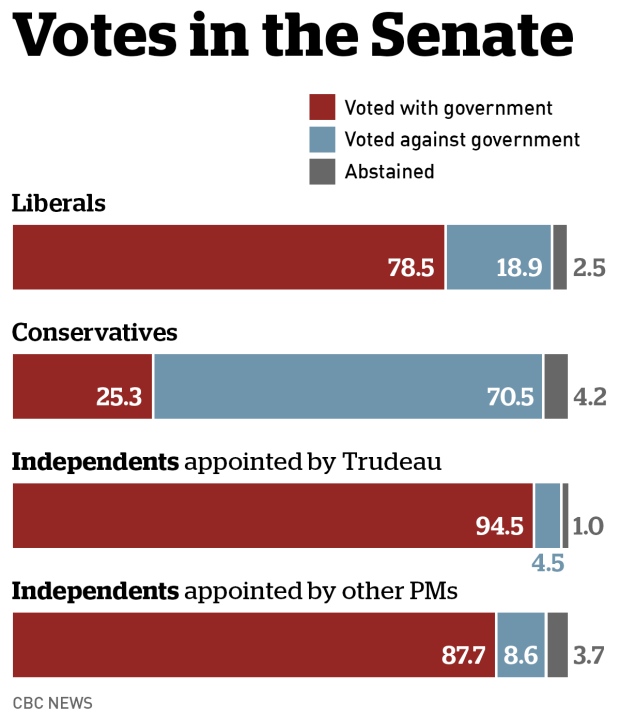
As the opposition in the Senate, the Conservatives have voted against the government’s position the most often, siding with Harder in just 25 per cent of all 48 recorded votes held since Harder took office. (This includes votes on both government and non-government bills and motions.)
But the swing votes in the Senate have not been the gaggle of independents, but rather the Senate Liberals, who have voted with Harder only 78.5 per cent of the time.
The independents, by comparison, have been much more co-operative. Independents appointed by Trudeau’s predecessors voted with Harder 88 per cent of the time, while independents named by the prime minister have stood with Harder in 94.5 per cent of recorded votes.
This makes Trudeau’s independents — as a bloc — the most reliable votes that Harder can count upon in the Senate.
Senate Liberal swing votes
This bloc is not large enough for Harder to easily steer the government’s legislation through the Senate.
With 98 senators — excluding Speaker George Furey and Jacques Demers, who has been away due to poor health — Harder needs 49 votes to pass legislation when all senators are in the chamber.
In addition to himself, Harder can count on the support of his deputy, Diane Bellemare, and government liaison Grant Mitchell. The independents named by Trudeau increase his vote total to 29.
Adding the six independent senators appointed by past prime ministers who frequently vote with the government bumps that number to 35 — still short of a majority.
So in order to pass legislation, Harder needs most of the votes from the 18 Liberals, making them the Senate’s decisive swing votes.
Seyran Ates introduces the first Friday prayers, on June 16, 2017, at Berlin’s Ibn Rushd-Goethe Mosque, which she helped to establish. (Sean Gallup/Getty Images)