Young Islamists have ′very scant′ knowledge of Islam, study finds | DW | 11.07.2017

Interesting analysis of texts among young radicalized Muslims:

Young Muslims who become radicalized often invent a patchwork, imagined version of Islam that has little or nothing to do with the Koran. That’s the conclusion drawn by scholars at the universities of Bielefeld and Osnabrück. They’ve just published a book analyzing 5,757 messages from a WhatsApp group of 12 young men ahead of a spring 2016 terrorist attack.

The messages came from a mobile phone, seized by police, that had belonged to one of the young men involved in the attack. The researchers say that the chat offers unique insights into the radicalization process and mindset of Islamists in Germany.

The messages also illustrate the enormous differences between Islamism and Islam. Many of the self-styled “true Muslims,” the experts found, themselves have little valid knowledge of the Koran or the rest of their religion.

“The result is a kind of ‘Lego Islam’ that can be continually adapted to new requirements and in practice has nothing to do with the forms of traditional Islam practiced by the majority of mosque communities in Germany,” write co-authors Becem Dziri and Michael Kiefer.

The authors omitted the names of those involved in the chat and didn’t specify the attack, although the time reference strongly suggests that it was the bombing of a Sikh temple in Essen in April 2016. At the time it was reported that the young people involved in that attack were radicalized via social media, and three of them, all teenagers, were later convicted of attempted murder and conspiracy to murder.

Deutschland Anschlag auf Sikh Tempel in Essen (picture-alliance/AP Photo/M. Kusch)Luckily no one was killed in the temple bombing

Budding Islamists mix jihad and genies

The conversations leading up to that act of violence suggest that the youths were willing to kill for a faith of which they had only a rudimentary understanding.

“The religious education within the group is very scant,” writes co-author Rauf Ceylan. “Often they didn’t even know the simplest Islamic theological basics. The members of the group are laymen and autodidacts who pick and choose information from the internet and communicate it to the rest of the group.”

Excerpts from the chats often seem like comedy sketches sprinkled with sometimes misused Arabic words and phrases and English slang. In one, a participant responds to a self-appointed leader’s call for a meeting to discuss the jama’a (group) by saying he didn’t have any Islamic clothing. The leader responds: “You can also were sweatpants or something like that. If you want I can loan you something for the day.”

Another message reveals that the author doesn’t even own a copy of Islam’s main religious text.

“I need a Koran,” he writes. “I’ll get one soon from lies [a Salafist group that gives away Korans on the street in Germany]. If I see abu nagi, I’ll tell him he’s a kafir [infidel] because he thinks erdogan [sic] is a Muslim.”

When asked what the most absurd detail of the chats was, Ceylan told DW that participants interwove the belief in magical genies in their pseudo-theology.

“Over the course of the chat protocol, you can see how a religious world gets invented in which supernatural beings can have real effects on the young men,” Ceylan said. “They take fragments of the Koran and cobble them together. That’s why we call it ‘Lego Islam.'”

Salafisten verteilen Korane (picture-alliance/dpa/B.Roessler)Salafists pass out free Korans on German streets

Careers as ‘pop preachers’

Scholars also say that the chat illustrates the process by which young Muslims get radicalized. Key is the role of the “amir,” the self-appointed leader, who “instructed” the others despite lacking any theological credentials himself.

“He’s an alpha male like you have in school,” Ceylan told Deutsche Welle. “The people who act as Salafist preachers aren’t theologians. They’re people who have sometimes failed in life, but if they have a gift for being alpha males, they can become superstars overnight. This shouldn’t be underestimated. You can make a whole career of being a pop preacher.”

The second ingredient in the making of a radical Islamist, the scholars explain, is a young person with the right biography. Emancipation from parents – becoming an adult – gets conflated with emancipation from the mainstream community as one of the “chosen ones.” Ceylan cites the example of a young man who became radical after discovering that his father was having an affair and telling his mother, which led to a divorce.

“These are fundamentally young people who are trying to overcome a crisis in their lives or a biological ruptures,” said Ceylan. “The timing is crucial. Who do I meet in this phase?”

Social media platforms often play a role in radicalizing young people

The importance of language

Ceylan says that although bogus theology is part of the problem, religious instruction is not enough to combat radicalization. He calls for more money for German language imams, psychological therapists in prisons, where many young people get radicalized, and interventions in schools.

“These young people don’t get radicalized secretly, as the chat protocols show,” Ceylan said. “Their teachers see that something’s not right. A kid grows his beard out or starts saying more and more radical things. And the parents see it before everyone else.”

Above all, Ceylan says, those who do intervene with young people susceptible to Islamism need to speak the right language.

“The characteristics of the charismatic ‘self-made’ preachers…are that they speak German, use young people’s slang, make a theatrical impression, display street credibility and present themselves cleverly. That, together with the simplicity of what they teach, makes them attractive to young people.”

Source: Young Islamists have ′very scant′ knowledge of Islam, study finds | TOP STORIES | DW | 11.07.2017

Federal Court voids Canadian citizenship revocation for 312 people

A second decision that reflects poorly on the Conservative government’s C-24 expedited revocation provisions (and that implements the earlier Federal Court decision – Canada can’t strip your citizenship without a trial, court rules – VICE News). It is, of course, part of a pattern where their policies and legislation were routinely ruled against by the courts.

One would hope that the policy and legal advice given to the government at the time highlighted the likely risk of adverse rulings.

Given the Conservative track record, their assertions regarding contesting the Khadr lawsuit should be taken with a grain of salt:

The Federal Court has nullified government attempts to strip Canadian citizenship from more than 300 people after an earlier judgment struck down key provisions of the Citizenship Act introduced by the former Conservative government under Stephen Harper.

The earlier ruling, in May, declared those provisions inoperative because they were an expedited process that deprived individuals of the right to an oral hearing and did not take into account humanitarian and compassionate considerations.

As a result, in a decision on Monday, Justice Russel Zinn voided the citizenship revocation of 312 individuals who had turned to the court after they were targeted in a sweep against people who had obtained their Canadian nationality through fraud.

Another 14 similar court requests, which had not been filed in a timely manner, can apply for a deadline extension, Justice Zinn ruled.

“It’s another judicial loss for the policies of the previous government,” Montreal lawyer Vincent Valaï, who represented some of the people in the case, said in an interview.

He noted that the Conservative government liked to say that obtaining Canadian citizenship is a privilege, not a right. However, the ruling in May said that once acquired, citizenship is a right.

“And because it is a right, you have to respect procedure fairness before revoking citizenship. That means the right to a hearing before an impartial judge,” Mr. Valaï said.

Another lawyer involved in the case, Matthew Jeffery, called the provisions in the law a “deeply flawed process.”

The government could start the revocation process against those people all over again but it would first have to rewrite the law to conform with the court rulings, Mr. Jeffery said.

The number of revocation cases began ballooning when Jason Kenney, who was immigration and citizenship minister in the Harper government, announced in 2012 that his department would cancel the citizenship of more than 3,000 people, in a crackdown against those who had faked the amount of time they have spent in Canada.

In February, 2014, the Harper government amended the Citizenship Act to fast-track the revocation process in what it called “non-complex” cases. It meant eliminating the right to a hearing for individuals when their citizenship had been obtained by fraud.

Several of the cases involved clients of Nizar Zakka, a Montreal immigration consultant who created a system to hide the fact that the clients were not residing in Canada for the required two-year minimum within a five-year span.

Faced with hundreds of applicants challenging their citizenship revocation, the Federal Court started with a review of eight lead cases while the other cases were held in suspension.

Last May, Justice Jocelyne Gagné ruled on the eight lead cases, striking down the new provisions for an expedited revocation process.

“They deprive the applicants of the right to a fair hearing in accordance with the principles of fundamental justice,” Justice Gagné wrote.

In one case that she highlighted, the government tried to revoke the citizenship of Fiji-born Thomas Gucake, who had come to Canada as a child and later served three tours in Afghanistan with the Princess Patricia’s Canadian Light Infantry regiment.

In 2015, Mr. Gucake received a notice of citizenship revocation because his father had failed to disclose a minor criminal conviction in Australia.

The current government has since amended the Act so that, by next year, the Federal Court would be the decision-maker in citizenship revocation cases.

Source: Federal Court voids Canadian citizenship revocation for 312 people – The Globe and Mail

Kiff: Disproportionate funding goes to media linked to Falun Gong | Ottawa Citize

Interesting analysis and valid questions. Given that Kiff is a principle of a lobbying firm (Solstice), this may not be a completely altruistic commentary which does not detract from the evidence presented:

While most of Canada’s conventional media have endured shrinking audiences and revenues in recent years, segments of the ethnic media have seen significant growth thanks to a constant influx of immigrants from all over the world.

In the Greater Toronto Area alone, there are about 120 ethnic media channels targeting various audiences. The number of Chinese daily newspapers has grown from about five in the 1990s to more than 50 in 2015.

According to Statistics Canada, in 2011, 13 ethnic communities had populations of more than one million, and others had sizeable and growing populations. Demographic projections indicate that by 2031, nearly half (46 per cent) of Canadians aged 15 and older could be foreign-born, or could have at least one foreign-born parent, up from 39 per cent in 2006.

With those numbers, the ethnic media sector in Canada is bound to keep on expanding.

The Canada Media Fund (CMF) helps to support this growth. It was created by the Department of Canadian Heritage back in 2010 with a mandate to foster, promote and finance the production of Canadian content and relevant applications for all audiovisual media platforms. Various CMF programs support productions reflecting Canadian diversity.

A closer look at the projects backed by the Canada Media Fund reveals some surprising funding patterns going back to 2010. Several production companies affiliated with New Tang Dynasty TV (NTDTV) have received close to $18 million in funding over six years compared to the combined total of about $13 million for other ethnic media outlets.

Studios with ties to NTDTV have received 43 per cent of the funding allocated through the Diverse Languages Program and have produced the near totality of funded projects in the Mandarin and Cantonese languages.

According to Wikipedia, NTDTV is a television broadcaster based in New York City with correspondents in more than 70 cities worldwide. The station was founded in 2001 as a Chinese-language broadcaster by practitioners of Falun Gong, a spiritual practice banned by the Chinese Communist Party.

NTDTV’s Canadian operation, with offices in North York, officially launched on March 28, 2012 on Shaw Cable. It is also available on Novus Entertainment in Vancouver and on Bell Fibe TV and Rogers Cable in Eastern Canada. It is unclear how many viewers NTDTV reaches in Canada.

So why does this relatively unknown broadcaster outside of the Chinese community, and its affiliated production companies, get what seems to be a disproportionate amount of funding compared to other ethnic broadcasters? Why are almost all funded Chinese-language projects produced for this broadcaster?

And what is known about the content of the material produced for a broadcaster with clear ties to a religious sect? Why, for example, are at least three funded projects linked to Shen Yun, the huge performing arts arm of Falun Gong that tours extensively throughout the world? Many critics have noted that this production’s overtly political content and proselytizing supersede its artistic merit.

When I spoke to the Canada Media Fund to confirm these figures, they pointed out that CMF is an independent non-partisan body and that CMF does not intervene in the subject-matter of funded projects, recognizing each production’s creative value and freedom of speech.

That is fine, as far as it goes. But, in this case an unexpected result is occurring.

Canada takes pride in its pluralistic and nonsectarian society. In spite of the CMF’s explanations, it seems odd and most un-Canadian that so much public funding is being allocated to a fringe religious group.

It is time for a bit more sunshine on what is occurring here.

Source: Kiff: Disproportionate funding goes to media linked to Falun Gong | Ottawa Citizen

U.S. Refugee Admissions Pass Trump Administration Cap Of 50,000 : The Two-Way : NPR

By way of comparison, the Canadian 2017 levels plans has a target of 40,000 (about 0.1 percent of the population), the US cap of 50,000 is about 0.02 percent of their population). However, the US has a much higher number of undocumented immigrants/refugees, estimated at 11 million or  about three percent of the population:

The U.S. refugee program surpassed the Trump Administration’s 50,000-person cap on Wednesday, meaning that many refugees will now be denied entry into the country.

The cap is expected to affect thousands of refugees. Last fiscal year, the U.S. admitted just under 85,000 refugees, and former President Barack Obama had aimed to resettle 110,000 refugees this fiscal year. But President Trump lowered the cap dramatically in his “travel ban” executive orders, and the cap went into effect on June 29.

“The State Department initially told resettlement agencies it expected to hit that threshold by July 6,” NPR’s Jackie Northam reports. “But that date came and went and the number of refugees entering the country wasn’t reached. So the date was extended to July 12.”

The total number of admitted refugees reached 50,086 by Wednesday afternoon. A State Department official tells NPR that the department decided to set the cutoff at the end of the day, instead of at the exact number 50,000, to keep the process “orderly.”

That number of admitted refugees could still rise by several thousand, as refugees with close family members already in the U.S. will continue to be allowed to enter the country, under the terms of a recent Supreme Court order.

You may recall that Trump established the 50,000-person cap in his initial and revised “travel ban” executive orders. For months, those orders were blocked from implementation. But in June, the Supreme Court announced it would consider the merits of the ban and that in the meantime, portions of the second executive order could go forward — as long as they didn’t block people who had a “bona fide relationship” with the U.S.

The administration later defined “bona fide” ties as including parents, children and siblings in the U.S., but not grandparents or more extended family members. Bona fide ties also include job offers in the U.S.

Refugees who do not have such ties will no longer be admitted this fiscal year, even if they have completed the two-year vetting process to enter the refugee program. The next fiscal year begins in October.

Last month, NPR’s Michele Kelemen explained what’s at stake:

“[R]efugees have arrived in the U.S. this fiscal year from all over the world — from Syria, of course, but also Myanmar, the Democratic Republic of Congo, Afghanistan. It’s really a global humanitarian program. …

“I’m told thousands could be affected by [the cap]. One refugee resettlement agency told me today that they usually book people about three weeks ahead of time. … It’s not just airline tickets. Refugees have to go through medical screenings. And those clearances don’t last forever. If they rebook for later, they might have to redo all of that medical screening and security checks.”

The Lutheran Immigration and Refugee Service, which resettles refugees in the U.s., said in a statement that the cap “will mean that vulnerable refugees, including those with severe medical needs, torture survivors, unaccompanied refugee children, and persecuted religious minorities will continue to be in harm’s way.”

The pause on refugee admissions “will have an immediate effect on our ability to conduct the lifesaving work of providing safety and protection,” Kay Bellor, a vice president at LIRS, said in the statement.

Trump’s executive order proclaims that admitting more than 50,000 refugees “would be detrimental to the interests of the United States.” It allows for individual refugees to be admitted on a “case-by-case basis,” based on the joint judgment of the secretary of state and secretary of Homeland Security.

Source: U.S. Refugee Admissions Pass Trump Administration Cap Of 50,000 : The Two-Way : NPR

George Soros: Hungarian government posters ‘anti-Semitic’ – BBC News

Sad:

Financier George Soros has accused the Hungarian government of using “anti-Semitic imagery” in its poster campaign against him.

Mr Soros has been vilified in a campaign costing the right-wing Fidesz government an estimated 5.7bn forints (£16.3m; $21m).

Many Hungarian Jews fear that open or concealed anti-Semitism lies behind the campaign, which the government denies.

This is the first time US-based Mr Soros, 86, has echoed that fear.

However, he also thanked those who had made it their mission to tear the posters down.

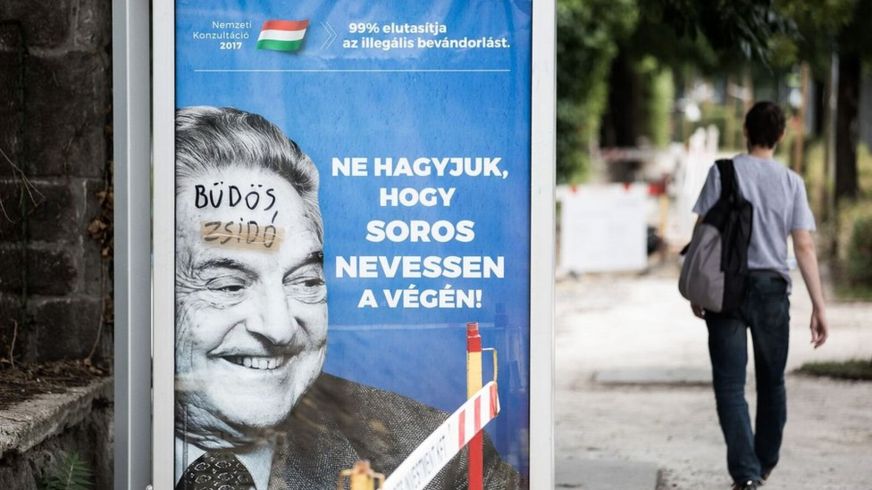
The most recent series of posters – many of which have had anti-Semitic graffiti scrawled on them – show a grinning Mr Soros beside the words, “Don’t let Soros have the last laugh”.

The slogan is a reference to the government’s claim the philanthropist is working to settle a million migrants in the EU.

A poster showing George Soros, on which someone has written Image copyrightAKOS STILLER
Image captionA poster showing Mr Soros, saying “Let’s not allow Soros to have the last laugh!” Someone has written “dirty Jew” on his forehead

In a statement, Hungarian-born Mr Soros said: “I am distressed by the current Hungarian regime’s use of anti-Semitic imagery as part of its deliberate disinformation campaign.

“Equally, I am heartened that together with countless fellow citizens the leadership of the Hungarian Jewish community has spoken out against the campaign.”

Mr Soros has spent $12bn, mostly through his Open Society Foundations, on civil initiatives to reduce poverty and increase transparency, and on scholarships and universities around the world, especially in Eastern Europe and the former Soviet Union, since the 1980s.

It has seen him come up against Hungarian Prime Minister Viktor Orban, who has declared war on liberalism.

Most recently, the university Mr Soros founded has come under attack after MPs passed a bill which could force it out of Hungary.

The posters have also drawn anger from outside the country.

Guy Verhofstadt, the chief Brexit negotiator at the European Parliament and leader of the Parliament’s liberals, wrote on Facebook: “The Hungarian regime’s xenophobia and demonization of refugees are anti-European. The claim that Soros is promoting a scheme to import a million illegal immigrants into Europe is Victor Orban’s fantasy. Darkness falls in Hungary. We cannot let this happen.”

Source: George Soros: Hungarian government posters ‘anti-Semitic’ – BBC News

Jagmeet Singh’s Quebec problem: Paul Wells

There have been a series of articles on the problems posed by Singh’s candidacy in Quebec. This one by Paul Wells goes into more detail than most, other good ones are by Konrad Yakabuski ( Singh complicates the NDP’s Quebec quandary ) and John Ibbitson ( In Jagmeet Singh, a unifying figure with divisive potential ):

The second most-popular story on Le Devoir‘s website as I write this is about mounting anxiety in the Quebec wing of the NDP over Jagmeet Singh’s candidacy for the party’s leadership. “Several activists are panicking” at the thought, the story says.

The problem? Singh, a practicing Sikh, wears a turban and kirpan. “To have a leader who’d wear ostentatious signs” of his religious affiliation, “we are not ready,” Pierre Dionne Labelle, who was an NDP MP from 2011 to 2015, says on the record. “Would I be at ease with that? I don’t think so.”

This is the first time Le Devoir has found a New Democrat willing to speak on the record about concerns over Singh’s candidacy. Several others seem willing to share similar concerns off the record. The story also adds two cases where Singh’s positions in provincial politics could arguably have been influenced by his religious beliefs: a private member’s bill that sought to exempt Sikhs from having to wear motorcycle helmets, and a member’s statement over the provincial Liberal government’s controversial changes to the primary-school sex-education curriculum.

I could quibble with the latter of these examples. Singh’s statement on the sex-ed curriculum could have been made by Patrick Brown, the province’s Conservative leader, who is not Sikh. “The lack of inclusive consultation before announcing the curriculum was disrespectful to parents in my constituency,” part of Singh’s little speech, is a stock line in much of the opposition to the curriculum change.

But it’s less interesting to debate these points than to note that the anxiety Le Devoir chronicles exists, that it’s a challenge to the Singh candidacy, and to try to understand why these concerns are being expressed most loudly by the NDP’s Quebec wing.

Luckily we have a recent poll to guide us.

On June 26 the Angus Reid Institute published the results of surveys in the United States and Canada on attitudes towards diversity in political leadership. The Canadian results come from a randomized sample of 1,533 members of Angus Reid’s online panel; full methodology can be found here. Respondents were asked whether they would vote for a party led by a woman, a gay man, a man or woman wearing a religious head covering, and so on. This produced all sorts of fun cross-border comparisons—68 per cent of Canadians expect an atheist Prime Minister in the next 25 years, against only 37 per cent of Americans who expect an atheist President. But the internalsfrom the poll suggest other useful comparisons. Here’s the Canadian regional table showing responses for various questions that begin, “Would you yourself consider voting for a party led by a person who is…”


Screenshot 2017-07-11 13.20.30

Support for a Sikh-led party is only 46 per cent in Quebec, the lowest regional score in the country by eight points. On the generic “…man who wears a religious head-covering,” support is lowest in Quebec by 12 points. Support is also lowest in Quebec for parties led by Muslims, by Jews, and indeed by evangelical Christians.

This would probably be a good time for this Maclean’swriter to say the Angus Reid data don’t show a generalized inability among Quebec respondents to show “openness” to “difference.” No, the results are way more interesting than that. In fact, Quebec respondents were markedly more likely than respondents in the rest of Canada to support parties led by a gay man, a lesbian or an atheist. And there was no marked difference between Quebecers and other respondents when the hypothetical party leader was transgender, Indigenous, black or a woman.

In no other part of the country do the results line up as they do in Quebec: markedly less likely to support parties whose leaders wear some visible sign of their religious affiliation, markedly more likely to do so if their difference is expressed in some other way besides religion.

There’s an obvious explanation for this, but it rarely gets mentioned whenever the debate over so-called “reasonable accommodations” rears its head in Quebec or outside. It’s that Quebec has a markedly different cultural history with organized and visible religion than much of the rest of Canada.

Many older Quebecers, those whose memories stretch back before the mid-1960s at least, have personal memories of a time when the Roman Catholic church had a strong influence over public affairs. Even most younger Quebecers will have been taught, in great detail, about the period before the Quiet Revolution. And the Catholic church was pretty big on ostentatious displays of religious affiliation.

(You needn’t take my word on any of this. Marie McAndrew, a professor at the Université de Montréal’s faculty of education, has written often and thoughtfully on the “reasonable accommodations” debate and its cultural roots. In this representative piece, she writes: “…[W]e must remember that the people of Quebec who are of French-Canadian origin have a specific and usually more negative relationship with religion than people in the rest of Canada…. For most people born before the 1960s, in fact, the association between religion and public space evokes bad memories or at least memories that are incompatible with their democratic ideals.”)

The Quiet Revolution in Quebec was specifically a rebellion against religious influence. Progressive politics in many other parts of the country has been a politics of generalized tolerance; in Quebec progressive politics was often a politics of specific resistance. I lived in Quebec for five years and have written about its politics in instalments for nearly a quarter-century since, and I find this is one element of the debate over religion and politics that’s hardest for many non-Quebecers to grasp: suspicion of religion in politics is often a progressive impulse in Quebec politics. (Emphasis on “often,” as in, “of course not always, in Quebec or anywhere else.”)

Source: Jagmeet Singh’s Quebec problem – Macleans.ca

When words become weapons, repression follows: Paris

Good column by Erna Paris – words matter:

It appears we can become accustomed to anything, provided it’s repeated often enough. What may have appalled us last year, or the year before, eventually loses its edge and is rendered normal. Think of the way highway speeding ratchets up as drivers accelerate to maintain the faster flow of traffic.

Something similar happens with language. Words accelerate. Without thoughtful restraint, they are like speeding cars, prone to accident.

Before Sept. 11, 2001, there existed a tacit consensus in Western pluralist societies that generalizations about race and religion might be destructive to the public good: the living memory of 20th-century atrocities largely sufficed to keep the most extreme animosities in check. These unspoken taboos were frequently breached, but racist speech was ordinarily frowned upon and usually did not sink deep roots. When the protective umbrella of taboo failed, as in the former Yugoslavia after the death of Josip Tito, for example, predictable violence ensued. Words matter, especially when they emanate from people in high places.

Since 9/11 and the advent of “the war on terror,” open, or dog-whistle, anti-Muslim rhetoric has increased exponentially as taboos have loosened. In the immediate aftermath, governments in Russia, China and elsewhere were happy to label their troublesome minorities “terrorists,” thus whitewashing repression. It became common to hear insinuating generalizations about Muslims.

Just last month, Statistics Canada reported that hate crimes against Muslims rose 60 per cent in 2015, alone. This is not surprising. That year encompassed Stephen Harper’s niqab and “barbaric cultural practices” initiatives. It was also the year of the failed Quebec Charter of Values that directly targeted Muslims.

With his darkly nativist rhetoric, U.S. President Donald Trump has upped the ante. He need not attack directly; in order to communicate his discriminatory message, he need only exact a travel ban on people from six predominately Muslim countries, or make atavistic speeches about the decline of Western civilization, as he recently did in Poland. We don’t yet know where his unfettered rhetoric will lead. What we do know is that he has opened Pandora’s Box – the place where we have historically guarded our protective taboos. From his White House perch, he has liberated people who used to keep their prejudices to themselves, if only for fear of social reprobation.

Citizens in liberal democracies expect their leaders to wield power responsibly and – excepting the rhetorical opportunism of Mr. Harper and others, such as Conservative leadership candidate Kellie Leitch – Canadians in high places usually do. That’s why it was particularly troubling to see Quebec Premier Philippe Couillard fall into a trap last month when he said, with regard to a terrorist act perpetrated by a Quebecois: “Unfortunately, you cannot disconnect this type of event – terrorism – from Islam in general.” Since Mr. Couillard is said to be a history buff, it is odd that he did not understand the import of language that conflated the entirety of Islam with the acts of a few. Wouldn’t he have known that the biblical texts of all three Mosaic religions contain writings in support of both war and peace, depending on one’s preference? It is not a defence of violence to note that, across history, all three religions have traversed periods of extremism, such as the Spanish Inquisition (Christianity) and, more recently, the fanatic Jewish settlers in Israel’s Occupied Territories whose religious claims to the land eschew the rights of others.

Mr. Couillard claimed to be echoing a speech made by French President Emmanuel Macron, but the situation in France is not comparable. France has miles to go before there is trust enough to enable co-operation between its Muslim population and the country’s political leadership, while in Canada, mutual co-operation already exists to a high degree. When Mr. Couillard held Islam and the Muslim community responsible for the acts of some of its members, he accelerated the traffic on the rhetorical highway, encouraging bigotry.

My husband, Tom, likes to rail about the damage that’s been done across time by the little word “all” – as in “all Muslims are ‘X’” or “all Jews are ‘Y.’” He’s right; words are not innocent. We are each responsible for maintaining the civility of public discourse, but people in positions of leadership hold a special trust. They set the rhetorical standard. And they must be held accountable.

Source: When words become weapons, repression follows – The Globe and Mail

Douglas Todd: Forgotten struggle for Canadian ‘unity’ leads to ‘silos’

The language-related tensions in Richmond have been simmering for some time, whether over Chinese-language signage only or this disturbing example of condo board proceedings (even if private bodies are not required to use English or French).

In terms of how widespread these kinds of issues are, Dan Hiebert’s various studies indicate Canada’s ethnic enclaves more diverse than you think, study finds. And overall, I don’t find the government’s message only being about diversity given the common values language that it also uses.

This may be more of an issue in Richmond (that should be taken seriously) than widespread, which is, accordingly to the 2011 NHS, 53 percent of East and Southeast Asian origin:

Andreas Kargut moved out of Richmond forever on the weekend that Canada marked its 150th anniversary.

The effort that Kargut, his immigrant wife and others put into fighting for the right to have their strata council meetings conducted in English, not Mandarin, had caused too much grief.

Kargut and six others filed a complaint last year with the B.C. Human Rights Tribunal because they couldn’t participate in the Mandarin-only meetings in their 54-unit complex.

Former B.C. premier Ujjal Dosanjh lamented how the strata council’s discrimination against Kargut illustrated the rise of ethnic and language “silos” in Canada. But Kargut said local politicians ignored their plight.

The language battle in Richmond, where half of residents are ethnic Chinese, is one of many challenges to Prime Minister Justin Trudeau and many small-l liberals who proclaim that diversity can only be celebrated.

While creativity definitely can emerge within the many manifestations of diversity, liberal platitudes censor questions about the real tensions that can also be provoked by diversity, a word that means difference.

Trudeau is among those heading into dangerous territory because he is not following the example of his prime minister father, Pierre, in standing up for English and French — and for the ideal of unity.

“When my parents immigrated from Germany, they knew there was an expectation for them to learn English so they could join the workforce and earn a living to provide for their family,” Kargut said in a posting on a Facebook page called Richmond’s Changing Neighbourhoods.

“Why is it then if a person immigrates from China they don’t need to learn English and can discriminate against English-speaking Canadians to the point of causing financial hardship?”

Many Canadians are asking similar questions. The Pew Foundation discovered only 21 per cent of Canadians believe place of birth is important to whether one is an authentic citizen (one of the lowest rates in the world).

But Canadians do care about English and French. Three in five Canadians agreed “being able to speak our national language(s) is very important for being truly Canadian.”

The dispute over language barriers is not only worrying whites. Longtime resident Ken Tin Lok Wong told Richmond News many of the city’s controversial Chinese-only signs are in a dialect known mainly to newcomers from the People’s Republic of China, which Wong says signals many are not willing to integrate.

Yet it’s Kargus’s departure from Metro Vancouver that is one of the more stark illustrations of self-segregation in this city, in Toronto and in Montreal, which are becoming increasingly defined by ethnic and language enclaves, whether South Asian, Chinese or European.

The kind of frustration felt by Kargut is something liberals in the U.S. are finally starting to note — as they try to come to terms with why the diversity-celebrating Democrats are constantly losing election campaigns.

Atlantic magazine has two articles in this month’s edition exploring why Hillary Clinton alienated former supporters among the white suburban and working classes, while methodically wooing Hispanic and black voters.

In “How the Democrats’ Lost Their Way on Immigration,” Peter Beinart notes one of Clinton’s prominent campaign images showed her surrounded by Spanish-language signs.

“Americans know that liberals celebrate diversity. They’re less sure that liberals celebrate unity,” says Peter Beinart, who credits Barack Obama with the ability to do both. Justin Trudeau doesn’t perform the balancing act, but his father stood up for ‘national unity.”

Barack Obama would not have done that, Beinart says. The former president once said he felt frustration when he’s “forced to use a translator to communicate with the guy fixing my car.”

With the National Academies of Sciences recently reporting new immigrants to the U.S. are learning English more slowly than their predecessors, Beinart maintains Democrats should put teaching immigrants English at the centre of their immigration agenda.

“Americans know that liberals celebrate diversity. They’re less sure that liberals celebrate unity. And Obama’s ability to effectively do the latter probably contributed to the fact he — a black man with a Muslim-sounding name — twice won a higher percentage of the white vote than did Hillary Clinton.”

Source: Douglas Todd: Forgotten struggle for Canadian ‘unity’ leads to ‘silos’ | Vancouver Sun

Citizenship For Military Service Program Under Fire : NPR

The Conservative government introduced a comparable provision in C-24 (residency requirements were waived for military personnel who had served three years with an honourable release):

A debate has broken out at the Pentagon and in Congress over a proposal to dismantle an 8-year-old program that gives fast-track citizenship to immigrant soldiers who were recruited because they have critical skills in languages and medicine.

More than 4,000 immigrant soldiers recruited through the program — mostly from China and South Korea — are serving in uniform, including on overseas tours. Another 4,000 recruits have enlisted and are awaiting training.

The program is known as MAVNI, for Military Accessions Vital to the National Interest. It was frozen last year amid security concerns about inadequate vetting of the recruits.

Pentagon and national intelligence officials say the recruits could have connections to foreign intelligence services or become insider threats, according to an internal memo obtained by NPR. The officials also said it would be both expensive and time-consuming to investigate these recruits more carefully.

Those officials are now proposing additional scrutiny of soldiers already serving and dropping those who have not yet shipped to basic training or been assigned a military unit. Some could be deported because their visas have expired.

A Pentagon spokesman, Johnny Michael, would not comment on the memo or the program.

Win-win or security risk?

The proposal has stoked a debate over how to balance national security concerns with the need for specialized skills and how to keep faith with recruits who pledged to serve their adopted country.

Several Defense Department officials, speaking on the condition of anonymity because they had not been authorized to discuss the program publicly, said mismanagement has been a problem.

In some cases, the officials said, the military didn’t use the MAVNI recruits effectively because they weren’t placed in jobs in which they used their language skills. And some recruits have been investigated for suspected ties to foreign spy agencies, one official said.

By some metrics, the program — which grants citizenship in exchange for eight years of honorable military service — has been successful.

According to a Pentagon breakdown, soldiers recruited through the program have educational levels that exceed the Army average, and their re-enlistment rates are higher than soldiers who are already citizens.

Most of the recruits with foreign language skills speak Chinese and Korean. The rest speak about three dozen other languages, ranging from Arabic and Thai to Indonesian, Turkish and Swahili.

The program also helps fill the medical ranks. About two-thirds of dentists in the Army Reserve are part of the MAVNI program. Others serve as nurses or hold other jobs in the Army Medical Corps.

One-third of the recruits have been in the United States for at least three or four years, according to the Pentagon’s breakdown, with one-quarter living in the U.S. for more than seven years.

One of those recruits is Jeevan Pendli, 34, who came to the U.S. from India on a student visa, earning a master’s degree from Carnegie-Mellon University. He stayed on a visa for tech workers and co-founded a company that helps people with chronic illnesses manage their health.

And last year he decided to join the Army, inspired after running the Marine Corps Marathon and seeing competitors in wheelchairs and using prosthetics.

“Things seemed fine when we signed and did the oath in May,” Pendli told NPR, “and it just fizzled out in a couple of weeks or months.”

Like some 2,000 other MAVNI recruits, Pendli is still waiting to be shipped to basic training.

That long wait is more than just an annoyance. If a recruit doesn’t make it to Army basic training by 730 days after signing a contract, the recruit “times out” and is kicked out before serving. Hundreds will reach that deadline by the end of the year. And each month after that hundreds more will “time out.”

No consensus in Congress

“Military recruits in the MAVNI program should not have to wonder whether the United States will honor the contract they signed,” wrote Sen. Mark Warner, D-Va., in a letter to Defense Secretary James Mattis.

“If we fail to hold up the contracts we made with MAVNI applicants, this will not only have a significantly deleterious effect on recruiting, it will also be met with a strong, swift Congressional reaction.”

But other lawmakers say there are legitimate concerns.

“Even with the MAVNI program, where it’s supposed to meet some of the vital national interests, the program has been replete with problems to include foreign infiltration, so much so that the Department of Defense is seeking to suspend the program due to those concerns,” said Rep. Steve Russell, R-Okla., a retired Army officer, during a recent hearing on the defense policy bill.

“And I can’t really discuss some of that here in this setting, but there are some major issues when it comes to vetting,” said Russell, who serves on the Armed Services Committee.

In the next few weeks, Mattis is expected to receive final recommendations from Pentagon personnel and intelligence officials about the way ahead.

Source: Citizenship For Military Service Program Under Fire : NPR

The never-ending argument over what is “real Islam”

Good piece and advice from The Economist:

IN THE commentariat, the world of higher learning (religious and otherwise) and the corridors of political power, the long-running, hot-tempered debate about the real nature of Islam shows no sign of reaching a conclusion. The temperature rises every time some ghastly act of violence is perpetrated by people who say they are inspired by their Muslim beliefs. Broadly it pits those who think that killers who practise violence in Islam’s name are traducing the faith and perhaps mis-stating their own motives, up against those who insist that Islam’s core beliefs (and not just some idosyncratic version of them) can easily prompt people to take up the sword.

Sam Harris, an atheist public intellectual, is among the best-known advocates of the second view. Despite the change of guard at the White House, and the apparent conversion of Donald Trump to a slightly more emollient view of Islam, Mr Harris is still pouring scorn on Barack Obama for insisting that Islam was at heart a religion of peace. Another person whose views Mr Harris excoriates is Tariq Ramadan, a Muslim thinker who combines leftist political ideas with fairly traditional religious ones. Mr Ramadan incurs the American writer’s contempt when he argues that political, economic or geopolitical grievance, rather than any Muslim beliefs, motivate the terrorist group known as Islamic State (IS).

In a new twist of the argument, Mr Harris has published a podcast, lasting nearly two hours, in which he discusses these matters with Graeme Wood, an author and reporter who has travelled the world interviewing prominent members or supporters of IS and probing their motives and intentions. Both broadly agree that some widely held Muslim beliefs, especially those connected with the world’s end times and the battles portending that era, are important drivers of violent behaviour. But this emphasis has been dismissed as “deeply wrong” by Phil Torres, author of a book entitled “The End: What Science and Religion Tell Us About the Apocalypse”. His book argues that apocalyptic ideas could easily become self-fulfilling. But he also observes that bloodshed (and other dramatic events) in the here-and-now are the real reasons why people suddenly start to think about the final acts in history.

All participants in this discussion merit a hearing. Mr Harris and Mr Wood do a decent job of demolishing some of the more simplistic arguments used to support the views they dislike. For example, the point is often made that many of the people who become jihadis, whether they are converts or Muslim by birth, lack theological sophistication. Indeed, at least one was found to be studying a book with the self-explanatory title, “Islam for dummies”. So, the argument goes, being extremely Muslim and being extremely violent do not seem to go together.

The point about non-sophistication may be true as far it goes, but as both Mr Harris and Mr Wood agree, a person can be very passionate about a belief system without fully understanding its details. And there is no guarantee that even if those details were fully mastered, they would prompt the learner to behave in more peaceful ways. To put it bluntly, jihadis may indeed be theologically ignorant, but that does not prove that a sound theological education would make them more peaceful. (That said, there may be plenty of other reasons for encouraging nuanced theological awareness.)

Mr Wood’s research has reinforced his view that IS is much more apocalyptic in its mentality than earlier jihadi movements such as al-Qaeda. IS propagandists take seriously the notion that Dabiq, a location in northern Syria, will witness a titanic battle between Islamic forces and those of “Rome”—which might mean anything from NATO to the Christian world to the constitutionally secular republic of Turkey. Also widespread is the expectation that an Antichrist figure known as Dajjal will emerge (possibly from an island in the Red Sea) and kill Muslim fighters until Jesus returns to earth and leads the faithful to victory. (Jesus is the second-most-revered prophet in Islam after Muhammad.)

Mr Torres agrees that these beliefs are widely held and significant, but also asks why this is now the case. It was the 2003 assault by America and Britain on Saddam Hussein’s Iraq which turned many Sunni Muslims to end-time thinking, he notes: “prior to the US invasion, Sunni Muslims were uninterested in apocalypticism.” He points out that apocalyptic thinking is most widespread in the two countries where American-led armies have entered in force, Iraq and Afghanistan. As Mr Torres sees things, apocalyptic obsessions can be both a result and a cause of real-world violence.

So how can the “true nature” of Islam, or any other religion, be determined? It might be helpful to divide statements about this into two categories. First, there are value judgments, usually made from inside the boundaries of one’s belief system. This includes statements from religious authority figures such as: “Having studied and reflected on the matter, I believe the real message of our religion’s founder(s) is…” Such messages can have moral force even if they run completely counter to the way in which most followers of a religion have, in practice, acted.

In the second basket are historical or sociological statements, which can be made by any fair-minded observer. These are on the long lines of: “Whatever the prophets and scriptures of this religion may teach, it’s an observable fact that hundreds of millions of followers of this faith behave in certain ways, and that they root this stance in their religious world view.” You might call it a behaviourist approach. In the case of modern Islam, one would have to concede that a not-insignificant number of Muslims are, in some cases, prepared to condone religious violence. But they are far outnumbered by the hundreds of millions of Muslims who live peaceful, law-abiding lives and hope that others will do the same. These are statements which can be debated, investigated, affirmed or falsified in a way that religious statements cannot.

For figures of secular authority, be they American presidents, counter-terrorism officials or even opinion-makers, it is often best to stick to the second kind of statement. The “real” nature of a religion, if such a concept has any meaning at all, is hard for an outsider to determine, and certainly well beyond the remit of a more-or-less secular state.

Source: The never-ending argument over what is “real Islam”