Le projet de cimetière musulman à Saint-Apollinaire est rejeté | Le Devoir

Relatively close vote and small number of voters. Unfortunate:

Le projet de cimetière musulman à Saint-Apollinaire, près de Lévis, a été rejeté dimanche à l’issue d’un vote serré d’une quarantaine d’électeurs.

Au total, 36 des 49 personnes appelées à se prononcer sur la création de ce cimetière se sont présentées au bureau de vote.

Dix-neuf de ces 36 électeurs ont voté contre le projet, soit seulement trois de plus que ceux qui ont voté pour. Un autre bulletin a été rejeté.

Le projet visait à construire un cimetière musulman sur la rue Laurier, à côté d’un site funéraire multiconfessionnel déjà existant près de l’autoroute 20. Il était piloté par la grande mosquée de Québec, qui a été frappée par l’attentat du 31 janvier au cours duquel six musulmans ont été tués.

La consultation concernait seulement les voisins immédiats du projet, soit 49 des 6000 habitants de la municipalité située à 35 kilomètres au sud-ouest de Québec.

Bernard Ouellet, maire de Saint-Apollinaire, a avoué sa déception à l’annonce des résultats, seulement 15 minutes après la fermeture du bureau de vote.

« Je suis déçu. Je pense que c’est surtout la peur et la désinformation qui a guidé le choix des gens, mais je ne crois pas que ce soit le racisme », a-t-il confié.

Quant au peu de citoyens qui avaient à se prononcer sur cette délicate question, le maire estime que le processus, bien que démocratique, n’était pas idéal.

« La loi est faite pour se prononcer sur un type de zonage. Ici, ce n’est pas l’usage du terrain qui était contesté, c’est le mot “musulman”, donc les électeurs n’ont pas rejeté un cimetière, ils ont rejeté un cimetière musulman », a souligné M. Ouellet.

Tous perdants

Les opposants au projet étaient toutefois loin de célébrer leur victoire dimanche soir. « Non seulement tout le monde est perdant, mais lundi on va être jugés et pointés du doigt. Ce qui arrive à Saint-Apollinaire, c’est triste, ça divise les gens au sein des familles, personne n’a gagné ce soir », a commenté en pleurs Sonny Létourneau, qui représentait le comité du « non ».

Mme Létourneau estime que les citoyens de Saint-Apollinaire ont fait preuve d’ouverture. « On a proposé que ce soit un cimetière multiconfessionnel. Même lorsqu’on a obtenu les signatures nécessaires pour le référendum, on a demandé que le projet soit mis sur la glace pour que tout le monde puisse discuter et trouver un terrain d’entente », a-t-elle souligné.

La semaine dernière, le principal défendeur du projet et secrétaire du Centre culturel islamique de Québec, Mohamed Kesri, avait exprimé le souhait que l’administration municipale ne tienne pas compte du résultat si celui-ci était négatif.

« On ne peut pas céder pour une poignée. Ils ont le pouvoir de ne pas aller en référendum, donc si on peut faire appliquer cela, pourquoi ne pas le faire ? » avait-il déclaré à La Presse canadienne.

«Insensé»

Dimanche, il retenait son indignation avec peine.

« Je suis un peu déçu, c’est normal. Comment voulez-vous que 19 [personnes] viennent arrêter un projet pour plusieurs milliers de personnes ? Ce n’est pas une consultation pour dire si on va ramasser les ordures le matin ou l’après-midi, quand même. C’est une demande importante. On ne peut pas se baser sur un refus de 19 [personnes]. C’est insensé. C’est incroyable. »

Le maire Ouellet ignore ce que réserve l’avenir pour le moment.

« Je n’ai pas de prochaine étape en vue. On va faire un résumé au cours de la semaine prochaine avec les gens de la mosquée », a-t-il dit.

Bernard Ouellet s’est consolé en se disant qu’au moins, le référendum était un point de départ pour parler des musulmans au Québec et mieux s’informer sur leur mode de vie.

Le promoteur du centre funéraire Harmonia responsable du projet, Sylvain Roy, était présent dans la salle lors du dévoilement des résultats.

Il n’a toutefois pas voulu commenter la situation.

Dans les dernières semaines, il avait affirmé se battre « contre le racisme ».

« Ils sont contre l’implantation d’une culture dans un milieu qu’ils veulent conserver 100 % québécois », avait-il déclaré.

Le week-end dernier, l’entreprise funéraire Lépine-Cloutier a annoncé qu’elle consacrerait une partie de son cimetière multiconfessionnel de Saint-Augustin-de-Desmaures, tout près de Québec, aux personnes musulmanes. Environ 500 lots leur sont dorénavant réservés.

Source: Le projet de cimetière musulman à Saint-Apollinaire est rejeté | Le Devoir
Langevin, Ryerson, Cornwallis: Is our past unfit for the present? – Peter Shawn Taylor

More good commentary by Peter Shawn Taylor (The case for keeping ‘Langevin Block’ – Peter Shawn Taylor, Begbie’s Statue – Bill McKee) and useful citing of historian Witt’s test questions on renaming:

Yale University has long wrestled with similar complaints about Calhoun College, named for benefactor John C. Calhoun, a U.S. senator from South Carolina and outspoken proponent of slavery during the pre-Civil War era. Last year, Yale asked historian John Fabian Witt to resolve the controversy. His response was a unique series of questions meant to gauge the validity of renaming demands. It’s a first stab at a coherent, standardized system for settling commemoration disputes, and other U.S. institutions have quickly grasped its significance. Last month, the University of Mississippi employed Prof. Witt’s test in removing some controversial names from its campus, while letting other remain. In the absence of anything similar in Canada, we should adopt the Witt test to settle our own namesake dilemmas.

Prof. Witt begins with the overarching principal that name changes should be considered “exceptional events” and not frivolous or political acts. “Renaming has often reflected excessive confidence in moral orthodoxies,” he observes, pointing with caution to the Soviet Union. Then again, not every urge to rename is Orwellian: post-Apartheid South Africa or post-Nazi West Germany, for example.

To decide what deserves to be removed and what should stay, the Witt test applies four questions, modified here for domestic use, that weigh the actions and time periods of commemorated individuals.

  • First: Is the principal legacy of the namesake fundamentally at odds with Canadian values? This requires a broad understanding of the life’s work of the individual in question.
  • Second: Was the relevant principal legacy significantly contested during the namesake’s lifetime? Isolated statements or actions considered controversial today may have been conventional wisdom at the time. Context matters.
  • Third: At the time of the naming, was the namesake honoured for reasons fundamentally at odds with Canadian values? Why was this person commemorated?
  • Finally: Does the building play a substantial role in forming community? The more prominent the edifice, the greater the casefor retaining names of historical significance, Prof. Witt says.

Using the Witt test, Yale announced in February the removal of Mr. Calhoun’s name. White supremacy, it concluded, was his principal legacy. Mr. Calhoun claimed slavery was “a positive good” and that the Declaration of Independence erred in stating all men are created equal. For this, he was criticized in his own time and today.

Applying these same standards to Mr. Langevin, however, yields a different result. As an important French-Catholic Conservative federalist in the Confederation era, Mr. Langevin’s principal legacy was building a bicultural Canada, something once considered a great virtue in this country. This is why his name was placed on an important building in Ottawa. Though his name is today often paired with residential schools, Mr. Langevin was primarily involved with constructing the buildings, not championing the policies. The infamous speech he gave in Parliament on the subject was actually parroting what his boss – Sir John A. Macdonald – had said days earlier. While his comments are grating to modern ears, he was merely repeating widely accepted views from his time. The Witt test exonerates Mr. Langevin.

The legacies of Mr. Begbie, Mr. Ryerson, Mr. Cornwallis and the rest of Canada’s historically accused deserve a fair trial as well.

Source: Langevin, Ryerson, Cornwallis: Is our past unfit for the present? – The Globe and Mail

Canadian girls are being taken abroad to undergo female genital mutilation, documents reveal

Good reporting by the Star, including some comparative analysis of what other countries are doing:

Thousands of Canadian girls are at risk of female genital mutilation, government officials believe. And some are being taken overseas to have the dangerous procedure done — an illegal act known as “vacation cutting.”

Officials from the federal government’s Global Affairs Ministry warn that, as with forced marriage, the “one chance rule” applies to these cases, meaning a professional might get only one opportunity to speak to a potential victim and save her, according to documents obtained by the Star.

And yet Canada has done little to understand the scope of the problem and is lagging far behind other developed countries in efforts to prevent it, experts say.

“Based on the limited information available, it is possible that a few thousand Canadian girls are at risk, some of whom will be taken overseas for the procedure,” wrote Elaine Cukeric of the federal government’s Vulnerable Children’s Unit in a June 2015 email to a Canadian consular official in Nairobi, Kenya. At the time, the unit — tasked with dealing with issues related to Canadian children abroad — was reaching out to consulates in Africa, the Middle East, India and Pakistan where cutting is prevalent and asking for their experience dealing with the practice so that “we might develop an effective strategy.”

In a statement to the Star, a Global Affairs spokesperson said the federal government “recognizes that female genital mutilation/cutting is one of the most severe violations of the human rights of women and girls” and when made aware of a case they provide “appropriate consular services.” The spokesperson could not say how many cases her ministry has dealt with in recent years because they “do not have a specific category to track cases of (FGM)” and, further, are “not aware of any updated statistics on the issue of Canadian girls at risk.”

…FGM affects more than 200 million women worldwide, according to UNICEF. It is a crime in Canada, as is sending a child elsewhere to have the procedure done.

What is unknown — beyond anecdotal evidence — is whether FGM is happening within Canadian borders. In the U.S., a doctor in Michigan was recently charged with carrying out the practice on up to 100 young girls, according to federal prosecutors, who say that no Canadian victims have been identified yet. There have also been cases in the U.K., France and Australia.

Cukeric’s email correspondence, and dozens of additional emails sent by government employees over the past three years and released to the Star through an access to information request, reference multiple cases the government is aware of in which Canadian girls have undergone or are alleged to have undergone cutting abroad.

Government officials reference summaries of specific cases they are aware of, which are housed in internal servers. Many of the cases arose because “a relative (aunt/cousin) was the complainant,” said a Nairobi official. A different consular official in Nairobi wrote that their office had seen “several cases, not all of them successful.” Other officials mention known cases in Somalia and Pakistan — where it is “understood they have a lot of experience dealing with” FGM cases.

In one email chain from September 2015, officials reference a case in which a “little girl” was “alleged to be removed from Canada for the purposes of female circumcision.” (The child’s location in Canada and the country she was allegedly taken to have both been redacted to protect her privacy.)

Local police and children’s services “were unable to prevent the girl from leaving,” said one email.

…In another document from June 2015 summarizing an hour-long phone call with a senior consular officer in Nairobi, the official describes the “very delicate cases” and focuses on Somalia as an example.

The official explains that many Somali families relocated to Canada during the civil war in the 1990s, and some grew “concerned about the development of Canadian values.” In one example, a family might tell their children they are going on vacation to Australia, but instead, according to the documents, they travel to a small, remote village in Somalia for the girls to be cut. The official adds that the Canadian government has found out about these cases because “having grown up in Canada, the girls know their rights” and use social media to tell a friend, who in turn contacts Canadian authorities.

The consular official then listed a series of challenges associated with intervening, including the “right of the father to prohibit movement” and the fact that locally engaged staff overseas “may be less concerned with FGM and therefore less likely to act.”

It is also very difficult for victims of FGM to speak out against their families, the official said, adding that telling the embassy their story means they might never see their parents or siblings again. “It becomes the most difficult decision of their young lives,” she said.

In another summary of a discussion about FGM with a Toronto-based expert whose identity has been censored, the expert tells the Vulnerable Children’s Unit that Global Affairs had previously received accounts of “some girls who have been severely beaten and/or sexually abused by family members prior to (FGM), sometimes due to the girl’s attempt to contact authorities for assistance.”

At the same time, officials acknowledge they likely aren’t seeing the majority of cases.

“I think (FGM) is highly under-reported at the consular level, as most victims are young … and often not in a position to help themselves,” said yet another consular official in Nairobi in an email sent in March of this year. She added that for older girls, “it is often done in conjunction with a forced marriage, so the two issues are closely linked and might be reported as (forced marriage) instead of (FGM).”

In 1997, the Criminal Code was amended to include female genital mutilation as a form of aggravated assault. It’s not just the person performing the mutilation who could face justice. Provisions in the code also allow for others to be charged, for example, if a parent actively participates in the offence by holding a child’s hands or requests that someone perform it. And the amendments make it illegal to remove a child from Canada for the purpose of female genital mutilation.

There has never been a criminal conviction for female genital mutilation in Canada.

In its statement to the Star, Global Affairs say efforts to prevent FGM “remain collaborative,” and it also sent statements on behalf of the RCMP; the Department of Justice; Immigration, Refugees and Citizenship Canada; and Status of Women Canada. They reference various steps taken by government agencies. For example, the RCMP is currently in the midst of developing an internal policy to deal with FGM. The Justice Department has given nearly $350,000 in funding to an organization in Quebec, RAFIQ, to develop “tools on the physical and psychological consequences of FGM.”

“The purpose of this project is to try to empower other women to denounce this kind of practice and to help young women to understand why it is not a good practice,” said Maria Montejo, chair of the board of RAFIQ.

The statement from Global Affairs also says that, “going forward, we will do more work with local women’s organizations.”

While there is some progress being made, Canada’s efforts fall short of what other countries are actively doing, said Corinne Packer, a senior researcher at the University of Ottawa’s school of public health. Packer co-authored a 2015 report on Canada’s response to FGM for the Canadian Medical Association Journal and reviewed the government responses provided to the Star.

“We’re behind the ball. We’re putting our head in the ground like an ostrich,” she said, adding that by the time a girl is overseas, it’s often too late. More work needs to done on prevention in Canada, Packer said.

Earlier this summer, U.S. Homeland Security launched a pilot program to help prevent vacation cutting. The program is based on an initiative at London’s Heathrow airport, where security agents are trained to identify girls who are risk.

Canada’s Justice Department, in a 2014 internal memo also obtained by the Star through an access to information request, acknowledges that the U.K. has “recently initiated a more proactive approach to FGM with a view to increased prosecutions.”

Kowser Omer-Hashi, a former Somali refugee now living in Toronto, was subjected to FGM. She is a former midwife who has been campaigning against the practice for more than two decades.

“We have a prime minister who declared himself a feminist and has a daughter the same age as children who could be losing their lives at this moment,” Omer-Hashi said. “If that doesn’t touch his heart to do something about FGM, I think there is no hope.”

In the internal emails obtained by the Star, government officials speaking amongst themselves suggest, and at times admit, that the Canadian response has not been adequate.

Source: Canadian girls are being taken abroad to undergo female genital mutilation, documents reveal | Toronto Star

Shia LaBeouf’s sorry apology for racist rant during arrest highlights lack of racial awareness: Paradkar 

Valid point:

You know that had you been Black or brown-skinned you would not be able to: struggle, get aggressive with police, yell profanities at them, run away when they were trying to arrest you without possibly deadly consequences. You know further that being openly racist to police and accusing them of being racist are actions that result in a few angry tweets, a few raised eyebrows and calls to help you, that they are textbook examples of the unearned privilege conferred upon you for the colour of your skin.

Do you think the words racist or race or racism deserved a place in your apology? No? Well, why would you?

In your world, being racist isn’t a crime. Only those who live with the consequences of racism are treated like criminals. Overt racism is never your fault. It’s invariably the fault of addiction or mental illness. It’s an act that cries out for compassion and forgiveness.

The system works for people like you. It works to erase the bits that reflect badly on other people like you. Look at all the stories eager to exonerate you.

Here’s CNN: “Body camera video released by authorities showed a surly, unco-operative LaBeouf yelling profanities at police.”

The very progressive Rolling Stone says, “the actor apologized for his language,” in a story that doesn’t mention the racist rants at all.

The headline in Variety: Shia LaBeouf Calls Police Officer ‘Dumb F—’ in Arrest Footage

It does list his racial tirade in another piece about the apology, but doesn’t mention that he didn’t apologize for the racism.

Turns out that in 2017, we still live in a place where profanities offend puritanical morals. Racism, not so much.

Source: Shia LaBeouf’s sorry apology for racist rant during arrest highlights lack of racial awareness: Paradkar | Toronto Star

Black Muslims in Ottawa upset over lack of diversity at Muslim conference

Diversity within diversity, and under-representation:

Some black Muslims in Ottawa are upset there are no people from their community speaking at a Muslim conference in the capital on Saturday.

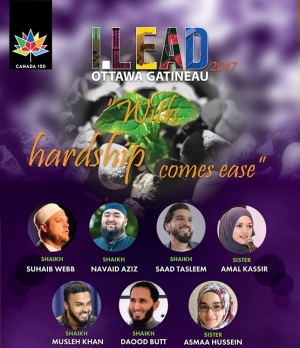
I.Lead is an annual conference put together with the help of various mosques in Ottawa. This year, there are seven speakers — five men and two women — who will address the conference’s theme “With hardship comes ease.”

However, none of them are black.

Jalil Marhnouj, who helped organize the conference, said several black Muslims were approached to speak but were unavailable.

“Every year, we invite speakers from different backgrounds … and they have attended and sometimes they can’t. And this year, some of them couldn’t,” he said.

Lots of experts to choose from

Chelby Daigle, editor of Muslim Link and the author of a recent report on anti-black racism in Ottawa, said part of the issue is the premise that there are only so many qualified black people available.

“People don’t realize that that is a form of discrimination,” she said. “It’s not intentional, but it shows a lack of understanding of the complexity of the Muslim experience in the city.”

Daigle believes there are all types of experts that could have been invited to speak from Ottawa’s large Black Muslim community and from across the country.

“Ottawa’s poet laureate is a black Muslim. The poet laureate right now for Edmonton is a black Muslim. We have Ginella Massa, who’s an anchor and who’s also a black Muslim. We have CBC journalist Eman Bare who we profiled on Muslim Link, who’s an award-winning journalist who also writes for Teen Vogue and helps to run Muslim Girl,” said Daigle.

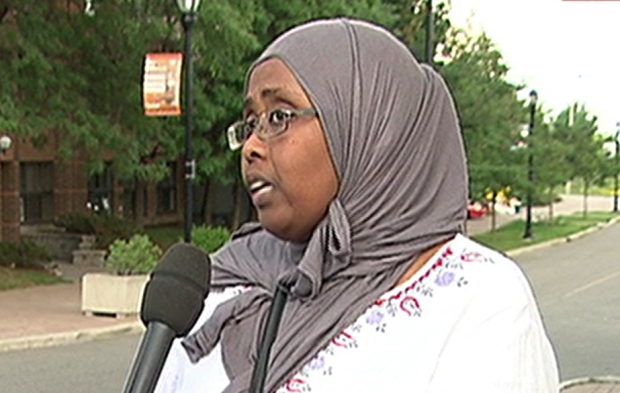
Amran Ali, a Somali-Canadian Muslim woman living in Ottawa, said she was also disappointed at the lack of diversity among speakers.

I.Lead roster

Although Ottawa has a large black Muslim population there are no black speakers at this year’s I.Lead conference. (Facebook)

“I wasn’t expecting to see such a limited list,” she said.

“Ottawa’s Muslim community is diverse. It’s made up of different ethnic backgrounds and different socioeconomic backgrounds,” said Ali.

“Any event that purports to be an event for the large Muslim community — and in particular Muslim youth — must be a reflection.”

Marhnouj said conference organizers are open to hearing suggestions and the conference will be a chance for people to voice their concerns.

“We will listen to them and we will take that into consideration, whatever they come up with, we will act accordingly,” he said.

“We work so hard to bring unity to our community and to bring knowledge,” he said. “And in the end it’s always a human effort and with human efforts there will always be shortcomings.”

The intersection of identities

Chelby Daigle thinks having greater diversity at conferences like I.Lead is important because intersecting identities shape people’s experiences differently and that needs to be reflected.

“I’m still more likely to face a hate crime because I’m black,” said Daigle.

According to Statistics Canada, in 2015 hate crimes targeting blacks declined but they still made up the largest percentage of the total number reported. Meanwhile, the number of police-reported hate crimes against Muslims jumped by 60 per cent.

“If you’re experiencing both anti-black racism and Islamophobia as a young person, that’s probably having a serious impact on your mental health, your concept of identity [and] where you feel welcomed,” said Daigle.

I.Lead isn’t the first Muslim-centred conference in Canada that’s received criticism from black Muslims.

​At the Reviving the Islamic Spirit conference in Toronto in December 2016, American Islamic scholar and president of Zaytuna College, Hamza Yusuf, made comments many participants found dismissed the struggles and work of anti-black racism advocates.

In particular, when asked if Muslim communities should be more supportive of movements like Black Lives Matter, Yusuf said “There are twice as many whites being shot by police but nobody ever shows those videos. It’s the assumption the police are racist and it’s not always the case.”

Amran Ali Canadian Somali Mothers Association Ottawa Abdirahman Abdi July 25 2016

Amran Ali says she was disappointed at the lack of diversity at this year’s I.Lead conference. (CBC)

Yusuf later apologized for his comments.

Promoting greater diversity and inclusion

Amran Ali believes the key ensuring greater diversity is reaching out to a broad range of people.

“Because it’s about Islam it means it has to be a big umbrella event where all Muslims — those who look like me, those who look like the organizers, those who look like Caucasian folk, Indigenous folks — should see themselves reflected,” she said.

“If we’re not reflected on the stage where people are talking or lecturing or teaching or inspiring and motivating, then frankly it feels isolating. It makes you feel you don’t belong, It makes you feel that you are less than.”

Source: Black Muslims in Ottawa upset over lack of diversity at Muslim conference – Ottawa – CBC News

High Alzheimer’s Rates Among African-Americans May Be Tied To Poverty : NPR

Social factors matter:

Harsh life experiences appear to leave African-Americans vulnerable to Alzheimer’s and other forms of dementia, researchers reported Sunday at the Alzheimer’s Association International Conference in London.

Several teams presented evidence that poverty, disadvantage and stressful life events are strongly associated with cognitive problems in middle age and dementia later in life among African-Americans.

The findings could help explain why African-Americans are twice as likely as white Americans to develop dementia. And the research suggests genetic factors are not a major contributor.

“The increased risk seems to be a matter of experience rather than ancestry,” says Megan Zuelsdorff, a postdoctoral fellow in the Health Disparities Research Scholars Program at the University of Wisconsin-Madison.

Scientists have struggled to understand why African-Americans are so likely to develop dementia. They are more likely to have conditions like high blood pressure and diabetes, which can affect the brain. And previous research has found some evidence that African-Americans are more likely to carry genes that raise the risk.

But more recent studies suggest those explanations are incomplete, says Rachel Whitmer, an epidemiologist with Kaiser Permanente’s Division of Research in Northern California.

Whitmer has been involved in several studies that accounted for genetic and disease risks when comparing dementia in white and black Americans. “And we still saw these [racial] differences,” she says. “So there is still something there that we are trying to get at.”

The research presented at the Alzheimer’s conference suggests the missing factors involve adverse life experiences beginning in childhood. These experiences have already been linked to a range of diseases, including heart disease and cancer.

“We’re starting to understand how early life stress and early life deprivation can increase your risk of a number of health outcomes in late life,” Whitmer says. “And the latest thing is understanding how and why that might affect the brain.”

Whitmer was part of a team that presented results of a study of more than 6,000 Kaiser Permanente health plan members, most born in the 1920s.

The team wanted to know whether people who grew up in harsher conditions were more likely to develop dementia. So they looked at people who’d been born in states with high infant mortality rates — an indicator of social problems like poverty and limited access to medical care.

White people’s risk of dementia wasn’t affected by their place of birth. But black people were 40 percent more likely to develop dementia if they’d been born in a state with high infant mortality.

“These people left the state and subsequently moved to northern California, yet there was still this very robust association between being born in a state with high infant mortality and increased risk of dementia,” Whitmer says.

Scientists from the University of Wisconsin presented results of a study of the link between stressful life events and mental function in middle age. They studied more than 1,300 people in their 50s and 60s, including 82 African-Americans.

Stressful experiences included having a parent with a drinking problem, financial insecurity, legal issues, divorce, being fired from a job, and the death of a child.

African-Americans reported 60 percent more of these stressful events than white Americans. But that was only part of the difference, Zuelsdorff says.

“The impact of these stressful events was stronger in African-Americans than it was in non-Hispanic white participants,” she says.

The researchers discovered this by administering tests that reveal the brain’s speed and flexibility in doing certain tasks. These abilities normally decline with age. So the team looked for evidence that stressful events were accelerating this decline.

And they found that in white participants, each stressful event added about a year and a half to normal brain aging. But in African-Americans, each event aged the brain an extra four years.

The next challenge for researchers is to figure out precisely how adverse life experiences are changing the brain, Zuelsdorff says. That will mean looking at the effects of stress hormones and seeing whether stress leads to inflammation in the brain, something that has been associated with Alzheimer’s.

Source: High Alzheimer’s Rates Among African-Americans May Be Tied To Poverty : Shots – Health News : NPR

AGO show humanizes the enslaved, Yorkville store tramples on tragedy: Paradkar

Nice piece contrasting awareness and obliviousness:

Two-and-a-half kilometres. That’s the distance between the gallery in Toronto where artworks utilize fashion to tell the stories of the oppressed and the alley where a store turns to fashion to trample on their tragedies.

One is a series called WANTED at the Art Gallery of Ontario where two Toronto artists have used fashion photography to cast light on the hushed-up history of slavery in Canada. The other is a camouflage jacket, on sale at a men’s store named Uncle Otis in Yorkville, that was worn by Belgian soldiers in the aftermath of an especially brutal and bloody colonization of what is now the Democratic Republic of Congo during which they killed more than 10 million people.

From the WANTED series, you’ll see on a billboard splashed up at Yonge-Dundas Square, an image of Tracy Moore, the host of Cityline.

In the photo, though, she is unnamed. She is wearing red, carrying weights. “Black gown and red callimanco petticoat” say the words on the image, describing her clothing. Next to the photo, another board that says “Not for sale.”

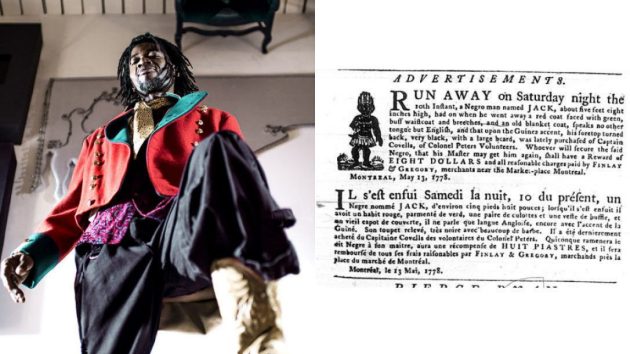
The inspiration for that “ad” and about nine others displayed at the AGO came from advertisements in newspapers such as Upper Canada Gazette and Quebec Gazette in the 1700s posted by Canadian slave owners after the people they had enslaved had run away. In the ads were descriptions of what the enslaved people were last seen wearing.

That detail motivated artists Camille Turner and Camal Pirbhai to transform those fugitive slave ads into artworks that look like contemporary fashion ads.

“Black gown and red callimanco petticoat” was the description that appeared in a newspaper ad in August 1766. “Whoever apprehends said Negro Girl, and brings her back to said WERDEN, or to Mrs. Mary Wiggans, at Montreal, shall have ONE PISTOLE Reward, and all necessary Charges, paid by I. WERDEN,” it read.

“We are not honouring slaves,” Turner told me by email.” We are honouring people who thought of themselves as free and took action to liberate themselves.”

“We wanted to restore their humanity. We don’t have access to the words of enslaved people but through these ads we know their actions. They took matters into their own hands, stealthily running away despite the risks and consequences of recapture.”

“None of my Canadian schooling had taught me about this reality (of slavery in Canada),” Pirbhai said.

“I immediately related this to the obliviousness we seem to show towards the current day slave trade existing in the fashion industry. Fashion ads were the perfect conduit to parallel the injustices of the past and the issues of today.”

Issues of today at a micro level include instances like at Uncle Otis that sells the camouflage jacket under the U.K. based label Maharishi.

This M65 Belgian Congo smock jacket is on sale at a Yorkville boutique.

One problem is the appropriation of the word Maharishi for a line of surplus military clothing. In Sanskrit, maha means great, rishi means sage. What a great sage has to do with military jackets beats me.

“The camouflage pattern, especially in the context of defence-budget-subsidised clothing, offers itself as a perfect canvas for customised, anti-military statements of peace and freedom,” says the Maharishi website.

This leaves me none the wiser.

Still, fashion is ripe with appropriation of “exotic” words from other languages — and in this case is likely used to add an aura of mysticism.

What about the choice of jacket? How is it any different from Nazi-era military gear?

Nobody responded to my repeated email requests for comment on the choice of label and the jacket from Maharishi and Uncle Otis; a manager at the store refused comment when I went there. I tried for two weeks. That was ample time to respond or quietly take down an offensive jacket after they were informed what it stood for.

The jacket itself selling for a hefty $590 (slashed, almost half price! from the original $950) is described thus: “This beautiful pick is of the M65 Belgian Smock Jacket used in the Congo. Maharishi reclaims it with handpainted tigerstripe came, repaired wear-and-tear holes and replaced missing buttons.”

Belgian Congo was rich in rubber, ivory, gold and other minerals, and Belgium extracted billions of dollars of wealth on the backs of local labour, committing atrocities and a genocide that decimated half the population of the land.

A more apt description of what this jacket symbolizes, then, would be: “It has the smell of the blood of the Congolese still. All the perfumes of Arabia will not sweeten this little smock jacket, neither will attempts to cover it with tiger stripes or repair the wear-and-tear brought about by kidnapping, beating, starving, mutilating, torturing, and murdering Congolese people for Europe’s economic gain. Wear it — to our economic gain.”

This isn’t art, this isn’t fashion. This is continuing to profit from exploitation.

Art has purpose.

“For us, art is about provoking critical thinking and prompting conversations,” said Turner. “We feel it is our responsibility to speak to future generations about our history.”

Over to you, Maharishi.

Source: AGO show humanizes the enslaved, Yorkville store tramples on tragedy: Paradkar | Toronto Star

Federal government to downsize failing Canada.ca project

Another failing IT project.

As someone who regularly accesses government information, never found Canada.ca terribly user friendly or easy to find the info I was looking for. The old departmental websites were more efficient from my user perspective (although that may reflect my comfort and familiarity with them or the more policy information that I was looking for).

And a bit disappointed the IRCC is one of the sites that will remain as it is one of the sites I consult with the most.

As with the other major IT failures – Shared Services Canada, Phoenix – one has to question the competence of the senior officials who made and prepared the case along with the Ministers who provided oversight and approval:

The federal government is substantially curtailing the multimillion-dollar Canada.ca project, acknowledging that its plan to merge 1,500 departmental and agency websites into a single website is sputtering.

Instead of migrating all departments and agencies to a single platform, the $11.8 million earmarked for the project will be used government wide, with a focus on four of the largest departments offering services most used by Canadians: health, environment, Canada Revenue Agency, and immigration.

Those departments will have until the end of this year to migrate their content to the new platform.

“The 2012 plan to migrate all government web content to the Canada.ca platform under delivered from the beginning in part due to poor project management, planning and underfunding from the outset by the previous Conservative government,” said Jean-Luc Ferland, press secretary to Scott Brison, president of the Treasury Board.

“We are refocusing project funds where they can make the biggest impact to improve Canadians’ online experiences.”

Most telling about the government’s flagging support for the initiative is that remaining departments and agencies will not be compelled to continue.

“Other departments will continue to have the option of migrating content to Canada.ca as resources and technology advances allow,” said Ferland.

Over budget and behind schedule

The Canada.ca initiative was launched with the goal of making it easier for people to find and use government information online. A $1.54-million contract for a new content management system, where all government websites would be moved, was awarded to Adobe in 2015.

But as CBC reported at the end of last year, the project is more than 10 times over budget and more than a year behind schedule, making it yet another failing government IT project, not unlike the Phoenix pay system or the email transformation initiative. It’s also another project the Liberal government is blaming on its predecessor.

A government source not authorized to speak on the record said the decision to pare down the Canada.ca initiative, yet allow it to limp along, was making the best of a bad situation.

“It’s like we walked into the kitchen where the meal is poorly planned and off to a rough start. Some dishes were forgotten, grill is overstuffed … your herbs are wilting on the counter. You don’t freak out and throw everything out. The responsible thing to do is to focus on your guests and make the most of everything you have.”

Tens of millions spent so far

In response to inquiries from CBC, the Treasury Board conceded that as of June, only 230,542 pages were hosted on Canada.ca, up from the 10,000 tabulated six months ago, but still an incredibly slow rate of movement over to the new portal.

There are more than 17 million government of Canada web pages in total.

As well, the Adobe contract has ballooned to more than $14.9 million, according to government figures. That does not include the tens of millions spent by departments and agencies that are responsible themselves for the actual migration of the websites, using existing budgets and staffing.

Since 2015, eight of the largest departments have spent or budgeted nearly $32 million on the project. Those departments include:

  • Employment and Social Development Canada.
  • Immigration, Refugees and Citizenship.
  • Health.
  • Environment.
  • Canada Revenue Agency.
  • National Defence.
  • Fisheries and Oceans.
  • Global Affairs.

A slow migration

“This is great news from a taxpayer’s perspective,” said Joel Brockbank, chief technology officer at OpenPlus, a content archictecture company that had submitted a bid to create the new content management system for Canada.ca

“These large IT renewals have a lot of momentum and it’s difficult to change course if it’s not going as planned. It’s amazing they are not doubling down and putting a lot more money into something that will ultimately fail.”

Experts who have warned against unmanageable, large, one-size-fits-all government IT projects agree.

“To focus the money on key sites which Canadians use most is the right decision,” said Timothy Lethbridge who teaches software engineering and computer science at the University of Ottawa.

The December deadline for the four big departments is probably still unrealistic, according to Lethbridge, but the idea of letting other departments off the hook is smart.

“To slowly migrate, as time permits, is more cost effective than a forced death march to get to an artificial deadline,” he said.

A time to cut losses

A government source with first-hand knowledge of the Canada.ca project, and who was speaking on condition of anonymity, said IT government workers have been told that none of the government’s arm’s-length agencies have been moving their material over to the new site for some time.

“In fact we are not even talking about Canada.ca anymore,” said the source, adding “the vast majority of the content on government sites is not being migrated at all.

“It probably just won’t happen.”

Source: Federal government to downsize failing Canada.ca project – Politics – CBC News

Australian senator quits over New Zealand dual citizenship – BBC News

May explain in part relatively low levels of diversity among Australian politicians although I suspect other factors more important:

An Australian senator has resigned after realising he holds dual citizenship, meaning his nine-year parliamentary career most likely breached the nation’s constitution.

Scott Ludlam, from the minor Greens party, said he only learned of his New Zealand citizenship last week.

Under Australia’s constitution, a person cannot run for federal office if they hold dual or plural citizenship.

Mr Ludlam had been told his eligibility would be challenged in court.

The senator, who was also Greens co-deputy leader, apologised for what he called an “avoidable oversight”.

Source: Australian senator quits over New Zealand dual citizenship – BBC News

CSIS faces $35-million harassment, discrimination lawsuit

Of the three – CSIS, Canadian Forces and RCMP – CSIS has the best visible minority  numbers:

Canada’s spy agency is being sued by five employees who are looking for upwards of $35 million in damages over allegations of years of harassment and discrimination based on their religion, race, ethnicity, gender and sexual orientation.

A statement of claim filed in Federal Court alleges that harassment, bullying and “abuse of authority” is rife within the Canadian Security Intelligence Service and that managers condone such behaviour.

The allegations are based on the experiences of five employees, none of whom can be legally identified within the document.

They allege that the harassment they have faced over years has caused them embarrassment, depression, anxiety and loss of income. They also allege that their complaints were ignored or dismissed by senior managers, some of whom suggested they should keep quiet out of fear of reprisal.

None of the allegations in the 54-page document have been tested in court.

In a statement, CSIS director David Vigneault says the agency does not tolerate harassment under any circumstance, which is reflected in the employee code of conduct.

Any allegations of inappropriate behaviour are taken seriously, he says.

Public Safety Minister Ralph Goodale have yet to respond to a request for comment.

Source: CSIS faces $35-million harassment, discrimination lawsuit – The Globe and Mail