Hearing into Liberals’ anti-Islamophobia motion [M-103] showcases confusion, fears of free speech loss

Interesting that the Post seems to be only covering the hearings with CPC-nominated witnesses:

27 Sep:

  • Jay Cameron, Justice Centre of Constitutional Freedoms
  • Raheel Raza,  Council for Muslims Facing Tomorrow
  • Peter Bhatti, International Christian Voice
  • Father Raymond de Souza

and not the hearings with government-appointed ones:

25 Sep:

  • Ayesha S. Chaudhry, Canada Research Chair in Religion, Law and Social Justice
  • Avvy Yao-Yao Go, Chinese and Southeast Asian Legal Clinic
  • Shawn Richard, Canadian Association of Black Lawyers
  • Shalini Konanur, South Asian Legal Clinic of Ontario.

Lack of reporter time, or lack of balance?

The Liberals’ anti-Islamophobia motion, M-103, could lead to thought control, oppression, disharmony and the criminalization of non-Muslims, the House of Commons heritage committee heard Wednesday, during some of the most extreme criticism of the motion it has heard to date.

It was a hearing that showcased much of the confusion and polarizing rhetoric that has swirled around M-103 since it was tabled by Liberal MP Iqra Khalid in December 2016, and highlighted doubts about the language of the motion. While the committee is supposed to be gathering recommendations for how to combat racism, several committee members spent much of their time trying to explain what M-103 actually means.

Liberal MP Julie Dabrusin was at pains to clarify that the motion is not a law, that the committee is not drafting a law and that the committee’s recommendations won’t create a new law. The committee is currently conducting a study of racism and religious discrimination, as required by M-103, which was passed in March.

“We’re just doing a study,” said Liberal MP Julie Dzerowicz.

The Liberals spent so much time trying to explain M-103 that, at one point, Conservative MP David Anderson accused them of “filibustering their time.”

“It seems they’ve been more interested in hearing their own voices than anyone else’s,” he said.

Still, some of the witnesses painted dire portraits of what might happen if criticism of Islam were somehow banned in Canada. Jay Cameron, a lawyer with the Justice Centre of Constitutional Freedoms, spent several minutes explaining that M-103 could prevent Canadians from criticizing such practices as female genital mutilation. He also claimed the motion implies that the government should police the thoughts of its citizens.

Source: Hearing into Liberals’ anti-Islamophobia motion showcases confusion, fears of free speech loss | National Post

Border agency reports big drop in number of long-term detainees

Latest numbers:

The number of people being held for more than 90 days in immigration detention centres has declined by almost a third this year over last year, according to statistics from the Canada Border Services Agency.

The figures show that the number of detainees being held for three months or longer dropped by 29.9 per cent in 2016-17 compared with 2015-16. They also show a decline since 2012-13 of 35.3 per cent.

The Canada Border Services Agency (CBSA) told CBC News that it is using federal funding announced last year to expand the use of alternatives to detention.

“The funding received is dedicated to developing and deploying a technology-enabled voice reporting solution that will make it easier for low-risk persons to comply with reporting conditions imposed by CBSA officers or the Immigration and Refugee Board, while living in the community,” a CBSA spokesperson said in an email to CBC.

Detainees are also now locked up an average of 19.5 days, down from 23.1 days last year, according to the agency’s statistics.

Last year, Public Safety Minister Ralph Goodale announced $138 million for a new national immigration detention framework, with the aim of creating a more humane system.

Part of the money is being spent on a new immigration holding centre (IHC) in Surrey, B.C., which should open in December 2018. The centre in Laval, Que., is scheduled for completion in 2021. The Toronto holding centre is also being upgraded.

“By July 2018 the Toronto IHC will be equipped to house higher-risk detainees, allowing more individuals in provincial detention facilities to be transferred to the IHC on a case-by-case basis,” CBSA said in the email.

Detention in jails

On any given day in Canada, hundreds of people are detained under the Immigration and Refugee Protection Act. Last year the border agency detained 6,251 people, 32.6 per cent of which were held at non-CBSA facilities such as provincial jails, even though they had not been charged with a crime.

“Detaining people long-term at short-term detention facilities is extremely problematic, and especially when some of the detentions are going on for a very long time, into the years,” said Lorne Waldman, a prominent Toronto immigration and refugee lawyer.

Immigration detainees are sent to provincial jails when they’re high-risk, aren’t close to a holding centre or, in the Vancouver area, held for more than 48 hours.

Source: Border agency reports big drop in number of long-term detainees – Politics – CBC News

Trump Administration To Drop Refugee Cap To 45,000, Lowest In Years : NPR

A smaller percentage than others. USA already had far fewer refugees than others in 2016:

EU USA Canada Australia
2016 Population

510,100,000

323,100,000

36,290,000

24,130,000

Refugees resettled or granted asylum

720,000

84,994

58,910

17,955

Per capita percent

0.14%

0.03%

0.16%

0.07%

The Trump administration plans to cap the number of refugees the U.S. will accept next year at 45,000. That is a dramatic drop from the level set by the Obama administration and would be the lowest number in years.

The White House formally announced its plans in a report to congressional leaders Wednesday, as required by law.

The number of refugees the U.S. admits has fluctuated over time. But this cap is the lowest that any White House has sought since the president began setting the ceiling on refugee admissions in 1980.

Refugee resettlement agencies are disappointed with the 45,000 cap, which they say falls far short of what is necessary to meet growing humanitarian needs around the world. They had recommended a limit of at least 75,000.

Last year, the Obama administration set the cap at 110,000. Only about half that number have been admitted, after the Trump administration put the entire refugee resettlement program on hold under its travel ban executive orders.

“Churches and communities, employers and mayors, are heartsick at the administration’s callous and tragic decision to deny welcome to refugees most in need,” said Linda Hartke, the president and CEO of Lutheran Immigration and Refugee Service, one of largest resettlement agencies in the country.

The debate over refugees is often framed as a clash between humanitarian goals and national security.

But Trump administration also argues that the U.S. spends millions of dollars a year to screen and resettle refugees and to help them once they arrive.

“For the cost of resettling one refugee in the U.S., we can assist more than 10 in their home region,” President Trump said in a speech to the United Nations earlier this month.

Once they arrive, refugees qualify for many social services, including health care, food stamps and cash assistance. Many of those costs fall on state and local governments, and some states are pushing back.

Earlier this year, Tennessee took the federal government to court over refugee resettlement.

“The bottom line is the federal government is coercing the state of Tennessee to spend Tennessee taxpayers monies in ways that some individual Tennesseans disagree with,” Republican state Sen. John Stevens told member station WPLN in March.

But many mayors across the country see refugees as an economic boon for their cities.

“These people are paying taxes. They’re buying houses. They’re going into our schools,” said Stephanie Miner, the mayor of Syracuse, N.Y.

Miner, a Democrat, says refugees are helping revitalize the city’s north side, which was home to Italian and German immigrants before them.

Source: Trump Administration To Drop Refugee Cap To 45,000, Lowest In Years : NPR

Penguins’ White House decision means Crosby can’t ‘stick to sports’ – Sportsnet.ca

Good analysis:

The president’s call for the release of NFL players who take a knee during the national anthem to protest racial injustice caused widespread backlash across the league this weekend. According to the Chicago Tribune, more than 200 players took a knee or sat on the bench while the anthem was played. Three teams, including the Pittsburgh Steelers, remained in their locker-rooms for the anthem. (Steelers offensive lineman, Alejandro Villanueva, an Army veteran, stood at the mouth of the players’ tunnel for the anthem by himself, though he has said that was due to a mistake.)

The president also disinvited the Golden State Warriors from visiting the White House as NBA champions, because the team’s star player, Steph Curry, said he wouldn’t attend — causing further backlash from NBA stars, like LeBron James and many others.

Curry says Trump’s comments just cement Warriors stance on White House visit

In the midst of it all, the Pittsburgh Penguins released a statement saying that they would, indeed, be attending the White House in celebration of the team’s Stanley Cup victory. That decision — not to mention the timing of the announcement — resulted in an outpouring of both criticism of and support for the Penguins.

When he was asked for his thoughts on visiting the White House by reporters after an exhibition game on Sunday, Crosby faced a polarizing question — whether he realized it or not.

“I support it,” the Penguins captain said. “It’s a great honour for us to be invited there.”

Despite Crosby’s honest efforts to be inoffensive, there was simply no way around it this time. He was going to offend one side or the other regardless.

And in that moment, Crosby made a statement about what he, his team and, yes, the NHL stand for.

Because in Trump’s America, sports and politics are inextricably linked. They’ve been mashed together like two mounds of Play-Doh in the hands of a toddler. And so Crosby was handed a discoloured pile of highly political mush, courtesy both of the president and of his own team’s decision to make an announcement about going to the White House.

This is the kind of discomfort that neither Crosby nor the NHL is used to.

Hockey is the least diverse of the major North American pro sports leagues. It is a sport that is by and large dominated by white people. And it is a sport that, for the most part, only the affluent can afford to play.

For those reasons, the NHL has less connection to the issues that are at the forefront in leagues like the NFL and the NBA. The majority of NHL players don’t face the systemic racism that their counterparts do. And so, in all its whiteness, the NHL doesn’t carry the social conscience that other leagues do. In fact, it deliberately tries not to.

Commissioner Gary Bettman has expressed his preference that players remain apolitical when representing the league. Meanwhile, Adam Silver, the NBA commissioner, has encouraged the players in the league to use their platforms to express their views.

The NFL, NBA and WNBA all have players who have long used their platform to protest the systemic racism that people of colour face in the United States. Some prominent baseball players, like Adam Jones, have also spoken out against racism. Oakland Athletics catcher Bruce Maxwell also knelt during the anthem on the weekend.

Although hotly debated, these protests have all been peaceful, respectful and eloquently explained by those who take part or support those who do. But the NHL has slipped through the controversy relatively unchallenged. Questions of race are left to black players such as P.K. Subban and Wayne Simmonds.

Still, hockey hasn’t been completely devoid of opinion. In recent years, several players in the NHL have shared their views about politics and social issues. Tim Thomas refused to meet with President Barack Obama when the Boston Bruins won the Stanley Cup. Earlier this year, Toronto Maple Leafs forward Nazem Kadri was critical of President Trump’s ban on people entering the United States from specific Muslim-majority countries. Mika Zibanejad of the New York Rangers spoke about the difficulty the ban created for his family still living in Iran. This weekend, Winnipeg’s Blake Wheeler slammed the president on Twitter for his comments regarding protesting athletes.

Source: Penguins’ White House decision means Crosby can’t ‘stick to sports’ – Sportsnet.ca

Robyn Urback’s take, after correctly calling out those using intemperate language criticizing Crosby:

Personally, I would have liked to see Crosby turn down the invite for any number of reasons: Trump’s attacks on athletes, women, immigrants, the U.S. Constitution and a normal news cycle, or for appearing to declare war on North Korea over Twitter. Take your pick.

I suspect Crosby assumed, rather adorably, that accepting the White House invitation was the less political of his two options. And after theexcoriation Boston Bruins goaltender Tim Thomas received for skipping his team’s White House visit in 2012, it’s not hard to see why he might think that.

Two wrong choices

But in 2017, there is no such thing as an apolitical move. Crosby was damned either way. He’d either be a Trump sympathizer by accepting the invitation, or a rogue liberal by turning it down.

Ideally, there would be room for some nuance, but we seem to exist in a climate now where there’s this impulse to characterize everyone — athletes, actors, co-workers, etc. — as either “with us” or “against us,” which is absolutely being encouraged by the guy in the White House.

Indeed, separating people into “good” and “bad” is straight from the Trump playbook, but that doesn’t mean the rest of us have to play along. We don’t have to see an athlete who visits the White House or chooses to stand during the national anthem as a de facto Trump sympathizer; perhaps he disagrees with Colin Kaepernick’s method of protest, or fears being seen as anti-American, or maybe he just wants to try to stay out of it, to the extent that’s possible.

There is an argument to be made, however, that someone who does nothing in the face of injustice is himself guilty of perpetuating that injustice. It’s a fair point, which is why Crosby doesn’t exactly deserve a high-five for shrugging off the president’s bizarre views on the free speech rights of athletes.

But it’s unrealistic to expect every prominent figure in the world to declare his or her position on this presidency. Some people just aren’t built for it (which, granted, speaks to an extraordinary level of privilege, since some people have to be political, whether they want to or not). Hockey players are not exactly known for their thoughtful takes on social justice.

In any case, Crosby is not the enemy. If there is an enemy here, it’s his indifference, which won’t be challenged by sending him a tweet calling him a moral leper.

You don’t change minds by dividing people into camps and declaring as enemies those with whom you disagree. And you don’t change minds by yelling at strangers on the internet.

Change happens when those with whom we disagree are seen as potential allies, not hopeless adversaries. Crosby could be an ally. Or else he’ll just be a pretty good hockey player.
 

Labour’s amendment on antisemitism should reassure Jewish supporters | Keith Kahn-Harris | The Guardian

One of the better commentaries that I have seen but welcome comments from those closer to UK politics:

In responding to this morning’s debate on party rule changes, Jim Kennedy, the Labour national executive committee (NEC) member who moved them, shook his head in wonder: “The rules used to be the most mundane part of the conference.” He was correct to reflect that the passionate attention paid to rule changes is a sign of the newly vibrant nature of the party’s internal democracy.

One of those rule changes looks like it should have been uncontroversial in a party where anti-racism is a central value:

“No member of the party shall engage in conduct which in the opinion of the NEC is prejudicial, or in any act which in the opinion of the NEC is grossly detrimental to the party. The NEC shall take account of any codes of conduct currently in force and shall regard any incident which in their view might reasonably be seen to demonstrate hostility or prejudice based on age; disability; gender reassignment or identity; marriage and civil partnership; pregnancy and maternity; race; religion or belief; sex; or sexual orientation as prejudicial to the party; these shall include but not be limited to incidents involving racism, antisemitism, Islamophobia or otherwise racist language, sentiments, stereotypes or actions, sexual harassment, bullying or any form of intimidation towards another person on the basis of a protected characteristic as determined by the NEC, wherever it occurs, as conduct prejudicial to the party.”

To the untrained eye, the manner in which the amendment was proposed looks like a welcome example of the party coming together after a fractious series of widely publicised controversies over antisemitism. It was proposed by the Jewish Labour Movement – which represents those Jews in the party who are Zionists – but it was also endorsed by Jeremy Corbyn himself, whose relationship with Zionism is sceptical to say the least, together with Momentum, some of whose activists have been accused in the past of antisemitism.

But such is the ability of antisemitism to spark conflict in the Labour party, that the amendment has not gone unchallenged, despite the apparent consensus. Labour Party Marxists already told its members: “This is supported by the Jewish Labour Movement, which already tells you that you should probably oppose without even having to read it.” There have been calls to expel the JLM for its support for Israel, including by delegate Sara Callaway during the debate.

Leah Levane, a Jewish delegate from Hastings and Rye, whose constituency had initially put forward a different wording, reluctantly withdrew her amendment in favour of the NEC one but not without a sharply worded declaration that the Jewish Labour Movement did not speak for her. Then, in the response to the debate, Naomi Wimborne-Idrissi castigated the JLM for “running to the Daily Mail and the Telegraph with stories” before objecting to the reference in Levane’s amendment to “holding” beliefs since: “That’s thought crime, comrades, and we can’t be having it.” Wimborne-Idrissi also lauded the launch the previous evening of Jewish Voice for Labour, a group that aims to push back at what it sees as attempts to “widen” the definition of antisemitism.

The controversy over antisemitism in Labour is therefore unlikely to go away any time soon. However much the party’s rules might condemn antisemitism and enable disciplinary action against those accused of it, there is no getting around the fact that there are competing definitions of what antisemitism consists of. That Jews themselves disagree only complicates matters further.

Nonetheless, the fact that the JLM, the NEC, Corbyn and Momentum were able to cooperate in this matter does suggest a desire to come together for the good of the party. Indeed, the JLM’s Twitter account proclaimed “help Jeremy Corbyn fight antisemitism”, a striking refutation of the accusation that the group is seeking to undermine his leadership. As Mike Katz from the JLM and Philip Cohen, a Jewish councillor from Finchley, both argued from the platform, the amendment might help to rally Jews back to Labour in some constituencies. The desire to achieve power can be a way of concentrating minds of Corbynites and Labour Zionists alike.

The amendment is another example of the tension between enabling free debate within Labour and ensuring it is a disciplined party that can win elections (the lack of Brexit debate is another). If Polly Toynbee is right and Corbyn has been transformed into a politically savvy pragmatist, then his backing of the amendment is a manifestation of this. What remains to be seen is whether those who spoke against the amendment will accept the inevitable restraint that this implies.

Source: Labour’s amendment on antisemitism should reassure Jewish supporters | Keith Kahn-Harris | Opinion | The Guardian

La gauche religieuse n’existe pas: Yakabuski

Good piece by Yakabuski on the Canadian centre left consensus on multiculturalism:

Bref, la chef du Bloc québécois, Martine Ouellet, se trompe de cible quand elle se dit inquiète de la montée de la gauche religieuse. Il n’y a tout simplement pas de gauche religieuse au Canada. La gauche canadienne est multiculturaliste, point. Même ceux qui ne l’appuient pas voient dans la candidature de M. Singh l’incarnation même de la modernité canadienne.

C’est ainsi que Justin Trudeau a pu dire au New York Times, en 2015, que le Canada serait le premier État postnational sans que l’opposition monte aux barricades. Les propos du premier ministre témoignaient de l’évolution de l’identité canadienne depuis l’instauration de la politique officielle de multiculturalisme et de la Charte canadienne des droits et libertés par son père Pierre Trudeau. Finie l’époque où les Canadiens angoissaient devant la faiblesse de leur identité face à la menace américaine. Si le Canada anglais s’est donné un projet de société, c’est celui de créer un nouveau modèle d’appartenance dont le monde entier pourrait s’inspirer. Selon l’ancienne gouverneure générale Adrienne Clarkson, elle-même réfugiée, le Canada ne serait rien de moins qu’une « société expérimentale ».

Bien sûr, la diversité comme projet de société n’emballe pas tous les Canadiens. Mais ses critiques ne se trouvent pas à gauche. Et même le nouveau chef du Parti conservateur, Andrew Scheer, ne se presse pas de s’associer à leur cause, ayant évincé sa rivale à la course au leadership Kellie Leitch du cabinet conservateur fantôme. L’opposition des candidats à la chefferie néodémocrate au projet de loi no 62 du gouvernement du Québec, interdisant le port du niqab lors de la prestation ou de la réception de services publics à des fins de sécurité, s’inscrit dans une philosophie d’inclusion où les accommodements sont devenus la norme dans une société multireligieuse. Si la plupart des Canadiens ne voient pas dans ces accommodements une menace à la laïcité de l’État, c’est parce qu’ils ont été conditionnés à croire que la même Constitution qui protège les droits des personnes croyantes protège aussi tous les Canadiens contre des gouvernements qui voudraient adopter des lois au nom de la religion. En quoi M. Singh, qui n’a d’ailleurs jamais manifesté un quelconque désir d’imposer sa religion aux autres, serait-il différent d’un catholique pratiquant à la tête du pays ?

Les Québécois ont peut-être une autre idée de la laïcité, influencée par leur histoire de catholicisme oppressant et par le républicanisme français. Mais de là à disqualifier des leaders politiques à cause de leur religion, il y a une marge.

Source: La gauche religieuse n’existe pas | Le Devoir

Canada’s access-to-information system has worsened under Trudeau government: report

Hopefully, this report will provoke some attention:

Canada’s access-to-information system has only gotten worse under Prime Minister Justin Trudeau’s government, and a new Liberal bill intended to fix the problems has “worrisome” elements, a new report has found.

A freedom-of-information audit from News Media Canada, a national association representing the Canadian news media industry, gives the federal government a failing grade for timely disclosure of information. It also said its performance in this year’s audit “was even worse than in the latter years of the former Stephen Harper government.”

“The results are not encouraging and show a system that seems as broken as ever,” said a report on the audit by journalist and professor Fred Vallance-Jones and Emily Kitagawa, a freelance journalist and social worker.

Nathan Cullen, the NDP democratic reform critic, called the findings “shameful.”

“It’s got to be a bad day for Liberals when Stephen Harper was more open to the Canadian public than they are,” he said.

The report came the same day the federal information watchdog said she is “generally very disappointed” with the Liberal bill that would revise the Access to Information Act, which is intended to let Canadians see federal files.

Information commissioner Suzanne Legault said on Tuesday she will outline her concerns about the planned changes in a special report to Parliament this week.

The act, which took effect in 1983, allows people who pay $5 to request everything from correspondence and studies to expense reports and meeting minutes.

Agencies must answer requests within 30 days or provide a good reason for taking more time.

Source: Canada’s access-to-information system has worsened under Trudeau government: report – The Globe and Mail

Germany’s election and the educational polarisation of voters | Times Higher Education (THE)

Interesting analysis:

Germany has voted. Angela Merkel is weakened, but she remains chancellor and is now seeking new coalition partners for government.

Instead of focusing on what the election means for German higher education and research policy – which probably won’t become clear until months of coalition negotiations have concluded – I want to highlight some interesting voting patterns among German graduates.

In the United States and the UK, it’s now a commonplace observation that voters seem increasingly divided by levels of education rather than traditional cleavages like levels of income. In the ballots of 2016 and 2017, graduates tended to take the side of more open, pro-cosmopolitan parties and politicians (Jeremy Corbyn’s Labour, Hillary Clinton, Remain in the UK’s EU referendum) against more closed, nationalistic forces (Theresa May’s Conservatives, Leave, Donald Trump).

You can certainly quibble with these groupings, but the overall trend is unmistakable.

For example, in this year’s UK general election, graduates were 10 percentage points less likely to back the Conservatives, and nine percentage points more likely to vote for Labour, than the broader voting public.

The divide was even starker last year during the EU referendum, when 68 per cent of graduates voted to remain.

Meanwhile, in the US election, Clinton won college graduates by a nine percentage point margin, while Trump won everyone else by eight points. “This is by far the widest gap in support among college graduates and non-college graduates in exit polls dating back to 1980,” according to the Pew Research Center.

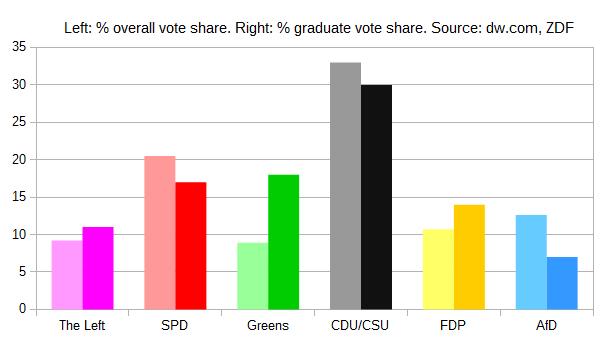
Is the same thing happening in Germany? Ostensibly not – German graduates seem more in line with their fellow citizens than in the UK or the US. This is most clearly visible when you look at the graduate vote share for Germany’s political parties arranged on the left to right political spectrum:

In terms of the bigger parties, graduates were a little less likely than other voters to vote for Merkel’s conservatives (CDU/CSU) – but exactly the same was true of the social democrats (SPD).German graduates voting patterns

Graduates were both more likely to opt for the radically left-wing Die Linke – and the almost diametrically opposed (at least on economic matters) Free Democratic Party (FDP). This feels very different from the US and UK, where graduates have come down heavily on one side or the other in the votes of the past two years.

Why might this be? A couple of potential reasons spring to mind. Germany is famed for the quality of its vocational education, which, although under pressure, still offers the hope of a well respected and remunerated life course that does not require university. Non-graduates are perhaps less likely to be economically “left behind” than in other countries.

There is also still no real equivalent of the Ivy League, Oxbridge or the grandes écoles in Germany, meaning that attending (a certain type of) university is arguably less of a prerequisite for power and influence.

But have a look at the chart again – there are nonetheless signs that educational polarisation is beginning to take root in Germany.

Graduates heavily backed the Greens, who, aside from their environmental policies, are known as supporters of multiculturalism, and have several high-profile leaders with a Turkish family background. The AfD on the other hand are emphatically against multiculturalism and have leaders who have made a series of brazenly racist statements; they were largely shunned by voters who have been to university.

As the AfD’s entry into parliament shows, Germany is not immune from the divisions afflicting the UK, the US and many other European countries. It will be interesting to see if the country becomes just as polarised on educational grounds as well.

Source: Germany’s election and the educational polarisation of voters | Times Higher Education (THE)

Promoting diversity and inclusion, and how to tell the difference: RBC Neil McLaughlin

McLaughlin, head of personal and commercial banking for the Royal Bank of Canada, on how to leverage and benefit from diversity:

Canada is one of the world’s most diverse countries. Business gets it.

Diversity and inclusion are part of our values. They’re critical to the future prosperity of our country. They’re a business imperative and key for growth and innovation.

We know this. So what are we doing about it?

That’s a growing challenge for Canadian businesses as we come to grips with twin revolutions in the technology we use and the society we serve.

This summer, Royal Bank of Canada (RBC) and the Institute for Canadian Citizenship surveyed 64 leading organizations – from hospitals to technology firms – that collectively employ 1.2 million Canadians to ask them about diversity and inclusion: how they define it, how they go about promoting it and how they measure it.

The survey results will be released at the 6 Degrees Conference in Toronto on Sept. 26, and the findings are both encouraging and concerning. Canadian business gets diversity, but we’re struggling with inclusion – an imprecise and ambiguous word that most employers don’t know how to approach. Diversity is often considered to be what we see. It’s a fact. Inclusion is what we hear – how we value, respect and involve everyone. It’s a choice.

Nearly 90 per cent of organizations in the survey strongly believe diverse and inclusive teams make better decisions. And, as we deal with whipsaw changes in the digital revolution, we realize we need more diverse perspectives than ever.

Here’s the rub. Where the majority of organizations see themselves as diverse, and go to great lengths to foster diversity, few have found a way to come to grips with inclusion strategically.

The numbers tell the story: 65 per cent strongly agree that leveraging diversity is fundamental to organizational performance, but only 10 per cent say they’re taking full advantage of a diverse work force. Only 20 per cent tie diversity and inclusion results to performance objectives and only 10 per cent measure the effects of diversity and inclusion on innovation.

In roundtables across the country, we heard shared concerns from different and diverse companies. A mining giant saw attracting more women as an answer to the problem of an aging work force – and then realized at its mine sites it didn’t have goggles or helmets that fit them properly. A state-of-the-art hospital in a low-income neighbourhood discovered that many of the residents its serves view it as the “castle on a hill” rather than a health-care partner or potential employer.

These firms recognized that while they’re surrounded by diversity, they’re not harnessing it and, therefore, are not moving at the pace of change of the communities around them. We all know we have more talent, more ideas, more passion, more perspectives than we use. In business, we’d call it a stranded asset.

When you consider that Canada accepts 300,000 immigrants annually, that one-fifth of Canadians are visible minorities and that 60 per cent of Canadian females between the ages of 25 and 64 have post-secondary degrees, the survey numbers tell us we need to do better. Add to that the fact global talent is highly mobile, and it’s clear: We need to do better now.

At RBC, we’ve seen incredible creativity and innovation through a co-op program, Amplify, that encourages students – two-thirds of whom were born outside Canada – to solve some of RBC’s most complex business challenges. We’re taking that diversity of thought and trying to leverage it for better business results. That’s inclusion.

It’s not about relying on the “smartest person in the room” but the talent of many. It’s about the whole being greater than the sum of the parts. As our Amplify program shows, a diverse group of engaged people is more likely to solve a challenge than a genius lone wolf. This diversity of thought is where you get innovation.

If we are to tackle challenges such as climate change and health care, we need to cultivate the talents of all our best minds. We need to see inclusion not as an employee-engagement tool, but a core part of corporate strategy and a way to build stronger communities.

So, how can Canadian employers leverage the country’s diversity to come up with new ways of thinking and working? Here are some ideas we heard in conversation with organizations across the country: Get the strategy group to make diversity and inclusion their own priority. Adopt innovation metrics to see how inclusion is paying off. Make it a central part of every leadership discussion. Promote a questioning culture, to engage the minds of the many, not just those who think they’ve got it figured out. Measure, measure, measure. Compensate accordingly. Repeat.

Canadian business gets it. Now we need to act on it.

Source: Promoting diversity and inclusion, and how to tell the difference – The Globe and Mail

ICYMI- No room for complacency: The Economist on #Antisemitism

Good overall assessment, picking up on the Institute for Jewish Policy Research covered in an earlier post (Over a quarter of British people ‘hold anti-Semitic attitudes’, study finds – BBC News):

ALL over Europe, there is concern about an increase in anti-Semitism, and deliberation over how to respond. Earlier this month the Parisian home of a 78-year-old Jewish community leader was attacked by intruders who shouted: “You are Jews, where is the money?” Along with his wife and son, the man was taken hostage, beaten and robbed, in what the government acknowledged was “an act …directly related to their religion”. Around the same time, the former head of a school in Marseille made waves by saying that when he was in charge he would advise Jews against enrolling, for fear of harassment.

Meanwhile the Vatican recently co-organised a symposiumin Rome on anti-Semitism and minority rights in the Middle East, at which Tony Blair was the main speaker. The former British prime minister declared:  “There is anti-Semitism in the East, but also in the West. There are manifestations in European countries, and also in the United Kingdom.”

So how bad are things in Mr Blair’s homeland? On the face of things, Britain is a relatively good place to be Jewish. When anti-Semitic feelings across Europe are compared, the UK tends to do well. But a new study by the London-based Institute for Jewish Policy Research gives an unusually nuanced picture of opinion in Britain.

It found that hard-core anti-Semites, who “express multiple anti-Semitic attitudes readily and confidently”, amounted to 2.4% of the population, while a further 3% could be described as “softer” anti-Semites, expressing somewhat fewer negative views. To probe their opinions, respondents were invited to react to propositions like “Jews think they are better than other people” or “The interests of Jews in Britain are different from….the rest” or “Jews have too much power in Britain…”

The study said that there was a “much larger number of people who believe a small number of negative ideas about Jews but…may not be consciously hostile or prejudiced towards them”. It found that 15% of Britons agreed at least in part to two or more anti-Semitic propositions, with a further 15% agreeing at least in part to one of them. The researchers’ interpretation was cautious:

“This emphatically does not mean that 30% of the population of Great Britain is anti-Semitic…Rather the 30% figure captures the current level of the diffusion of anti-Semitic ideas in British society, and offers an indication of the likelihood of British Jews encountering such ideas.”

The report also tackled the sensitive question of how far hostility towards Jews is linked with negative feelings towards Israel. It found the two mind-sets to be correlated, but not co-extensive. Thus 86% of those British people who hold no anti-Israel attitudes hold no anti-Semitic views either; but among those who hold a large number of anti-Israel attitudes, only 26% are completely free of anti-Semitic feelings.

Still, there clearly are people who are strongly critical of Israel, but not anti-Jewish, and a somewhat smaller contingent who harbour anti-Semitic sentiments but have no particular gripe with the Jewish state. As the report puts it, “anti-Semitism and anti-Israel attitudes exist both separately and together.”

Meanwhile Germany this week joined Britain, Austria and Romania in adopting a working definition of anti-Semitism drafted last year by the International Holocaust Remembrance Alliance, a Berlin-based body. It says:

“Anti-Semitism is a certain perception of Jews, which may be expressed as hatred toward Jews. Rhetorical and physical manifestations of anti-Semitism are directed toward Jewish or non-Jewish individuals and/or their property, toward Jewish community institutions and religious facilities.”

The definition is controversial. It has been criticised by some British Jews on the political left who argued that it could muzzle legitimate criticism of Israel, and by a leading British barrister who concluded after studying the text, and the accompanying guidelines, that it was both too narrow (it might fail to capture some anti-Jewish conduct) and too broad, in the sense that free speech over the Middle East, for example in universities, might be curtailed.

In its recommendation on how to apply the definition, the IHRA tries to give an idea of how far, in its view, disapproval of Israel can reasonably go. It says that “manifestations [of anti-Semitism] might include the targeting of the state of Israel, conceived as a Jewish collectivity. However, criticism of Israel similar to that levelled against any other country cannot be regarded as anti-Semitic.”

The European Jewish Congress, which styles itself as the “sole political organisational representative of European Jewry”, hailed the German move as “vitally important”. It would help to change a state of affairs where “astonishingly, anti-Semitism used to be defined by the perpetrator not the victim”.

Source: No room for complacency