New Atheists are wrong about Islam. Here’s how data proves it – Salon.com

Interesting study by Steven Fish of Berkeley on his study and book, Are Muslims Distinctive?: A Look at the Evidence, finding less difference between Muslims and others than commonly believed:

I [Fish] found that Muslims in general are less distinctive than many of us think. In many ways there is really very little difference between Muslims and everybody else. Sometimes I use “everybody else” as the reference category, and sometimes I use Christians in particular, because Christianity and Islam are by far the world’s biggest faith traditions…

Even in some areas in which we expect … I didn’t find a great deal of difference. For example, many people think that Muslims are really intent on fusing religious and political authority, that there’s really no room in Islamic thinking for independent civic sphere that is not run by religious authorities, and in which religious authority and doctrine predominate, meaning there’s little room for an independent civil society and public sphere. Well, I found in this survey data that … Muslims and Christians don’t differ very much on this question, and that most Muslims, once one controls for everything that needs to be controlled for in these statistical analyses, actually do not want to fuse religious and political authority…

Some, of course, do. Some absolutely do. But some Christians do as well … There are many American Christians who are skeptical about dividing church and state rigorously. That’s true for many Muslims as well. But a majority of both Christians and Muslims seem to embrace at least some separation of sacred and secular in politics. That’s one finding that was perhaps surprising and also showed that Muslims are less distinctive than we might think.

Another finding that showed that Muslims were less distinctive than we might think looked at … membership in organizations, all kinds of things that we would use to actually measure social capital — interpersonal trust, for example. We find there that there really is little or no difference between those Muslims and everyone else.

There’s some questions by which I did find evidence of Muslim distinctiveness. For example, gender inequality; I find in the data that there are big problems in the Muslim world relative to other regions, and among Muslims relative to people of other faiths when it comes to gender inequality. It seems that there are lower workforce participation ratios — that is, female-to-male and earned-income ratios — among Muslims than among non-Muslims, generally speaking, which means that women tend to work less and earn less than men do in Muslim countries to a greater extent than they do elsewhere. I also find other evidence of gender discrimination …

Generally speaking, women should outlive men by several years. I found that that gap is somewhat smaller in predominantly Muslim societies, which is a red flag and shows that perhaps there are gender discrimination problems that run more deeply than in predominantly non-Muslim societies.

New Atheists are wrong about Islam. Here’s how data proves it – Salon.com.
Corrections Canada reverses course on chaplains

Good. And trust that a mix of religions, reflecting the diversity of the prisoner population, will be the result:

After three years of cuts, the Correctional Service of Canada says it is now looking for new community chaplains to work with former inmates.

The department told the Star this week it will be hiring 27 part-time positions in 21 cities across Canada. The one-year contract positions have the option of being renewed until 2020.

The surprise decision comes a week after the Star wrote about how federal government cuts to community chaplains resulted in the loss of dozens of part-time positions, with many chaplains opting to work for free so that they could continue helping parolees who needed guidance.

In explaining the hires, CSC spokesperson Sharon Pieris said in an email that chaplains contribute to “spiritual and religious growth and provide an essential link between the re-integrating offender and their community.”

Corrections Canada reverses course on chaplains | Toronto Star.

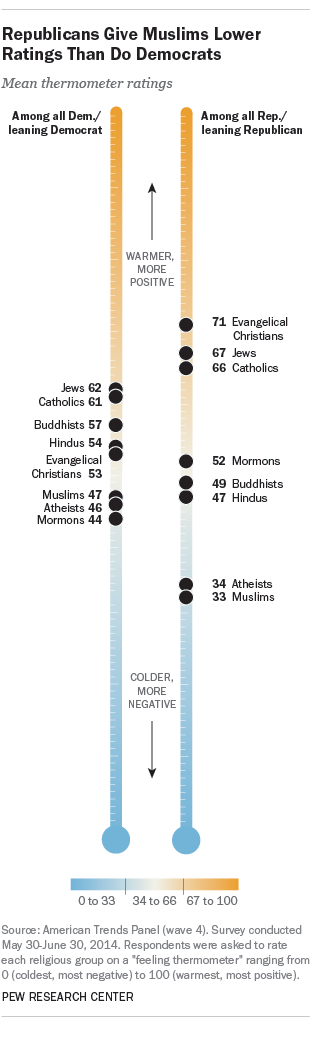
The US political divide on views toward Muslims and Islam | Pew Research Center

USA Views of Religion - PewMapping US party affiliation to attitudes towards different religions. Sharp contrast:

Party affiliation is not the only factor that correlates with differing views toward Muslims and Islam. Younger U.S. adults of all ideological stripes feel more warmly toward Muslims than do older Americans. On the feeling thermometer, those ages 65 and older gave Muslims an average rating of 32 – they don’t rate any group more negatively – while Americans ages 18-29, on average, rated Muslims more positively, at 49.

One’s own religious affiliation also is a factor. For instance, we found that no other religious group is cooler toward Muslims than are white evangelical Protestants, who give Muslims an average rating of 30.

Compared with other groups, older Americans and white evangelicals both tend to affiliate heavily with the Republican Party.

Haven’t seen an equivalent chart for Canada mapping political affiliations to political party supporters although one would expect a similar breakdown between Canadian right and left leaning parties.

The political divide on views toward Muslims and Islam | Pew Research Center.

Un imam radical prêchera aux jeunes Montréalais 

One really wonders why such people wish to stay in Canada, given their world outlook and values are so much at odds with liberal democratic values (other religions have their equivalents):

L’imam Hamza Chaoui a fait des vagues par le passé en raison de ses enseignements rigoristes. Sur sa page Facebook, où il prêche à quelques centaines d’abonnés, l’imam a récemment exposé son rejet total du système démocratique. «La législation islamique et la démocratie sont sur deux lignes en parallèle qui ne seront jamais en intersection» parce que la démocratie peut déboucher sur des Parlements formés «d’un mécréant ou bien d’un homosexuel ou d’un athée qui affirme l’inexistence d’Allah», selon M. Chaoui.

En réponse aux commentaires d’autres internautes, il a ajouté que «le vote en islam est haram (un péché) et n’est pas permis». «La démocratie est un système de mécréance et il faut le boycotter.»

M. Chaoui juge aussi sévèrement le système criminel canadien, qui n’apprendrait pas aux criminels à ne plus recommencer. Dans un prêche prononcé en 2013, il défend notamment l’amputation d’une main devant la foule pour punir les voleurs ainsi que la lapidation pour les époux adultères.

Il souligne toutefois qu’il s’agit de la conséquence prévue pour ces crimes dans l’islam, et que les musulmans canadiens ne devaient pas se faire justice eux-mêmes ou appliquer cette loi au Canada.

L’imam se prononce toutefois contre l’interdiction de conduire pour les femmes saoudiennes. De toute façon, la possibilité «d’entrer en contact physique avec les hommes» dans le transport en commun ou encore d’être seule dans un taxi avec un chauffeur de sexe masculin serait bien pire, selon lui.

Un imam radical prêchera aux jeunes Montréalais  | Philippe Teisceira-Lessard | Montréal.

And the Quebec government considers its options:

Jeudi, la ministre de l’Immigration, de la Diversité et de l’Inclusion, Kathleen Weil déclarait que cet imam tient des propos «dangereux» et qu’elle ne souhaite pas l’ouverture d’un tel centre communautaire. Or vendredi, La Presse a révélé que le projet avait déjà reçu l’aval de l’arrondissement Mercier-Hochelaga-Maisonneuve, un feu vert permettant de réaménager le local que l’imam loue. Hamza Chaoui doit également obtenir un certificat d’occupation, une formalité qui, normalement, consiste seulement à vérifier si l’adresse correspond au zonage. Mais l’arrondissement et la Ville analysent également le dossier sous l’angle de la sécurité.

Alors que l’imam a déjà obtenu un permis, Kathleen Weil a répondu qu’elle «ressent des préoccupations» concernant «la sécurité publique». «L’État regarde tout ce qu’il a à sa disposition» pour intervenir dans ce dossier, a-t-elle dit au cours d’une brève mêlée de presse vendredi.

«L’État a beaucoup de choses à sa disposition. Il faut bien examiner la question. Il y a beaucoup d’acteurs au sein du gouvernement pour examiner ces questions. On pourra vous donner des réponses en temps et lieu», a-t-elle affirmé. Elle a souligné que la Sécurité publique est impliquée dans le dossier.

Parmi les outils à la disposition du gouvernement, elle a parlé de manière générale de «mesures dans la prévention, la détection et la répression de certains actes». «Il faut examiner, comprendre les enjeux avant de décider des actions. Ce n’est pas parce que moi je ne vous donne pas les réponses concrètes sur ce qui se fait que les choses ne se font pas», a-t-elle affirmé, mitraillée de questions sur les options qui s’offrent au gouvernement. La mêlée de presse a eu lieu avec 30 minutes de retard : la ministre a eu un long échange avec un membre de l’entourage du premier ministre Philippe Couillard avant de se présenter devant les journalistes.

Imam Chaoui: Québec étudie ses options

In English media:

Speaking to reporters in Quebec City, Kathleen Weil, Quebec’s minister of immigration, diversity and inclusion, said Mr. Chaoui’s views are “dangerous” and “unacceptable” in a democratic society like Quebec, where the rule of law applies and men and women are treated as equals.

“The city of Montreal, I am sure, shares our values, which are Quebec values,” Ms. Weil said. “They [his remarks] are dangerous.

“Clearly, my desire is that we don’t have this [community centre] where someone can spread these concepts. It’s unacceptable that we can have people on our territory who are teaching this to other people and the new generation.”

Later, Agnès Maltais, the Parti Québécois point person on secularism, and the PQ’s Carole Poirier denounced the imam’s statements and called on authorities to do everything in their power to impede him.

“The Imam Hamza Chaoui has made radical statements in the past, including stating the democracy and Islam are not compatible and that the vote is a sin,” Ms. Maltais said. “We strongly denounce these medieval statements.”

They said the situation shows that Premier Philippe Couillard’s statement that fundamentalism is a “personal choice,” as long as the laws are all respected, is illogical.

Anti-democracy imam gets cold reception from politicians over Montreal community centre plan

Kenney: Conservative anti terror bill needs to walk a fine line

Will be interesting to see how the Government walks that fine line when the Bill is tabled Friday.

Kenney, given his strong belief in freedom of religion, will likely have weighed in during Cabinet and other discussions (his initial reaction to one of the periodic Quebec controversies over the niqab was more accommodating than his present positions):

There’s a fine line between legitimate religious expression and inciting terrorism, says Conservative cabinet minister Jason Kenney.

It’s that line the government will be walking – carefully – in its new anti-terrorism bill, expected to be unveiled Friday.

The bill is the government’s long-awaited legislative response to two attacks carried out on Canadian soldiers last fall by men believed to have been influenced by radical Islam – attacks the government considers acts of terrorism.

Though police already have the power to go after those suspecting of being on the verge of committing terrorist attacks, the new bill is partially aimed at stopping the seeds of those attacks from germinating altogether.

“Our objective is not to diminish legitimate expression of political or religious views, but rather incitement to terrorism – and there is a fine line there that the legislation will try to draw,” Kenney said in an interview Tuesday.

“Obviously there are some malevolent religious influences that can add to the process of radicalization towards violent extremism, and we have to be extremely mindful of that.”

Kenney: Conservative anti terror bill needs to walk a fine line.

L’intégrisme est un choix personnel, juge le premier ministre | Le Devoir

Sensible voices in Quebec:

Philippe Couillard n’a aucune intention de limiter le droit des intégristes de pratiquer une version radicale de leur religion, un choix personnel, selon lui, dans la mesure où ils respectent la loi.

« L’intégrisme, c’est une pratique religieuse poussée à l’extrême qui, tant qu’elle n’enfreint pas les droits des autres — des autres, exemple, les femmes —, bien sûr fait partie des choix personnels de chacun », a déclaré lundi Philippe Couillard, avant de participer au caucus présessionnel de ses députés.

Il ne faut pas confondre intégrisme et terrorisme. « Il y a beaucoup d’amalgames qui sont faits sur des concepts qui sont très distincts », a soutenu le premier ministre. Le terrorisme est « l’expression des extrémismes de tout type, bien sûr celui de l’islam radical, mais il y a d’autres extrémismes sur la planète. Mais celui-là est bien sûr celui dont on est préoccupé. »

Les propos de Philippe Couillard rejoignent ceux qu’a exprimés dans La Presse samedi Gérard Bouchard. « Il y a manifestement un lien entre intégrisme et terrorisme, mais l’un ne conduit pas nécessairement à l’autre. D’où la question : la prévention de la radicalisation religieuse conduira-t-elle à surveiller tous les intégristes et à restreindre leurs droits ? Ce serait inadmissible », juge l’historien et sociologue.

L’intégrisme est un choix personnel, juge le premier ministre | Le Devoir.

Tony Abbott tells Sydney Islamic protesters to ‘lighten up’

I think Abbott has a point:

The group, Hizb ut-Tahrir, planned to rally in south-west Sydney on Friday evening against the kind of images that proliferated in the wake of the Charlie Hebdo killings.

Abbott told 2GB he hoped there would be only a few protesters.

“Frankly I don’t think any of us really want to be in the business of insulting anyone, but on the other hand we all believe in free speech, and I have to say some people are a bit thin-skinned about free speech,” he said.

“I just hope the organisers of this protest lighten up a bit, and accept that in our robust democracy, a lot of people say a lot of things, and sometimes it’s right, sometimes it’s wrong, and we just have to accept the rough and the smooth together.”

A spokesman for Hizb ut-Tahrir likened Abbott’s comments to being asked to “discard the sacredness of our values”.

“It’s quite disingenuous to suggest a people, ie Muslims, lighten up over something that is provocative and quite derogatory to their core values and beliefs, the centre of which is obviously the prophet Muhammad,” he said.

Tony Abbott tells Sydney Islamic protesters to ‘lighten up’ | Australia news | theguardian.com.

Judging The Beards Of Believers – SCOTUS decision

The latest US SC ruling on religious freedom, this time with respect to beards. Similar to Canadian approach. Commentary below by Carrie Severino:

[This ruling] emphasizes that it is the religiously-motivated view of an action, not the unbelieving bystander’s judgment of its importance, that determines whether a burden is substantial. That is particularly important where, as here, courts are dealing with a minority or unpopular religion.

The Court also clarified some key points respecting substantial burdens. First, it noted that permission to engage in many other aspects of religions exercise – here, praying daily, keeping a prayer rug, corresponding with religious advisors, keeping a halal diet, and observing religious holidays – does not cancel out the effect of denying Holt the ability to carry out his simultaneous religious obligation to grow a beard. Additionally, the Court corrected a misunderstanding below that only “compelled” religious practices could be substantially burdened or that disagreements within the Muslim community about the necessity of growing a beard meant curtailing that ability was not a substantial burden. After all, courts have no business making a judgment call about the fundamentally theological questions of how much religious practice is “enough” or which view of a certain religion is correct.

Judging The Beards Of Believers « The Dish.

Meet the honor brigade, an organized campaign to silence debate on Islam

More on the progressive voices within the Muslim communities, this time by Asra Nomani, who has been advocating that women should be able to pray in the main halls of mosques, rather than segregated spaces, and a fairly extensive list of how this and similar discussions has been subject of efforts to be shut down:

Beyond these statements, though, we need a new interpretation of Islamic law in order to change the culture. This would require rejecting the eight schools of religious thought that dominate the Sunni and Shiite Muslim world. I propose naming a new one after ijtihad, the concept of critical thinking, and elevating self-examination over toxic shame-based discourse, laws and rules. Such a project could take the power out of the hands of the status quo clerics, politicians and experts and replace it with a progressive interpretation of faith motivated not by defending honor but acting honorably.

Meet the honor brigade, an organized campaign to silence debate on Islam – The Washington Post.

Islam’s Problem With Blasphemy

Good piece by Mustafa Akyol in the NY Times:

Before all that politically motivated expansion and toughening of Shariah, though, the Quran told early Muslims, who routinely faced the mockery of their faith by pagans: “God has told you in the Book that when you hear God’s revelations disbelieved in and mocked at, do not sit with them until they enter into some other discourse; surely then you would be like them.”

Just “do not sit with them” — that is the response the Quran suggests for mockery. Not violence. Not even censorship.

Wise Muslim religious leaders from the entire world would do Islam a great favor if they preached and reiterated such a nonviolent and non-oppressive stance in the face of insults against Islam. That sort of instruction could also help their more intolerant coreligionists understand that rage is a sign of nothing but immaturity. The power of any faith comes not from its coercion of critics and dissenters. It comes from the moral integrity and the intellectual strength of its believers.

Islam’s Problem With Blasphemy – NYTimes.com.