When does Islam generate Western anxiety? – The Washington Post

Interesting and relevant analysis, an interesting suggestion for further research and some likely controversial advice for Muslim groups in terms of their use of words:

In recent years, the United States and its “Western” allies have faced countless foreign policy choices involving the Islamic world, from engaging with Islamist governments in Egypt and Tunisia to negotiating with Iran to managing drone campaigns in at least three countries. While foreign policy decisions are shaped by many factors, public opinion is a major input. So how does the perceived Islamic character of actors influence foreign policy attitudes toward them?

Unfortunately, our existing understanding of these perceptions is limited. Research shows that religious differences are an important ingredient in foreign policy attitudes — recent survey experiments have shown that Western citizens were more willing to start a war against “Muslim” than “Christian” adversaries. But religious differences are often more complex.

Consider the key participants in the Syrian civil war: The Islamic State, Jabhat al-Nusra, the “moderate” Free Syrian Army, Kurdish rebel groups, Hezbollah and the Bashar al-Assad regime are all broadly “Muslim,” but their Islamic character is portrayed — by themselves as well as by Western media — quite differently. Do these differences shape foreign policy attitudes toward them? When are Western populations really fearful and mistrustful of Islamic political actors?

Our new study in Political Research Quarterly explores these dynamics. In an original survey experiment, we randomly assigned subjects different news stories about the ongoing Syrian conflict in which we manipulated the Islamic character of a fictitious yet realistic foreign actor — the “Free Syria Movement” (FSM) — seeking U.S. military assistance. Specifically, we examined whether giving the actor common Islamic language like “Allahu akbar,” policy goals such as sharia law, and/or labels including “Islamist” affected the respondents’ social affect, political attitudes and foreign policy preferences toward the group. Conducted in May 2015 via Amazon’s Mechanical Turk (MTurk) platform, the survey was completed by 1,095 respondents, with at least 120 in each of the eight conditions.

1. Islamic cues do indeed matter.

Under normal circumstances, we found that respondents’ attitudes towards the FSM were relatively benign. Although they knew the group was Muslim, they tended to give neutral or mixed responses about its level of trustworthiness, compatibility with American values, emotional impact on them and potential role as an American regional ally. Likewise, respondents had mixed views about sending FSM the requested American military aid, although they leaned slightly against doing so overall.

In contrast, with the three cues incorporated, all of these responses shifted in a significantly negative direction. Respondents tended to see the group as untrustworthy, incompatible with their values and interests, a source of fear and a potential regional adversary. Their willingness to give it aid moved firmly toward opposition, dropping on average by more than seven percentage points. And other attitudes saw even larger negative shifts, with the average trust in the group dropping by 10 percentage points. Essentially, respondents did not inherently have hostile attitudes toward the Islamic actor, only when “cued” to do so.

2. Some cues matter more than others.

Yet we also found that some of the Islamic cues harmed attitudes toward the group far more than others. Of the three, insertion of “sharia law” as a policy goal had the most harmful impact, while use of the “Islamist” label did not yield any statistically significant negative effects on any of the outcomes. This is not wholly surprising. Although sharia can have many different meanings in the Muslim world — from inclusive welfare states to punitive morality codes — Western elites have characterized this concept solely in terms of violence and oppression. In the words of Newt Gingrich, sharia is “a mortal threat to the survival of freedom in the United States and in the rest of the world as we know it.” In fact, anti-sharia legislation had been proposed in 23 American states by 2011. This “sharia-phobia” is not unique: other broad Islamic political goals such as the pursuit of a caliphate have been received with similar apprehension in Western political discourse.

3. The influence of these cues depends on partisanship.

Finally, we found that the impact of the cues depends on party identification. With all three cues activated, for example, we see a 22 percentage point drop in trust in the group among Republicans, a 10 percentage point drop among independents and a 5 percentage point drop among Democrats. This also is not wholly unexpected. Republican political elites often describe national security threats in more explicitly Islamic terms — with a greater willingness to label terrorist groups as “Islamic” and invoke concepts such as sharia and the caliphate to characterize their goals. We interpret this mostly as Republican identifiers taking cues from their elites. Yet, as indicated above, independents and Democrats are not immune from these reactions either.

This study suggests at least two promising areas of future research. First, we can examine the flip side of the coin: how adopting Christian language, policies and labels in the West influences foreign policy views in the Islamic world. This could help determine whether these processes mirror each other, in a Sisyphean cycle of religious politicization. Second, we could research whether and how these negative reactions to Islamic cues can be effectively countered. Does including brief translations and explanations of these cues that highlight their positive aspects, diverse meanings and/or Judeo-Christian equivalents ameliorate Western apprehension?

For now, we know that politicized Islamic cues such as sharia spark deeply negative Western perceptions and preferences toward their users. In the foreseeable future, Muslim actors seeking Western assistance or support would be wise to use them with great care.

Source: When does Islam generate Western anxiety? – The Washington Post

On Islam, the GOP has lost its mind and forfeited its soul – The Washington Post

Good commentary:

As a Christian who served in the Bush and Obama administrations, I watched in dismay….

It was not long ago that George W. Bush won the Muslim vote in 2000. Throughout his presidency Bush went out of his way to express respect for Islam and to tamp down the swell of anti-Muslim sentiment after the September 11 attacks.

But the election of Barack Hussein Obama — a black man with an Arabic name and a natural rapport with Muslims — unleashed that swell of Islamophobia on the right. Even though Obama has used many of the same lines as Bush — for instance, “We are not at war with Islam” and “Islam is a religion of peace” — too many Republicans have ignored the calls for respect.

Enter Trump, stage (far) right. From registering American Muslims to banning foreign Muslims, rejecting refugees, reviving waterboarding, and implying Obama is an ISIS sympathizer, Trump’s campaign been littered with anti-Muslim pronouncements and policy proposals. And the crowds at his rallies have cheered each new inane, hateful idea. Trump has turned prejudice into an applause line.

The Republican party, in its treatment of Muslims, has lost its mind: An overwhelming amount of research shows that Muslim faith typically has very little to do with the underlying motivations for terrorism. The 2016 Republican platform champions national security, but alienating and antagonizing devout Muslims — those best situated to discredit extremist narratives — runs directly counter to America’s security interests.
And in its treatment of Muslims, the GOP has lost its soul: The Islamophobia at the Cleveland convention was a betrayal of the “Judeo-Christian heritage” touted in the GOP Platform. At the heart of Judaism and Christianity — and Islam — is the command to love God and love neighbor. For Christians, Jesus’ parable of the Good Samaritan makes it abundantly clear that our neighbors include those who are ethnically and religiously different.

In contemporary America, Muslims are the new Samaritans.

One need only look to the Bible — which Trump claims as his favorite book — to know how our forefathers would tell us to treat the Samaritans among us. And it wasn’t what we saw in Cleveland.

Source: On Islam, the GOP has lost its mind and forfeited its soul – The Washington Post

Swastika flags at Vancouver home spark cultural dialogue

Certainly succeeding in provoking a dialogue, and one that appears to be carried out respectfully. It is also an example of one of most, if not the most, egregious case of cultural appropriation:

Sital Dhillon was driving through her neighbourhood in South Vancouver when she noticed a house with two prominent yellow flags adorned with swastikas flying at the front gate.

“When I saw the symbol, I stopped and took a second look and it started to provide questions in my mind,” said Dhillon. “I didn’t want to draw conclusions.”

Dhillon quickly noticed the flags weren’t the only thing decorating the front of the house — there were several posters, banners, and other religious symbols, hinting that there may be something more to the use of the swastikas.

But the symbol, so associated with Nazi terrors, still touched a nerve.

“The Western world does not have a very good perception of the swastika,” she said, “It’s evil. It’s hate.”

Religious symbol

Homeowner Ravinder Gaba doesn’t see anything wrong with his use of the swastika.

Ravinder Gaba put two swastika flags in front of his house to honour a spiritual guru who is staying at his house. He says the swastika is a symbol meaning peace, love, and purity in Hinduism and other religions.

“This symbol, if you go to India, in every temple that symbol is there,” he said.

Gaba, who is Hindu, is playing host to a spiritual leader — a man believed by his followers to be an immortal living saint, Brahmrishi Shri Gurudev. The flags are flying outside his home for a few days to celebrate the occasion.

Gaba points out that the swastika goes back thousands of years, long before Adolf Hitler and the Nazis began using it.

“It’s nothing with Hitler. We don’t follow Hitler. We don’t follow even extremist people right now, okay? We are a religion against that,” he said. “Believe me I don’t know that’s his symbol. That’s a Hitler’s symbol? I don’t know.”

Swastika

Ravinder Gaba’s home was recently built and includes a large custom mantle decorated with Sanskrit swastikas. (Rafferty Baker/CBC)

Gaba’s newly built home even has an elaborate stone mantel in the living room with stylized swastikas decorating the corners.

‘A lot of pain’

Carey Brown, a rabbi at Temple Sholom Synagogue in Vancouver, reacts strongly to the flags, even with the knowledge that they aren’t a Nazi reference.

“It is very jarring to see it,” she said. “Whether it’s graffiti on a bus stop or a flag flying in someone’s lawn, even if they’re placed there for two different reasons, just seeing it … is very jarring.”

“Certainly as a Jew, it’s a symbol that has a lot of emotional painful resonance for me. We have many members of our synagogue who themselves are survivors of the holocaust, or have parents or grandparents that survived,” said Brown. “It’s a lot of pain and a little bit of fear as well.”

Brown has travelled throughout India, and is fully aware of the ancient use of the swastika in religions like Hinduism, Buddhism, and Jainism.

“While it’s a little bit strange to see swastikas all around you, I know that in its context it means something very peaceful,” she said.

But for Brown, that context is removed once the swastika is flown in Canada.

“Symbols have meaning, and the meaning of this symbol — in the Western world certainly — is one that is the absolute opposite of peace, and to see it flying in Vancouver it is difficult to see and it represents something that’s very hateful to me.”

Cross-cultural dialogue

Gaba says his religion teaches love and peace, and that’s all he means to promote with his swastika flags.

He hopes that anyone who has misgivings about the flags will knock on his door and engage in a conversation about the issue.

“They should come to us and ask us first. We are always open. Anybody can come and ask us a question,” he said. “We are loving people.”

But for Brown, knocking on the door of a house that has swastikas outside doesn’t seem like a likely proposition.

“I think many people would want to not knock on the door, because they would be nervous about who they might encounter inside,” she said, adding that she would welcome a cross-cultural conversation about what the symbol means to different people.

Source: Swastika flags at Vancouver home spark cultural dialogue – British Columbia – CBC News

Suresh Kurl provides some historical context:

Historically, Swastika goes back to approximately 12,000 years, when it was discovered carved on an ivory figurine in Mezine (Ukraine).

In Buddhism, svastika is also considered a symbol of good fortune, prosperity, abundance and eternity. It is found carved on statues on the soles of Lord Buddha’s feet and on his heart.
In Jainism, Svastika symbolises the four states of existence: Heavenly beings (devas), Human beings, Hellish being and Tiryancha, as flora or fauna,  representing the perpetual nature of the universe in the material world, where a creature is destined to one of those states based on their karma. Amazingly, Native Americans also use this symbol for the sun.

Recently, Mr. Ravinder Gaba of South Vancouver put two swastika flags in front of his residence to honour his spiritual guru.  As a practicing Hindu he must have learned that the swastika is an old Vedic symbol denoting peace, love and purity.

If I may add, this Hindu-Auspicious symbol spelled as, Sv-asti-ka in Sanskrit also means well being, fortune, luck, success, prosperity and victory — a far cry from its Nazi association. The symbol represents the Hindu Lord Vishnu (the preserver of this planet) and god Surya (Sun).

Rabbi Carey Brown of Vancouver said, “Certainly as a Jew, it’s a symbol that has a lot of emotional painful resonance for me. We have many members of our synagogue who themselves are survivors of the holocaust, or have parents or grandparents that survived,” said Brown. “It’s a lot of pain and a little bit of fear as well.”

No human with a conscience can dispute this tragedy. I am a Hindu. I was not even born, when Adolf Hitler adopted the symbol, redefined it, corrupted it and rained his terror over Jewish people under his Nazi brand of Swastika flags.

I sincerely apologise on behalf of Mr. Gaba for flying those flags with Swastika. Though his behaviour would seem insensitive I would like to believe it was not intentional.

As we live in a multi-cultural and Inter-faith country, I believe it will be advisable to first run such symbols and objects through the litmus test before putting them out for a public display : “How it will affect the general public before we display them?  No worship or celebration can be fruitful if it ends up hurting our fellow human beings. We know it.

That said the Inter-faith Associations also have an obligation to review such sensitive issues and come up with harmonious solutions.

SWASTIKA: Cultural Sensitivity Should Take Precedence When We Display Controversial Symbols And Objects

Le coût de la diète religieuse bondit dans les prisons

Part of the cost of living in a diverse society and respecting different faiths:

Le coût des repas religieux servis dans les prisons québécoises a bondi au cours de la dernière année, en particulier en ce qui concerne les mets préparés pour les détenus de confession juive. Un repas casher en prison coûte maintenant deux fois plus cher qu’un repas non religieux, a appris La Presse. Portrait de la diète carcérale, un régime de 12,6 millions par année.

Chaque repas casher servi en centre de détention a coûté 6,98 $ pendant l’année financière 2015-2016, contre 5,25 $ un an plus tôt, selon des données du ministère de la Sécurité publique (MSP) rendues publiques par la Loi sur l’accès à l’information. Selon le Ministère, ce bond de 33 % en un an est la conséquence de la résiliation du précédent contrat pour l’achat de repas cashers congelés.

« Durant la période sans contrat, les établissements de détention ont dû s’approvisionner auprès de fournisseurs locaux, à coûts plus élevés. »

– Louise Quintin, porte-parole du ministère de la Sécurité publique

Un nouveau contrat de deux ans pour l’approvisionnement de repas cashers congelésa d’ailleurs été conclu en décembre dernier pour 223 582 $. Une seule des deux soumissions déposées a été jugée admissible. En vertu du contrat, le fournisseur doit préparer jusqu’à 35 058 repas et les livrer dans quatre centres de détention de la région métropolitaine. Plus de 20 000 repas cashers sont destinés à l’Établissement de détention de Montréal (Bordeaux). Les autres sont partagés entre les prisons de Laval, de Saint-Jérôme et de Rivière-des-Prairies.

 Les 11 759 plats cashers servis en 2015-2016 – en hausse de 15 % par rapport à l’année précédente – représentent à peine 0,17 % des quelque 7 millions de repas servis chaque année dans les prisons provinciales. En incluant les coûts de la main-d’oeuvre, la préparation de chaque repas non religieux a coûté 3,27 $ en 2015-2016, une hausse de 6 % en un an, soit trois fois plus que l’inflation. La facture a donc bondi de 516 000 $ pour la diète standard, même si 34 000 repas de moins ont été servis.

Le coût unitaire d’un repas halal a augmenté de 14 % en un an, passant de 3,61 $ à 4,10 $, en raison de la cherté de la viande halal, selon le Ministère. Ainsi, les 91 988 plats préparés en 2015-2016 pour les détenus de confession musulmane ont coûté 124 646 $, en hausse de 10 %. Ces repas sont généralement préparés à partir de viande hachée halal achetée en « très petite quantité » pour remplacer le boeuf d’un hamburger, par exemple.

« Il est important de souligner que le nombre de repas halal a diminué [de 7 %] […]. De plus, notons que les repas cashers et halal servis dans les établissements de détention représentent moins de 2 % de l’ensemble des repas servis en détention », soutient Louise Quintin. En fait, la diète religieuse représente 1,47 % de tous les repas servis en prison provinciale.

Les centres de détention ont l’obligation d’offrir un repas halal ou casher à un détenu qui en fait la demande écrite. L’administration doit alors valider « l’appartenance à la communauté religieuse du demandeur ainsi que la sincérité de sa croyance », explique Mme Quintin. Un détenu peut démontrer sa croyance religieuse par un document pertinent, par sa connaissance de sa religion ou par sa participation à des activités spirituelles.

Source: Le coût de la diète religieuse bondit dans les prisons | Louis-Samuel Perron | Actualités

ICYMI: A Muslim get-out-the-vote group plans a flag initiative

While it should not be necessary (we don’t expect this from churches, temples or gurdwaras), appears a good idea in the current context:

Jawed Rathore wants to see a big Canadian flag flying from a prominently positioned flagpole in front of every mosque in the country to send the simple message that Muslims are proud Canadians.

The real estate development executive pitched the idea this week in a suburban Toronto banquet hall to a crowd of about 700 supporters of The Canadian-Muslim Vote, a non-partisan organization that made its mark by campaigning to boost turnout among Muslim voters in last fall’s federal election.

The group’s July 13 inaugural dinner to mark Eid, the end of the Muslim holy month of Ramadan, drew dozens of federal, provincial and municipal politicians, with federal Citizenship and Immigration Minister John McCallum delivering the keynote speech.

But Rathore took the podium earlier and proved a hard act to follow. The 39-year-old chief executive of Fortress Real Developments, father (as he mentioned more than once) of six children under seven, is a massively built six-three. His exuberant speaking style is as hard to ignore as his physical presence, and he offered an upbeat overview of the place of Muslims in Canada today. “For the first time ever, it’s kind of cool to be Muslim,” he proclaimed, arguing that every outburst of anti-Islamic bigotry tends to be followed by even more forceful statement of support for the Muslim community from sympathetic non-Muslims.

Still, Rathore proposed that Muslims should send a clear signal of patriotism by flying the Canadian flag in front of their mosques. In an interview with Maclean’s, he framed the initiative as a natural follow-up to the group’s push to boost the Muslim vote. (The Canadian-Muslim Vote points to exit polls that suggest the percentage of voting-age Muslims who cast a ballot might have soared to 79 per cent in the 2015 election, from an estimated 46.5 per cent in 2011.)

“We thought this would be a great opportunity,” Rathore said. “As we talked to the Muslim community about the most Canadian thing you can do, which is to vote, we [wondered], ‘What else can we do to engage with the community?’ And that’s where the team came up with this really exciting idea of getting big Canadian flags in front of every mosque across Canada.”

Although Rathore sees a high level of acceptance of Muslims in Canada, he doesn’t deny his community remains misunderstood by too many. “There’s a sense when you talk to people about Islamophobia, or even just people’s general unawareness of Islam, they think because of some of the things they see and hear that Muslims choose to exclude themselves, that Muslims choose to segregate themselves,” he said. “Nothing could be further from the truth.”

He said most Muslims want to be seen as part of the Canadian social fabric. “Nothing really says that more than a Canadian flag going up,” he said. “Sometimes the simplest medium is the most effective one.” [Note: See the Environics Institute Why Muslims are proud Canadians – The Globe and Mail which largely confirms this].

Rathore brings a business branding perspective to the image challenge facing Muslims. Fortress Real Developments, headquartered just north of Toronto, has real estate projects underway in six provinces. “You look at some of the big U.S. brands that have come north of the border, and Walmart is one of the big examples: at every supercentre they have there is a huge Canadian flag,” he said.

“When they were coming up here, there was the usual rhetoric about ugly Americans, and Walmart made the very simple gesture of saying, ‘We recognize that we are not seen as being from here, we’re outsiders, we’re strangers, and we are coming to Canada’—and they erected these huge flags.”

At the Eid dinner, Rathore showed slides of major mosques, then clicked to the same photos adorned with rudimentary illustrations of Canadian flags flying in front of them. It wasn’t high-tech, but it seemed to convey what he has in mind. In the 24 hours after the dinner, he said groups called, emailed and texted with offers to sponsor 55 flag poles at mosques. His company will pay for the first ten, though.

The Canadian-Muslim Vote plans to take the next few weeks to figure out how to proceed, Rathore said, and hopes to start putting up flagpoles in September or October.

Source: A Muslim get-out-the-vote group plans a flag initiative

Let’s face it: The world has an Islamic problem – Marquardt

Felix Marquardt’s, founder of the Al-Kawakibi Foundation for Islamic Reform and the think tank Youthonomics, take on Islam and terror and, in particular, an interesting argument for showing the horrific videos:

If Muslims want to be taken seriously when we argue that our religion is one of love and peace and social justice, then we must not cede to the natural inclination to say we have “nothing to do” with the authors of the ignominious crimes committed in the name of Islam.

We have one thing in common with them. We all call ourselves Muslims. Of course, their vision of Islam is perverse and completely, well, wrong. There is a common thread between despicable acts of violence committed around the world these days. And that common thread is that the people who commit them think of themselves as Muslims.

In other words, no, there is no intrinsic “problem” with Islam, but yes, hell yes, there is a contemporary degenerescence of our religion that is threatening its very existence and future. If we, as Muslims, cannot agree on this, then we must brace ourselves, for Islam will disintegrate completely before our eyes in the coming years. To address a problem, one must first admit that there is a problem.

This brings into focus another major issue that has popped up since Thursday’s attack in Nice: the dissemination of the footage of the slaughter and its aftermath.

The French authorities are asking that people refrain from sharing the gruesome pictures and videos, claiming that doing so may galvanize or trigger other would-be kamikazes. Others argue the same thing out of respect to the families of the victims.

I have news for you: In this day and age, Islamic State admirers and supporters who want to gain access to this footage will find a way to do so.

And, as far as I am concerned, is it precisely out of compassion for the victims that I want all the people in the world who share my faith to see what is being done in the name of our religion. Images of Nazi extermination camps and the picture of the naked Vietnamese girl fleeing napalm bombings shocked the world and brought change, precisely because they shocked the world.

We are encouraged to share footage of police abusing and killing black people all over the United States to make the world aware of what is going on there, but we should hide what IS is doing in southern France? Muslims all around the world must see what is being committed in the name of their religion so they can finally confront the reality of Islam in the 21st century: Medina, Cairo …we have a problem.

Source: Let’s face it: The world has an Islamic problem – The Globe and Mail

What France thinks of multiculturalism and Islam – The Washington Post

2300europemuslims-11-1024x799Some interesting polling data that sometimes gets lost in the rhetoric:

In the aftermath of a devastating attack in Nice, France, Poland’s interior minister, Mariusz Blaszczak, told reporters that the blame lay with the embrace of multiculturalism. “Have we not learned lessons from previous attacks in Paris and Brussels?” the Financial Times reported Blaszczak as saying. “This is a consequence of the policy of multicultural politics, and political correctness.”

A member of Poland’s controversial right-wing Law and Justice Party, Blaszczak’s point may be in bad taste. However, many around the world probably agree with it.

It’s certainly hard to disagree with the idea that France seems to be more embracing of multiculturalism than Poland. In a recently released study by the Pew Research Centerthat was conducted early this year, just 24 percent of French people were found to believe that diversity made France a worse place to live. A higher proportion, 26 percent, said it made France better, while 48 percent said that it didn’t make much difference.

These results appeared to show that France has one of the most tolerant, though also largely indifferent, attitudes to racial and ethnic diversity in Europe. Only Spain had a higher positive view of diversity. Meanwhile, in Poland, 40 percent of the population said that diversity was a negative, while only 14 percent said it could be a positive and 33 percent said it made no difference. Hungary, Italy and Greece were the only countries with higher negative feelings toward diversity.

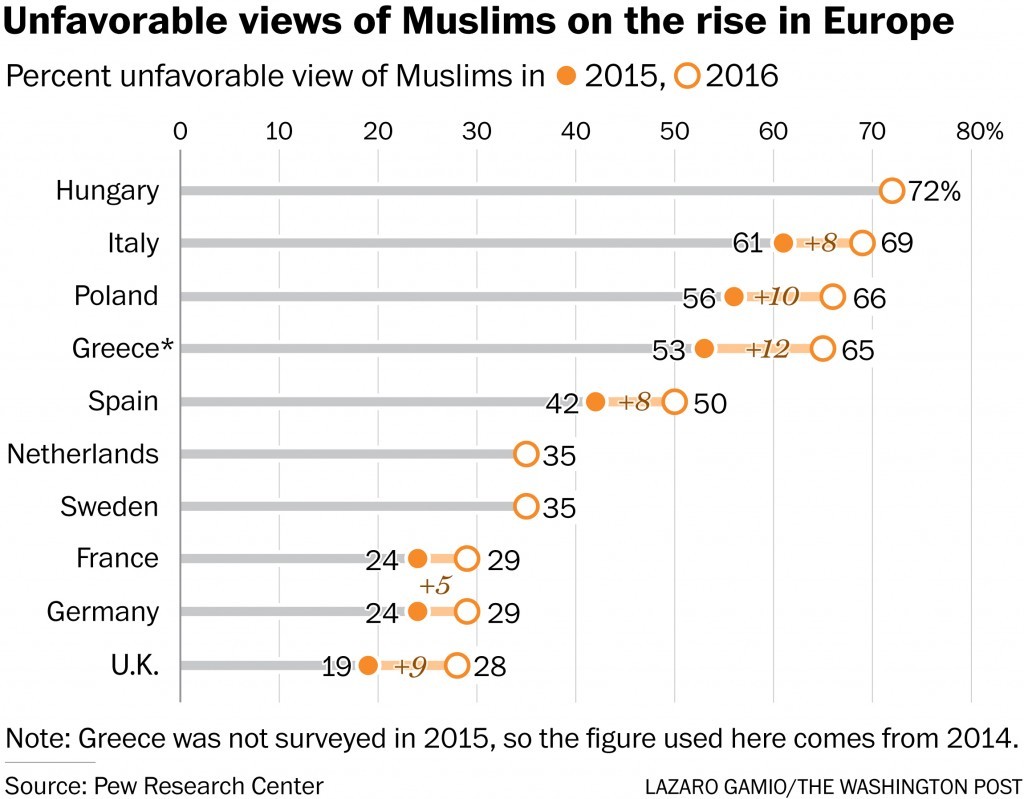
The same poll found that France had a far more positive view of Muslims than much of Europe. Despite a series of terror attacks that were inspired by Islamic extremism, just 29 percent of French citizens were found to have a negative view of Muslims, while 67 percent had a positive view. While this was an increase of 5 percentage points over previous years, only Germany and Britain had more positive views.

Conversely, in Poland, 66 percent had negative views of Muslims, while only 19 percent said they had positive views. Hungary and Italy were the only countries with more negative views — 72 percent and 69 percent, respectively.

People in Poland were also far more likely to believe that Muslims in their country were supporters of groups like the Islamic State, a group whose supporters have cheered the attack on Nice but have not claimed official responsibility. Twelve percent of Poles were said to believe that “most” Muslims in their country supported extremist groups, and a further 23 percent said “many.” Just 12 percent said “very few” supported these groups. In France, 44 percent said “very few” Muslims in their country supported extremism, while just 6 percent said “most” and 13 percent said “many.”

And despite the perceived link between refugees from Muslim majority countries and terrorism that is widespread across Europe, Pew’s data showed that on the whole, French citizens were more concerned about economic factors.

Source: What France thinks of multiculturalism and Islam – The Washington Post

‘That Ignoramus’: 2 French Scholars of Radical Islam Turn Bitter Rivals – The New York Times

Personally, I think it is a mix of the two elements – the individual and the structural:

What propels Islamist terrorism and attacks against France is more than an academic debate: The answer shapes policy toward blunting the threat.

So it is no inconsequential matter in a culture under attack, and one that so cherishes its intellectual debates, that France’s two leading scholars of radical Islam — former friends — have turned bitter rivals over their differing views.

“Madman,” “thug,” “illiterate,” “paranoid,” “ass,” “not a thinker” — these are just some of the choicer insults the two men have hurled at each other in a peculiarly personal quarrel with far larger stakes that has reverberated through the French news media and society for months.

The two distinguished academics, Olivier Roy and Gilles Kepel, have long lists of books to their name, and years of field work in the Middle East, Central Asia and the troubled French suburbs. They are both eagerly consulted by the French news media and government officials.

But with France on edge and the continued target of terrorist attacks, their clashing analyses of the origins, development and future of jihadism have broken out of academic circles to present an important question for France and for all of Europe: Which man holds the key to understanding the phenomenon?

Mr. Kepel, 61, a professor at Sciences Po, the prestigious political science institute, finds much of the answer inside France — in its suburbs and their dysfunctional sociology — and in the role of Islam, angering many on the left.

Mr. Roy, 66, who as a bearded young man roamed Afghanistan with the mujahedeen in the 1980s and now teaches at the European University Institute in Florence, Italy, places greater emphasis on individual behavior and psychology in a jihadism he considers strictly marginal to Islam.

Mr. Kepel sees individuals as cogs in a system — part of a classically French, structuralist tradition that minimizes the role of individual human agency.

Mr. Roy, on the other hand, sees mostly troubled people in the jihadist ranks who act out their fantasies of violence and cruelty.

The terrorists who have carried out recent attacks were mostly marginalized young men and petty criminals, he says, adding that they have used Islam as a cover to pursue extreme violence.

“They haven’t had a militant past,” Mr. Roy said of many of these terrorists, in a telephone interview. The problem they represent, he says, is the “Islamicization of radicalism.”

It is a signature phrase that enrages Mr. Kepel, who leans toward its opposite: the radicalization of Islam.

“That ignoramus,” Mr. Kepel grumbled in an interview this month in his book-lined office, offering some choice gibes about his onetime friend’s lack of Arabic.

Mr. Kepel testified for an influential 2015 parliamentary report, wrote a best seller on terrorism after the attacks in Paris in November, and has been omnipresent in television and radio studios.

“At the ministry, they tell me, ‘I saw Kepel yesterday,’ ” said Mr. Roy, himself a favorite of the country’s dominant left-leaning news media. His arguments, for the moment at least, appear to be winning in government circles.

As the jockeying has intensified in official circles, so has the falling-out between the old friends.

Today they cannot stand each other, and, with the passion that typifies intellectual fights in a country where nothing short of war is more serious, they contemptuously dismiss each other’s views.

“The King Is Naked,” read the headline on Mr. Kepel’s attack on Mr. Roy this spring in the newspaper Libération, in a play on the French meaning of Mr. Roy’s name.

In turn, while acknowledging a long and now broken friendship, Mr. Roy today offers his own less-than-friendly critique of Mr. Kepel as a kind of cloistered intellectual.

 “We were friends for 20 years,” Mr. Roy said in the interview. “I traveled with him in Istanbul. But I was very struck by his incapacity to talk to anybody.”

“He’s sincere the way a madman is,” he added. “He’s not a thinker. He’s not a philosopher.”

The French debate has echoes of Republican criticism in the United States of President Obama for his reluctance to use the word Islam in connection with terrorism.

But as is so often the case in contemporary France, the heart of the dispute here is a disagreement about the country’s relationship with Islam.

Mr. Roy sees a Muslim population that is relatively well-integrated.

But for Mr. Kepel, the murderous jihadism that struck France in 2015 is the expression of a slow-burning Islamist radicalization that took shape over decades because of a failure of integration.

Source: ‘That Ignoramus’: 2 French Scholars of Radical Islam Turn Bitter Rivals – The New York Times

A Saudi Morals Enforcer Called for a More Liberal Islam. Then the Death Threats Began. – The New York Times

Good long read by Ben Hubbard on the tensions within Saudi Arabia’s religious establishment and broader society:

For most of his adult life, Ahmed Qassim al-Ghamdi worked among the bearded enforcers of Saudi Arabia. He was a dedicated employee of the Commission for the Promotion of Virtue and the Prevention of Vice — known abroad as the religious police — serving with the front-line troops protecting the Islamic kingdom from Westernization, secularism and anything but the most conservative Islamic practices.

Some of that resembled ordinary police work: busting drug dealers and bootleggers in a country that bans alcohol. But the men of “the Commission,” as Saudis call it, spent most of their time maintaining the puritanical public norms that set Saudi Arabia apart not only from the West, but from most of the Muslim world.

A key offense was ikhtilat, or unauthorized mixing between men and women. The kingdom’s clerics warn that it could lead to fornication, adultery, broken homes, children born of unmarried couples and full-blown societal collapse.

For years, Mr. Ghamdi stuck with the program and was eventually put in charge of the Commission for the region of Mecca, Islam’s holiest city. Then he had a reckoning and began to question the rules. So he turned to the Quran and the stories of the Prophet Muhammad and his companions, considered the exemplars of Islamic conduct. What he found was striking and life altering: There had been plenty of mixing among the first generation of Muslims, and no one had seemed to mind.

So he spoke out. In articles and television appearances, he argued that much of what Saudis practiced as religion was in fact Arabian cultural practices that had been mixed up with their faith.

There was no need to close shops for prayer, he said, nor to bar women from driving, as Saudi Arabia does. At the time of the Prophet, women rode around on camels, which he said was far more provocative than veiled women piloting S.U.V.s.

He even said that while women should conceal their bodies, they needed to cover their faces only if they chose to do so. And to demonstrate the depth of his own conviction, Mr. Ghamdi went on television with his wife, Jawahir, who smiled to the camera, her face bare and adorned with a dusting of makeup.

It was like a bomb inside the kingdom’s religious establishment, threatening the social order that granted prominence to the sheikhs and made them the arbiters of right and wrong in all aspects of life. He threatened their control.

Mr. Ghamdi’s colleagues at work refused to speak to him. Angry calls poured into his cellphone and anonymous death threats hit him on Twitter. Prominent sheikhs took to the airwaves to denounce him as an ignorant upstart who should be punished, tried — and even tortured.

Source: A Saudi Morals Enforcer Called for a More Liberal Islam. Then the Death Threats Began. – The New York Times

Charter for Inclusive Communities: NCCM

The latest and praiseworthy initiative of the NCCM: call to stand against Islamophobia in the broader context of anti-discrimination, anti-racism and shared values for all Canadians and communities.

Of course, like all charters and principles, the challenge arises in putting them into practice and the dialectic of balance of rights, but these provide a baseline to assist such debate and discussion:

By signing this Charter, we commit to standing up for the rights and dignity of everyone in order to promote inclusive, just, and respectful communities in Canada.

  • We strongly affirm that:Islamophobia, like all other forms of racism, hate, xenophobia, and bigotry, has no place in Canadian society.

  • Discrimination and acts of hate against anyone, marginalize individuals and communities and exclude them from participating fully in society and fulfilling their potential.

  • The dignity of every person in Canada is essential to a healthy and vibrant society.

  • Everyone in Canada has a role to play in creating safe environments for us all.

  • All levels of government, civil society, communities, and public officials have a duty to work together in developing policies, programs and initiatives to reduce and eliminate Islamophobia in all of its forms.

  • By working together, we can nurture inclusive communities and strengthen our shared commitment to Canada’s values of equality, respect, justice, and the dignity of all persons.

Source: NCCM – National Council of Canadian Muslims