Ontario facing ‘epidemic of Islamophobia’ survey finds

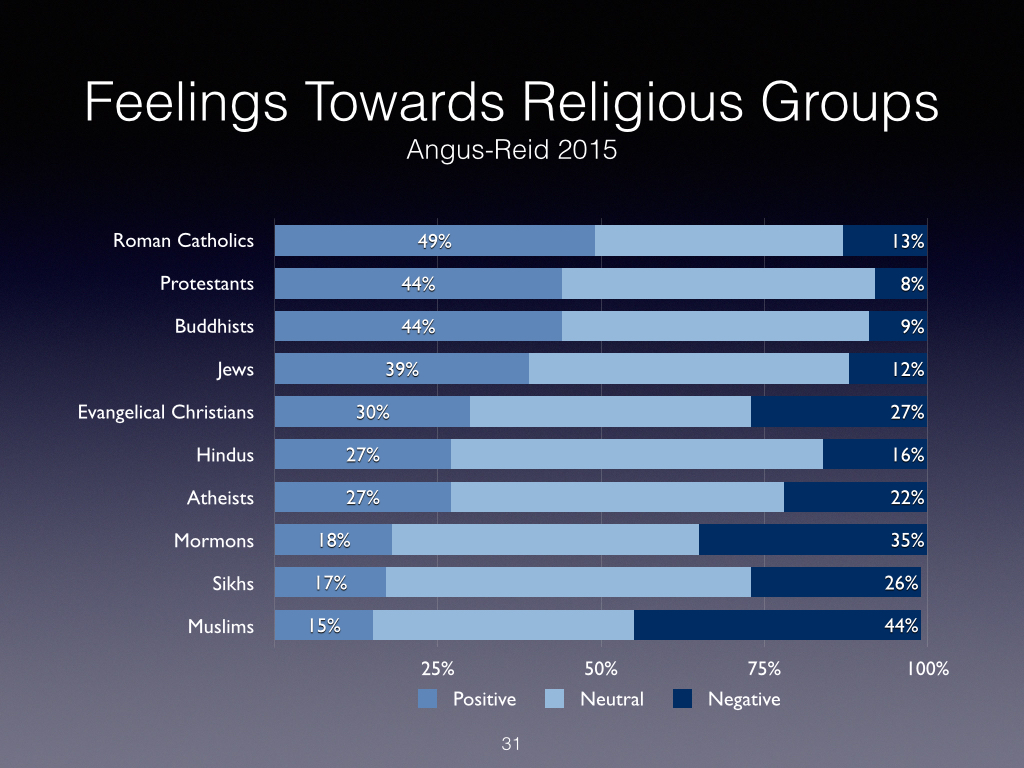
Angus Reid Religon Poll 2015 - Feelings Towards.001Consistent with most other surveys I have seen although labelling it as an ‘epidemic’ compared to other biases and prejudices appears to be an exaggeration (see chart above from 2015 Angus Reid survey):

The survey by polling firm MARU/VCR&C measured public perceptions of ethnicity and immigration in Ontario in the wake of the recent influx of thousands of Syrian refugees — almost 12,000 to this province alone.

“There is an epidemic of Islamophobia in Ontario. Only a third of Ontarians have a positive impression of the religion and more than half feel its mainstream doctrines promote violence (an anomaly compared to other religions),” said the 51-page survey to be released this week by the Ontario Council of Agencies Serving Immigrants and advocacy group Mass Minority. “These sentiments are echoed with Syrian refugees in Ontario where acceptance often coincides with acceptance of Islam.”

Ontario has seen a number of recent incidents targeting Muslims. A woman wearing a hijab was attacked at a supermarket in London in June and a Western University student from Iran was beaten by two men who taunted him and told him to go back to his country. Also, in June, an anti-immigrant group rooted in Germany held an anti-Muslim protest in Toronto.

While the survey’s respondents agreed that immigrants play a valuable role in society (72 per cent) and are an important part of our cultural identity (71 per cent), three-quarters of the survey participants said we need to focus on taking care of the people “here” instead of spending resources on refugees.

“Taken together, this suggests that Ontarians see non-immigrants as more entitled to social care. This entitlement is, in some ways, a contradiction given the inherent value that immigration offers,” said the poll of 1,009 Ontarians conducted between May 11 and 16.

The survey was funded by the province and the City of Toronto for its recently launched public awareness campaign on Islamophobia, which has sparked heated debate over its provocative posters, seen by some as reinforcing stereotypes and fuelling tensions.

The research was commissioned to take a snapshot of Ontario residents’ attitudes and perception towards immigrants and ethnic minorities as a benchmark to assess the effectiveness of the multimedia campaign. A followup survey is planned after 12 months.

While 46 per cent of Ontarians feel Canada admits too many immigrants, 45 per cent said they welcomed the right amount.

“Higher and lower levels of acceptance are associated with distinct demographic profiles,” the report said. “Less educated and rural Ontarians over-index on feelings that Canada accepts too many immigrants.”

Three-in-five residents in the province supported Ottawa’s decision to accept Syrian refugees while one-fifth of all respondents said they have participated in welcoming Syrians to Canada in various ways from donating money to furniture, volunteering and participating in a sponsorship group.

Comparing Canada’s six major mainstream religions, Islam is the most likely to be viewed by the respondents as a promoter of violence, followed by Sikhism, Christianity, Hinduism, Judaism and Buddhism.

Three-quarters of Ontarians said they feel Muslim immigrants have fundamentally different values, largely due to perceived gender inequality, the survey found.

“Opposition to Syrian refugees is higher among those with unfavourable impressions of Islam,” said the report. “Opposition is mainly because of concerns that Syrian immigration will mean less help at home. Those opposed see Canadians as needing support first and foremost.”

Source: Ontario facing ‘epidemic of Islamophobia’ survey finds | Toronto Star

Tasha Kheiriddin’s commentary seems to be unaware of the many activities by moderate Canadian Muslims to counter the narrative:

And all the public education campaigns in the world, such as those currently playing out across Toronto, won’t change the fact that fundamentalist practitioners of Islam maintain a worldview very different not only from those held by non-Muslims, but from those held by moderate Muslims as well.

As with any extremist religion-based movement, it’s the latter group that holds the key to transforming the faith and the way it is perceived. Moderate Muslims need to speak out against extremism, from the mosque to Main Street. Otherwise, radicals and their actions will continue to feed the fires of prejudice, help elect Donald Trump to the White House, and undermine the very principles of tolerance and equality which Western countries — including the millions of Muslims who call them home — hold dear.

http://ipolitics.ca/2016/07/04/are-we-becoming-more-islamophobic/

Easier to spot a liar in a niqab, says study challenging Canada’s courtroom ban on Muslim veils

Counter-intuitive but interesting study.

Another study I would like to see done is a new version of the Implicit Association Test (IAT) that would use a variety of faces and headgear rather than just the white/black current test. More appropriate for the multicultural reality of Canada, although I always recommend taking the current version for its insights into bias:

In a landmark finding inspired by a Supreme Court ban on niqab-wearing court witnesses, a Canadian study has come to the surprising conclusion that it is actually easier to detect a liar if their face is veiled.

“There’s concrete data from over 500 people showing that, in fact, the courts were incorrect,” said Amy-May Leach, an associate professor at the Oshawa-based University of Ontario Institute of Technology.

Leach’s study, published in the latest edition of the journal of the American Psychological Association, had test subjects guess the truthfulness of women with and without religious veils.

The result? “Veiling actually improved lie detection.”

Veiling actually improved lie detection

“People were focusing on what the women are saying, rather than what they look like,” said Leach.

In a 2013 ruling, the Supreme Court of Canada effectively levied a courtroom ban on the wearing of niqabs by testifying witnesses.

NP Graphics

NP GraphicsClick or tap to enlarge
…Leach’s study worked by taking female volunteers and showing them one of two videos featuring a woman and a backpack. In one video, a woman is shown vigilantly watching over a backpack. In the other, the woman is rifling through the backpack to steal its contents.

After the video, the volunteers are then led into a mock courtroom to be questioned by a “prosecution” and a “defence.” Whatever video they saw, the volunteer had to maintain that no theft took place. Thus, anybody who saw the “stealing” video was forced to lie.

People were focusing on what the women are saying, rather than what they look like

Trials were staged with volunteers having their heads uncovered, wearing a hijab (a Muslim hair covering) or wearing a face-covering niqab.

Videos of the trials were then played to a second set of volunteers who were asked to guess if the witness was telling the truth.

For unveiled women, witnesses spotted the liars at a rate of about 50 per cent — no better than if they had flipped a coin.

“It was only when witnesses wore veils (i.e., hijabs or niqabs) that observers performed above chance levels,” wrote the study.

Subsequent repeats of the experiment in the United Kingdom and the Netherlands found similar results.

Source: Easier to spot a liar in a niqab, says study challenging Canada’s courtroom ban on Muslim veils | National Post

I worked in the CIA under Bush. Obama is right to not say “radical Islam.” – Vox

Reprinted in its entirety:

The recent verbal attacks by the Republican presumptive nominee Donald Trump and his supporters on President Barack Obama for avoiding the phrase “radical Islam” in his public pronouncements are simplistic, racially inflammatory — and flatly misinformed.

Settling upon accurate and strategically nuanced terms to describe the post-9/11 enemy is not the product of “political correctness” (contra Trump) or a failure to understand the enemy (contra a much-discussed Atlantic cover story). Nor are objections to using overly broad terms like “Islamic radicalism” limited to Democrats. The Bush administration understood the power of words, too. It concluded that distinctions that may seem small to Christian-American ears make a big difference to the mainstream Muslims we need on our side.

When I [Emile Nakhleh] directed the Political Islam Strategic Analysis Program at the CIA in the early 2000s, I frequently interacted with senior Bush administration policymakers about how to engage Muslim communities and, when doing so, which words and phrases to use to best describe the radical ideology preached by al-Qaeda and other terrorist organizations. Always, the aim was to distinguish between radicals and extremists and the vast majority of mainstream Muslims, and to make sure the latter understood that we were not lumping them in with the former.

Like the Obama administration, the Bush administration correctly judged that the term “radical Islam” was divisive and adversarial, and would alienate the very people we wanted to communicate with.

Trump and those who echo his views must realize there is no such thing as one Islamic world or one Islamic ideology — or even one form of radicalism in the Muslim world. Many diverse ideological narratives characterize Muslim-majority and Muslim-minority countries and the 1.6 billion Muslims across the globe. To paint them all with the same broad brush of radicalism and extremism is absurd, dangerous, and politically self-serving.

Trump and those who share his views on this question may truly believe, as they insist when pressed, that “Islamic radicalism” describes only a subset of Muslims. But to Muslims, or for anyone familiar with the many strands of Islam, the phrase connotes a direct link between the mainstream of the Muslim faith and the violent acts of a few. What’s more, Trump appears to be recklessly pandering to the uninformed part of the American electorate that does believe in such a connection between the mainstream and the fringe.

Like the Obama administration, the Bush administration knew words matter

The project of choosing words carefully must begin with knowledge. Al-Qaeda, and more recently ISIS, have mostly drawn on the radical Sunni Wahhabi-Salafi ideology, which primarily emanates from Saudi Arabia. How to describe that narrow ideology to a broader audience was the focus of many conversations and briefings I attended after 9/11.

Many in the West, including some senior policymakers, have had only a scant knowledge of this type of ideology, which has wreaked deadly violence against Muslims and non-Muslims alike. I recall a conversation I had with a senior policymaker in which he asked me to explain “Wahhabism.” Since he had very limited time, I told him, “Wahhabists are akin to Southern Baptists.” That is: They read the holy text literally and are intolerant of other religious views. Wahhabists, like some Baptists, also abhor reasoning or “ijtihad” that would encourage them to question their religious brand. (Further complicating matters, Saudi Arabian officials, who generally embrace Wahhabi Salafism, describe those who use this ideology to justify their attacks on Saudi Arabia and other Muslim states as “deviants” from the faith.)

The roots of this radicalism go back to the Hanbali School of Jurisprudence, one of the four Schools in Sunni Islam, dating to the ninth century. Muhammad ibn Abd al-Wahhab, an 18th century Saudi theologian, adopted the teachings of the Hanbali School as the authentic teachings of Islam. This Saudi strain of Islam has been further radicalized by Osama bin Laden, al-Qaeda, ISIS, and other Sunni terrorist groups. The other three, generally more liberal, schools are the Shafi’i, the Maliki, and the Hanafi — also named after their founders in the eighth and ninth centuries. Adherents of these more tolerant schools live across the wider Muslim world, from Morocco to Indonesia, from Turkey to South Asia.

Any terminology that the commander in chief of the United States settles on ought to reflect that we are speaking of Sunni-based radicalism — a strain that takes a particularly intolerant, exclusive, narrow-minded view of Islam and its relations with other Muslims and the non-Muslim world.

But there are at least two reasons why speaking of Wahhabism, while accurate, won’t fly in most public pronouncements: The word means little to the US domestic audience, and it could alienate Saudi Arabia, a complicated partner (to say the least) in anti-terror efforts. This is the one area in which the charge of “political correctness” carries some weight (although “political realism” may be a more reasonable way of describing the phenomenon).

Beyond ruling out “radical Islam” as overly broad, policymakers and advisors under both the Bush and Obama administrations have been careful not to accept the characterizations that violent extremists give to themselves, which inflate their role within their faith. That is why we don’t call them “jihadists” or, more obviously, “martyrs.”

The decision to avoid “radical Islam” is a strategic one

In short, both the Bush and Obama administration officials have refrained from using “Islamic radicalism” and its variants not because of “political correctness” but because of their nuanced knowledge of the diversity of Islamic ideologies. The term doesn’t enhance anyone’s knowledge of the perpetrators of terrorism or of the societies that spawn them, and it might hurt us in the global war of ideas. Policymakers refer to members of al-Qaeda and ISIS as “hijackers” of their faith in order to signal their support for mainstream Islamic leaders in an alliance against minor radical offshoots, not because they are unaware that some members of al-Qaeda and ISIS are theologically “sophisticated” (or “very Islamic,” as the Atlantic provocatively put it).

As our interest in Saudi Arabia’s oil wanes, some expect future administrations to take a tougher approach toward Saudi Arabia on the question of radical religious ideology. We may yet begin to hear talk of Wahhabi Salafism from a future White House.

But more likely, the next administration — I expect it will be the Clinton administration — will continue the policy the Bush administration began of referring to terrorists by the names of their organizations: Hezbollah, Ahl al-Bayt, the (Iranian) Islamic Revolutionary Guard Corps, the Quds Force, ISIS, and so on.

Using such terms avoids demonizing majorities of Sunni Muslims who just want to follow their faith, devoid of politics or activism. Simple terms like “terrorists,” “killers,” and “criminals” are also quite effective.
Source: I worked in the CIA under Bush. Obama is right to not say “radical Islam.” – Vox

Young immigrants twice as likely to be religious than Canadian-born: Todd

Worth noting:

Young and middle-aged immigrants to Canada, most of them from Asia, are countering the trend that sees homegrown Canadians becoming more secular.

I’ll write more in the future on a revealing Angus Reid Institute poll, which has found immigrants between the ages of 18 and 34 are more than twice as likely than the average Canadian to be actively religious.Young immigrants super religious

While 21 per cent of people born in Canada attend religious services, that figure jumps to 49 per cent for young immigrants — whether they are Muslim, Christian, Buddhist or Sikh.

Here’s an excerpt from the Angus Reid Institute website:

Findings:

  • People born outside Canada are considerably more likely to attend religious services than people born in Canada (35% versus 21%).
  • Young arrivals aged 18-34 and 35-54 (increasing numbers of whom are coming from Asian and African countries) are much more likely to actively attend services than their older counterparts (49% for the young compared to 27% of those 55 and older).
  • Additional analyses shows a similar, though somewhat weaker pattern holds for the religious self-designations of younger arrivals from other countries: 42 per cent of those who are 18 to 34 say they are embracing religion.
  • Similarly, 38 per cent of 35 to 54-year-olds born elsewhere are embracing faith – also well above the level for their Canadian-born counterparts.

Interestingly enough, it looks as if the largest religious group among immigrants in recent times has been Roman Catholics.

The second largest religious group among immigrants is Muslims, who have a much lower average age.

Religions of immigrants to 2011

Source: Young immigrants twice as likely to be religious than Canadian-born | Vancouver Sun

ICYMI: The Obama Doctrine: What the President Actually Thinks About Radical Islam – The Atlantic

Another good piece by Jeffrey Goldberg:

The fundamental difference between Obama and Trump on issues related to Islamist extremism (apart from the obvious, such as that, unlike Trump, Obama a) has killed Islamist terrorists; b) regularly studies the problem and allows himself to be briefed by serious people about the problem; and c) is not racist or temperamentally unsuitable for national leadership) is that Trump apparently believes that two civilizations are in conflict. Obama believes that the clash is taking place within a single civilization, and that Americans are sometimes collateral damage in this fight between Muslim modernizers and Muslim fundamentalists.

In one conversation, parts of which I’ve previously recounted, Obama talked about the decades-long confrontation between the U.S. and communism, and compared it to the current crisis. “You have some on the Republican side who will insist that what we need is the same moral clarity with respect to radical Islam” that Ronald Reagan had with communism, he said. “Except, of course, communism was not embedded in a whole bunch of cultures, communism wasn’t a millennium-old religion that was embraced by a whole host of good, decent, hard-working people who are our allies. Communism for the most part was a foreign, abstract ideology that had been adopted by some nationalist figures, or those who were concerned about poverty and inequality in their countries but wasn’t organic to these cultures.”

He went on to say, “Establishing some moral clarity about what communism was and wasn’t, and being able to say to the people of Latin America or the people of Eastern Europe, ‘There’s a better way for you to achieve your goals,’ that was something that could be useful to do.” But, he said, “to analogize it to one of the world’s foremost religions that is the center of people’s lives all around the world, and to potentially paint that as a broad brush, isn’t providing moral clarity. What it’s doing is alienating a whole host of people who we need to work with us in order to succeed.”

Does Obama go too far in avoiding the terms “radical Islam” or “violent Islam”? This question represents a not-unreasonable basis for an interesting debate. However, given the realities of the battlefield—that most of the fighting against ISIS is done by Muslim-majority states, and Muslim organizations, and that the leaders of these entities would rather not see the U.S. overgeneralize its description of the fight—then it seems to me, at least, that Obama’s semantic prudence is justifiable.

Donald Trump, I believe, is not capable of making the sort of analysis Obama has made about the splits within Islam. Nor has refuted Obama’s analysis in a cogent fashion. But this is not Trump’s main sin; his main sin is to refuse to listen to experts on counterterrorism, including experts in the U.S. military and intelligence community, who argue that he is helping ISIS by demonizing Muslims. Abu Bakr al-Baghdadi, the so-called caliph of Islamic State, argues that there is no place in the West for a devout Muslim. Donald Trump often gives the impression that he shares this view, and that he is advancing the cause of ISIS, by endorsing its premise that the struggle in which it is engaged is, in fact, civilizational.

None of this is meant to be an argument that Obama does enough, or does enough of the right things, in the struggle against ISIS. I could (and will!) write a critique of the administration’s tactical approach, particularly as it relates to Syria. And Obama could bring more emotional intelligence to bear on this problem: He is eloquent in condemning the fearmongers, but he sometimes fails to acknowledge the legitimate fears of non-racist, non-paranoid Americans who would prefer not to be killed by terrorists acting in the name of Islam. The United States is under intermittent attack from an organization called the Islamic State, which, as Graeme Wood has pointed out in this magazine, represents one, extreme, branch of Islam. There is no point in trying to convince Americans that what is happening is not happening. But neither is there a point in encouraging hysteria and division.

Privately, Obama expresses the deepest loathing for ISIS and other radical Islamist groups. ISIS, he has noted, stands for—quite literally—everything he opposes. Nevertheless, his approach to the challenge of Islamist terrorism is sometimes emotionally unsatisfying; it is sometimes insufficient to the challenge; and he himself is sometimes too fatalistic about the possibility of change in the Middle East.

Donald Trump’s approach, on the other hand, is simply catastrophic.

Source: The Obama Doctrine: What the President Actually Thinks About Radical Islam – The Atlantic

Repeal Islam’s scarlet-letter sex laws – The Washington Post

Asra Q. Nomani on the challenges and need for reform of sex laws and attitudes:

We are never going to see a real cultural shift in the Muslim mind-set about sex and homosexuality until we call out and repeal these scarlet-letter sex laws, and instead choose an interpretation of Islam that values compassion, privacy, acceptance and love over judgment and bigotry.

Just one day after the Orlando massacre, a Dutch woman in Qatar was convicted of the crime of “illicit sex” — for coming forward with the complaint that she had been raped. Several years ago, a Norwegian woman faced similar charges in the United Arab Emirates. Meanwhile, the Islamic State is throwing men accused of homosexuality off rooftops, and the governments of Iran and Saudi Arabiahave executed gay men.

Of the 57 states that belong to the Organization of Islamic Cooperation, a quasi-United Nations for countries with large Muslim populations, at least 23 have zina laws and 38 criminalize consensual adult same-sex, according to data from human rights groups and the International Lesbian, Gay, Bisexual, Trans and Intersex Association. These governments are promoting an interpretation of political Islam, or Islamism, that feeds this culture of punishment for even consensual sex.

The punishments are even worse for gays. Influential Saudi cleric Muhammad Saalih Al-Munajjid, following the rigid interpretation of Islam known as Wahhabism or Salafism, condemns zina as a crime and calls homosexuality “the most abhorrent of deeds,” calling for “execution of homosexuals,” from having them “burned with fire,” “stoned to death” and “thrown down from a high place then have stones thrown at them.”

As in the West, cultural attitudes are closely intertwined with legislation. Babies born out of wedlock, gay sex, transgender relationships and other forms of allegedly illegal sex are shamed, stigmatized or punished — whether by court of law or by vigilante justice, as we saw in Orlando last weekend.

Source: Repeal Islam’s scarlet-letter sex laws – The Washington Post

Islam stands above German law for half Turkish Germans – survey — RT News

Ongoing integration challenge:
Almost half the ethnic Turks living in Germany consider following Islamic teaching more important than abiding by the law, a new survey claims. They also view Islam as the “only true religion” with about one in five justifying violence if it is provoked by the West.

The study by the University of Münster titled “Integration and Religion from the viewpoint of the Turkish Germans in Germany” outline some deep divisions within the German society as 47 percent of ethnic Turks living in the country said that following religious dogmas was “more important” to them than obeying “the laws of the land in which I live,” particularly if the two were incompatible. Moreover, 32 percent from those questioned said they yearn to live in the society of the times of the Prophet Mohammed.

The results, gathered by surveying over 1,200 people, came as a surprise for the researchers from one of the biggest German universities. Detlef Pollack, spokesman for the “Religion and Politics”Excellence Cluster said that the authors “didn’t expect that,” Deutsche Welle reported.

However, the survey also revealed that Turks completely understand that it would be much easier for a law-abiding citizen to successfully integrate. Respecting laws was ranked second among the list of conditions to meet in order to integrate into German society, trailing only the language skills.

But despite the fact that an overwhelming majority of Turkish Germans, 90 percent, said they are pleased with their life in the country, over half of the respondents feel like “second-class citizens” with no chance to integrate fully into society. Some 70 percent went even further and expressed a readiness to integrate “absolutely and unconditionally.” At the same time, the phrase “no matter what I do, I will never be recognized as a part of German society,” strikes a chord with 54 percent of Turks.

Interestingly, the attitude of the respondents to the adherents of other religions and atheists differed greatly. While the total of 80 percent holds a favorable view of Christians, the number tolerating atheists and Jews is considerably lower. Only half think positively of these groups. The same number consider Islam to be the “only true religion.”

As right-wing German parties claim that Islam poses an “imminent threat” to the country with rallies being held against the so-called “Islamization” of the West against the backdrop of a migrant influx from North Africa and the Middle East, 20 percent of Turks agree that “the threat to Islam posed by the Western world” can justify violence with which Muslims “defend”themselves. A further 7 percent agree that the use of violence can be justified for the sake of spreading Islam.

Asked about the compatibility of Islam and the West, 61 percent of the Turks saw no obstacles in the way of its anchoring in western society. However, according to the study, this standpoint is not popular with the German people as a whole.

Such fundamental values of a modern western civilization as human rights and tolerance are not associated with Islam by Germans, the poll says. Fifty-seven percent of Turkish Germans link the protection of human rights to Islam while only 6 percent of all Germans nationals maintain the same opinion. Only 5 percent of all Germans associate Islam with tolerance, while 56 percent of Turks in Germany believe so.

Based on the findings, pollsters attributed the 13 percent of the surveyed 1,201 people to the category of “religious fundamentalists.” 

The survey’s authors claim that, while the Turks blame Germans for misunderstanding of the inherently peaceful nature of Islam, they note that, Muslims are also to blame for generating negative perception of their religion.

“Quite a few of them hold onto religious positions which don’t do much to counter the magnitude of suspicions and mistrust,” the report concludes.

When a Phrase Takes On New Meaning: ‘Radical Islam,’ Explained – The New York Times

More on language and terminology, another good piece:

When I asked Mr. Hamid [a scholar at the Brookings Institution] this, he countered with a different question. Given how many labels already exist to describe terrorists that draw on Islam, why insist on this one?

He listed several — “radical jihadists, Salafis, Islamist extremists, jihadis, jihadi-Salafists” — none of which, he said, carry the baggage of “radical Islam.”

But if it’s that baggage that repels scholars, it may also be what draws others. “Radical Islam” has come to imply certain things about issues that are closer to home than abstract terrorist ideology: political correctness, migration, and the question of who belongs.

Those same issues have animated debates over terrorism and terminology in other societies. In Germany, “multiculturalism” has become shorthand for larger questions of how to absorb migrants and whether there is a degree of minimum assimilation. There is endless sparring over “British values,” and what sort of burden this puts on migrants before they will be welcomed into society.

France has had its own parsing of “radical Islam,” though the fight over “secularism” is even fiercer.

Even majority Muslim societies have had versions of this same argument, Mr. Hamid pointed out. In Egypt, he said, the struggle over terms is, in part, a way of litigating whether parties like the Muslim Brotherhood are ideologically akin to terror groups — and therefore whether they should be allowed to participate in society.

What these debates have in common is that arguing about how to define terrorism becomes a way to push and pull the contours of national identity, determining who is invited in to that identity and who is kept out.

In every case, the debate is framed as one of pluralism versus security. Pinning terrorism on “multiculturalism” or non-secularism or foreign values or “radical Islam” all portray inclusiveness as somehow threatening and exclusiveness as safer.

The question of whether pluralism and security are indeed in tension, or whether pluralism in fact enhances security, is one that people around the world have long grappled with. But it’s hard to discuss because it is so core to national identity. Debating semantics is much easier.

Source: When a Phrase Takes On New Meaning: ‘Radical Islam,’ Explained – The New York Times

The big problem with calling it ‘radical Islam’: McWhorter – CNN.com

Great piece by John McWhorter of Columbia on the semantics of what to call and not to call, terrorism and extremism carried out by Muslims:
Still, the right claims the two are ignoring the fact that a disproportionate number of men who perpetrate acts such as Mateen’s are Muslims infuriated at the West.
They assert further that as long as we say “radical Islam” rather than “Islam” alone, we are suitably specifying that we don’t hate Muslims. But that isn’t how it would appear to Muslims themselves, and — if we break the language down to its structure and meaning — they’re right.
In a sentence such as “We must eradicate radical Islam,” the object of the verb eradicate is technically “radical Islam,” yes, but the core object, the heart of the expression “radical Islam,” is “Islam.” Radical Islam is a kind of Islam. The object of the eradication in the sentence is “Islam,” modified — not redefined into something else — by “radical.”
That truth affects how one processes such a sentence. The adjective can come off as a kind of decoration — it feels parenthetical, even when talking about something innocuous. Take the sentence, “I’m thinking about one of those juicy steaks.” We process the speaker mainly as thinking about steak, not steaks with the particular quality of being juicy.
We must take heed of such qualities of language, especially when the object in question is already loaded with pungent associations. Perhaps if Islam were something most of us had little reason to think about, then qualifying its name with an adjective could qualify as neutral expression. “Restorationist Zoroastrianism” — OK, maybe.
But this is the real world. Let’s face it: These days, most of us need reminding that Islam is a religion of peace. Human beings generalize; we harbor associations. In such a climate, it’s particularly easy to interpret “radical Islam” as a summation of Islam in general. It’s how many of us might guiltily hear it, and how many Muslims would process it. Certainly Islamist terrorists would: Of all the qualities one might attribute to them, subtlety of interpretation is not one of them.
Suppose someone decided to battle “radical Christianity”? Note that whatever justifications that person offered along the lines of “We don’t mean all Christians,” they’d sound a little thin. Note also that in modern American English, “radical” can mean not only “extreme,” but also, by extension, “genuine.” After all, the “radical” Islamist considers himself to be the “true” Muslim just as the “radical” feminist might consider herself more devoted to her cause than someone who would shirk that label. Meanwhile, with the pop-culture exclamation “Rad!” thrown into the mix, there’s an even finer line between its connotation “Amazing!” and the implication “That’s the way it should be!”
There actually is room for terminological compromise here. “Radical Islam” is an unhelpful term because it sounds too much like “Islam” and has been used so much that it practically sounds like “Islam” alone at this point. However, one could get the point across with something like “violent Islam” as some have tried. “Violent Islam” actually sounds like a subset of Islam rather than the thing itself, and “violent” has no alternate connotation of “authentic,” as “radical” does.
It’s important to stress, however, that semantics — used one way or another — will not change any terrorists’ minds. Omar Mateen did not shoot up the Pulse because people said “radical Islam” instead of “Islam.” Accounts of ordinary, seemingly secular Muslims mysteriously but implacably deciding to leave comfortable existences in Western Europe to join ISIS in Syria likewise make it plain that word choice will not win or lose this battle for us.
Rather, we must maintain the cognitive equipoise that refuses to revile members of a worldwide religion because of the actions of a small band of amoral true believers. In doing so, we are embodying a more enlightened worldview than ISIS and its sympathizers.
We must resist overgeneralization — a tendency hardwired into human nature — not because we think it would have restrained an Omar Mateen, but because it makes us better human beings, and possible models for future ones. Virtue, Aristotle called it. And not in the sense of stalwartly refusing to call someone a dirty name a la Dudley Do-Right, but in the sense of cultivating personal excellence simply because, in the end, it’s a perfect foundation for an existence, especially if as many people do it together as possible.
So, the indignant right-wing columnists who yearn for America to express a more direct, religiously inflected contempt for terrorists are missing the strength in what they misread as a sign of weakness. In saying we are battling “terrorists” rather than “radical Islam,” we reveal ourselves as better than the barbarians who wish to harm us.
The alternative that the right would prefer would be a nyah-nyah contest, what we might euphemistically call a competition in the distance one can cover via the act of urination. Make no mistake: I detest what people like Mateen do — the mere thought of that man this week, for example, nauseates me. Neither Sykes-Picot, nor American support for Israel, nor brown skin, nor any other historical or present-day factor justifies actions like his. But that’s why we must do better than they do, including in how we use language. I’m glad that many of us are.
And I, for one, am not against using language that allows us to refer to the painfully obvious fact that so many of these attacks stem from a perversion of the doctrine of a particular religion. Those who feel that the mere observation of this reality constitutes racism or incivility carry their own burden of justification here.
However, I highly suspect that the people who despise the President and Hillary Clinton for not saying “radical Islam” wouldn’t be quite satisfied with “violent Islam.” Why? Because it doesn’t sound like an insult, and that would reveal, again, what these detractors are really seeking — to win a competition, not to solve a problem. Like I said, we can — and must — do better than that.

Source: The big problem with calling it ‘radical Islam’ – CNN.com

Making a mass murderer — the meaning of Orlando: Jebara

Good commentary by Imam Jebara of the Cordova Centre:

When I heard of the massacre in Orlando and learned something about the background of the gunman, I knew — before hearing any details — what the story was about. The young man evidently was struggling with a conflicted sense of identity. He was, apparently, gay himself. He felt ashamed of who he was and struggled to reconcile the conflicting — yet undiscussed — duplicity inherent in the ultraconservative religious culture of his family’s native Afghanistan.

His religious or political views may have had nothing to do with the tragedy; the professed vehement homophobia of his family’s culture most certainly did. When the father claimed that he was shocked by his son’s appalling act of violence, it was apparent to me that he — like too many other parents — had ignored how his son’s self-hatred had been the catalyst for his so-called “radicalization”.

It’s important to separate Islam, the faith, from the tribal systems that tend to be intertwined with it — tribal systems which consider their particular culture and habits to be indistinguishable from Islam itself. (It’s really not much different from the case of Americans affiliated with the Ku Klux Klan who consider their world-view and ideology as vital parts of their ‘Christian’ identity.)

I have witnessed several cases of young men coming from the same background as Mateen who had homosexual inclinations — young men who came from families that publically supported extremist groups, spewed anti-Western rhetoric online, in public and in the community, and supported extremist interpretations of Islam that embrace the execution of homosexuals, rampant misogyny and other self-destructive and violent forms of behaviour.

These families espoused these views because of the tensions created by the clash between their native cultures and their adopted one. Luckily for those young men, they learned to reconcile their religious identity with a candid assessment of their cultural identity, helping them divert themselves from the sort of mental and psychological breakdown that might have led them to violence.

Many cultural factors influence how we behave — and religion is interpreted as reflection of the culture in which it is observed, not the other way around. Most known extremists and terrorists are anything but spiritual and devout individuals. They tend to be broken people — empty shells with weak personalities and low self-esteem, carrying emotional baggage from childhood, from growing up in unbalanced families.

So what’s the solution? Rather than supporting generalizations against all Muslims, we should treat the various manifestations of violent extremism as we would any other mental health problem or crime. Steps should be taken to train and equip parents to recognize signs of mental illness, as well as the subtleties of unstable behaviour patterns, and to take the proper measures to have their child’s condition diagnosed and treated.

Fearmongering and victimization are counterproductive — they amount to sticking our heads in the sand regarding the effect of cultural pressures and alienation. Recognizing the influences of the various cultures from which we come can circumvent the development of more fringe psychotics and prevent future acts of heinous violence.

Source: Making a mass murderer — the meaning of Orlando