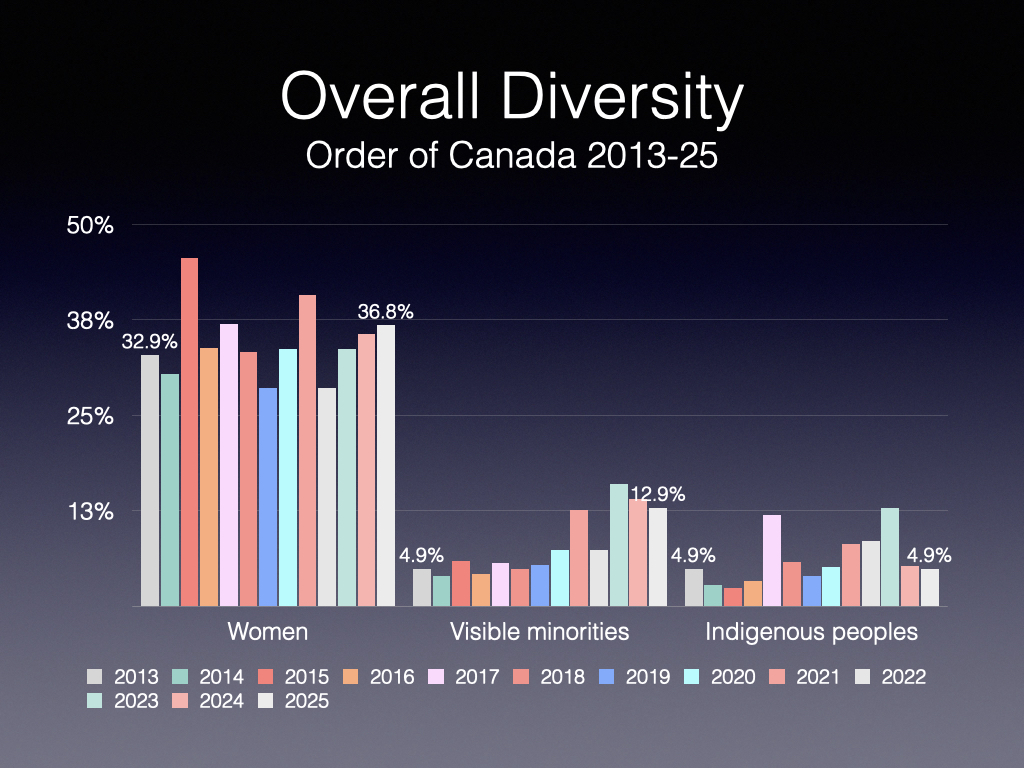
“How Trudeau Liberals’ DEI obsession helped kill Canadian culture”


Good long and disturbing read:

…Some blamed a misreading of DEI as “Diversity, Equity, and Exclusion,” or the Canada Council’s zealous “decolonization” agenda; others noted that with only about 25 per cent of editorial staff male, female editors naturally preferred female perspectives; and some disputed that White male authors were disadvantaged at all, or, if true, that it mattered. Whatever the cause, male writers appear to have fallen out of fashion. The 2025 Sobey Arts Award shortlisted twenty-six women and twelve Indigenous artists among thirty nominees — none of the four men were White. Recent Giller and Governor General’s prizes show similar trends: roughly two-thirds of winners were women, and only one White man among them. These results likely reflect publishing priorities rather than overt bias, yet they signal a profound cultural shift.

Fundamental to any program to resurrect Canada’s book business is the necessity to reform its major cultural institutions. Over the last decade or more, they have become deeply politicized, pursuing a specific and polarizing social and economic agenda. They have turned it into a wedge that excludes certain people from consideration, certain forms of address from polite society, and certain manners of speaking as incompatible with good behaviour. The penalties for violating these often ambiguous standards can be devastating. These strictures have narrowed the boundaries of discourse and cast a chill on what can be said, written, or shown, radically restricting artists’ freedom of expression.

Diversity, equity, and inclusion were never supposed to evolve in this direction. Properly understood, it is not a negative, punishing exercise in ideological purity, but a formula for discovering and celebrating what had previously been arbitrarily suppressed. Murray Sinclair, the chairman of the Truth and Reconciliation Commission, made the point explicitly when he explained that reconciliation was not about tearing down the statues of John A. Macdonald, but raising up statues to Big Bear. It is a program that calls for a deep understanding of both the good and the bad in historical figures and events. It assumes that people are sufficiently sophisticated to hold two thoughts in their heads at the same time. Some of the things Macdonald did were good; some were bad. There is no need to choose sides, only to see clearly what happened. That is precisely why it was called the Truth and Reconciliation Commission.

When major funders like the Canada Council set out to “decolonize” Canadian literature, they are pursuing a political agenda as surely as the censors of the Soviet Union insisting that all writing conform to the dictates of “socialist realism.” When tenured bureaucrats can harass people for wrongthink, and when it’s possible to lose essential public support for straying beyond the boundaries of correct and morally appropriate thinking, creators and cultural workers will be cautious, often second-guessing themselves. Great work flourishes in environments where people can take risks, knowing that the worst consequence will be failure, not penury and banishment.

The DEI project in Canada’s cultural agencies, government, publishing houses, and media needs to be recalibrated. It needs to focus on its original aims of combatting racism, sexism, and intolerance. It needs to seek truth, not for the purpose of punishment, but for learning. When mistakes are made, when the wrong word or hurtful language is thoughtlessly used, it needs to be treated as a teachable moment, not as a call to puritanical vengeance. It needs to start from an assumption that the overwhelming majority of Canadians are people of good will. Do they sometimes make cruel mistakes? Of course. The important thing is to learn together and bank the fires of self-righteous rage.

— A former executive vice-president of the CBC, Richard Stursberg has written widely on Canadian media and cultural policy. His previous books include The Tower of Babble, named by the Globe & Mail as one of the best books of the year, and The Tangled Garden, which was short-listed for the Donner Prize for the best book on public policy written by a Canadian.

Source: “How Trudeau Liberals’ DEI obsession helped kill Canadian culture”

Genetic Data From Over 20,000 U.S. Children Misused for ‘Race Science’

Sigh…:

Genetic researchers were seeking children for an ambitious, federally funded project to track brain development — a study that they told families could yield invaluable discoveries about DNA’s impact on behavior and disease.

They also promised that the children’s sensitive data would be closely guarded in the decade-long study, which got underway in 2015. Promotional materials included a cartoon of a Black child saying it felt good knowing that “scientists are taking steps to keep my information safe.”

The scientists did not keep it safe.

A group of fringe researchers thwarted safeguards at the National Institutes of Health and gained access to data from thousands of children. The researchers have used it to produce at least 16 papers purporting to find biological evidence for differences in intelligence between races, ranking ethnicities by I.Q. scores and suggesting Black people earn less because they are not very smart.

Mainstream geneticists have rejected their work as biased and unscientific. Yet by relying on genetic and other personal data from the prominent project, known as the Adolescent Brain Cognitive Development Study, the researchers gave their theories an air of analytical rigor.

earch group were ineligible to obtain data from the ABCD project. But one of them gained access through an American professor who was already being investigated by the N.I.H. over his handling of another child brain study.

Their papers have provided fodder for racist posts on social media and white nationalist message boards that have been viewed millions of times. Some of the papers are cited by A.I. bots like ChatGPT and Grok in response to queries about race and intelligence. On the social media platform X, Grok has referred users to the research more than two dozen times this month alone.

“It’s evil,” said Dr. Terry L. Jernigan, national co-director of the ABCD Study and a neuropsychologist at the University of California, San Diego. “It’s not just that the science is faulty, but it’s being used to advance an unethical agenda.”…

    Source: Genetic Data From Over 20,000 U.S. Children Misused for ‘Race Science’

    List of suspected Nazi war criminals welcomed in Canada should stay secret, information watchdog rules

    Seems a bit too precious given not released earlier prior to the Russian attack on Ukraine:

    …LAC had told Caroline Maynard, the Information Commissioner, that disclosing the list would result in significant injury to Canada’s relationship with a foreign government. LAC also told her it would “cause significant injury to the defence of a foreign state allied with Canada,” Maureen Brennan, an investigator in Ms. Maynard’s office, said in the e-mail. 

    The e-mail said the harm would extend “beyond Canada’s relations with the foreign government in question” and would adversely affect Canada’s relationships with other allied states.

    “I reviewed LAC’s consultation materials and note that there was an overall consensus that, in the current political climate, disclosure of the information would give rise to serious concerns about reasonably expected harm,” Ms. Brennan said. 

    Dozens of leading scholars from around the world, including Sir Richard Evans, former Regius professor of history at Cambridge University and author of 18 books, including Hitler’s People, have called on Canada to declassify the report.

    On Friday Canada’s Friends of Simon Wiesenthal Center, named after the famous Nazi hunter, reacted with dismay that the information watchdog had upheld Ottawa’s decision to keep the list secret. 

    “The government’s claim that revealing the truth about Nazi war criminals living in Canada could somehow be a threat to national security or international diplomacy is an insult to the intelligence of the public,” said Jaime Kirzner Roberts, senior director, policy and advocacy at the center. 

    “It is long past time for the facts to come out about the Nazi perpetrators of genocide and war crimes who were allowed to escape justice and live comfortable, protected lives in our country.”

    A research team led by UCLA historian Jared McBride, an expert on war crimes in the Second World War, last year unearthed what he concluded was an earlier annotated version of the secret list.

    The Information Commissioner’s office argued that this list had been released through an access to information request in 2019, “at a time which predates the relevant current global context.” 

    Among the names on this list, seen by The Globe, was Helmut Oberlander, a member of the Nazi Einsatzgruppen death squads during the Second World War. The Canadian government spent years trying to strip him of his citizenship, but he died at the age of 97 in 2021 while the matter was still before the courts.

    Professor Per Rudling of Lund University in Sweden, who has researched the settlement of alleged Nazis in Canada, said he found the decision to keep the list secret “curious.” He said Ukraine had opened up its own KGB archives and the U.S. has released the bulk of its documents pertaining to alleged Nazi war criminals. 

    “Of all comparable Western liberal democracies, Canada stands out as being particularly restrictive on archival materials in regards to purported war criminals,” he said in an e-mail. 

    Source: List of suspected Nazi war criminals welcomed in Canada should stay secret, information watchdog rules

    Robson: Canada’s prevention gap grows wider the more complacent we become

    Thorny lines to draw and not easy to implement but needed given the nature of some of the protests and protestors:

    …Diaspora dynamics, therefore, require institutional maturity. The challenge is not to cast suspicion on whole communities. It is to distinguish legitimate protest from intimidation, and political grievance from early-stage radicalization cues—especially when imported conflicts are weaponized inside Canadian information spaces.

    Prevention doctrine has to be able to say, without flinching, that a small minority within some diaspora and newcomer populations—including naturalized Canadians—carry or adopt illiberal and extremist ideologies, and that those ideologies can express themselves as targeted hatred toward Jews. Treating that as an institutional design problem—triage rules, evidence standards, and earlier handoffs—avoids both naïveté and collective blame.

    It also means using international tools without outsourcing Canadian standards. Many subjects who could fall within the scope of a promotion offence did not begin their political trajectory in Canada. Some may have prior histories of supporting extremist organizations, being investigated abroad, or coordinating across jurisdictions.

    Canada already has mechanisms to seek corroborating information while preserving due process through the Mutual Legal Assistance in Criminal Matters Act. The aim is not to “import” foreign decisions. It is to avoid assessing a suspect’s online activity here as if it exists in isolation—especially when trusted partners can corroborate a pattern of propaganda production or cross-border coordination that should inform Canadian risk assessments for bail, peace bonds, and sentencing.

    So what does “prevention” mean when radicalization cycles move faster than case-prioritization and reassessment? Canada has conceptual building blocks: the RCMP explicitly acknowledges the linkage between hate crime and violent extremism and stresses prevention alongside enforcement in its hate-crime overview. The gap is operationalization—multilingual capability, faster evidence capture, clearer handoff triggers, and disruption that treats a heightened hate environment as a security condition, not a communications problem.

    Canada cannot prevent every attack. But it can choose whether to keep treating antisemitic extremism as a late-stage file—something we condemn after it becomes violence. If we continue to manage weak signals as “not urgent,” we will eventually face the question other democracies face after tragedy: What did we notice early, and why did we decide it was not urgent enough?

    Daniel Robson is a Canadian independent journalist specializing in digital extremism, national security, and counterterrorism.

    Source: Canada’s prevention gap grows wider the more complacent we become

    Supreme Court weighs road safety against racial profiling in ‘driving while Black’ case

    To watch:

    …Now, in a two-day hearing starting Monday, the Supreme Court of Canada will hear this landmark equality and police powers case – and revisit a long-ago precedent.

    Quebec and several provinces, alongside lawyers for the federal government, will try to convince judges of the Supreme Court to overturn the rulings of the lower courts and reaffirm precedent. 

    Governments insist it is a matter of essential road safety.

    Mr. Luamba and an array of groups want the top court to strike down precedent and recognize that giving police such powers enables racism. They are calling on the Supreme Court to ban police from random stops of drivers throughout Canada.

    “There isn’t anything random about these suspicion-less stops,” said Harini Sivalingam, director of the equality program of the Canadian Civil Liberties Association, which, with Mr. Luamba and the Canadian Association of Black Lawyers, is a respondent at the Supreme Court.

    “We’re not saying all police officers are biased,” said Ms. Sivalingam. “But there’s a systemic bias – and it’s well-documented.” 

    In 1990, the Supreme Court ruled – in a 5-4 decision – that cops were allowed to randomly stop drivers, declaring “statistics relating to the carnage on the highways substantiate a pressing and substantial concern.”…

    Source: Supreme Court weighs road safety against racial profiling in ‘driving while Black’ case

    Financialized landlords disproportionately apply to evict in Black neighbourhoods, study finds

    Good data-based study:

    Tenants of financialized landlords in high-income, majority-Black Toronto neighbourhoods faced 33 eviction applications per 100 households from 2016 to 2019 — a rate five times higher than the city average for that landlords group of 5.6 per 100 households, a new study has found. 

    “Financialized landlords” in the study refers to asset managers, real estate investment trusts, family conglomerates and “financialized property managers” focused on maximizing the value of portfolio assets for investors. 

    The report conducted by researchers at Toronto Metropolitan University, funded in part by the Canadian government and published in the International Journal of Urban and Regional Research, draws from more than 100,000 formal eviction filings for purpose-built rental apartments in Toronto from 2016 through 2021.

    It found renters in Black-majority neighbourhoods experience “disproportionately high rates of housing instability and eviction filings by financialized landlords” and argues “profit-driven motives systematically undermine Black lives and spaces.”

    From 2016 to 2019, eviction rates in Black-majority areas, “regardless of income level, were significantly higher than in other racial/ethnocultural groups, with few exceptions.”

    The eviction-application rate in high-income, majority-Black neighbourhoods was more than double the rate of 14 per cent in low-income, majority-Black neighbourhoods from 2016 to 2019, the report found.

    The study categorized neighbourhoods as “low-income” or “high-income” depending on whether the areas had median renter household after-tax incomes above or below the Toronto renter median for the census year ($42,000 for 2016 and $57,600 for 2021).

    Lead researcher Nemoy Lewis, an assistant professor at TMU’s School of Urban and Regional Planning, said this finding challenges common assumptions about evictions….

    Source: Financialized landlords disproportionately apply to evict in Black neighbourhoods, study finds

    ICYMI – Bouchard: Quand l’espoir vient des citoyens

    Always worth reading:

    « En haut, en haut ! C’est un grand concept sociologique sophistiqué, ça, en haut ! », s’exclame-t-il d’un ton faussement bourru. Me sentant désarçonné au bout du fil, il éclate d’un grand rire.

    Le ton est donné : interviewer Gérard Bouchard sera tout sauf ennuyant. Ce monument de l’histoire et de la sociologie a codirigé la fameuse commission Bouchard-Taylor sur les accommodements raisonnables, a enseigné à Harvard, a écrit de nombreux ouvrages. Et à 81 ans, le sociologue chéri des Québécois est vif, drôle, versant autant dans l’autodérision que dans les critiques acerbes.

    Des critiques qu’il dirige beaucoup vers le gouvernement du Québec actuellement. C’est là, « en haut », qu’il déplore les plus grandes dérives. Mon intention n’était pas nécessairement d’amener mon interlocuteur dans l’arène politique, mais il y a sauté lui-même à pieds joints.

    Lorsque je lui demande ce qu’il souhaite collectivement aux Québécois pour 2026, sa réponse est immédiate.

    « Je souhaiterais que tout le débat sur l’identitaire perde enfin de l’actualité. L’identitaire est un sac vide. Cette affaire-là ne va nulle part. C’est un débat qui divise, mais qui n’ouvre pas sur grand-chose. »

    — Gérard Bouchard

    Il enchaîne en dénonçant la désinvolture avec laquelle, selon lui, le gouvernement Legault écarte les droits fondamentaux pour imposer sa vision de la laïcité.

    « Ça relève d’un sentiment antireligieux, je ne vois pas autre chose, dit-il. L’idée qu’une société, pour être laïque, doit repousser le religieux dans ses derniers retranchements pour qu’il ne soit finalement plus visible du tout… Ce n’est pas un idéal pour une société, ça ! Ou alors, si c’est un idéal, ça en est un qui repose essentiellement sur la violation d’un droit fondamental. »

    « On vit encore sur cette espèce de revanche que l’on prend contre les abus du clergé que notre société a subis jusqu’au milieu du XXsiècle, analyse-t-il. On avait de sacrées bonnes raisons de le faire, on a beaucoup souffert. Mais là, il faudrait en finir avec ça. On ne va quand même pas vivre sur ce ressentiment de génération en génération ! »

    Je lui fais remarquer que bien des Québécois sont d’accord avec un renforcement de la laïcité au nom de l’égalité entre les hommes et les femmes.

    « On en est venu à percevoir que les deux sont incompatibles, déplore-t-il. Que pour défendre les droits des femmes, il faut faire reculer le religieux ! »

    Le sociologue estime que la loi 21 sur l’interdiction du port de signes religieux par les enseignants ainsi que les projets de loi visant à élargir cette loi aux éducatrices de garderie, notamment, sont dangereux pour notre vivre-ensemble.

    « Le dommage que ce gouvernement va causer chez les musulmans, chez les jeunes musulmanes… Ces gens-là ne sont quand même pas des monstres ! Ce sont simplement des croyants. »

    S’il dénonce les dérives « en haut », Gérard Bouchard reprend espoir en regardant « en bas », c’est-à-dire du côté des citoyens. C’est là qu’il observe des exemples du modèle d’intégration qu’il prône depuis longtemps : l’interculturalisme.

    Brève parenthèse théorique. Là où l’assimilation cherche à effacer les différences et où le multiculturalisme laisse se développer des cultures séparées et souvent isolées, l’interculturalisme prône l’intégration à une culture et une langue communes, mais avec un respect de la différence et des droits de chacun. Un modèle qui implique aussi des échanges et une curiosité envers l’autre.

    « Il y a un paquet d’institutions qui l’ont appliqué à leur niveau, que ce soit dans les écoles primaires ou secondaires », observe Gérard Bouchard. …

    Source: Quand l’espoir vient des citoyens

    Lederman: The fallout from the Gaza War continues to be felt in the literary world

    Sad that this needs to be said:

    …A plea – and I make this as someone whose own appearance at a book festival last year attracted letters of protest: We must ensure literary spaces are inclusive and encourage intellectual debate and diverse voices. We must not seek to censor well-meaning, serious artists, but to invite them in and respectfully challenge opinions that rankle (although there should be no place for actual hate). To allow discussion about their books and beliefs. That is the value of a literary festival, a literary prize, and books themselves.

    Source: The fallout from the Gaza War continues to be felt in the literary world

    Immigrants more likely to cite human rights, diversity as ‘Canadian values’: survey

    Of note:

    Immigrants are more likely than those born in Canada to identify things like respect for human rights and gender equality as “shared Canadian values,” say survey results in briefing notes prepared for Immigration Minister Lena Diab.

    The survey results — part of a package assembled for the minister when she took over the portfolio last May — were obtained by The Canadian Press through an access to information request.

    The Statistics Canada survey asked respondents whether they saw human rights, respect for the law, gender equality, linguistic duality, ethic and cultural diversity and respect for Indigenous culture as shared “Canadian values.”

    In each case, the percentage of immigrants surveyed who said they saw those values as distinctly Canadian was higher than the percentage of people born in Canada who said the same.

    The data was pulled from Statistics Canada’s December 2022 general survey on social identity. The data was collected between August 2020 and February 2021, with a sample of more than 34,000 people that included almost 14,000 landed immigrants.

    The survey suggests 67 per cent of immigrants who were aged 13 or older when they came to Canada see respect for the law as a shared Canadian value, while just 40 per cent of respondents born here agreed.

    The responses from people who came to Canada aged 12 and younger were more in line with those of people born here.

    Lori Wilkinson, Canada Research Chair in migration at the University of Manitoba, said she thinks that statistic is the result of a younger cohort of immigrants growing up in Canada.

    “The longer (immigrants) stay here, the more they act Canadian. And I suspect that that’s an issue with attitudes as well,” she said.

    “The more you’re here, you pick up the norms and values of the Canadians that you live around. So it’s not surprising they become more like Canadians.”

    The survey suggests about 58 per cent of immigrants are satisfied with their lives, while just 44 per cent of Canadian-born respondents said the same.

    The survey was conducted during the COVID-19 pandemic — a time when many people were stuck at home due to public health measures and more likely to be out of work.

    Daniel Bernhard, CEO of the Institute for Canadian Citizenship, said this result matches research his organization has conducted. He said immigrants tend to be more focused on their potential for future prosperity after making personal sacrifices to come to Canada.

    “There is recognition there that it is difficult to move to a new country, that the economic conditions here, you know, can be difficult for everybody. But as long as they feel that they’re making progress, they’ll be willing to stay,” he said.

    Bernhard said his institute has also found immigrant attitudes tend to converge with those of Canadian-born citizens the longer they’re in Canada.

    Wilkinson said she expects satisfaction rates across the entire population have declined in recent years due to the elevated cost of living.

    “I think people in general, whether you’re immigrant or not, are going to be more angry the longer that affordability is not addressed, the longer homelessness and (housing) precarity are not addressed,” she said….

    Source: Immigrants more likely to cite human rights, diversity as ‘Canadian values’: survey

    Nicolas | Maintenant… l’avenir du Québec

    Lot’s of various commentary, with this one focussing on the polarization on identity issues Legault engendered:

    …“Des ministres comme Jean-François Roberge, Simon-Jolin Barrette et Bernard Drainville semblent particulièrement à l’aise avec l’aspect plus « identitaire » de la coalition. Je soupçonne fortement des ministres comme Mathieu Lacombe, Eric Girard ou Sonia LeBel de nourrir ailleurs leur passion pour la chose publique. Je ne sais pas si Kateri Champagne Jourdain est particulièrement à l’aise avec le traitement réservé aux Premiers Peuples dans le projet de Constitution québécoise. Je mettrais ma main au feu que le discours de certains collègues sur l’immigration ou sur le filet social a travaillé la solidarité ministérielle d’un Lionel Carmant, bien avant que le débat sur la rémunération des médecins ne soit lancé.

    Le premier ministre a démissionné en reconnaissant que les Québécois veulent du changement. Sa succession doit être libre de prendre ses distances par rapport à certaines de ses idées, méthodes, discours ou approches. La course au leadership qui s’organise devra certainement être libre d’en débattre.

    “Si la CAQ veut se donner une chance de se renouveler, la première étape, c’est de ne pas lier les mains de sa succession à un agenda législatif qui non seulement polarise inutilement et crée de potentiels dommages à notre état de droit, mais n’aura pas réussi à faire ce pour quoi il a été pensé : sauver François Legault et son parti. Il faut proroger le Parlement durant la course, se donner au moins l’option de repartir sur du neuf.”

    Source: Chronique | Maintenant… l’avenir du Québec

    “Ministers like Jean-François Roberge, Simon-Jolin Barrette and Bernard Drainville seem particularly comfortable with the more “identity” aspect of the coalition. I strongly suspect ministers like Mathieu Lacombe, Eric Girard or Sonia LeBel of nurturing their passion for public affairs elsewhere. I don’t know if Kateri Champagne Jourdain is particularly comfortable with the treatment reserved for the First Peoples in the Quebec Constitution project. I would put my hand on the fire that the speech of some colleagues on immigration or the social net worked the ministerial solidarity of a Lionel Carmant, long before the debate on the remuneration of doctors was launched.

    The Prime Minister resigned, acknowledging that Quebecers want change. His succession must be free to distance himself from some of his ideas, methods, speeches or approaches. The leadership race that is being organized will certainly have to be free to debate it.

    “If the CAQ wants to give itself a chance to renew itself, the first step is not to bind the hands of its succession to a legislative agenda that not only polarizes unnecessarily and creates potential damage to our rule of law, but will not have succeeded in doing what it was designed for: saving François Legault and his party. We must extend the Parliament during the race, at least give ourselves the option to start again.”