Most of the commentary has understandably focussed on the formal removal of non-partisanship in appointments. But little has been said regarding the diversity of appointments, whether of minority groups, sectoral or ideological. While the initial four appointments are too few to establish a trend, half are political, three-quarters are men, one visible minority but no Indigenous. The two non-political appointees appear to be more centrist than some of the activist senators appointed under the Trudeau government:
The chamber of sober second thought is apparently too sober for Prime Minister Mark Carney’s liking, and tends to waste all kinds of time in second thought. What it needs, we are told, is more party loyalists.
So Mr. Carney appointed his principal secretary and campaign manager, Tom Pitfield, to the Senate, alongside Conservative MP Richard Martel, 65, who bolted from Pierre Poilievre’s joyless Conservative caucus for another nine years and eight months of job security.
But the PM also changed the appointment process for new senators to remove the nominal requirement of non-partisanship, thus opening the door wide to former politicians, aides and fundraisers.
It seems strange for a Prime Minister with so little partisan history of his own, but it was not the first time Mr. Carney has removed restrictions on partisanship in power. Last year, he loosened rules on the government spending on partisan ads – and now Mr. Carney’s Canada Strong campaign slogan is often heard in TV commercials.
…Trudeau was wise, I thought, to stop putting hacks, fundraisers and failed candidates into the upper chamber, and he never had to deal with any blowback.
The backroom fixers in the Liberals and Conservatives are glad to see Carney set aside Trudeau’s reforms, offering thin arguments about political tradition, but that is because they and their friends want to get in there.
It looks dirty, and Carney will wear it if these appointments go wrong.
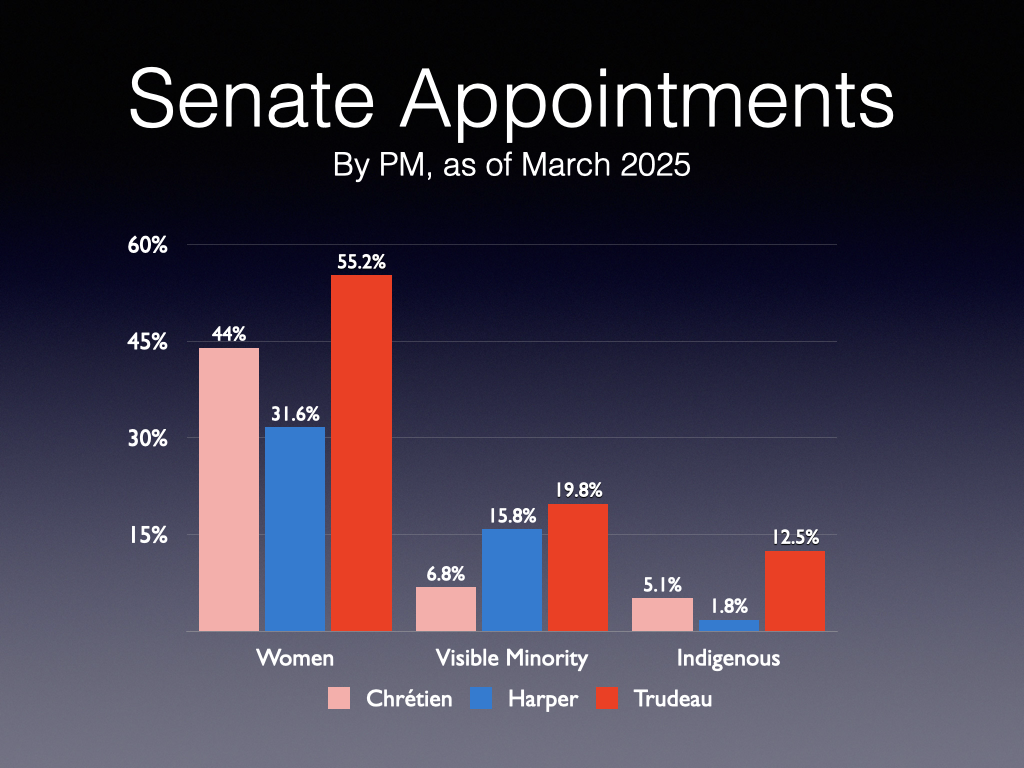
Will be interesting to see whether there is any impact on the diversity and political leanings of Carney appointments. Trudeau appointments: 55.2 percent women, 19.8 percent visible minorities, and 12.5 percent Indigenous:
Prime Minister Mark Carney said Wednesday he will continue to rely on the independent advisory board created by Justin Trudeau to suggest Senate appointments, but gave no timeline for filling a growing number of vacancies.
After more than a year in office Mr. Carney has yet to make a single Senate appointment. Vacancies are mounting not just among senators but also on the board tasked with selecting new members of the Senate.
There are currently nine vacancies in the 105-member Senate and another six senators are planning to retire by the end of 2026. The Independent Advisory Board for Senate Appointments, consisting of federal, provincial and territorial representatives, currently has just five members. It has 24 vacancies, leaving most provinces without representation on the board.
At a Montreal-area press conference, Mr. Carney gave no indication of when he would begin addressing the vacancies in the Senate. “We will be appointing senators in due course, and I will take into account the advice of the independent advisory committee that was established by my predecessor,” he said.
Of note. My analysis of the diversity of appointments below across three prime ministers:
With just days to go until Prime Minister Justin Trudeau leaves federal politics, his office says five new appointments have now filled all the vacancies in the 105-seat Senate.
The Prime Minister’s Office says in a news release that the Governor General has appointed former Moncton mayor Dawn Arnold for New Brunswick and former MLA Tony Ince for Nova Scotia.
Non-profit executive Katherine Hay, charity CEO Farah Mohamed and former provincial politician Sandra Pupatello have been appointed for Ontario.
There were 22 vacancies in the Senate when Trudeau became prime minister in 2015 and launched what his government called a “new, non-partisan, merit-based process” to advise on appointments.
There have been 100 independent appointments to the Senate made on the advice of Trudeau, with a dozen in 2024 and 10 this year.
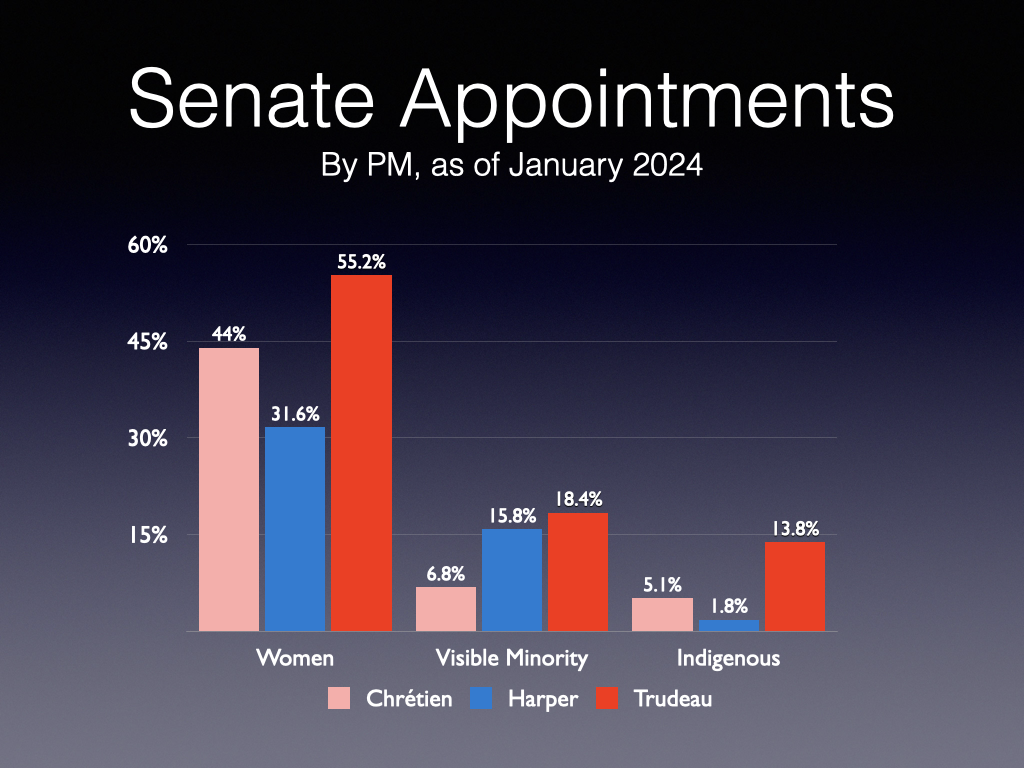
Diversity stats of appointments by PM (last minute senate appointments can be a poisoned chalice for governments):
…Prime Minister Justin Trudeau is planning a final wave of appointments to fill the 10 vacancies in the Senate before he retires in March, Radio-Canada has learned.
The move would allow him to leave a mark on Parliament for years to come, as these unelected legislators will be able to sit until the age of 75.
A source familiar with the matter says that the selection process for the future senators is already underway and should be completed before his departure. After proroguing Parliament earlier this month, Trudeau announced that he will leave power after the Liberal Party chooses a new leader on March 9.
In a written response, the Prime Minister’s Office confirmed that the advisory board for Senate appointments is at work to propose candidates for all vacancies.
“Prorogation did not affect the ability of the Governor General to make appointments to the Senate based on the advice of the prime minister,” said PMO spokesman Simon Lafortune. “The prime minister takes his responsibility to appoint senators seriously and will do so as long as he remains in office.”
The prime minister likes to praise the independence of the senators he has appointed since 2016, but he has nonetheless picked several high-profile Liberals to sit in the Senate in recent years.
The Conservative Party of Pierre Poilievre, which is leading in national polls, has long been critical of Trudeau’s choices of senators. The Conservatives now fear that Trudeau-appointed senators will try to block their agenda if the party wins the next election, which is expected in the spring.
There are currently 12 senators affiliated with the Conservative Party in the 105-seat chamber.
“For someone who advocated an independent Senate, [Trudeau] will have ended up filing the Senate with a large majority of Liberals or people who support his policies,” said Conservative Senator Claude Carignan….
Of note. Haven’t done a political linkages analysis but the table below contrasts senate appointments by PM from a diversity perspective:
Despite Prime Minister Justin Trudeau’s promise to rid the Senate of partisanship and patronage, most of the senators appointed to the upper house over the past year have ties to the Liberals.
Since July 2023, Trudeau has nominated 12 senators, eight of whom — 66 per cent of the total — have donated money to the federal Liberals or have worked with the federal party or a provincial Liberal party.
That’s a significant jump in the number of Senate appointees with partisan Liberal ties — up from about 30 per cent of all senators appointed between January 2019 and July 2023.
“I think it is a disturbing trend,” said Emmett Macfarlane, a political science professor at the University of Waterloo who wrote a draft document that became the basis for the advisory committee on Senate appointments.
“The appointment of the occasional partisan or person with a partisan history is completely, I think, valid,” he said. “What is troubling is to see a slew of partisan appointments, particularly those that match the government stripes. This actually goes against the whole spirit of the reform.”
As prime minister, he created an independent and nonpartisan advisory board for Senate appointments in 2016. Since then, he’s named only senators recommended by the board. Trudeau has named more than 80 senators since taking office.