Canadian dream elusive for some racialized 2nd-generation Canadians, study finds

Insightful although the differences between racialized groups is not new:

New research has found that the Canadian dream is proving elusive for some racialized second-generation Canadians born since the 1960s, despite having higher educational levels than their white counterparts.

A new study, entitled “Is the Canadian dream broken? Recent trends in equality of opportunity for the racialized second generation,” found that educational attainment and employment earnings are not uniform across groups of racialized second-generation Canadians, with some groups experiencing further disparities below the mainstream average.

And while educational levels for some racialized groups have surged, employment earnings were lower for most groups compared to the mainstream population, the study found. It also discovered intergroup differences.

The study, by researchers at four universities and released on Wednesday, defines the Canadian dream for immigrants as equality of opportunity and the chance to achieve financial security. Even if the first generation lives in poverty, the next generation will be able to pull itself out of poverty and achieve economic success, according to this definition.

“I don’t think the Canadian dream is accessible to everyone equally,” said Rupa Banerjee, one of the authors of the study and associate professor at Toronto Metropolitan University.

“For some, the Canadian dream is holding pretty well, but for others, it’s failing. And that failure has really, really serious and significant repercussions, not just for them and their family, but for the entire society,” added Banerjee, also the Canada Research Chair in the economic inclusion of immigrants.

“We’ve always kind of been smug that Canada is not like Europe or Canada is not like the U.S., that we’re much more multicultural. We believe in pluralism. But I think that’s a bit of a myth that we’ve kind of felt good about but doesn’t really exist, and in that sense, the Canadian dream is failing.”

The study defines second-generation as Canadian-born individuals with at least one immigrant parent.

It looked at educational attainment and employment earnings in three of “successive 10-year birth-cohorts” of second-generation Canadians from the mid-1960s to the mid-1990s, specifically 1966-1975, 1976-1985, and 1986-1995.

It focused on people 26 to 35, using data from the 1981, 1991, 2001, 2021 Canadian Census of Population and the 2011 National Household Survey. Examining the progress of five racialized groups, South Asian, Chinese, Black, Filipino, and Latin American, it compared them to third-and-higher generation white Canadians.

The study sample would have completed their education and begun their work careers.

Anti-Black racism is real, study author says

According to Banerjee, the study’s main findings include:

  • Chinese and South Asian populations have maintained high educational levels, whereas Black individuals, and to some extent Filipino and Latin American individuals, show declining trends across cohorts.
  • Despite a higher proportion of second-generation individuals holding university degrees, earnings were lower for most groups compared to the mainstream population, with pronounced declines observed over time among Black second-generation men and women.
  • Changing characteristics of immigrant parents do not fully account for these trends, raising questions about longer-term integration processes among different ethno-racial minorities in Canada.

Banerjee said the study shows that anti-Black racism is real and Canada is not a post-racial society.

Source: Canadian dream elusive for some racialized 2nd-generation Canadians, study finds

Lisée | Laïcité, deuxième tour

On the renewal of the notwithstanding clause for Loi 21. Appears like CAQ just wants to renew legislation as is but Lisée argues for some more restrictive provisions, including greater consistency for all religions:

Il est formidable, ce délai de cinq ans. Il y a des contraintes comme ça, qui nous semblent excessives au premier abord, mais qui nous rendent service à l’usage. Cinq ans, c’est le délai après lequel les législateurs, comme les nôtres à l’Assemblée nationale, doivent décider s’ils renouvellent ou non la disposition de dérogation. Celle qu’ils ont attachée à une loi pour dire aux juges : « Pas touche. Nous avons décidé qu’en ce cas précis, les élus, plutôt que les juges, vont rendre un arbitrage entre les droits individuels et les droits collectifs. »

Le sens des mots est important, et le fait que l’on « déroge » à une charte des droits est très négativement connoté. C’est pourquoi le gouvernement de la Coalition avenir Québec tente d’y substituer l’expression « clause de souveraineté parlementaire ». Une autre vraie façon de voir la chose. Un peu comme la séparation et l’indépendance.

Il y a cinq ans déjà que la Loi sur la laïcité de l’État québécois a été adoptée. Notez que le système juridique canadien n’a même pas été capable, pendant cet assez long délai, de donner son dernier mot sur la constitutionnalité de ce texte législatif. On a eu un jugement de la Cour supérieure en avril 2021. Prenant son temps, la Cour d’appel a entendu les parties en novembre 2022. Prenant encore plus son temps, elle n’a pas donné signe de vie depuis. Et quoi que disent ces augustes juges, on ira ensuite en Cour suprême, chez des gens qui ne sont pas non plus connus pour leur célérité.

Cette révision à pas de tortue donne raison aux parlementaires qui ont voté pour la loi et pour sa clause de souveraineté parlementaire, et donc son application immédiate dans le réel, soit ceux de la Coalition avenir Québec et du Parti québécois (PQ). Sinon, on n’aurait vraisemblablement jamais pu appliquer les aspects de la loi qui interdisent le port de signes religieux chez les policiers, les gardiens des prisons provinciales et les enseignants du primaire et du secondaire. (La loi prévoyait de l’interdire aux juges québécois, mais ces derniers ont usé d’entourloupes pour s’en exempter.)

Le ministre de la Langue française, Jean-François Roberge, a déposé un projet de loi qui ne contient qu’une clause : celle qui renouvelle la disposition de dérogation/souveraineté parlementaire pour cinq ans. Ne faudrait-il pas, au contraire, refaire le point et franchir des pas de plus  ? C’est en effet graduellement, une ou deux fois par décennie, qu’on a fait avancer ce principe clé depuis 1960. 

D’abord, on a constaté l’an dernier qu’il manquait une disposition à la loi lorsqu’un mouvement pas tout à fait spontané de prières à l’école a poussé le gouvernement à décréter qu’il y avait des temples pour cette activité et que les écoles n’en étaient pas. Même la députée Marwah Rizqy et tout le Parti libéral du Québec ont exprimé leur accord avec cette interdiction. Le Conseil national des musulmans canadiens poursuit l’État québécois à ce sujet et pourrait convaincre le premier juge trudeauiste venu de la qualité de ses arguments. D’où l’intérêt de colmater la brèche, sous le parapluie de disposition de dérogation/souveraineté parlementaire, dans une modification à la loi qu’on pourrait baptiser du nom de Rizqy.

On entend aussi le péquiste Pascal Bérubé et la solidaire Ruba Ghazal pester contre les subventions accordées à des écoles qui imposent à leurs élèves un enseignement religieux. La journaliste radio-canadienne Laurence Niosi a fait le compte l’an dernier : c’est à hauteur de 60 % que sont financées 27 écoles catholiques, 14 juives, 4 musulmanes, 2 protestantes évangéliques, 2 arméniennes et 1 grecque orthodoxe, au coût de 161 millions de dollars. Je verrais d’un bon oeil une modification Bérubé-Ghazal ordonnant une élimination graduelle de ces subventions.

Puis il y a la question des exemptions fiscales accordées aux immeubles religieux. Les fouineuses Sylvie Fournier et Jo-Ann Demers, de l’émission Enquête, ont révélé que l’Église catholique, qui plaide l’indigence en cour pour éviter de dédommager ses nombreuses victimes d’agressions sexuelles, a au moins 1,8 milliard de dollars dans ses coffres. Ces bidous ne sont pas apparus par l’effet de la bonté divine. Pendant des générations, nos aînés versaient régulièrement à l’Église catholique la dîme, une fraction de leurs revenus, en plus de la quête remise chaque dimanche. Ce n’était pas obligatoire, mais Dieu avait bien prévenu que, pour un chrétien, ne pas la payer équivalait à le voler personnellement. 

L’existence de ce pactole rend parfaitement faisable l’abolition des exemptions fiscales pour les biens religieux, qui privaient en 2019  les villes et le Trésor québécois de 180 millions de dollars par an, selon le calcul des collègues Stéphane Baillargeon et Magdaline Boutros. Les fruits de cette fiscalisation devraient être d’abord consacrés à la sauvegarde du patrimoine religieux et à la reconversion des églises, comme l’a récemment suggéré mon estimé collègue chroniqueur de La Presse Maxime Pedneaud-Jobin.

L’étape quinquennale de la Loi sur la laïcité de l’État devrait aussi être le moment d’adopter la proposition, faite il y a cinq ans par le PQ, d’étendre l’interdiction des signes religieux à tout le personnel des écoles, y compris celui du service de garde scolaire et de la direction. Puisque le droit acquis s’applique, cet élargissement tombe sous le sens, et il n’aurait pas d’effet notable sur la pénurie de main-d’oeuvre. La vraie étape à franchir à ce chapitre devrait être l’interdiction du port de signes religieux par les fonctionnaires en contact avec la clientèle, avec respect des droits acquis, bien sûr. Pour le reste, on verrait dans cinq ans.

La combinaison de ces avancées aurait un avantage majeur. Par la force des choses, l’ensemble des mesures toucherait bien davantage le catholicisme que les autres confessions. Cela ficherait un pieu dans l’objection centrale des critiques de la loi, qui évoquent avec effroi le spectre de la catho-laïcité. On en aurait fini avec cette calomnie, Dieu merci.

Source: Chronique | Laïcité, deuxième tour

Investigation: The antisemitism that Oct. 7 unleashed in Canada

Good and alarming compendium of antisemitic speech and actions:

….In intelligence briefs released under the Access to Information Act, the Canadian government’s Integrated Terrorism Assessment Centre said violent extremists were spreading antisemitic rhetoric.

Using social media as their “main pathway,” extremist influencers have praised Hamas and disseminated antisemitic content and conspiracy theories that incite violence, according to an Oct. 12, 2023 report.

“The narratives encourage hate crimes, violence and terrorism,” said the report, titled Canada: Trends Influencing Antisemitic Violent Extremism.

A report issued two weeks later predicted the Israel-Hamas conflict would “exacerbate the current steady increase in hate crimes targeting the Jewish community in Canada.”

“Violent rhetoric celebrating the Oct. 7 attack and encouraging like-minded individuals to conduct lone actor attacks could inspire individuals to conduct attacks targeting Israeli interests or the Jewish community,” it said.

The grandson of Holocaust survivors, Karmel said he was glad his grandparents were not around to witness the turn of events in Canada.

“To see this happening again, it’s terrifying,” he said. “It’s hatred.”

Kathrada became leader of the Dar al-Ihsan Islamic Centre, run by Muslim Youth of Victoria, in 2018. His weekly videos soon attracted attention.

The Middle East Media Reserarch Institue (MEMRI), a U.S. group that monitors online extremism, began issuing reports on Kathrada that same year.

Since then, MEMRI has issued 60 reports on him, including one that quotes him preaching that non-Muslims are “enemies,” and not to associate with them.

“I want our children to understand this well: the non-Muslims are the enemies of Allah, therefore they are your enemies,” he said in one of the videos.

In another video, he said that “people of faith hate the Yahud because of their disbelief in Allah.” He defined Yahud as “Zionists, Zionist Jews, whatever you like.” Yahud is the Arabic term for Jews.

“If you do not hate the opponents of Allah you have no faith,” he continued. “Having said that, once again, we have not ever called toward violence toward others.”

The government’s Integrated Terrorism Assessment Centre took note of Kathrada in a 2020 report obtained by Global News.

Under the heading “Online proliferation of incitement,” it cited his sermon about the beheading by French extremists of school teacher Samuel Paty, whom he called a “filthy excuse for a human being.”

Slobinsky said religious leaders had an obligation to unite people, rather than to sow division, and that words have consequences.

“Words carry meaning and words can scare people, can affect their sense of safety, their sense of belonging and the sense of mental well-being,” he said.

“The speech that Younus Kathrada uses is highly inflammatory and derogatory towards Jews. Nobody should be, listening to what he says.”

Sent a series of questions, Kathrada did not respond directly, but later wrote on Facebook that he was being harassed by “lazy misfits” who “twist people’s words.”…

Source: Investigation: The antisemitism that Oct. 7 unleashed in Canada

Horn: The Return of the Big Lie: Antisemitism is winning

Long read with concluding thoughts applicable to all groups on what universities and other institutions need to do:

It is fairly obvious what Harvard and other universities would need to do to turn this tide. None of it involves banning slogans or curtailing free speech. Instead it involves things like enforcing existing codes of conduct regarding harassment; protecting classroom buildings, libraries, and dining halls as zones free from advocacy campaigns (similar to rules for polling places); tracking and rejecting funding from entities supporting federally designated terror groups (a topic raised in recent congressional testimony regarding numerous American universities); gut-renovating diversity bureaucracies to address their obvious failure to tackle anti-Semitism; investigating and exposing the academic limitations of courses and programs premised on anti-Semitic lies; and expanding opportunities for students to understand Israeli and Jewish history and to engage with ideas and with one another. There are many ways to advocate for Israeli and Palestinian coexistence that honor the dignity and legitimacy of both indigenous groups and the need to build a shared future. The restoration of such a model of civil discourse, which has been decimated by heckling and harassment, would be a boon to all of higher education.

Harvard has already begun signaling change in this direction: The university recently reiterated and clarified rules regarding the time, place, and manner of student protests. For Harvard to take more of these steps would be huge, but I have struggled to understand why all of them still feel so small. Perhaps it’s because the problem is a multi-thousand-year fatal flaw in the ways our societies conceive of good and evil—and also because somewhere deep within me, I know what has been lost. There was a time, not so very long ago, when we didn’t have to prove our right to exist.

Among the mountains of evidence that Jewish students sent me, one image has stayed in my mind. There are videos of crowds chanting “Long live the intifada!” inside Harvard’s Science Center, and “There is only one solution: intifada revolution!” in Harvard Yard, along with other places equally familiar from my student days. But I keep coming back to the crowds marching and screaming in front of Harvard Law School’s Langdell library, because Langdell is a sacred place for me. On my 22nd birthday, in 1999, when I was a senior at Harvard, a law student I’d met at Hillel took me up through Langdell’s maintenance passageways to the library’s rooftop, where he asked me to marry him. I said yes.

I watched the video of the students marching and screaming in front of Langdell, and in an instant I remembered everything: studying in campus libraries for my Hebrew- and Yiddish-literature courses, talking for hours with Muslim and Christian and progressive and conservative classmates, inviting friends of all backgrounds to join me at Hillel, scrupulously following the Jewish tradition of “argument for the sake of heaven” in even the most heated debates, gathering for Shabbat dinners crowded with hundreds of students—and over those long and beautiful dinners, falling in love. My classmates and I often disagreed about the most important things. But no one screamed in our faces when we wore Hebrew T-shirts on campus. No one shunned us when we talked about our friends and family in Israel, or spat on us on our way to class. No crowds gathered to chant for our deaths. No one told us that there should be no more Jews. That night, my future husband and I worried only about getting in trouble for sneaking up to the library roof.

Source: THE RETURN OF THE BIG LIE: ANTI-SEMITISM IS WINNING

Barclay: Systemic change needed to recognize harms of antisemitism in the public service

Yet another pressure (and DEI in general has discounted Jews and antisemitism). That being said, recognizing Jews as a separate category would also require recognizing other religions, further muddying the waters between gender, racialized minorities and religious minorities, making intersectionality analysis likely beyond the capacity of the public service.

Analysis would be stronger if there was some data presented in terms of discrimination and harassment reported cases (sorry, “reported” without references or actual data doesn’t cut it):

In 2022, the Jewish Public Service Network (JPSN) petitioned the Employment Equity Act Review Task Force to designate Jewish public servants as an “employment equity ginvroup” in response to the blatant antisemitism, anti-Jewish hatred, and oppression that have become endemic within Canada’s public service.

However, only months before Hamas’ savage attacks against the state of Israel on Oct. 7, 2023, the Employment Equity Act Review Task Force rejected the JPSN’s request and stated that, despite the rampant antisemitism that Jewish public servants have been forced to endure, the Task Force does not “recommend the creation of a separate category for some or all religious minorities at this time.”

Unfortunately, although the Employment Equity Act Review Task Force has refused to designate Jewish public servants as an “employment equity group,” it is readily apparent that Jewish people throughout Canada’s public service are consistently the victims of overt antisemitism, explicit oppression, and anti-Jewish hatred.

For example, data shows that antisemitic incidents have become increasingly frequent and are consistently permitted to transpire throughout Canada’s public service, particularly in the wake of Hamas’ recent attacks against the state of Israel. Even the Task Force itself was forced to acknowledge in its final report that it was “especially concerned by the reported rise in anti-Semitism [in Canadian society and Canada’s public service].” In fact, whenever the Israel-Palestine conflict erupts, antisemitic incidents and violent antisemitism inevitablyskyrocket.

In addition, antisemitic canards about Jews and money are routinely invoked, and countless macabre antisemitic delusions about the Jewish community have been allowed to migrate freely throughout Canada’s public service. For instance, when one Jewish public servant dared to eat matzah at work, she was immediately beset by a colleague who asked, “How could you eat that given it is made from the blood of Egyptian children?”

Sadly, it is clear that the Employment Equity Act Review Task Force has struggled profoundly to accurately locate the Jewish experience within the public service, and has completely failed to earnestly interface with the intersectionality that is inherent to every Jewish identity, ideology, and experience.

For example, the word “antisemitism” only appears twice throughout the Task Force’s entire final reportFurthermore, the words “Jew,” “Jewish,” and “antisemitism” do not appear at all within the report’s executive summary. In contrast, the Black community and the 2SLGBTQI+ community are referred to more than 300 times and 175 times, respectively.

In addition, the Task Force has remained particularly unable to reconcile the fact that it is impossible to classify the Jewish identity as merely “race” or “religion.” As the JPSN itself was forced to reiterate: “Jews are often described as a ‘religious minority’… [However,] the Jewish people are an ethno-religion. Both the ethno and the ‘religion’ are important.”

Unfortunately, the Employment Equity Act Review Task Force’s utter inability to earnestly interface with the challenges that are innate to Jewish identity and to empathize with the plight of Jewish people is not a unique phenomenon.

Rather, Canadian society and the international community have long remained doggedly committed to the myth that the Jewish community is a rich, white, homogenous mass.

Moreover, throughout the advent and onset of “identity politics,” the Jewish nation’s alleged “whiteness” and purported ideological uniformity have consistently been used as the impetus for countless antisemitic tropes, as well as blatant antisemitic abuse and violence.

In fact, countless political actors and organizations deny the plight of Jewish people around the world and dismiss the constant surge of anti-Jewish violence and antisemitism throughout the international political system, simply because the Jewish community does not satisfy the requisite “diversity criteria.”

Therefore, although Jewish identity is certainly the product of centuries of vigorous tradition and customs, it has become essential for all Jewish people and every Jewish ally to expose and embrace anew the vibrant diversity that is inherent to the Jewish community and its fundamental ethos.

Canadian society and the myriad structures that comprise its political apparatus, such as the Employment Equity Act Review Task Force, must first accept the premise that every Jew is an individual and that Jews are real people, replete with problems, social needs, and ills aplenty, before any Jew will truly be treated as a human being in Canada.

William Barclay is a political theorist and consultant who has collaborated with political actors and organizations throughout North America and Europe in order to inform policy and help successfully resolve various unique political challenges.

Source: Systemic change needed to recognize harms of antisemitism in the public service

Eric Kaufmann: Canadians aren’t actually ‘woke’

Pretty flawed methodology as the polling questions focus on contemporary controversies rather than probing for more underlying perspectives, where many other polls and research highlight significant differences. The classic analysis of how polling can be misleading is from Yes, Prime Minister, https://www.youtube.com/watch?v=ahgjEjJkZks. Poll questions appear designed to generate these responses and advance Kaufmann’s viewpoint rather than being more objective:

Canadians have nearly identical views on culture war issues to Americans and Britons. Across some fifty questions concerning free speech, national heritage, and transgender issues, Canadians, like Britons and Americans, lean around two-to-one against the “woke” cultural socialist option and in favour of cultural liberalism or conservatism. This is the story that emerges from my new report for the Macdonald-Laurier Institute, “The Politics of the Culture Wars in Canada.”

Woke refers to the sacralization of historically marginalized race, gender, and sexual identity groups. This belief system elevates equal outcomes and emotional harm protection for such groups as its highest value. As a result, woke activists seek to cancel speakers or historical figures deemed to be offending the sensibilities of the most hypothetically sensitive member of a minority group. In this clash of values, cultural socialism trumps expressive freedom and symbolic attachment.

Prime Minister Justin Trudeau has distinguished himself on the world stage as the paragon of this belief system, and many outside Canada assume he reflects an equally woke Canadian public. But is this truly the case? To better understand Canadian views, The Macdonald-Laurier Institute asked Maru Public Opinion Polls to conduct a nationally representative survey of 1,500 adults, in which I fielded numerous questions previously put to American and British samples. 

What did I find? Surprisingly, despite their reputation, Canadians largely reject the woke ideology. For instance, they oppose the idea of separating pupils in class by race—assigning whites as privileged and minorities as oppressed—by a whopping 92 to 8. By 85-15, they reject the idea of teaching children that “There is no such thing as biological sex, only gender preference.” Excluding those with no opinion, 80 percent of respondents were against the idea of J.K. Rowling being dropped by her publisher. By a similar slant, Canadians say “political correctness has gone too far.”

In most cases, respondents came out strongly against established practices found in Canadian institutions. For example, when Toronto teacher Richard Bilkszto pushed back against diversity trainer Kike Ojo-Thompson’s characterization of Canada as more racist than the United States, none of his colleagues defended him and his travails eventually drove him to suicide. Yet, by a stunning 95-5 margin, Canadians overwhelmingly reject the idea that their country is more racist than other countries. Among those with an opinion, just 30 percent say that Canada is a racist country while 70 percent disagree. A similar share says they do not want schoolchildren taught that the country is racist.

Or consider the fact that almost all statues of Sir John A. Macdonald have been removed from major Canadian cities. Yet, Canadians oppose removing statues of Canada’s Father of Confederation by a two-to-one ratio. Among those with an opinion, a mere 8 percent say activists should be allowed to remove statues without government approval, with 92 percent against. Almost 45 percent of Tory and PPC voters strongly disagree with removing Macdonald. In addition, only 5 percent of Liberal, NDP, and Green voters strongly agree that his statues should be removed. The majority of left-wing voters oppose rather than support Macdonald’s removal.

Canada has been one of the most trans-affirming societies on earth. Only in the past year have conservative premiers in New Brunswick, Saskatchewan, and Alberta begun to curb trans activism in education by requiring schools to inform parents of their children’s change of pronouns. And only recentlyhas Pierre Poillievre been willing to oppose puberty blockers for minors. In Premier Doug Ford’s Ontario, not to mention in provinces run by the NDP or Liberals, the writ of trans activism runs through government and the schools. 

But when we look at public opinion on the trans question, an entirely different picture emerges. By a four-to-one ratio, Canadians oppose gender reassignment surgery for those under 16. By two-to-one, they want parents informed of pronoun changes at school and don’t want transgender women (i.e. biological males) to enter women’s sports competitions. Three in four Canadians say we talk too much about transgenderism. Even when it comes to people displaying their pronouns in work emails or social media profiles, more Canadians disapprove of this practice than support it, placing them even to the right of the British public.

It is striking how similar Canadian public opinion is to that of supposedly more conservative America or Britain. Across 30 questions I asked in Britain in 2022 and Canada in 2023, the average difference in opinion between the two countries is just 0.3 of a percentage point. Furthermore, of the 13 questions asked in the U.S. in 2021, the average gap with this Canadian survey was just one point! There is essentially no appreciable difference—especially if we take variation in date and sample (as well as random error) into account. Canadians are somewhat more likely than Britons or Americans to say biological males who identify as women should be allowed in women’s sports, and somewhat more supportive of Black Lives Matter. But they are considerably less likely than Britons or Americans to say their country is racist. Canadians under 35, in particular, stand out as being far less likely than their American or British youth counterparts to call their respective country racist.

French-English differences are also much smaller than the stereotype of woke English Canada versus plain-speaking traditional French Canada would lead us to expect. Francophones are somewhat less woke than Anglos on many transgender questions and more inclined to colourblindness rather than race and gender-conscious Diversity, Equity, and Inclusion (DEI) policies. However, Anglophones are more critical of Black Lives Matter than Francophones, more likely to say political correctness has gone too far, and more opposed to removing statues and renaming buildings—though the examples tested involve Anglophone figures such as Macdonald or Ryerson, to whom Francophones have weaker historical attachments.

English Canada’s culturally-left political and media elite contrasts with that of red-state America, and, to a lesser degree, with Britain and Quebec. If English-Canadian public opinion is largely aligned with the others, why have its policies and politicians diverged from their British, American, and Quebecois equivalents? 

One possible answer is Canadians’ relatively high trust in elites and institutions. More than half of Canadians trust journalists while fewer than 20 percent of Britons and barely a third of Americans do. Even 30 percent of conservative Canadians trust journalists compared to 11-15 percent of conservative Americans and Britons. A somewhat similar pattern holds with respect to academics and teachers. Canadians’ elevated trust in their largely progressive-dominated institutions gives the Canadian elite more leeway to deviate from public opinion.

The key takeaway is that culture war issues are far less settled than a lot of mainstream commentary would have Canadians believe. Polling irrefutably shows that Canadians are as inclined as Americans or Britons to disagree with a lot of the woke shibboleths that are present in the media, universities, and other major institutions. As for the political implications, these findings may represent a glaring opportunity for conservatives and a glaring risk for progressives. 

Source: Eric Kaufmann: Canadians aren’t actually ‘woke’
Court ruling OK’s Amnesty Canada intervention in Black Class Action lawsuit

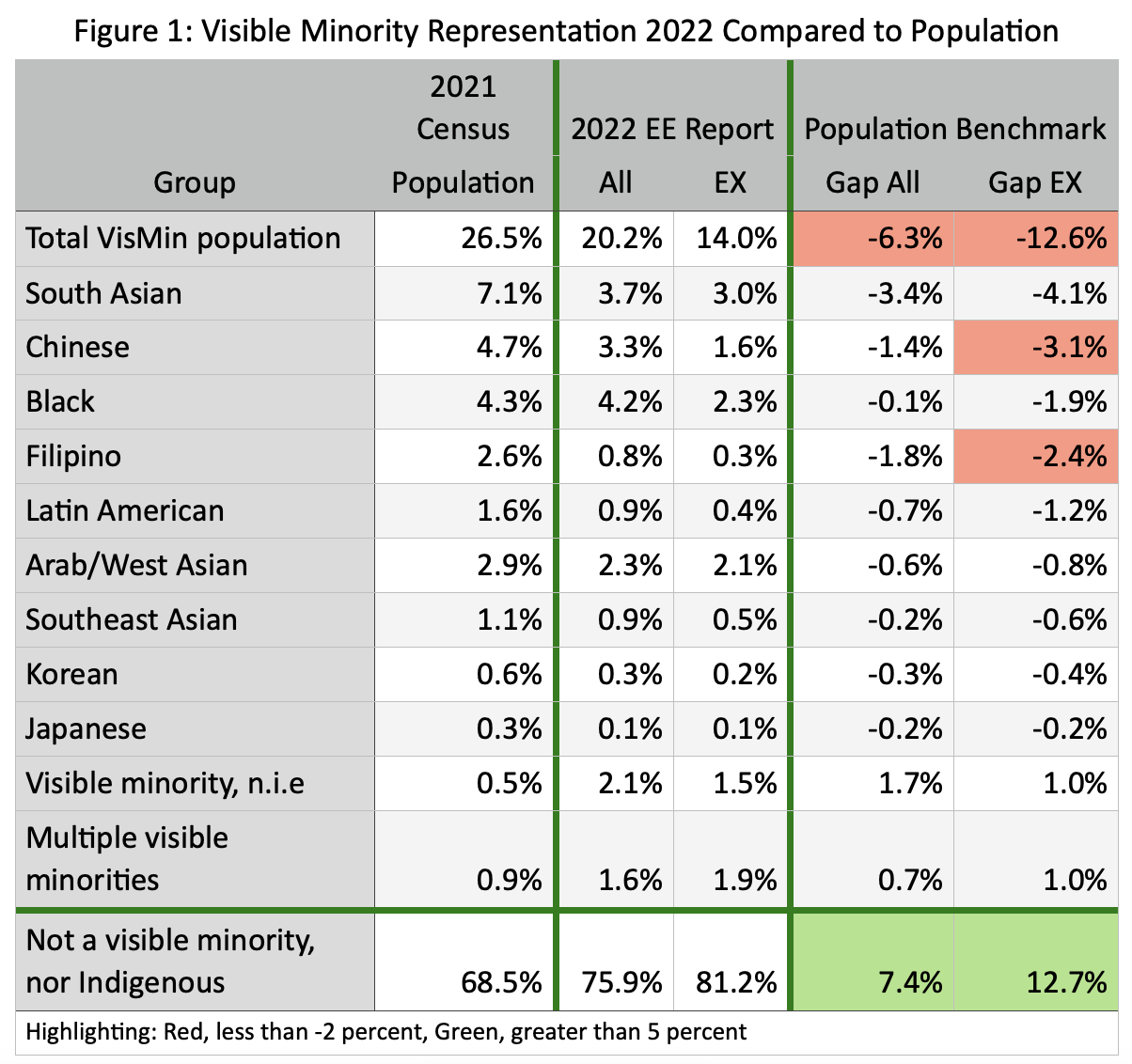
Fair enough but would have thought higher priorities, particularly given overall representation number of Black public servants compared to other visible minority groups:

….In October 2022, the federal government called for a Federal Court judge to dismiss the uncertified class action seeking $2.5 billion in compensation, arguing workers should pursue other avenues for redress, including filing complaints with the Canadian Human Rights Commission.

Amnesty Canada applied to the court to intervene last summer, with the organization’s counsel noting in a cross-examination a few months later that its participation would be “limited to making legal arguments regarding the defendant’s obligations under international law.”

“Canada’s duty to uphold federal workers’ rights goes beyond the Charter and domestic employment equity legislation,” Ketty Nivyabandi, Secretary General of Amnesty International Canada’s English-speaking section, said in a news release about the decision. “As we will stress to the court, Canada also has clear obligations under international law to promote equity, counter racism and provide an effective remedy when people are subjected to systemic discrimination.”

The court decision stated that the government was the only opponent to the motion, “largely on the basis that the proposed submissions are substantive in nature and not relevant to the procedural issues raised in the certification motion and motion to strike, and on the basis that, in any event, these issues are not governed by international law.”

In a news release, the Black Class Action Secretariat said it welcomed the court’s decision to allow Amnesty International Canada’s intervention in the lawsuit despite the government’s efforts to “vehemently oppose it.”

“This pivotal ruling underscores the necessity of incorporating international human rights perspectives in the fight against systemic discrimination within the federal public service,” a BCAS statement read. “This intervention highlights the national and international importance of our cause and the urgent need to address these injustices.”

The certification hearing is expected to take place after May 3, but BCAS said it called on the government to consent to the certification of the class action instead of “forcing workers to relive decades of trauma.”

“This step is crucial in moving forward toward a fair and just resolution for the affected Black workers,” its statement read. “We urge the government to commit to meaningful actions that address and rectify the discrimination within the public service, thereby restoring trust and integrity in Canada’s federal public service.”

Source: Court ruling OK’s Amnesty Canada intervention in Black Class Action lawsuit

UK: Shadow minister says Labour will investigate allegations as antisemitism row deepens

Of note:

The shadow defence secretary has said Labour will “follow the hard evidence” to ensure anyone who does not meet the standards of the party will be investigated.

His remarks come as Keir Starmer’s party was plunged into a damaging row about the handling of antisemitism allegations, with parliamentary candidate Graham Jones suspended on Tuesday, only a day after Labour was forced to suspend and withdraw its backing for Rochdale by-election candidate Azhar Ali.

Mr Starmer was forced to act after audio, obtained by website Guido Fawkes, appeared to capture Mr Jones using the words “f****** Israel” at the same meeting Mr Ali attended, while also allegedly suggesting that British people who volunteer to fight with the Israel Defence Forces should be “locked up”.

John Healey today urged anyone else at the meeting who witnessed antisemitism or unacceptable comments to report it to the party.

Speaking to Sky News, the shadow minister said: “Anyone at that meeting, if there is evidence that they have, that people acted or spoke in a way that doesn’t meet the standards, or is incompatible with the values of our Labour Party, they need to report it, provide it and the Labour Party will take it seriously and investigate it.

He added: “It’s what we do with every case.”

Pushed on whether Mr Ali was properly vetted, Mr Healey said the Rochdale candidate was “widely respected” and “widely supported across communities, including the Jewish community in the North West”.

He also said that there are “strong checks” and “due diligence” in the process. “But you can’t see everything everywhere. What’s important is that if new information comes to light, as in this case, we will act to investigate, we will act to block those who are not fit to serve as MPs,” he added.

It is too late now to replace Mr Ali as the Labour candidate so he will still appear on the ballot paper as the party’s choice.

On Tuesday the Labour leader Sir Keir Starmer addressed the controversy for the first time since the allegations broke.

“Information came to light over the weekend in relation to the candidate [and] there was a fulsome apology. Further information came to light yesterday calling for decisive action, so I took decisive action,” he said.

The Labour leader added: “It is a huge thing to withdraw support for a Labour candidate during the course of a byelection. It’s a tough decision, a necessary decision, but when I say the Labour party has changed under my leadership I mean it.”

Labour has been criticised for not taking tougher action sooner, with some suggesting Mr Ali was given favourable treatment because he was an ally of the leadership.

Source: Shadow minister says Labour will investigate allegations as antisemitism row deepens

Jesse Kline: Amira Elghawaby defends antisemitic protest in front of Toronto hospital

Not a great look:

…Not that the protesters themselves would ever admit this, as doing so would expose them to hate crime charges. The group Toronto4Palestine said that Mount Sinai “just happens to be along our regular rally route.” How were they supposed to know it’s the one hospital in that area with strong ties to the Jewish community?

It’s not hard to see through their thinly veiled excuses, but that hasn’t stopped their fellow travellers from putting on blinders and coming to their defence — including Elghawaby, Canada’s “special representative on combating Islamophobia.” Taking to the social media platform formally known as Twitter on Tuesday, Elghawaby noted that blocking the entrance to a public hospital was “troubling,” but also criticized “the rush to label protesters as antisemitic and/or terrorist sympathizers.”

Never mind that they deliberately targeted an institution with Jewish roots. Never mind that signs could clearly be seen portraying terrorists as freedom fighters. And never mind that they were loudly chanting, “Long live the intefadeh,” a reference to the two Palestinian uprisings, in which hundreds of Israeli civilians were killed in suicide bombings and other terrorist attacks, many of which were committed by Hamas, the perpetrator of the Oct. 7 massacre.

You’d think that someone whose job is to combat hatred would be the first to denounce a hate-filled rally such as this, even if it was antisemitism being espoused, rather than Islamophobia. But according to Elghawaby, such displays should only be condemned “if police determine any action was motivated by hate.” (Which is a little hard to do since we can’t read minds, and highlights the folly of creating a separate class of crimes that are dependant on the thought processes of the perpetrators.)

source: Jesse Kline: Amira Elghawaby defends antisemitic protest in front of Toronto hospital

California’s Push for Ethnic Studies Runs Into the Israel-Hamas War

Not surprisingly, as would any history program:

California has grand ambitions for ethnic studies. By 2025, the state’s public high schools — about 1,600 of them — must teach the subject. By 2030, students won’t be able to graduate high school without it.

For policymakers, a goal is to give California students, 80 percent of whom are nonwhite, the opportunity to study a diverse array of cultures. Research has shown that ethnic studies classes can raise grades and attendance for teenagers at risk of dropping out.

But even in a liberal state like California, scholars, parents and educators have found themselves at odds over how to adapt the college-level academic discipline for high school students, especially because of its strong views on race and the Israeli-Palestinian conflict.

While the name “ethnic studies” might bring to mind a broad exploration of how ethnicity and race shape the human experience, the discipline, as taught in universities, is narrower — and more ideological.

Ethnic studies focuses on four groups: Black Americans, Latinos, Native Americans and Asian Americans. It aims to critique various forms of oppression and spur students to take action, often drawing analogies across disparate expanses of time and geography. The Palestinian experience of displacement is central to that exercise, and has been compared by some scholars to the Native American experience.

In reworking ethnic studies for high school, California came up with a 700-page model curriculum that captures much of the discipline’s leftist, activist spirit. But it added the stories of other ethnic groups, including Jewish Americans, while eliminating discussions of the Israeli-Palestinian conflict. It said lessons should include “multiple perspectives” on political issues.

The state’s model ethnic studies curriculum does not directly address the Israeli-Palestinian conflict, but does include an optional sample lesson that emphasizes Jewish roots on the land that is now Israel.Credit…California Department of Education
The state’s model ethnic studies curriculum does not directly address the Israeli-Palestinian conflict, but does include an optional sample lesson that emphasizes Jewish roots on the land that is now Israel.

Now some prominent ethnic studies scholars and educators say the state has bowed to political critics and censored their field. They are promoting a competing vision, which they call “liberated ethnic studies.” It is truer to how the subject is taught in colleges, but more politically fraught. It largely excludes the histories of ethnic groups, including Jews, who are typically understood as white within the discipline’s context. (Arab American studies is defined as fitting into Asian American studies.) And it offers lessons that are critical of Israel — and, some argue, antisemitic.

A number of California school districts are working with curriculum consultants who embrace liberated ethnic studies, while other districts are drawing upon these materials in creating their own classes.

The dueling approaches have prompted several lawsuits and sparked a heated debate: How should millions of California teenagers engage with these explicitly activist concepts in the classroom?

Resolutions to this question may shape education across the country. States including Oregon, Vermont and Minnesota plan to introduce K-12 ethnic studies in the coming years.

Source: California’s Push for Ethnic Studies Runs Into the Israel-Hamas War