Jon Kay: Canadian Human Rights Commission must establish a special human-rights tribunal to address human-rights complaints pertaining to the presentation of human-rights issues at the Canadian Museum of Human Rights

Funny and ironic piece by Jonathan Kay who captures some of the absurdity of  identity politics and the criticism regarding the Canadian Museum for Human Rights:

The response of Canadian identity groups to the museum overall is perhaps best epitomized by a statement put out by the Ukrainian Canadian Congress last year, complaining that the museum’s treatment of Stalin’s forced starvation of millions of Ukrainians was fatally undercut by the fact that a panel on the subject was located too close to the public toilets. (Whose exhibit should be closest to the toilets? The Rwandans? The Cambodians? The Armenians? The Ukrainian Canadian Congress hasn’t told us.)

…If the true goal of the Canadians Museum of Human Rights is to create a “national hub for human rights learning and discovery,” shouldn’t visitors to the museum not be able to file a human rights complaint at the museum itself?

The museum boasts of providing visitors with “an immersive, interactive experience that offers both the inspiration and tools to make a difference in the lives of others.” What could be more “interactive” than a special in-museum kiosque that invited visitor to sue the museum itself under applicable Canadian human rights law?

In special circumstances, visitors to the museum might even be permitted to sue each other — Indians versus “wealthy children of settlers,” and Jews vs. Ukrainians, for instance. Following on the 2013 Ukrainian-Canadian protest described above, human-rights complainants at the museum might also seek injunctive relief to prevent fellow museum-goers from using the bathrooms. Where human rights are at stake, no remedy should be off-limits.

In time, the number of successful human-rights claims against the Canadian Museum of Human Rights might become so enormous that these cases would, themselves, become the subject of an entirely new museum — the Canadian Human Rights Museum-Related Human Rights Museum. And since this, too, would be built on “stolen land,” and would necessarily include some cases and exclude others, the cycle of human rights violation, complaint, litigation and resolution would be guaranteed to blossom anew.
The Canadian Human Rights Commission must establish a special human-rights tribunal to address human-rights complaints pertaining to the presentation of human-rights issues at the Canadian Museum of Human Rights

Plan to revoke passports raises concerns

Waldman is correct to highlight that this power could be applied arbitrarily but given that court safeguards exist, and given that there are some Canadians engaged in extremist activities in Syria and Iraq, it seems a prudent measure. See earlier Canadian government revoking passports of citizens trying to join extremist groups for background.

Not the same level as revoking citizenship:

Lorne Waldman, the head of the Canadian Association of Refugee Lawyers, says he’s worried the government might use its powers arbitrarily.

Waldman likened the practice to Canada’s secretive no-fly list, which civil liberties groups have argued violates the right to due process.

In the case of passport revocation, Waldman says there are at least legal avenues available for people to appeal such a decision through the courts.

But he said there should be assurances that power is used fairly by Citizenship and Immigration Minister Chris Alexander.

“The Passport Order gives the minister the right to deny passports if there were issues of national security,” Waldman said Sunday.

“Now, that’s pretty vague and pretty broad, and the minister is going to have to justify it in some way or another.”

Plan to revoke passports raises concerns

Twin visions of Islamic Feminism Split Muslim Community – The Daily Beast

A good counter-point to ISIS/ISIL use of social media and how Muslim women activists are using it to press for a greater role and equality:

Fast-forward to present day and the explosive popularity of social media, which has finally given Muslim women, and Muslim feminists in particular, a resounding voice in cyberspace. “Social media has been great for Muslim feminism,” Zobair said. “It provides a space for Muslim women to speak, which is often denied particularly in sacred spheres such as mosques where the boards are all men and women are kept out of the decision-making. Sites like Twitter allow women to speak out.”

And speak out they have. Twitter hashtags such as #EmpoweredMuslimWomen and #ifKhadijacandoit, referring to the Prophet Muhammad’s first wife, a respected businesswoman and trusted advisor to the prophet in Islam’s early days, have gone viral as Muslim women have taken to social media to help shape their own discourse. Tumblr sites, such as Side Entrance, which highlights the inconsistent standards of women’s prayer spaces at mosques around the world and websites, such as Muslimah Montage, which offers a space for Muslim women to share their own personal narratives, have provided a window into how Muslim women truly feel about their place in society.

Call it Islamic feminism 2.0 – a global cyber movement where Muslim women and their male and non-Muslim feminist allies seek to drown out the critical rhetoric of both fundamentalist mouthpieces that seek to silence their Muslim sisters as well as Islamophobes that seek to reduce Muslim women to caricatures of oppression. But Islamic feminism, like its Western counterpart, is not without controversy.

Twin visions of Islamic Feminism Split Muslim Community – The Daily Beast.

Islam and Catholicism: Beyond reason versus faith | The Economist

The Economist’s commentary on faith, reason, Islam and Catholicism:

These are choppy seas for any theologian or historian of religion to navigate.  In every faith that believes in divine revelation—the idea that at certain moments, God discloses essential truths about Himself or the universe—there is bound to be a tension between revelation and reason as methods of understanding the world. Christians and Muslims have found many different answers to that dilemma.  It’s probably true, on balance, that after much internal debate, Islamic thought from the Middle Ages onwards put more emphasis on divine revelation, while Christianity as it emerged in western Europe put more stress on reason. But that did not make the west Europeans behave more peacefully.

Over the centuries, Muslim thinkers have had a lot to say about reason, including the reasonableness of God; and many Christian texts—including the New Testament—stress the fact that God can utterly trump and render meaningless whatever passes for intelligent reason among unaided human minds.

Ironically, this is exactly the sort of thing that Christian and Muslim thinkers could and should talk about in a civilised way. They cant and wont agree on the question of when and to whom God definitively revealed himself—unless one or the other religion ceases to exist. But they do face common intellectual dilemmas, and they can interact constructively as well as destructively. Not all the exchanges between Christianity and Islam in the medieval era were as abrasive as the Byzantine emperors dialogue quoted by Benedict.

His big failure of tact, perhaps, lay in making generalisations about Islam which relied on Christian commentaries, instead of letting Islamic sources speak for themselves. To any Muslim listener, his tone sounded “Orientalist” and condescending. But an indirect result of the furore was the “Common Word” initiative launched in 2007 by 138 Muslim scholars who invited their Christian counterparts to a debate on the subject of “love of neighbour and love of God”—and the resulting debate continues in universities like Yale and Cambridge.

None of that is much help, you might say, to people threatened by the nihilist fury of al-Qaeda or Islamic State fighters in Iraq and Syria. But ill-judged pronouncements in the world of academia can certainly have a negative effect on the streets. It would be nice to think that the opposite is also the case: that jaw-jaw is not merely better than war-war but at least a partial antidote.

Islam and Catholicism: Beyond reason versus faith | The Economist.

Germany To Fund Anti-Semitism Education for Muslim Youth – Forward.com

Much of the focus of Canadian Holocaust Centres is reaching the diverse communities of Canada, not just Muslims, to increase awareness and understanding of the Holocaust and its lessons:

Felix Klein, Germany’s special representative for relations with Jewish organizations, is in Washington this week to meet with Jewish groups and with Obama administration officials because of American concerns about a spike in anti-Semitism in Germany during the recent Israel-Hamas conflict in the Gaza Strip.

Many of the offenders were Muslims, and many of those were members of Germany’s substantial Turkish minority.

“Sometimes, we hear it is difficult to teach the Holocaust” to Muslim students, Klein told JTA in an interview Wednesday at the German embassy in Washington.

“We would give special tools that would interest young Muslims, that would incorporate the role of Turkey” during World War II, he said.

Klein said there was a “feeling of unease” among Germany’s 100,000 Jews after the spate of anti-Semitic incidents.

Germany To Fund Anti-Semitism Education for Muslim Youth – Forward.com.

Three Cheers for Pluralism Over Separatism – Friedman

Friedman on pluralism vs. separatism (or federalism vs separatism):

Why is pluralism such a big advantage today? Two reasons: politics and innovation. Before I explain, though, it’s worth recalling: What is pluralism? I like the definition that the Pluralism Project at Harvard offers on its website: “pluralism is not diversity alone, but the energetic engagement with diversity” because “mere diversity without real encounter and relationship will yield increasing tensions in our societies.” A society being “pluralistic” is a reality see Syria and Iraq. A society with pluralism “is an achievement” see America.

Pluralism, it also notes, “does not require us to leave our identities and our commitments behind. … It means holding our deepest differences, even our religious differences, not in isolation, but in relationship to one another.” And, it posits that real pluralism is built on “dialogue” and “give and take, criticism and self-criticism” — and “dialogue means both speaking and listening.”

Or, as we would say with respect to multiculturalism, integration and accommodation, rather than more Cartesian fixed ideas of how the world should be.

But pluralism, like multiculturalism and interculturalism, have a certain plastic quality and can be interpreted differently, ranging from deep (parallel social institutions like faith-based schools and laws) and shallow (common institutions like public schools and common legal framework).

So the question becomes less the term used, but rather what it means or how it is interpreted (a mistake that most critics of multiculturalism make).

Three Cheers for Pluralism Over Separatism – NYTimes.com.

UK and US Muslim communities key to tackling rise of Islamic extremism?

Starting with the UK:

‘As the prime minister said, the root of these actions lies in a poisonous political ideology that a small minority supports. In contrast, Islam is a religion which is observed peacefully and devoutly by more than a billion people.’

But commenting on Mr Brokenshire’s remarks, Nadim Nassar said distancing the extremism from Islam would not help the problem.

‘Mr Brokenshire is right to condemn these horrible acts of terrorism in Iraq and Syria,’ he told Lapido, ‘and to work with the community to get some aid to those areas. I do not agree that the problem is purely political and ideological because the extremists are abusing religion for political ends and they are recruiting religious leaders to help them.‘

It is simplistic to say that this is “nothing to do with Islam or any other faith”. Young people are being recruited not through political speeches; they are being recruited by religious leaders that use the Quran and the Hadith. We have to acknowledge that Islamic extremism is not a true representation of Islam any more than the Crusades are a true representation of Christianity; in both cases, however, they are “to do with” Islam and Christianity.’

Muslim communities key to tackling rise of Islamic extremism? | Lapido Media – Centre for Religious Literacy in World Affairs.

And from the US, a more theological message:

The Prophet Muhammad, who was a head-of-state as well as a prophet, established a society that is the model to all Muslims. That state was declared a sanctuary, protecting and securing all members of his community including non-Muslims. He said that the Jews were a community alongside the Muslims. They had their religion and the right to practice their customs and religious laws. Fourteen hundred years later, the advancement of civilization made by Islam remains idealistic to all Muslims today. At the very least, let these ideals can extinguish the venom from ISIS.

That’s the message that needs to be conveyed to Muslims worldwide in order to isolate ISIS from Islam and provide Islam as the antidote to the ideological distortion of ISIS and its destructive ambitions. That’s the substance in countering the narrative of violent extremism. It needs a vehicle and that’s where media, government and civil society can help.

The Key to Defeating ISIS Is Islam

Barbara Kay: ‘Values’ return to Quebec in more sensible Liberal version

Barbara Kay on the more narrow approach to a “values charter.
Apart from her intellectually lazy comment “multiculturalism as it is practised in English Canada,” hard not to oppose the narrow requirement to show one’s face when receiving government services.:
In Quebec, “values” is a loaded term. Last year, the Parti Québécois bought into the assumption that a crackdown on hijabs and yarmulkes and other outward signs of religious belonging would stir up nativist emotions along sovereignty-friendly lines. The gambit failed rather spectacularly, arousing latent racism at the margins, producing across-the-board cultural tensions, and in the end the now-infamous Bill 60, the Charter of Quebec Values, contributed to the PQ’s dramatic tumble from power in last April’s election.

Which does not mean that Quebecers aren’t concerned about cultural self-preservation. Protectionism is not a dirty notion in Quebec, and for good historical reasons. Apart from Montreal, Quebec is the only ethnically homogeneous collective in North America of its size. Disapproval of the PQ version of values protectionism was not an endorsement of multiculturalism as it is practiced in the ROC.

Before there was a PQ Charter of Values, let us remember, there was Bill 94, a Liberal project that had as its centerpiece a prohibition on face cover in the getting and receiving of public services. Polls gave the bill near-unanimous support in Quebec – 95% – and 75% support in the rest of Canada. The lack of equivocation is due not only to Quebecers fears of cultural dilution, but to Quebec’s outsized commitment to feminism (in part a response to the outsized patriarchism of the Catholic Church in Quebec’s history). Female politicians exert a powerful influence over all social and cultural policies and disbursements here. The galling sight of veiled, depersonalized women in this women’s rights stronghold arouses far more animus than any multiculturalist ideal can counter.

And so, now that Quebec has a Liberal majority government once more, it should come as no surprise that Bill 94, which foundered with Liberal party fortunes several years ago, is being revived. On Wednesday Justice Minister Stéphanie Vallée announced that her government will proceed this fall with “inclusive” values legislation. It will be tamer than Bill 60 – I take that to mean no hijabs, crosses or yarmulkes will be challenged – but it would require that public services be dispensed and received with the face uncovered.

Hurrah! One can argue until one turns blue that face cover is of a piece, rights-wise, with head coverings and crosses, but as the Sesame Street Song has it, “One of these things is not like the other.” Three of “these things” are socially harmless. Face cover is anti-social, anti-equality and anti-community in the larger sense of the word. It is associated with oppressive, misogynistic regimes. It is not clothing and is not worn; it is a mask and is, so to speak, “borne.” We do not have the freedom to give or receive pubic services while naked. Too much cover is as indecent as too little when it comes to psychological comfort in our culture.

Barbara Kay: ‘Values’ return to Quebec in more sensible Liberal version

Canadian Museum for Human Rights – More Dissent

More on the CMHR and one of the most vocal critics, Lubomyr Luciuk (see Canadian Museum of Human Rights: Letter Regarding Portrayal of World War 1 Internment):

The editorial Museum opening may silence critics Sept. 17 advises us to wait and see what the Canadian Museum for Human Rights is all about before complaining.

What that counsel ignores is that the CMHRs spokespeople have always admitted that this publicly funded institution will feature a permanent and privileged central gallery space elevating the suffering of one community above all others.

More than four million Ukrainians perished of hunger in six months during the Holodomor, making this arguably the greatest genocide to befoul modern European history. Why wouldnt this Soviet crime against humanity already have a permanent and central place at the CMHR?

The newspaper’s uncritical boosterism in support of the CMHR does not mask the fact that this project will remain controversial and divisive because those responsible for its content never wanted that content to be thematic, comparative, or inclusive. What a shame.

Lubomyr Luciuk

Ukrainian Canadian Civil Liberties Association

Most subsequent letters have taken issue with this view, including the assertion of the Holodomor, not the Holocaust, as the “greatest genocide to befoul modern European history.”

By what measure? What criteria? Starvation worse than gas ovens? Numbers of victims?

Comparing collective and individual suffering under genocides or equivalent atrocities undermines Luciuk’s arguments by diminishing what was, arguably again, unprecedented in terms of its explicit ideology and industrialization.

Just as Luciuk did with the Orwell Animal Farm-inspired postcards saying “some galleries are more equal than others,” and invoking pig imagery (see The war against the Holocaust).

Unfortunate, as he and others in the Ukrainian Canadian community have done much to raise awareness of the Holodomor and World War 1 internment.

Have your say – Winnipeg Free Press.

Chinese immigrants happy with life in Metro Vancouver: survey

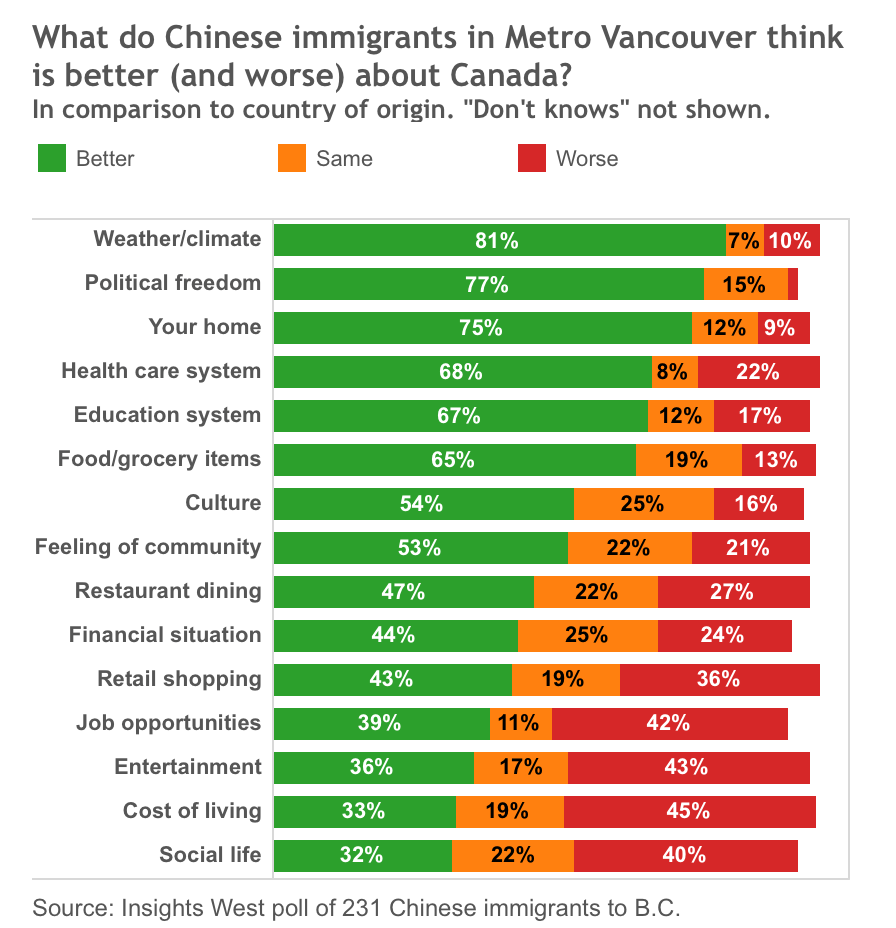
Chinese_immigrants_happy_with_life_in_Metro_Vancouver__surveyNot necessarily surprising results but interesting nevertheless, as well as the differences between mainland and Hong Kong Chinese:

The survey found Chinese immigrants are very happy with their level of political freedom in Canada, with 77 per cent saying it’s better here and only two per cent saying it’s worse. They also like the weather, with 81 per cent saying the climate here is better than where they came from. And government services get a thumbs up, with 68 per cent saying Canada’s health care system is better and 67 per cent preferring our education system.

Immigrants are less impressed, however, with the job opportunities available to them in this country. Just 39 per cent say their job opportunities in Canada are better than in their country of origin, compared to 42 per cent who say they’re worse.

The cost of living in Metro Vancouver is also a concern, with 45 per cent saying life is more costly here.

Chinese immigrants happy with life in Metro Vancouver: survey.