Was it ‘terrorism’? We need answers, not labels – Globe Editorial

Good editorial in the Globe on the need to avoid simplistic labels:

The debate – terrorism or not? – isn’t particularly useful. It takes a complex issue and tries to reduce it to a label. It short-circuits an honest inquiry into questions that demand answers: Why did these men do what they did? And what can be done to reduce the likelihood of future attacks? Invoking the threat of terrorism may also lower public resistance to new security measures that wouldn’t otherwise be acceptable, such as making it easier for police to detain people suspected of being sympathetic to terrorist groups or ideas. Or, as Justice Minister Peter MacKay mused publicly this week, making it a criminal offence to “glorify” terrorist groups or activities, a law adopted by the British that has been highly controversial and almost never used.

Everyone can agree that the Ottawa attack was criminal. And leaving it at that leaves the door open to deeper thought: How do we monitor people before they suddenly commit a crime? Should we monitor some people more closely? How much evidence should be required to monitor or detain? And was Mr. Zehaf-Bibeau’s attack driven above all by long-standing mental health issues rather than a long-held ideology? If so, why wasn’t he able to get help? How did he get his hands on a rifle? Are guns properly secured in Canada?

Canadians need to ask every imaginable question about what happened in Ottawa. A fight over labels gets in the way of an honest search for answers and solutions.

Was it ‘terrorism’? We need answers, not labels – The Globe and Mail.

Hamilton racism social experiment ends with a punch | Toronto Star

More dramatic than polling on attitudes:

One man immediately pushes back:

“You know, you can’t stereotype and judge people by their clothes, or their nationality or anything else, you know what I mean? What happened there, it was incident of fanatics.”

A woman pipes up, too:“It was awful and tragic, but I don’t think that’s any reason to persecute someone just because what they’re wearing.”

But Giamou keeps making his case, eventually trying to physically remove his fellow actor. At that point, someone jumps to the Muslim man’s defence and slugs Giamou in the face.

After a brief clip that shows him talking to a police officer, Giamou, who has a bloody face, offers this conclusion:

“So the social experiment had a negative ending to it, but its positive because he stood up for him and I appreciate that, that’s good, that’s good.”

Hamilton racism social experiment ends with a punch | Toronto Star.

Peter MacKay suggests anti-terror laws don’t need major overhaul – Politics – CBC News

As the Government continues to consider what further changes, if any, are required to current legislation, some mixed signals:

… former public safety minister Stockwell Day warned hes hearing the government may try to eliminate the requirement that a judge sign off on such orders, giving discretion solely to the minister of public safety.

“One of the provisions Im hearing about, I don’t know if its accurate yet, is there may be a provision for a minister like myself to sign for [preventive] arrest, and not having it countersigned by a judge,” he said in an interview on CBC Radio’s The Current.

“I’ r always appreciated the balance [of both judge and minister signing] for preventive arrest and wiretaps … I would take a close look at that if a judge’s [signature] is no longer required,” Day added.

Without getting into specifics, MacKay seemed to dismiss that idea, “We’re not going to upset that balance that requires police to make that very important evidentiary determination.”

“I always would come down on the side of judicial oversight before you would make any interventions,” MacKay added.

MacKay also said the government is looking for ways to crack down on those who encourage terrorist acts online. “There’s no question that the type of material that is used often to recruit, to incite, and the word I don’t particularly like … but, glorification,” he said, adding he’s looking closely at legislation in the United Kingdom on this topic.

Day believes the legislation will “talk about things like, those who support calls on terrorists to attack Canadians or to kill Canadians, those who support groups who are calling for attacks on Canadians.’”

Peter MacKay suggests anti-terror laws dont need major overhaul – Politics – CBC News.

And the information and privacy czars pick up on the point that any increased powers should be matched by increased review and oversight.

If you step up police powers to fight terrorism, make watchdogs more powerful, privacy czar tells Tories

Similarly, a note of caution not to rush things from former judges, Frank Iacobucci, John Major and Dennis O’Connor:

Panel of judges urges caution in passing new anti-terror laws

Adam Chapnick has a thoughtful piece on the challenge of managing our reactions to terror:

As a professor of defence studies, I know all too well that it’s impossible to stop every ‘lone wolf’ with a gun or a bomb. No measure enacted by any government can guarantee our safety.

It follows that the national conversation led by our parliamentarians over the next few weeks cannot be about terrorism. It must be about managing the terror that Canadians feel.

We need calm reassurance, not more calls to be fearful. We need to see unity of effort and purpose among all of our MPs — not the divisive, fearmongering partisanship to which we have grown far too accustomed.

The debate must last as long as is necessary to enable all interested Canadians — not just supporters of the government — to understand what new measures are being exacted, and why.

It must shape a degree of consensus over the extent to which we are willing to surrender the freedoms we hold so dear in order to feel more comfortable on our streets and in our homes.

Terrorism is a state-level problem — but terror itself is personal. Let us hope that our elected representatives understand the difference as we move forward.

The real problem isn’t terrorism. It’s terror (pay wall)
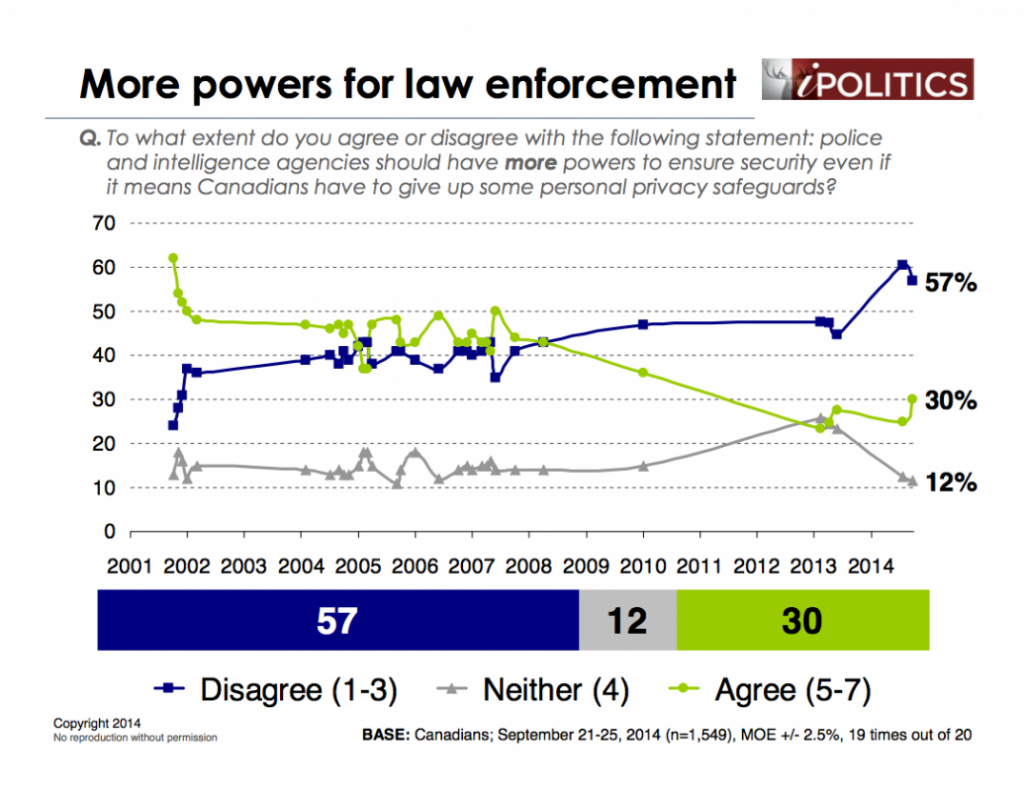
 

The EKOS poll: Fear fades — values endure

Ekos - Law Enforcement and TerrorismFrank Graves of Ekos on public opinion regarding the threat of terrorism:

  • Virtually all responses made by Western governments to the threat of terrorism in the 21st century have been deemed failures in hindsight. Almost universally, the public sees these past interventions as having yielded nothing but a more dangerous world.
  • Overwhelmingly, Canadians want to see their leaders re-think their reliance on military and security-oriented approaches to the terrorist threat, in favour of approaches more in keeping with our core values as a nation.
  • Canadians have lost faith in the security agenda which says the problem can solved by restricting civil liberties even further, and want to see our leaders place more emphasis on the traditional tools of diplomacy and development.

The EKOS poll: Fear fades — values endure (pay wall)

Kent Roach and Craig Forcese: Putting CSIS surveillance on a firmer legal footing

Hard to disagree:

A smarter bill would link the enlargement of CSIS’s powers with better Parliamentary review. It also would address more integrated review of how CSIS’s actions affect terrorism policing and investigations. The Air India commission proposed that this difficult task be handled by a National Security Co-ordinator, but the government rejected this fix.

In sum: The government deserves credit for a legal initiative that will put CSIS extraterritorial surveillance on a more clear legal footing, clearly acknowledges a judge may violate international and foreign law in authorizing this surveillance, and that will protect CSIS sources, subject to an innocence-at-stake exception (in criminal proceedings, at least).

In so doing, it squarely puts on the table important policy issues that should be debated in full. But along the way, it will be useful to add more to the “accountability” side of the “reform of CSIS” ledger.

Kent Roach and Craig Forcese: Putting CSIS surveillance on a firmer legal footing

Australians support immigration and multiculturalism

CIC Tracking - Support for ImmigrationComparable to Canadian levels of support (see chart above):

The study titled 2014s Mapping Social Cohesion report by Scanlon Foundation which surveyed over 24,000 people reported strong public support for immigration intake and the benefits of multiculturalism. ”

Australia’s public sentiment toward immigration intake is possibly the most positive in the western world. In 2014, 58 per cent of people agree that the immigration intake is about right or too low. Just 35 per cent of people consider that the immigration intake is too high,” the Foundation said in a statement.

“This level of public support is somewhat surprising in the context of rising unemployment and other economic concerns, as well as international comparisons,” said report author Andrew Markus of Monash University.

“In 2014, American and European surveys have found disapproval of immigration in the range of 60 to 75 per cent,” he said.

Support for multiculturalism was also high at 85 percent (“been good for Australia”) but discrimination remains an issue with some 18 percent of respondents reporting experience of discrimination.

Australians support immigration and multiculturalism: Study – The Economic Times.

Islam and hadiths: Sifting and combing

Point well made in The Economist on religious and scriptural interpretation, and whether or not they lead to moderation:

Mr [Jonathan] Brown [author of Misquoting Muhammad] takes particular issue with The Economist for predicting that the information age will undermine the authority of old-time scholars and revolutionise the way in which ideas about Islam’s core teachings are formed. Given his fascination with long intellectual traditions, the author insists that nothing good can come of people going straight to texts which can foster extremist ideas unless they are leavened by scholarly wisdom.

In our defence, it is an already observable fact that electronics are making it much easier for ordinary Muslims, or self-taught “experts”, to bypass the older authorities and come to their own judgements on what their holy texts say and how they should be read. And as The Economist writing on the subject has made clear, this change can have bad consequences as well as good. Amateur theologians, bent on bypassing the professionals, can come to enlightened conclusions or appalling ones, such as the gimcrack theology used to justify acts of mega-terror by al-Qaeda or Islamic State.

However it’s also worth pointing out that neither conscientious scholarship nor participation in a centuries-old chain of editing and learning are foolproof guarantees of moderation. True, scholarly activities like hadith-sifting can sometimes help to mellow a religion. But remember, too, that the leaders of the Iranian revolution, who raised the standard of militant political Islam in the modern world, included many conscientious scholars.

Islam and hadiths: Sifting and combing | The Economist.

More articles on radicalization of interest

Ongoing amount of reporting and commentary on radicalization and fundamentalism.

Starting with Premier Couillard’s measured (i.e., not rushing it) legislation requiring faces to be uncovered when giving or receiving government services, and what initiatives, if any, are planned with respect to non-violent fundamentalists inPhilippe Couillard promet d’agir sur lintégrisme religieux | Politique québécoise.

More meetings within the Muslim community in Montreal, reminding of the need for measures to improve the economic integration as part of any anti-radicalization in L’intégration plutôt que la stigmatisation.

CBC report on Self-radicalized and adrift: The shared traits of the ‘lone wolf’ killers discussed the commonalities but with experts (Dawson, Zekulin) noting correctly that there is no one pattern for those drawn to violent extremism.

For those interested, a fairly good overview of the respective roles and responsibilities of the security agencies involved in countering radicalization in Michael Zehaf-Bibeau and Martin Couture-Rouleau: How Canada tracks homegrown radicals.

And while only one “slice” of those radicalized, Maclean’s discusses issues related to converts as many extremists are in Islam’s conversion problem, echoing Imam Soharwardy’s call for more “vetting” by mosques of those wishing to convert (Prominent Muslim cleric urges imams to vet new Islamic converts).

“Everything Poisons Religion” « The Dish

Interesting discussion on Karen Armstrong’s book, Fields of Blood: Religion and the History of Violence, and the links between religion and imperial power and the degree that religion can be separate from economics, social issues and politics:

The conversion of Constantine also meant the conscription of Christianity. It was not long before Augustine of Hippo was developing the convenient theory of the ‘just war’. Similarly the ahadith, the later reports of the Prophet’s sayings, confer a spiritual dimension on warfare which it doesn’t have in the Koran. Militant Sikhs today prefer to quote the martial teachings of the Tenth Guru rather than those of their founder Guru Nanak, who taught that only ‘he who regards all men as equals is religious’.

“Everything Poisons Religion” « The Dish.

Reza Aslan on the ‘Sudden Jihad Syndrome’

Good take down of  the rhetoric:

Indeed, there’s even a term for this idea: Sudden Jihad Syndrome — an imaginary contagion invented by the neo-conservative commentator Daniel Pipes to describe how any normal-seeming Muslim can suddenly snap for no reason at all and go on a murderous rampage thus proving Pipes point that “all Muslims must be considered potential terrorists”.

Strangely, this causal connection between belief and behavior seems not to be as aggressively applied if the criminal in question claims a different religion than Islam. Take the example of the Norwegian terrorist Anders Breivik, who slaughtered 77 people, the majority of them children, in 2011. Breivik explicitly defined himself as a Christian warrior fighting what he called an “existential conflict” with Islam.

Nevertheless, a great deal of the media coverage surrounding his actions seemed to take for granted that his crime had nothing to do with his Christian identity — that it was based instead on his right-wing ideology, or his anti-immigrant views, or his neglectful upbringing, or even, as Ayan Hirshi Ali famously argued, because his view that “Europe will be overrun by Islam” was being censored by a politically correct media, leaving him “no other choice but to use violence.”

All of the above explanations for Breiviks behavior, including his religious beliefs, are pertinent in understanding the motivations for his behavior. But to argue that Breiviks or Bibeaus actions were motivated solely by their religious beliefs — or that their religious beliefs necessarily dictated their actions — is simply irrational.

How strong a tie between faith and terror? | News – Home.