Legatum Prosperity Index

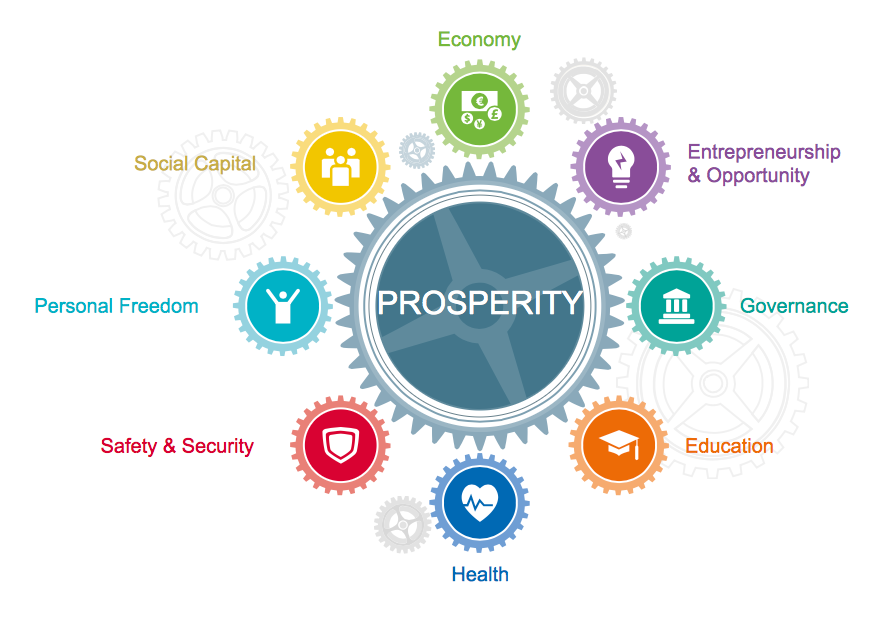
The_2014_Legatum_Prosperity_Index_-_HomeFor those who like indicators and graphics, The Legatum Prosperity Index of a UK-based think tank, provides both in spades, both in pdf forum and interactive web-graphics.

Legatum Prosperity Index (website)

Download The Legatum Prosperity IndexTM (for pdf)

A bit clunky to generate comparative tables, but from an immigration, citizenship and multiculturalism perspective, the two questions of interest and Canada’s score (one of the highest):

  • Good place to live for ethnic minorities: Canada 90.8 %
  • Good place to live for immigrants: Canada 88.8 %

For the policy wonks who are interested in detailed methodology, there is an extensive separate report. Suffice to say, that for those interested in the above two indicators, the source if the Gallop World Poll.

How to prosecute radicalized Canadians a quandary, Senate group hears | Ottawa Citizen

The challenges of prosecuting radicalized Canadians and Government messaging of note from Senator Beyak:

“The legitimate investigation by the police of those individuals does not necessarily coincide at this moment in time to there being that many cases that are ready to go for charges.”

He and Saunders then detailed how seven Canadians, including five initial suspects in the Toronto-18 terror case, have been placed on peace bonds, court orders that restrict the movement of people not found guilty of an offence but deemed a risk to others. They also mean stiffer sentences for someone if later found guilty of a crime.

But even that power is limited, according to police. RCMP Commissioner Bob Paulson, speaking before the committee last week, complained that the legal threshold for obtaining peace bonds needs to be lowered to a “reasonable suspicion.”

Saunders later added that gathering evidence against suspected Canadian overseas fighters who have returned to Canada is even more difficult.

“It’s a challenge the police face, to gather evidence for activities that people may have been engaged in while they’re overseas in countries where it’s difficult for our authorities to have access to,” he said.

He added: “We have to prove that somebody is guilty beyond a reasonable doubt, that will not be changed.”

After more than an hour of committee questioning, Sen. Lynn Beyak’s frustrations boiled over.

Canadians “don’t want to hear us talk, they don’t want to hear 1,000 reasons why we can’t solve this problem,” she told the witnesses.

“They want us to put our collective heads together and find a way to protect the rights of 35 million Canadians instead of the rights of 90 or 93 or 130 individuals.

“There has to be a better way for Canadians then to just listen to us talk and the problem gets worse.”

Part of the trade-off with the rule-of-law that the Government so often cites as one of the key Canadian values along with freedom, democracy, and human rights.

How to prosecute radicalized Canadians a quandary, Senate group hears | Ottawa Citizen.

Austria’s Muslims fear changes to historic Islam law

On foreign funding of mosques in Austria:

The draft law has also been criticised by constitutional experts, who say that some of its provisions fail to treat Muslims equally.

Professor Stefan Hammer from the University of Vienna says, while it is legitimate for the government to try and prevent misuse of donations from abroad, a blanket ban on foreign funding for the Islamic Community is constitutionally very problematic.

“Financing of religious communities is part of their internal affairs. This does not mean the state may not address any aspect of that, but it has to be proportional,” he says.

Other religious groups and churches receive external funding, notably the Russian Orthodox Church from Moscow, so differentiating between religions would clearly be excessive, he believes.

“It would be a clear breach of the principle of equal treatment.”Carla Amina Baghajati from the Islamic Community says the draft is infused with “a spirit of mistrust”, which she fears could play into the hands of the radicals.

“The radicals make use of the identity question, telling people: Look at the European societies, you wont ever be on the same level, you will always be an outsider. They wont accept you, so come and join us.

“This is very dangerous. We have to help young people to find their identity and the law is one of the important pieces in this identity building. It has helped in the past and we want it to help in the future.”

Seems like the solution could be a ban on any foreign funding for any religion to address the equal treatment issue.

BBC News – Austrias Muslims fear changes to historic Islam law.

Citizenship in India not gender-neutral, Arizona State U professor asserts

Interesting article on the long-standing impact of “personal law” and group religious rights in India:

One aspect of Indian democracy that is unfamiliar to most Americans is the concept of personal law, a legacy of British colonial administration. Four religious communities – majority Hindu and minority Muslim, Christian and Parsi – have their own personal laws. Other religious groups, Sikh, Buddhist and Jain, are subsumed under Hindu personal law. No one may opt out of a religious identity, and therefore no one is exempt from personal law. Proponents of personal law claim that it secures religious difference, Behl said.

“Personal law associated with India’s religious communities shapes every aspect of a woman’s life – her status at birth; her capacity to own, inherit and manage property; her freedom to work, marry, divorce and remarry; and her relationship with her children,” she [Natasha Behl] said.

“Personal law effectively suspends Indian women’s most basic rights on behalf of group rights. The issue of personal law divides women on multiple fronts – between their respective religious communities, between civil rights and minority rights, and between gender equality and minority claims for recognition.”

The interviews Behl conducted for the “Situated citizenship” article document situations including a disconnect between property and inheritance rights for women, which in theory are legally protected, and the reality in the community. “Practically speaking, girls don’t receive any land from their parents, and they don’t receive any land from their in-laws,” one interviewee told her.

Deep multiculturalism focus on group rights rather than ‘shallow’ multiculturalism focussing on individual rights as in Canada, Australia etc.

Citizenship in India not gender-neutral, ASU professor asserts | ASU News.

Toronto school fundraising raises questions about equity in public-education system

Given that one of Canada’s strength in education, as measured by the OECD’s PISA studies, is with respect to equity in education, the funding disparity suggests that this may diminish over time:

Schools in Toronto’s most affluent neighbourhoods are fundraising 300 times more money per student than needier schools, using the cash for field trips and playground renovations and raising questions about equity in the public-education system.

Fundraising figures for elementary schools provided by the Toronto District School Board and analyzed by The Globe and Mail found that children in those affluent neighbourhoods are getting almost as much as $900 each in educational extras, from new playgrounds to Scientists in Schools. The money is raised through events such as fun fairs and pizza lunches. Some schools in lower-income neighbourhoods raise as little as $3 a student.

Canada’s largest school board provides special grants to schools in high-needs communities to help compensate for the vast differences.

But it still cannot catch up to the hundreds of thousands of dollars schools in the city’s richest neighbourhoods raise. Blythwood Junior Public School, situated around Mount Pleasant Road and Lawrence Avenue East, a wealthy neighbourhood, raised almost $700 a student in the 2012-13 academic year. Thorncliffe Park Public School, located in an area that serves as a landing pad for recent immigrants, raised about $45.

The board can’t afford to fully make up the differences, according to Carla Kisko, associate director of the TDSB. “It’s a serious concern because there are significant differences between communities,” she said.

Certainly nothing like the US system, where much of school funding is by neighbourhood in contrast to the block funding in Canada, but still something to watch.

Toronto school fundraising raises questions about equity in public-education system – The Globe and Mail.

Deradicalization programs aim to get ahead of the curve in stopping extremists

Good overview on various deradicalization programs (and the absence of Canadian ones), and the challenge of measuring their effectiveness:

While there is greater interest in deradicalization programs, questions remain about their effectiveness.

McCants at the Brookings Institution acknowledges that the Saudi program has had some success in turning detainees into productive members of society, but “whether they’ve left the ideology behind is a harder question to answer.”

The Saudi government has acknowledged some of the graduates of its deradicalization program have returned to extremist activity, including one who became deputy commander of al-Qaeda in the Arabian Peninsula.

Brian Jenkins, a counterterrorism expert at the Rand Corporation, says that while a lot of things are being tried, the success of deradicalization strategies is notoriously difficult to measure.

According to a story published in the Christian Science Monitor in July, Hayat Berlin had steered 20 individuals from fighting in Syria. But even if they had proceeded to the front lines, it doesn’t necessarily mean they would have returned to wage attacks at home.

“Is there some comparative statistic that says, does this particular technique work, did that particular technique work? I havent seen anything that tells me that,” says Jenkins. “The statistics aren’t there.”

Part of that may be deliberately hedging on the part of the governments involved, says Jenkins, but it also reflects the fact that while its easy to keep statistics on criminal incidents, “its hard to count things that don’t occur.”

Deradicalization programs aim to get ahead of the curve in stopping extremists – CBC News – Latest Canada, World, Entertainment and Business News.

ICYMI: Lone wolves, police state – Gagnon

Good commentary by Lysiane Gagnon, detailing all the limits of current government soundings of proposals to reduce the risk of violent extremism, particularly for “lone wolves” like Couture-Rouleau and Zehaf-Bibeau.

She concludes with:

These are repugnant opinions [justifying terrorism], but even the most abhorrent ideas must be tolerated for freedom of speech to exist. This is what makes Canada a liberal democracy. Denying it would be granting a moral victory to the terrorists who are fighting against this country’s most fundamental values.

Lone wolves, police state – The Globe and Mail.

Ontario’s Teacher Diversity Gap

Interesting study on the gap between visible minority representation among teachers and the student population in Ontario and Toronto, including comparisons with the USA:

  • The demographic divide between teachers and students in Ontario and the Toronto CMA is large. In Ontario, racial minorities represent 26% of the population, yet make up only 10% of the 70,520 secondary school teachers and 9% of the 117,905 elementary school and kindergarten teachers. In the Toronto CMA, racial minorities represent 47% of the population, yet make up 20% of secondary school teachers and 18% of elementary school and kindergarten teachers.
  • The Teacher Diversity Gap is worse in Ontario and the Toronto CMA than for the United States overall. While Ontario and the Toronto CMA are doing a slightly better job of reflecting the diversity of the student population than states such as Ohio, we are also doing worse than other states, including New York, Mississippi, Alabama and Louisiana. The Teacher Diversity Gap for the United States as a whole is slightly smaller than the gap for Ontario and the Toronto CMA.
  • The Teacher Diversity Gap is no better for the Toronto CMA than it is for Ontario. The Teacher Diversity Gap in the Toronto CMA is .40, while the gap for Ontario is .38. This means that the demographic divide between teachers and students is just about the same for students in the Toronto CMA as it is for students in the rest of the province.
  • The gap could get worse as the population becomes more diverse. While we currently face a large Teacher Diversity Gap, the province is rapidly becoming more diverse. Statistics Canada data shows that racial minorities currently represent 26% of the Ontario population and 47% of the Toronto CMA population. Statistics Canada projects that by 2031 racial minorities could make up 63% of the Toronto CMA population. As such, without significant changes to the composition of the teaching population, the Teacher Diversity Gap may widen.

Previous  employment equity reporting provided much more detail (e.g, 2006 reports cited) compared to today’s high level overview limited to the Canadian public service and federally regulated sectors (banking, communications, transportation).

Combination of budget cuts and change in government priorities.

Ontarios Teacher Diversity Gap – TURNER CONSULTING GROUP INC..

Why online Islamophobia is difficult to stop

More on Islamophobia from both the UK and Canadian perspectives:

Online Islamophobia is also flourishing in Canada. The National Council of Canadian Muslims NCCM is receiving a growing number of reports.

But there are now fewer means for prosecuting online hate speech in Canada. Section 13 of the Canadian Human Rights Act protected against the wilful promotion of hate online, but it was repealed by Bill C-304 in 2012.

“It’s kind of hard to say what the impact is, because even when it existed, there weren’t a lot of complaints brought under it,” says Cara Zwibel of the Canadian Civil Liberties Association.

Though there is a criminal code provision that protects against online hate speech, it requires the attorney general’s approval in order to lay charges — and that rarely occurs, says Zwibel.

Section 319 of the Criminal Code of Canada forbids the incitement of hatred against “any section of the public distinguished by colour, race, religion, ethnic origin or sexual orientation.” A judge can order online material removed from a public forum such as social media if it is severe enough, but if it is housed on a server outside of the country, this can be difficult.

Ihsaan Gardee, executive director of NCCM, says without changes, anti-Muslim hate speech will continue to go unpunished online, which he says especially concerns moderate Muslims.

“They worry about people perceiving them as sharing the same values these militants and these Islamic extremists are espousing.”

Same issues arise with antisemitism.

Ironic that the government is publicly musing about measures to curtail ISIS and related radicalization messaging on-line given their elimination of s 13 of the Canadian Human Rights Act (hate speech).

Why online Islamophobia is difficult to stop – CBC News – Latest Canada, World, Entertainment and Business News.

Harper’s silence on anti-Muslim backlash disheartens Muslim groups

They have a point. Silence from the top speaks:

Muslim groups have condemned the killings and the extremist beliefs which apparently motivated them. But they say their efforts to demonstrate that most Muslims do not share those beliefs and to show solidarity with non-Muslim Canadians need to be reinforced by political leaders, particularly the prime minister.

“We are trying to work together with our law enforcement and our authorities to end this what is called radicalization of youth. We are trying to do our utmost to help,” said Mostefa.

But when political leaders denounce Muslim extremists but don’t come to the defence of moderate Muslims, Mostefa said young Muslims will think: “This is my country and you don’t come to my support to stand by my side.”

And that sends “the wrong message.”

….. “Our leaders have a very important role to play,” concurred Amira Elghawaby, human rights co-ordinator for the National Council of Canadian Muslims.

“It’s the leaders who have to set the positive tone.”

Immediately following the 9-11 terrorist attacks in New York and Washington, Elghawaby noted that then-prime minister Jean Chretien visited a mosque “just to show Canadians that there’s no such thing as collective guilt.”

She said her group expects Harper, “as leader of our country, to speak up for the minorities that live here.”

“He has a responsibility to represent everyone and certainly Canadian Muslim communities are extremely worried about a backlash and I think that needs to be spoken to.”

Alia Hogben, executive director of the Canadian Council of Muslim Women, said it’s “very disheartening” that Harper has not bothered to speak out against the anti-Muslim backlash. But it’s not surprising to her.

“I don’t think he much likes Muslims,” Hogben said.

Canada is a multicultural country with over 1 million Muslims, most of whom are Canadian citizens whose religion is only part of their identity, she pointed out.

“I think it’s absolutely vital that the head of the country, like the prime minister, would accept that and also somehow reinforce it and reassure people.”

Asked why Harper has not specifically denounced any of the recent anti-Muslim incidents, the prime minister’s spokesman Jason MacDonald said: “These acts are obviously unacceptable.

Contrast this to any number of statements and the like on antisemitic incidents.
Harpers silence on anti-Muslim backlash disheartens Muslim groups.