Le PQ associe Justin Trudeau aux déportations et aux exécutions de francophones

Stay tuned. André Pratte also has commentary on the relative extreme positions PSPP: André Pratte: Quebec separatism is resurging, and Trudeau isn’t taking the threat seriously

Justin Trudeau poursuit l’oeuvre de son père et des architectes de la « déportation » et des « exécutions » de francophones par ses politiques migratoires et ses incursions dans les champs de compétence du Québec, a plaidé mardi le chef du Parti québécois, Paul St-Pierre Plamondon.

Mardi, le chef péquiste a accusé le premier ministre du Canada de mener une « charge offensive » contre le Québec. « Justin Trudeau est en continuité avec son père, Pierre Elliott Trudeau », a-t-il soutenu avant de reprocher aux commentateurs de l’actualité de ne pas déceler des « intentions » derrière cela.

« C’est vraiment oublier l’histoire récente, comme le rapatriement unilatéral de la Constitution canadienne sans le Québec, oublier l’oeuvre de Pierre Elliott Trudeau, oublier ce que les francophones ont vécu dans les déportations, les exécutions, l’interdiction d’avoir de l’éducation en français. Ce régime-là a été constant durant toute son histoire », a-t-il déclaré.

Paul St-Pierre Plamondon voit les signes de cette charge dans « l’immigration temporaire, qui est passée de 80 000 en 2016 à 560 000 [personnes] », ainsi que dans les récentes incursions du fédéral dans les compétences du Québec, notamment en logement.

« Radical » et « conservateur »

Lors du conseil national de la fin de semaine dernière, le chef péquiste avait déjà évoqué une « charge frontale » en provenance d’« un régime qui ne sait qu’écraser ceux qui refusent de s’assimiler ». Des propos qui ont beaucoup fait réagir les oppositions à l’Assemblée nationale mardi.

Le chef intérimaire du Parti libéral, Marc Tanguay, a qualifié ce discours de « déconnecté », d’« exagéré » et de « radical ». Ce n’est pas crédible, a-t-il dit « que le fédéral se lève tous les matins pour planifier notre déclin ».

Du côté de Québec solidaire, Gabriel Nadeau-Dubois a dit ne pas avoir « souvenir d’un chef du Parti québécois avec un discours aussi conservateur ». « Ce que j’ai entendu, c’est un discours empreint de ressentiment. »

Quant au gouvernement caquiste, il s’est aussi inscrit en faux contre cette lecture. « Nous, on fait des gains concrets », a dit le ministre de la Justice, Simon Jolin-Barrette, en évoquant notamment la loi 96 et après avoir dit ne pas être « résigné ». « On est conscients des risques, mais on agit », a-t-il affirmé.

Source: Le PQ associe Justin Trudeau aux déportations et aux exécutions de francophones
Regg Cohn: Peel school board should learn a lesson in controversy over Nakba Day

Peel SB has a habit of controversial policies and stands. Money quote: “A better way for educators to navigate modern times and historical legacies would be to always remain mindful of unity in diversity — and the reality of complexity. Find ways to bring people together rather than drive them apart:”

Nakba Day is coming to schools in two of Ontario’s biggest cities.

Not familiar with the term?

It takes place on May 15, the day after the anniversary of Israel’s founding day in 1948 — not celebrating but commiserating over the Jewish state’s creation.

Al-Nakba is an Arabic term that translates as “the catastrophe.” Yasser Arafat, in his heyday as head of the Palestinian Authority, declared it an official day of mourning across the West Bank and Gaza in 1998.

Now, the Peel District School Board is bringing it from the Middle East into schools it controls across the GTA — in Brampton, Caledon and Mississauga.

The revelation of Peel’s preoccupations has stirred fresh controversy — including demands that the board rescind its move and counterdemands to keep it in place. That very controversy tells the story of why it’s such a bad idea to keep bringing back the world’s problems to the modern multicultural metropolis that is Greater Toronto.

To be clear, there is not much about Nakba Day that is contentious for Palestinians or disputed by historians. It marks the undeniably catastrophic impact of Israel’s creation on hundreds of thousands of people whose lives were ended or upended in 1948.

How you see the world’s epochal events — and historical terminology — depends on who you are, where you live and when you’re talking.

When the late Arafat belatedly proclaimed Nakba Day, I was the Star’s Middle East correspondent, watching him work hand-in-glove with Israel. Their shared goal was two states for two peoples.

Today, on the streets of the GTA, you don’t hear protesters talk much of two states. You’ll hear slogans such as, “From the river to the sea, Palestine will be free” — implying a new Palestinian state should displace the old Jewish state from the Jordan River to the Mediterranean Sea, dismantling the so-called colonial enterprise they believe Israel to be.

The world has changed, and political agendas have changed with them. Which brings us back to the Peel school board.

As part of its multicultural mission, it has a committee that curates a long list detailing “days of significance” for “secular and creed-based days.” It begins with Canada Day last year and ends with Boxing Day this year.

In between those bookends, the list catalogues celebrations of relevance and reverence in chronological (not spiritual) order — Hinduism, Jainism, Buddhism, Bahaism, Islam, Zoroastrianism, Judaism, Wicca, Christianity and so on. And then there are worldly listings for Emancipation Day, Labour Day, Literacy Day and the like.

Since Canada Day is top of the list, let’s consider the Canadian context.

Some bemoan any recognition of Confederation, condemning it as a celebration of colonization; some have absented themselves from July 1 fireworks events in solidarity with Indigenous critics. That said, I cannot imagine the Peel school board voting to recognize a Canada Catastrophe Day on July 1, for it would surely spark disagreement and disunity.

That tension — between celebration and condemnation — reminds us that the creation of one nation can easily diminish another people at home and abroad. The point is that it should be possible to be both pro-Canada and pro-Indigenous, pro-Israeli and pro-Palestinian, to be mindful and respectful of people on both sides, all sides.

As for Israel, it emerged from a vote of the United Nations, which partitioned the Holy Land into two nations, Jewish and Arab (retaining special status for Jerusalem). History tells us that Arabs rejected that compromise, and the resulting catastrophe was undeniable; historians have also documented episodes of ethnic cleansing, although Arab minorities endured in Israel and gained citizenship.

In the aftermath, Nakba Day makes perfect sense in Palestinian schools, but it is surely misplaced in Peel schools. For unless the board is about to declare a day of celebration for the creation of Israel on May 14 — and I don’t see it on the list, nor do I foresee it down the line — why must Peel pick a side?

When the UN General Assembly decided in 2022 to formally mark Nakba Day — three quarters of a century after birthing the state of Israel — Canada joined many nations in opposing the gesture. What qualifies Peel’s school board to reach the opposite conclusion?

A better way for educators to navigate modern times and historical legacies would be to always remain mindful of unity in diversity — and the reality of complexity. Find ways to bring people together rather than drive them apart.

Source: Peel school board should learn a lesson in controversy over Nakba Day

Nicolas | Compétitions traumatiques

Good arguments on the risks of avoiding blind spots (which we all have to varying degrees) and the risks of leaving such debates to political partisans or single interest groups with little to no curiosity for other perspectives and experiences:

Je suis d’accord avec Paul St-Pierre Plamondon sur au moins une chose : il est indéniable que le colonialisme britannique et sa violence ont profondément marqué, voire forgé, l’histoire du Canada.

Il y aurait beaucoup de choses à dire sur la maladresse avec laquelle le chef du Parti québécois a fait rejaillir cette question dans l’espace public, appel du pied (dog-whistle) en prime. On y reviendra.

Mais plusieurs observateurs lui ont aussi reproché le simple fait de parler du passé. « Il ressasse de vieilles histoires », « le Québec est rendu ailleurs », lui a-t-on rétorqué. Je comprends et respecte le réflexe. Cette chronique s’adresse à ceux que l’héritage du colonialisme britannique intéresse.

Ma vie professionnelle me donne l’occasion de sillonner le pays. Partout, je cherche à comprendre comment les gens voient le Canada ou leur province, leur histoire familiale, les liens qu’ils font entre leur récit personnel et les récits nationalistes. Et partout, dès qu’on gratte un peu, la question du colonialisme britannique ressort, explicitement ou implicitement, dans les rapports que les gens entretiennent les uns aux autres, avec le territoire et l’État.

Ce que je constate toutefois, c’est que la compréhension qu’on a de l’histoire canadienne est souvent prise dans des angles morts qui suivent à peu près les trous dans les curriculums d’histoire de nos provinces respectives.

Je vais me souvenir toute ma vie d’une conversation surréelle avec une personnalité politique pourtant sénior de l’Ouest canadien qui associait systématiquement le français au Québec — seulement le Québec. Je lui avais demandé si l’agacement des Prairies à l’endroit de la différence québécoise pouvait être un héritage de la violence d’État envers les Métis, les Premières Nations et les francophones de l’Ouest à la suite de la pendaison de Louis Riel. Comme si, après avoir « travaillé » si fort à stigmatiser la différence locale, on s’étonnait qu’une autre partie du pays ose la revendiquer. Elle n’y avait jamais réfléchi.

C’est aussi là une démonstration de la manière dont on peut atteindre les plus hauts postes politiques dans l’Ouest et parler de « l’aliénation » des gens de l’Ouest (en vertu de l’exigence de bilinguisme à Ottawa) sans jamais s’être demandé pourquoi l’Ouest n’est-il pas plus bilingue, ou multilingue, et comment cela est-il advenu 

L’absence de réflexion témoignait d’un important angle mort. En associant la francophonie canadienne exclusivement au Québec, on s’était privé d’une clé de compréhension centrale pour sa propre région. Parce que les gens, fondamentalement, cherchent à se comprendre eux-mêmes, mes questions ne pouvaient être reçues autrement qu’avec beaucoup d’ouverture.

De la même manière, j’espère qu’on a assez de recul pour sourire de la façon dont la génération de leaders qui a mené la saga constitutionnelle des années 1980 et 1990 s’est étonnée de voir la perspective autochtone surgir, un peu comme un cheveu sur la soupe, dans son bras de fer entre « peuples fondateurs ». Quel ne fut pas l’émoi collectif lorsqu’Elijah Harper, leader cri et député de l’Assemblée législative du Manitoba, a bloqué l’adoption de l’Accord du lac Meech, qui n’incluait aucune reconnaissance constitutionnelle pour les Premiers Peuples. On avait cru pouvoir régler la place du Québec dans le Canada sans qu’aucun Autochtone ne lève le doigt pour dire : et nous ?

C’est incroyable, quand même, avec le recul. L’épisode reste un symbole du trou béant dans l’éducation politique et historique de nos dirigeants de l’époque.

Je pourrais donner encore beaucoup d’exemples. Les perspectives autochtones, celles des communautés immigrantes provenant d’autres ex-colonies britanniques, celles des communautés noires et asiatiques qui ont encaissé de plein fouet le racisme de l’Empire, celles immigrant du sud ou de l’est de l’Europe qui ont essuyé le chauvinisme protestant, des familles irlandaises et écossaises qui avaient déjà une longue histoire avec Londres avant de débarquer au Canada viennent compléter les récits familiaux qui continuent de circuler dans bien des familles francophones et acadiennes.

Mais il est rare que l’on considère ces mémoires et ces perspectives comme des éléments qui se complètent. J’ai souvent l’impression que chacun tient à son bout de casse-tête régional, linguistique ou culturel et tente de démontrer aux autres l’importance du morceau qu’il a en main. Très rares sont ceux qui cherchent à développer une vue d’ensemble du casse-tête.

Ainsi, les mémoires traumatiques entrent en compétition : chacune tire la couverture, personne ne s’écoute véritablement. Et on normalise une vision de la politique où la seule manière d’être respecté, c’est de faire la démonstration de sa force, quitte à écraser plus petit que soi comme on craint soi-même de se faire écraser.

Je ne sais pas si on comprend que chaque fois qu’on dit que la seule manière d’être respecté, c’est de redessiner les cartes pour se créer un espace majoritaire, on avoue implicitement ne pas croire qu’il puisse exister un pays où chaque groupe est respecté, peu importe son nombre. Il y a bien sûr plusieurs raisons de vouloir fonder un pays. Mais lorsque l’on justifie son désir par une aspiration à jouir à son tour de la force du majoritaire, le message est bien entendu par les gens qui resteront minoritaires. J’avais dit que j’allais revenir à l’appel du pied.

Je pense qu’un exercice de dialogue sur les cicatrices laissées un peu partout par l’histoire de ce pays est nécessaire pour que chacun puisse mieux se comprendre et mieux se respecter. Il se fait d’ailleurs déjà tranquillement, au fil de rencontres portées par la société civile — souvent loin des parlements, des caméras et des réseaux sociaux. Vous me permettrez toutefois d’avoir peu confiance en la réussite d’un exercice aussi délicat lorsqu’il est accaparé par la politique partisane ou par des gens qui démontrent peu de curiosité pour l’ensemble du casse-tête.

Source: Chronique | Compétitions traumatiques

Budget 2024: Statement on Gender, Diversity, and Inclusion, varia

Definitely worth a look, for the richness of the data as well the insights into the government’s diversity and inclusion priorities and how it stitches the narrative together with political and Canadian public priorities.

Intro has the key messages:

  • “Early Learning and Child Care, which is supporting better economic outcomes for women, by making it possible for more women to participate in the workforce, while securing access to quality child care and learning, thus contributing to positive childhood development and the future well-being of children.
  • The interim Canada Dental Benefit has helped hundreds of thousands of children get the oral health care they need, and once fully implemented in 2025, the new Canadian Dental Care Plan will improve the long-term health of 9 million Canadians, who may have previously been unable to visit an oral health professional due to the cost.
  • The National Action Plan to End Gender-Based Violence provides targeted action to protect Canadians who experience or are at risk of experiencing violence because of their sex, gender, gender identity, gender expression, or perceived gender.
  • The Federal 2SLGBTQI+ Action Plan advances the rights and equality for Two-Spirit, lesbian, gay, bisexual, transgender, queer, intersex, and other sexually and gender diverse people in Canada.
  • The Implementation of the National Action Plan to End the Tragedy of Missing and Murdered Indigenous Women and Girls is providing targeted, culturally-appropriate supports to Indigenous women, girls, and 2SLGBTQQIA people, while working to address the root causes of the violence they face.

In Budget 2024, the government is making investments to close the divide between generations. For younger Canadians, the government is taking new action to reduce tax advantages that benefit the wealthy, is investing to build more homes, faster, is strengthening Canada’s social safety net, and is boosting productivity and innovation to grow an economy with better-paying opportunities.

These efforts will improve the lives of all younger Canadians, and their impacts will be greatest for lower-income and marginalized younger Canadians, who will benefit from new pathways to unlock a fair chance at building a good middle class life.

This starts with a focus on housing. Resolving Canada’s housing crisis is critical for every generation and the most vulnerable Canadians. The government is building more community housing to make rent more affordable for lower-income Canadians, including through:

  • The $618.2 million Federal Community Housing Initiative;
  • The $15 billion Affordable Housing Fund, including a $1 billion top-up in Budget 2024;
  • The $1.5 billion Co-Operative Housing Development Program; and,
  • The $4.4 billion Housing Accelerator Fund, including a $400 million top-up in

These investments provide Canadians and younger generations with opportunity ––finding an affordable home to buy or rent; having access to recreational spaces, amenities, and schools to raise families.

Having a place to call home creates a broad range of benefits. When survivors of domestic partner violence can find affordable housing, this creates a safe home base for their children to break cycles of violence and poverty. When Indigenous people can find affordable housing that meets their specific needs that means they can access culturalsupports to help heal from the legacy of colonialism. When persons with disabilities are able to find low-barrier or barrier-free housing, this enables them to utilize the entirety of their homes.

To ensure that young people and future generations benefit from continued actions for sustained and equitable prosperity for all, this budget makes key investments to guarantee access to safe and affordable housing, help Canadians have a good quality of life while dealing with rising costs, and  provide economic stability through good-paying jobs and opportunities for upskilling.”

Interestingly, no mention of the employment equity task force and its recommendations, although it is mentioned in the Budget.

Immigration aspects are limited to “continued funding for immigration and refugee legal aid” (but the Budget has significant funding for immigration and reflects the government’s pivot away from unlimited temporary workers and international students and post 2015 ending annual increases).

The Budget also has a reference to “Permit the Financial Transactions and Reports Analysis Centre of Canada (FINTRAC) to disclose financial intelligence to provincial and territorial civil forfeiture offices to support efforts to seize property linked to unlawful activity; and, Immigration, Refugees and Citizenship Canada to strengthen the integrity of Canada’s citizenship process (with little to no detail).”

No surprise, but the 2019 and 2021 election platform commitments to eliminate citizenship fees remain unmet.

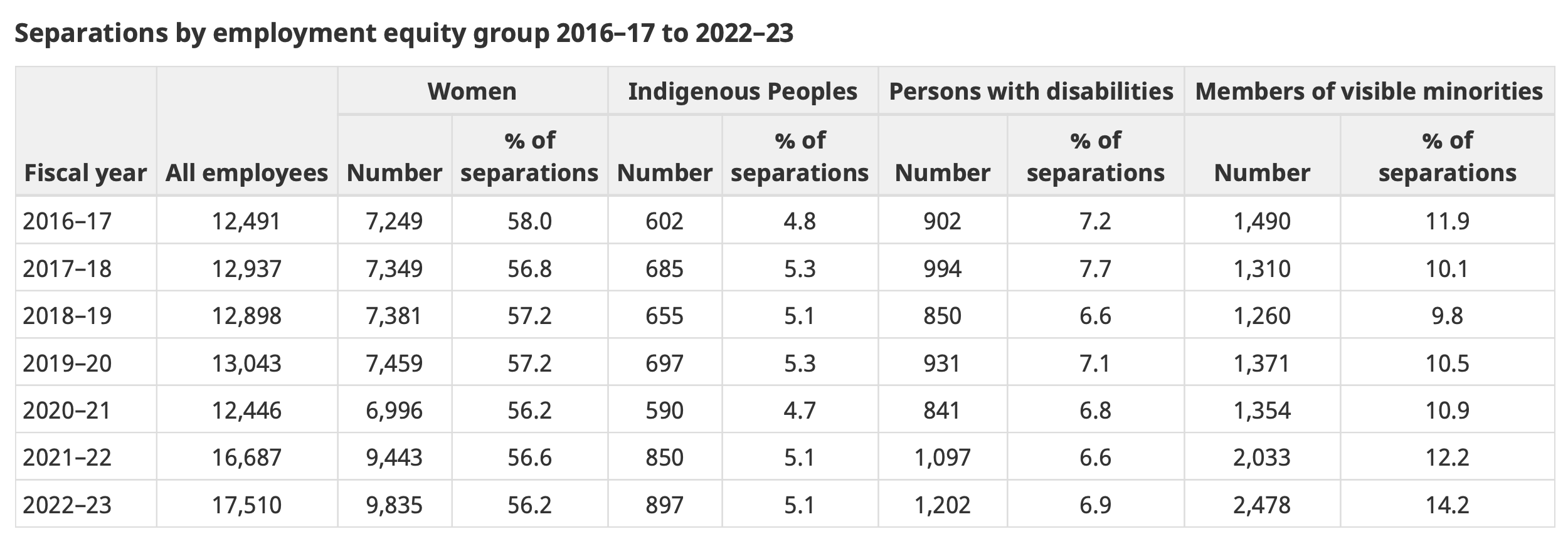
The Government’s proposed reduction in the public service by 5,000 public servants over four years (1,250 per year) is meaningless as the 2022-22 EE report shows annual separations more than 10 times that:

One thought that crossed my mind while browsing this close to 40 page document is whether this level of detail and effort would survive a change in government. Unlikely IMO, given the pressure to reduce spending and the CPC general aversion to excessive employment equity reporting and measures.

Source: Budget 2024, Statement on Gender Equality, Diversity, and Inclusion

Gurski: Trudeau government shows it’s not serious about foreign election-meddling

Of note:

There is much to take away from all the recent analysis and counter-analysis of foreign interference in Canada’s elections — and none of it is good.

In summary, our government minimized the threat to our electoral process, admitting that while there “may” have been “some minor” efforts to sway voter intention, when all was said and done the results were not affected. (I am waiting for someone to explain how this conclusion was drawn: does the government know the reasons individual Canadians voted and the reasons for their choice of party/candidate?)

From an intelligence angle, while not much new was introduced at the Foreign Interference Commission last week, a few takeaways need re-emphasis.

1. Canada’s “intelligence culture” is worse than I feared. Politicians and senior bureaucrats do not understand, appreciate or know how to use the information provided by The Canadian Security Intelligence Service (CSIS) and others to help them identify threats to our national security and counteract them.

2. The prime minister does not read intelligence reports (or does he? There were mixed messages on that front) but prefers to be “orally briefed.” In theory there is nothing wrong with that as long as those doing the briefing have a background, preferably a strong operational background, in intelligence. Relying on “advisers” with no experience at the spy coalface to tell you about the nature of intelligence and its meaning is akin to asking your cousin Clem about your lung cancer rather than going to a qualified medical source. Not a great strategy.

3. Our leader arrogantly dismissed CSIS intelligence — which was provided on at least 34 (34!) occasions over the past few years — on People’s Republic of China shenanigans as “inadequate” and uninteresting. Accusations such as “it was not evidence” expose a significant ignorance of what intelligence is and is not.

No, it is not collected to an evidentiary standard (and is not normally used in court cases) but what is eventually provided to the prime minister and his team has been very carefully analyzed, corroborated, debated, checked and double-checked and is subject to intense scrutiny before it leaves the building. Is it perfect? No, nothing is.  But based on what I saw over 32 years at the Communications Security Establishment (CSE) and CSIS, the product is damn good. It is as accurate as can be given the sources and the fact that investigations leading to useful intelligence are in constant motion.

Where do we go from here, then? While the inquiry did provide the average Canadian with a peek into the shadows of espionage and counter espionage, under the guise of what foreign powers are doing on our soil to harm our democracy, this commission report will be relegated to the usual filing cabinet, like the results of other inquiries. In other words, thanks for coming and testifying but there is nothing to see here, so please move along.

The other sad fact is that national security issues are rarely, if ever, important on the campaign trail. Voters care more about inflation, interest rates, the housing crisis and what can be done to help a Canadian team win the Stanley Cup (31 years and counting). What the PRC and others are doing to threaten diasporas, steal votes and seek a government that will do its bidding simply does not register. Yes, these other challenges resonate more, but if you cannot ensure a free and fair election, what does your democracy stand on?

My normally optimistic self notes that we have seen this movie before and will see it again, unless we take major steps to prevent it. We need a national security adviser with real intelligence experience, not a part-time bureaucrat. We need the prime minister to meet regularly with the heads of CSIS, CSE and the RCMP.

We need a government to take intelligence and threats seriously.

Source: Gurski: Trudeau government shows it’s not serious about foreign election-meddling

Why is this nurse working at a Toronto insurance firm? Ontario’s battle to get foreign-trained nurses into the field

Useful analysis and report:

…The report by World Education Services (WES) Canada, a non-profit organization that assesses foreign credentials, surveyed 758 internationally educated nurses not currently working as nurses in Ontario, and found that half had not begun the province’s registration process to practise, even if they wanted to. 

The respondents cited financial barriers as the top factor affecting their ability to become registered. (Registration costs, exams and testing fees can total $3,000 at the low end.) The need to show evidence of recent nursing practice, a lack of clarity around the registration process and the time it takes to get registered also played a role.

The report also said data gaps make it “nearly impossible” to track how many internationally educated nurses are in Canada, how many intend to or are trying to qualify, and how many are practising. 

“No one can tell us how many internationally educated nurses are actually out there who could potentially be working,” said Joan Atlin, strategy, policy and research director at WES Canada. “There’s still a significantly underutilized population of nurses in the province who are still falling outside of the supports.”

The pandemic has forced health officials to confront the underutilization of skills brought by immigrants meant to fill labour needs, said Atlin, who has been engaged in foreign credential issues for two decades.

The province is well aware of the issues in the report and has worked with the College of Nurses of Ontario, which regulates the profession, to help internationally educated nurses become registered. 

In 2022, the Health Ministry introduced changes, including covering the cost of exams and registration with the college, and made it easier to meet language proficiency requirements. 

Just last month, the province made permanent a program that places these nurses under an employer’s supervision to gain work experience. The college says that as of the end of March 2024, it had matched 4,230 applicants with employers, enabling 3,324 nurses to register. 

“It has created that opportunity for health-care employers to hire those who have already applied for licensure and allow nurses to meet the practice and language proficiency requirement, by actually working and having their employer attest to their ability to work in English,” said Atlin.

In total, the college says as of April 1, it had registered more than 7,500 international applicants, with 5,215 new internationally educated nurses registered in 2022 alone. …

Source: Why is this nurse working at a Toronto insurance firm? Ontario’s battle to get foreign-trained nurses into the field

Globe editorial: Substitutions and deletions, please: The absolutes of the culture wars are divisive and exhausting

Good editorial:

….So let’s stop playing those roles, or shoving others into them. Enough with the tyranny of orthodoxy and treating any disagreement as instant evidence of bad faith.

Your brain and your window on the world aren’t a no-substitutions-allowed meal kit. It’s a grocery store where you can pick up and discard what works for you. If someone doesn’t like the looks of what’s in your shopping cart, that doesn’t make you an awful cook – or a terrible human being. It just means they want something different for dinner tonight.

The underlying irony is that most of us don’t even want to play this game.

When Angus Reid asked people to pick the word they most associate with the culture wars, a clear majority of Canadians picked two words: “divisive” and “exhausting.”

Now there’s something all of us can agree on.

Source: Substitutions and deletions, please: The absolutes of the culture wars are divisive and exhausting

Jamie Sarkonak: Zealous DEI commissars threaten integrity of Canada’s medical profession

Captures the perspective and views of what a possible Conservative government thinks about DEI and what they might do with respect to employment equity:

…The next place DEI intends to colonize is the foundational set of themes that underpin physician training in Canada, the CanMEDS framework. Last revised in 2015, CanMEDS is up for renewal in 2025. The most radical change? DEI.

Doctors involved in the revision are proposing to make progressive-left values standard in physician training, including anti-racism, social justice, cultural humility, decolonization and intersectionality — all concepts coined by progressive, redistributive racialists who tend to despise western culture.

Health equity experts are all-in on this stuff, so expect the “experts say” coverage to be overwhelmingly positive. A preview is offered by Kannin Osei-Tutu, a medical professor at U of C, who recently hailed the upcoming CanMEDS revision as an “unprecedented opportunity” for transformation.

“Transformative change in medical education and practice demands explicit integration of anti-oppressive competencies,” he wrote in last month’s issue of the Canadian Medical Journal of Health (which only ever seems to publish one side of this great debate).

“Progress hinges on cultivating a critical mass of physicians committed to this change, thus paving the way for more equitable and just health care.”

Wondering where all this goes? Look to New Zealand, a fellow British colony that has taken to reconciling with extreme self-flagellatory policies. In 2023, some of the island nation’s hospitals began prioritizing Indigenous Māori and Pacific patients on elective surgery wait lists on the basis of race.

“It’s ethically challenging to treat anyone based on race, it’s their medical condition that must establish the urgency of the treatment,” one anonymous doctor told the New Zealand Herald.

Plenty more like-minded doctors exist in Canada, but they are drowned out by heavy-handed administrations that insist on turning their profession into another stage of ideological performance. Their best recourse? Their provincial ministers of health and post-secondary education, who are uniquely empowered to turn things around.

Source: Jamie Sarkonak: Zealous DEI commissars threaten integrity of Canada’s medical profession

Reaction in Canada to Israel-Palestine war has me feeling spiritually homeless and disconnected

Thoughtful reflections, although it would appear that the activists on the Palestinian side have been engaging in more anti-Jewish community activities than vice-versa and her social media posts are more one-sided than this commentary:

The last few months have shown me that the Israel-Palestine war has changed what diversity, inclusion and respect for freedom of speech and religion means in Canada.

Whether these changes are permanent are yet to be determined. It is a sad waiting game and I wonder if my children will grow old in the Canada that is the only home they know.

Suffice to say, two things are true: Almost all Canadians have some opinion on this war, and almost all Canadians have zero control over what is happening in Gaza right now. The same applies to what happened in Israel on Oct. 7.

Where does that leave us? Are broken professional and personal relationships salvageable? Is there any way we can find our way back to one another? Is this the actual hill that professionalism and respect for religion will die on?

Everyone (including me) says this is not a Muslim and Jewish issue. My quivering voice is losing conviction, and here is why:

The social media campaigns are stronger than ever. The protests and public outcry (on both sides) around the atrocities in the Middle East are still making headlines (and they should). People continue to remain obsessed on what qualifies as hate speech conflating freedom of expression with the same. Furious onlookers continue to call for arrests at protests, conflating the right to demonstrate freely with targeted hatred toward a group of people.

People are angry and while they cannot control what is going on there, they are trying hard to control what is happening here. 

Jewish and Muslim businesses, places of worship and neighbourhoods are being targeted. Antisemitism and Islamophobia are rapidly on the rise. Those angry about the war are only targeting members of the Muslim and Jewish communities. That makes this a Muslim and Jewish issue in a morbidly tangible sense.

Our politicians have contributed to this religious divide. Put another way, even when they whisper about respecting religious values, their actions contradict them — loudly.

In the holy month of Ramadan, certain Canadian politicians have failed to offer customary Ramadan well wishes to Canadian Muslims. They have publicly solidified their anger toward Muslim communities. Conversely, other politicians say nothing to remind Jewish communities that they cannot and should not be targeted. They have left Jewish communities feeling painfully isolated.

The silence has incensed both sides, because these politicians care far more about their voter base and less about Canadians in general. A true failure as elected officials.

In my legal community, the divide is vicious and the criticism is relentless. The professional advocates on LinkedIn have spoken and in comparison to your average Canadians, they say they know best. They hold zero sympathy for anyone who disagrees with their view and I know with certainty that some relationships of many years are over — forever.

While I have no interest in debating the politics (to what end?), I would be the first to sit with my fellow Canadians to work toward a solution on how we continue forward with respect and professionalism. This has become imminent in my view. It our right as Canadians to continue to protest, to continue to advocate and to continue to support the causes that are nearest and dearest to us.

Let us also work to repair the damage to relationships preventing us from working together, learning together and respecting one another. Without a commitment from all sides to simply pause and forgive before saying something hateful here about what is happening there, the continued erosion of our Canadianness will continue.

We can protest and disagree, but not in a way that creates hate and division for any group in Canada. This present-day Canada has me feeling spiritually homeless and disconnected. If you are a leader of any kind, take a moment and ask yourself what steps you can take to cultivate safety in your home — if in fac fact, you still consider Canada to be your home.

Muneeza Sheikh is an employment lawyer.

Source: Reaction in Canada to Israel-Palestine war has me feeling spiritually homeless and disconnected

Olive: To address housing crisis, Canada needs to lower annual immigration intake

Late to the party, almost appears that it required PM Trudeau’s a Captain Renaud “I’m shocked, shocked to find that gambling [high levels of immigration] is going on in here!” for Olive to argue for reduced levels (and he largely ignores the major problem, the massive increase in temporary migration):

So, we must address the demand side of the supply and demand imbalance.

Justin Trudeau has said as much. “We’ve seen a massive spike in temporary immigration,” the prime minister said in an April 2 press conference.

“(It) has grown at a rate far beyond what Canada has been able to absorb.”

And so, Ottawa has announced a 20 per cent reduction in new temporary residents — international students, temporary foreign workers and refugee claimants — over three years, to a still sizable two million.

Yet Ottawa is determined to further increase housing demand with its targets of 485,000 permanent residents in 2024, and 500,000 in each of 2025 and 2026.

That plan to add close to 1.5 million more permanent residents by 2026 follows the record population increase of 1.2 million in 2022-23.

Instead, Canada needs to lower annual immigration intake to about 300,000 permanent residents in each of the next few years. That was the level as recently as 2020.

The U.K., Australia and New Zealand, all coping with the same housing crisesas Canada after surges of newcomers, are each planning to reduce immigration levels.

Rishi Sunak, the British PM, has said U.K. immigration inflows are “far too high” after recent government reports that immigration soared to a record 745,000 in 2022.

Australia plans to cut its migrant intake by about 50 per cent over two years, after welcoming a record 510,000 immigrants in the year ending June 2023.

And New Zealand Prime Minister Christopher Luxon said his country’s net immigration increase of 118,835 people in the year through September “doesn’t feel sustainable for New Zealand at all.”

U.S. immigration policy is already restrictive and would likely become more so in a second Trump presidency.

A new Canadian housing strategy would match immigration targets with realistic expectations of increased housing supply.

A meaningful reduction in newcomers for a few years would give us the chance to develop that balanced model — to determine what types of new housing we need and where to build it.

In time, we can carefully raise immigration levels again once we’re confident that newcomers and those already here will have an affordable, decent place to live.

Source: To address housing crisis, Canada needs to lower annual immigration intake