Getting past victimhood starts with an honest look in the mirror: Sheema Khan

Another good piece by Sheema Khan:

While Canadian Muslim leadership is evolving, there are still too many who ascribe to victimhood and conspiracy theories. Such self-defeating attitudes do not serve the community well; blaming others prevents much-needed self-introspection, thereby allowing flaws to fester.

Islamophobia is real and must be addressed. This week alone, a London mosque was vandalized and a video surfaced of an anti-Muslim verbal attack on a Calgary cab driver. But Islamophobia should not be used as a cover to mask wrong behaviour.

A parallel theme weaves through Saul Bellow’s novel The Victim, in which a Jewish protagonist blames his misfortunes on anti-Semitism without much introspection. Gradually, he takes stock of his own shortcomings, and with a renewed moral compass takes on life’s challenges (including anti-Semitism) with a confident, balanced attitude.

This type of fresh outlook is evident in the next generation of Muslim leaders, such as physician Alaa Murabit, who was raised in Saskatoon and moved to Libya at the age of 15. Shocked by widespread gender discrimination in her new environment, she eventually founded the Voice of Libyan Women (VLW) to challenge the prevailing norms.

In her recent TED talk, “What my religion really says about women,” Ms. Murabit is unapologetic about her love for Islam, her source of strength. She readily acknowledges the discrimination faced by women in Muslim cultures (rather than blaming news media for reporting on real-life horrors). She seeks to address the “crooked foundation” by advocating that women reclaim their religion by looking to examples of Muslim women in early Islamic history, to the authentic example of the Prophet Mohammed and to the Koran itself.

The Noor Campaign, a VLW program, has used this approach to combat violence against women in Libya and abroad. It is gruelling work. Criticized by the right, the left, the fundamentalists and the secularists, Ms. Murabit marches on with honesty, humility and compassion – because she believes in forging positive societal change.

Canadian Muslims do not need to wait for leadership from traditional institutions to evolve to this level of dynamism. They can independently forge initiatives that address areas of neglect, such as family dysfunction, substance abuse and mental health. Or they can participate in wider campaigns on issues such as poverty and the environment. They should also demand a seat at the table at Islamic centres, since women and youth are stakeholders.

Getting past victimhood starts with an honest look in the mirror – The Globe and Mail.
Canadians converting to Islam: A rocky, complex road, new study finds

More details on the study on converts (see earlier post Canadian converts to Islam focus of study by Australian sociologist):

“Converts are disconnected from mosque communities usually because they are from a different ethnic background,” said Australian researcher Dr. Scott Flower during a weekend Ottawa workshop on conversion.

Mosques are initially warm and welcoming to converts because conversion is one of their duties, he said.

But the welcome can quickly wear out.

“Most mosques are Pakistani, Turkish, Saudi or whatever, and converts are not being accepted into those communities,” he said. “So they are outsiders. If they are not connecting to the mosque and they lose their families, they are doubly isolated.”

Flower, a professor in political economy at the University of Melbourne, is leading the first known Canadian study into conversion to Islam.

The study, featuring a 70-question survey for participating converts across the country, and separate interviewing of imams, is being funded with a $170,000 grant from Public Safety Canada.

Flower has conducted similar studies in Australia and Papua New Guinea.

Public Safety officials haven’t specifically told Flower what they hope to gain from the study when the research is complete and analyzed, likely early next year.

“They don’t know anything about Muslim converts in this country because there is still not one peer-reviewed academic journal article on the topic,” he said. “They are trying to get any general information they can to better understand converts.

“And I’m glad because in their world they see everything through this tiny pipe called classified information,” added Flower. “It’s much broader and much more complex. Ninety-nine-point-nine per cent of converts never radicalize or even get political. They just practise their religion. If you want to understand those who do (radicalize), you also have to understand those who don’t.”

Flower concedes that an atmosphere of suspicion among Canadian Muslims in the “post-911 environment” could be impacting the quality of the study.

“They are living in this environment and it’s not conducive to openness,” he said. “They ask, ‘Do you work for CSIS?’ or, ‘Do you work for the government?’ Even if they don’t ask it, it has to be on their minds. It’s the reality of doing research on this very sensitive topic.”

While it’s generally accepted that conversion to Islam is a growing phenomenon, Flower says a lack of co-operation from imams he and his researchers have approached so far is making it difficult to quantify.

But there is no simple answer to why Canadians convert, he added.

“We can’t say it’s lack of education because we have people who are professors, have master’s degrees or Grade 12 educations. It’s not about income, either. We have people in our sample who are incredibly wealthy and have converted and people on welfare who have converted.”

But typically, he says, converts experience a spiritual search or personal crisis before converting — a common trait, too, in Canadians gravitating to Pentecostal Christianity, another growing branch of religion.

Canadians converting to Islam: A rocky, complex road, new study finds | Ottawa Citizen.

Multiculturalism in Canada: Evidence and Anecdote – Charts and Tables List

For those interested, the detailed list of the over 200 charts and tables provides a further sense of the scope and depth of the book.

Charts and Tables

Book will be available, initially in e-book (full-colour pdf) week of August 3rd (print-on-demand version to follow one or two weeks later).

Using Algorithms to Determine Character – The New York Times

Good piece on the increasing use of algorithms in granting loans and in the workplace, and the potential for (and limits to – see emphasized text) reducing bias:

Mr. Merrill, who also has a Ph.D. in psychology (from Princeton, in case Mr. Gu wants to lend him money), thinks that data-driven analysis of personality is ultimately fairer than standard measures.

“We’re always judging people in all sorts of ways, but without data we do it with a selection bias,” he said. “We base it on stuff we know about people, but that usually means favoring people who are most like ourselves.” Familiarity is a crude form of risk management, since we know what to expect. But that doesn’t make it fair.

Character (though it is usually called something more neutral-sounding) is now judged by many other algorithms. Workday, a company offering cloud-based personnel software, has released a product that looks at 45 employee performance factors, including how long a person has held a position and how well the person has done. It predicts whether a person is likely to quit and suggests appropriate things, like a new job or a transfer, that could make this kind of person stay.

It also characterizes managers as “rainmakers” or “terminators,” depending on how well they hold talent. Inside Workday, the company has analyzed its own sales force to see what makes for success. The top indicator is tenacity.

“We all have biases about how we hire and promote,” said Dan Beck, Workday’s head of technology strategy. “If you can leverage data to overcome that, great.”

People studying these traits will be encouraged to adopt them, he said, since “if you know there is a pattern of success, why wouldn’t you adopt it?”

In a sense, it’s no different from the way people read the biographies of high achievers, looking for clues for what they need to do differently to succeed. It’s just at a much larger scale, based on observing everybody.

There are reasons to think that data-based character judgments are more reasonable. Jure Leskovec, a professor of computer science at Stanford, is finishing up a study comparing the predictions of data analysis against those of judges at bail hearings, who have just a few minutes to size up prisoners and decide if they could be risks to society. Early results indicate that data-driven analysis is 30 percent better at predicting crime, Mr. Leskovec said.

“Algorithms aren’t subjective,” he said. “Bias comes from people.”

That is only true to a point: Algorithms do not fall from the sky. Algorithms are written by human beings. Even if the facts aren’t biased, design can be, and we could end up with a flawed belief that math is always truth.

Upstart’s Mr. Gu, who said he had perfect SAT scores but dropped out of Yale, wouldn’t have qualified for an Upstart loan using his own initial algorithms. He has since changed the design, and he said he is aware of the responsibility of the work ahead.

“Every time we find a signal, we have to ask ourselves, ‘Would we feel comfortable telling someone this was why they were rejected?’ ” he said.

Using Algorithms to Determine Character – The New York Times.

Douglas Todd: Mixed unions applauded by some, but dismissed by others as brownwashing

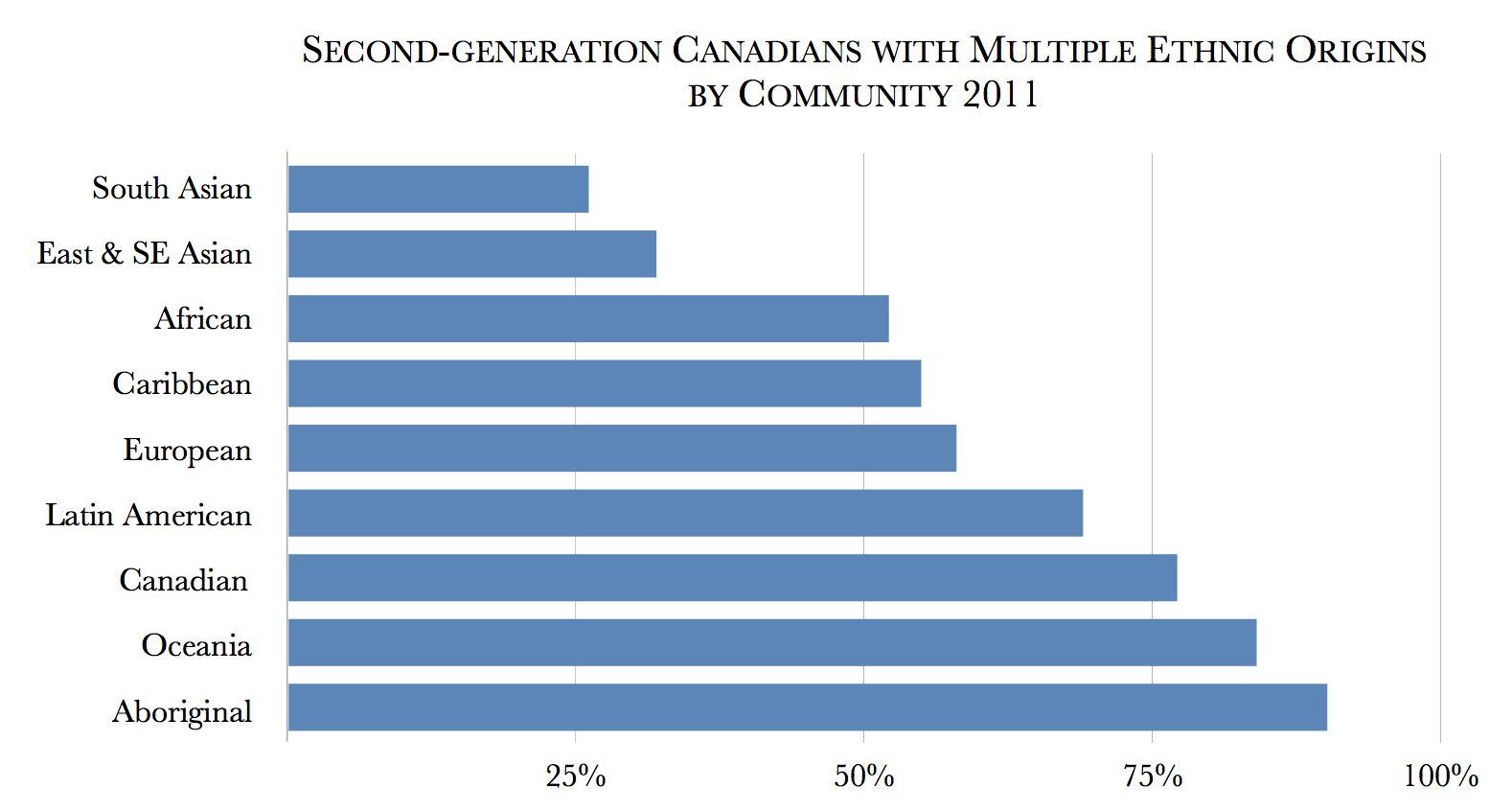
Canadians G2 Multiple origensTodd reports on the study by Feng Hou, Zheng Wu and Christoph Schimmele showing that community size and availability matter (“Group Size and Social Interaction: a Canada-US Comparison of Interracial Marriage”).

The overall StatsCan ethnic origin data shows the longer the community has been in Canada, the greater the number of Canadians with mixed ethnic origins, the result of more mixed unions. The above chart highlights second-generation immigrants who indicate also having Canadian ancestry (the third generation for most of the newer communities are not large enough, and old enough, to analyze):

But three cultural trends are shaking up this utopian dream, which places inter-ethnic couples at the vanguard of cultural fusion.

The first shift is demographic. Canadian statisticians have documented how the growth of ethnic groups in the Western world is actually making inter-ethnic couples less likely in major cities.

Secondly, many of the countries with traditional cultures that produce immigrants to the West remain resistant to ethnic intermarriage, often because of concerns about offsprings’ religious identities.

Thirdly, some race activists and social scientists are criticizing what they call the “brownwashing” of the population, arguing a mixed-union revolution is mostly sought by white liberals.

… A study published this year by Hou, Zheng Wu and Christoph Schimmele found the intermarriage rate among members of an ethnic group goes down in regions that house a large cohort of that group. No one is quite sure why.

The intermarriage rate in mid-sized Canadian cities such as Kelowna, Victoria and Trois-Rivières, where there are relatively few visible minorities, is reaching almost 40 per cent. People there appear motivated to go outside their ethno-cultural group for friends, dates and, importantly, marriage partners.

On the other hand, in Canadian metropolises where visible minorities, mostly Asians, account for almost half the population, the intermarriage rate is much lower. In Metro Vancouver it’s just 9.6 per cent. In multi-racial Toronto it’s only 8.2 per cent.

People seem to feel little need to find a partner outside their ethno-cultural group when living among hundreds of thousands of people with familiar backgrounds.

For instance, South Asians and ethnic Chinese make up the largest immigrant groups to Canada. But Statistics Canada reports they’re among the least likely to intermarry. Only 19 per cent of Chinese-Canadians in a couple, and 13 per cent of South Asian-Canadians, are in a mixed union.

Hou admits researchers can’t explain the complicated causes of intermarriage. But he cautioned against “blindly treating the prevalence of intermarriage as the litmus test of inter-group relations.” Hou says, “The prevalence can be low or go down simply for demographic reasons.”

Douglas Todd: Mixed unions applauded by some, but dismissed by others as brownwashing.

Canadian converts to Islam focus of study by Australian sociologist

Some Government rhetoric notwithstanding, the Kanishka Project continues to fund some interesting and potentially useful studies on the sociology of extremism and radicalization:

Public Safety Canada is funding a project by an Australian academic to study why Canadians convert to Islam.

This is the first study on the subject ever conducted in Canada and one of a number of studies to receive money from Public Safety through its Kanishka Project, which funds research into terrorism and counterterrorism.

“Canada was a country that had not even one published journal article on converts between its borders. So, I thought, ‘Wow, what a great opportunity,'” said Prof. Scott Flower of the University of Melbourne.

Flower’s earlier research looked into Muslim converts in Papua New Guinea and Australia and he was looking for comparative cases in other Western nations.

Scott Flower, a researcher from The University of Melbourne in Australia, says he understands why some Muslims may be leery of his research. (University of Melbourne)

He hopes to spend the next few months in Canada conducting interviews with converts to Islam with a view to finding out what spurred their conversion.

Flower doesn’t know what the government will eventually do with his research but he did stress in an interview with CBC Radio’s Ottawa Morning that he understands how the subjects of his study might be leery of it.

“You’d have to be very ignorant to not sense the level of concern amongst the Muslim community in general, let alone the convert community. There’s been a number of recent legislative bills passed in this country — I won’t use the word oppressive — but I would say that it’s really made Muslims go to ground,” said Flower.

He added that this atmosphere is complicating his research.

“That’s really posing a challenge to recruiting participants to what is really a study that is not interested in security whatsoever,” he said.

Canadian academics who have received money from the Kanishka Project for other studies say there is nothing nefarious about its intentions.

“All the work is being done by independent scholars that are arm’s length,” explained Jeremy Littlewood, a Carleton University professor and terrorism expert.

Amarnath Amarasingam, a post-doctoral fellow at Dalhousie University in Halifax, agrees with Littlewood, but sympathized with Flower’s challenges.

Amarasingam is conducting his own research into violent radicalization, also funded by the Kanishka Project.

“We’ve tried very hard to explain that [our] research was independent. None of the data is being handed over and the government is seeing the final product and there is no secret report,” he said.

“As the researchers retain copyright, such reports provide policy research advice and do not necessarily represent the policy position of Public Safety Canada,” wrote Jean Paul Duval, a spokesperson for the department, in an email to CBC News.

Canadian converts to Islam focus of study by Australian sociologist – Politics – CBC News.

Government seeks to revoke Canadian citizenship of convicted terrorist Misbahuddin Ahmed

And then there were two. The focus (so far) is on those who have been convicted in Canadian courts (which avoids all sorts of due process issues with respect to those convicted overseas):

Pakistan-Canadian Ahmed, 32, is serving 12 years at Warkworth, a medium-security prison in Ontario.

A third accused was acquitted of the one conspiracy charge against him and charges against the fourth man were dropped.

“Misbah knows about this and instructed me to do whatever is possible to prevent the revocation of his citizenship,’ said lawyer Ertel. “We intend to challenge the legislation and oppose this in every way.

“Like many Canadians I’m no fan of the draconian legislation or the apparent lack of restraint in its application,’ he added.

Ahmed now has 60 days to respond to the government’s application.

When he sentenced Ahmed, Ontario Superior Court Justice Colin McKinnon said he was convinced that Ahmed had renounced his terrorist inclinations.

He refused to impose a maximum sentence, meaning Ahmed could apply to the parole board for early release after serving one-third of his sentence.

“But for the fact that Mr. Ahmed has been convicted for terrorism offences rather than some other serious offence,” said the judge, “he would likely be considered an appropriate candidate for a conditional (non-custodial) sentence.”

He rejected the prosecutions request for a 20-year sentence saying it would be an “injustice.”

Ahmed, a former Ottawa Hospital diagnostic-imaging technician and the father of three young daughters was convicted of conspiracy to facilitate terrorism and facilitating terrorism. He was acquitted of a more serious third charge of possessing an explosive device.”

Crown prosecutors say Ahmed’s sentence is too lenient and are appealing.

Ahmed, for his part, is appealing the sentence on the grounds it is too harsh.

Government seeks to revoke Canadian citizenship of convicted terrorist Misbahuddin Ahmed | Ottawa Citizen.

Canada’s diverse work force gave my startup an unfair edge

A concrete example of Canada’s advantage in having a diverse workforce by Allen Lau, CEO of Wattpad:

In today’s Internet economy, software is king. The next technology behemoths will innovate with software and operating systems instead of new devices and machines. Several Canadian companies (Kik, Hootsuite, Slack) have proved that you can win on the global stage, even when you’re based in Canada. When you build an Internet company, success does not come from the patents you hold or the lobbyists you’ve hired; it’s about the product and the value it offers to users.

I would even argue that these companies are doing exceptionally well because they’re based in Canada. Indeed, we have one major advantage that our neighbours to the south will never be able to trump with a powerful lobby or judicial strategy.

More than half of Toronto’s residents were born outside Canada, myself included. For my company, Wattpad, a global community of 40 million readers and writers, I believe that Toronto’s diversity gives me an unfair advantage.

True innovation is rooted in the ability to solve problems. Toronto’s diversity has helped me build a team that is insightful and mindful enough to tackle the challenges that arise when you build a global Internet company.

When you aspire to serve a global population, you need diversity in your work force. I’m talking about the kind of diversity that goes beyond hiring someone to translate text in the product. You need to hire people who can not only speak different languages, but also understand cultural nuances. This is something that exists naturally in Toronto, as well as other parts of Canada.

Since the Internet is the first technology that simultaneously connects billions of people around the world, companies that focus only domestically miss out on a massive business opportunity. I see this opportunity get bigger every day as the number of people who can access the Internet grows, thanks largely in part to affordable smartphone technology.

When Wattpad first launched, it supported one language: English. Growth was painfully slow. My co-founder, Ivan Yuen, and I decided to support additional languages, such as Vietnamese and Tagalog. Almost immediately, this move attracted new readers and writers from around the world. However, user growth did not come without challenges.

As we expanded into other languages – ones we didn’t read or understand – it became critical to engage these international audiences and support their needs by adapting our product. Fortunately, we had made the decision to base our company in Toronto, and could immediately reach out to friends and colleagues who were fluent in these newly supported languages and could offer us regional perspectives and insights.

Today, Wattpad sees growth in markets where smartphone penetration is on the rise, and in places that are underserved by the traditional publishing industry. Fifty per cent of our traffic comes from outside North America, and we have a team based in our Toronto headquarters that supports the growing international community. The majority of Wattpad employees can speak a second or third language. They are world travellers, having lived in 76 different cities around the world. Many are immigrants or first-generation Canadians.

Canada’s diverse work force gave my startup an unfair edge – The Globe and Mail.

Does ‘sharing’ mean caring? – AirBnb, Uber and McDonald’s

Good piece by Francis Woolley on the risks to social inclusion with the rise of sharing services like AirBnB and Uber:

The idea of rating might seem fair. People who do bad things, such as making drivers wait or spilling red wine on the carpet, get bad ratings and are punished. Yet once a service starts rating customers, it becomes a bit less impartial; a bit less like McDonald’s, where almost everyone receives the same quality of service. Highly rated customers get a ride right away; low-rated customers wait longer.

But taxi drivers have always had to find ways to avoid bad fares and seek out good ones. In the past, drivers have made snap decisions about whether or not to pick up a potential passenger on the basis of that person’s appearance – characteristics such as their clothing, age or race. But anyone can get a good rating on Uber by being ready on time and giving generous cash tips to the driver. A world where the people who get rides quickly are those who have earned a high Uber rating seems fairer than one where the people who get rides quickly are those whose skin tone holds the promise of a more generous tip.

But what about AirBnB, which insists that users post a clear, frontal face photo? A photo that reveals a user’s age, race and gender?

There is ample scholarly evidence of discrimination in housing markets. Women, people with good jobs and those with the right ethnic origin find it easier to obtain rental accommodation. There is also growing evidence of discrimination in online markets. For example, an experiment by economists Jennifer Doleac and Luke Stein found that online photos made a real difference to the selling price for goods. A used iPod held in a black hand sold for, on average, 11-per-cent less than the same iPod held in a white hand. IPods held in tattooed hands sold for 10-per-cent less than iPods held by the tattoo-free.

The sharing economy puts power in the hands of the people. Unfortunately people can be real jerks. It is easy to criticize McDonald’s, and those worker-exploiting, tax-avoiding multinational corporations. But McDonald’s makes a substantial contribution to human dignity every day by providing millions of people with good (or good enough) coffee at a reasonable price, free WiFi and a washroom.

Does ‘sharing’ mean caring? – The Globe and Mail.

How Minority Job Seekers Battle Bias in the Hiring Process

More evidence (USA) on the impact of bias and prejudice in the hiring process:

For example, research has shown that white job applicants receive 50% more callbacks for interviews than equally qualified African American applicants. And, in the low-wage labor market, scholars have found that African American men without criminal records receive similar callback rates for interviews as white men just released from prison. Researchers have also documented discrimination in hiring against women, with particularly strong penalties against mothers.

But how does this reality affect these groups – African Americans and women – as they hunt for jobs? Do they tailor their searches narrowly to help them avoid discrimination, sticking to job opportunities deemed “appropriate” for them? Or do they cast a wider net with the hopes of maximizing their chances of finding a job that does not discriminate?

Until now, we have known little about this issue, largely because no existing data source has closely followed individuals through their job search.

New research that we recently published in the American Journal of Sociology attempts to address this limitation by drawing on two original datasets that track job seekers and the positions to which they apply.

The results of our study point to three general conclusions about the job search process:

  1. African Americans cast a wider net than whites while searching for work.
  2. Women tend to apply to a narrower set of job types than men, often targeting roles that have historically been dominated by women.
  3. Past experiences of discrimination appear to drive, at least in part, the broader job search patterns of African Americans.

On an important side note, these racial differences exist for both men and women and these gender differences exist for both whites and African Americans.

The study’s conclusion:

Together, the findings from our study suggest that the job search process plays an important role in shaping, reinforcing and sometimes counteracting inequality in the labor market.

At the same time, discrimination and other barriers to employment must be considered to fully understand how labor market inequality is generated.

And, as the comparison of race and gender suggests, how individuals adapt to workplace barriers can take different forms and have distinct consequences.

Our research points to the importance of systematically examining both job search processes as well as discriminatory behavior and other constraints in the workplace if we hope to fully understand and rectify persistent racial and gender inequalities in the labor market.

How Minority Job Seekers Battle Bias in the Hiring Process | TIME.