Diversity in political backrooms still lacking

My piece in The Hill Times:

The Liberal government included in its mandate letters to all ministers a “commitment to transparent, merit-based appointments, to help ensure gender parity and that indigenous Canadians and minority groups are better reflected in positions of leadership.”To recall, the Prime Minister appointed a Cabinet with gender parity (15 each of men and women) and almost 17 per cent visible minority ministers (four Sikh and one Afghan Canadian).

Gender parity was not attained for parliamentary secretaries (12 positions out of 35 or 34 per cent) or other leadership positions such as whips and House leaders, visible minority parliamentary secretaries are over-represented (nine positions or 24 per cent) in relation to their share of the voting population (15 per cent).

Given this commitment and action, is the Liberal government also applying diversity and inclusion to its hiring of political staff? What about the official opposition?

To assess this, I looked at the Prime Minister’s Office (59 total positions and 12 senior staffers), the Leader of the Official Opposition’s office (OLO, 23 positions), and ministerial offices (senior staff defined as chief of staff, directors of communications, policy, issues and parliamentary affairs, along with press Secretaries, total number of 101 positions filled at time of writing).

Sources for the data include the regular ‘Hill Climbers’ updates in The Hill Times, other relevant press articles, and the imperfect Government Electronic Directory Services (GEDS). Gender and visible minority status were identified through names, LinkedIn profiles, biographies and photos where available.

From a gender perspective, women are under-represented at the senior level in PMO (one-third), but close to 40 per cent for all 59 PMO staffers. OLO has slightly lower representation of women (30 per cent). For minister’s offices, the percentage of chiefs of staff is slightly less than the overall per cent of close to 40 per cent who are women.

Visible minorities are consistently under-represented, save for the overall numbers in PMO (15 per cent). OLO and senior ministerial office staff all range between four to seven per cent, less than half of the percentage of visible minority Canadian citizens, with chief of staff visible minority representation slightly higher at 10 per cent.

While I have focused on gender and visible minority status, diversity includes of course other dimensions such as regional diversity (many, if not most Liberal staffers come from, or have worked in, Ontario and Toronto), sexual orientation, religion, education etc. R. Paul Wilson’s A Profile of Ministerial Policy Staff in the Government of Canada provides the best most recent analysis of the different aspects of diversity among staffers under the Conservative government October 2012 to June 2013.

Does this matter? In many ways, it does not. Gender parity in Cabinet and relatively strong Parliamentary Secretary representation set the tone for the government and Parliament.

Being a political staffer may not necessarily lead to a direct path to becoming a future MP. Staffer experience is not necessarily perceived as an asset in local riding associations or to the broader public. Staffers may be asked by the party to be its flag-bearer in unwinnable ridings. The most famous example of a staffer becoming an MP is, of course, former Prime Minister Harper, who was a staffer to Reform Party leader Preston Manning among other positions.

All three major parties were able to recruit an impressive number of visible minority candidates (women less so).

However, staffers play an important role in government (and opposition) decision-making. Having a diversity of backgrounds and experience generally helps inform decision-making.

The Liberal government’s commitment to diversity and inclusion, so well executed at the public level for both women and visible minorities, is lacking in the backrooms, particularly for visible minorities. Given the role that staffers play in preparing ministers for debates and discussions, this may impact on the degree to which the overall diversity and inclusion agenda is implemented.
http://www.hilltimes.com/opinion-piece/2016/03/02/diversity-in-political-backrooms-still-lacking/45495 

Why do so many jihadis have engineering degrees?

Long but interesting article on why so many radicalized individuals have an engineering background:

That takes Hertog and Gambetta (the researchers who conducted the study)  to the thorny question of “mindsets for extremists.” Different types of people are attracted to different kinds of extremism—engineers mostly on one side, social scientists and humanities grads on the other—and the authors went in search of traits found in both secular and jihadi extremists as well as among engineers. Three stand out among conservatives in general in recent psychological research: disgust (or the felt need to keep one’s environment pure, which can underpin everything from homophobia to xenophobia); the “need for cognitive closure” (a preference for order and certainty that can support authoritarianism); a very high in-group/out-group distinction.

These are present in particularly high concentration among Nazis and Salafists alike, while European surveys show engineers to be consistently more conservative than other students: moderately right-wing, anti-immigration and tough on crime. Whether the discipline makes the man—it’s worth noting engineering, like the virtually women-free world of right-wing extremists, is male-dominated—or the man seeks the discipline, Hertog is not prepared to say, but the correlation is undeniable. And so is what it points to: contrary to what seems obvious, religious faith does not so much drive Islamist terror as provide its cover.

Why do so many jihadis have engineering degrees?

Douglas Todd: Divorce, Shariah and gold coins

 I always find Todd’s articles of interest and this one is no exception:

Lawyer Zahra Jenab often comes face to face with couples embroiled in acidic disputes over a small fortune in gold.The West Vancouver family lawyer, who was born in Iran and raised in Canada, works frequently with ex-partners wrangling over thousands of gold coins, which may or may not have been given by the husband in a dowry under Islamic Shariah law.

Canadian courts are increasingly being called upon to rule on religious laws of the Middle East and Asia. But they’re finding it tricky to distribute family property across nations and in an era when dowries contain symbolic promises of Qur’ans along with valuable coins.

Jenab has made her way through hundreds of trans-national divorces in which Canadian family law clashes with traditions from Iran, Egypt, Pakistan, East Africa and East Asia, and her desk is piled with yellow case files.

When separating immigrant women and men ask her why their divorces can’t follow the rules of their old country, Jenab has to tell them: “Because we’re in Canada, now.”

Estranged couples can be devastated when they discover the religious laws of their homelands don’t apply in Canada.

“My heart often breaks for the suffering couple,” Jenab said. “But the driving issue is Shariah property law.”

As trans-national divorce increasingly falls under the scrutiny of Canadian judges, the decisions they’re making about what Shariah says about the distribution of property are “all over the map,” Jenab said.

Unfortunately, an expert witness on Shariah has not emerged to guide Canada’s courts.

The focus of many trans-national divorces in Canada is the often-considerable dowry, sometimes known as a mahr or meher, which is customary in most countries containing the world’s 1.5 billion Muslims.

“The dowry is financial security for the female. It is the man’s promise to provide finances, often in gold. It can be claimed by her at any time.”

When discord tears apart the bonds of matrimony, as it often does in all cultures, conflicts over often-unwritten promises about dowries can become intense.

In some countries where Shariah is enshrined, Jenab says, men can be arrested for not providing the dowry when the wife demands it.

…Property rights are also often not equal in many Muslim countries, where males are favoured.

Trans-national divorces, as a result, are often complicated when spouses work, or hold property, in their country of origin. “That makes the fair division of property hard to enforce.”

Many of Jenab’s clients, women and men, end up wanting both the benefits of Canada’s relatively equal family law and the advantages of their traditional religious culture.

They’re often stunned or angry, she said, when they learn Canadian family law — including the ideal of parents sharing joint custody of children — doesn’t line up with their religious customs.

“It’s difficult to see families struggle as they move out of their marriages, especially the children,” Jenab said. “That’s why I try to talk everyone down from taking a scorched-earth approach.”

http://www.vancouversun.com/opinion/columnists/douglas+todd+clash+cultures+divorce+shariah+gold/11753275/story.html

ICYMI: Douglas Todd: Lest we overlook the ‘Asian Holocaust’

Good piece by Todd:

Nazi Germany’s invasions and the Holocaust have been thoroughly exposed through an avalanche of books and movies. Germany’s leaders have repeatedly apologized and offered redress. And the German people, including the young, carry the guilt of their forebears’ atrocities.

That’s not the case when it comes to Japan’s war crimes.

Eugene Sledge, a U.S. professor and veteran who advised Ken Burns on his documentary, War, has said: “The best kept secret about World War II is the truth about the Japanese atrocities.”

The full horror of Japanese aggression began manifesting itself first in 1937, when Japanese soldiers launched a brutal, sexually sadistic invasion of the Chinese city of Nanking.

Peter Li, an historian at Rutgers University, continues to think Canada and the U.S. have to be held responsible for Japanese internment camps. But he also doesn’t want the world to turn a blind eye to the devastation wrought by Japan.

“As Auschwitz has become a symbol of the Jewish Holocaust and Nazi atrocities in World War II, the ‘Rape of Nanking’ has become the symbol of the Japanese military’s monstrous and savage cruelty in the Asia Pacific War from 1931 to 1945,” Li says.

“But in comparison to the Jewish Holocaust, relatively little has been written about the atrocities perpetrated by the Japanese military in China, Korea, the Philippines, Singapore and Indonesia, where close to 50 million people died at the hands of Japanese aggression. In China alone, an estimated 30 million people lost their lives.”

Given the hot spotlight on Nazi Germany, it’s little wonder those who want to shift the attention of resistant Westerners to Japan’s war crimes often use the term, “the Asian Holocaust.”

Why have Japan’s war outrages lacked the scrutiny directed at Germany?

The University of Victoria’s John Price is among those who argue one reason for the silence has been U.S. strategy since the war. After Japan surrendered in 1945, the U.S. occupied the country and turned it into an ally in its conflicts with Communist China, Korea and elsewhere. Needing a “friend” in Asia, the U.S. and other Western powers, Price suggests, have not found it in their interest to rub Japan’s nose in its iniquities.

The second reason lies in Western guilt over dropping atomic bombs on Nagasaki and Hiroshima. Those explosions helped force Japan to surrender, but at the cost of roughly 100,000 civilian lives.

As a result, in East Asia, controversy burns openly over whether Japan should more fully apologize for starting the war. But in Canada the question rarely comes up.

That’s despite Canada sending thousands of young soldiers to the Asian war, where many were killed or injured or suffered torture and mistreatment.

A person needs a strong stomach to read even a basic Wikipedia page about “Japanese war atrocities.”

Japanese military leaders often ordered troops to “Kill all captives,” says Li, editor of Japanese War Crimes: The Search for Justice. Japanese troops were routinely ordered to decapitate, rape or pour gasoline on citizens and prisoners of war.

When Japan’s soldiers weren’t burying humans alive, they were told to build their courage by plunging 15-inch bayonets into unarmed people. “Killing was a form of entertainment,” says Li. The indignities performed on corpses of victims of rape are too gruesome to cite.

Grassroots efforts to draw attention to the need for fuller Japanese apologies and redress have faced a mountain of obfuscation and denial.

Unlike in Germany, Japan’s responsibility for the war “is not clearly established in the minds of many Japanese today,” says Li. “The Japanese people have introduced the notion of ‘a good defeat’ … and they rarely invoke an enemy, or hatred for the enemy. Somehow the war has become an ‘enemy-less’ conflict.”

Last year, on the 70th anniversary of the war, Japanese Prime Minister Shinzo Abe expressed his “profound grief” for his country’s actions.

But Abe continues to send mixed messages, since he has also visited the Yasukani Shrine, which contains graves of Japan’s worst war criminals. And accounts of war atrocities remain slim to non-existent in Japanese textbooks.

Source: Douglas Todd: Lest we overlook the ‘Asian Holocaust’

Sharmeen Obaid-Chinoy, Oscar winner, says Canada informs her work

Nice Canadian connection:

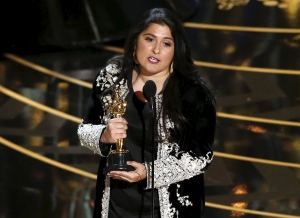
Pakistani-Canadian filmmaker Sharmeen Obaid-Chinoy, who won the Academy Award for documentary short, credits her time in Canada for helping inform her powerful storytelling.

“When you live in a country like Canada, you begin to realize how right things can be,” Obaid-Chinoy told CBC inside the Oscars press room after her win. “Then when you travel back to Pakistan and to other countries which are in conflict, you can see what’s going wrong.”

Her winning documentary short, A Girl in the River: The Price of Forgiveness, is about honour killings, told through the eyes of Saba Qaiser.

“She wanted her story told,” said Obaid-Chinoy. “The impact of her story is tremendous, because it is going to change lives, and it’s going to save lives, and there can be no greater reward than that.”

Qaiser, 18, fell in love with a man against her family’s wishes. Shortly after they eloped, her father and uncle shot her in the head and left her for dead. Her survival led her to become a rare voice for women in similar situations and the one needed for Obaid-Chinoy to tell the story.

AWARDS-OSCARS/

Pakistani-Canadian journalist and filmmaker Sharmeen Obaid-Chinoy accepts the award for Best Documentary Short Subject Film for A Girl in the River: The Price of Forgiveness at the 88th Academy Awards in Hollywood, California Feb. 28. (Mario Anzuoni/Reuters)

“I think it’s important to see what what human beings are capable of,” said the filmmaker.

Obaid-Chinoy, who now lives in Pakistan but has spent a lot of time going between Toronto and her home country, said her work has prompted difficult conversations that often risked her life but that there is “payback” in doing so.

The filmmaker and journalist also won an Academy Award for her 2012 documentary Saving Face, about women in Pakistan searching for justice after suffering acid attacks.

That win made her the first Pakistani to capture an Oscar.

“The power of being nominated for an Academy Award really does mean for a country like Pakistan that you can change laws.”

Source: Sharmeen Obaid-Chinoy, Oscar winner, says Canada informs her work – Arts & Entertainment – CBC News

Diversity on parliamentary committees: Does it matter? | My piece in The Hill Times

Diversity_on_parliamentary_committees__Does_it_matter____hilltimes_comMy piece in The Hill Times (excerpt):

If we look at the overall committee membership of 288 members in both the 25 House of Commons and three joint Senate-Commons committees (some MPs are members of more than one committee), only 21.2 per cent are women, significantly lower than the overall 26 per cent of women MPs.

For visible minorities, however, committee representation largely matches overall Commons representation at 14.6 per cent, just marginally under the number of visible minorities who are Canadian citizens. Indigenous peoples committee representation is less than their share of the population (3.1 compared to 4.3 per cent).

Looking at individual committees, only the Access to Information, Privacy and Ethics and Industry, Science and Technology committees have no women members. Veterans Affairs, Agriculture and Agri-Food, Environment and Sustainable Development, Fisheries and Oceans, Official Languages, National Defence, Physician-Assisted Dying have no visible minority members.

Women are predictably over-represented in Status of Women (nine out of 10 members) and visible minorities are similarly overly represented in Citizenship and Immigration (seven out of 10 members).

Source: Diversity on parliamentary committees: Does it matter? | hilltimes.com

Asian sex abusers to be stripped of UK citizenship and deported

Implementation of the slippery-slope argument with respect to revocation in the UK (yes, these are horrific crimes, but very long jail time is the appropriate response):

Asian-born sex abusers will be stripped of their UK citizenship and deported at the end of their sentences under a new Home Office drive, The Independent can reveal.

Theresa May, the Home Secretary, is planning to significantly increase her department’s use of legal powers that allow serious criminals with dual nationality to have their British citizenship withdrawn, Whitehall sources say.

Until now, the powers have predominately been used to remove the UK passports of terrorists and terrorist sympathisers.

But senior department sources told The Independent that – in response to the series of Asian sex abuse gangs uncovered in towns across the country in recent years  – there is likely to be an “acceleration of passport strike-outs and potential deportations”.

British-Pakistani members of the gang of six men and women from Rotherham who were convicted on Wednesday of offences including rape, forced prostitution, indecent assault and  false imprisonment are expected to face action to strip them of their UK citizenship after they are sentenced today. Legal proceedings seeking their potential deportation to Pakistan are likely to follow.

The abuse of predominantly white girls by networks of Asian men has led to prosecutions across the North of England and the Midlands. More trials are imminent.

David Greenwood, head of the child abuse department at Switalskis solicitors in Sheffield, who represents almost 60 victims subjected to sexual abuse by the Rotherham gang between 1996 and 2012, said: “This trial is just the first of many and is the tip of a very big iceberg. From the work I have done, it appears that gangs of Asian men have been operating to sexually abuse young white girls in Rotherham, Oxford, Keighley, Bradford and Rochdale.”

Although amendments to British nationality laws in 2014 making it easier to strip dual nationals of citizenship were primarily aimed at terrorists who could undermine the UK’s security, the Home Office is now using the same legal sanctions to target serious crime, including sex abuse.

Source: Asian sex abusers to be stripped of UK citizenship and deported | Crime | News | The Independent

John Ivison: Jason Kenney’s newfound energy signals that the Tory leadership race has started in earnest

Good profile by John Ivison on Jason Kenney and his post-election reflections (I have great respect for former Minister Kenney from my time as former DG – Citizenship and Multiculturalism – as chronicled in my book, Policy Arrogance or Innocent Bias: Resetting Citizenship and Multiculturalism):

“The fatal flaw was our tone. It seemed too often the government went out of its way to make enemies, not friends, starting with the media,” he said.

“On identity questions, every public opinion poll demonstrated a super-majority of Canadians supporting the notion that the citizenship oath should be taken openly … So I think we were on the right side of those issues substantively and politically. But when dealing with sensitive issues you have to communicate with great nuance and subtlety. I accept that was not necessarily the case in our campaign.”

The received wisdom is that these mistakes led to a hemorrhaging of support from the loose coalition of new Canadians that Kenney, more than anyone else, had helped knit together. But he disputes there was a repudiation of the Conservative message among ethnic voters.

“We got 32 per cent of the new Canadian vote, down from the low 40s in 2011, which was proportionate to our popular vote. It’s encouraging that it is still a far higher percentage than the Conservative Party has attracted historically. The problem is our vote didn’t grow with the electorate, which was mostly an issue with the under-30s. The bottom line is we now have a competitive environment. It wasn’t catastrophic.”

What Kenney doesn’t say, is that while the Conservatives got 32 percent of the new Canadian vote, this was 20 points behind the Liberals in the 33 ridings where visible minorities are in the majority (905, BC’s lower mainland) – and where he personally invested considerable time in wooing those communities.

It was not only a question of tone in these ridings: a number of citizenship and immigration changes did not, in the end, go down well with many voters.

“Showing up” was not enough.

Source: John Ivison: Jason Kenney’s newfound energy signals that the Tory leadership race has started in earnest

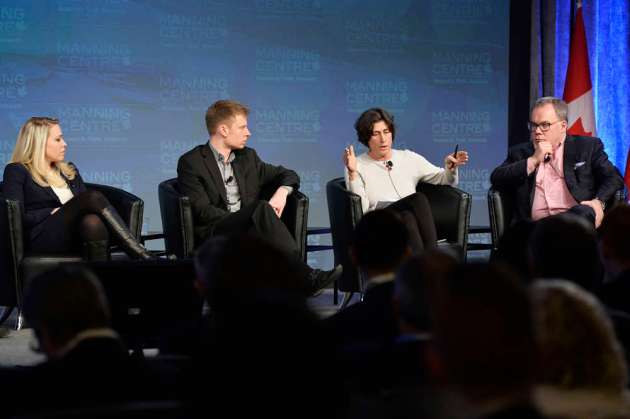
At the Manning conference, identity politics continue to torment the Conservatives

Interesting. Conservatives really need to come to terms with this given just how much their outreach strategy to ethnic voters collapsed in ridings with strong visible minority populations, as well, it appears, being offside mainstream Canadian values:

Toronto Star columnist Chantal Hébert was blunt about the mini existential crisis the conference was exposing.

CTV Journalist Mercedes Stephenson, Sun Media Journalist Anthony Furey, Journalist Chantal Hebert and MacleanÕs Journalist Paul Wells take part in a panel during the Manning Centre Conference in Ottawa on Friday, February 26, 2016. iPolitics/Matthew Usherwood

“Why did Justin Trudeau win the niqab debate on an issue he should’ve lost (according) to the polls? Because his stance on the niqab debate, which is a policy stance, goes to who the Liberals are. You could set your clock on Justin Trudeau saying what he said about the niqab,” she said.

“I look at your party and the niqab, and I don’t know who think you are. If you can, explain it….There are issues that brand a party beyond tone. And before you set out, you need to decide who you are.”

Back in the other room, where Scott-Marshall was explaining the results of their survey, she spoke of a type of free association exercise where participants were asked what words came to mind when they heard Conservative.

There were some positives, but also negative descriptors in line with what Weston had heard at peoples’ doors: “Old, outdated, and mean.”

When the survey drilled down further into how Canadians felt about common terms in the political vernacular — liberal, progressive, democrat, centre, independent, left-of-centre, socialist, conservative, libertarian, radical — they got a strong negative reaction to “conservative”.

“The most common negative reaction is to the word radical, not surprising probably. Although the second most common negative reaction is actually to the term conservative.” Scott-Marshall said.

“Just over a third of Canadians, 36 per cent, say they have a negative response to the term conservative when they hear it. And only 20 per cent say they have a positive response. Something to bare in mind just in terms of maybe negative…baggage that’s being associated with the term Conservative now.”

At the Manning conference, identity politics continue to torment the Conservatives

Multiculturalism ‘good for Australia’ say 85% of Australians

While the overall patterns are quite similar to Canada’s, one of the major differences is the degree to which our political systems are representative of diversity. In Australia, where 28 per cent of the population is foreign-born, only 9 per cent of MPs are, with only a handful being visible minorities. In Canada, 14 percent of MPs are from visible minorities:

The Scanlon Foundation has been looking at these perceptions over the past decade, and most recent research shows 85 per cent of Australians agree that multiculturalism has been good for the country.

The Scanlon Foundation’s Multiculturalism Discussion Paper has been tracking people’s views across more than a decade of surveys.

Data shows Australians are generally very accepting of cultural diversity and immigration, but the level of support varies across generations, geographical locations and demographic groups.

Research Professor at Monash University Andrew Markus says this report looks in detail at research that’s been going on over the past 30 years.

“There’s very high levels of support. 85 per cent of people think that multiculturalism is good for this country and those sort of high figures, people have been obtaining for 20 or more years but what is particularly interesting in the findings that we’re releasing now is that we look more closely at that proportion who say that it’s been good for Australia – we disaggregate those figures – we try to make sense of those figures in more detail.”

Professor Markus says the research shows current support for immigration is at relatively high levels, compared to 30 or 40 years ago.

“There does seem to be a pattern of greater support for immigration. When it comes to some other issues, such as different ethnic groups, at the level of the data that we have it’s more length of time in Australia and people are more positive towards people who’ve been here for 20 or 30 years and similarly amongst the immigrants themselves, there’s more differentiation among the recent arrivals in terms of the support that they’re looking for from government.”

Centres such as Sydney and Melbourne have the highest level of support for multiculturalism, with younger people also more inclined to be in favour.

But the research not only casts light on external perceptions, it also shows how recent migrants feel about settling in the country.

“What we find when we look at the most recent immigrants is high levels of engagement with Australia but also, and from other research, concerns at the present time about how difficult it is for people to get jobs in the areas they’ve been trained. So there’s certainly some important issues for government in terms of current immigration intake and capacity for people to find the sort of employment that they’re looking for.”

Scanlon Foundation CEO Anthea Hancocks says the paper sets out to explore the complexity of the issue, encourage debate and foster social cohesion.

Ms Hancocks says Australia’s diverse culture is one of the country’s most defining characteristics.

Source: Multiculturalism ‘good for Australia’ say 85% of Australians | SBS News