As of June, the company was 68 percent male and 32 percent female, Apple said on its website. That’s a shift of a single percentage point in favor of women.
In the U.S., the company was 56 percent white, 19 percent Asian, 12 percent Hispanic, 9 percent black, and 2 percent multiracial, another 1 percent being gathered into an “other” category. Notably the company actually increased the percentage of white employees 2 points, although Asian and Hispanic numbers were up 1 point apiece.
Less than 1 percent of American staff were undeclared, something Apple credits to “stronger internal processes and employees properly identifying themselves.” Most of the people who were previously undeclared turned out to be white, possibly explaining the above demographic shift.
On the pay equity front Apple claims that it has achieved total equity in the U.S. as of August, but is still working on the problem worldwide — this includes scrutinizing salaries, bonuses, and stock grants. There are no statistics on the company’s pay gaps elsewhere.
Like other tech companies Apple has sometimes come under criticism for being predominantly white and male in the U.S. In the past several years, though, the company has tried to adjust its hiring practices at all tiers. Its VP of Worldwide Human Resources, Denise Young Smith, is a black woman, and its retail head is former Burberry CEO Angela Ahrendts.
The Ahmadiyyas, one of the most persecuted sects in the Muslim community, have finally managed find a place in India as a sect of Islam in the 2011 census. With a large section of Muslim clerics deeming the community to be heretics, successive governments in previous years had refrained from including them as a sect of Islam in the census report. This happened despite successive High Court judgments upholding their legal status as Muslims.
The community, which was recently lauded by Prime Minister Narendra Modi for its “religious tolerance and universal brotherhood”, has found its name included in the “Details of Sects/Religions clubbed under specific religious community” data released by the government last week. In earlier census reports, only Sunnis, Shias, Bohras and Agakhanis were identified as sects of Islam.
Conservative estimates of the community’s population in India, which originated in Qadiyan in Punjab, is pegged at 1 lakh. “It is a welcome move by the government,” said Mahmood Ahmed, former president of the Ahmadiyya Muslim Jamaat, Mumbai.
The sect’s origins lie in Qadian in Punjab. Mirza Ghulam Ahmad founded the movement in 1889. Rejecting orthodox Muslim beliefs, he preached that he was the promised messiah with the divinely inspired task of bringing God’s teaching into harmony with the present-day world. He said he was the messiah whose advent was awaited by Muslims, Christians and Jews alike, as well as the incarnation of Krishna.
Since its inception, the sect has been opposed by hardline Muslim clerics. This opposition culminated in a constitutional amendment in 1974 in Pakistan, declaring the Ahmadiyyas to be non-Muslims in the eyes of law. Soon after, there was widespread violence and persecution against the community in Pakistan.
Will be interesting to see if this is picked up more widely:
A trio of Christian leaders from the Middle East are calling on Canada’s government to provide direct aid to Christians being persecuted in that region.
The three church leaders — one from war-torn Syria, one from Iraq and one from Lebanon — were in Toronto Wednesday as part of the Knights of Columbus’ annual Supreme Convention gathering.
All three spoke of the persecution of Christians in Middle Eastern hotspots by radical Muslim groups, such as the Islamic State (ISIS).
Archbishop Bashar Warda of Erbil, Iraq, says Canada — like the U.S. — has a “moral responsibility” to help.
“The Canadian people have a long tradition of helping and supporting the persecuted and marginalized people around the world,” said Warda, using Canada’s 1994 peacekeeping mission in Rwanda — albeit a doomed one — as an example. “Canadians were there. We’re not asking some extra efforts here. It is just the commitment of the Canadian people and the Canadian nation, that they would be always defending the marginalized and the (victimized) around the world. Here, there is a clear case … there are people being persecuted because of their faith, because of their way of life.”
The problem, says Warda, is that Canada’s government does not deal with church-affiliated organizations directly, but funnels aid money through various “institutions.”
“How much of this … (has reached) the Christian … refugees? … It is a very small amount,” he said.
Gina Csanyi-Robah, Robert Eisenberg and Vahan Kololian on the Roma:
A slaughter that in many ways paralleled both the Armenian genocide perpetrated by the Ottoman Empire in 1915-16 as well as the Jewish Holocaust. August 2 is the official date designated by the worldwide Roma community to commemorate the Devouring. So why have so few people heard of it?
Unlike Jewish history and what has become the best recorded genocide of the modern era, the Devouring is still little known. While the history of the Roma genocide has been passed on orally through the generations, only recently has there been a movement to record this tragic history. Following the war the Roma community was so devastated it took 60 years to rebuild.
As a result, estimates of the number of Roma killed by the Nazis vary significantly, ranging between 250,000 and 1.5 million. Dr. Ian Hancock of the University of Texas, a world renowned expert on the Roma genocide suggests “… of the estimated 20,000 Romanies in Germany in 1939, fully three quarters had been murdered by 1945. Of the 11,200 in Austria, a half were murdered. Of the 50,000 in Poland, 35,000. In Croatia, Estonia, the Netherlands, Lithuania and Luxembourg, almost the entire Romani populations were eradicated.”
And there are many more in the field of genocide studies who have supported Dr. Hancock’s theory. Indeed, it is telling that the only country at this point that has recognized the Devouring as a legitimate genocide is Germany.
Like Eastern European Jews, they were designated as Untermenschen, unworthy of life. Along with the Jews, they were rounded up from their nomadic villages and thrown onto cattle cars destined for death camps. Indeed, it is said that Roma and Jews walked hand in hand into the gas chambers of Auschwitz.
The designation of genocide has always been emotionally charged. Motivated by both the Armenian genocide and the Holocaust, international legalist Raphael Lemkin coined the term to give specific meaning to the systemic and systematic murder of an entire people. Today, the United Nations genocide convention, which has universal acceptance, defines it as “acts committed with intent to destroy, in whole or in part, a national, ethnical, racial or religious group.”
If denoting genocide is emotionally charged, its political ramifications can be even greater. The Armenian community struggled long and hard to have Canada finally recognize their tragedy. Threatened economic and diplomatic repercussions from Turkey – which has steadfastly refused to accept the slaughter – were lodged with Canadian authorities when it discussed recognition in Parliament. Nonetheless in 2004, the Parliament of Canada began the process that was completed two years later by the Harper government with full recognition.
The Roma community in Canada, indeed worldwide, has neither the clout in government nor the institutional presence necessary to convince governments to recognize the Devouring. Sadly, global systemic discrimination was also a key factor for ignoring their history. Indeed, to this day the Roma, especially in Eastern Europe, remain persecuted targets of neo-Nazi and other extreme right-wing groups. However, time has certainly come for this recognition.
We lost Elie Wiesel last month, a Nobel laureate and a chronicler of the Holocaust. Mr. Wiesel once wisely noted: “Without memory, there is no culture. Without memory, there would be no civilization, no society, no future.”
iPhone owners will have more than 100 new emoji to choose from when Apple launches its iOS 10 software this fall.
The new characters appeared in the developer preview of the software on Monday, and the Cupertino, Calif.-based company provided an early look at what’s to come in a press release. The update will introduce new, more inclusive characters as well as redesigned versions of already existing emoji. These will include female versions of sports-oriented emoji, such as the addition of a female swimmer, biker, surfer, weight lifter and basketball player.
Professional emoji like the detective and construction worker symbols will also be getting a female counterpart with the software update, and Apple has already proposed new characters to the Unicode Consortium based on occupations like astronaut, artist, firefighter, judge and pilot. It’s unclear when those latter symbols will be approved, however.
Apple
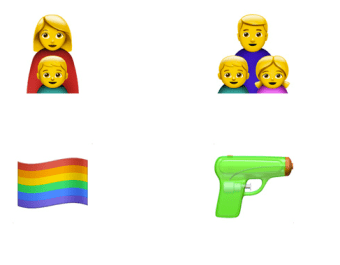
The new family-themed emoji coming in iOS 10 will include new symbols to more accurately represent different types of families, as shown below. A rainbow flag character will also be added to the roster.
Apple
The update is another sign that tech companies are pushing for more diverse emoji representations. A group of Google employees proposed a batch of new emoji in May that would include female scientists, doctors and farmers, among other professions. Last month, Facebook unveiled a set of gender diverse emojis for its Messenger platform as well.
While I understand the rationale to shut-down such places of hate, one can question whether shutting them down will simply drive them underground, where their activities may be harder to detect and contest:
“Fight against the #radicalization: since December 2015, twenty Muslim places of worship have been closed,” the Interior Ministry tweeted.
Of the country’s 2,500 mosques and prayer halls, approximately 120 of them have been suspected by French authorities of preaching radical Salafism, a fundamentalist interpretation of Sunni Islam, according to France 24.
“There is no place … in France for those who call for and incite hatred in prayer halls or in mosques … About 20 mosques have been closed, and there will be others,” Cazeneuve said.
The announcement came days after French Prime Minister Manuel Valls called for a temporary ban on foreign funding of French mosques. A Senate committee report on Islam in France published in July found that though the country’s mosques are primarily financed through individual donations, a significant portion of their funding also comes from overseas—specifically from Morocco, Algeria, and Saudi Arabia. The same report called banning foreign financing of mosques “absurd and impossible,” calling instead for more transparency.
Because of France’s 1905 law establishing the separation of church and state, or laïcité, the French government cannot finance religious institutions directly. Some experts say this rule has made many mosques reliant on foreign funding.
Cazeneuve also announced Monday that French authorities would be working with the French Muslim Council to launch a foundation to help finance mosques within France.
When Derakhti speaks, the criticism — and unnerving threats — come from many quarters.
The most potent anti-Semitism in Sweden and Europe today comes from Muslim immigrant communities, where some have called Derakhti a traitor and told him he should fear for his life. Some ultra right-wing Swedes nurse their own brand of prejudice, rooted in historic European anti-Semitism. And on the left, many are staunchly anti-Israel and extend their disdain to Swedish Jews. Some Swedes say the liberals among them have failed to denounce anti-Semitism on the part of the country’s Muslim minority for fear of appearing Islamophobic.
This apathy and vitriol seems only to deepen Derakhti’s empathy. “I feel like I am a Jew,” he said.
But he comes off as a cool young Muslim.
Derakhti is a hip dresser, accessorized with earbuds, an earring and tattoos — including a prominent one in Arabic. He talks cool — in both English and Swedish — and quickly admits that, to his parents’ chagrin, he was no student. He and David fought off anti-Semites, but Derakhti also casually mentions how, in their teenage years, they had fun smoking pot, and generally driving the adults around them crazy.
Derakhti’s image can only help him convince more young people to summon the courage to confront bigotry, said Silberstein, a well-educated, middle-aged Jewish man who has been working on the issue far longer than Derakhti.
“I’m pretty used to speaking in public,” Silberstein said. “But when I went into a school with Siavosh, when I spoke they hardly listened. When he got up and spoke, that’s when they really started listening.”
Derakhti has lost count of the number of times he has taken a busload of Swedish teenagers to Auschwitz and other concentration camps. He thinks it’s close to 20. He has also toured them through Srebrenica, the site of the worst massacre in Europe since the Holocaust, where Bosnian Serbs in 1995 slaughtered more than 8,000 Muslim men and boys during the Bosnian War.
His Jewish friend David was not the only one to inspire the trips he now leads to concentration camps and killing fields. His parents — persecuted in their native Iran as members of the Azerbaijani minority — moved the family to Sweden, where Derakhti was born. His father took him to Bergen-Belsen when he was 13, and Auschwitz when he was 15, to show him where hatred can lead.
“My father told me that if you’re in a minority, you always have to stand up for a friend,” Derakhti said.
Growing up in Malmo, a city with a reputation for intolerance in a country known for just the opposite, Derakhti saw its tiny Jewish minority — including its Chabad rabbi — attacked by members of the city’s much larger Muslim community. Many Malmo Jews fear wearing a yarmulke or other symbol of Jewishness. In the capital, Stockholm, Jews feel safer, but still wonder about their future in Sweden, particularly when Israel is at war, as it was during the summer of 2014 against Hamas in Gaza.
You may object that moral considerations should limit our opposition to nonbelief. Don’t people have a human right to follow their conscience and worship as they think they should? Here we reach a crux for those who adhere to a revealed religion. They can either accept ordinary human standards of morality as a limit on how they interpret divine teachings, or they can insist on total fidelity to what they see as God’s revelation, even when it contradicts ordinary human standards. Those who follow the second view insist that divine truth utterly exceeds human understanding, which is in no position to judge it. God reveals things to us precisely because they are truths we would never arrive at by our natural lights. When the omniscient God has spoken, we can only obey.
For those holding this view, no secular considerations, not even appeals to conventional morality or to practical common sense, can overturn a religious conviction that false beliefs are intolerable. Christianity itself has a long history of such intolerance, including persecution of Jews, crusades against Muslims, and the Thirty Years’ War, in which religious and nationalist rivalries combined to devastate Central Europe. This devastation initiated a move toward tolerance among nations that came to see the folly of trying to impose their religions on foreigners. But intolerance of internal dissidents — Catholics, Jews, rival Protestant sects — continued even into the 19th century. (It’s worth noting that in this period the Muslim Ottoman Empire was in many ways more tolerant than most Christian countries.) But Christians eventually embraced tolerance through a long and complex historical process.
Critiques of Christian revelation by Enlightenment thinkers like Voltaire, Rousseau and Hume raised serious questions that made non-Christian religions — and eventually even rejections of religion — intellectually respectable. Social and economic changes — including capitalist economies, technological innovations, and democratic political movements — undermined the social structures that had sustained traditional religion.
The eventual result was a widespread attitude of religious toleration in Europe and the United States. This attitude represented ethical progress, but it implied that religious truth was not so important that its denial was intolerable. Religious beliefs and practices came to be regarded as only expressions of personal convictions, not to be endorsed or enforced by state authority. This in effect subordinated the value of religious faith to the value of peace in a secular society. Today, almost all Christians are reconciled to this revision, and many would even claim that it better reflects the true meaning of their religion.
The same is not true of Muslims. A minority of Muslim nations have a high level of religious toleration; for example Albania, Kosovo, Senegal and Sierra Leone. But a majority — including Saudi Arabia, Iran, Pakistan, Iraq and Malaysia — maintain strong restrictions on non-Muslim (and in some cases certain “heretical” Muslim) beliefs and practices. Although many Muslims think God’s will requires tolerance of false religious views, many do not.
A Pew Research Center poll in 2013 found that in Iraq, Malaysia, Pakistan and other nations in which Islam is officially favored, a large majority of Muslims think some form of Islamic law should be the law of the land. The poll also found that 76 percent of such Muslims in South Asia and 56 percent in the Middle East and North Africa favored executing Muslims who gave up their religion, and that in 10 Muslim counties at least 40 percent favored applying Islamic law to non-Muslims. This shows that, for many Muslims, the revealed truths of Islam are not only a matter of personal conviction but must also have a central place in the public sphere of a well-ordered society.
Does this mean that Islam is evil? No, but it does mean that it has not yet tamed, to the extent that Christianity has, the danger implicit in any religion that claims to be God’s own truth. To put it bluntly, Islam as a whole has not made the concessions to secular values that Christianity has. As President Obama recently said, “Some currents of Islam have not gone through a reformation that would help people adapt their religious doctrines to modernity.” This adaptation will be long and difficult and require many intellectual and socio-economic changes, some produced by outside forces, others arising from the increasing power of Islamic teachings on tolerance and love. But until such a transformation is achieved, it will be misleading to say that intolerance and violence are “a pure betrayal” of Islam.
There is no central religious authority or overwhelming consensus that excludes such Muslims from Islam. Intolerance need not lead to violence against nonbelievers; but, as we have seen, the logic of revelation readily moves in that direction unless interpretations of sacred texts are subject to nonreligious constraints. Islamic thinkers like Ibn-Sina accepted such constraints, and during the Middle Ages Muslims were often far more tolerant than Christians. But the path of modern tolerance has proved more difficult for Islam than for Christianity, and many Muslims still do not accept the ethical constraints that require religious tolerance, and a significant minority see violence against unbelievers as a divinely ordained duty. We may find it hard to believe that religious beliefs could motivate murders and insist that extreme violence is always due to mental instability or political fanaticism. But the logic (and the history) of religions tells against this view.
Speaking to journalists aboard his return flight from Krakow, Poland, July 31, the pope also stressed that violence exists in all religions, including Catholicism, and it cannot be pinned to one single religion.
“I do not like to speak of Islamic violence because everyday when I look through the papers, I see violence here in Italy,” the pope told reporters. “And they are baptized Catholics. There are violent Catholics. If I speak of Islamic violence, I also have to speak of Catholic violence,” he added.
Spending about 30 minutes with reporters and responding to six questions, Pope Francis was asked to elaborate on comments he had made flying to Poland July 27 when he told the journalists that religions are not at war and want peace.
The pope’s initial comment came in speaking about the murder July 26 of an elderly priest during Mass in a Catholic church in Saint-Etienne-du-Rouvray, France. Two men, armed with knives, entered the church during Mass. The attackers murdered 84-year-old Father Jacques Hamel, slitting his throat. The Islamic State group later claimed responsibility for the murder.
Although the death of the French priest was committed in the name of Islam, the pope said that it is unfair to label an entire religion violent because of the actions of a few fundamentalists.
“One thing is true. I believe that in almost all religions, there is always a small fundamentalist group. We have them, too,” the pope said. “When fundamentalism goes to the point of killing — you can even kill with the tongue. This is what St. James says, but (you can kill) also with a knife. ”
“I do not think it is right to identify Islam with violence. This is not right and it is not true,” he said.
Instead, the pope said, that those who choose to enter fundamentalists groups, such as the Islamic State, do so because “they have been left empty” of ideals, work and values.