Warsaw’s Populist Right Whitewashes Holocaust History – The Daily Beast

More disturbing news about Poland:

Katarzyna Wielga-Skolimowska was given 24 hours to clear out her office, until the end of the month to vacate her flat, and is forbidden to talk to the press about any of it.

The elegant redhead, who is credited for her knowledge of architecture and theater, was abruptly fired from her job as director of the Polish cultural institute in Berlin last week. Did her programs have “too much Jewish content,” as Israel’s Haaretz headlined bluntly? The Forward in the United States made that a question: “Was Polish Culture Institute Director Fired for Too Much ‘Jewish-Themed Content’?”

As various theories circulate in Berlin about why, one thing is clear—that this is the latest attempt of Poland’s radical nationalist government to revamp its image abroad, not least by playing down any Polish role in the Holocaust. A law proposed last summer, for instance, would make it a crime to use the phrase “Polish death camps” for, say, Auschwitz, which was a Nazi death camp in occupied Poland.

“Everything points to the fact that the dismissal [of the Polish Institute Director] was politically motivated,” Berlinische Galerie director Thomas Köhler tells The Daily Beast. “Her contract would have ended next year. This was clearly intended as a punishment—It’s really bad form.”

Together with other leading culture fanatics in the capital, Köhler signed a protest letter that expressed “dismay“ and “irritation“ at the sudden dismissal. Cilly Kugelmann, who directs the Jewish Museum in Berlin, initiated the letter.

Last year, the Polish Institute screened “Ida,” an Oscar-winning Polish film about a Catholic woman who discovers she is the Jewish child of Holocaust victims. But while showing the film may have gone down well in Berlin, it could have been another strike against Wielga-Skolimowska for Warsaw.

Since Poland’s Law and Justice Party won elections in 2015, the Warsaw government has been going to great pains to “recalibrate many of the ways in which Poles think, talk and learn about their own history.” And to some, it looks like Law and Justice wants to whitewash a lot of the country’s history, even the Shoah, by appealing to nationalist pride.

The way in which “Ida” was broadcast on public television in Poland this year has provided one ground for such suspicion. The film that had won best film prize at the Polish Film Academy in 2013 was this time accompanied by a 12-minute clip in which three critics tore into it, warning about supposed historical inaccuracies.

In October, Wielga-Skolimowska received a damning internal evaluation by the newly appointed Polish ambassador to Berlin, Andrzej Przylebski. Among other things, he warned her, “not to overdo the emphasis—particularly in Germany, which should not receive the role of mediator—on the importance of Polish-Jewish dialogue as the main example of intercultural dialogue which takes place in Poland.“

So this week, the left-leaning Berlin paper TAZ chose the provocative title “Warsaw Purges in Berlin” to report on Wielga-Skolimowska’s dismissal. Two other papers followed suit and claimed that Wielga-Skolimowska was fired for over emphasizing Jewish topics. The theme, as noted, was picked up by the Israeli press. And the Polish embassy was not happy. Both the Berliner Zeitung and the Tageszeitung received a letter demanding a correction.

Law and Justice is not generally considered an anti-Semitic party, not least because it is very pro-Israel. And according to political scientist Janusz Bugajski, despite Poland’s shady new attitude to historical accuracy, there is also “sensitivity that Germany is still evading a full accounting of World War II war crimes and that Poles as a nation are depicted as anti-Semites.”

In his evaluation, Ambassador Przylebski also accused Wielga-Skolimowska of having done a bad job inviting guests and choosing topics. “The blind imitation of nihilistic and hedonistic trends does not lead to anything good in terms of civilization.” he wrote, rather mysteriously and apocalyptically. “Poland must resist this.”

Wielga-Skolimowska is the 14th out of 24 Polish Institute directors around the world to be fired this year, and the reasons vary. Vienna was forced to stop working with an Austrian journalist and writer after he criticised “Law and Justice” in his articles. But the director in Madrid already had to go for not focusing enough on Chopin.

“The Polish government is really celebrating national pride now,” Köhler muses, “and you can understand that: the country has a nasty history. But I expect that now they’ll be doing a very conservative backwards program, with uncritical writers, artists, and Chopin evenings. I don’t know if I’ll still feel like going.”

Bugajski, the political scientist, notes that Ambassador Przylebski, at the very least, seems to be “repeating the kind of language that communists used against ‘decadent Western bourgeois art.’  He adds, “It just shows you that politicians should not try to be culture critics.”
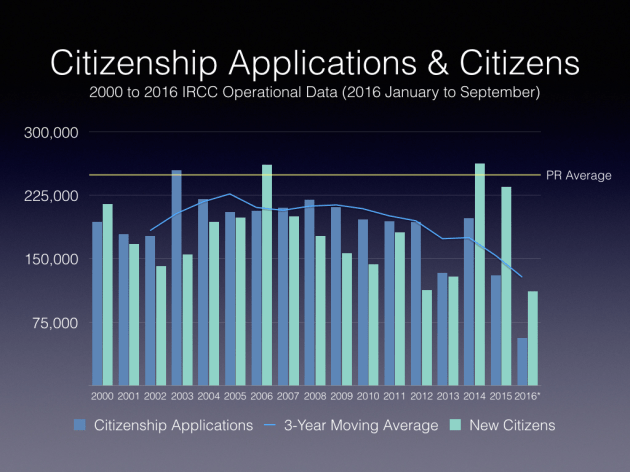
Citizenship Applications: Third Quarter Continues to Show Decline

citizenship-data-slides-010Further to my earlier analysis of the half-year numbers showing a dramatic decline (The impact of citizenship fees on naturalization – Policy Options), the third quarter numbers issued this week confirm the overall trend: only some 56,000 applications were received, compared to 112,000 for the same period in 2015, just about half.
This quarter is the first quarter one year after minimum residency requirements were changed to four years from three and so one might have expected some increase. Indeed, the July-September numbers show an increase for the quarter from 12,000 in 2015 to 20,000 in 2016. But this does not change the overall picture: the total number of applications this year is likely to be around 75,000 compared to 130,000 in 2015, a drop of over 40 percent.

Nor does it change my overall argument that the likely major factor responsible for this decline was the steep increase in adult citizenship processing fees in 2015 to $530.

Of course, the one bright spot in this decline is that the backlog has been reduced: the current inventory is just over 55,000 compared to about 250,000 at the beginning of 2015. Processing time has also declined, from 21 months for the same period in 2015 to 16 months currently.

The most recent approval rate is 91 percent, slightly down from 93 percent.

But reducing the backlog and reducing processing times by reducing demand for citizenship through higher fees and other barriers runs against the government’s overall diversity and inclusion agenda.


Battle against religious persecution ‘diminished’ under Liberal government: ex-ambassador

Bennett’s comments are not surprising, as the intent of the merger into the human rights division was to encourage a more integrated approach to all rights, which ultimately means a lower profile for religious freedom than provided by a separate office.

Same thing happened when multiculturalism moved from Canadian Heritage to IRCC in 2008 under then Minister Kenney, where it withered away in terms of personnel, funding and importance, and has yet to recover despite its move back to Canadian Heritage:

I agree fully with his call for greater religious literacy among officials (not just diplomats), given the place that religion plays in many peoples lives:

Canada’s former ambassador for religious freedom launched thinly veiled criticisms at the new Office of Human Rights, Freedoms and Inclusion on Wednesday.

Speaking to the Senate’s human rights committee, Andrew Bennett, now a senior fellow with Christian think-tank Cardus, said the “ill-defined and thoroughly vague” concept of “inclusion” could muddy the water and distract from specific religious persecution issues faced by minorities abroad.

Bennett implied the Liberal government’s new office, which replaced his Office of Religious Freedom earlier this year, has a vaguer mandate less focused on specific issues of religious persecution than it did under the Conservatives.

He said more training is needed because there is a “relative ignorance” of religion in the public-service ranks and a “false understanding of separation of church and state” still seems prevalent. To ignore the fact that religion plays a role in public life is “out of step,” “historically inaccurate” and a “very serious diplomatic blind spot,” he said.

“Allies are wondering why there has been a diminishment in focus on religious freedom,” Bennett added, arguing that religious freedom is fundamental and that to prioritize it does not deny attention to other human rights.

“Certain human rights need to be brought to the floor and actively and persuasively championed when they’re most being challenged,” he said. His office could have been louder, Bennett noted, when it came to specific issues, such as the treatment of Falun Gong practitioners and Tibetan Buddhists in China, of Christians in Saudi Arabia and of Shia Muslims in Pakistan.

Bennett said he worked with the new office as part of a transition process, including extending his own network of contacts, until June. But, in the context of a question about the transition period, he said, “unfortunately I was never afforded the opportunity to brief the minister on the work of the Office of Religious Freedom.”

Foreign Affairs Minister Stéphane Dion’s press secretary, Chantal Gagnon, said however that the two had met earlier, on Feb. 10, when they “discussed the work of the office.”

In an emailed follow-up statement to the National Post, Bennett said the meeting was held with “no more than two hours’ notice” and that Dion requested “advice on the political sensitivities of the non-renewal of the office” and his relationship with the office’s External Advisory Committee. “But that was not a structured, formal briefing on the office itself.”

Le cours d’éthique et de culture religieuse jugé sexiste | Le Devoir

Should have seen this coming – the challenge of how to improve awareness of different religions and their beliefs, a desirable goal in a diverse society, while placing these in the context of gender and other rights:

Le Conseil du statut de la femme (CSF) reproche au cours d’éthique et de culture religieuse d’enseigner les religions sans critiquer leur contenu sexiste. Dans un nouvel avis, il recommande que l’enseignement des religions soit séparé de celui de l’éthique, et joint au cours d’histoire.

Le cours ne « remet pas en question les pratiques sexistes au sein des religions » et se contente de décrire les récits religieux sans offrir de mise en contexte critique, déplore le CSF.

On donne l’exemple du récit d’Abraham dans l’Ancien Testament et de ses rapports avec son épouse Sarah et la servante de qui il aura un enfant (Ismaël). Certains manuels, note le Conseil, rendent Sarah « responsable du viol » de la servante et« euphémisent » la violence sexuelle subie par cette dernière.
Les textes sur l’institution du mariage catholique posent le même problème, selon le CSF. On expliquera par exemple aux enfants que les interdits et les rites visent à mettre les femmes « au service de la communauté » en favorisant notamment la « stabilité de la famille ». Or, à nouveau, c’est décrit sans regard critique, plaide-t-on.
Même chose pour la pratique du « gèt » (acte de divorce) dans la religion juive qui est réservée aux hommes, ou des règles régissant l’habillement des femmes dans les religions musulmane ou hindoue.
« Aucun élément de contenu ne permet aux élèves de comprendre que les religions sont des institutions sociales certes significatives pour un grand nombre de personnes, mais qui ont été et demeurent responsables d’un grand nombre de violences envers les femmes, ainsi que du maintien de pratiques et de représentations inégalitaires. »
Le CSF propose donc que la religion soit enseignée dans le cadre du cours d’histoire plutôt que dans celui du cours d’éthique. L’éducation à l’égalité, à la citoyenneté et à la sexualité devrait quant à elle s’insérer dans le cours d’éthique durant tout le parcours primaire et secondaire.

L’avis s’en prend en outre au cours d’histoire, qui explique mal ou peu les luttes menées par les femmes. Ainsi, dans un manuel traitant de l’obtention du droit de vote en 1940, on écrit qu’Adélard Godbout leur a « accordé » sans expliquer qu’elles ont « lutté des années pour l’obtenir ». Certains efforts sont toutefois soulignés, tel l’ajout de personnages historiques féminins dans les manuels.

Des biais sexistes

L’organisme s’inquiète en outre de la persistance de certains biais sexistes chez les enseignants. On constate que ces derniers donnent trop de place aux stéréotypes selon lesquels les garçons sont meilleurs en mathématiques, plus physiques et ont plus besoin de bouger que les filles, alors que ces dernières seraient plus à l’aise dans le monde des sentiments, des émotions et de l’aide au prochain.
« Si le corps enseignant peut tenir compte de ces différences — dues à la socialisation différenciée des garçons et des filles —, il ne devrait pas les consolider, écrit le CSF. Au contraire, l’école devrait contribuer à contrecarrer les effets de la socialisation de genre en évitant de réserver certaines approches pédagogiques ou certaines activités aux filles et aux garçons. »
Pour l’affirmer, l’organisme s’appuie notamment sur un questionnaire mené auprès de 393 enseignants. Parmi les répondants, 80 % ont soutenu que les garçons avaient besoin de méthodes éducatives plus « dynamiques et actives ». Une enseignante du primaire citée dans l’avis raconte « qu’il y a des exemples qui parlent plus aux garçons (mise en situation parlant de hockey) et d’autres qui intéressent plus les filles (décoration pour traiter de l’aire par exemple). »

Cela pousse le Conseil à faire une série de recommandations, dont l’ajout à la formation des maîtres d’un cours obligatoire sur le thème des inégalités de sexe. Or, le milieu semble réticent. Mercredi, lors du dévoilement de l’avis à l’Université Laval, la vice-doyenne à la recherche Annie Pilote a expliqué qu’il n’y avait « pas de marge de manoeuvre » pour un tel ajout dans le programme et qu’il faudrait plutôt que cela s’insère dans la formation continue.

Bowing to public pressure, Merkel calls for partial burka ban in Germany

Similar approach to Quebec’s law 62 focussing on the public sector. Hard to disagree with the sentiment that parallel societies are generally undesirable, whatever the religion, ethnicity or ideology from an integration and social cohesion/inclusion perspective. However, one can question whether a ban is the appropriate response, or only requiring the face to be revealed for identity authentication (e.g., identity cards, airport security):

For months, as the Western political establishment shook around her, German Chancellor Angela Merkel remained a stolid and increasingly lonely champion of liberal values. But on Tuesday, she joined those chipping at the idea of “live and let live” liberalism, embracing a populist call for a partial ban on the head-to-toe burka.

The proposed ban comes less than three weeks after Ms. Merkel announced she would seek a fourth term as Chancellor in parliamentary elections expected next September. It also comes days after Italian voters forced the resignation of their prime minister, and in the wake of both Donald Trump’s shocking run to the White House, and Britain’s unexpected vote to leave the European Union.

Speaking Tuesday to a conference of her centre-right Christian Democratic Union – which faces a threat on its right flank from the anti-immigrant Alternative for Germany (also known by its German acronym, AfD) – Ms. Merkel took aim at “parallel societies” that she said were forming in Germany. Borrowing from the rhetoric of the AfD and other populist parties on the rise around the continent, she said the full-face veil “should be banned wherever it is legally possible.”

“We do not want any parallel societies, and where they exist we have to tackle them,” she said to loud applause from party delegates gathered in the city of Essen. She specifically named sharia, an Islamic legal code based on a strict interpretation of the Koran. “Our laws have priority over honour codes, tribal and family rules, and over sharia. That has to be expressed very clearly.”

Ms. Merkel – who was re-elected as the CDU leader on Tuesday with just under 90-per-cent support – said the full-face veil inhibited “inter-human communication” and “was not appropriate” in Germany.

The remarks were a move away from the role many had hoped to see Ms. Merkel assume following Mr. Trump’s election win.

On a recent trip to Berlin, outgoing U.S. President Barack Obama hailed the German Chancellor as his “closest international partner,” leading to talk Ms. Merkel would – by default – become the voice and de facto leader of Western liberals.

The burka-ban proposal is a reminder that Ms. Merkel has always been a pragmatist first.

In reality, only a small minority of the estimated five million Muslims living in Germany wear the full burka. (A 2008 government-funded study found 28 per cent of German Muslims wore some kind of head covering; that figure includes those who wear the hijab, the much more common headscarf that covers the hair but not the face).

The proposed ban would likely only apply to schools, courts and other government buildings, as any wider restriction would seem to violate the country’s constitution.

The true aim of Ms. Merkel’s move against the burka is to soothe public anger over her decision last year to welcome into Germany hundreds of thousands of refugees from Syria, Iraq and other countries. The country has struggled – both culturally and bureaucratically – to process the new arrivals.

Source: Bowing to public pressure, Merkel calls for partial burka ban in Germany – The Globe and Mail

Canadian students are excelling: Don’t get complacent (OECD PISA)

Good overall assessment of the latest OECD PISA results and Canadian students and schools by Bonnie Schmidt and Andrew Parkin:

Canadians can be proud of our showing in the 2015 Programme for International Student Assessment report, released Tuesday. We are one of only a handful of countries that places in the top tier in the Organization for Economic Co-operation and Development in each of the three subjects tested: science, reading and math.

Canadian students not only exceeded the international average in science performance – they were among the best in the world in this subject. This is a positive result, given the diversity of our education systems and of our student population. Canada was also near the very top in reading, and remained in the top 10 in math. The OECD even singled Canada out for our ability to combine high achievement with a commitment to equity in education.

There is no gender gap in science performance in Canada, nor is there a gap between immigrant students and those born in Canada. Parents should welcome these findings.

Not only do Canadian students perform well in science, but they are also more likely than the OECD average to expect to have STEM careers (in science, technology, engineering and math) – 34 per cent of Canadian students have this expectation, compared with an international average of 25 per cent. This is good news for Canada and a testament to the many organizations across the country that help schools connect the dots between classroom science learning and the world of work.

But significant gender differences remain in terms of the specific types of STEM careers that boys and girls expect to have, with girls much more likely to expect careers in health sciences (29 per cent versus 10 per cent) and boys much more likely to expect careers in engineering (18 per cent versus 7 per cent) and information and communications technology (3.7 per cent in the ICT field versus 0.3 per cent).

While the PISA results do warrant celebration, we can’t become complacent. Challenges continue, not the least of which is figuring out how to continue evolving learning opportunities for Canadian youth so they can participate as citizens and in the labour market in a rapidly changing world.

And even though Canada stands out for its record in equity, some students still struggle to get the necessary attention. For example, PISA makes no reference to indigenous students. In addition, girls continue to significantly outperform boys in reading (though the gap narrows with digital reading) and, in some (but not all) provinces, boys outperform girls in math. Minority language classrooms (i.e. French learners outside Quebec and English learners in Quebec) also continue to lag behind.

Source: Canadian students are excelling: Don’t get complacent – The Globe and Mail

New archive highlights years of racism faced by Chinese Canadians | Toronto Star

A good reminder of our history:

Seventy-one years ago Mavis Chu Lew Garland and eight of her preschool classmates were photographed on the porch of the Chinese Canadian Institute on the corner of Dundas St. W. and University Ave.

Times were different, rather “extremely difficult,” she says, being born to a Chinese immigrant father and a white mother when interracial marriages were seen as unacceptable.

But now, at the age of 76, Garland and her classmates have come together to recreate a photo that was taken during a period of discrimination, and now represents a snapshot of Canadian immigrant history.

The photo, which Garland found while scrounging through old shoeboxes is just one of the artifacts donated to the Toronto Public Library as part of a three-year initiative, the Chinese Canadian archives, which opened on Tuesday at the Toronto Reference Library.

Since the announcement calling for donations in July, the library has received hundreds of articles to commemorate the historic voices of the Chinese people in Canada. Among the collection are old photographs of the city’s first Chinese restaurants, and businesses that once existed in the area where City Hall stands today.

But among the pieces of colourful memorabilia are documents highlighting a Canadian history of discrimination, including documentation on the racist Chinese head tax, showing how it rose from $50 in 1885 to $100 in 1900 and eventually to $500 in 1903 — at the time the price of buying two houses in Toronto.

Seventy-one years ago Mavis Chu Lew Garland and eight of her preschool classmates were photographed on the porch of the Chinese Canadian Institute on the corner of Dundas St. W. and University Ave.

Times were different, rather “extremely difficult,” she says, being born to a Chinese immigrant father and a white mother when interracial marriages were seen as unacceptable.

But now, at the age of 76, Garland and her classmates have come together to recreate a photo that was taken during a period of discrimination, and now represents a snapshot of Canadian immigrant history.

The photo, which Garland found while scrounging through old shoeboxes is just one of the artifacts donated to the Toronto Public Library as part of a three-year initiative, the Chinese Canadian archives, which opened on Tuesday at the Toronto Reference Library.

Since the announcement calling for donations in July, the library has received hundreds of articles to commemorate the historic voices of the Chinese people in Canada. Among the collection are old photographs of the city’s first Chinese restaurants, and businesses that once existed in the area where City Hall stands today.

But among the pieces of colourful memorabilia are documents highlighting a Canadian history of discrimination, including documentation on the racist Chinese head tax, showing how it rose from $50 in 1885 to $100 in 1900 and eventually to $500 in 1903 — at the time the price of buying two houses in Toronto.

Then there was the construction of the Canadian Pacific Railway in 1881, when an estimated 17,000 Chinese workers were brought to Canada and endured long working days, for around $1 a day. Due to the poor working conditions and illnesses, records estimated that they died in the thousands.

“All of them remained nameless in the history of Canada,” the monument standing just outside the Rogers Centre commemorating the Chinese CPR workers reads.

“I feel like a lot of the lives, work, and contributions of Chinese-Canadians have remained nameless,” 28-year-old Coly Chau told the Star.

Chau immigrated to Montreal from Hong Kong at the age of 5.

“Elementary and secondary education gave me very little exposure to the history of Chinese Canadians” Chau says.

After graduating high school, Chau said a lack of belonging pushed her to “dig deeper” to research and learn about her history.

“As an immigrant, my experiences have been greatly attributed to the contributions and experiences of those Chinese Canadians that came before my family and I,” Chau said. “There are instances of racism that I’ve experienced, or the feeling of being an outsider — but those that came before me worked very hard to dismantle a lot of it, and lessen it for us now.”

Source: New archive highlights years of racism faced by Chinese Canadians | Toronto Star

Despite uproar over Trinity Western, many B.C. Christian school policies bar LGBTQ teachers | National Post

Open question whether this form of discrimination in religious schools is compatible with continuing to receive public funding:

While the debate over Trinity Western University’s community covenant rages on through the courts and the media, many Christian elementary and high schools that receive B.C. government funding are quietly operating with similar policies that essentially bar gay and lesbian teachers from employment.

The independent schools all belong to the Society of Christian Schools in B.C. (SCSBC), which requires each of its 31 member schools to draft “community standards policies” for employees to follow. The suggested language includes refraining from all sexual activity outside of heterosexual marriage.

Several members of the society have posted policies that include these restrictions online, including schools in Abbotsford, Surrey, Langley, Nanaimo, and Houston. These policies also tend to include prohibitions on things like public drunkenness and watching porn.

“What a terrible message,” said former Vancouver school trustee Patti Bacchus. “Something like that, it just goes backwards. It’s flat-out discrimination and a violation of someone’s human rights.”

Ed Noot, the executive director of the SCSBC, is overseas and declined to answer questions by email.

Canadian legal precedent largely falls on the side of protecting the rights of religious schools to set their own policies, as long as they’re made in good faith and based on honestly-held religious beliefs. The defining Supreme Court of Canada case dates back to 1984, when the justices ruled in favour of a Vancouver Catholic school that fired a teacher after she married a divorced man.

The B.C. Court of Appeal followed that line of thinking when its panel of five judges ruled in favour of TWU establishing a law school, calling the B.C. Law Society’s attempt to deny the school accreditation on the basis of its discriminatory covenant a well-intentioned act carried out in an “intolerant and illiberal” manner.

That case will likely end up in the country’s highest court, and there are those who say it’s time for a change in direction.

Vancouver lawyer and queer activist Barbara Findlay believes that freedom of religion and freedom from discrimination are both essential rights, but she has strong feelings about how these rights should be balanced.

“I say that your right to freedom of religion ends where you want me to do something. My right to be free from discrimination can only exist if your right to freedom of religion is not allowed to trump it,” findlay said.

“I’m hoping that this question will be definitively settled in the Trinity Western case when it heads to the Supreme Court.”

This fall, Education Minister Mike Bernier announced that all public and private schools in B.C. would have to include protections for LGBTQ students in their anti-bullying policies, and choked up as he remembered the difficulties his lesbian daughter faced in school. Meanwhile, the province’s new curriculum asks teachers to ensure their lessons support inclusion and diversity, including “diversity in family compositions and gender orientation.”

In an emailed statement, the education ministry stressed that “We believe in safe, respecting and inclusive schools.” But the statement also pointed out that Canada’s Human Rights Act allows certain schools to discriminate if their primary purpose is promoting the interest of a religious group. Most independent school authorities in B.C. meet the requirements for that, according to the ministry.

Source: Despite uproar over Trinity Western, many B.C. Christian school policies bar LGBTQ teachers | National Post

Enclaves of Islam see UK as 75% Muslim | News | The Times & The Sunday Times

Failure of British integration and related programs. Some interesting observations at the end of the article about the risk of monocultural white schools and far right radicalization:

Some Muslims lead such separate lives that they believe Britain is an Islamic country where the majority of people share their faith, according to a report to be published this week.

Evidence gathered by Dame Louise Casey, the government’s community cohesion tsar, will lift the lid on how some Muslims are cut off from the rest of Britain with their own housing estates, schools and television channels.

Her report finds that thousands of people from all-Muslim enclaves in northern cities such as Bradford, Dewsbury and Blackburn seldom, if ever, leave their areas and have almost no idea of life outside.

A source who has read the report said: “Certain Muslims, because they are in these communities and go to Muslim schools, think Britain is a Muslim country. They think 75% of the country is Muslim.”

The correct figure, according to the 2011 census, is 4.8% of the population in England and Wales. Christians account for 59.3%.

Casey’s report will be embarrassing for ministers, and Theresa May in particular, because it will say the government does not have any serious integration strategy.

The report will criticise the Home Office, which May used to run, and other departments for not doing enough to manage the pace and consequences of mass immigration.

“It will say that nobody has been on it,” said a source familiar with the contents.

A source close to Casey said: “There is a desire [among policymakers] to tolerate such a level of significant difference that you have overcompensated and gone way too far.”

Those familiar with the report say Casey, who investigated failings by children’s services at Rotherham council after the child abuse scandal, has seen off attempts by the Home Office to water down her report. One described it as “full-fat Louise”.

The report will “send shock waves through the system”, a Whitehall source said, adding: “It’s going to be quite hard reading for some people.”

Casey will attack the police and other state bodies for “weakness” and pandering to false notions of what they think ethnic communities want — such as a police chief who said female officers could be allowed to wear the full veil.

“The report will say that we are in a vicious circle where some institutions are so wrongfully interpreting their version of political correctness that they are gifting the far right,” a source said.

Sir Michael Wilshaw, the departing chief inspector of schools, warns today that about 500 schools in England are either 100% white or 100% ethnic minority — and pupils in them are at risk of alienation and radicalisation.

Wilshaw told The Sunday Times that parallel communities were developing in Britain and children growing up in monocultural schools in these communities were in danger of being cut off from British values and vulnerable to either far-right or Islamist causes.

The chief inspector said that he was particularly worried about a cluster of 21 schools in Birmingham — many of them primaries with predominantly Muslim pupils — where there were no white pupils. Nearly half of the schools have been judged “less than good”.

“We have to make sure these schools are good schools so youngsters in them feel they are part of British society and they have to respect other people’s faiths and cultures,” Wilshaw said.

“In white-only schools the same thing applies. Though we might not be as concerned in white communities about radicalisation, certainly we are worried about alienation and the rise of the far right.

“If these children have not been well educated and cannot get jobs as a result that will feed into alienation and the espousal of right-wing ideologies.”

Casey has examined the social alienation felt by the white working class. Although her report will not dismiss the far right it will say that Islamist extremists pose a more serious threat.

The report will also attack the government for not doing enough to defend Prevent, its embattled counter-extremism policy, against misinformation put out by Islamist and far-left groups.

Source: Enclaves of Islam see UK as 75% Muslim | News | The Times & The Sunday Times

‘We won’t back down’: Young right-wing activists agitate across Europe for an idealized past – Canada – CBC News

Interesting profile of the white supremacist movement and key players in France, similar to the likes of Robert Spencer and the like in USA:

They are traditionalists with a YouTube channel, nostalgic nationalists who text and tweet.

Young, white and European, they call themselves Identitarians, right-wing activists agitating across the continent against immigration and Islam and for a future rooted deep in an idealized past.

“I’m a product of my time,” says Pierre Larti, a spokesman for Génération identitaire (GI), the French branch of the movement. “But I know the difference between what is good in this era and what isn’t.”

Larti is buff, squeaky clean and, at 27, already part of the old guard of the movement.

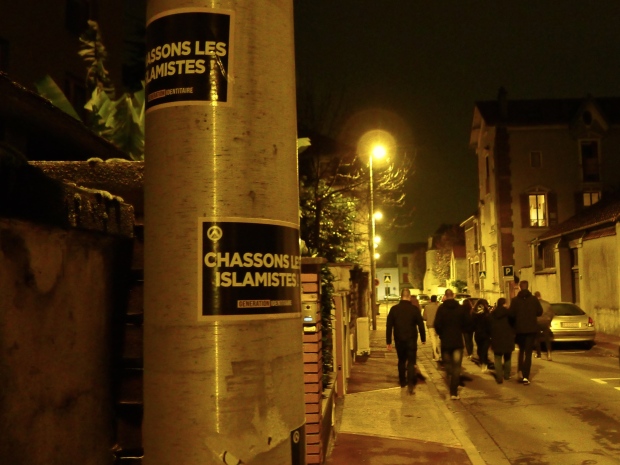
Issy stickering

Génération identitaire uses of range of strategies to get its message across, from Greenpeace-style shock tactics to postering and stickering in like-minded neighbourhoods. (Michelle Gagnon/CBC)

After a long day and a meeting that ran late — Larti works in HR at a yogurt factory — he travelled more than 50 kilometres to lead a low-tech, late-night postering and stickering campaign in Issy-les-Moulineaux, a suburb just outside Paris.

“I’ve lived in this multiethnic society and seen its ravages, the dangers it poses for us, for the French. We’ve become passive, too accepting,” Larti says.

“We accept the veil in the public square. We accept burkas. Little by little, we accept everything. We accept that France now has more than 2,500 mosques.

“We accept one or two attacks a year,” he pauses and then asserts: “I cannot accept that.”

Source: ‘We won’t back down’: Young right-wing activists agitate across Europe for an idealized past – Canada – CBC News