More people should engage in politics so ‘no party gets to run against Muslim Canadians,’ Justin Trudeau says

Pitch perfect:

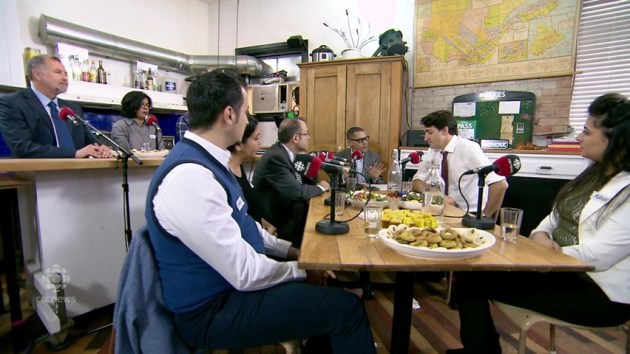
Galloway asked the prime minister for his reaction to the proposal to screen immigrants for “anti-Canadian values” put forward by federal Conservative leadership candidate Kellie Leitch.

Trudeau did not address Leitch by name. He said he told a group of Muslim-Canadians during a recent meeting that he was happy to have them as supporters. However, he said he suggested they encourage family members and friends to also get involved in politics, whether on behalf of the Liberals or another party that aligns with their values.

Media placeholder

“The other two political parties have leadership races on now. I’d like to see more Canadians of diverse backgrounds engaging with parties that line up with their convictions and ideologies to make sure that no party gets to run against Muslim Canadians or any other group of Canadians and demonize them,” Trudeau said.

“And I think the way we do that is getting involved in the whole breadth of the political spectrum in Canada. I’m happy when people decide they are more aligned with me and my party, but they should also think about being active and aligned with parties that disagree with me on certain issues.”

Galloway also asked the prime minister about how his policy, which has brought more than 35,000 Syrian refugees to Canada in just over a year, contrasts with that of U.S. president-elect Donald Trump and some politicians across Europe, who advocate for a more closed approach on refugees.

“I’m not going to answer whys,” he said. “I’m just going to continue to point out the facts that the way Canada is benefiting from welcoming in people who are so deeply committed to living up to the opportunity given to them.”

He added, “I challenge any one of those governments or those citizens to sit down around a table like this and break bread and not be afraid of the other.”

Source: More people should engage in politics so ‘no party gets to run against Muslim Canadians,’ Justin Trudeau says – CBC.ca | Metro Morning

Inside Quebec’s far right: Take a tour of La Meute, the secretive group with 43,000 members

Worrisome, even if numbers still small (and mainstream parties like the CAQ and PQ that pander to these fears and play identity politics, need to reflect on their impact):

La Meute’s leaders are now attempting to translate the group’s online popularity into concrete political influence.

They hope to become a lobby group of sorts, dedicated to making Quebecers aware of the threat posed by Islamic fundamentalism.

“I don’t have the desire to live under Shariah. I don’t want to live under a totalitarian Islamic regime,” said Eric Venne, one of the group’s founders, a veteran of the war in Afghanistan who goes by Corvus, after the genus of crows, ravens and rooks.

“But we are heading that way. It may not look like it in 2016. Tomorrow, people might go, ‘Oh.’ But by then it will be too late.”

Where others sputtered, La Meute surged

Corvus started La Meute with Patrick Beaudry, another former soldier, in the fall of 2015, just as the first of 25,000 Syrian refugees began arriving in Canada.

At a sugar shack in the Beauce, south of Quebec City, the pair drew up plans for a hierarchical organization modelled on their military background.

They gave it a name to invoke the sense of camaraderie they felt was needed in the face of what they considered a grave existential threat. In an early communiqué, Corvus described the influx of refugees as a “Trojan horse” for Islamic terrorists.

La Meute is among dozens of social media groups, blogs and websites that have popped up in recent years to give voice to concerns about Islam in Quebec.

But where other groups sputtered, La Meute surged.

The group’s activities were initially confined to its secret Facebook page. But as the group grew — it had more than 40,000 members by the start of the summer — it diversified.

A non-profit organization was registered to serve as La Meute’s fundraising arm, and fundraisers that each drew 150 people were held in Quebec City and the Saguenay.

By August, the group was distributing pamphlets around the province. Later that month, Corvus and several fellow members disrupted an information session near Quebec City organized by a group of volunteers trying to host a family of Syrian refugees.

Source: Inside Quebec’s far right: Take a tour of La Meute, the secretive group with 43,000 members – Montreal – CBC News

The Scourge of Racial Bias in New York State’s Prisons – The New York Times

Good but disturbing investigative reporting:

Most forbidding are the maximum-security penitentiaries — Attica, Clinton, Great Meadow — in rural areas where the population is almost entirely white and nearly every officer is too. The guards who work these cellblocks rarely get to know a black person who is not behind bars.

Whether loud and vulgar or insinuated and masked, racial bias in the state prison system is a fact of life.

It is also measurable.

A review by The New York Times of tens of thousands of disciplinary cases against inmates in 2015, hundreds of pages of internal reports and three years of parole decisions found that racial disparities were embedded in the prison experience in New York.

In most prisons, blacks and Latinos were disciplined at higher rates than whites — in some cases twice as often, the analysis found. They were also sent to solitary confinement more frequently and for longer durations. At Clinton, a prison near the Canadian border where only one of the 998 guards is African-American, black inmates were nearly four times as likely to be sent to isolation as whites, and they were held there for an average of 125 days, compared with 90 days for whites.

A greater share of black inmates are in prison for violent offenses, and minority inmates are disproportionately younger, factors that could explain why an inmate would be more likely to break prison rules, state officials said. But even after accounting for these elements, the disparities in discipline persisted, The Times found.

The disparities were often greatest for infractions that gave discretion to officers, like disobeying a direct order. In these cases, the officer has a high degree of latitude to determine whether a rule is broken and does not need to produce physical evidence. The disparities were often smaller, according to the Times analysis, for violations that required physical evidence, like possession of contraband.

Blacks make up only 14 percent of the state’s population but almost half of its prisoners. Racial inequities at the front end of the criminal justice system — arrest, conviction and sentencing — have been well documented.

The degree of racial inequity and its impact in the prison system as documented by The Times have rarely, if ever, been investigated. Nor are these issues systematically tracked by state officials. But for black inmates, what happens inside can be profoundly damaging.

Bias in prison discipline has a ripple effect — it prevents access to jobs and to educational and therapeutic programs, diminishing an inmate’s chances of being paroled. And each denial is likely to mean two more years behind bars.

A Times analysis of first-time hearings before the State Board of Parole over a three-year period ending in May found that one in four white inmates were released but fewer than one in six black inmates were.

Source: The Scourge of Racial Bias in New York State’s Prisons – The New York Times

Ottawa: Community tells Ontario government of systemic racism

The last in a series of public consultations to help inform the Ontario anti-racism directorate:

Hiwot Adhanom couldn’t believe what she was hearing from two co-workers conducting a hiring process for a public service job.

Her colleagues were attempting to determine who might meet the job criteria’s preference for Canadian citizens. “The first answer is ‘I guess we can tell by their name’,” Adhanom said she overheard them say. It wasn’t until they saw her nameplate that they stopped to think that Canadian citizenship means more than that. It was not her first experience with racism in a workplace.

At another job, a manager at a retail store who hired her nonchalantly told her how she was “not anything like all of the other black people who come in here looking for work.” “She saw nothing wrong with that, she thought she was paying me a compliment by insulting me and every other person who happens to be black,” said Adhanom, one of dozens of people who lined up behind microphones Saturday to tell their experiences to Ontario’s political leaders.

The anti-racism directorate is attempting to come up with a strategy to address systemic racism within government. The meeting is the last of 10 public consultations held across the province before it comes up with a policy, which is expected to be released in the spring of 2017.

For Adhanom, it was asking the directorate to develop tools and resources that employers are required to use to ensure fairness and equality in hiring.

It was just one of a spectrum of concerns about systemic racism and injustice that Ontario’s minister responsible for anti-racism, Michael Coteau, heard about from an audience of 200 during the two-hour meeting at the RA Centre. Others described systemic racism in the criminal justice system, health care, child welfare system, schools and the hiring process. Many called on more education as a means to combat it.

Attorney General Yasir Naqvi also attended the meeting, along with local MPPs Nathalie Des Rosiers, John Fraser and Marie-France Lalonde. Ottawa police chief Charles Bordeleau, other senior police officers and Ottawa councillors Jeff Leiper and Mark Taylor were also present.

The directorate’s goal is to eliminate systemic racism in institutions governed or regulated by the Ontario government, increase awareness and understanding of systemic racism among the public, promote fair practices and policies that lead to racial equity, and collaborate with the community, business organizations and the Ontario Human Rights Commission.

“You have to start in government. You can’t go out there preaching that change needs to happen but not take care of that change internally,” said Coteau. “What we are talking about today is not about putting in quotas or saying ‘X amount of jobs have to be this,’ it’s about removing barriers so people have the opportunity to compete on a fair basis to get the types of jobs that they are qualified to get.”

Source: Ottawa Citizen | Latest Breaking News | Business | Sports | Canada …

Europe’s Jews have reason to fear today’s political climate: Saunders

Interesting column by Doug Saunders:

To understand this, it’s worth following the work of Yascha Mounk, a Harvard University scholar. Mr. Mounk made headlines this week with a new study, co-authored with Roberto Stefan Foa at the University of Melbourne, which found that voters in most European countries and the United States are increasingly less likely to believe it is “essential” to live in a democracy. This effect is stronger among younger people and right-wing voters.

For Mr. Mounk, this is part of a larger phenomenon. Two years ago, he published Stranger in My Own Country, a memoir of his life as a young German Jew. It noted that the Christian Europeans around him, while professing liberal tolerance, were continuing to treat Jews such as himself as different, other or outside. In an essay titled “Europe’s Jewish Problem,” he linked these observations to the rise of the new right-wing populist movements.

“Europe’s political climate is more hostile to Jews now than at any time since the second intifada,” he wrote. But he concluded that it wasn’t Muslim anti-Semitism leading the trend; rather, it was the far larger populations of Christians. As he noted, the number of Spanish citizens who express unfavourable views of Jews is almost 50 per cent; Muslims make up less than 3 per cent of Spain’s population and aren’t growing fast. So “a European anti-Semite remains far more likely to be Christian than Muslim.”

The larger problem, he concluded, is “the tendency of wily politicians to play Jews and Muslims against each other for purposes of their own.”

A recent large-scale survey of French attitudes toward Jews by political scientist Dominique Reynié found that anti-Semitism in general is declining, but the country’s Muslims do indeed have higher rates of anti-Jewish beliefs than the general population. What really stood out, though, were the many people who support Marine Le Pen’s National Front party: They were even more likely than Muslims to agree with Jewish-conspiracy claims such as “Jews use their status as victims of the Nazi genocide for their own interest” or “the Jews are responsible for the current economic crisis.” And they were almost equally likely to support statements such as “there is a Zionist conspiracy on a global scale,” at rates twice as high as the general population. Muslims make up only 7 per cent of the population of France, but Ms. Le Pen commands at least one-fifth of the population, and her support is rising fast.

These parties and movements, Mr. Mounk concluded, attract those who are hostile toward both Muslims and Jews. “The very same revival of nationalism that has been fuelled by their invocation of Jews [as foils for their politics],” he wrote, “can, in this way, quickly turn into anti-Semitism.” And that, combined with a growing group of voters who don’t care about democracy, is something that Europe ought to fear.

Source: Europe’s Jews have reason to fear today’s political climate – The Globe and Mail

L’État rate Latin American cible: La campagne publicitaire du ministère de l’Immigration fait rager des membres du comité consultatif sur la radicalisation

When advertising campaigns get it wrong:

« Assimilationniste », « négationniste », pleine de « clichés ». La campagne sur la diversité lancée lundi par le ministère de l’Immigration du Québec choque des leaders de la communauté musulmane. Au moins l’un d’eux, invités à siéger à une table de travail sur la prévention de la radicalisation, a annoncé son départ et d’autres songent à le faire, jugeant leur rôle inutile au sein de ce comité consultatif, a appris Le Devoir.

« La campagne me semble tout à fait grossière compte tenu de la responsabilité du ministère », a déclaré Haroun Bouazzi, président de l’Association des musulmans et des Arabes pour la laïcité au Québec (AMAL-Québec). « D’un côté, on a la négation du racisme et de l’autre, la discrimination est abordée du bout des lèvres. » Furieux, ce Canado-Tunisien a quitté la Table de travail intersectorielle sur la prévention de la radicalisation menant à la violence, à laquelle il siégeait bénévolement à la demande du ministère de l’Immigration (MIDI), aux côtés d’une dizaine d’autres leaders de la communauté musulmane.

Au coût de 1,2 million, la première phase de la campagne « Ensemble, nous sommes le Québec » qui se déploiera sur cinq ans consiste pour l’instant en deux capsules vidéo, tournées par le réalisateur Ricardo Trogi et diffusées à la télé et sur Internet. Misant sur des modèles d’intégration réussis, on y voit le joueur de soccer de l’Impact Patrice Bernier, un Haïtien d’origine né à Longueuil, et la productrice et animatrice Alexandra Diaz, une Chilienne qui a grandi au Québec, parler de leur expérience d’immigrant de façon positive, faisant allusion aux jokes de Rock et Belles oreilles, au hockey et à la tarte au sucre.

« Le bon immigrant, dépeint par les deux publicités, ne doit pas seulement apprendre le français, il doit aussi connaître toutes les répliques de RBO par coeur. Le bon racisé ne doit pas se contenter d’être un bon joueur de soccer (le sport le plus pratiqué au Québec), il doit aussi savoir jouer au hockey », a déploré M. Bouazzi dans une lettre coup de gueule envoyée au MIDI.

Vernis interculturel

Siégeant également à cette table intersectorielle, Bochra Manaï, professeure et spécialiste d’études urbaines à l’Université d’Ottawa, croit que la campagne du ministère rappelle celles des années 1980-1990, où le Québec faisait encore du « vernis interculturel ». « Ça me fait penser à [la vidéo] pour le 375e de Montréal, c’est complètement à côté de la plaque, dit-elle. Si, politiquement, on continue à faire dans le très superficiel, c’est qu’on ne comprend rien à l’époque dans laquelle on vit ». Elle appelle à plus de « courage » de la part du gouvernement. « Je ne vois pas qui on peut vraiment choquer aujourd’hui en faisait une pub d’un immigrant qui dit qu’il a du mal à se trouver une job parce qu’il s’appelle Mohamed », soutient Mme Manaï.

Ève Torrès, coordonnatrice de La Voie des femmes, s’étonne aussi que le gouvernement soit à ce point « frileux » en lançant une campagne aussi consensuelle. « On se moque de nous, s’indigne-t-elle. Nous, on pensait que le message était passé et qu’il y avait vraiment un éveil, une compréhension des enjeux et une envie de collaborer. Mais même après toutes ces années de collaboration des communautés, il n’y a rien qui sort. »

La professeure à l’UQAM, Maryse Potvin est d’avis que le gouvernement donne l’impression qu’il n’est pas à l’écoute. « Il semble ne pas entendre les voix qui lui demandent de prendre en charge certains problèmes de discrimination. Il fait simplement montrer des gens bien intégrés qui sont heureux d’être ici […] les gagnants, constate-t-elle. Le vivre-ensemble, c’est aussi être conscient qu’il y a des gens qui sont rejetés dans la société et dire un peu plus comment on va faire et ce qu’on a mis en oeuvre pour les aider. »

Exclus de la discussion

Certains membres de cette table de travail sur la radicalisation, fondée il y a deux ans à la demande du gouvernement Couillard, sont d’autant plus choqués qu’ils disent n’avoir jamais été consultés à propos de la campagne audiovisuelle. Ils n’ont été mis au courant que deux jours avant son lancement lundi dernier. « On est un peu le comité “ bonne conscience ”, qui légitime et valide ce que [le gouvernement] choisit de faire », indique Bochra Manaï. Elle se dit « choquée » que la table de travail, qui avait été lancée pour discuter des questions d’islamophobie et de radicalisation, n’ait rien produit de probant à cet effet. « Je suis la seule chercheuse qui siège. Il faut beaucoup plus de monde et de chercheurs. »

Il n’y a pratiquement que des Maghrébins qui siègent à cette table, et aucun musulman converti ou non francophone. Tous de bonne foi, ils ont même accepté de participer à une rencontre convoquée par le ministère le 12 septembre dernier… jour même de l’Aïd, qui est aux musulmans ce que Noël est aux chrétiens.

« On est là bénévolement pour s’assurer qu’on a un vrai vivre-ensemble, qui évite la xénophobie et l’exclusion, mais on n’a pas été écoutés », déplore une personne membre de cette table qui désire garder l’anonymat. Elle reconnaît toutefois que la ministre Kathleen Weil semble avoir « une volonté d’écouter nos propositions, mais ça ne se reflète pas dans les actions du ministère ».
Source: L’État rate la cible | Le Devoir

Ryerson ‘concerned’ about allegations of anti-Semitism at student union meeting

Worth noting:

Ryerson University has expressed concern about complaints of anti-Semitism that erupted at a student union meeting this week after students made a motion to mark Holocaust education week on campus every year.

“The university is very concerned about allegations at a recent RSU (Ryerson Students’ Union) meeting,” Johanna VanderMaas, manager of public affairs, said in an email Thursday.

“We are committed to providing a civil and safe environment which is free of discrimination, harassment and hate, and is respectful of the rights, responsibilities, well-being and dignity of all of its members.”

VanderMaas confirmed that Ryerson president Mohammed Lachemi had met with Obaid Ullah, head of the student union, to discuss the matter.

Ullah said the student union is also investigating the allegations, which he called disturbing.

Lachemi’s office has also spoken with one of the students who made the claims “to provide support, guidance and to ensure their concerns are heard” and contacted the Jewish student organization Hillel Ryerson, she said.

The alleged incident took place Tuesday evening at an RSU general meeting, during which a student introduced a motion to commemorate Holocaust education week with events to teach and remember the tragedy.

Third-year student Aedan O’Connor, there to support the motion, said she and other students were subject to jeers and snickers when they spoke, which escalated to anti-Semitic comments.

She also accused two groups of orchestrating a spontaneous walkout so quorum would be lost at the meeting, and with it an opportunity to vote on the motion for Holocaust remembrance — which both groups denied.

“Several students left crying and having panic attacks,” said O’Connor, 20, a member of Hillel Ryerson. Some posted their experiences on the RSU and other Facebook pages.

Neither Ullah or Tamara Jones, RSU vice-president of equity, said they heard any derogatory remarks from their positions on stage at the front of the room.

But they said the union is disturbed by the claims. The motion for a week to mark the Holocaust has the support of the board and will likely be approved at the next meeting, said Ullah.

“At the end of the day we have zero tolerance for this,” he said. “We do not tolerate any form of oppression. It’s not fair for these students to feel upset, or negative or hear such negativity on their own campus.”

He said he has met with two Jewish groups, Hillel Ryerson and Students Supporting Israel, and “they’ve been assured they have our support and the university’s support.”

Ullah said the controversy broke out more than three hours into the meeting, after many attending to support earlier motions had left, and attendance was hovering around the required quorum level of 100 people.

When someone proposed the motion regarding Holocaust education week be broadened to a week commemorating all genocides, “it definitely caused a lot of heat in the room,” he said, adding that proposal “was not appropriate.”

News of the allegations quickly spread on social media and sparked condemnation from such groups as B’nai Brith Canada and Hillel Ontario.

Jones said since the meeting, she has heard from half a dozen upset students and expects to hear from more.

“I’m shocked and disheartened that any of this had to happen,” said Jones.

Both groups accused of orchestrating the walkout strongly denied it on Facebook and did not respond to media requests.

“Allegations that we organized or directed the loss of quorum are completely false and hurtful,” said a post from the Ryerson Muslim Students’ Association.

“We strongly believe in free speech, the right for all paying members of the RSU to put forth motions, and the importance of motions being debated and put to a democratic vote.”

A statement from the executive of Students for Justice in Palestine said it supports the call for a week to commemorate the Holocaust at Ryerson and “did not engage in any manner in the ‘planned’ walkout.”

Austria election: Holocaust survivor’s appeal goes viral – BBC News

We neglect these warnings at our peril:

An emotional appeal from a Holocaust survivor has gone viral ahead of Austria’s presidential election.

Gertrude, 89, said Norbert Hofer’s right-wing Freedom Party “brings out the basest in people”, as she urged people to vote for his competitor.

“I have seen this once before… and it hurts and scares me”, she said, referencing anti-Semitism in the 1930s.

She was deported to the Auschwitz death camp with her family aged 16. She was the only one to survive.

Gertrude, known only by her first name, shared the video through Mr Hofer’s rival, Alexander Van der Bellen. It has been viewed almost three million times.

Austria’s presidential vote re-run is on 4 December and the polls indicate the result is too close to call. If Mr Hofer wins, he will become the EU’s first far-right head of state.

His party was founded in 1955 by a former general in the Nazi SS and it is also distinctly anti-immigration.

“That’s what bothers me the most … no respect for others, they bring out the basest of people – not the decent, but the indecent,” Gertrude said in her video.

“And it’s not the first time something like this has happened.”

She compared the rhetoric surrounding immigration to her memories of Jewish people being mocked and laughed at as they cleaned the streets of Vienna in her youth.

“That hurts. I am afraid of that,” she said.

Gertrude also said she was particularly worried by comments from the Freedom Party’s leader.

Heinz-Christian Strache in October spoke of an “uncontrolled influx of migrants alien to our culture who seep into our social welfare system”, adding that “civil war in the medium-term [is] not unlikely”.

Gertrude said she remembered a civil war from when she was seven years old and saw a dead body for the first time – something she said she could never forget.

It is not clear which war she was referring to, but Austria’s February uprising of 1934 was a four-day armed conflict which left several hundred dead.

“A shiver ran down my spine and I thought to myself: this should not even be mentioned, or even thought of,” she said.

“This is probably going to be my last election. I don’t have much time left. But the young ones still have their whole life ahead of them.

“And they have to look after themselves and for a bright future.”

Source: Austria election: Holocaust survivor’s appeal goes viral – BBC News

Immigrant acculturation and wellbeing in Canada: John Berry and Feng Hou

Another informative study by John Berry and Feng You showing that an acculturation and integration strategy that involves a strong sense of belonging both to Canada and the country of origin tends to result in higher levels of well-being:

Consistent with much of the research on acculturation strategies, we found that the integration strategy (in the present case, a strong sense of belonging to the two countries) was by far the most preferred strategy. This general preference for integration has been found in many previous studies (reviewed by Berry, 1997). This preference for integration is observed even when the assessment of these strategies is operationalised in very different ways (Berry & Sabatier, 2011; Snauwaert, Soenens, Vanbeselaere, & Boen, 2003). However, both these authors also found that that these differing operationalisations provided varying estimates for the extent of preference for each strategy. In the present study, even when using only the two dimensions of sense of belonging, and having only one question for each dimension, this approach seems to have provided results that are consistent with much of the research literature: integration is by far the most preferred strategy.
The relationship between the two belonging dimensions was examined by a simple correlation. We found this to be .13, which, while significant, does not indicate that they assess the same phenomenon. Berry et al. (2006), using two cultural identities (ethnic and national) in their study of immigrant youth, found a similar positive correlation between these two identities. In the 13 countries in the sample combined, the overall correlation was .17, ranging across societies of settlement from highs of .32 to a low of .28. The overall pattern was for positive correlations to be in “settlement societies” (such as Australia, Canada, New Zealand, and the United States) and negative in all other societies. This is a well-established finding in the acculturation literature, particularly in traditional immigrant-receiving countries such as Australia, Canada and the United States (e.g., Benet-Martinez, 2011; Berry, 1997; Berry et al., 2006; Costigan, Su, & Hua, 2009; Snauwaert et al., 2003).
Having created these four acculturation strategies, we attempted to assess what factors might be related to each of them. With integration taken as the control, we found patterns of demographic and social factors that are associated with each of the other three strategies.
  • Those in the assimilation group: had resided longer in Canada, had immigrated earlier in their lives, were more likely to be in the labour force, had lower bonding with their own cultural community, and were more likely to be divorced or separated. These latter two associations seem to represent a way of living in Canada that is one of living alone, and not being linked to their cultural community.
  • Those in the separation group resided in Canada for a shorter period of time; this could well represent a lag in coming to learn about and feel part of their new society. Previous research has shown this phenomenon both longitudinally (Ho, 1995) and cross-sectionally (Berry et al., 2006). Those pursuing separation were also more likely to have experienced discrimination; this finding may be an example of the phenomenon of “reactive identification” (which was referred to earlier), where individuals who feel rejected reciprocate this feeling and reject those who are the source of discrimination. This seems to represent a way of living in Canada of turning inward toward one’s own group, at least in the short term.
  • Those in the marginalisation group were more likely to be underemployed and have a lower income, were very likely to have come to Canada in the family or dependent class, and more likely to be widowed or never married. This seems to represent a way of living in Canada that, while being initially tied to a family, they now are more alone in both their economic and family situation. These patterns of association between acculturation strategies and demographic and social factors are the most common ones to be found in the literature (see Sam & Berry, 2016 for an overview).

The main focus in this study is on the wellbeing of immigrants, and whether their wellbeing can be associated with their acculturation strategy, as well as with these demographic and social factors.

First, we found that in keeping with much of the previous literature, including numerous individual studies (e.g., Berry et al., 2006) and a metaanalysis (Nguyen & Benet-Martinez, 2013), the integration acculturation strategy was associated with higher levels of wellbeing (both life satisfaction and mental health) compared to the other three strategies. This remained the case when the scores were adjusted for the demographic and social control variables that also have impact on wellbeing.

Also in keeping with much of the research literature, marginalisation was associated with the poorest levels of wellbeing.

This pattern adds to the growing evidence that when immigrants remain attached to their heritage culture, and also become involved in their new society, they achieve a greater level of wellbeing. In sharp contrast, when they are disengaged from both cultures, lacking bonding and bridging capital, they have poorer outcomes.

The present study confirmed that integration is associated with higher wellbeing. This pattern shows that being involved in both the heritage culture and in the larger society (by way of integration) promotes life satisfaction.

The research carried out on the relationship between social interactions and wellbeing in a variety of samples (Jetten, Haslam, Haslam, & Branscombe, 2009; Jetten et al., 2015) provides a broader context within which to interpret this relationship: Being engaged in and identifying with many social groups provides a basis for wellbeing. This consistent finding with immigrant samples seems to be a specific example of this general pattern.

Of particular important is the finding that the effects of acculturation strategy was larger than the social and demographic factors that are often held to account for wellbeing (Helliwell, Layard, & Sachs, 2016).

Immigrant acculturation and wellbeing in Canada

Dutch lower house approves limited ban on burqas, niqabs

Somewhat more restrictive than Quebec’s Bill 62 given that it also covers public transport:

Lawmakers in the lower house of the Dutch parliament on Tuesday approved a limited ban on “face-covering clothing” including Islamic veils and robes such as the burqa and niqab.

The legislation, approved by a large majority in the 150-seat lower house, must now be approved by the upper house of parliament before it can be signed into law.

In a text message to The Associated Press, anti-Islam lawmaker Geert Wilders called the limited ban, “a step in the right direction” and said he will push for a full burqa ban if his Freedom Party wins elections in March.

Studies suggest that only a few hundred women in the Netherlands wear niqabs or full-face burqas, but successive governments have attempted to ban the garments, following the example of European countries such as France and Belgium.

The Dutch proposal, described by the government as “religion-neutral,” does not go as far as the complete bans in those countries. It applies on public transport and in education institutions, health institutions such as hospitals, and government buildings.

In a debate last week that paved the way for Tuesday’s swift vote, Interior Minister Ronald Plasterk acknowledged that debate about the burqa had played a major role in the ban. But Plasterk, who is from the centre-left Labor Party, said that in a free country like the Netherlands people should be allowed to appear in public with their faces covered, if they want to, but that in government buildings, schools and hospitals people need to be able to look each other in the face.

The maximum fine for breaching the ban, which also covers ski masks and full-face helmets, is just over 400 euros ($425).

Source: Dutch lower house approves limited ban on burqas, niqabs – The Globe and Mail