Liberal Jewish and Muslim MPs condemn imams who called for the death of Jews [and anti-Muslim hate]

Great initiative and statement:

….So right now, the Parliamentary record shows Liberals voting down a motion condemning racism and intolerance even as Conservatives, New Democrats, and Bloc Quebecois MPs, along with the lone Green Party MP, voted in favour of condemning all racism and religious intolerance. (Conservatives, it should be noted, vowed not to vote for M-103 when that motion comes to the floor, preferring, instead the one voted on Tuesday.)

It’s in that context — the reports of the imams calling for death to Jews and the Liberal rejection of a motion condemning, in part, discrimination against Jews —  that a group of Liberal Jewish and Muslim MPs issued this statement Wednesday:

“As Canadians, we rise and fall together. Polarization doesn’t only hurt targeted groups, it hurts all Canadians.

As Parliamentarians, we feel it is our responsibility to rally Canadians around our shared values of human rights, equality and respect for each other. It is our duty to speak out and set an example for Canadians in confronting stereotypes and prejudice, and advancing understanding and education.

We are horrified by reports that two Imams in Montreal and Toronto called for the death of Jews during sermons. We condemn such behaviour and call on the mosques’ administration to take appropriate action.

We are equally troubled by reports of hate notes posted outside identifiable Jewish homes in Toronto this past weekend, as well as deeply concerning accounts from university campuses of Jewish students being targeted and vilified. Anti-Semitism is real and we must stand together against it.

We are also united in condemning Islamophobia and supporting Motion 103. Three weeks ago, six Muslim Canadians were killed during their prayer service at a Quebec mosque. Since the attack, there have been troubling incidents of mosque vandalism and a protest with hateful slogans outside a Toronto mosque. As Parliamentarians we recognize this rise in Anti-Muslim sentiment as Islamophobia.

We respect and defend Canadians’ right to freedom of speech and peaceful protest, and Motion 103 does nothing to change speech laws in Canada, contrary to falsehoods being circulated. We believe the best way to counter hate is through free and open dialogue and as such we also want to exercise our right to speak out against intimidating Canadians, including children, when they’re visiting their place of worship.

Motion 103 sends a message of solidarity to all those affected by religious and other forms of systemic discrimination and calls on the Heritage Committee to study and make recommendations to respond to them.

Religious, ethnic, gender and sexual orientation discrimination is a threat to our diversity and social cohesion. We call on all Canadians to lead by example. Words matter.

The overwhelming majority of Canadians reject guilt by association and stigmatization. That is why we must redouble our efforts to promote education and understanding.

We take pride in the countless Canadian stories of interfaith groups coming together to make our communities better.

We must continue to defend a Canada that is based on our Charter of Rights and Freedoms respecting the rights and responsibilities of all. Diversity is our strength.

Members :
Hon. Jim Carr, Winnipeg South Centre
Hon. Karina Gould, Burlington.
Hon. Ahmed Hussen, York South — Weston
Hon. Maryam Monsef, Peterborough — Kawartha.
Omar Alghabra, Mississauga Centre
Julie Dabrusin, Toronto — Danforth.
Ali Ehsassi, Willowdale.
David Graham, Laurentides — Labelle.
Anthony Housefather, Mount Royal
Majid Jowhari, Richmond Hill.
Iqra Khalid, Mississauga — Erin Mills.
Michael Levitt, York Centre
Yasmin Ratansi, Don Valley East
Dan Ruimy, Pitt Meadows — Maple Ridge.
Marwan Tabbara, Kitchener South — Hespeler
Arif Virani, Parkdale — High Park.
Salma Zahid, Scarborough Centre”

Lose the anger, Conservatives, and recall your inclusive heritage: MacDougall

Sound advice by former Harper spokesperson, Andrew MacDougall:

Reputations are built over time and lost in an instant. It’s a vaudeville saying that’s grown more relevant in our digital age. It also applies to parties and movements. These are the stakes now facing the Conservative Party of Canada as it searches for its new leader. Build, or be lost.

Which makes the squalid tussle over Liberal MP Iqra Khalid’s Motion 103 on Islamophobia even more depressing. Have Conservatives learned nothing from the last election? On cultural issues there is no benefit given to Conservative doubt. It might not be fair, but it’s a fact of life. Conservatives are supposed to be in favour of facts.

Here’s another fact: If Conservatives want to win the next federal election they will do it by presenting a friendlier face to a wider section of the electorate. This isn’t an argument to drop conservatism, it’s a plea to sell conservatism – actual conservatism, not its populist incantation – as a happy warrior, not as an angry misanthrope.

It’s the difference between snitch lines and recognizing immigrant communities as hard-working, family-oriented and fiscally conservative, and speaking to them through that lens, as Stephen Harper and Jason Kenney did for most of the life of the modern Conservative Party of Canada.

Unfortunately, these facts don’t apply as firmly to the unspooling Conservative leadership election, with its older, whiter voting pool, which is why too many of the dozen-plus candidates are willing to tolerate the less-tolerant now currently leading the debate.

But just because those with fringe views need to make a living doesn’t mean the Conservative leadership candidates should foot the bill. The movement is stronger with pressure from its right flank, but it also needs to apply some pressure the other way. When the fringe presents a false frame to a debate, as they did with Ms. Khalid’s meaningless motion, it’s up to the responsible voices to shout “no,” not throw the attack dog a treat.

When places of worship are shot up, as happened recently in Quebec City, the only response is expressing unqualified solidarity with the impacted community. Now is the time to give Muslims a giant hug, not shove them away. And if the Liberals play politics with it, recognize it as such and avoid taking the bait.

Spare the hysterics; Muslims aren’t coming to take over the country. Most are fleeing horrific scenes. There is no critical mass, and, if Canada applies its immigration standards and extends its traditional warm welcome, there never will be. This can be done while remaining vigilant for things that are antithetical to Canada, including radical Islamists.

That vigilance includes an alarm bell, but it only works if it’s not ringing all of the time over things that aren’t really issues (e.g. M-103). The one person you don’t want to be when the threat finally arrives is the boy who cried wolf. Or the party that cried wolf, whether that’s on Muslims or the other dirty m-word these days: the media.

It’s time for Conservatives to shrug off their anger and reaffirm their proud, inclusive conservative heritage.

Canadian conservatives, whether under their Progressive Conservative, Reform, Alliance, or modern Conservative Party of Canada guises, have notched up an impressive list of historical firsts: the first Japanese, Chinese, Muslim, Indo woman MPs, for a start. But what matters now is the present, and the party is presently failing its own standards.

This begins in the leadership race, where it’s 12 white faces, one red Tory (Michael Chong) and no-hope Deepak Obhrai.

It might be too late to diversify the leadership field, but Conservatives should still broaden the message. There’s little time to waste before a good reputation is lost.

Source: Lose the anger, Conservatives, and recall your inclusive heritage – The Globe and Mail

US: Low-Income PoCs Still Don’t Trust The Police, But Would Work With Them : NPR

Interesting study with identifying the problem (lack of trust) and opportunity (willing to work together):

While trying to catch a bus to school, Emilio Mayfield, 16, jaywalked. When he didn’t comply with a police officer’s command to get out of the bus lane, a scuffle ensued. Mayfield was struck in the face with a baton and arrested by nine Stockton, Cal. police officers. The arrest was captured on video by a bystander and the video went viral.

A police officer responding to a domestic violence call shot Jamar Clark, 24, in the head as he lay on the ground. He died the next day, sparking weeks of protests. A Minneapolis Police Department internal investigation later cleared the two officers involved in the shooting of any wrongdoing.

Devon Davis crashed his car and was running away from cops when they caught up to him. A witness says officers severely beat Davis in the legs before carrying him away. Police assert that Davis injured his legs in the car crash. Davis sued the city of Pittsburgh and six police officers.

These incidents — which all took place in 2015 — may have been on the minds of residents in these cities when they were asked to participate in a study of their views on the police.

The study, released Wednesday, reveals that while the majority of residents in high-crime, high-poverty areas have a negative view of the police, they also have great respect for the law and are willing to work with law enforcement to make communities safer.

The majority of residents surveyed hold a very negative impression of the police. Less than a third believe that the police respect people’s rights, “treat people with dignity and respect,” and “make fair and impartial decisions in the cases they deal with.” More than half of residents say that “police officers will treat you differently because of your race/ethnicity” and that officers act “based on personal prejudices and biases.” Survey respondents identified as black (66 percent), white (12 percent), and Latino or Hispanic (11 percent). The majority are female (59 percent). Most respondents live in extreme poverty, reporting a total annual income of less than $20,000.

Residents also expressed a firm belief in the law and a willingness to partner with police to improve community safety. Seven in 10 respondents believe that the “law should be strictly obeyed” and that laws benefit the community. More than half agree with the statement “the laws in your community are consistent with your own intuitions about what is right and just.”

And while only 38 percent of respondents say that they feel safe around the police or find them trustworthy (30 percent), they also say they would work with police. More than half are willing to attend a community meeting with police and close to half say they would volunteer their time to help the police solve a crime or find a suspect.low-income_pocs_still_don_t_trust_the_police__but_would_work_with_them___code_switch___npr

The Urban Institute, a think tank based in Washington, D.C., conducted the study in partnership with local organizations in six cities: Birmingham, Alabama; Fort Worth, Texas; Gary, Indiana; Minneapolis, Minnesota; Pittsburgh, Pennsylvania; and Stockton, California. The focus on households located in the highest crime, lowest income areas — with predominantly residents of color — is a marked departure from most surveys about perception of law enforcement which sample the general population.

Using data from the U.S. Census and crime data provided by police departments in the six cities, researchers identified the areas with the highest concentrations of crime and poverty in each city. Focusing their research in this way allowed them to survey the “people who live in the areas where trust may be weakest, but who may benefit the most from increases in public safety.”

“General population surveys often mask differences between groups,” the authors said. “Those who are white and more affluent are the most likely to respond to general population surveys and tend to have relatively favorable views of the police.” Researchers conducted surveys in person, instead of using the more common methods of mail or phone because residents who are low income, have less education, or are racial or linguistic minorities tend to be underrepresented in phone and mail surveys.

In Pakistan, tolerant Islamic voices are being silenced | William Dalrymple | The Guardian

Saudi Arabia’s support for its particular form of Islam is contributing to extremism, not making the world a better place:

Last week, only three days after a suicide bomb went off in Lahore, an Islamic State supporter struck a crowd of Sufi dancers celebrating in the great Pakistani shrine of Sehwan Sharif. The attack, which killed almost 90, showed the ability of radical Islamists to silence moderate and tolerant voices in the Islamic world.

The attack also alarmingly demonstrated the ever-wider reach of Isis and the ease with which it can now strike within Pakistan. Isis now appears to equal the Taliban as a serious threat to this nuclear-armed country.

The suicide bombing of the Sehwan shrine is an ominous development for the world, in a region that badly needs stability. It is an Islamic shrine where outsiders, religious minorities and women are all welcomed. Here, 70 years after partition and the violent expulsion of most of the Hindus of Pakistan into India (and vice versa with Muslims into Pakistan), one of the hereditary tomb guardians is still a Hindu, and it is he who performs the opening ritual at the annual festival. Hindu holy men, pilgrims and officials still tend the shrine.

But the wild and ecstatic night-long celebrations marking the Sufi saint’s anniversary were almost a compendium of everything Islamic puritans most disapprove of: loud Sufi music and love poetry sung in every courtyard; men dancing with women; hashish being smoked. Hindus and Christians were all welcome to join in the celebrations.

Since the 1970s, Saudi oil wealth has been used to spread such intolerant beliefs across the globe

A radical anti-Sufi movement is growing throughout the Islamic world. Until the 20th century, ultra-orthodox strains of Islam tended to be regarded as heretical by most Muslims. But since the 1970s, Saudi oil wealth has been used to spread such intolerant beliefs across the globe. As a result, many contemporary Muslims have been taught a story of Islamic religious tradition from which the tolerance of Sufism is excluded.

What happens at the Sehwan Sharif shrine matters, as it is an indication as to which of the two ways global Islam will go. Can it continue to follow the path of moderate pluralistic Islam, or – under the pressure of Saudi funding – will it opt for the more puritanical, reformed Islam of the Wahhabis and Salafis, with their innate suspicion (or even overt hostility) towards Hinduism, Christianity and Judaism?

Islam in south Asia is changing. Like 16th-century Europe on the eve of the Reformation, reformers and puritans are on the rise, distrustful of music, images, festivals and the devotional superstitions of saints’ shrines. In Christian Europe, they looked to the text alone for authority, and recruited the bulk of their supporters from the newly literate urban middle class, who looked down on what they saw as the corrupt superstitions of the illiterate peasantry.

Hardline Wahhabi and Salafi fundamentalism has advanced so quickly in Pakistan partly because the Saudis have financed the building of so many madrasas that have filled the vacuum left by the collapse of state education.

Source: In Pakistan, tolerant Islamic voices are being silenced | William Dalrymple | Opinion | The Guardian

La haine se propage au Québec – L’actualité

Latest provincially-collected data (last StatsCan provincial data shows 184 in Quebec – 2013 Police-Reported Hate Crimes by Province), with particular attention to extreme right motivated crimes:

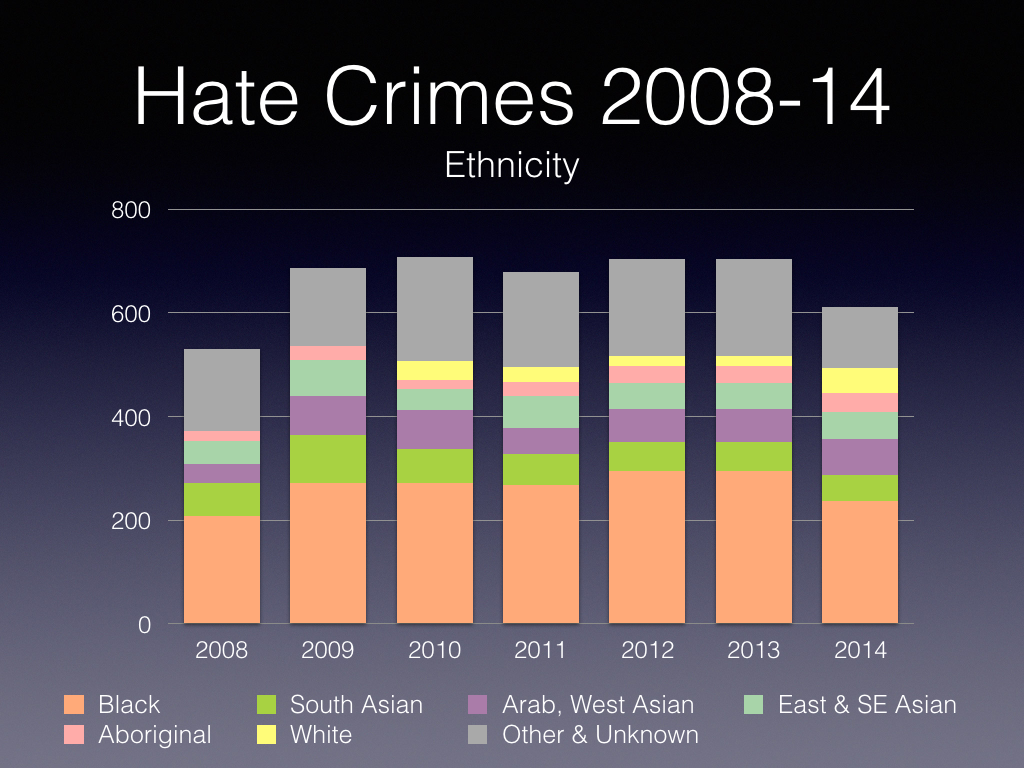
Selon un rapport daté de 2015 du ministère québécois de la Sécurité publique, le nombre de crimes haineux enregistrés par la police — ce qui peut aller du vandalisme aux voies de fait en passant par les menaces — est passé de 176 en 2009 à 257 en 2014, un bond de 46 %.

Ce sont les crimes motivés par la haine d’une religion qui ont connu l’augmentation la plus marquée, tout particulièrement entre 2013 et 2014. Entre ces deux années-là, qui correspondent à l’époque où le projet de charte des valeurs du Parti québécois faisait débat, le nombre de délits haineux de nature religieuse a presque doublé, passant de 48 à 93. C’est le type de haine la plus répandue dans la province, devant les infractions liées à la race ou à l’origine ethnique, à l’orientation sexuelle, au sexe, à la langue, au handicap ou à l’âge.

Un mouvement morcelé

La mouvance d’extrême droite au Québec est tout aussi morcelée et volatile que celle du reste du pays. Mais elle a aussi ses caractéristiques propres. Samuel Tanner, de l’École de criminologie de l’Université de Montréal, et Aurélie Campana, du Département de science politique de l’Université Laval, en ont tracé les contours dans un rapport publié en 2014.

On retrouve dans la province une concentration particulièrement forte de skinheads d’extrême droite parfois violents. Figurent dans ce cercle des groupes comme Dead Boys Crew, Légion nationaliste, Québec Radical, Ragnarok ou Vinland Front. Certains de leurs membres ont été condamnés pour des agressions à l’arme blanche envers des personnes noires ou d’origine arabe, notamment.

Les skinheads québécois gravitent par ailleurs autour d’une scène musicale fort active, qui constitue un puissant outil de recrutement. Certains de ces groupes ont donné leurs concerts (et craché leur xénophobie) jusqu’en Amérique du Sud et en Europe.

Les chercheurs reconnaissent une autre frange de l’extrême droite québécoise: une frange ultranationaliste, animée par la conviction que la population québécoise de souche canadienne-française doit protéger sa langue, sa culture et son identité contre la menace que représentent à ses yeux les immigrants. Ces groupes sont de plus en plus visibles depuis quelques années: ils organisent des marches, des campagnes de distribution de tracts ou d’autocollants, des conférences et d’autres activités dont la rhétorique ne laisse planer aucun doute sur le sentiment islamophobe qui les motive. En font partie notamment la Fédération des Québécois de souche, Atalante Québec ou encore Pégida Québec.

Source: La haine se propage au Québec – L’actualité

Barbara Kay: Actually, one needn’t be a hysterical bigot to have concerns with M-103, other commentary by Lorne Gunter and Chris Selley

Barbara Kay continues not to understand, or appear not to understand, what M-103 includes and what is do not. Coyne is on much sounder ground than she, despite her examples of unacceptable comments:

In December, for example, Georges Bensoussan, a Morocco-born scholar on Jewish communities in Arab countries, was prosecuted in France, because a complaint was filed against him for incitement to racial hatred by the “Collective Against Islamophobia.” His crime? Two quotations were cited in the charge, taken from an interview last year on a French cultural radio show. Bensoussan said, “Today, we are witnessing a different people in the midst of the French nation, who are effecting a return on a certain number of democratic values to which we adhere,” and “This visceral anti-Semitism proven by the Fondapol survey by Dominique Reynié last year cannot remain under a cover of silence.” (Here he was referring to a 2014 survey finding Muslims in France were nearly three times more likely to be anti-Jewish than French people as a whole.)

If these are not fair comments by Andrew Coyne’s standards, then I do not know what is. But Bensoussan is in the dock for them. His story frightens me — with reason.

Ironically, I happened to come across this story at the same time as it was revealed that in at least two sermons distributed on Youtube, imam Sayyid al-Ghitaoui of Montreal’s Al-Andalus Islamic Centre called for Allah to “destroy the accursed Jews,” to “kill them one by one” and to “make their children orphans and their women widows.” (Has he been fired yet? I ask because only Jewish media considered it a story worth covering.) It’s not as if this imam is unique here either. Imams all over the world say the same and much worse about Jews, citing sacred Islamic texts. ISIL members too tell journalists they are following the prophet Mohammed “in the strictest way.” They feel their Islam is as “real” as those who wrote E-411.
So I say to the petitioners of E-411 that I have received their opinion loud and clear. And now I would like to make up my own mind about Islam, as I do with all contentious issues: that is, according to primary sources, credible commentators, legitimate opinion surveys and so forth.

I do not wish to be told by a petition or by the recommendations of a study based on that petition what I must think — or say in a considered and thoughtful way — about any ideology or belief system in deference to the sensibilities of a specific group in order to earn a seal of non-Islamophobic approval from agenda-driven advocacy groups and their political allies.

I greatly admire Andrew Coyne for his exegetical brilliance in the hermeneutics of electoral reform, but on the subject of creeping Shariah-based blasphemy laws across the Western world, it grieves me to say that he has revealed himself as an authority of rather lesser stature.

Source: Barbara Kay: Actually, one needn’t be a hysterical bigot to have concerns with M-103 | National Post

Lorne Gunter picks up the same slippery slope argumentation:

After arguing it was wrong to tar all Muslims – extremists and moderates – with the same brush, Prof. Kutty then added I was way off base for linking the treatment of suburban Montrealer Antonio Padula with the effects M-103 may have.

Padula is just some guy from the Montreal-area community of Kirkland. One evening shortly after the horrific murders at a Quebec City mosque, Padula saw three police cars pull up outside his home. He was arrested, taken away in cuffs and put in jail for the night, all because police misinterpreted some tweets he posted as promoting hatred toward Muslims.

Kutty said Padula’s treatment had nothing to do with the intent of M-103, that he was being charged under hate crimes and other laws, not under a Parliamentary motion offering support for Muslims.

But that’s how these things start. Too often they begin with well-meaning intentions. Yet once they get into the hands of politically correct bureaucrats, Parliamentary committees and human rights commissioners, they morph into something unrecognizable.

Tremont asked me whether, perhaps, Padula’s treatment was justified given that his indelicate tweets came just days after the bloody shooting. But isn’t that just promoting a climate of fear – fear that everyone who posts politically incorrect tweets is a potential murderer who deserves to be arrested and throw in a cell, and possibly face months of expensive legal defence to clear his name?

The supporters of M-103 insist there is an increasing public climate of hatred and fear against Muslims. But wasn’t the treatment of Padula just as much an overreaction based on fear?

If Muslims shouldn’t be condemned for the actions of a few extremists in their faith, shouldn’t it also hold that Antonio Padula shouldn’t be arrested just because officials are suddenly acting out of fear that everyone who tweets unkind ideas is a potential killer?

Prof. Kutty also said it was wrong to focus on the word Islamophobia because he had a good definition of it. And, I’ll admit, his wasn’t bad. But that’s the problem – everybody has his or her own definition. Give that much leeway to the human rights police and the broadest possible definition will be upheld. There will be more, not fewer, Antonio Padula’s rousted from their beds in the middle of the night for the “crime” of being politically incorrect, or even just ironic.

Source: M-103 could morph into something unrecognizable

Chris Selley nails it beautifully in this commentary, contrasting the federal conservatives with their Ontario counterparts:

Ontario Progressive Conservative Leader Patrick Brown says he will support Liberal MPP Nathalie Des Rosiers’ private member’s motion asking the legislature to “condemn all forms of Islamophobia.”

“I think it’s pretty straightforward to condemn any form of hate,” Brown told reporters Tuesday morning. “In terms of Islamophobia, it is real.” He said he would encourage his MPPs to vote likewise. And there is no sign of significant dissent in the ranks.

That’s a good thing. Private members’ motions compel the government to do precisely nothing. They are not the soil in which legislation grows, nor are they fertilizer. They are farts in the wind. And on thorny issues like Islamophobia or Israel or transgender rights, their primary purpose is often to expose one’s political opponents as holding unsuitable positions and then denounce them.

Nothing good can come from falling into that trap — and if there was any doubt about that, Brown’s former colleagues in Ottawa are proving it in spades.

It is now lost forever in a toxic fog, but there were legitimate debates to be had about Liberal MP Iqra Khalid’s private member’s motion M-103, which calls on the government to “condemn Islamophobia and all forms of systemic racism and religious discrimination,” and to “develop a whole-of-government approach to reducing or eliminating systemic racism and religious discrimination including Islamophobia.”

Perhaps the platonic ideal of this legislatively inconsequential motion would not single out any one religion. Perhaps it would be worded differently: were he still an MP, Irwin Cotler said he would have proposed replacing “Islamophobia” with “anti-Muslim bigotry” or “anti-Muslim hatred.” That’s perfectly reasonable. To some people Islamophobia means “anti-Muslim bigotry” or “anti-Muslim hatred,” but to others it means what it says: fear of Islam.

You’re allowed to be afraid of religions (though I wouldn’t recommend it), and you’re certainly allowed to criticize religions. Some Canadians spent the entire Stephen Harper era being afraid of evangelical Christians, for example. On Monday the Masjid Toronto mosque apologized for a supplication recorded on its premises asking Allah to “purify Al-Aqsa Mosque (on the Temple Mount) from the filth of the Jews.” (That’s as translated by Jonathan Halevi of CIJ News.) I’m certainly not going to sit here and condemn Jews for “fearing” Islam.

But these are delicate arguments to make even in a regular political climate. It’s quasi-suicidal in today’s political climate — one in which six parishioners were recently gunned down at a mosque in Quebec City; in which protesters have descended on Toronto mosques with signs reading “ban Islam,” “Muslims are terrorists” and the like; and in which some portion of Canadian conservatives who were already leery of Islam have followed Donald Trump’s tire tracks into a ditch of conspiracist madness.

Among the ditch-dwellers and those who flog merchandise to them, M-103 is an “Islamic blasphemy law” that prohibits criticism of Islam or it is the first step (or another!) toward the implementation of Shariah law in Canada. Ezra Levant’s Rebel Media held an entire “free speech” rally based on those premises last week, and four Conservative leadership candidates actually showed up — including whichever demons have seized the bodies of well-regarded diplomat Chris Alexander and orthopaedic surgeon Kellie Leitch. Enough has transpired in the past couple of weeks to fill an entire campaign’s worth of attack ads for the Liberals; they must be thrilled to pieces.

Back at Queen’s Park, there are many grounds on which to question whether Patrick Brown is the best man for the job of ending nearly 14 years of Liberal rule. The Liberals will cast him as the worst Conservative bogeyman since the last worst Conservative bogeyman: anti-abortion, anti-sex-ed, anti-government, the whole lot. Many conservatives, meanwhile, wonder whether there’s much conservatism to Brown at all — or much of anything that outranks political expediency.

But Brown’s outreach to immigrant communities remains one of his key accomplishments; there is no reason to believe he isn’t sincere in supporting Des Rosiers’ motion on principle. And if there are Ontario Tories who do have minor concerns, the Ottawa precedent makes it clear how best to proceed: express those minor concerns by all means, but vote for the motion. There is nothing to be gained by doing otherwise.

This is a low bar the Ontario Tories are clearing here, and it shouldn’t be a surprise. Given that their federal cousins are currently beating themselves around the mouth and ears with that same bar, however, it is nevertheless a reassuring sign of basic political competence, leadership and sanity. It’s quite a world Canadian Conservatives are living in all of a sudden.

Source: Chris Selley: On Islamophobia, Ontario Tories look to pass the very easy test their federal cousins failed


La laïcité déculottée [Pelletier on Charles Taylor’s revisiting Bouchard-Taylor recommendations]

Good piece by Francine Pelletier on the further reflection of Charles Taylor:

Mais où commencer ? Les malentendus sont nombreux et combien enchevêtrés ! D’abord, cette notion voulant que la Révolution tranquille ait transformé le Québec en terre de la laïcité. Oui, la province s’est rapidement sécularisée dans les années 60 ; il y a eu une grande « perte d’influence de la religion », pour ne rien dire de la déconfessionnalisation des écoles. Mais la laïcité implique une séparation de l’Église et de l’État autrement plus pointue, une qui passe par l’ordre juridique et qui aurait exigé, excusez-moi de le souligner à gros traits, le retrait du crucifix à l’Assemblée nationale.

La laïcité comporte un deuxième volet, plus important encore : la neutralité de l’État. Contrairement aux interprétations souvent véhiculées, cela n’implique pas une désaffection religieuse. Loin de récuser, la neutralité « accueille » toute religion seulement sans favoritisme ni parti pris. Comme le suggère le sociologue belge Marc Jacquemain, il ne s’agit pas  d’une valeur en soi, mais d’un dispositif qui garantit une valeur, celle de la liberté de pensée et de religion. L’important n’est pas la neutralité ni l’absence de religion, en d’autres mots, mais bien la liberté de conscience. La possibilité pour chacun d’entre nous de vivre selon ses croyances, en toute liberté. Pour que ce foisonnement individuel puisse se réaliser, l’État, lui, doit offrir une page blanche.

Rien de ça n’a été officiellement discuté, encore moins légiféré, sous le gouvernement Lesage. Il ne l’a pas été beaucoup plus lors de la commission Bouchard-Taylor qui, de toute façon, se penchait sur un à-côté de la laïcité, les accommodements religieux. Les commissaires ont beau avoir inscrit la notion de « laïcité ouverte » dans leur rapport, celui-ci, on le sait, a été grossièrement tabletté. La notion n’a donc guère de sens pour l’ensemble des Québécois aujourd’hui. Si elle avait été bien comprise, aurait-on fait un tel gâchis de la « charte des valeurs » cinq ans plus tard ?

La législation proposée par le gouvernement Marois offrait un premier exercice, en bonne et due forme, sur la laïcité. À la bonne heure. Mais plutôt que de discuter de la neutralité de l’État et du type de laïcité que nous voulions, le débat s’est enlisé sur la question de l’identité nationale. C’est la raison pour laquelle l’exercice a été rapidement rebaptisé « charte des valeurs québécoises ». Il ne s’agissait pas d’établir rationnellement, juridiquement, le « rapport entre le politique et le religieux » ; il s’agissait de dire ce qu’on ne tolérait pas au Québec. C’est chaque fois, en fait, la même chose. Que ce soit dans la foulée de la Révolution tranquille, du « code de vie » d’Hérouxville ou de la charte des valeurs, le sentiment antireligieux, la hantise du passé prennent le dessus et dictent les résultats.

Comme le note Marc Jacquemain, il n’y a que la France qui opte pour cette laïcité dite républicaine, nourrie de suspicion envers la religion (Révolution française oblige) et où, au nom d’une supposée cohésion sociale, on a comme mission « l’émancipation » du croyant. Or, le type de laïcité proposée par MM. Bouchard et Taylor, aussi appelée laïcité libérale, est aux antipodes de cette laïcité française où, plutôt que de défendre « le droit de l’individu face à l’État » on défend « le droit (et même le devoir) de l’État de défendre l’individu face à la religion ».

Ce qui nous amène au consensus que M. Taylor aurait malencontreusement fait voler en éclats, celui d’interdire aux juges, magistrats et policiers le port de signes religieux.

D’abord, est-ce vraiment une victoire d’ériger ce principe en loi alors qu’on ne comprend guère sur quoi une telle restriction repose ? Il s’agit, après tout, de bafouer les droits fondamentaux de certains individus. La « neutralité d’apparence » en vaut-elle vraiment la chandelle ? Je suis plutôt disposée à le croire, mais je trouve suspect qu’on veuille applaudir seulement à ce qui restreint ici les droits individuels alors que c’est silence radio sur ce qui garantirait leur épanouissement. Plutôt qu’un geste réfléchi en vue d’une laïcité réelle, un tel consensus n’agit-il pas plutôt comme un gros diachylon sur la plaie béante de l’identité nationale ?

Charles Taylor a raison de nous forcer à y réfléchir à deux fois.

ICYMI: Trump’s dangerous delusions about Islam | Christopher de Bellaigue | The Guardian

Good long read by Christopher de Bellaigue, taken from his latest book, The Islamic Enlightenment: The Modern Struggle Between Faith and Reason (conclusion excerpt):

Even accounting for the new arrivals of recent years, Muslims amount to just 6% of Europe’s population, and 1% of that of the US. But proportionality of response is not considered a virtue among the new nationalists – and even if the Muslim immigration figures were to start to fall, and all fear of submergence under a Muslim tide was demonstrated to be empirically groundless, who’s to say the populists would allow the thrill of fear to abate?

What seems more likely is that today’s proponents of harsh anti-Muslim measures will find retroactive justification in any virulent reaction they excite, leading to even more and harsher measures against Muslims – much as the European powers whose interventions helped hasten the collapse of the Islamic Enlightenment at the start of the last century felt their actions were vindicated by the violence that followed.

For those whose primary concern is the perpetuation of cultural homogeneity, the pressing question is a simple one: what is to be done with the Muslims? The clashist version of history makes their antipathy to modernity indisputable; integration and assimilation are therefore impossible. This would seem to be the position of the 60% of Germans, for example, who have been found in surveys to agree with Frauke Petry’s AfD that Islam does not belong in their country.

This is the kind of polling that converts easily into action by a decisive commander-in-chief. And it is surely legitimate to observe that Islamism of a strident and intermittently violent sort has made inroads in European societies, bringing a combative intolerance to parts of the continent where the socio-economic indicators are in any case low.

But the question for anyone concerned for the overall health of society is a more complicated one; the answer will have to address the actual threat of jihadism, calm the fears of those who believe an intangible and precious part of their culture is endangered, and revive the dimming faith in the possibility of inclusive, multi-ethnic liberal democracy.

We already know what Trump’s reaction to the next atrocity will be. “I told you so,” he will say, and give the screws a turn. Electronic tagging; deportations; orders to shoot illicit refugees (a suggestion of the AfD’s Petry) – the menu of vengeful retributions before the clash-mongers is long and mouthwatering.

For those grappling with the second of the two questions, the options are already limited. The European refugee crisis has hardened the continent’s heart, probably forever, and sectarian identity has been placed at the heart of western political debate. All of this happened before Trump entered the White House; under Obama, it was already hard enough for anyone hailing from a Muslim-majority country to gain entry to the US.

But as Trump and his allies are eager to demonstrate, there is a vast difference between the existing regimes of stringent border security – which effectively served as a moratorium on any mass Muslim migration – and the new environment of official vilification. The scapegoating of Muslim communities in Europe and America is the road to pogroms, and it is that road that we are starting down, even if we can still turn back.

Relish for the clash is in the air. Bannon is up for it. So are the jihadis; Trump is doing their work for them, proving that the west hates Islam for xenophobic reasons, which is what they said all along. The entrenchment of clashism – as an observation presented to a few academics in 1957 becomes the creed of a new ruling class – will only draw more and more people into believing its truth. 

Source: Trump’s dangerous delusions about Islam | Christopher de Bellaigue | News | The Guardian

ICYMI: Mark Zuckerberg warns against reversal of global thinking – The Globe and Mail

Interesting comments and growing public role:

Facebook Inc. chief executive Mark Zuckerberg laid out a vision on Thursday of his company serving as a bulwark against rising isolationism, writing in a letter to users that the company’s platform could be the “social infrastructure” for the globe.

In a 5,700-word manifesto, Zuckerberg, founder of the world’s largest social network, quoted Abraham Lincoln, the U.S. president during the country’s 19th century Civil War known for his eloquence, and offered a philosophical sweep that was unusual for a business magnate.

Zuckerberg’s comments come at a time when many people and nations around the world are taking an increasingly inward view. U.S. President Donald Trump pledged to put “America first” in his inaugural address in January. That followed Britain’s decision last June to exit the European Union.

“Across the world there are people left behind by globalization, and movements for withdrawing from global connection,” Zuckerberg wrote, without naming specific movements.

The question, the 32-year-old executive said, was whether “the path ahead is to connect more or reverse course,” adding that he stands for bringing people together.

Quoting from a letter Lincoln wrote to Congress in the depths of the Civil War, he wrote to Facebook’s 1.9 billion users: “The dogmas of the quiet past, are inadequate to the stormy present.”

Zuckerberg said that Facebook could move far beyond its roots as a network for friends and families to communicate, suggesting that it can play a role in five areas, all of which he referred to as “communities,” ranging from strengthening traditional institutions, to providing help during and after crises, to boosting civic engagement.

In comments on Facebook, some users praised Zuckerberg’s note for staying positive, while others declared “globalism” dead.

Facebook has been under pressure to more closely police hoaxes, fake news and other controversial content, although the concerns have had little impact on its finances. The company reported 2016 revenue of $27.6-billion, up 54 per cent from a year earlier.

One area where Zuckerberg wrote that Facebook would do better would be suggesting “meaningful communities.” Some 100 million users are members of groups that are “very meaningful” to them, he wrote, representing only about 5 per cent of users.

Facebook is also using artificial intelligence more to flag photos and videos that need human review, Zuckerberg wrote. One-third of all reports to Facebook’s review team are generated by artificial intelligence, he wrote.

Zuckerberg’s letter was “a bit more ambitious and a bit more of the 30,000-foot view than I see from most tech company CEOs,” Peter Micek, global policy and legal counsel at Access Now, an international digital rights group, said in a phone interview.

But Zuckerberg stayed away from certain subjects on which Facebook could be vulnerable to criticism, mentioning the word “privacy” only once, Micek said.

Source: Mark Zuckerberg warns against reversal of global thinking – The Globe and Mail

After Pedophilia Comments, Milo Yiannopoulos Loses CPAC Invite, Simon & Schuster Book Deal : NPR

So it took this for CPAC and Simon & Shuster to act, while ignoring all his hate speech?

Breibart News editor Milo Yiannopoulos lost both a speaking gig at a prominent conservative event and a book deal in less than 24 hours.

First, Monday afternoon the American Conservative Union rescinded its invitation to the right-wing provocateur — noted for his political posts on the Internet — to speak at its annual Conservative Political Action Conference this upcoming weekend. Then, a few hours later, Simon & Schuster announced that it was canceling the publication of Yiannopoulos’ upcoming book, Dangerous.

These actions come in the wake of a social media backlash against Yiannopoulos after the conservative news outlet The Reagan Battalion tweeted videos on Sunday in which Yiannopoulos appears to condone statutory rape and sexual relationships between boys and men.

Yiannopoulos sought to clarify his comments Monday in a Facebook post citing the video clips as “deceptive editing” and blaming his own “sloppy phrasing” for any indication that he supports pedophilia. He goes on to defend himself by referencing his own relationship when he was 17 with a man who was 29. The age of consent in the U.K. is 16.

There were several references to sex between boys and men in the video.

Source: After Pedophilia Comments, Milo Yiannopoulos Loses CPAC Invite, Simon & Schuster Book Deal : The Two-Way : NPR