Unfettered hate speech fuels Chinese fear of Islam | The Japan Times

Of interest:

A flood of angry anti-Muslim rhetoric on social media was the first sign of how fiercely suburban middle-class homeowners in the central Chinese city of Hefei opposed a planned mosque in their neighborhood. It quickly escalated into something more sinister.

Soon a pig’s head was buried in the ground at the future Nangang mosque, the culmination of a rally in which dozens of residents hoisted banners and circled the planned building site.

Then the mosque’s imam received a text message carrying a death threat: “In case someone in your family dies, I have a coffin for you — and more than one, if necessary.”

“How did things get stirred up to this point?” the imam, Tao Yingsheng, said in a recent interview. “Who had even heard of the Nangang mosque before?”

On the dusty plains of the Chinese heartland, the bitter fight over the mosque exemplifies how a surge in anti-Muslim sentiment online is spreading into communities across China, exacerbating ethnic and religious tensions that have in the past erupted in bloodshed. It is also posing a dilemma for the ruling Communist Party, which has allowed Islamophobia to fester online for years as part of its campaign to justify security crackdowns in the restive region of Xinjiang.

“It has let the genie out of the bottle,” said James Leibold, a professor at La Trobe University in Australia who has tracked the growth of anti-Muslim hate speech on China’s internet.

Interviews with residents and an examination of social media show how a few disparate online complaints by local homeowners evolved into a concerted campaign to spread hate.

Key to it was an unexpected yet influential backer: a Chinese propaganda official, 2,500 kilometers (1,500 miles) away in Xinjiang, whose inflammatory social media posts helped draw people into the streets on New Year’s Day, resulting in a police crackdown.

First mosque in 1780s

A stone inscription outside its gate shows the original Nangang mosque was established in the 1780s by members of the Hui minority, the descendants of Silk Road traders who settled across China centuries ago. In its present form, the mosque has served the area’s 4,500 Hui for decades, its domed silhouette partially hidden by overgrown shrubs in the countryside beyond Hefei’s last paved boulevards.

Over the past 10 years urbanization has come to Hefei, with sprawling development reconfiguring the landscape and its demographic flavor, and Hui leaders had been pushing for years to relocate their mosque to a more convenient urban location.

City planners in November finally selected a site adjacent to the newly built Hangkong New City condominiums, with its $200,000 two-bedroom units, faux-Mediterranean styling and a Volvo dealership across the street.

The project’s homeowners — overwhelmingly members of China’s ethnic Han majority — began complaining on China’s popular microblog Weibo. Some complained the mosque would occupy space promised for a park. Others warned that safety in the area would be compromised.

Others were more blunt: Han residents were uncomfortable that a center for Hui community life would be less than 100 meters from their building, a homeowner who later identified himself in messages to the AP by his surname, Cheng, wrote in a petition posted in December. “And the less said about what happens on Eid al-Adha, the better,” Cheng wrote, referring to the Islamic holiday in which animals are slaughtered for a sacrificial feast. “It’s absolutely shocking.”

Source: Unfettered hate speech fuels Chinese fear of Islam | The Japan Times
Canada’s anti-Islamophobia study to start next month

I suspect that the Committee witnesses will have a fairly broad range of witnesses from a number of communities that overall will maintain the focus on Islamophobia/anti-Muslim while situating the issues in the broader context of racism and discrimination:

A committee study that Canada’s controversial anti-Islamophobia motion called for is likely to get underway next month, the Sun has learned.

All eyes will be on the Standing Committee on Canadian Heritage as it hears from dozens of witnesses to study the ill-defined phenomenon of Islamophobia, along with other forms of discrimination and racism.

Liberal MP Iqra Khalid’s M-103 passed in the House of Commons by a vote of 201-91 on March 23 after weeks of controversy surrounding the wording of the motion. Now the committee will pick up where the motion leaves off.

While the motion supposedly denounces all discrimination, Islamophobia was the only one that received a specific mention. Khalid has stated her motion was partially inspired by E-411, an online petition exclusively focused on Islam.

A number of mainstream pundits argued during the controversy that the motion was nothing more than a gesture and would never amount to anything.

However now that the issue is headed to committee, it will result in a report that will provide recommendations that may inspire legislation.

Multiple sources confirmed to the Sun that lists of suggested witnesses have already been put forward.

Typically, Liberal, Conservative and NDP members of a committee each put forward their own party list of witnesses and then together they narrow it down to a smaller, mutually agreed upon list.

The witnesses invited to testify for this study will largely determine the scope and tone of the committee meetings. Will they give equal time to representatives of all religions, as well as the non-religious? Will those speaking about Muslim issues be liberal Muslims or more orthodox, pro-sharia voices?

Meanwhile, a petition on the government’s official e-petition website that was created to voice opposition to sharia law gaining a foothold in Canada has reached 42,000 signatures.

The petition that inspired Khalid’s motion reached 70,000 before it was closed for signatures.

Source: Canada’s anti-Islamophobia study to start next month | Canada | News | Toronto S

Having Just One Black Teacher Can Keep Black Kids In School : NPR

Interesting and, I think, significant:

How important is it to have a role model?

A new working paper puts some numbers to that question.

Having just one black teacher in third, fourth or fifth grade reduced low-income black boys’ probability of dropping out of high school by 39 percent, the study found.

And by high school, African-American students, both boys and girls, who had one African-American teacher had much stronger expectations of going to college. Keep in mind, this effect was observed seven to ten years after the experience of having just one black teacher.

The study is big. The authors, Seth Gershenson and Constance A. Lindsay of American University, Cassandra M.D. Hart of U.C. Davis and Nicholas Papageorge at Johns Hopkins, looked at long-term records for more than 100,000 black elementary school students in North Carolina.

Then the researchers checked their conclusions by looking at students in a second state, Tennessee, who were randomly assigned to certain classes.

There they found that not only did the black students assigned to black teachers graduate high school at higher rates, they also were more likely to take a college entrance exam. “The results line up strikingly well,” says Papageorge.

And this isn’t news to many African-American families who already feel strongly that their children need role models in their education. Khalilah Harris has experienced the issue both as a policymaker and as a mother of three daughters. She was the Deputy Director of the White House Initiative on Educational Excellence for African Americans under the Obama administration. She recently transferred her two older daughters, 12 and 14, to a progressive private school to expose them to more diverse teachers and curriculum.

“My youngest, who is 7, goes to supposedly the best public school in Baltimore City, but there is not any teacher of color there, and that is deplorable,” she says. “If you grow up in a world that does not reflect your essence as valuable from birth, the fact that you don’t have a teacher … who looks like you, will cause cognitive dissonance.”

Papageorge says the “role model effect” that Harris describes is quantifiable. “Sometimes when I talk about expectations, people think I’m talking about magic fairy dust,” he says, “but in economics, it’s one of the biggest things that determine the kinds of investments people make.” In other words, whether it’s money you put toward a mutual fund, or time and energy you spend on your education, how much you expect to get out can determine how much you put in.

If a low-income black boy never sees anyone in the classroom who looks like him, Papageorge says he might conclude, “‘Hey, college is just not for me’. And then why would you work hard in school?”

Yolanda Coles Jones of Charlottesville, Va., says she and her husband avoided the school system altogether. They homeschool their four children, two girls who are 9 and 7, and 4-year-old twin boys. She says they didn’t see their local public or private schools “understanding the needed emphasis on black children seeing black faces.” The family is part of a homeschooling co-op called Community Roots, that, Coles Jones says, was founded “to have an atmosphere that is safe for children of color to be in.”

In future research, Papageorge hopes to replicate the study and unpack the powerful and long-lasting effects observed. But based on the evidence he already has, he has an immediate policy recommendation. Having just one black teacher in his study made all the difference to students; having two or three didn’t increase the effect significantly. Therefore, schools could work to change student groupings so that every black student gets at least one black teacher by the end of elementary school.

“Should we hire more black teachers?” he asks. “Yeah, probably, but it requires more black college graduates … We could push around rosters tomorrow, change the way we assign kids, and have some effects next school year, not 10 years from now.”

Source: Having Just One Black Teacher Can Keep Black Kids In School : NPR Ed : NPR

A political scientist explains how multiculturalism’s “success” gave us Trump – Vox

Interesting and thoughtful interview with Pippa Norris, a Harvard comparative political scientist:

Last November, I interviewed moral psychologist Jonathan Haidt about the tensions endemic to multicultural societies, and he concluded that “diversity, immigration, and multiculturalism are right at the heart of the sociological problem in Western democracies.” Haidt wasn’t opposed to multiculturalism as such, but he worried that it leads to reduced social capital and the amplification of “tribal tendencies.”

Pippa Norris, a Harvard comparative political scientist, sees it much differently. In a conversation with me last month, she said:

“No, we’re actually witnessing the success of multiculturalism: It’s taking over in the broader sense in the population and in society. I can give you lots and lots of trends on that. You can look at various polls and surveys measuring things like tolerance of minorities, cosmopolitanism, the attitudes toward the United Nations, toward NATO, toward the European Union, and you find that young people are incredibly cosmopolitan, incredibly multicultural. They see their lives as being one where you work in one country, you live in another, you end up in a third.

But, predictably, there is a reaction against multiculturalism, which is a sign that it has succeeded. Social changes have accelerated multiculturalism, and that is perceived as threatening to those opposed to it. There are immense pressures to adapt and adopt.

We have to think about how best to adapt to multiculturalism, but in terms of broad social attitudes, there’s no evidence that, for example, attitudes toward homosexuality or gender or religion are in any way going in a more traditional direction.”

According to Norris, the ultranationalist drift we’re seeing is predictable: Societies are changing, becoming more inclusive, and that has occasioned a reaction from older, more traditionalist citizens.

The crucial question is whether individual states can absorb these reactionary movements. If, for the foreseeable future, we’re going to see more populist pushback, does that mean we can expect more societal disruptions and constitutional crises in Western countries?

Norris is cautiously optimistic:

“A lot depends on the type of system a country has. Different systems will respond in different ways to populist pressures. In most European systems, the party system is flexible. In the United Kingdom, for example, you have 13 parties sitting in Parliament. In Netherlands, Germany, and other countries, you’ve got a multi-party system. In a few countries, like the United States, you’ve only got two parties. Now, those parties themselves are umbrellas, so they’re ideologically indistinct in certain regards, but it’s also very difficult for other parties to break through.

Are there going to be populist parties in the future? Absolutely. They’re not going to go away. How successful they are depends on the institutional rules and depends on how other parties respond to them in terms of either taking over their issues, ignoring them, or trying to isolate them in certain regards. But the American system is resistant to major shocks because of the strength of the two-party structure.”

Ultimately, Norris sees more reasons to be hopeful than not. In America, at least, our institutions are doing precisely what they should do. But, she warns, the real test has yet to occur:

“The courts have done what the courts should do. The media has done what it’s supposed to do. Civil society is still vibrant. The protests are amazing. Young people are energized. Opposition groups like the ACLU are seeing a tremendous spike in contributions. But we haven’t yet been properly tested. The tests are not in the good times or safe times. The tests are when the major crises occur. There will be another crisis in the next four or eight years, another terror attack or some other emergency.

This will be the real test.”

Source: A political scientist explains how multiculturalism’s “success” gave us Trump – Vox

Le Québec semble bien gérer les questions d’accommodements raisonnables

I tend to share the assessment that the drop in numbers reflects that public and private organizations are dealing with requests on their own, with no need to refer cases to the Commission:

Les demandes de conseils sur les accommodements raisonnables de type religieux sont en baisse depuis deux ans à la Commission des droits de la personne (CDPDJ) et sont désormais supplantées par les demandes faites par les personnes handicapées.

Entre avril 2015 et mars 2016, le nombre de demandes de conseils reçus est passé à 20 et ce nombre s’est maintenu ces derniers mois. C’est la moitié de ce qu’on observait les années précédentes (40 demandes en moyenne).

Depuis la Commission Bouchard-Taylor, la Commission offre un service-conseil en matière d’accommodements raisonnables de type religieux. Le service s’adresse aux employeurs et aux organismes donnant des services. Les conseils sont donnés à titre indicatif et ne sont, dès lors, pas décisionnels.

La liste des demandes reçues révèle en outre que les congés religieux sont l’enjeu qui génère le plus de questions. Ainsi en 2015-2016, de nombreuses demandes provenaient d’entreprises privées et portaient sur la pratique du ramadan.

Le président d’une compagnie de biocarburant, par exemple, s’inquiétait pour la sécurité parce qu’un de ses employés était affaibli par le jeûne. Chez un fabricant de vêtements de sport, on déplorait que trois employés de la même chaîne de montage aient réclamé des congés en même temps. Au total, huit demandes concernaient la période du ramadan et trois des congés liés à des célébrations juives comme celle du Nouvel An juif en septembre.

Une minorité de demandes étaient toutefois plus complexes comme ce cas d’une étudiante de confession juive qui réclamait du matériel pédagogique non informatisé pour pouvoir se préparer à son examen final pendant le Sabbat.

Un seul cas portait sur le port de signes religieux (le voile) et deux concernaient la tenue de prières musulmanes dans des institutions publiques ou des commerces. Enfin, un employeur a contacté le service à propos d’un employé qui exposait une photo de Jésus « de grande dimension » dans son lieu de travail.

En vertu de la Charte, les accommodements sont un corollaire du droit à l’égalité et les organisations doivent chercher à en offrir à ceux qui le demandent. L’accommodement raisonnable est toutefois balisé par le concept de « contrainte excessive » qui protège l’organisation ou le milieu de travail.

Un bon signe, selon les experts

Cette baisse suggère que les organismes s’en tirent plutôt bien avec ces questions, croit le professeur Marc-Antoine Dilhac, un expert des enjeux d’inclusion rattaché à l’Université de Montréal. « C’est plutôt encourageant, dit-il. Il y a une forme de jurisprudence qui s’est imposée pour des affaires similaires. »

François Rocher, de l’Université d’Ottawa, un spécialiste des enjeux d’immigration, souligne que même à 40 par an, ce sont de petits nombres et que contrairement à certaines perceptions, la « Commission n’est pas submergée de demandes ».

« Mon hypothèse, c’est que les organisations publiques et les entreprises ont bien compris la notion d’accommodements et que la société civile réussit assez bien à s’organiser avec ce problème-là. »

M. Dilhac constate en outre que les questionnements soulevés sont souvent les mêmes et qu’il est dès lors de plus en plus facile pour les employeurs de savoir quoi faire.

Le record de demandes d’avis reçus sur les accommodements religieux a été établi en 2009-2010 avec 52 dossiers contre 29 pour les personnes avec un handicap qui normalement donnent lieu au plus grand nombre de questions.

Cette tendance s’est depuis renversée. Ainsi en 2015-2016, le Service a reçu deux fois plus de demandes pour des accommodements raisonnables touchant des handicaps que pour des accommodements religieux (57 contre 20).

Source: Le Québec semble bien gérer les questions d’accommodements raisonnables | Le Devoir

BC Asia-Pacific curriculum aims to bring international perspective to high schools

Good initiative and will be interesting to see how it develops and how it deals with more controversial historical issues in the region:

B.C. schools will be the first in Canada to get Asia-related curriculum material to teach in history and socials classes through a new program that may eventually be rolled out nationwide.

The Asia-Pacific Curriculum, a $500,000 pilot program funded by the Asia Pacific Foundation and the province, launched Thursday with a website that contains teaching material to be incorporated into classes for Grades 6 through 12.

The program will also provide workshops for educators to help them teach children more effectively about understanding cultures and issues in various countries across the Pacific.

“There is very little that’s more important to the future well-being of British Columbians over the next 10 to 20 years than our people’s ability to deal with Asia,” said Asia Pacific Foundation chairman David Emerson. “You can see from recent and historic events that our relationship with the United States will always be very important, but it’s volatile. And when you think long-term, inter-generational benefits and the need for B.C. to economically diversify, there’s no market that’s going to be more important than the Asian market.”

Currently, the asiapacificcurriculum.ca website features profiles on South Korea, Malaysia, the Philippines and India, as well as two key topics — China’s one-child policy and a history of the Khmer Rouge in Cambodia. The topics were chosen after consultation with the B.C. Social Studies Teachers Association, said Eva Busza, vice-president of research and programs at the Asia Pacific Foundation.

Busza noted that teachers want topics with a link to current events — China’s one-child policy was recently loosened after decades of strict enforcement, while the Khmer Rouge issue highlights how to deal with reconciliation, a topical point of discussion for Canadians.

Engaging teachers on what to include in the curriculum is crucial, she added, because the program is voluntary.

“Teachers have indicated to us that they want this information, and that they see this as a gap (in the current curriculum),” Busza said. “We wanted to make sure they own this work, so we’ll be doing a lot of work with the teachers in the summer, before these modules are launched in the classroom, so that their comfort level with the material is high.”

Future topics will include a history of the ongoing territorial disputes over certain islands in Northeast Asia, as well as recent controversies around South Korean textbooks. Program officials said they hope to extend the program beyond high school, and across Canada.

Brenda Ball, senior school director at North Vancouver’s Brockton School and a social studies teacher, noted that there had been a gap in Asia-Pacific studies in B.C.’s high school curriculum, but much of that has been addressed with the new provincial curriculum being implemented now.

The key for the success of the new program, Ball said, is accessibility for the teachers who want it.

“I grew up in an era where I was being taught history that was predominantly Euro-centric, and some of the publications used are still fairly Euro-centric. The only way we can make that change is if we have access to the new material.

“I think the more material, the better. And having access to free material is always welcomed by teachers, because money isn’t always endlessly available.”

Surrey Muslim School principal (and former social studies teacher) Ebrahim Bawa said his school has already begun adopting portions of the material appropriate for younger students at the K-7 institution. He urged organizers to expand the program to elementary schools as early as possible.

“If you can adapt it down to the elementary level, it is something that — especially in the Lower Mainland — a lot of kids will be able to relate to, because of the large Asia-Pacific population,” Bawa said. “If the program is marked well — if you notify the individual school principals, because they will be the ones setting the direction for the schools — this would have a higher uptake than if you leave it to individual teachers.”

Source: BC Asia-Pacific curriculum aims to bring international perspective to high schools | Vancouver Sun

Marine Le Pen: France ‘not responsible’ for deporting Jews during Holocaust – The Washington Post

Sigh … hope French voters react:

The Velodrome d’Hiver is an eternal stain on French history.

After dark on July 16, 1942, French police rounded up about 13,000 Jews from across occupied Paris and deposited them in the “Vel d’Hiv,” a famous indoor stadium that had hosted the 1924 Summer Olympics and where the likes of Ernest Hemingway would come to enjoy the races. From the stadium, not far from the Eiffel Tower, the vast majority of these interned Jews in 1942 were deported to Auschwitz. Most would never return from that World War II Nazi concentration camp.

The reason the Vel d’Hiv lingers in France’s national memory is that the roundup was carried out by French police — not by the German occupiers.

In a republic devoted to the lofty ideals of equality and universal citizenship — and that had legally emancipated its Jews long before any of its European neighbors — the Vel d’Hiv roundup exposed the deadly hypocrisy of collaboration with the Nazi regime. In 1995, speaking at the site of the stadium, then-President Jacques Chirac put it this way: “France, the homeland of the Enlightenment and of the rights of man, a land of welcome and asylum — France, on that day, committed the irreparable. Breaking its word, it handed those who were under its protection over to their executioners.”

Now enter Marine Le Pen, the leader of France’s far-right National Front party, who is making a run for the presidency in the April 23 election.

“I don’t think that France is responsible for the Vel d’Hiv,” she declared Sunday on French television. “I think that in general, more generally, if there were those responsible, it was those who were in power at the time. This is not France.”

In remarks that elicited outrage across the French media, Le Pen went further: “France has been mired in people’s minds for years. In reality, our children are taught that they have every reason to criticize her, to see only the darkest historical aspects.”

“I want them to be proud to be French again.”

French far-right leader Marine Le Pen is among the top contenders in France’s presidential campaign. Here’s what you need to know about her.(Bastien Inzaurralde/The Washington Post)

Israel condemned Le Pen’s remarks, saying they reflect rising anti-Semitism that, “unfortunately, is once again raising its head.”

After Egypt attack, sectarianism and extremism go hand in hand: Hellyer

Good commentary and linkages:

Here is something else we know. The primary targets of the attacks today were Christian – their Christian identity is what singled them out for the attackers, and they paid for that identity with their lives. No one should be under any delusion in this regard – IS propaganda spoke specifically about Christians, and Christians were specifically targeted. This deadly sectarianism has to be identified as what it is – hateful, bigoted, and murderous.

But blood doesn’t know those boundaries. Among the dead today, Egyptians shared pictures of Muslims who died in the blasts – more than half a dozen Muslims, men and women, who died in the course of their duty, as police officers, protecting the security of their Christian compatriots. Had they not fulfilled their duty, many more in Alexandria would likely have paid the ultimate price. Their being Muslim did not immunize them from the crimes of the attackers. It wouldn’t.

Indeed, it is also being reported that the Egyptian security services dismantled a bomb in a mosque in Tanta today – a mosque that is known particularly for an adherence to Sufism, which is part of normative Sunni Islam, historically. But the likes of IS, informed as they are by an extremist form of Wahabism which rejects much of normative Sunni Islam in the first place, may have targeted the mosque anyway.

There will be those from the majority Muslim community who made the ultimate sacrifice to protect their Christian compatriots. There will be those who marched on the church to show solidarity with their Christian compatriots, which likewise happened in Tanta by imams. It’s one type of model. It’s a model which, regrettably if ironically, is rejected by anti-Muslim bigots in the West, many of whom took the opportunity today to further Islamophobia. Hatred, it seems, also loves company.

But there will also be those who will deceitfully condemn the murders on the one hand – and create the conditions for the sectarianism that inspired it on the other. Sectarian incitement has been an issue that far too few have been willing to tackle head-on when it comes to the pro-Islamist universe – and that includes the Muslim Brotherhood. For years, anti-Christian populist sentiment is a currency that too many in these movements traffic in – and too little attention is given to confronting it.

It would be wrong and inappropriate to associate the entirety of the Islamist camp with the radicalism of the likes of IS – but likewise, it would be the height of naiveté and an utter fallacy to assume that sectarianism is only a problem in the pro-IS faction. It goes far beyond that. Condemning the attacks, for example, in English, while propagating conspiracies and “false flag” theories about them in Arabic, only means that the mood music for sectarian incitement is left unchecked even further.

To avoid further tragedy, we need to recognize that sectarianism and radical extremism remain crucial problems to resolve.

Source: After Egypt attack, sectarianism and extremism go hand in hand – The Globe and Mail

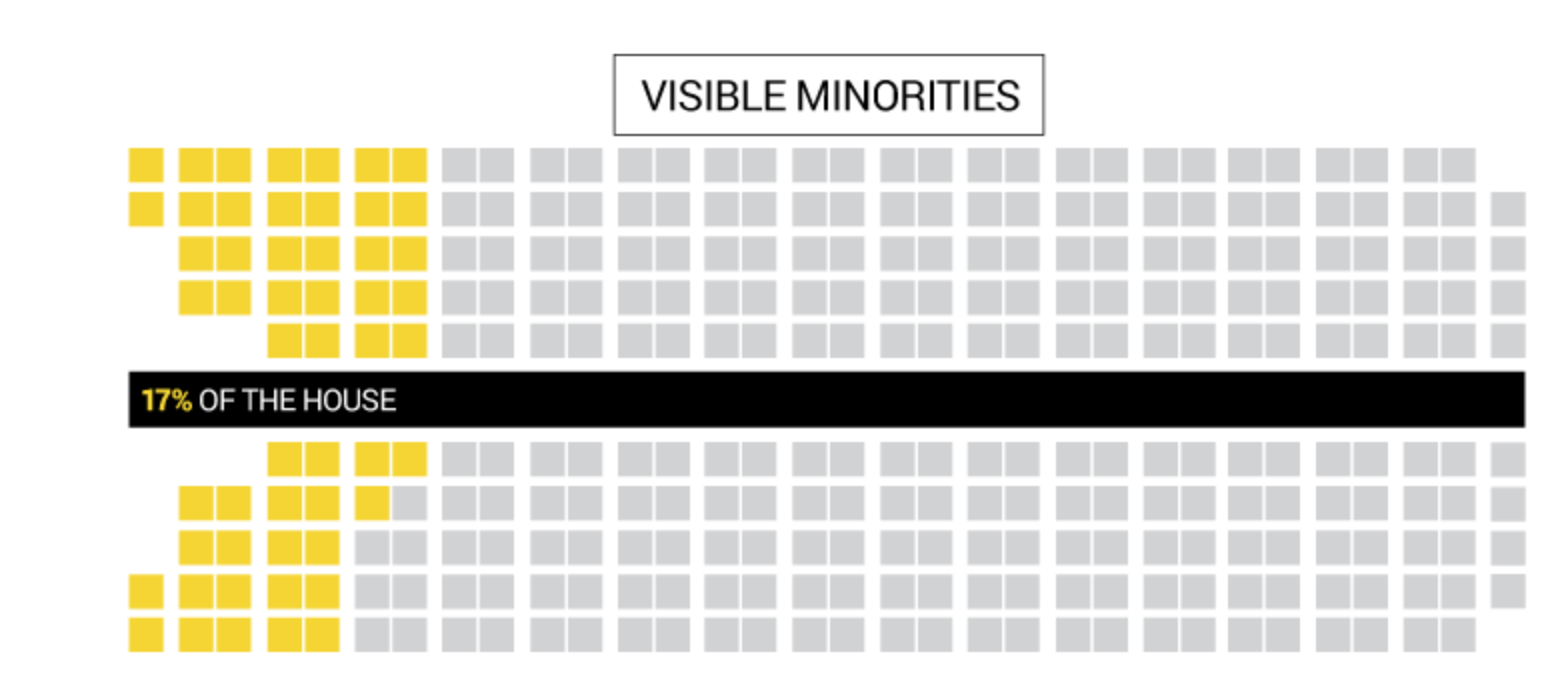
Samara’s 2017 Democracy 360 Second Report Card on How Canadians Communicate, Participate and Lead in Politics – Visible Minority Methodology Issues

While I have great respect for the work Samara does and continues to do, as exemplified in their latest report, I would be remiss in not pointing out some serious methodological mistakes made with respect to visible minority representation.

Their diversity numbers:

While our current Cabinet was selected to be more reflective of the Canadian population, Parliament generally, with 74% men, still has a long way to go. Women represent half of Canada’s population, but they are only 26% of its MPs. Visible minorities are better represented—they make up 17% of MPs and 19% of the population. Indigenous MPs make up 3% of the House and 4% of the population. In terms of representation of the youngest cohort of voters Canadians, representation has lost ground since 2015. Only 4% of MPs in the 41st Parliament are aged 18 to 30, a cohort that comprises 17% of the Canadian population.

The two mistakes are:

  • Using the wrong baseline for visible minority representation. Samara uses the overall population of visible minorities (19 percent) rather than the correct baseline of 15 percent, those visible minorities who are also Canadian citizens and thus able to vote. This is the second time that this incorrect baseline has been used and should be corrected for future reports; and,
  • Their count of the number of visible minority MPs is wrong. The correct count is 47, not the 53 indicated in the chart below.

The corrected numbers show visible minorities forming 14 percent of the House of Commons (2015 election), compared to 15 percent of the visible minority voting population. A good result.

Samara and I have shared our respective data sets and discussed these concerns and they have been forthcoming on the reasons for the discrepancies. Their count of visible minorities included some Indigenous MPs and Alexandra Mendès (but not Pablo Rodriguez) and they used the overall visible minority population to be consistent with their earlier report.

For future reports, my main recommendations:

  • for women, foreign-born and Indigenous MPs, use the authoritative parlinfo biographical information which would avoid mis-categorization of Indigenous as visible minority MPs;
  • use existing analysis rather than re-inventing the wheel. Erin Tolley, Kai Chan and I all came up with the 47 number (Erin and I compared notes to ensure that neither of us missed anything, Kai did his work independently; and,
  • use the population of visible minorities who are also Canadian citizens as the baseline, not the total visible minority population.

Their numbers for foreign-born, women and Indigenous MPs are correct, taken from the parl.gc.ca site (however the graphics are not – 40 versus the correct figure of 41 foreign-born, 81 versus 88 women, 9 versus 11 Indigenous peoples).

Source: 2017 Democracy 360

Human rights chief praises police oversight report’s focus on race and diversity

It all starts with data:

The provincial government’s commitment Thursday to require police watchdogs to collect race-based statistics is evidence Ontario is in “a very unique moment” when it comes to recognizing the need for such data, says Ontario’s chief human rights commissioner.

One day after the release of Ontario Justice Michael Tulloch’s broad-ranging report on police oversight in Ontario, Renu Mandhane said the judge’s work provides a detailed road map to rebuild trust between community and police oversight agencies at a time of “historic levels of distrust.”

Shortly after the release of Tulloch’s 129 recommendations — many aimed at increasing transparency within the police watchdogs — Ontario Attorney General Yasir Naqvi committed to act on the key recommendation that civilian oversight bodies, including the Special Investigations Unit (SIU), begin collecting demographic data such as statistics on race, ethnicity and indigenous status.

Currently, none of Ontario’s civilian watchdogs — the SIU, the Office of the Independent Police Review Director (OIPRD) and the Ontario Civilian Police Commission (OCPC) — collect statistics on race or any demographic data on religion, age, mental health status, disability, or indigenous status of complainants and alleged victims.

That move shows “the conversation has shifted in terms of the collection of data,” Mandhane said in an interview Friday, but stressed the importance of ensuring the data is both collected and then publicly reported; Tulloch recommended an advisory board be established to develop “best practices on the collection, management, and analysis of relevant demographic data.”

“There needs to be real thought about who is going to receive the data and making sure they have the resources to effectively analyze the data,” Mandhane said.

Tulloch’s race-based statistics recommendation was one of several praised by rights groups and advocates, who appreciated the emphasis placed on diversity, cultural training and the focus on indigenous communities. The report states Ontario’s oversight bodies must be “both socially and culturally competent.”

During consultations with First Nations communities in particular, Tulloch said there was consensus that the oversight bodies “lack cultural sensitivity and often are disrespectful of Indigenous peoples.” During consultations, he was told of cases where an SIU investigator arrived in a First Nations community following an incident, spoke briefly with someone from the community, and had no further contact.

“Equally troubling, some First Nations communities in the north described having to wait days for SIU investigators to arrive on scene. In some cases, matters were closed without talking to members of the community and the leadership,” the report states.

To begin to remedy fraught relationships, Tulloch recommended mandatory social and cultural competency training for watchdog staff — developed and delivered in partnership with the communities they serve.

The report also says Ontario’s police watchdogs should reflect their diverse communities, meaning the oversight bodies must take initiatives to hire people from communities currently under-represented within the organizations.

“This includes all individuals at the oversight bodies: the directors, the investigators, the adjudicators, and the staff dedicated towards outreach, communications, administration, affected persons services, and so forth,” the report states.

The move toward greater diversity is long overdue, said Julian Falconer, a Toronto lawyer who has represented many families of people killed by police and who also practices in Thunder Bay.

In his submission to Tulloch during the review process, he says he was “quite blunt” about the lack of diversity when it comes to the director of the SIU.

Source: Human rights chief praises police oversight report’s focus on race and diversity | Toronto Star