The report by Bessma Momani and Jillian Stirk has now been posted on their website.
Their main recommendations, largely familiar, focus on domestic policies. Not much that is new, but nevertheless worth repeating and been given broader distribution.
They have been holding a series of cross-country roundtables and discussions to share the results and follow-up the earlier round of consultations that helped inform report.
I am not sure that the experiences with systemic racism of sub-Saharan Africans is that different from Haitians, although given that Haitians have been in Quebec longer, there may be a difference.
But the article’s reporting of the criticism focusses purely on the representation issue, with no examples of any substantive difference in lived experiences:
Des Québécois originaires de l’Afrique subsaharienne déplorent l’absence de membres de leur communauté au sein du comité-conseil sur le racisme et la discrimination systémique, créé il y a un mois par le ministère de l’Immigration. «Un manque flagrant», qui doit être corrigé, déplore le Comité d’initiative provisoire des Afro-Québécois (CIPAQ), qui signe une lettre ouverte pour réclamer que leur voix soit entendue dans une «étape aussi cruciale du processus.»
«C’est surprenant que la catégorie la plus touchée en matière d’intégration à l’emploi ne soit pas représentée à ce comité», s’étonne Doudou Sow, consultant formateur en intégration professionnelle et gestion de la diversité et membre du CIPAQ. Il fait ainsi référence à une étude publiée en 2012 par la Commission des droits de la personne qui révélait que, sur le marché du travail, les noms à consonance africaine étaient les plus discriminés (42 %), comparativement aux noms arabes (35 %) et latino-américains (28 %).
Présidé par Maryse Alcindor, première sous-ministre noire, le comité-conseil, qui se penchera sur les modalités de la consultation sur le racisme et la discrimination systémique, compte 14 membres, qui sont pour la plupart des universitaires haïtiens d’origine ou issus de la communauté arabo-musulmane. Tout en saluant l’initiative, certaines personnes nommées à ce comité ont néanmoins souligné le fait qu’il y ait effectivement beaucoup d’universitaires et aucun représentant des 85 organismes ayant réclamé un tel exercice, à part les quatre porte-parole qui en avaient fait publiquement la demande au début de l’année.
Basé sur l’« expertise »
Mise au fait de ces critiques, la ministre de l’Immigration a rappelé que le rôle du comité n’est pas de «lutter» contre le racisme et la discrimination, mais plutôt de «conseiller» le gouvernement sur la consultation prévue pour cet automne. «Le comité est composé notamment de chercheurs qui ont été choisis en fonction de leur expertise et de leur expérience», a indiqué l’attachée de presse de la ministre, Gabrielle Tellier. Les organismes seront plus tard invités à participer à la consultation elle-même, y compris des membres de la communauté subsaharienne.
Pour Doudou Sow, le fait que le ministère ait justifié que ses nominations ont été faites sur la base de «l’expertise» est un comble. «C’est l’arroseur arrosé. Le ministère met en place une commission qui prétend combattre, et à juste titre, les causes de la discrimination, mais tombe dans le même panneau.»
M. Sow est d’autant plus étonné qu’il est reconnu pour son expertise sur les questions de l’intégration au marché du travail — il travaille depuis longtemps sur le sujet et a écrit des livres — et qu’il avait même été pressenti par la ministre Kathleen Weil et sa garde rapprochée. «Je n’ai jamais eu de retour. Mais même si le gouvernement venait mevoir demain pour m’inclure, je dirais non. Je ne veux pas que ce soit perçu comme un combat pour ma personne. Je le fais pour mesenfants et toute la prochaine génération.»
Paul Eid, sociologue spécialiste de l’immigration qui fait partie de ce comité-conseil, se veut rassurant. «Je ne travaille pas pour un groupe ou un autre. L’idée c’est de documenter les causes, et ça touche tous les groupes racisés», soutient-il. «Je crois que c’est la même chose pour tous les membres du groupe».
Pas des Haïtiens
Mame Moussa Sy, du centre communautaire Bon courage de Place Benoit, est lui aussi déçu de la composition du comité-conseil. «Ça ne tient pas la route. Ça ne reflète pas la diversité», dit-il. Après avoir partagé son coup de gueule sur les réseaux sociaux, il a lancé une pétition qui a récolté environ 500 signatures jusqu’ici.
Certes, des Haïtiens siègent au comité-conseil, mais leur voix n’est pas celle des Africains subsahariens, explique-t-il. «Le scientifique, le professeur, l’intervenant haïtien qui est là, il sera toujours porté à prendre des exemples de son quotidien, de ce qu’il a vécu. Mais c’est très différent de ce qui se passe au Sénégal, au Congo», explique-t-il.
Haven’t read the book or watched the show but this interview with the creator, Neil Gaiman, is particularly relevant to current times:
To assert these stories as quintessentially American—to acknowledge the global melting pot of cultures, faiths, and trauma that defines America—is something Gaiman, himself an English immigrant, never fathomed as controversial when the book was first published in 2001. “I never got shit for it then,” he says plainly.
“I thought that I was saying non-contentious things,” he goes on, shaking his head, clad in his customary all-black. “Things like, ‘This is a country where everybody’s an immigrant. And it’s been made by immigrants and it’s worked fundamentally by welcoming them in and being a hospitable place.’ I didn’t think that was in any way a controversial thing.”
Today, unfortunately, it is. Anti-immigrant sentiment fuels many of the current administration’s policies. Verbal attacks and heightened xenophobia have given way todeadly violence. Promises of border walls, deportations, and eliminating “filth” have instilled debilitating fear in immigrant communities.
“I wish the world hadn’t gone mad,” Gaiman sighs.
“It’s sort of like, we took this weird lurch to the right in which fringe Nazi beliefs are now just the right-wing,” he laments, hunched over a table inside a hotel room in New York. “Like, no. No. You guys used to be over there, hung against the wall, dressing up in your fucking sheets. You’re not meant to be in the White House. You’re not meant to be going, ‘We are the rational middle.’”
Imitating Press Secretary Sean Spicer claiming Hitler “didn’t even sink to using chemical weapons” and Trump supporter Carl Higbie citing World War II-era internment camps as “precedent” for an immigrant registry, Gaiman mock-whines: “Obviously we’re not reallyNazis because we don’t actually want to send anybody to camps—well, we might but there won’t be showers and they’re not gonna gas people!”
American Gods is anchored in the odyssey of an ex-con named Shadow (Ricky Whittle), who takes a job as servant and accomplice to a mysterious god named Mr. Wednesday (Ian McShane) after discovering his wife has died in a car accident. It wasn’t exactly intended as a direct response to current events, as co-creators Fuller and Green explain.
“When we first started talking about doing this [show] two and a half years ago, the immigrant stories were always the emotional foundation because everyone could get on board with immigrant stories,” says Green. “Now, representing immigrant stories has become a political act. And that’s fascinating in a very dark way.”
“We are living in a political climate where hate has been pushed out of many Americans and it’s what we see first before we see the color of their eyes,” laments Fuller. “And that is a great travesty that this administration has inflicted on the country.”
Interesting story on some of the challenges in improving diversity in theatre:
Personal stories of race, gender and sexuality shared in a Caribbean hair stylist’s chair. A glimpse into a convenience store and an Asian-Canadian family’s struggles. A thoroughly remixed Hamlet delivered in English and American Sign Language.
Canada is no stranger to acclaimed plays told from diverse perspectives, but a new wave of theatre artists is pushing past existing boundaries to make inclusive storytelling the new normal.
“I want a contemporary colour palette. I want the people of the world that I see around me to be telling those stories,” says director Ravi Jain.
“That homogenous world that I see onstage [traditionally]? It’s just not my world. I don’t recognize that.”
Toronto-based Jain’s latest work is his Shakespeare reboot Prince Hamlet, featuring actors in gender-swapped roles, performers from different racial backgrounds and a key character who is deaf and narrates the story in American Sign Language.
Why Not Theatre’s latest production is Prince Hamlet, a reboot of the Bard featuring actors in gender-swapped roles, performers from different racial backgrounds and a key character who narrates the story in American Sign Language. (Bronwen Sharp/Why Not Theatre)
It’s the latest reason his aptly named Why Not Theatre, currently celebrating its 10th anniversary, has earned kudos for innovative, thought-provoking and entertaining productions that offer something fresh to devoted theatre-goers, while also appealing to communities underrepresented in the performing arts.
“That’s the thing for me,” he says. “Can we let people be their fullest selves when we tell stories and let their experiences they had growing up be the lens through which we see the story told?”
Making change
Canada has seen past blockbusters like Trey Anthony’s da Kink in my Hair or Ins Choi’s Kim’s Convenience and the work of indie troupes such as Cahoots, FuGEN and Obsidian, which specialize in stories from diverse communities. But Canadian theatre overall has long been a bastion of white, European stories. There’s still a distance to go toward more inclusive representation, especially for the larger, more established companies.
“If you look around, you go to the theatre and a lot of times – especially at the established ones – the audience is predominantly aging white people,” admits Martin Morrow, president of the Canadian Theatre Critics Association.
“There’s definitely a serious awareness of a lack of diversity in the past and a real sincere attempt to improve that today,” he says.
Theatre has yet to regularly reach some large, untapped audiences – in part “because what people are seeing on the stage are not the faces on the street,” according to Morrow.
Despite the massive success of plays like Kim’s Convenience, truly diverse stories and productions are still more the exception than the norm in Canadian theatre. (Bruce Monk)
A generation of artists raised on traditional Canadian theatre is now changing the game, settling into roles as sought-after and influential creators, leaders and decision-makers.
They’re revitalizing the scene by casting a wider net of collaborators and highlighting unheard perspectives. The argument heard in the past, that Canada didn’t have the necessary pool of diverse actors, directors, playwrights and other creators, no longer holds. Being inclusive – as other industries have shown – makes financial sense.
“The private sector figured out that it was good for business and good for society to have a more diversified workforce and to try to promote change at all levels of leadership. It seems like we’re just figuring that out now [in theatre],” says director and playwright Jovanni Sy,
The challenge of every theatre company in Canada, especially in urban centres, is to navigate the divide between engaging existing subscribers and attracting new ones, he says. Sy has seen thousands of new audience members visit Richmond, B.C.’s Gateway Theatre for the first time after he introduced a contemporary, Chinese-language adjunct to the mainstage offering: one that appeals directly to residents of Chinese heritage (who comprise nearly half of Richmond’s total population).
As artistic director, Sy’s approach has been two-pronged: choosing programming that “shows the rich, multicultural nature of modern-day Richmond,” and reaching out with initiatives like the Gateway Pacific Theatre Festival “as a way of opening our doors and making a bigger tent.
“People want what’s comfortable to them,” he explains, but “one of the beautiful things about theatre is it lets you glimpse into someone else’s reality, lets you sit in someone else’s shoes for a couple of hours.”
Rick Salutin’s related comments about entry barriers to the arts, particularly for those from less wealthy families:
A recent depressing study of Toronto schools found that kids who go into public high schools for the arts are disproportionately white and wealthy: 67 per cent white versus 29 per cent in the general school population.
Half of the students come from 18 “feeder schools” that lacked diversity; a quarter from just five largely “homogeneous” schools; 57 per cent come from “high income” families versus about half that in the general school population.
Not surprising since the former, unlamented school board director Chris Spence once said the purpose of “academies” and special schools was to offer “private school opportunities within the public system.” Whose kids did you think all those special programs (including French immersion) were created for?
But it got me thinking about who rules in the arts altogether. A few years ago I found myself frequently checking family backgrounds of actors, mostly because with Wikipedia, you can: they usually start with family background.
So Hugh Grant’s forebears are “a tapestry of warriors, empire-builders and aristocracy.” Zooey Deschanel’s parents were a cinematographer and actor. Benedict Cumberbatch’s are actors; his granddad was from “London high society” and his great-granddad was Queen Victoria’s consul-general in Turkey. Gene Hackman’s dad, though, was a typesetter who abandoned the family.
Let’s not overstate. The arts have typically implied nepotism and privilege, even in cases of black sheep who scorned the family firm to run off with a theatre troupe. But there was something down-market about the arts that made room for the lower orders — especially with the mass audience that came along with movies. Most of all, you didn’t need a university degree to get a foot in.
There were outsiders and scalawags like Charlie Chaplin, who grew up rough and learned to hate middle class dogooding social workers; or Edward G. Robinson, who lived in a tenement and became a toney art collector to compensate. There was a coarser look to many of them; you didn’t need perfect features. It was even was an asset not to have them since that mass movie audience could identify. Charles Laughton actually played romantic roles. One of the last was Hackman, who didn’t seem to know he wasn’t Cary Grant. (Grant’s parents, on the other hand, were a factory worker and a seamstress.)
But the privilege element has now moved up to another level. This is partly due to the so-called “culturalization” of the economy, where art is no longer economically peripheral. It’s as gainful and respected (or more so) to be an actor, musician (or news anchor) than a tycoon. In fact, they all sort of blend.
This shift gets most noted, naturally, in the U.K. with its hyper sense of class. There’s debate about a takeover by “posh” actors: Tom Hiddleston, Hugh Laurie and Tom Hollander — stars of The Night Manager — who all went to the same private elementary school; the former two went on to Eton, alongside Eddie Redmayne and Damien Lewis. Almost everyone attended Oxford. This may underpin the “Downtonization” of British TV drama. In Canada, we tend to phrase these trends in terms of race, but it largely amounts to the same thing.
Much (in fact, too much) depends on education, especially with the decline of other routes to the arts, like provincial rep companies in the U.K. In the early years there are arts programs, where wealthier parents can fundraise for supplies, such as musical instruments or theatre trips — though here they can’t yet buy actual arts teachers for their kids’ schools.
Then come university programs that are harder to access with rising tuition; and even if you get there as a poor kid, you probably need to work rather than try out for plays.
The grad programs follow, which require auditions (which often demand fees) and prepping for those. The same goes for writing, where postgrad creative writing degrees have become ubiquitous, though what they mostly provide is simply time to write.
What gets lost? Voices — literally in the case of actors. I knew a theatre director who made a note during auditions: “has access to class.” That won’t matter much if you don’t have writers who write about class, as David Fennario did in Canada.
What would’ve been lost if Mozart’s or Chopin’s dads hadn’t been composers and teachers? But wait — what of all the latent Mozarts and Chopins whose dads weren’t? How much richer might the world that kids arrive in have been?
Not to mention the small matter of justice (social variant).
Will be interesting to watch and how they reconcile this “diversity and inclusion” messaging with their past in playing identity politics:
Le Parti québécois (PQ) a encore une «pente à remonter» auprès des communautés culturelles. Le chef du parti, Jean-François Lisée, lance un blitz de recrutement de candidats issus des minorités et affirme que la lutte contre la discrimination et le racisme sera un des thèmes importants de la campagne électorale de 2018.
Le chef péquiste a demandé à ses 125 associations de circonscription de tout mettre en oeuvre pour qu’au moins 12 % des délégués au congrès du parti, en septembre prochain, soient issus des minorités. Déjà, plus de 12 % des employés du parti à l’Assemblée nationale proviennent des communautés culturelles.
«On a encore du travail à faire au niveau de la diversité du sein du parti et on est en marche. On prend toutes sortes d’initiatives, on voit des résultats», a dit Paul St-Pierre Plamondon au cours d’un point de presse dimanche. La diversité reste un «réel défi»pour le parti, et «rien n’est encore joué», écrit-il.
L’ex-candidat à la chefferie du PQ, nommé conseiller de Jean-François Lisée, a dévoilé le rapport final de la vaste consultation qu’il a menée depuis l’automne dernier dans le but de renouveler le parti. Le rapport Osez repenser le PQ formule 156 recommandations destinées à renforcer les liens entre le PQ et les communautés culturelles, les jeunes et les entrepreneurs.
Brasser la cage
«Il ne faut pas craindre la critique et la voir plutôt comme une occasion de bâtir des ponts», écrit Paul St-Pierre Plamondon. Son rapport d’étape, publié en février dernier, avait créé un «léger tourbillon médiatique», admet l’avocat de 40 ans : il décrivait le PQ comme «un parti figé, conservateur et vieillissant» aux allures de «club social».
Depuis, le parti semble avoir amorcé un rajeunissement. Le nombre de membres de 40 ans et moins a grimpé de 31 % en six mois ; 16 683 des 90 000 membres du PQ appartiennent désormais à cette catégorie d’âge. Près du tiers des 125 présidents d’association — et 37,4 % des membres des exécutifs de circonscription — sont âgés de 40 ans et moins.
Paul St-Pierre Plamondon a mené 162 consultations auprès de 3600 personnes, surtout des gens qui ne sont pas membres du PQ, pour arriver à son diagnostic. Pas moins de 43 des recommandations visent à tisser des liens entre le PQ et les communautés culturelles. Le diagnostic est presque aussi vieux que le parti : les nouveaux arrivants et les anglophones se méfient du mouvement indépendantiste.
L’auteur du rapport Osez repenser le PQ invite le parti à «revoir la notion de nationalisme de manière à valoriser un nationalisme civique et inclusif». Il insiste pour que la lutte contre la discrimination à l’emploi, contre le racisme et contre le profilage racial par la police soit une priorité pour le PQ aux élections de l’automne 2018.
«Le PQ doit en quelque sorte briser l’association malsaine que certains font entre PQ et racisme (une allégation qui est non fondée lorsqu’on interroge les militants de la diversité culturelle qui militent au sein du PQ), en étant le champion de la lutte contre le racisme, au moment où un vent de populisme et d’extrême droite souffle à plusieurs endroits en Occident.»
Paul St-Pierre Plamondon recommande que le parti délègue 100 «ambassadeurs»pour nouer des liens avec les communautés culturelles «sans chercher quoi que ce soit ni attendre quelque chose en retour».
Pour rapprocher le PQ des jeunes et des minorités, Paul St-Pierre Plamondon recommande au parti de «s’approprier les thèmes de l’international, de la mondialisation et de l’ouverture sur le monde». Il estime aussi que les souverainistes doivent tourner la page sur l’épisode de la charte des valeurs.
«La laïcité et l’identité québécoise sont deux choses dissociables pour les moins de 40ans. Le Parti québécois doit désormais parler de l’identité québécoise en faisant référence à la langue française, à la spécificité québécoise et à la culture du Québec. La laïcité doit être présentée comme un enjeu politique qui contribue au vivre-ensemble. Elle n’est cependant pas une composante de l’identité des citoyens et des citoyennes.»
Commentary by Daniel Williams, Author, Forsaken: The Persecution of Christians in Today’s Middle East:
The Pope seemed as determined to put distance between the image of Islam and the global terrorist wave as address the Christian plight. For instance, Francis dropped statements he had made in other countries that Christian communities in the region face genocide.
Instead, and maybe hopefully, it was left to Ahmed al-Tayeb, the chief imam of al-Azhar, the influential educational and religious complex in Cairo, to offer up a prescription for ending persecution of Christians and other minorities.
Two days in advance of the Pope’s visit, al-Tayeb dismissed the formal discrimination against Christians (and Jews) as practiced under Islamic Caliphates dating from the Seventh Century until the fall of the Ottoman Empire in the 1920s. Presumably, this would include the special poll tax demanded from Christians and Jews living under Islamic rule and any other kind of inequity.
“The Caliphate era was being ruled by certain legislations suited to its era regarding non-Muslims and their rights in the Caliphate. However, it makes sense, and according to Islam as well, that if the political system changes, many related legislations change with it,” Al-Tayeb said.
“There is no doubt that citizenship is the true guarantee to achieving the absolute equality of rights and duties between Muslims and non-Muslims.”
Two months earlier at al-Azhar, a conference between Muslim officials and representatives of Eastern Christian churches concluded with a call for equal citizenship under “the practice of coexistence in a single society founded on diversity, pluralism and mutual recognition.”
The meeting’s closing declaration endorsed the concept of a “National Constitutional state founded on the principles of citizenship, equality and the rule of positive law.” Under such an arrangement, no one could speak of citizens, including Christians, as belonging to a minority, the statement said.
In addition, the conference demanded that any “association of Islam or any other religions with violence be brought to a stop.”
The endorsement of equal citizenship is clearly welcome for anyone seeking an end to persecution of minorities. Al-Azhar is a prestigious institution throughout the Islamic world, although neither al-Tayeb nor any one religious leader speaks for all Muslims.
Of course, the call for a constitutional state and rule of law might ring hollow in Egypt itself, governed as it is by an ex-general who seized power in 2013 from an elected, if incompetent and authoritarian president, Muhammed Morsi, a Muslim Brotherhood leader.
Morsi and thousands of suspected Brotherhood followers have been jailed. Many have death sentences hanging over them. Human rights groups report widespread torture and disappearances.
Although Sisi’s anti-Brotherhood campaign is being carried out in the name of anti-terror, he has found time to imprison secular opposition figures, including some who were involved in the 2011 popular uprising to oust long-time ruler Hosni Mubarak. Sisi has pledged to put Egypt on the road to democracy, yet freedom of the press, speech and labor rights to strike have all been proscribed.
And Copts, the main Christian sect in Egypt, continue to be subject to terrorist brutality and the government’s inability to curb sectarian violence. The Palm Sunday bombings of Coptic churches in the Nile Delta town of Tanta and in Alexandria that took 46 lives were the worst so far this year. In December, a bomb killed 29 worshippers at a church in Cairo. Francis visited the Cairo church on Friday.
Sisi is dealing with a terrorist uprising centered in the Sinai Peninsula, but which has also spread to other parts of Egypt with groups claiming allegiance to the Islamic State, the fundamentalist rebel organization in Iraq and Syria.
In that context, perhaps al-Tayeb was simply limiting his call for plurality and tolerance to the religious realm, and put civil rights issues aside so as not to offend Sisi. This, unfortunately, puts the al-Azhar establishment and even the Coptic hierarchy as tacitly complicit with Sisi’s iron rule.
Francis did a little better, calling for, “unconditional respect” not only for equality and religious freedom but also freedom of expression.
Good long read about one family’s visit to a former internment camp:
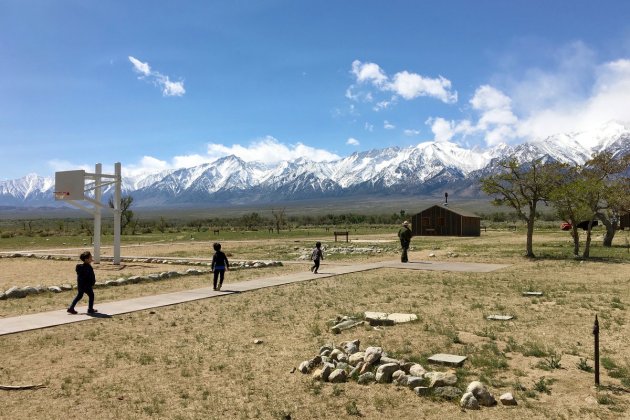
The military-style camps were intentionally located in remote areas. Manzanar is about four hours north of Los Angeles by car and 3,800 to 4,200 feet above sea level. It is on U.S. Route 395, east of the Sierra Nevada and west of Death Valley. The nearest populated area is a tiny village six miles north named Independence. Before the trip, I debated whether I should go. The drive from Northern California is long, and my car is old. But I decided that I wanted to see Manzanar with my own eyes, so that my understanding of history might feel deeper through the experience of place.
Two reconstructed buildings stand in the former Manzanar War Relocation Center. Once, 10,046 people were imprisoned here.
Melissa Hung for NPR
What we saw was a flat desert with vegetation scrappy and close to the ground, stubborn trees here and there, tumbleweed bounding across the landscape, propelled by the wind. In the distance, Mount Williamson, majestic and snow-covered, looked like a painting.
“I hadn’t pictured it this beautiful,” I said.
“I imagine it must have felt ironic for the people living here,” Erin replied.
Manzanar opened on March 21, 1942, so the weather would have been similar to what we were experiencing on this sunny April day. I was wearing a sweatshirt and a vest. But here spring gives way to summers of up to 110 degrees and winters below freezing. In all seasons, the wind covers surfaces with sand and dust. Like the force of history, it is a constant that cannot be ignored.
Our guide for the day was park ranger Mark Hachtmann. He dressed the way I imagined a park ranger would: a uniform of green pants, a matching green jacket with a U.S. National Park Service patch on the arm, and a brimmed hat. He led us through the few buildings in Block 14, which now serve as exhibits. After the war, most of the buildings at Manzanar were dismantled. After Manzanar became a historic site in 1992, buildings were recreated according to historical photographs. The two barracks in Block 14 were built in 2010.
From what had been rebuilt, we were to imagine the entirety of the camp. There were 36 blocks in all for Japanese Americans. Each block contained 20 buildings: 14 barracks, a mess hall, a recreation hall, a laundry facility, an ironing room, a women’s latrine, and a men’s latrine. Between 250 and 400 people lived in each block, the blocks separated by open areas to prevent fires from spreading, a real threat in this land of wind. The whole camp was just under one square mile.
The residents were resigned to being in the camp ¾ Shikata ga nai(nothing can be done) ¾ and tried to make life a little more normal and comfortable. They created sports teams, published a newspaper, and started a co-op store. I was impressed by their self-organizing and resilience, but also felt a lingering sadness, especially for the older adults who had built their businesses and professions in the face of discrimination, only to have almost everything taken away. Did they ever recover? As we walked from building to building, the boys picked up sticks and dug at the dirt. I wondered how much they understood and if they would remember any of this. They played, I imagined, as kids their ages had done when the camp was full of families.
While in use, the camp included a 250-bed hospital, a fire station, an orphanage for 101 children, and baseball fields. More than 10,000 people ¾ 6,000 adults and 4,000 children ¾ had lived here in a hastily built, temporary city of concrete blocks, wood, and tarpaper. The War Relocation Authority staff ¾ the camp director, police chief, fire chief, social workers, and others who were mostly white and often referred to as the “Caucasian staff” ¾ lived in other blocks with their families, in buildings with their own bathrooms, kitchens, and lawns.
Given Canada’s large Canadian Sikh population, likely more awareness, but polling shows fewer Canadians view Sikhism positively compared to other religions, save Muslims and Mormons:
Nearly 60 percent of Americans admit knowing nothing at all about Sikhs. That lack of knowledge comes at a deadly cost. In the wake of recent incidents from the 2012 Oak Creek Massacre to a shooting of a Sikh man in Washington this March, the Sikh community is taking a more vocal stand against hate.
This month, the National Sikh Campaign, an advocacy group led by former political strategists, launched a $1.3 million awareness campaign, “We are Sikhs.” Funded entirely by grass-roots donations, the campaign’s ads will air nationally on CNN and Fox News as well as on TV channels in central California — home to nearly 50 percent of the Sikh American population — and online.
The ad, which aims to tackle misperceptions of Sikhism, shows Sikh men and women speaking about how values of their faith — tolerance, religious freedom and gender equality — align with American values. According to Gurwin Singh Ahuja, the executive director of the National Sikh Campaign, “These are core values of the United States, yet we’re often perceived as anti-American or as religious extremists. Our community is hurt by bigotry and ignorance, which is, in many ways, compounded by our own silence. To change these perceptions, I felt we had an obligation to share our stories with our neighbors.”
Some young Sikhs like Sabrina Rangi, a medical student at Michigan State, are optimistic about the potential impact of the campaign. “I think after years of struggling to find the right words, this campaign is getting it right,” says Rangi. “This initiative embodies everything that Sikhism represents, especially its emphasis on shared values and equality. I see this practiced in the gurdwara, where all of the participants sit together on the floor, beneath our holy book, to symbolize that regardless of gender, race or social standing, we are all one.”
Founded over 500 years ago, Sikhism is a monotheistic religion centered on the teachings of 10 spiritual gurus. Guru Nanak, the founder of the faith, rejected India’s caste system and declared all human beings equal. During Guru Nanak’s time, Indian women were considered property with little social standing. Nanak denounced the sexism of the day by proclaiming women equal and encouraging them to participate in all aspects of the gurdwara, or Sikh temple.
The 10th Sikh Guru, Guru Gobind Singh, also promoted the principle of equality. During his time, family names signified social status and caste. To break this tradition, Guru Gobind Singh gave all men the last name “Singh,” meaning lion, and women the name “Kaur,” meaning princess. Sikh turbans, the most visible symbol of the faith, are also a rejection of hierarchy of the caste system. Worn historically by South Asian royalty, the Sikh Gurus adopted the practice of wearing the turban to demonstrate a public commitment to maintaining the values and ethics of the tradition, including service, compassion and honesty.
But the turban’s symbolism is lost on most Americans. According to Ahuja, “Our turbans, which are often perceived as symbols of extremism, are actually representations of equality.” Following Sept. 11, images of Osama bin Laden and al-Qaida associates wearing turbans circulated frequently in the media. Heightened national fear in combination with poor awareness of America’s Sikh community has often made Sikhs the victims of anti-Muslim hate crimes.
Valarie Kaur, a Sikh civil rights activist and lawyer, warns that violence against Sikhs is not only cases of mistaken identity. Attacks against Sikhs in the United States pre-date the Sept. 11 attacks. In 1907, a group of Sikh immigrants were driven out of town by xenophobic mobs during the height of the American nativist moment. Whether 1907 or today, according to Kaur, “it appears to matter little to perpetrators of hate crimes whether the person they are attacking is Sikh and not Muslim. They see turbans, beards and brown skin and it is enough for them to see us as foreign, suspect and potentially terrorist. It’s time to retire the term ‘mistaken identity.’ It’s a dangerous term, because it implies that there is a correct target for hate.”
Here is a proposition that may seem self-evident to many people: As societies become more modern, religion loses its grip. Superstition inevitably gives way to rationality. A belief in magic is replaced by a belief in science.
Sociologists call it the “secularization thesis.” In 1822, Thomas Jefferson suggested an early version of it, predicting that Unitarianism “will, ere long, be the religion of the majority from north to south.”
Some data from modern countries support the thesis. Fifty years ago, about four of ten children in England attended Sunday school. Today, it’s only about ten percent. In the United States, just five percent of the population in 1972 reported no religious affiliation. By 2016, one out of four said they were unaffiliated.
Recent research, however, has suggested that religion is more durable than was previously thought. While church attendance has declined sharply in western Europe, secularization has been less evident in the United States. The number of Americans who list their church affiliation as “none” has certainly increased, but more than 70 percent still identify generally as Christian.
A study released this week by the Pew Research Center on the relation in the United States between religiosity and educational attainment (one component of modernization, along with technological change and others) at first glance appears to support the secularization thesis: The more education people have, the less religious they are.
“College graduates are less likely to say they believe in God with absolute certainty,” noted the lead Pew researcher, Gregory Smith. “They are less likely to say that religion is very important in their lives. They are less likely to say they pray regularly, and college graduates are more likely than others to identify themselves as atheists and agnostics.”
A closer look at the data, however, offers a more nuanced picture. While highly educated Jews tend to be less observant than less educated Jews, the relation between education and religiosity is weaker among those Americans with a strong Christian identity.
“Highly educated [Christian] adherents are just as religious, in some cases more religious, than their fellow members who have might have less education,” Smith said. Among mainline Protestants, for example, college graduates were actually found to be more likely than non-college graduates to report weekly church attendance. Regardless of their educational attainment, these Christians find meaning in their church experience.
The sharp rise in the number of Americans who report no religious affiliation may also have an explanation that is unrelated to secularization. Research by Philip Schwadel at the University of Nebraska suggests it may simply be that it was less acceptable 50 years ago to identify as religiously unaffiliated than it is today.
Schwadel and others also argue there are significant differences between the United States and Europe when it comes to the process of secularization. In Europe, organized religion has generally been associated with governments to a far greater degree than in the United States. As a result, anti-government sentiment may have been more likely in Europe to produce antagonism toward the church. Government support for religion in many western European countries may also have weakened the vitality of those church communities.
“When a state creates a relationship with a religion, religious leaders no longer have the same impetus to go out and get people excited,” said Schwadel. “They get money from the state through taxes, so they don’t have to collect money from their congregants.”
In the United States, by contrast, religious leaders have to “hustle” more, Schwadel said. “They need to get more congregants if their church is going to survive.” Perhaps as a result, Americans are more committed than Europeans to their church congregations.
The notion that religious belief and practice have evolved with modernization does remain broadly accepted. As literacy has increased and scientific knowledge has advanced, supernatural explanations for developments in the natural world have become less important. Religion has nevertheless survived, Schwadel argues, because it plays a variety of roles.
“Religion provides people with a lot more than just explanations for the natural world,” Schwadel said. “It provides community. It provides them with friends. It provides them with psychological support and economic support. It provides a lot more than simply an understanding of where they are in the world in relation to the afterlife.”
A 2016 Pew study found that more Americans reported growing feelings of “spirituality” even while saying they were less attached to organized religion. To the extent that churches respond to that need, they will presumably have better prospects for survival.
The question facing religious leaders and sociologists of religion is whether modernization will eventually lead to secularization in the United States and other countries, just as it has in western Europe. Some argue that a diminished emphasis on traditional doctrine about the meaning of salvation, for example, or the existence of heaven and hell, is merely an early sign of growing secularism.
Interesting article on the changing nature of Black Canadian activism.
While sympathetic and understanding of some of their concerns (indeed as the Ontario government’s recent data collection and related anti-racism strategy does), and that activism is needed for change, exaggerated rhetoric hardly helps the case with the broader public discussion and debate.
But of course, that is part of free speech and related rights:
At a time when so many Canadians were celebrating the end of the Harper era and, with it, an apparent return to “sunny days,” Khogali’s words eroded the image of Canada as a genteel, meritocratic, accepting nation, instead indicting its leader on the grounds of racism and discrimination. Khogali not only named whiteness—a bold act given the state of our national discourse on race—but specifically white supremacy. She also labelled the Prime Minister a terrorist, implicating Canada as a nation trafficking in fear and oppression. While there were certainly Black Canadians who did not endorse Khogali’s words, online discussions and think pieces written in the aftermath of Khogali’s statement suggest that her statement wasn’t as aberrant for young Black Canadians as for their white counterparts. But regardless of where one finds themselves in relation to Khogali’s words, one thing is clear: a vision of change that does not require the nation state or the sanction of white allyship—let’s call it disruption—has begun to gain credence among Black Canadians. It may make some uncomfortable—but it’s also starting to produce results.
This paradigm was on display during BLMTO’s disruption of Toronto’s Pride Parade last summer, an action that drew the ire of many white members of the LGBTQ community who believed that BLMTO was undermining its authority and the gains that it had made in society. It was on display at Tent City when BLMTO occupied the area outside of the Toronto Police Headquarters. It was on display when BLMTO showed up at Ontario Premier Kathleen Wynne’s private residence in protest of police. These are the new tactics of disruption: disruption of parades, disruption of privacy, disruption of comfort, disruption of permission, decorum, civility, and the various ways they have been used to obscure Black plight. Disruption is inspired by a lack of visible progress promised by the Prime Minister’s own father.
Currently, BLMTO boasts 18,000 followers on Twitter including many high-profile members of the Canadian media landscape, some of whom subscribe to the same style of activism; Desmond Cole’s recent disruption of the TPS meeting in protest of carding is a compelling example. BLMTO is also actively involved in Toronto’s Black communities, holding many discussions and events and, in March, the group achieved its goal of having police banned from Toronto’s Pride parade.
I ended up speaking out against the elder’s words at the meeting; silence felt inadequate. I told the young man that an appeal to reason could not work in a system predicated upon his dehumanization, and that to assume otherwise was dangerous. When I spoke, I found myself supported by several others in the room, including a few elders. As Foster observes of Black elders, “many of them immigrated to Canada with their heads full of dreams. They were going to do well and succeed, become an example for all those back home. Now, in the middle of the night, they find themselves scratching their heads and asking what went wrong. For they did not attain their dream, and what is even more significant, they now despair their kids will be worse off than they.”
In these dire times, when 42 per cent of Black students have been suspended at least once in the Toronto District School Board and Black Canadians constitute nearly ten per cent of federal prisoners—but only three per cent of the Canadian population—unwavering subscription to infiltration is difficult and often dangerous. Entire generations of Black Canadians have watched Black teachers in Ontario face racism in the staff rooms and barriers to promotion. We’ve seen how the establishment of the SIU, a major reform secured through the tireless efforts of the Black Action Defense Committee, did not protect Jermaine Carby or Andrew Loku. We see the hollowness of the promises made four decades ago.
For Black Canadians wedded to the idea of infiltration, it is high time to acknowledge its limitations, the many ways in which the face of the mainstream has yet to soften. It is also incumbent upon non-Black Canadians and, especially, White Canadians to examine their relationship to Canada in light of history. To label Khogali’s words violent and call for her resignation without any discussion of state-produced violence is to ignore centuries of injustice in this country. It invests in ideals of merit and civility, assuming the effectiveness of nationhood, while conveniently overlooking the violence visited upon racialized bodies and, in particular, Indigenous bodies.
As people across this country move to celebrate Canada 150, the important shifts that have occurred in Black political engagement from Trudeau to Trudeau ask all Canadians to re-evaluate the narratives that structure what it means to be “Canadian.” The politics of disruption recognizes that systemic racism may be just as Canadian as maple syrup. The barriers to full participation in Canadian society have not been removed—in fact, many have been redoubled. In contrast to the decades of Black support for Pierre Trudeau, Khogali’s indictment of Justin Trudeau reminds us that it is racialized Canadians who are often left in the shadows of these long-awaited sunny days.
 Source: Diversity Dividend Report