The Order of Canada and diversity

My latest, in Policy Options:

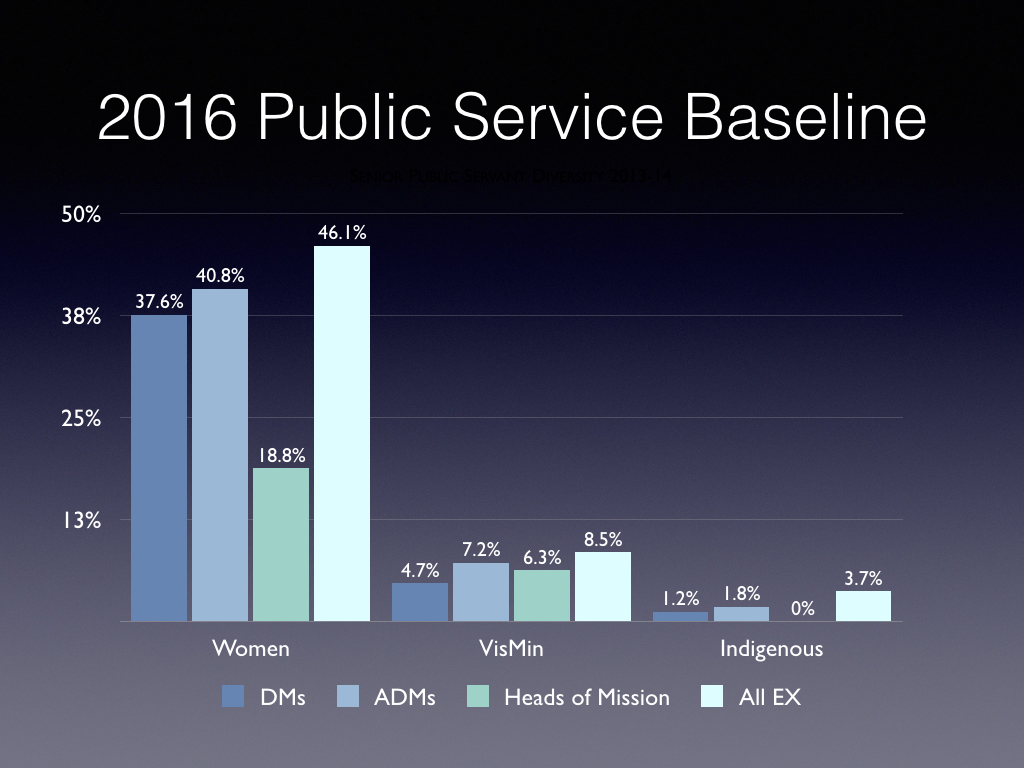
In Budget 2015, the then Conservative government announced additional funding of $13.4 million over five years and $2.8 million in ongoing funding for the Canadian Honours System. This aimed to “bring [honours] closer to all Canadians” by increasing the number of Order of Canada nominations from “under-represented sectors” (e.g. business) and regions (i.e. the West).

This was prompted by an Ottawa Citizen analysis that showed only 26 percent of recipients since the Order’s creation in 1967 came from the West, compared to the region’s 31 percent share of the population. In contrast, Atlantic Canada had 11 percent of recipients, about twice its share of the population. Moreover, the study showed an increasing percentage of awards had gone to those active in the arts while the share going to business people had declined.

Source: The Order of Canada and diversity (for complete article)

Supreme Court judge [Justice Wagner] says Canadians shouldn’t worry about arrival of refugees, migrants 

Thoughtful and pertinent comments, particularly interesting his comments on identity:

Wagner said the notions of identity, human dignity and democratic values permeate the Charter and “lay the foundations for looking beyond our own borders.

“We can welcome refugees and migrants with the confidence that our society is able not only to manage our differences, but to thrive on them,” said Wagner.

Speaking to reporters later, Wagner acknowledged that, while his speech was delivered to a legal and academic audience, there was a message for Canadians concerned about the influx of refugees and migrants.

“We should, I think, welcome all those people and we should be willing to accommodate them and not change them,” he said.

“People should not be afraid of having migrants and refugees in their own countries. I think we’re strong enough and . . . we have strong moral values, and one of those values is the respect for human dignity. And, if we take our role seriously, we’ll look, we’ll adopt the perspective of the other, and it could only, I think, as far as I’m concerned, grow society much better in the future.”

Asked if that means there should be room for face veils and other individual expressions of religious identity, Wagner declined to answer, saying: “I don’t know if those cases will come before the court, so I don’t want to comment.”

Wagner holds one of the three high court seats reserved for Quebec. Quebec’s legislature is now studying a bill to require “religious neutrality” of those who deliver or receive public services, amid calls to ditch the bill in the wake of the slaying of six Muslims at a Quebec City mosque.

Wagner said judges have an “obligation” to try to understand the perspective of a person who says their equality rights are breached, but he added “that doesn’t mean that the claimant is right . . . that doesn’t mean that I would adopt his way, or his reasoning, or his opinion, or his end result.”

In his speech, Wagner admitted early approaches to how judges analyzed discrimination did not stand up to the task. He said Charter interpretation is still “a work in progress,” but, he added, over the past 150 years “the constitution has enabled us to navigate difficult questions of identity.

“Personal and group characteristics are the starting point of Charter equality jurisprudence, but identity is not about labels; it is a shorthand for how people see themselves, how others see them, and how those two things interact in people’s lives.”

Wagner said the Supreme Court looks to the context and experiences of a person claiming discrimination, and seeks to understand the person’s perspective, which is an especially important consideration in cases of aboriginal law or where there are overlapping characteristics of a person’s identity that influence how they experience discrimination.

Wagner said the experience of a woman who is part of a visible minority can be totally different from that of a young man who has the same characteristics. “If one of the two is not a citizen, or has a different sexual orientation, their experience could be even more different.”

“When the court eventually faces a question touching on trans-gender identity, these two propositions will provide essential frames of reference: that identity is not fixed, but changing, and that identity is not innate, but contextual,” he said.

Wagner predicted that, although the principle of “dignity” fell out of favour in judicial analyses of equality claims, it would find new traction in future Charter litigation. It is a crucial consideration when judges weigh whether a rights violation is reasonable and justified. “Equality infringements ought to be increasingly difficult to justify to the extent that it strikes at the heart of someone’s individual or group identity and, with it, their recognition as full participants in Canada’s ongoing democratic dialogue,” he said.

University of Ottawa law professor Errol Mendes said Wagner’s speech would please equality-seeking groups on the one hand, but he said Wagner also emphasized “democratic values” and “substantive” equality over any superficial concept of equality.

To Mendes, it was a signal from a judge who some suggest could one day become the chief justice of Canada, that the balance won’t always tip in favour of those who feel their rights are breached.

Helping Immigrant Students Catch Up, Fast — It Takes A Whole School : NPR

US example of how schools facilitate the integration process:

For many immigrant students, the trauma of crossing the border follows them into the classroom — affecting their performance and ability to learn. And that’s where Michelle’s school comes in.

At Langley Park, in Prince George’s County, Md., 87 percent of students are Spanish-speaking. Out of 176 students, 24 countries are represented and 15 languages are spoken at home, not including English.

The school started last fall. So far, the school sits in temporary buildings, but the kids don’t mind it too much — unless it’s raining.
Her school is part of a larger network across the country called Internationals Network For Public Schools. It serves English language learners, or ELLs, and recent immigrants.

For students like Michelle, the problem is two-fold: Not only are they dealing with trauma, but they also belong to one of the most marginalized student populations.

According to a recent Stanford study, the achievement gap between ELL-Hispanic and white students is the largest in the context of race and ethnicity. And, the average high school graduation rate of ELLs is 19 percentage points lower than the national rate, 63 percent compared to 82.

In 1985, the network opened its first school to address that long-standing disparity. Since then, it has grown to 27 schools in seven states, including Washington, D.C.

And, it seems to be working. Last year, ELLs who attended the network’s high schools in New York City graduated at a rate 16 percentage points higher than ELL students in the city’s public schools, the nation’s largest school district.

As for Langley Park, it hasn’t had a graduating class, yet — it opened last fall — but results so far look promising. In the first class of students, 98 percent showed improvement in their English language skills.

Two talented young artists — Stefany Novoa (left), 16, and Frishta Wassl, 14 — work on self-portraits in Christine Wilkin’s art class.

LA Johnson/NPR

How does the network do it when so many other schools struggle to educate ELLs? It seems to boil down to three simple things:

Every teacher is a language teacher. Tammy Tatro, who teaches technology, says implementing English-language instruction into her class curriculum is “really hard.” But she does it by repeating herself and using visual aids to get concepts across to students.

Second, one of the network’s vital principles is collaboration. That’s why the classes are a mix of students with varying English language skills.

“They all want to lift each other up,” Tatro says. “When one fails, especially if they’re working on a team project, then they all kind of fail. So, they have to help each other.”

A third key principle, Principal Carlos Beato says: the school’s partnerships.

Christine Gilliard, a phys ed teacher, used to teach at a large high school where she had “a two-story gym and two storage closets.” Now she teaches out of a trailer-sized temporary building. “We may not have the best of everything, but we have each other,” she says.

LA Johnson/NPR

CASA de Maryland, a Latino advocacy organization, is one of Langley Park’s partners. The organization offers legal advice for students and their families. Students can also take a social justice class from CASA to learn about advocacy and their rights, depending on their immigration status.

Partnerships like this are crucial, given the extra challenges many of these students face — homelessness, separation from their parents and, of course, the language barrier. Without tending to all of their social and emotional needs, Beato explains, “we wouldn’t be getting any of the academics done.”

Most of the network’s schools employ a full-time social worker. At Langley Park, that’s Lesly Lemus. Her job is to support students any way she can as they cope with life outside school, whether it’s connecting them to community resources or just listening.

Source: Helping Immigrant Students Catch Up, Fast — It Takes A Whole School : NPR Ed : NPR

ICYMI: 82 per cent of BC minorities have experienced racism, survey finds

Not surprising, and likely similar in other major centres. No gradation regarding the degree or seriousness of racism encountered. These regional studies, as useful as they are, suggest the need for a new Ethnic Diversity Survey (the last one was carried out in 2002):

As multicultural as Canada may be, it appears we are not immune to racism.

According to a new survey conducted in B.C., 82 per cent of visible minorities say they have experienced prejudice or some form of discrimination, while 56 per cent of all respondents reported having overheard racist comments.

Of those who identified themselves as visible minorities, 46 per cent said they believe they face social disadvantages because of their background, and 33 per cent said they have been a target of abuse. Another 29 per cent reported facing discrimination simply based on their name, while 10 per cent have dealt with disadvantages because of their religious beliefs.

And 11 per cent said their experiences with discrimination were traumatic enough to prompt thoughts of moving to a new location.

“The majority of British Columbians are welcoming and embrace multiculturalism. However, it’s clear that racism is alive and well in our communities and we need to call it out when we see it,” said Catherine Ludgate, a spokeswoman with Vancity. The report was commissioned by the credit union as part of its community investment efforts.

 Some 82 per cent of all those who responded said they felt multiculturalism has been “very good” or “good” for Canada, though three-quarters thought the population of immigrants should remain the same. Just over a quarter thought the population should increase.

…The numbers are from a new report released today, conducted in January by Insights West and is in anticipation of a community roundtable series to be launched by SUCCESS B.C., an immigrant assistance organization, and sponsored by Vancity.

Dates for the roundtable series have yet to be announced, but the series follows a forum on immigration hosted by SUCCESS in February.

Queenie Choo, CEO of SUCCESS BC. According to a new report conducted in B.C., 82 per cent of visible minorities have experienced prejudice or some form of discrimination, while 56 per cent of all respondents have overheard racist comments being made.“We didn’t want to host the forum and the forget about it,” said Queenie Choo, CEO of SUCCESS, who was quick to note that it’s important to continue discussing these issues lest history repeat itself.

Choo said the discussions would be a chance for immigrants to share their experiences with social groups and government, which in turn could help shape programs and policy. She also noted it’s important to ensure Canadians speak up for social justice in light of events taking place in the U.S.

“I truly believe that we (Canada and the U.S.) hold shared values of diversity and inclusion. If those are no longer our shared values, then there is a big question mark,” she said. “We need to make a stand. By not raising the issue and creating this opportunity (to discuss racism), it will signal to people that it’s acceptable.”

For every individual that joins Vancity between now and May 30 and sets up a pre-authorized payment or deposit, the credit union will donate $100 to the Vancity Humanitarian Fund to support refugee families. The donations are in addition to $100,000 already donated to the fund, part of which has already helped refugees settling in Victoria and Abbotsford.

Source: 82 per cent of BC minorities have experienced racism, survey finds | Vancouver Sun

ICYMI: We’re giving our babies distinctly Canadian names and impact of diversity

Another measure of increased diversity is the presence of ethnic names (end of excerpt):

Every year, another snooze-worthy report is published of the country’s most popular baby names—for the past decade, a sea of Emmas, Bens, Liams and Sophias. But this year, to further distinguish ourselves from our American neighbours perhaps, the creative brains at Canadian data journalism site the 10 and 3 (their mission: “to tell compelling and unusual stories about Canada through maps, interactive charts and other interesting visualizations”) decided to look past the Ethans and Isabellas and crunch some distinctly Canadian numbers.

What exactly makes a name more Canadian? “Firstly, it has to be relatively popular in Canada,” explains Arik Motskin, data scientist and founder of the10and3.com, “but more importantly, it has to be much more popular than however popular it was in the United States.” Take the name “Brody:” in 1990, 0.1% of Canadian baby boys were given it, compared to 0.01% of American babies, giving Brody a “Canadian Factor”—as the site calls it—of 10. “That means you’re ten times as likely to meet a Brody in Calgary than you are in Kansas City,” says Motskin. And now with a handy new mode of measurement, plus a century’s worth of data to explore, here are a few things the Canadian Factor has taught us.

Surprise! We love hockey players

A modern-day name with a top Canadian Factor is Linden, who scored a 20 and currently sits atop the scale, for former Vancouver Canucks hockey star (and current exec) Trevor Linden. “There are other hockey names, like Duncan and Darcy, but the Linden thing came out of nowhere for us,” says Motskin. Fittingly, it’s not only Trevor’s Linden’s prodigious sports skills that made his name, but also that he’s so well loved in Vancouver for being a nice guy (how Canadian is that?).

Sorry Pierre and Jean-Paul, name stats are an imperfect science

Name data, though it might seem straightforward enough, is actually notoriously difficult to find. “In Canada, name statistics are [kept] at the provincial level, but beyond the top 10, most provinces don’t provide more details—both for privacy reasons and because they just don’t have the manpower.” The 10 and 3 mostly lucked out across the country, but no dice in Quebec, which presented two problems: “We weren’t able to get data from Quebec, but even if we did, we’d have to crunch the numbers differently,” says Motskin. When French Canadian names showed nation-wide popularity, their Canadian Factor automatically spiked off the scale—like Josée in 1970s with a massive top score of 634. “Maybe French names should be compared to France,” says Motskin.

So long, stereotypes

Co-authored by Zack Gallinger and Neil Oman, Motskin’s piece is titled “Gord, Sheila, Graham and Beverley? The Most Distinctively Canadian Names Are Not What You’d Expect.” While Gordon makes a lot of sense—Downie, Howe, Lightfoot come right to mind—the others are, admittedly, inventions of the authors to make a point. “Everyone has their stereotypes, and these were just ours,” says Motskin. While some stereotypically Canadian-sounding names (looking at you, Nate and Duncan) definitely appear on each decade’s Top 10 list, names like Mohammad and Syed, with a Canadian Factor of 8.7 and 10.3 respectively, measure up equally Canadian.

…Of all Motskin’s number- and name-crunching, the most fascinating was abrupt cultural changes that arrived in distinct waves. The 1930s and 40s saw distinctly Anglo-Saxon monikers like Archibald and Angus for men, Catherine and Doreen for women, he notes, but “by the mid 20th century, suddenly there were a lot of Italian names like Giuseppe and Antonietta.” Immigrants often name their children traditional names, who in turn grow up more assimilated in Canada and look right back to the top 10. “I suspect in 20 years, those kids will have a lot of Emmas and Liams—or whatever’s popular then.”

Source: We’re giving our babies distinctly Canadian names – Macleans.ca

Canada’s last lines of defence against populism: Geddes and Gilmore contrasting views

Two contrasting views on the risks of populism in Canada, starting with the stronger one IMO by John Geddes:

If the Canadian election map makes taking an anti-immigrant line a losing proposition, and the Canadian way of choosing party leaders makes it hard for a populist outsider to win, there’s still the possibility that the Conservatives might try to activate the economic side of populism.

Even there, though, the formula behind Trump and Brexit doesn’t look like a natural fit in Canada. Trump blended his anti-immigrant rhetoric with promises to scrap or overhaul free-trade agreements. The Brexit forces linked discomfort with foreigners to resentment of the EU free-trading order. But in Canada, liberalized trade enjoys broad buy-in—particularly on the political right, and notably in the Conservatives’ resource-exporting western strongholds.

So echoing Trump and the Brexiters in railing against unfair foreign competition is a non-starter for Canadian Conservatives. That leaves, perhaps, finding a way to give voice to the anxieties of that broad swath of Canadians who, as Graves portrays them, fear that the middle class is shrinking and that opportunities for their children and grandchildren are dwindling.

But the Tories would find themselves playing catch-up with the Liberals when it comes to tailoring a populist message for those worried voters. Trudeau has been arguing since 2014 that failure to push income growth down from high-earners to middle-class families would eventually prompt a dangerous backlash. His answer, or at least part of it, came in last year’s budget, in the forms of a modest middle-income tax cut, an upper-income tax hike and a significant boost in federal payments to parents.

Is more policy in the same vein coming in next month’s 2017 budget? In a significant recent speech in Germany, at Hamburg’s annual St. Matthew’s Day Banquet, Trudeau strongly suggested he isn’t done trying salve that middle-class sense of grievance. “With the pace of globalization and technological change,” he said, “there is a very real fear out there that our kids will be worse off than we are.”

Adopting his own version of the populist line, Trudeau took direct aim at corporations that post record profits but somehow can’t afford to offer job security to their workers. “Increasing inequality has made citizens distrust their governments, distrust their employers,” he added. “It turns into ‘us vs. them.’ ”

From the sounds of his Hamburg speech, Trudeau doesn’t intend to leave the next Conservative leader any easy opening to outdo him when it comes to giving voice to the disquiet of Canadians who believe the economic order is stacked against their families. It remains to be seen what additional policies the Liberals unveil in the upcoming budget to back up that rhetoric.

If Trudeau fails to deliver, a right-leaning populist might seize the chance to try to fill the vacuum. Overall, though, the prospects for a right-of-centre populist movement in Canada look dim, even though opinion in Canada, according to pollsters like Graves and academics like Donnelly, contains plenty of the same mix of fear and pessimism that fuelled Trump and Brexit.

There’s no shortage of Canadians who, if they’d heard Ted Falk wishing God’s blessing for Donald Trump, might well have said, “Amen.” But if they’re hoping that Trump-style populism will slip across the border and succeed in Canadian politics, they’re likely to discover that Canada’s welcoming reputation has its limits.

Less convincing, in my view, is Scott Gilmore’s, who views the increased number of foreign-born as a risk, in contrast to Geddes who notes the political importance of that demographic, particularly in the battle ground suburban ridings needed to win:

Which brings us to Canada. Will we see a similar rise in populism here? When I sat down to write this column, my instinctive answer was “no.” I agreed with many of the arguments made by my colleague John Geddes, who sees systemic and political barriers to Canadian populism. My thinking was that the apparent growth in global populism is because we are focused on Trump and starting to pay attention. But where I could find data, it didn’t support my conclusion. One study from Harvard, for example, found that support for populist parties on both the left and the right has grown undeniably and steadily since the 1960s, doubling its support since then.

But it was another study completed late last year by a group of academics from the U.S., Europe and Japan that left me especially troubled. They looked at a dozen European countries to see if there was a correlation between the relative size of the immigrant population and the support for right-wing populist movements. The researchers found that there was a direct connection, and that support grew at an increasing rate as the size of the immigrant population grew. And what is more, their data suggested there was a “tipping point” in western societies: when immigrants comprised 22 per cent of the population, support for anti-immigrant parties approached a political majority. If a country takes in too many immigrants, a populist backlash may be unavoidable.

In Canada, our foreign-born population is already at 20 per cent and growing. This is far higher than in the United States and (except for Luxembourg and Switzerland, where there are large numbers of itinerant professional residents like bankers) it is far higher than in any other European nation. And it’s getting bigger. Statistics Canada just released a report that projected Canada’s immigrant population will increase to between 26 per cent and 30 per cent within two decades. This puts Canada well beyond the theoretical 22 per cent threshold in the European study.

It makes sense that countries become unstable with too many foreigners. I have first-hand experience in places like Pakistan and Timor Leste, where sudden massive influxes of refugees can pull a country apart at the seams. But is it possible that even when immigrants arrive gradually and they are integrated successfully, it can still destabilize a country? Perhaps a populist backlash is inevitable in Western democracies when the immigrant population grows to a certain size.

This is not because the newcomers bring crime or undermine our democratic institutions (they do neither), but because the native citizens, whether they are Canadians or Austrians or Americans, instinctively feel threatened by newcomers. Perhaps the experiences add up—new faces on TV, new clothes in the street, new music on the radio—until the average person reaches a tipping point and pushes back. After all, a fear of strangers is wired into our brains, an instinct that kept us alive in our tribal past.

If this is true, it upends a lot of assumptions that this country is built on regarding multiculturalism, pluralism and immigration. Canada may be facing larger global forces, tectonic shifts which are are not felt until it’s too late and a populist earthquake shatters our carefully built house of peace, order and good government.

Ontario government unveils 3-year plan to battle racism

More ambitious and extensive than I had expected.

Particularly important is the emphasis on collecting race-based data as well as a race-based lens (the federal government could learn from this: Canadian Heritage, responsible for multiculturalism, to note):

The provincial government has announced a sweeping new plan for tackling systemic racism that includes Ontario’s first anti-racism legislation, $47 million for black youth, and a framework for collecting race-based data — something community activists have long demanded.

The “pan-government” strategy — developed over the last year by the province’s still-fledgling anti-racism directorate — was unveiled Tuesday at a crowded news conference attended by the Attorney General and several cabinet ministers.

In his remarks, Minister of Children and Youth Services Michael Coteau, who heads the directorate, promised “concrete steps” to end systemic racism in government institutions.

One of these steps is proposed legislation to be introduced this spring — which, if passed, will mandate the collection of race-based data across multiple sectors, including child welfare, education, health and justice. Another is a new framework to apply an anti-racism lens to future policies and programs.

The “A Better Way Forward” strategic plan highlighted specific barriers faced by black youth, who will become the beneficiaries of a four-year, $47-milllion “action plan” aimed at reducing disparities and helping them succeed. “I want black youth in this province to know that their lives matter,” Coteau said.

The plan also calls for education initiatives and public awareness campaigns — something Coteau believes is “especially needed when we talk about Islamophobia.”

“Our government is ready to take responsibility and to make change,” Coteau said. “It’s taken us decades to get to this point. And I believe that it’s never too late for us to correct our course.”

The anti-racism directorate was formed to “address racism in all its forms” in February 2016 — 10 years after the Ontario government first passed legislation that enabled them to create an office for tackling systemic racism.

The directorate fills a long-time void left by the province’s former anti-racism secretariat, which was killed in the mid-1990s by the Progressive Conservative government at the time.

In February 2016, Premier Kathleen Wynne said the need for an anti-racism directorate had “sharpened” in recent times, pointing to ongoing issues like police carding and the debate over Syrian refugees.

Arguably, the need has since become more acute. In the hours before the anti-racism strategy was unveiled, news broke of bomb threats made against Jewish community centres in Toronto and London.

Tuesday’s threats come on the heels of several other, troubling events: the Quebec City mosque shooting in January; last week’s bomb threat against Muslim students at Concordia University; and a string of racist and anti-Semitic vandalism attacks, to name a few.

The anti-racism directorate has spent the past year holding a series of emotionally-charged public meetings across Ontario, meeting with community members everywhere from Toronto to Thunder Bay.

Last July in Toronto — where the first of 10 meetings was held — a crowd of more than 1,000 people packed Daniel’s Spectrum in Regent Park. Some criticized the province for only allocating $5 million to the anti-racism directorate and the crowd periodically broke out into chants of “black lives matter.”

Attendees expressed frustration over what they described as an endless cycle of proposed — and failed — initiatives to address systemic racism in Ontario.

“There hasn’t been a time in the last 50 years when we have not marched on the streets of Toronto calling — calling out, calling out, calling out — to put an end to racism,” said Akua Benjamin, a longtime black activist and professor with Ryerson University.

“There hasn’t been a time when we have not faced (policymakers) — whether it is the Liberals, whether it is the NDP, whether it is the Conservatives — around this issue of racism. And so here we are again.”

On Tuesday, some community members again expressed skepticism of the new strategy, especially with a provincial election looming.

But the mood was markedly more optimistic. While Avvy Go was disappointed by the strategy’s lack of focus on employment inequities, she was heartened by the strategy’s embrace of race-based data collection.

“The collection of disaggregated data is foundational to the success of any anti-racism strategy,” said Go, a founding member of the Colour of Poverty campaign and director of the Metro Toronto Chinese & Southeast Asian Legal Clinic.

“Without such data, we simply cannot properly measure the progress over time of any plan that the government might choose to adopt and implement.”

Donna Harrow, executive director of the Alexander Park Community Centre, also stood up to thank Coteau for his work with the directorate.

Harrow has seen many government promises come and go in her 40-some years of black activism. But this new strategy, she believes, “is different.”

“This is the first time that they have actually named systemic racism (and committed) funds to African-Canadian young people who have not had an equitable chance in our society,” she said.

“For the first time, I can say that someone from the Ontario government has listened and has acted for a specific group of people — my specific group of people.”

Source: Ontario government unveils 3-year plan to battle racism | Toronto Star

Senate staff diversity under a microscope #cdnpoli

The same study should be made with respect to MP and Ministerial staff (the latter, when I looked at in late 2015 and early 2016, showed considerable under-representation in Ministerial offices, particularly of visible minorities and Indigenous peoples):

Women made up 59 per cent of Senate administration staff as of March 2016, according to the Senate administration report tabled in December. That’s a bump of 10 percentage points from the same month a year prior, and the highest level since at least 2009.

That shift was enough to prompt Sen. Marshall to ask the subcommittee’s witness, Senate human resources director Luc Presseau, whether the Senate’s efforts to ensure equal representation for women had created an overrepresentation.

The Senate administration has been working for several years to ensure proper representation of women, aboriginal people, disabled people, and visible minorities.

“When you swing one way to fix something, sometimes you swing the other way a little too far,” Sen. Marshall told The Hill Times in an interview.

In this case, the large jump in representation seems more dramatic than it really was; there were actually six fewer women working in the Senate administration staff last year than the year prior, but the total number of Senate staff had declined by an even greater proportion over that time, from 437 employees (215 women) to 354 (209 women). The Senate administrative staff dropped by 83 people last year after the Senate Protective Service was merged into the Parliamentary Protective Service, which is now a separate entity.

Last year women represented more than half of the top-earning Senate staff—55 per cent of those making six-figures—and exactly half of those in senior and middle management.

The Senate administration report, the fifth of its kind, shows modest changes to representation of visible minorities (15 per cent last year), aboriginal peoples (3.4 per cent), and persons with disabilities (5.6 per cent) since 2009. The report did not cover staffers working in the offices of Senators, but included all components of the Senate bureaucracy.

Mr. Presseau flagged underrepresentation of individuals with disabilities as a problem, telling the subcommittee, “our numbers are not quite as good as what the availability of the population might be.” He also said that indigenous people, particularly from the North, continue to be underrepresented.

None of the Senate administration’s 30 managers identified themselves as aboriginal last year, according to the report.

The Senate has been working to improve diversity among the ranks of its administrative staff for years. The Senate diversity subcommittee isn’t unprecedented either, as a similar subcommittee was set up in 2011 and tabled a report on the subject in 2012.

Mr. Presseau noted that the statistics included in the Senate report are based on individuals identifying themselves as belonging to a minority group—though that is not the case for gender—and said the numbers might look different if staff were reminded to self-identify.

Sen. Tannas, who also sits on the Senate Aboriginal Peoples Committee, asked whether the Senate could track whether those who identify as aboriginal could be verified as having official status—registered with the government as “status Indians”—as a way to prevent false claims.

“It’s becoming a bit of an urban legend that if you want to get ahead in the civil service that you suddenly identify with your aboriginal roots. And we don’t want that,” he told The Hill Times, adding it seemed unlikely that the Senate would be able to meet that request.

Sen. Tannas also urged the Senate to focus on increasing regional diversity among its staff, suggesting a program to temporarily exchange staff with provincial legislatures, in part to combat the perception out West that the government is run by people from Central Canada.

“I think it’s important in the national Parliament that we don’t wind up with a perfectly sealed bubble, where everybody involved in the affairs of the country drives no more than an hour to work,” he told The Hill Times.

Senators on the subcommittee also stressed the importance of hiring more veterans to work in the Senate, and finding a way to guard against name-based bias, wherein job applicants are overlooked, consciously or unconsciously, because their name suggests they belong to a minority group.

Sen. Jaffer told The Hill Times she hoped the subcommittee could wrap up its work and put together a report before June.

Source: Senate staff diversity under a microscope – The Hill Times – The Hill Times

Black People Are Wrongly Convicted Of Murder More Often, Data Show : NPR

Speaks for itself:

A record number of people, at least 166, were exonerated last year after being wrongly convicted of crimes, according to the most recent annual report from the National Registry of Exonerations.

It’s the third year in a row that data collected by a group of law schools showed a record number of exonerations in the U.S. — with 149 in 2015 and 125 the year before that.

Using information on exonerations going back to 1989, the latest report also shows that black people continue to be more likely to be wrongly convicted in America than people of other races. There is no standardized reporting system for exonerations, but the registry is the most complete national data collected on the subject.

Take the crime of murder. Last year, the report collected data on 52 people who were exonerated of murder. More than half of them, 28, were black.

companion report on race and wrongful conviction, also released Tuesday, states:

“African Americans are only 13% of the American population but a majority of innocent defendants wrongfully convicted of crimes and later exonerated. They constitute 47% of the 1,900 [total] exonerations listed in the National Registry of Exonerations (as of October 2016).”

As NPR’s Joe Shapiro reported last year, “after almost nine years in prison, his conviction was overturned when a state investigation found that the real killer had later confessed to Wayne County police and prosecutors.”

Joe also reported that court fees, including a $1,500 bill for a public defender, nearly kept the now-23-year-old man from being released — even after he had been exonerated.

Last year, The Texas Tribune reported that the state had paid 101 people who were wrongly convicted nearly $100 million over the previous 25 years.

Why Mixed-Race Americans Will Not Save The Country : NPR

Interesting and useful discussion on whether an increased percentage of mixed race reduces bias and discrimination, with some compelling examples and notes of caution:

What Biracial People Know,” a recent op-ed in The New York Times, argues that the growing multiracial population may act as a “vaccine” to the bigotry that buoyed Trump’s campaign, granting America “immunity” to the longstanding politics of exclusion shaped by racism.

But this hope that a mixed-race future will result in a paradise of interracial and ethnically-ambiguous babies is misleading. It presents racism as passive — a vestigial reflex that will fade with the presence of interracial offspring, rather than as an active system that can change with time. A 2015 study by Pew Research Center concluded that mixed-race Americans describe experiences of discrimination in the form of slurs, poor customer service, and police encounters. These figures were highest among people of black-white and black-Native American descent.

In their personal lives, mixed-race people may feel pressure to identify with one group or the other. They may have their sense of identity or belonging dismissed by the groups to which they belong, or by the dominant society.

Diana Sanchez, an associate professor in psychology at Rutgers University and a scholar of multiracial identity and experiences, says mixed-race individuals may face subtle forms of aggression in their daily interactions. “People have trouble putting multiracial people in a box … and have opinions about how they should be racially categorized,” she explained. In such instances, mixed-race people may not seamlessly blend in with others’ perceptions, but rather be told that they do not belong to a group, or that they must choose only one, contrary to their personal identity. For some, this disconnect between their sense of self and how the world identifies them can be difficult to navigate.

But when it comes to systemic barriers, experts point out that instances of racial discrimination for mixed-race people may not be very different from the experiences of people who identify as belonging to a single race. Tanya Hernandez, professor of law at Fordham University and the author of the forthcoming book Multiracials and Civil Rights, points out that in legal cases covering a wide-range of contexts, including education, employment, public accommodations, and criminal justice, “people who identify as mixed-race … describe … strikingly binary, black/white or White/non-white forms of discrimination.” Hernandez adds that many mixed-race people find themselves discriminated against, not explicitly because of their mixed-ness, but because of their belonging to a non-white group. She explained that in most of these cases, “the individual…is lumped together in stark contrast to whites, so it’s a white/non-white racial hierarchy.”

The fact that mixed-race people who present as non-white face discrimination because of their proximity to a non-white group reinforces the idea of racial discrimination emphasizing categorization with one group, rather than hybridity. As Sanchez notes, regardless of personal identity, “a lot of research points [out that] mixed-race people tend to be perceived along the lines of their minority identity.”

But what happens to those who aren’t easily categorized?

While not all mixed-race people are considered racially ambiguous, and not everyone perceived as racially ambiguous is of mixed parentage, there is evidence that the inability to categorize people as one race or the other may itself present new forms of bias. Sanchez’s research suggests that white people from less-diverse neighborhoods have more difficulty processing the faces of mixed-race individuals, and that this may result in bias. White people with less exposure to non-whites “have more discomfort trying to make decisions about mixed-race people…and that has consequences for their beliefs around those groups,” she notes.

The upshot, according to Sanchez, is that “the more [people] are exposed to racially-ambiguous individuals, the more likely they are to see race as a social construct, not a biological one.” That realization, that race is a social fiction, “would be a step in the right direction … in terms of trying to reduce racial prejudice and social inequalities,” she says. If people are willing to accept that race is a human fabrication, they may also be more willing to shift their attitudes and perceptions about other groups.

Acknowledging that mixed-race people may experience discrimination and that institutional racism, along with individual prejudice can take forms that target mixed-race people is central to developing policies that address the dynamic face of racism and the effects it has on our communities. But realizing that a mixed-race society can also uphold racism is crucial to a nuanced understanding of the challenge of recognizing and overcoming racism and bias.

Ultimately, the narrative that imagines mixed-race people as a panacea for racism is a flawed one that reinforces ideas around the very existence of race. Instead, we might want to refocus our conversation around how the collective fiction of race is weaponized to limit access to equality and justice for some groups and not others, then maybe we’re onto something.

Source: Why Mixed-Race Americans Will Not Save The Country : Code Switch : NPR