Opinion: Nationalist anti-immigrant parties thrive in Europe. Why not in Canada? | Herbert Grubel

While I disagree with much of Grubel’s argumentation, I do agree with his assessment that the FPTP provides a degree of immunity compared to PR systems. This combined with 41 ridings that are visible majority (mainly in the 905 and Lower Mainland) makes it virtually impossible to win a majority and likely a strong minority for any party:

The German federal elections on Sept. 24 produced an electoral earthquake. The country’s ruling coalition headed for 12 years by Chancellor Angela Merkel lost its majority, mainly because of the success of the nationalist/anti-immigrant party Alternative for Germany (AfD), which won 97 seats, up from zero in the preceding elections. On Nov. 16, Merkel made the unprecedented announcement that she had been unable to form a new governing coalition and refused to head a minority government, preferring a new election instead.

Nationalist/anti-government parties in other countries of Europe also have gained much support from voters. The percentage of the total vote and the number of seats gained in these countries after the most recent elections were: Switzerland 29.4 per cent and 65 seats out of 200; Denmark 21.1 and 37/179; Austria 26 and 51/183; Finland 17.7 and 38/200; Norway 15.2 and 27/169; Netherlands 13.1 and 20/150; Sweden 12.9 and 49/349; Germany 12.6 and 97/631.

In France, the National Front received 13.2 per cent of the vote this year, more than the gains by the AfD, but because of the country’s electoral system won only eight out of 377 seats in parliament. In Poland, the Law and Justice party received 37.6 per cent, and with a majority of 235 out of 460 seats has formed the government. Nationalist/anti-immigrant parties have also been successfully attracting votes in the Czech Republic, Hungary, Bulgaria, Latvia and other former communist countries of Eastern Europe.

Voters dissatisfied with their countries’ immigration policies also played important roles in the victory of the British referendum that led to Brexit, and of President Donald Trump in the United States.

The platforms of the nationalist/anti-immigrant parties in Europe appealed to voters who had personal experiences and learned from media reports that immigrants were responsible for many growing social and economic ills in their lives: the number and scope of terror attacks and criminal acts; threats to cultural and religious institutions and practices; the cost of housing; the crowding of schools, hospitals and public spaces; and the scarcity of jobs.

The establishment politicians in the countries with strong nationalist/anti-immigrant parties obviously have not been able to counter these views by claiming that their supporters are racist, xenophobic and fascists and that they do not understand the large benefits brought by immigrants: the elimination of labour shortages; reductions in the financial problems of social programs; increases in global solidarity with needy people in the rest of the world; and the benefits of greater cultural and religious diversity.

Canadian politicians and intellectual elites have been ignoring the growth of nationalist/anti-immigrant parties in Europe. The current government has instead increased the planned annual number of immigrants from the recent 250,000 to a high of 360,000 by 2020.

It seems that this policy is out of touch with the views of the public. An Angus Reid poll in the middle of 2017 found that 57 per cent of Canadians agreed with the statement that “Canada should accept fewer immigrants and refugees.” The latest annual poll by the federal Department of Immigration reported in November that increasing numbers of Canadians hold negative views about the current level of immigration.

Why the persistence of the difference between government and public views on immigration policies? The answer is that Canada uses the first-past-the-post system to allocate seats in parliament. In Europe, most countries use proportional representation to assign seats, which enabled the creation and success of the nationalist/anti-immigrant parties.

Canada’s establishment parties will not abandon the present electoral system. Their assured protection from anti-immigrant parties brings them too many opportunities to use immigration policies to buy the votes of employers of cheap immigrant labour, the firms and professionals wanting larger domestic markets for their output, the real estate and construction industries, the communities of recent immigrants and the immigration industry of lawyers and consultants — even as they know that the public disapproves of the mass immigration they create.

The majority of Canadians who want to see fewer immigrants will have to wait a long time before they get their way.

via Opinion: Nationalist anti-immigrant parties thrive in Europe. Why not in Canada? | Vancouver Sun
Canada’s problem with polygamy: Islamic family law – The Economist

Would be nice to have some estimates of the numbers rather than just relying on the fact that some of Canada’s top source countries permit polygamy.

Is there not any data on how widespread polygamy is in the Philippines, Iran and Pakistan (three of our large source countries, one mainly Christian, the others Muslim)?

Immigrants go through a rigorous process, it is not simply a matter of a “snap judgement” of a border agent.

Not to say that this polygamy does not occur, and that processes would benefit from further review along with greater enforcement, but a greater analysis of how prevalent it is would help assess what measures are required:

MENTION polygamy in Canada and what might come to mind is Bountiful, a suitably named town in British Columbia. It is home to Canada’s best-known polygamist, Winston Blackmore, who has an estimated 148 children. He and James Oler, a fellow adherent of a fundamentalist splinter sect of the Mormon church, practised “plural marriage” for decades until a court found them guilty in July of the crime of polygamy. (Their appeal will be heard on December 12th.)

It was the first conviction for more than a century under a law from 1892 that aimed to stop American polygamists (many of them Mormons irked by their church’s renunciation of polygamy in 1890) from practising in Canada. Authorities had been wary of laying such charges for fear of a constitutional challenge. That obstacle was removed in 2011 when the Supreme Court in British Columbia found freedom of religion could not be used to justify actions that harmed others.

The debate about the conflicting principles of human rights and religious freedom is shifting to Islamic immigrants. That is partly because of the trial of Mohammad Shafia, an Afghan immigrant who in 2009, with the help of his second wife and son, murdered three of their other children, as well as his first wife; and partly because of the passage in 2015 of the Zero Tolerance for Barbaric Cultural Practices Act by the previous Conservative government. The law, which reiterated that polygamy is a crime, as are “barbaric practices” such as genital mutilation and the forced marriage of children, was criticised for having an Islamophobic tone. Yet it struck a chord with those Canadians who feel Muslims do not share their values.

Polygamy is legal for Muslims in three of the top five source countries for immigrants to Canada in 2015 (the Philippines, Iran and Pakistan) and quite common in another (India). Canada has advised UNHCR, the UN’s agency for refugees, not to refer any refugees in polygamous marriages to Canada for resettlement. But border agents in Canada must often make snap judgments based on little information. Often the only way they can identify a polygamist is if he were to volunteer the information or tried to bring in more than one wife at once. Easier to bring them in separately as domestic servants or relatives (Ms Shafia was brought in as a servant and described as the children’s aunt).

Often the first sign officials have of a polygamous relationship is when it comes to light in a case of domestic abuse, says Shalini Konanur of the South Asian Legal Clinic of Ontario, which helps women in violent relationships who risk deportation. The impact of enforcement falls most heavily on women, who are barred at the border, abandoned in their home country or stuck in abusive relationships in Canada for fear of being found out and deported.

Martha Bailey, a specialist in family law at Queen’s University in Kingston, says polygamy sometimes comes up as an issue when multiple wives seek shares in an inheritance. Susan Drummond, a legal anthropologist, argued in 2009 that the ban on polygamy should be dropped because Canada has other laws and regulations to protect women and minors.

Canada’s prime minister, Justin Trudeau, has promised to ensure Canadian laws are analysed to see if they harm women. That is a nice gesture. But he should look at how laws work in practice, too.

via Canada’s problem with polygamy – Islamic family law

Fiery exchange erupts in Ottawa over reports citizenship guide for immigrants may be changed

Minister is being disingenuous – Canadian Press obtained a draft a few months ago (New citizenship study guide highlights Indigenous Peoples, Canadian …):

Immigration Minister Ahmed Hussen won’t say whether the government will keep a warning against female genital mutilation in a revamped study guide for the Canadian citizenship exam.

During a House of Commons committee meeting Thursday, Conservative immigration critic Michelle Rempel grilled Mr. Hussen on a Canadian Press report earlier this year that said the reference to female genital mutilation (FGM) had been removed from a leaked draft of the new citizenship guide. The document, known as the Discover Canada guide, is currently being rewritten by the government.

The Liberal government has made gender issues a prominent part of its foreign policy, launching what it called “Canada’s first feminist international assistance policy” earlier this year. The Conservatives want the government to make it clear in the citizenship guide that FGM is illegal in Canada, so that female newcomers from countries where it is allowed understand their rights.

Mr. Hussen declined to comment on the draft guide or say whether the government will include references to FGM in the new version.

“There hasn’t been any removal of anything. There is no citizenship guide that has been written, so your assertion that we removed something from something that hasn’t been completed is completely false,” Mr. Hussen said in a fiery exchange with Ms. Rempel.

“I commit to continue to consult Canadians on the citizenship guide.”

In 2011, the then-Conservative government inserted a warning against “barbaric cultural practices,” such as FGM, honour killings, forced marriage and spousal abuse. Former Liberal immigration minister John McCallum – Mr. Hussen’s predecessor – was in favour of removing this section from the document.

A draft version of the guide obtained by The Canadian Press in July showed that the Conservative section on “barbaric cultural practices” had been removed. Ms. Rempel asked Mr. Hussen which stakeholders wanted the government to remove the reference to FGM.

“No one has,”Mr. Hussen said.

The minister’s response left Ms. Rempel baffled.

“In the minister’s own words, nobody is asking for this change. So I don’t understand why they wouldn’t just say ‘okay’ [to the guide’s FGM reference],” Ms. Rempel said after the committee meeting.

When Ms. Rempel tried to ask Mr. Hussen for his opinion on FGM, her question was ruled out of order by committee chair Robert Oliphant who said the minister’s personal views were irrelevant.

Speaking to The Globe and Mail after the committee meeting, Mr. Hussen made his views clear.

“Of course I’m against FGM. It’s a criminal offence. I’m a lawyer. I’m an officer of the court,” Mr. Hussen said. “My personal opinion on this is irrelevant.”

The United Nations Entity for Gender Equality and the Empowerment of Women says FGM has been perpetuated against at least 200 million women and girls worldwide. The UN says 98 per cent of women and girls in Somalia aged 15 to 49 have undergone FGM, followed by Guinea at 97 per cent and Djibouti at 93 per cent.

Ms. Rempel has sponsored a petition in Parliament calling on the government to include the condemnation of FGM in its final version of the citizenship guide. It has garnered more than 17,000 signatures to date.

The Immigration Department did not respond to a query asking when the government will release its updated version of the citizenship guide.

via Fiery exchange erupts in Ottawa over reports citizenship guide for immigrants may be changed – The Globe and Mail

While many fixate on swastikas, insidious hatred is increasingly normalized: Oliver Schmidtke

Good piece by Schmidtke, a professor of history and political science at University of Victoria:

Across North America and Europe, we’re being confronted with a striking increase in hate crimes and symbols of intolerance toward minorities and migrants.

The University of Victoria and the University of British Columbia have both seen racist posters and activities on their campuses in recent weeks. “This brazen outburst of far-right anti-semitism at a Canadian university is a serious concern,” noted B’nai Brith Canada CEO Michael Mostyn to media after white-supremacist posters surfaced at UVic in October.

We are understandably shaken by the growing prominence of a symbol that ought to have been irreversibly discredited by history: the swastika. Penned on walls in our cities, scribbled on desks in libraries and on campus whiteboards, left on public display in parks, exhibited endlessly on the internet – the hakenkreuz (hooked cross) as the symbol of Hitler’s National Socialists and the Holocaust has made an eerie comeback.

How should we react to these intolerable displays of anti-Semitism? Is the public informed by the subsequent media attention, or does it merely provide visibility to acts of hate? Does the reappearance of the swastika in our public spaces indicate a rise in anti-Semitic and racist ideologies?

Clearly in many cases, the use of this symbol simply reflects ignorance. Let’s presume the vast majority of those drawing the swastika in public places would be hard-pressed to explain what they’re trying to invoke, let alone reflect on the symbol’s relation to the myth of Aryan racial superiority and genocide orchestrated by Germany’s fascist regime.

Yet this ignorance does not take away from the viciousness with which the swastika is used as an instrument of hatred.

One of the key challenges for those alarmed by this trend is the anonymity of those spreading an ideology of race-based hatred. The people behind the incidents at UVic and UBC remain invisible.

The internet is an ideal tool for disseminating messages of hate with little fear of repercussion. Legal instruments such as the prohibition of hate propaganda in Canada’s Criminal Code remain difficult to apply to online hate sites.

Germany recently introduced a “social media law” in an effort to provide more robust investigative and legal means to address hate speech on internet platforms. The jury is still out on the effectiveness of such approaches.

STORY CONTINUES BELOW ADVERTISEMENT

What we must keep in mind amid the resurgence of hate crimes and overt displays of racism is that ugly posters celebrating white supremacy and swastikas in our public spaces are only the most obvious examples of a much subtler and troubling shift.

The most organized groups employing fascist messaging are in fact moving toward a more cautious use of direct references to Nazi-era fascism. Across Europe and North America, nationalist groups seek to gain respectability in mainstream politics and media. French politician Marine Le Pen sacked her father and founder of the Front National from the party after he described the Holocaust as a “mere detail” in history.

Similarly, organizers of the Unite the Right march in Charlottesville, Va. – or Germany’s new party, the Alternative for Germany – carefully avoid conspicuous references to Hitler’s regime.

Claims of white supremacists and extreme nationalists are now primarily framed in terms of protecting one’s culture or identity, reflected in slogans such as “They won’t replace us” or “Patriotic Europeans Against the Islamization of the West,” which conceal overt reference to ideas of racial superiority.

With issues of migration and refugees looming large in public discourse, extreme nationalists have sensed the opportunity to spread their message to parts of society that once would have rebuffed the rhetoric of exclusion. We are confronted with a deliberate and insidious attempt to muddy the waters regarding what constitutes intolerable racism, especially when political elites accept this gradual normalization of exclusionary nationalism.

When U.S. President Donald Trump comments on the “fine people” among the white supremacists in Charlottesville, or when Polish Interior Minister Mariusz Blaszczak describes as “a beautiful sight” the Nov. 11 march of 60,000 extreme nationalists advocating for an exclusively Catholic and white Poland, it shakes the foundations of an inclusive and pluralistic society.

Such statements normalize and legitimize beliefs of cultural homogeneity that provide the breeding ground for race-based hate.

Recent history has demonstrated how vulnerable democratic practices and norms are to authoritarianism and extreme nationalism. We are currently at a critical threshold, as those with lived memory of fascist dictatorships and the Holocaust are aging and dying.

The role of our educational institutions, political leadership, media and civil society has never been more essential for educating coming generations of the threat that xenophobia and authoritarianism pose to the viability of a democratic and inclusive society.

Yes, images that call up the Nazi era rightly repel us. But the most insidious forces for racist hatred are among us, with no swastika in sight.

via While many fixate on swastikas, insidious hatred is increasingly normalized – The Globe and Mail

Poll: Asian-American Discrimination Marked By Individuals’ Prejudice : NPR

Latest in NPR polling on discrimination:

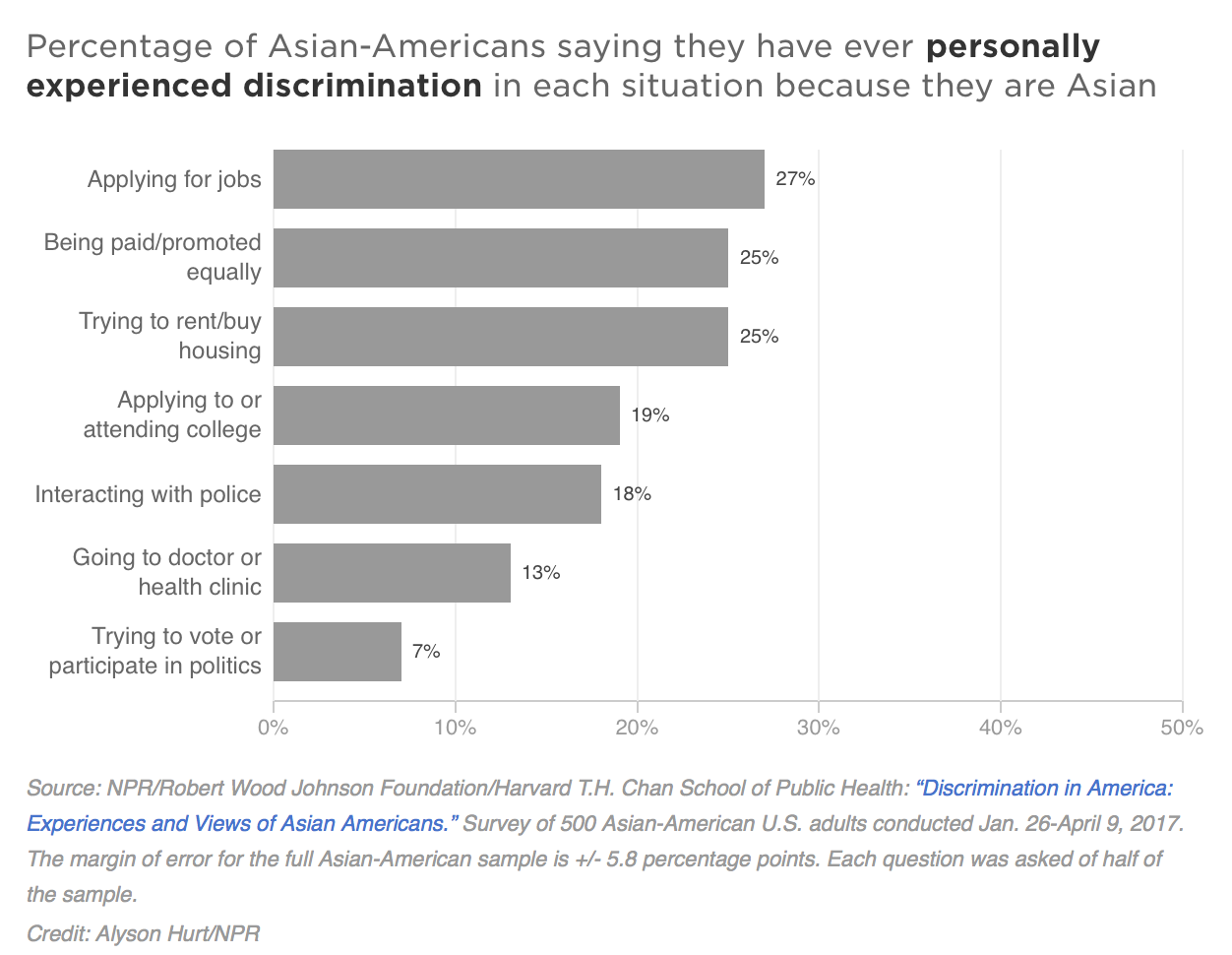
New results from an NPR survey show that large numbers of Asian-Americans experience and perceive discrimination in many areas of their daily lives. This happens despite their having average incomes that outpace other racial, ethnic and identity groups.

The poll, a collaboration among NPR, the Robert Wood Johnson Foundation and the Harvard T.H. Chan School of Public Health, also finds a wide gap between immigrant and non-immigrant Asian-Americans in reporting discrimination experiences, including violence and harassment.

“Our poll shows that Asian-American families have the highest average income among the groups we’ve surveyed, and yet the poll still finds that Asian-Americans experience persistent discrimination in housing, jobs and at college,” says Robert Blendon, professor of health policy and political analysis at the Harvard Chan School who co-directed the survey. “Over the course of our series, we are seeing again and again that income is not a shield from discrimination.”

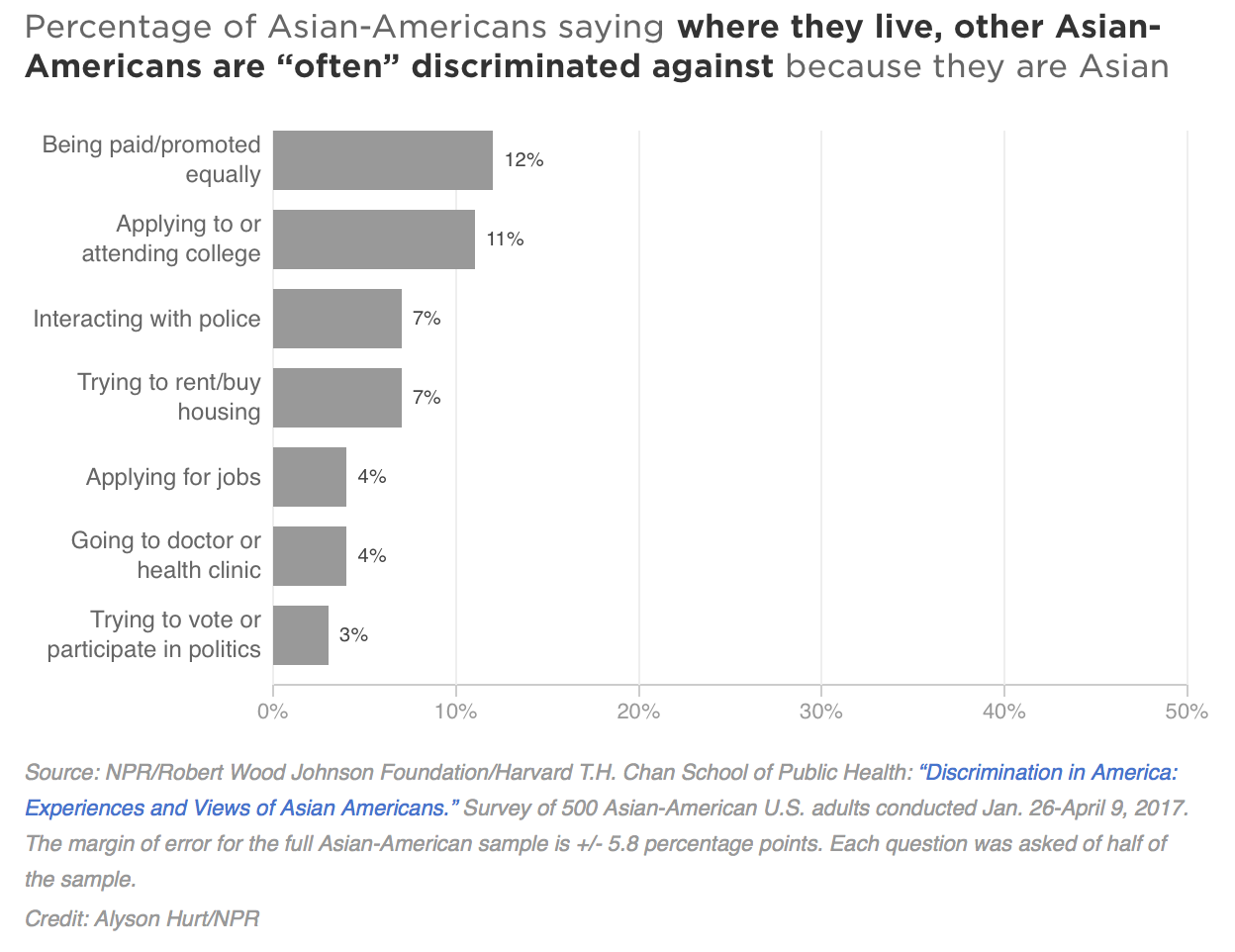
In addition to asking about personal experiences with discrimination, we also wanted to find out what people’s perceptions are of discrimination within their own neighborhoods. The numbers for Asian-Americans were lower on this measure than for personal experiences but still show that a notable level of discrimination exists in everyday life.

The survey was conducted among a nationally representative probability-based telephone (cell and landline) sample of 500 Asian-American adults. The margin of error for the total Asian-American response is 5.8 percentage points at the 95 percent confidence interval. Interviews were conducted in English, Mandarin, Cantonese and Vietnamese. Complete methodological information is in the full poll report.

Looking at the split according to immigration status, we found that nonimmigrant Asian-Americans are more than three times as likely to say they’ve experienced violence because they are Asian and more than twice as likely to say they’ve been threatened or non-sexually harassed because they are Asian.

We also saw a similar gap based on immigration status in terms of experiencing sexual harassment. But it’s important to note that our poll was done earlier this year, before the country’s widespread discussions of sexual assault and harassment in the fall. “These national conversations may have affected how people viewed or responded to their own experiences, or on their willingness to disclose these experiences in a survey,” Blendon says.

via Poll: Asian-American Discrimination Marked By Individuals’ Prejudice : NPR

Veiling is compulsory in Islam, debate unacceptable: Al-Azhar – Egypt Independent

Speaks for itself – “any debate on the topic is unacceptable”:

Egypt’s Al-Azhar, the Sunni Muslim world’s main religious institution, asserted on Monday in a fatwa, or religious decree, that it is compulsory for women in Islam to wear the veil, while those who deny this are “extremist” and “abnormal”.

Through a statement released by The International Electronic Center for Fatwas of Al-Azhar, the institution said the veil, or hijab, is an obligatory duty imposed by the teachings of Islam, and any debate on the topic is unacceptable.

“It is not acceptable that anyone from the public or non-specialized people, regardless of their culture, to voice their opinions on the matter. The hijab […] aims to preserve [women’s] feminine nature, ” the statement read.

It went on to say that the fact that the veil is compulsory in Islam helps women to become successful and productive in society while preventing them from just being seen as a body.

It added adding that in different countries around the world such as India, China and Japan women wear clothes similar to Islam’s veil as they are keen to follow the nature’s of their nations.

The statement concluded by calling on all who deny that the veil is compulsory in Islam to stop spreading their opinions or issuing fatwas on the matter as they are not specialized or authorized to speak on the issue.

via Veiling is compulsory in Islam, debate unacceptable: Al-Azhar – Egypt Independent

Racist cyberattacks at U of T highlight barriers to addressing anti-Blackness: Shree Paradkar

Good long read by Paradkar on the ongoing use of the n-word among some at UofT:

Justice Huyer of BSA said, “There is a list of penalties (in the code of student conduct) that was not created by us. We demand they be upheld. That’s what is acceptable for us. And going forward we will accept nothing but a safe space for Black people on campus and to do better in terms of dealing with cases of racism.”

An adequate space where Black students can feel supported is one of the other demands of the BSA, which is also seeking funding toward an anti-Black racism campaign and for the National Society of Black Engineers program, which has no physical space at all. Its members are contactable only by email, Huyer said.

“We have LGBTQ positive spaces that have signs and invitations,” she said. “We have a First Nations House for Indigenous students to come together.

“But the Black Students’ Association, we have the third-largest student association on campus. We have a cubicle that is semi-private with glass windows in a basement that can hold approximately five people and we serve hundreds.”

The students say when they tried to raise the other issues at the meeting, the faculty didn’t engage with them. “We were just met with blanks stares. And kind of silence,” said Mark.

Then the faculty suggested another meeting, a move Mark sees as a “derailing tactic” to tire them out.

“There certainly have been discussions around (office) space issues for Black students,” Welsh said. “I think these are things we are talking about right now.”

It’s past time to still be in the discussion phase of these changes. And the university could extend some of its own solutions used for other marginalized groups.

At an orientation for international students on campus, the complainant who is anonymous, says, “We were taught about how the university is an LGBTQ-friendly space and we were made very aware of the fact that we needed to use neutral pronouns, that we needed to not be transphobic, not be queer phobic because a lot of our backgrounds are countries where homophobia is unfortunately the culture.

“There shouldn’t be a reason they can’t do that as well with anti-Blackness,” she said.

There shouldn’t be a reason they can’t do that with all students. An Asian Canadian, a South Asian Canadian and a white Canadian were involved in the N-word and digital Blackface messages, she said.

“We know anti-Black racism exists on our campuses and I know there is more that we can do to address it,” said Welsh. “We need to continue to listen — and hear — what are the concerns of our students, our faculty and our staff.”

“More than anything else, students are saying, we want to see change,” said Bain.

“We’re asking for something fundamental, something concrete. We want to see the institution itself start looking at the way it functions on a day-to-day basis.”

via Racist cyberattacks at U of T highlight barriers to addressing anti-Blackness | Toronto Star

A Chinese-Canadian to his parents: ‘Privately, I yearned for your love’

Powerful personal story:

….We fought often. If I tripped on my laces, I was clumsy. If I scored below an A, I was stupid. If I wanted to hang out with my friends, I was wasting my time. I grew to resent the pressure you put on me, resolving to make your lives as difficult as you were making mine. I ran away from home in 2005 after a particularly bad fight, staying at a different friend’s house every day for a week. I spoke dismissively about you, told you I hated you, and that I couldn’t wait to leave the house. But privately, I yearned for your love and affection. I often fantasized about having the family I saw in the movies—the ones where everyone would talk like best friends and hug each other hello and goodbye.

I grudgingly continued down the path you laid out for me—getting into a prestigious business school and landing a stable nine-to-five job—until I couldn’t anymore. My job after graduation was at a top accounting firm, and it could not have been a worse fit for me. My superiors eventually caught on – in 2012, barely eight months into the job, I was laid off.

I was so embarrassed as I cleaned out my things in front of the entire office, but worse to me was the shame of having to tell you what happened. I considered throwing myself off my balcony to avoid facing you. Instead I made the decision to forge a path I could be proud of. I promised myself I would face you when I knew what that path would be.

That month, through a well-timed Craigslist ad, I found my way onto the set of a Guillermo del Toro movie as a minimum-wage extra and instantly fell in love with acting and filmmaking. I checked Craigslist every morning afterwards, applying for anything and everything I could. A few months later I booked my first national commercial and, unable to keep my new life from you any more, I finally came out to you as an actor. Five years later, serendipitous as it may seem, I am now playing myself on TV: a troubled kid, burdened by his relationship to his parents, trying to find his place in the world.

Today, although our relationship is the best it’s ever been, we still rarely talk about the past. I often catch myself replaying some of our worst confrontations in my head; it’s the unfortunate byproduct of a life spent mostly in conflict with you. But something is changing in me too, and I’m finding myself looking at the events of my childhood not through my lens, but through yours.

Liu, flanked by his parents, at his graduation from Western University.

In hindsight, I know that you were doing the best you could. Money was always tight, and so you worked hard and often; the alternative would have meant all of us going hungry. You pushed me as hard as you could so that I would never have to know the struggle of not knowing where my next meal would come from. And when I seemed to be squandering all that you had worked towards, you became frustrated. I would have been too. All I wanted as a child was a safe space, but there was no such thing for you—the threat of poverty was too great for you to risk taking your foot off the gas.

Despite some bumpy roads along the way, I believe that you have succeeded at everything you’ve set out to do. You built a better life for me. You made sure that I never had to worry about things like student debt or spending money. You instilled in me the idea that nothing could be taken for granted in this world, and that if I wanted something badly enough, I had to earn it through work. You made me into everything I am today—hardworking, ambitious, resilient—and I wouldn’t trade that for anything.

In November, you attended a screening of Kim’s Convenience at the Glenn Gould Theatre in Toronto. It was the first time you had attended any of my shows or events, and although I tried to downplay it, I was giddy with excitement on the inside. It was a perfect night: I was surrounded by the love of my friends and family, and it was better than anything I saw in those movies with the parents I dreamed of having. It took 28 years, but I finally realized that was the kind of relationship that I want with you every day. No more damaged kid. No more anger.

So it’s with a full heart that I want to tell you that I am grateful for all the gifts and privileges you bestowed upon me. I am so proud of everything you have achieved in your careers, despite overwhelming odds. You are my heroes and my inspirations, and I work hard every day not because it’s what you expect of me, but because it’s what you taught me to expect of myself.

via A Chinese-Canadian to his parents: ‘Privately, I yearned for your love’ – Macleans.ca

Religion, multiculturalism and the public square: Shachi Kurl, Angus Reid

See the article for the charts:

The inclusion of “God” in the preamble to Canada’s 1982 Constitution Act was a last-minute addition by Pierre Trudeau.

Thirty-three years later, as his son Justin presided over the swearing in of a new Liberal cabinet, over half of its members chose to drop the words “so help me God” from their oath of office. In a little more than a generation, the religious beliefs that were once the central tenets of Canadian society have been swept aside, as the courts and Parliament moved to assert a person’s individual liberty over their body, their identity and their relationships, from birth to death. And Canadian public opinion — sometimes leading, at other times following — has marched largely kept pace with this transformation.

The era when churches and religious leaders held sway over public policy in Canada has come to an end. There are important pockets of religious opposition to abortion, assisted dying and gender neutralization, but in the final analysis secularism seems to have won the day.

Religion and religious influence declined in Canada after the Second World War. (In Quebec during the 1960s the process accelerated, and the province moved from being the most to the least churched society in the modern world.) In the 1980s, not long after Pierre Trudeau wrote the word “God” into the constitutional preamble, regular church attendance in Canada was at around 40 percent. When Justin Trudeau formed his first cabinet in 2015, regular attendance had decreased to around half that….

With this decline in influence, the era of religious dominance in the public square has come to an end. But this is not the end of the story. The role of religion in setting public policy has been replaced by a new issue: religion itself as a topic for public policy.

The highest-profile example is the controversy over the clothing worn by some Muslim women. In Quebec — once more at the centre of a religion-versus-state tangle — Bill 62 would require citizens to show their faces when receiving public services. Squarely aimed at niqabs and burkas, this legislation is wildly popular in Quebec but less so in the rest of Canada, where such moves have failed to garner majority support…

The niqab/burka issue is part of a larger drama playing out in Canada concerning rising levels of religious diversity, how Canada should adapt to this multifaith reality and the importance Canadians place on religious freedom guarantees enshrined in the Constitution.

The current debate over religious freedom isn’t limited to the Muslim religion. Indeed, major issues of religious freedom that have recently been before the courts involve Christian organizations attempting to assert their rights: for example, in British Columbia, Trinity Western University’s policies that impose moral standards on their students; in Ontario, the fight with the College of Physicians and Surgeons over exempting health care workers from activities related to abortion or assisted dying; and in Quebec, Loyola College’s demand to be able to set its own religious instruction curriculum, independent of the one established by provincial education authorities.

Beyond the legal aspects, the fate of religion in Canada ultimately depends on public attitudes. On this, the results of surveys by the Angus Reid Institute in 2017 reveal there is cause for concern among religious communities and faith groups. The most startling finding is the relatively tepid support for the very concept of religious freedom. Asked whether the inclusion of religious freedom in the Constitution makes Canada a better or worse country, only slightly more than half (55 percent) of 1,500 respondents in an October 2017 poll said “better.” A sizable minority — roughly 1 in 7 — said “worse”….

These findings, which reflect deep division in Canada over the country’s increasing religious diversity, follow decades of immigration from non-Christian countries. Canada may prize its multiculturalism, but when it comes to the religious roots of this diversity, Canadians are divided.

When asked if religious diversity in Canada is good or bad, 26 percent said “good” and 23 percent “bad,” and the rest were unsure or felt the impact is “mixed.” (Not surprisingly, Quebec is the outlier on this question, with those who said “bad” outnumbering those who said “good” by nearly 2 to 1.) This finding is supported by another from our polling, which asks Canadians if they think the country does too much to accommodate different religious and faith groups… Here we find opinions massively on the side of doing too much (53 percent think the country does too much to accommodate religion, only 9 percent say it doesn’t do enough, and the rest think it strikes the right balance).

The lack of deep support for religious freedom and religious diversity suggests that faith communities could come under increased scrutiny in the future, especially if political leaders sense an advantage in limiting the special status enjoyed by these organizations in taxation, education and health care.

On taxation, recent polling shows Canadians divided — 55 percent in favour and 45 percent against — on special tax status for religious organizations; in Quebec, the percentages are reversed…. The same pattern is evident on opinions about religious schools and about regulations that would curtail the right of faith-affiliated hospitals to opt out of assisted dying.

Starting with the election of Stephen Harper, and continuing into Justin Trudeau’s government, there has been an increasingly politicized debate over religion. Although Harper appointed a special ambassador for religious freedom, he also voted against a motion proposed by members of his own caucus to set up a parliamentary committee to study when life begins. Trudeau, in contrast, did not hesitate to ban pro-life candidates from running for the Liberal Party. When the Governor General he appointed used her maiden speech to disparage those who believe in “divine intervention,” he was quick to jump to her defence.

It’s still early days in this political chapter, where leaders are seeking to change public expression and institutional arrangements associated with religious belief. Ironically, the diversity that is at the heart of this emerging debate may impose the greatest limits on those who would seek to limit religious expression: Canadian immigration policies favour vibrant Islamic, Sikh, Hindu and Christian communities.

The late Richard Neuhaus, one of the 20th century’s great activists and thought leaders on matters of religion and the public square, was born a few miles down the Ottawa River from Canada’s parliament. He understood better than most that politics is a function of culture, and culture is ultimately a function of religion. Canada, which so proudly celebrates its multiculturalism, is witnessing a growing debate over religious diversity that eventually will have far-reaching political consequences. How the debate evolves depends on whether the different religions and traditions can cooperate and have sufficient impact in the political sphere to withstand the forces of secularism that are driving large elements of public policy in Canada.

via Religion, multiculturalism and the public square

Breaking The Bubble Of Food Writing: Cultivating Diverse Stories : NPR

Another way to look at food writing:

The first, and probably most pervasive, challenge is that writers of color are often limited to writing about their traditional foods, while white writers are given much more latitude to explore a wide variety of cuisines beyond their immediate expertise. This not only applies to writing assignments from an employer or freelance work, but to getting a food media job. An established food writer of color, speaking on the condition of anonymity for fear of jeopardizing her ability to get assignments from editors, shared with me a failed attempt to get a senior-level editing job at a major food magazine. Despite an excellent resume featuring this person’s work experience as a trained chef, author and ghost-writer of several successful and award-winning cookbooks and freelance pieces on several types of cuisines, this person was turned down for the position. Why? Because the magazine’s gatekeeper making the hiring decision said that the applicant’s expertise in ethnic cuisine wasn’t transferable to a mainstream publication.

My personal “favorite” is the pervading and persistent belief that the only appropriate time for disseminating African-American food stories is on the Martin Luther King Jr. federal holiday or during “Black History Month,” which happens in February. I thought the word was out by now that black people, just like everyone else, cook and eat all year long. Perhaps not. Yet, other ethnic groups aren’t so arbitrarily constrained. Imagine mostly reading about Chinese food around the lunar New Year celebration, about French food on Bastille Day, about Italian food on Columbus Day and about Mexican food on Cinco de Mayo. I have pitched stories that offered a roundup of black-owned restaurants in a particular city in order to highlight the diverse culinary expressions of African-heritage cuisines in that city’s dining scene. In order to get a “hook” for their readers, editors have suggested running the piece in February. There’s an entire world of food out there waiting to be explored, but we tend to hear about the same cuisines over and over again. This happens despite growing evidence that Americans are more curious about different cuisines than ever before. For the moment, diverse food writers take comfort that stories are getting published at all.

Another mystifying occurrence is the ongoing invisibility of African-Americans in food stories that have an obvious African-American connection. How many more “Best Southern Chef,” “Best Southern Restaurant” or “Best Barbecue” articles (particularly ones with lists) and television shows must we read and watch that overwhelmingly feature white people? With 46 million black people living in the United States, isn’t it possible that there’s one African-American who can cook and has a good story to tell?

The final head-scratcher comes when media outlets finally choose to feature an African-American food story, and a white writer gets the assignment. Am I arguing that only people of a certain race should write food stories about their culture? No. I’m arguing for more balance in who gets the writing assignment. Depending upon the angle sought, an African-American writer may be able to tell a story with more dimension than someone unfamiliar with the culture. At the very least, that writer will avoid the kinds of mistakes that get people in a lot of trouble on social media.

I could go on, but one must ask, “Why does this stuff keep happening?” Having worked with a lot of these gatekeepers, I don’t think that the main problem is overt racism. We’re seeing the end product of an industry full of people living in a bubble. The gatekeepers tend to be cut from the same cheesecloth in terms of race, class and culture, and their professional and social circles are filled with similar people. This mix leads to a very narrow view of what’s possible and interesting in the food universe, and an echo chamber in terms of what’s trendy. Thus, the gatekeepers believe that their customers want stories from a certain range of subjects, and we readers and viewers get those stories ad nauseum. The gatekeepers may believe that they are casting a broad net, but it’s actually fairly limited when diverse perspectives are taken into account.

via Breaking The Bubble Of Food Writing: Cultivating Diverse Stories : The Salt : NPR