“Baby, It’s Cold Outside” and the rise of Islamic fundamentalism

A different angle to the Baby, It’s Cold Outside controversy. Not convinced it was  just one song but clever way of expressing Sayyid Qutb’s reaction to everything he saw in America (as has happened with others):

“Baby, It’s Cold Outside”—a song written by a Jewish composer that has become a secular Christmas anthem—played a small but crucial role in the rise of modern Islamic fundamentalism.

Back in 1950, the Egyptian author and religious theorist Sayyid Qutb spent two years as an exchange student at a teacher’s college in Greeley, Colorado.

He was infuriated by many things about American life—people spent too much time taking care of their lawns, and it was impossible to get a decent haircut—but especially by a church dance where a pastor played Frank Loesser’s Grammy-winning song on a gramophone:

“The dance hall convulsed to the tunes on the gramophone and was full of bounding feet and seductive legs,” Qutb wrote later. “Arms circled waists, lips met lips, chests met chests, and the atmosphere was full of passion.”

“Baby, It’s Cold Outside,” long a holiday classic in the United States, has recently come under scrutiny in the #MeToo era for its light-hearted portrayal of sexual coercion—though a close reading suggests the song could just as easily be a sly homage to female empowerment.

Not to Qutb. His description:

A dialogue between a boy and a girl returning from their evening date. The boy took the girl to his home and kept her from leaving. She entreated him to let her return home, for it was getting late and her mother was waiting, but every time she would make an excuse, he would reply to her with his line: but baby it’s cold outside.

The song confirmed Qutb’s worst suspicions about American culture.

“To most people watching this dance, it would have been an innocent dance of happiness,” documentary filmmaker Adam Curtis observes in his film, The Power of Nightmares. “But Qutb saw something else. The dancers in front of him were tragic lost souls. They believed they were free, but in reality they were trapped by their own selfish and greedy desires.”

When Qutb returned to Egypt, he was a changed man, determined to reject the West and embrace a purified version of Islam. As journalist Lawrence Wright wrote in the New Yorker:

Qutb returned to Egypt a radically changed man. In what he saw as the spiritual wasteland of America, he re-created himself as a militant Muslim, and he came back to Egypt with the vision of an Islam that would throw off the vulgar influences of the West. Islamic society had to be purified, and the only mechanism powerful enough to cleanse it was the ancient and bloody instrument of jihad.

Qutb eventually became a senior member of the Muslim Brotherhood, plotted to assassinate Egyptian president Gamal Abdel Nasser, and was executed by hanging in 1966. But his teachings and writings became a primary inspiration for a generation of militant Islamists, including Osama bin Laden and Ayman al-Zawahiri.

Source: “Baby, It’s Cold Outside” and the rise of Islamic fundamentalism

Christie Blatchford: Police and blacks in Toronto: The numbers tell a hard truth

Lot of coverage on the just released report by the Ontario Human Rights Commission but picked Blatchford given her generally more sympathetic coverage of police issues, with her column all the more devastating as a result:

There is nothing like solid data — naked, objective, hard data — even for someone like me, who struggles mightily with numbers.

Numbers are what’s at the core of an Ontario Human Rights Commission report released Monday. I don’t know that it’s the first time the commission has backed up the anecdotal with hard data, but it’s the most astonishing such marriage I can remember.

The report includes analysis of data collected from the Special Investigations Unit, the arms-length agency that probes all serious incidents where police forces in Ontario inflict serious injuries upon civilians.

For the first time, it also includes a review of the SIU director’s reports, a rich trove of heretofore unreleased detail — including descriptions of the circumstances of each incident, assessments of the civilians involved and the justification behind the SIU director’s decision to charge or not charge police.

Using that information, plus SIU investigator notes, case photographs, police documents such as officer notes and even media reports (solely when race couldn’t be otherwise determined) the analyst — University of Toronto associate criminology professor Dr. Scot Wortley — examined 244 completed SIU investigations of civilian/Toronto Police Service encounters in the four years from 2013-2017.

In those years, black people made up about 8.8 per cent of the population in Toronto. Yet, shockingly, they also made up 70 per cent of police shootings that resulted in death, 61 per cent of other sorts of lethal force encounters, almost 29 per cent of all Toronto police use of force cases and fully one quarter of all SIU TPS investigations.

As Chief Commissioner Renu Mandhane said, “This inquiry is different from past initiatives. We will examine racial disparities in how police services are provided in Toronto and will marry hard data with lived experience and case law.”

The report is called A Collective Impact, the commission’s interim report on its inquiry into racial profiling and racial discrimination of black Torontonians by police.

Even its aim is different. “The goal of the inquiry is to build trust in law enforcement and make our communities safer,” Mandhane said. That’s exactly what such an inquiry should hope to do, but not all its predecessors have been so clear.

Now, to put this in perspective, it’s important to remember that Toronto police have about 30,000 encounters a year with those it calls “in crisis,” meaning people who are emotionally or mentally disturbed. About 97 or 98 per cent of these end without the use of any sort of force. And encounters with people in crisis account for a significant chunk of those who end up in use of force clashes — almost 30 per cent.

Another troubling note: In a “significant minority” of SIU cases, the SIU director had problems with Toronto Police co-operation, though, a small mercy, such problems were no worse in cases involving black citizens.

One of these issues was delayed or improper notification to the SIU; police are supposed to notify the unit immediately whenever a civilian has been seriously injured or died. Sometimes, police notes indicate there was early awareness someone had been badly hurt, but the SIU was still not called right away.

Sometimes, the SIU director questioned the legal basis for police to have stopped or detained the black person in the first place, or for conducting searches.

And black men were significantly over-represented in SIU investigations of sexual assault complaints — six times more likely than their numbers in the population would suggest.

The data lend heft to the “lived experiences” people have been hearing about for decades and which the commission heard about in focus groups — black Torontonians being stopped because they “matched the description” of a suspect, including a young black man who was running to school, excited about a special event, and was stopped in full view of his classmates, and a black man who earlier this year who was leaving his office and searched in front of his workmates and onlookers both.

“I was feeling embarrassed,” the youth told the commission. “This is not who I am. This is not who I want to be. After that, people were looking at me different, like I was a criminal or some type of thug.”

It’s funny, but not so long ago, I was in a room full of accomplished black citizens; this was the judicial discipline hearing into the conduct of Ontario Court Judge Donald McLeod, one of a few black faces on the bench. Many of them were upset that the hearing had even been called. McLeod is a distinguished man who made it to the bench from a hard background (single mom, subsidized housing) and who in his efforts to pay it forward by founding a non-profit national black organization allegedly crossed a line judges should not cross.

McLeod had been moved to act by the shooting of a pregnant young woman, which hit close to home; he’d gone to school with the young woman’s aunt.

There was a real sense of affront in the room, that somehow, even this good and honourable man who rose so high should have been brought down like this.

It’s not quite the same thing, rather a real sense of injury and injustice, when black people end up, in such out of whack numbers, dead or hurt after encounters with police. We leave it alone to fester at our peril.

Source: Christie Blatchford: Police and blacks in Toronto: The numbers tell a hard truth

Study highlights ‘uncomfortable truth’ about racism in the job market

My analysis shows similar patterns, but with distinct differences between the various visible minority groups, with some groups (i.e., Chinese) doing better, others (same groups as identified in their study) doing worse, with visible minority women doing relatively better, compared to not visible minority than is the case for men:

Racialized workers in Ontario are significantly more likely to be concentrated in low-wage jobs and face persistent unemployment and earnings gaps compared to white employees — pointing to the “uncomfortable truth” about racism in the job market, according to a new study.

The study from the Canadian Centre for Policy Alternatives found that women of colour are the most disadvantaged in the province’s labour market: they experience higher unemployment rates than all other groups and earn 58 cents for every dollar that a white man makes — a gap that has improved by just five cents since 2006.

Sheila Block, senior economist with the CCPA’s Ontario office and co-author of the report with Ryerson professor Grace-Edward Galabuzi, said the findings showed the “persistence of labour market inequality despite an increasing racialized population.”

“A policy of approach of benign neglect is not going to be sufficient to ensure that all Ontarians’ talents, whether they are racialized or non-racialized, are fully utilized,” she said.

Racialized Canadians now make up 29 per cent of the Ontario population, compared to 23 per cent in 2006 — meaning that job market barriers impact a larger demographic.

“It has negative impacts on the individuals that are discriminated against, but it also has a negative impact on our overall economic activity and efficiency,” Block said.

The study, being released Tuesday, is based on Statistics Canada census data and shows that racialized communities in Ontario face higher unemployment rates than non-racialized workers — but also have higher participation rates, which measures how many people are either employed or actively looking.

Block said that indicated that despite putting “similar effort” into working or finding work, racialized workers are less likely than their white counterparts to actually get a job.

Racialized women had the highest unemployment rate at 10 per cent, compared to 8.7 per cent for racialized men, 7 per cent for non-racialized men and 6.4 per cent for non-racialized women.

Employment dipped for all groups since 2006, showing an “overall deterioration in labour market conditions,” the report found — driven in part by the impact of the loss of middle-class manufacturing jobs over the past decade.

The erosion of traditional middle-class industrial jobs saw a “sharper deterioration” in conditions for men, particularly for white men. Non-racialized men’s unemployment rates increased by 1.4 per cent since 2006, compared to 0.9 per cent for racialized men.

But the study showed that women, especially women of colour, are still significantly more likely to be concentrated in low-wage jobs. Racialized women were 25 per cent more likely to be working in occupations in the bottom half of the income distribution than white men. Racialized men were less likely to be in low-wage occupations than women, but more likely than white men.

“I think that tells us that is still a very large gap over that 10-year period and that gap has remained despite the hollowing out of middle-income jobs and particularly manufacturing jobs,” Block said.

The report notes that a “common Canadian narrative is that the discrimination that racialized workers face … is part of the immigrant experience and that it is common to all immigrants.”

That, the data suggests, is untrue: racialized male immigrants earn 70 cents for every dollar that non-racialized immigrant men make, and racialized female immigrants make 78 cents for every dollar that white immigrant women make. Those gaps persisted for second- and even third-generation immigrants.

“These findings point to the need for Ontario to deal with the uncomfortable truth that its labour market is not equally welcoming to all immigrants,” the report notes.

Outcomes varied for different racialized communities: Black, Latin American, and Filipino workers, for example, consistently had a “large earnings gap despite the length of time their families had been in Ontario,” according to the study.

“Addressing the labour market discrimination faced by racialized workers will require a deeper understanding of racism and the different ways it is manifested in the labour market for different racialized groups,” said the report.

The findings come as the Ontario government reverses recently enacted labour protections aimed at improving conditions for precarious workers. Bill 47 cancelled a scheduled minimum-wage increase from $14 to $15 in January, removed the right to equal pay for equal work for temporary, part-time and casual employees, and cancelled two paid sick days for all Ontario workers.

A report on provincial workplace standards written by two special advisers under the previous government found that visible minorities, new immigrants and women were overrepresented in precarious jobs.

“When we are lowering the floor, we are disproportionately having an impact on racialized workers and in particular racialized women,” Block said.

“We need legislation that both strengthens the Employment Standards Act and makes it easier for workers who are in precarious employment to unionize.”

“The bottom line: we are still waiting for bold new policies to close the persistent gap between racialized and non-racialized men and women in Ontario,” the report concludes.

“Until we tackle the barriers to employment equity and to decent work, Ontario’s racialized income gap is likely to remain.”

Source: Study highlights ‘uncomfortable truth’ about racism in the job marketWomen of colour most disadvantaged, with higher unemployment rates, lower pay, according to report by Canadian Centre for Policy Alternatives.

In Canada, the term ‘nationalism’ doesn’t seem to have a bad rap. Here’s why

Interesting and relevant changes to how Canadians perceive attachment and belonging (Ekos more reliable than Leger’s web panel):

On a historic Remembrance Day, a century after the end of the First World War, Prime Minister Justin Trudeau told a Paris crowd that decaying trust in public institutions will lead citizens to look for easy answers “in populism, in nationalism, in closing borders, in shutting down trade, in xenophobia.”

The implication was clear: if nations turn in on themselves and treat outsiders as threats, we might again find ourselves in a bloody conflict with fronts all over the world.

But a series of surveys suggest the idea of being a nationalist, and nationalism in general, are viewed fairly positively by most Canadians.

What the data suggest is that Canadians don’t see the concept of nationalism the way people do in the United States, where the term is often linked with white-nationalist groups, and then with white supremacy and racism.

Rather, Canadians appear to have constructed their view of nationalism on the idea of feeling connected to our country and ensuring that others feel connected as well — even as we watch the term pilloried globally.

“It is used in different ways — when people are talking about the Trump nationalism, they would say (it’s) bad. But in Canada, they accept it because it is equated with certain communities and they see it as a way it’s helping vulnerable populations find their place in Canada,” said Kathy Brock, a political studies professor at Queen’s University in Kingston, Ont.

“Canadians have just acclimatized to this dual view of nationalism.”

In the 1950s and 1960s, Canadians often reported feeling greater attachments to their particular communities or ethnic groups than they did to the country. In the intervening years, connection to country has strengthened while connection to community has faded, said Frank Graves, president of EKOS Research Associates, a polling and market-research firm. The opposite has happened in Europe, he said.

Research also suggests Canadians’ attachments to their ethnic groups have weakened over the last 20 years in favour of an attachment to country, Graves said, even as census data shows the country’s population is becoming ever more diverse.

“We don’t have a common ethno-linguistic homogeneity that produces a definition of ‘the people.’ It’s more civic nationalism,” Graves said.

“In Canada, national identity has been created through a dialogue between citizens and the state and the public institutions — medicare, the Mounties, Parliament Hill. It isn’t as much steeped in history or common race and identity, which probably inoculates it from some of the more disturbing expressions of nationalism.”

Newly released survey data from the Association of Canadian Studies says that 60 per cent of respondents hold a somewhat or very positive view of nationalism, compared with about 45 per cent in the United States. The results were similar in both English and French Canada.

There also appears to be an association between Canadians’ views on nationalism and their views on multiculturalism.

“In contrast to the European idea of nationalism, having that ethnic component to it, most Canadians don’t see nationalism as ethnically driven. They see it more as a form of patriotism,” said Jack Jedwab, the association’s president. “It doesn’t intersect as much as it does in the European context with anti-immigrant sentiment, or a sentiment against diversity.”

The Leger Marketing survey of 1,519 Canadians on a web panel was conducted for the association the week of Nov. 12. Online surveys traditionally are not given a margin of error because they are not random and therefore are not necessarily representative of the whole population.

A day after his Nov. 11 comments, Trudeau was asked how he defined nationalism and where he saw it in Canada.

“In Canada, we’ve demonstrated many times that identities are complimentary,” he said. “I’m an extremely proud Quebecer, I’m an extremely proud Canadian and like most Canadians, they don’t see a contradiction in that.”

Experts say the more negative forms of nationalism are nevertheless simmering in Canada. Jedwab’s survey data suggest that respondents who have positive views of nationalism are somewhat more worried about immigration and security along the U.S. border than those who have negative views of nationalism.

Part of what fuelled U.S. President Donald Trump’s political rise, and his populist rhetoric, was financial worry — or what Graves described as the idea of the everyman versus the corrupt elites. Brock said Canada has thus far avoided similar concerns about class and finances, particularly coming out of the recession a decade ago, and a similar rise of nationalist rhetoric.

“Now, we’re facing some really serious economic challenges and if they come to pass, then we could see a different manifestation of this,” she said. “So I don’t think those (polling) figures are necessarily set in stone.”

Source: In Canada, the term ‘nationalism’ doesn’t seem to have a bad rap. Here’s why

QS: des divisions autour du port de signes religieux

Not terribly surprising that the QS divisions reflect Quebec society at large. Will be interesting to see how and if resolved:

Des lignes de fracture sont apparues au grand jour dans les rangs de Québec solidaire (QS), samedi, alors que le parti s’apprête à redéfinir sa position sur la laïcité.

Des membres de partout au Québec sont réunis à Montréal depuis vendredi à l’occasion du Conseil national de la formation, le premier depuis les élections du 1er octobre. Le rassemblement vise à faire le point sur la campagne historique qui a mené à l’élection de 10 députés solidaires.

Mais en parallèle, les délégués entament une réflexion sur l’enjeu explosif de la laïcité. En mars, ils seront appelés à redéfinir la position du parti sur l’interdiction des signes religieux dans la fonction publique. Et déjà, les clivages étaient apparents samedi.

« Ça peut être très déchirant », a convenu Lise Boivin, coordinatrice du Collectif pour la laïcité de Québec solidaire.

Ce groupe milite pour une interdiction complète des signes religieux dans l’ensemble de la fonction publique, une position plus ferme encore que celle de la Coalition avenir Québec. Mme Boivin fait valoir que les employés de l’État ne peuvent afficher leur appartenance à un parti politique. Selon elle, il devrait en être de même pour la religion.

« La religion, c’est une idéologie aussi. On est libre d’adopter celle qu’on veut. Mais quand on est au service des citoyens, on ne devrait pas afficher notre appartenance religieuse. »

À l’autre bout du débat, on trouve l’ancienne candidate dans Mont-Royal-Outremont, Ève Torres. Cette musulmane féministe porte le voile. Elle souhaite que l’aile parlementaire du parti cesse de défendre le compromis Bouchard-Taylor, qui propose l’interdiction des signes religieux aux fonctionnaires en position de coercition comme les policiers, les juges et les gardiens de prison.

« Ce n’est pas ma position personnelle, a affirmé Mme Torres. Pour moi, il est évident, en tant que féministe, que personne très engagée pour la justice sociale, pour moi il n’y a pas de compromis possible parce que j’ai bien conscience de l’impact que ça a. »

Les tenants des deux positions ont disposé des tables dans le collège de Maisonneuve, où se tient le Conseil national. Ils distribuent des tracts aux membres, qui recevront demain un document de réflexion sur le sujet.

ÉCHANGE ET DISCUSSION

La co-porte-parole de QS Manon Massé ne craint pas que la laïcité sème la discorde au sein de ses troupes.

« Ce que ça démontre, c’est que QS n’est pas le parti dogmatique qu’on tend à vouloir dépeindre. Il y a de la vie, il y a de l’échange, il y a de la discussion. Ce n’est pas tout le monde qui pense pareil et c’est ce qu’on veut permettre avec le cahier de réflexion. »

Les députés interrogés samedi matin n’ont pas manifesté le désir de changer leur position sur le compromis Bouchard-Taylor.

« Moi, je suis à l’aise de défendre cette position en ce moment, a résumé la députée de Sherbrooke, Christine Labrie. Mais je trouve qu’effectivement, ça vaut la peine de se poser la question à savoir si c’est encore la meilleure position. »

« Ma position, c’est le compromis Bouchard-Taylor, a renchéri le député de Jean-Lesage, Sol Zanetti. C’est ça qu’on défend. Il est possible que ce soit maintenu, il est possible qu’on diffère. »

« SENSIBLE »

Émilise Lessard-Therrien, qui représente Rouyn-Noranda-Témiscamingue, s’est dite à l’aise avec la position actuelle du parti. Elle s’attend cependant à un débat vigoureux dans les rangs solidaires au cours des prochains mois.

« Possiblement que ça va être quelque chose de sensible, a-t-elle reconnu. Mais en même temps, on peut juste l’appréhender. On ne l’a pas vécu encore et ça va se passer au cours des prochains mois. »

Source: QS: des divisions autour du port de signes religieux

Kurl: Quebec’s – and Canada’s – tolerance for religious symbols remains selective

Useful reminder:

As battle lines are drawn over the Coalition Avenir Quebec’s promised ban on public servants wearing religious garments or articles at work, it’s instructive to separate generalities from specifics.

When Quebecers are asked general questions such as “do you support a ban” on public employees in positions of authority wearing religious symbols at work, two-thirds say yes. But when asked specifically which symbols would be unacceptable for said public employees at work, it appears what they’re really saying is they support a ban on non-Judeo-Christian symbols.

This is a key distinction, because some observers take this majority support on the general question as a sign the province – and the rest of the country – is becoming more secular. Indeed, Quebec Premier François Legault himself wraps his plans in words such as “secularism” and “neutrality.” Public sentiment, however, is anything but “neutral.”

While most Quebec residents support the provincial government’s proposal overall, our polling data also show that majorities believe public employees should be allowed to wear a crucifix or a Star of David on the job (73 per cent and 68 per cent, respectively). Indeed, polling further indicates Quebecers are nearly twice as likely to want to see the crucifix in Quebec’s National Assembly stay put as to see it removed.

Quebecers aren’t alone in this thinking. Majorities in all other provinces are also more amenable to the display of Judeo-Christian symbols in the workplace. But where the province differs from the rest of the country is that while more than half say “non” to public servants wearing the Muslim hijab (57 per cent) and the Sikh turban (55 per cent), majorities in the rest of the country (between 70 and 80 per cent, depending on the province) have little issue with it.

These general opinion trends aren’t new. But Legault now represents the fourth premier (the CAQ the third governing political party) to try such a moratorium. Beyond legal challenges, there’s a reason his predecessors, while never explicitly abandoning the idea, also never quite got around to making it happen.

In a province where Catholic nuns have a centuries-old tradition in health care, is any political party in Quebec willing to apply its own ban evenly and tell them they can no longer provide comfort to hospital patients while in habit? In a province where the first Jewish synagogue was established in the 1760s, will this government politically survive telling a public school teacher to remove his kippah?

Meanwhile, it’s not like the rest of the country is completely tolerant of minority religious symbols. If there is something that “unifies” people across Canada, it is opposition to and discomfort with three specific articles of faith identified with the Sikh and Muslim religions. Regardless of where people live, most don’t think the burqa and the niqab – worn by some Muslim women – or the kirpan, the ceremonial dagger worn by some Orthodox Sikhs, should be worn by public servants in their own provinces.

Many would use these general opinions towards a religious symbol ban as evidence Canada is becoming more hostile to religion. But in fact, more people are inclined to see the general role and contributions of religious and faith groups to Canadian society as good than bad. Instead, the sobering reality is this hostility is reserved for some garments and symbols associated with specific religions.

In a country that often prides itself on acceptance of different cultures and ways of life, this can seem depressing. But a silver lining could exist in the views of the next generation. Times change. Nearly three decades ago, this country was gripped by a divisive debate over whether turbaned Sikhs should be able to serve in the RCMP and armed forces. Today that debate is over. And today, it is younger people – both in and outside Quebec – who are more permissive towards all articles of faith being worn in public workplaces. For more than a decade, a province and a country has exhausted itself talking about these issues. Maybe, a generation from now, the debate will be over.

Source: Kurl: Quebec’s – and Canada’s – tolerance for religious symbols remains selective

What The Ebbs And Flows Of The KKK Can Tell Us About White Supremacy Today

Good long and informative interview with Kathleen Blee:

As long as the United States has existed, there’s been some version of white supremacy. But over the centuries, the way white supremacy manifests has changed with the times. This includes multiple iterations of the infamous Ku Klux Klan.

According to the sociologist Kathleen Blee, the Klan first surfaced in large numbers in the 1860s in the aftermath of the Civil War, then again in the 1920s, and yet again during the civil rights era.

Blee is a professor and dean at the University of Pittsburgh, and the author of Inside Organized Racism: Women in the Hate Movement, as well as Understanding Racist Activism: Theory, Methods and Research. She says the anonymity allowed by the internet makes it difficult to track just how much white supremacist activity we’re seeing today.

But despite this difficulty, she and other experts say there’s been an indisputable uptick in hate crimes — and an overall rise in white supremacist violence: Earlier this fall, a gunman shot and killed 11 worshipers at a Pittsburgh synagogue. In 2017, a clash with protesters at the Unite The Right rally in Charlottesville, Va., left one woman dead. In 2015, the shooting at the Mother Emanuel AME church in Charleston, S.C., killed nine black churchgoers. And in 2012, a rampage at the Sikh Temple of Wisconsin in Oak Creek, Wisc., killed six people.

As we consider this spate of racist attacks, we thought it’d be helpful to talk to Blee about the ebbs and flows of white supremacy in the United States — and what, exactly, those past waves say about today’s political climate.

Our conversation has been condensed and edited for clarity.


First, can we talk about the various phases of white supremacy in the U.S. throughout history — and what caused those ebbs and flows?

The 20th to 21st century Klan actually formed after the Civil War, during the Reconstruction period. Then it was entirely contained within the South, mostly in the rural South. It [was] all men. There were violent attacks on people who were engaged, or [wanted] to be engaged, in the Reconstruction state, [including] freed blacks, southern reconstructionists, politicians and northerners who move to the South. That collapses for a variety of reasons in the 1870s.

Then, the Klan is reborn in the teens, but becomes really big in the early 1920s. And that is the second Klan. That is probably the biggest organized outburst of white supremacy in American history, encompassing millions of members or more. … And that’s not in the South, [it’s] primarily in the North. It’s not marginal. It runs people for office. It has a middle class base. They have an electoral campaign. They are very active in the communities. And they have women’s Klans, who are very active and very effective in some of the communities. That dissolves into mostly scandals around the late ’20s.

Then there’s some fascist activity around the wars — pro-German, some Nazi activity in the United States — not sizable, but obviously extremely troubling.

The Klan and white supremacy reemerge in a bigger and more organized way around the desegregation and civil rights movement — again, mostly in the South, and back to that Southern model: vicious, violent, defensive, Jim Crow and white rights in the South.

And then it kind of ebbs. After a while, it kind of comes back again in the late ’80s and the early 21st Century as another era. And then there’s kind of a network of white supremacism that encompasses the Klan, which is more peripheral by this time. Also Neo-Nazi influence is coming as white power skinheads, racist music, and also neo-Nazi groups. The Klans tend to be super nationalist, but these neo-Nazi groups have a big international agenda.

Then the last wave is where we are now, which is the Internet appears. The movement has been in every other era as movement of people in physical space like in meetings, rallies, protests and demonstrations and so forth. It becomes primarily a virtual world, and as you can see, has its own consequences — many consequences. It’s much harder to track. And then there are these blurred lines between all these various groups that get jumbled together as the alt-right and people who come from the more traditional neo-Nazi world. We’re in a very different world now.

That’s a long history. You mentioned that, for a variety of reasons, the Klan in the Reconstruction era collapsed. What are some of the factors that contributed to that?

I would say two things that mostly contributed to that ebb over time.

One is the white supremacist world, writ large, is very prone to very serious infighting. Internal schisms are quite profound in collapsing white supremacists, even as an entire movement, over time.

What’s that infighting look like? How racist to be?

No, no. It’s almost always power and money. So, for example, the ’20s Klan — I say “Klan” but in every era there were multiple Klans, they all have different names, they all have different leaders — they are trying to extract money from their groups, and they are all fighting about money …. and then over power, and who controls the power, because white supremacy groups don’t elect their leaders right away. To be a leader just means to grab power and control. So there’s a lot of contention in these groups of control.

It’s not ideas. Ideas aren’t that central. They have these certain key ideas that they promulgated — race and anti-Semitic ideas — but the fine points of ideological discussion don’t really occur that much in white supremacist groups, nor do they get people that agitated. It’s not like in other kinds of groups, where people might have various versions of ideas, versions of ideologies. [The Klan] just have kind of core beliefs. But they do tend to fight over ideas for money, power and access to the media.

So that’s the fighting. The other thing is, in different waves of history, there are prosecutions, either by the police or civil prosecutions that collapse groups and movements. Sometimes, there’s kind of a blind eye to white supremacist organizing, but at other times there is really successful either civil or state prosecutions of these groups that do debilitate them.

How does the longevity of white supremacy or these [hate] groups coincide with who has political power?

It’s very hard to create a generalization here. Certain groups, like the Klan, tend to rise and fall based on the threats to who is in power. The 1870s Klan [was] based on the Southern racial state formed during slavery being threatened by Reconstruction. In the 1920s, the idea was that political power [was] being threatened by this wave of immigrants. The 1920s Klan [was] very anti-Catholic, as well as racist and anti-Semitic. Part of this anti-Catholicism [was] based on the idea that Catholics were going to start controlling politics as well as the police.

There’s some really good analysis by some sociologists that showed that the Klan appeared in counties where there was the least racist enforcement of the law. Because in counties where the sheriff and the county government was enforcing racist laws, there was no need for the Klan.

How does this apply to this more recent wave of white supremacy?

Right now, we have an extremely heterogeneous group that we might call white supremacists. So some of them, probably the smallest group, are nationalistic. And probably the larger group are not particularly nationalistic. This is why it’s hard to make generalizations. It’s not the case that nationalist fervor just finds itself in the white supremacist movement. The person accused of the shooting in Pittsburgh is an example. If you look at [his] writings, they’re not nationalistic, they’re in fact anti-nationalistic. And that’s pretty common with white supremacy today — some of them have this sense that their mission is this pan-Aryan mission. They’re fighting global threats to whites and creating a white international defense. So that’s not a nationalist project, that’s an internationalist project.

And the other reason is there’s this idea among white supremacists in the United States that the national government is ZOG — Zionist Occupation Government — and that’s a shorthand way of saying that the national government is secretly controlled by an invisible Jewish cabal. So some of them will be amenable to very local government … they’ll embrace, and work with, and even try to seize control of the government at the county level. But generally, national politics are quite anametha for those two general reasons.

In the 1920s, synagogues were targeted by the KKK. Can you run through other examples of violence like this?

People will say the ’20s Klan was not as violent as other Klans. But that’s really because its violence took a different form. So there, the threat that the Klan manufactured was the threat of being swapped — all the positions of society being taken by the others — so immigrants, Catholics, Jews and so forth. So the violence was things like, for example, I studied deeply the state of Indiana where the Klan was very strong — pushing Catholics school teachers out of their jobs in public schools and getting them fired, running Jewish merchants out of town, creating boycott campaigns, whispering campaigns about somebody’s business that would cause it to collapse. So it’s a different kind of violence but it’s really targeted as expelling from the communities those who are different than the white, native-born Protestants who were the members of the Klan. So it takes different forms in different times. It’s not always the violence that we think about now, like shootings.

When did we start seeing the violence that we see today?

Well, the violence that we see today is not that dissimilar from the violence of the Klan in the ’50s and ’60s, where there was, kind of, the violence of terrorism. So there’s two kinds of violence in white supremacy. There’s the “go out and beat up people on the street” violence — that’s kind of the skinhead violence. And then there’s the sort of strategic violence. You know, the violence that’s really meant to send a message to a big audience, so that the message is dispersed and the victims are way beyond the people who are actually injured.

You see that in the ’50s, ’60s in the South, and you see it now.

I was wondering if we could kind of talk a little bit about the language we use when we talk about mass killings that are related to race, religion or ethnicity — especially about the second type of violence, “strategic violence,” that you describe. I’ve seen people use the phrase “domestic terrorism.” What do you make of that phrase?

Terrorism means violence that’s committed to further a political or ideological or social goal. By that definition, almost all white supremacist violence is domestic terrorism, because it’s trying to send a message, right? Then there’s that political issue about what should be legally considered domestic terrorism, and what should be considered terrorism. And that’s just an argument of politics, that’s not really an argument about definitions right now.

How these things get coded by states and federal governments is quite variable depending on who’s defining categories. But from the researcher point of view, these are terrorist acts because they are meant to send a message. That is the definition of terrorism. So it’s not just, you don’t bomb a synagogue or shoot people in a black church just because you’re trying to send a message to those victims or even to those victims and their immediate family. It’s meant to be a much broader message, and really that’s the definition of terrorism.

I think what we don’t want is for all acts of white supremacist violence to be thought of as just the product of somebody who has a troubled psyche. Because that just leaves out the whole picture of why they focus on certain social groups for one thing. [And] why they take this kind of mass horrific feature … so I think to really understand the tie between white supremacism and the acts of violence that come out of white supremacism, it’s important to think about that bigger message that was intended to be sent.

What are the most effective strategies to combat these ideas of white supremacy, or this violence?

I’d say the most effective strategy is to educate people about it, because it really thrives on being hidden and appearing to be something other than it is. I mean, millions of white supremacist groups have often targeted young people, and they do so often in a way that’s not clear to the young person that these are white supremacists, they appear to be just your friends and your new social life, like people on the edges who seem exciting. … And so helping people understand how white supremacists operate in high schools, and the military, and all kinds of sectors of society gives people the resources the understanding to not be pulled into those kinds of worlds.

Twenty years, or even 10 years ago, I would have said it’s really effective to sue these groups and bring them down financially, which was what the Southern Poverty Law Center was doing.

[Now,] they don’t have property; they operate in a virtual space. So the strategies of combating racial extremism have to change with the changing nature of it.

Source: What The Ebbs And Flows Of The KKK Can Tell Us About White Supremacy Today

Belgium begins long-overdue discussion on racism by looking to its ‘brutal’ past

Recognition and acknowledgement of the shameful parts of history are essential, however painful:

There is perhaps no greater symbol of Belgium’s failure to address the dark chapters of its colonial past than the Royal Museum for Central Africa. This weekend, it reopens after a five-year process to revamp the story it tells — a story many Belgians have never been taught.

…

The Royal Museum for Central Africa just outside Brussels has long been accused of complicity in perpetuating that distorted history.

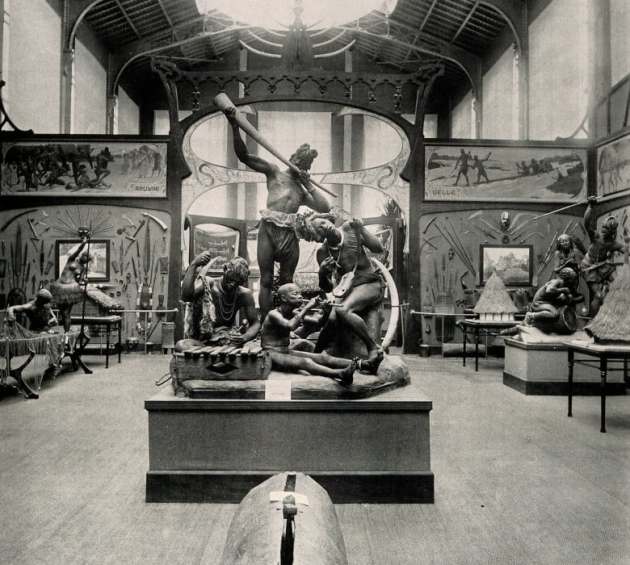
Now housed in one of Leopold’s Versailles-like palaces, its roots date back to 1897, when the king built a special tramline so people visiting the World Fair in Brussels could also visit his own exhibition showcasing his colonial exploits.

He even built a “human zoo” of grass huts inhabited by 267 Congolese brought over to be a part of the display.

This is a look at King Leopold II’s original exhibit at the colonial museum. (Wellcome Collection)

There is perhaps no greater symbol of Belgium’s failure to address the dark chapters of its past than the museum, which has maintained its colonialist perspective for all these decades.

“We have one gallery, for example, with the names of the 1,600 Belgians that died between 1876 and early 20th century in the Congo Free State,” director Guido Gryseels said. “There’s not a single mention about the many Congolese victims of colonization.”

Until now.

Gryseels is the man behind a five-year renovation that he insists will “decolonize” the museum in form and message, delivering a more honest narrative when it reopens its doors to the public this weekend.

“That the Congo was not the story of bringing civilization, that it was not a story of eliminating the slave trade, that it was a story of brutal capitalism, looking for resources, looking for profits.”

Leopold’s private agents were given free rein in his African empire. They used slave labour to satisfy Belgium’s hunger for rubber and other natural resources. Those who fell behind in delivering their quotas could be punished with the loss of a limb, or worse.

That these horrors still feel somehow veiled from ordinary Belgians seems extraordinary.

Gryseels says it is an emotional issue for many Belgians, who will have had relatives who worked in Congo in one form or another over the years, in particular after the Belgian government took over from the king in 1908.

“Many people are very nostalgic about the past,” he said. “For many Belgians, our museum is a symbol of the times when Belgium was still a major power, in 1961, one of the richest countries in the world thanks to colonialism. And, of course, now it’s gone down.”

Immigration from Belgium’s former colonies, which also included Rwanda and Burundi, was not actively encouraged before or after Congo gained its independence in 1960.

But the Central African community here numbers well over 100,000 people. Whether to engage with the museum as it tries to reform and rebrand itself has been a difficult question for many.

Artist Aimé​ Mpane won a competition to design an installation for the main rotunda of the new museum.

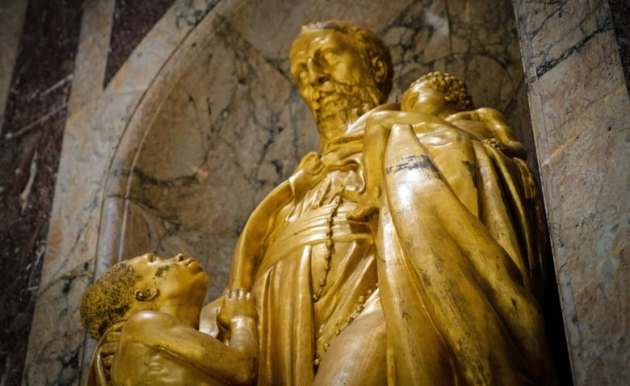
It will serve as a contrast to statues still in place from the old era, portraying colonizers as civilizers, including a golden piece depicting African children cowering at the feet of a cross-bearing missionary.

A statue of a missionary and a young boy at the museum. (Lily Martin/CBC)​

Mpane’s piece, titled New Breath, is a giant latticework head sculpted from wood and placed over a crown etched on the floor of the rotunda.

“I [wanted] to create one big piece that will take the place of King Leopold II,” he said. “That will replace this story, which links us all, with the good and the bad.”

The work also features a plant that seems to grow from the top of the head, in place of a crown, and draws the eye upward.

“There’s always a link between what’s on the ground and what’s in the sky,” he said. “And that’s to show the idea of genesis, of rebirth. We can rise above our past and reach something that’s ours.”

Mpane’s work, New Breath, in the museum’s rotunda. (Lily Martin/CBC)​

Mpane says he initially had doubts about taking part, despite reassurances that proper context would be provided for the colonial statues.

“But when I started to dig a bit deeper into it, I realized we’re really talking about our history and we must try to make sense of it. If we don’t take part in it, who is going to do it?”

Return the artifacts

Others say true contrition for the wrongs of the past would require returning all the cultural artifacts taken from colonial Africa now lining the museum’s shelves, from ritual masks and sculptures to tribal drums and a wooden canoe carved out of a single log.

The debate in Belgium comes in the wake of a report commissioned by French President Emmanuel Macron that recommended the return of thousands of items taken from former French colonies without consent.

The report, which was penned by the French historian Bénédicte Savoy and Senegalese writer Felwine Sarr, has sparked debate in other European countries including Germany and Belgium.

The current Belgian king, Philippe, changed his mind and decided not to attend the Royal Museum’s reopening this weekend in the wake of the controversy.

“I think that giving back these works of art is a question of law and justice,” said activist Mireille-Tsheusi Robert, who came to Brussels at the age of three with her Belgian father and Congolese mother.

“The original owners whose objects were stolen are villagers, chieftains, whole villages — in short, a country.”

Keeping the works of art sends the message: “We vanquished them,” she said.

For now, returning the artifacts is a step too far for Gryseels, although he acknowledges the role of the museum in Belgium’s failure to see itself as a multicultural society and to reflect the diversity of its population in its public institutions.

“For the most Belgians, their first encounter with Africa is through a visit of our museum. If then, in this museum, you get the impression that Africans don’t have a culture of their own, that the European view is superior, then you can’t be surprised that that has an impact. So we take our responsibility.”

‘Only ignorance’

To really change though, the country as a whole must take on that responsibility, many Belgians say. To carry it out of the museum and into mainstream society.

Pierre Kompany says he believes his election is a sign Belgium is headed in the right direction.

But he also says the country must work much harder to acknowledge the past if it wants to free itself from it.

“When it comes to history, there is no compromise,” he said. “Only ignorance.”

Source: Belgium begins long-overdue discussion on racism by looking to its ‘brutal’ past

Labour market outcomes for college and university graduates, class of 2010 to 2014

Good study on the differences in economic outcomes by gender, coming out just before my presentation at the ACS organized conference, STATISTICS CANADA: 100 YEARS AND COUNTING, looking at visible minorities and outcomes.

Same gender gaps but when one compares  visible minority women, Canadian-born, with not visible minority women, a number of visible minority groups have comparable economic outcomes whereas visible minority men, Canadian-born, do relatively worse compared to not visible minority men.:

Even with the same university degree or college diploma, female graduates earn, on average, less than their male counterparts two years after graduation. Results from a new study, based on administrative data, are focused for the first time on the annual employment income of college and university graduates over time in all provinces and territories.

From 2010 up to 2014, over 900,000 students under 35 years of age graduated from a Canadian public postsecondary institution and entered the labour market. Most of these graduates obtained an undergraduate degree (53%) or a college-level diploma (14%). The median employment income two years after graduation was $43,600 for those with an undergraduate degree and $39,100 for college-level diploma holders.

For all graduating cohorts from 2010 to 2014, men with college-level diplomas or undergraduate degrees had higher median employment income than women with the same credentials. The median employment income was $43,900 for men who graduated with a college-level diploma and $36,200 for women who obtained the same qualification. For those who obtained an undergraduate degree, the median employment income was $47,200 for men and $41,300 for women. Gender differences in employment income are influenced by various factors, such as choice of field of study, occupation, and hours of work. The current study cannot identify whether or not the occupation is related to the field of study of the graduate.

The employment income of graduates varies by educational qualification

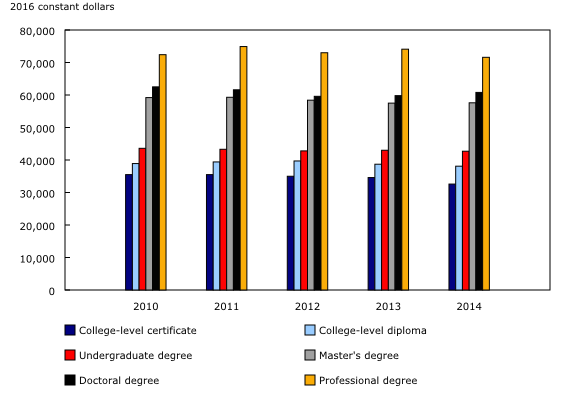
Among graduates who obtained their postsecondary credential from 2010 to 2014, the year of graduation had little impact on their employment income two years after graduation as each cohort of graduates entered a similar labour market environment. However, differences in income were observed by type of qualification for all graduating classes.

Chart 1  Chart 1: Median employment income of postsecondary graduates two years after graduation, by educational qualification, 2010 to 2014 cohorts
Median employment income of postsecondary graduates two years after graduation, by educational qualification, 2010 to 2014 cohorts

Chart 1: Median employment income of postsecondary graduates two years after graduation, by educational qualification, 2010 to 2014 cohorts

For the most recent graduate cohort (students who obtained a credential in 2014), the median employment income two years after graduation ranged from $32,600 for graduates with a college-level certificate to $71,600 for those with a professional degree (which includes graduates from law, medicine, dentistry, veterinary medicine, optometry or pharmacy). The results varied for other qualifications. For example, it was $38,100 for a college-level diploma, $42,700 for those with an undergraduate degree, $57,600 for a master’s degree, and $60,800 for doctoral degree graduates.

Median employment income for men ranged from $35,300 (graduates with a college level-certificate) to $72,800 (graduates with a professional degree). The median employment income for women ranged from $30,400 (college-level certificates) to $70,800 (professional degrees).

Studies in architecture, engineering and related technologies and in health and related fields lead to relatively high median employment income

Graduates from 2014 in architecture, engineering and related technologies, and in health and related fields, had the highest median employment income two years after graduation for college-level diplomas ($47,600 and $44,900, respectively) and undergraduate degrees ($60,000 and $58,200, respectively). Women and men had slightly different results.

For 2014 college-level diploma graduates, the median employment income two years after graduation in health and related fields was $44,000 for women and $50,500 for men. This was followed by architecture, engineering, and related technologies, with women earning $41,100, while men earned $48,900.

Women who obtained an undergraduate degree in health and related fields had the highest median employment income two years after graduation at $60,800, followed by architecture, engineering, and related technologies where the median employment income was $55,900.

Men with an undergraduate degree in architecture, engineering and related technologies had the highest median employment income ($61,000), followed by graduates in mathematics, computer and information sciences ($56,100). Health and related fields programs yielded the seventh highest median employment income for men at $44,100.

Among the 2014 cohort of graduates, women represented 16% of the college-level diplomas and 20% of the undergraduate degrees in the architecture, engineering and related technologies field. In contrast, they accounted for 84% of college-level diplomas and 80% of undergraduate degrees in health and related fields.

For graduates from most provinces, architecture, engineering and related technologies, and health and related fields were also among the top-earning fields of study for both college-level diploma and undergraduate degree graduates.

Employment income increases over time for postsecondary graduates

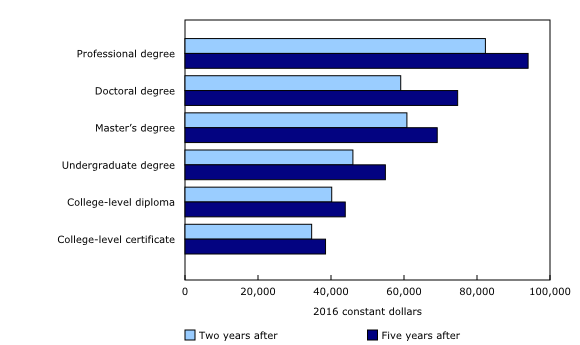
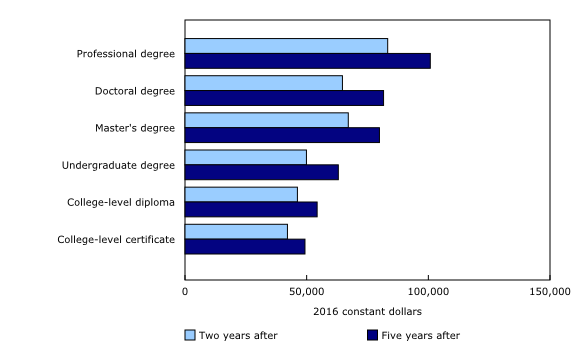
The 2011 graduating class saw their median employment income increase between 9% (for college-level diploma graduates) and 26% (for doctoral degree graduates) when measured first at two years, and then five years after graduation.

Chart 2  Chart 2: Median employment income of postsecondary graduates two and five years after graduation, by educational qualification, both sexes, 2011 longitudinal cohort
Median employment income of postsecondary graduates two and five years after graduation, by educational qualification, both sexes, 2011 longitudinal cohort

Chart 2: Median employment income of postsecondary graduates two and five years after graduation, by educational qualification, both sexes, 2011 longitudinal cohort

Chart 3  Chart 3: Median employment income of postsecondary graduates two and five years after graduation, by educational qualification, males, 2011 longitudinal cohort
Median employment income of postsecondary graduates two and five years after graduation, by educational qualification, males, 2011 longitudinal cohort

Chart 3: Median employment income of postsecondary graduates two and five years after graduation, by educational qualification, males, 2011 longitudinal cohort

Chart 4  Chart 4: Median employment income of postsecondary graduates two and five years after graduation, by educational qualification, females, 2011 longitudinal cohort
Median employment income of postsecondary graduates two and five years after graduation, by educational qualification, females, 2011 longitudinal cohort

Chart 4: Median employment income of postsecondary graduates two and five years after graduation, by educational qualification, females, 2011 longitudinal cohort

Students who obtained a professional degree in 2011 continued to have the highest median employment income five years after graduation, with an increase of 14% between year two and five. Those with a master’s degree had a slightly higher median employment income two years after graduation than those who earned a doctoral degree, some of whom may have pursued postdoctoral studies. However, five years after graduation, the doctoral degree graduates were earning more.

For graduates who earned a college-level diploma in 2011, the median employment income for males increased by almost 18% between two and five years after graduation. Female graduates, in turn, had a more modest rate of growth of 4% over the same period.

Among male students who earned an undergraduate degree in 2011, overall median employment income increased by almost 26% from years two to five following their graduation. The rate of growth in median employment income for female graduates over the same time period was lower, at 15%.

Median employment income for graduates in health and related fields grows slowly

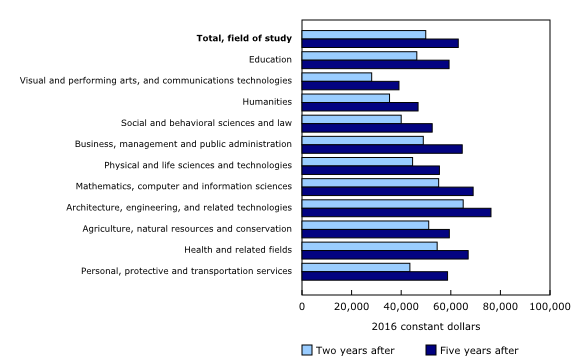
Although median employment incomes in health and related fields had the lowest growth rate among those with an undergraduate degree from years two to five after graduation (at approximately 4%), it was still among the top fields of study in terms of employment income. Graduates from humanities programs had the second highest growth rate of median employment income (28% between year two and five after graduation), however, their income ranked as one of the lowest among graduates from the major fields of study who obtained an undergraduate degree.

Chart 5  Chart 5: Median employment income of undergraduate degree graduates two and five years after graduation, by field of study, both sexes, 2011 longitudinal cohort
Median employment income of undergraduate degree graduates two and five years after graduation, by field of study, both sexes, 2011 longitudinal cohort

Chart 5: Median employment income of undergraduate degree graduates two and five years after graduation, by field of study, both sexes, 2011 longitudinal cohort

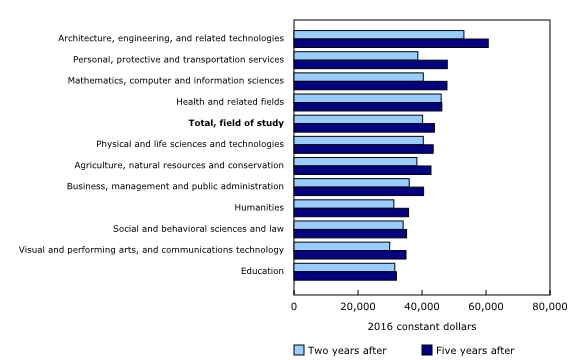
Chart 6  Chart 6: Median employment income of undergraduate degree graduates two and five years after graduation, by field of study, males, 2011 longitudinal cohort
Median employment income of undergraduate degree graduates two and five years after graduation, by field of study, males, 2011 longitudinal cohort

Chart 6: Median employment income of undergraduate degree graduates two and five years after graduation, by field of study, males, 2011 longitudinal cohort

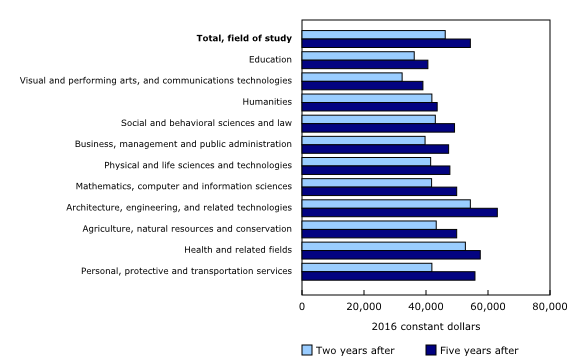
Chart 7  Chart 7: Median employment income of undergraduate degree graduates two and five years after graduation, by field of study, females, 2011 longitudinal cohort
Median employment income of undergraduate degree graduates two and five years after graduation, by field of study, females, 2011 longitudinal cohort

Chart 7: Median employment income of undergraduate degree graduates two and five years after graduation, by field of study, females, 2011 longitudinal cohort

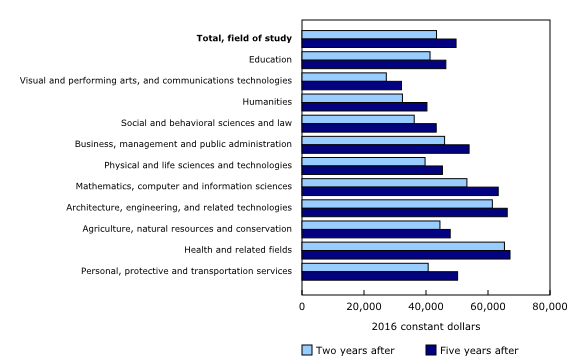
Chart 8  Chart 8: Median employment income of college-level diploma graduates two and five years after graduation, by field of study, both sexes, 2011 longitudinal cohort
Median employment income of college-level diploma graduates two and five years after graduation, by field of study, both sexes, 2011 longitudinal cohort

Chart 8: Median employment income of college-level diploma graduates two and five years after graduation, by field of study, both sexes, 2011 longitudinal cohort

Chart 9  Chart 9: Median employment income of college-level diploma graduates two and five years after graduation, by field of study, males, 2011 longitudinal cohort
Median employment income of college-level diploma graduates two and five years after graduation, by field of study, males, 2011 longitudinal cohort

Chart 9: Median employment income of college-level diploma graduates two and five years after graduation, by field of study, males, 2011 longitudinal cohort

Chart 10  Chart 10: Median employment income of college-level diploma graduates two and five years after graduation, by field of study, females, 2011 longitudinal cohort
Median employment income of college-level diploma graduates two and five years after graduation, by field of study, females, 2011 longitudinal cohort

Chart 10: Median employment income of college-level diploma graduates two and five years after graduation, by field of study, females, 2011 longitudinal cohort

As was the case for students with an undergraduate degree, those with a college-level diploma in health and related fields had the lowest rate of growth (less than 1%) from two to five years after graduation, but started with relatively high median employment income. College-level diploma graduates in visual and performing arts, and communications technologies, had larger income growth between two and five years after graduation at 17%, but started with the lowest median employment income.

Canada is a tinderbox for populism. The 2019 election could spark it.

Frank Graves and Michael Valpy focus on the shifting views of millennial men, visible minorities as well as not visible minority, towards populism and the right. The 2019 election will provide a test of their thesis but certainly the Conservatives seem to mining this resentment in much of their messaging:

As Canadians, we sit atop the continent, watching as our neighbours slide into cultural civil war. It has become easy to just be appalled as America becomes riven, with social media and antagonistic rhetoric on both sides of the political spectrum erasing the middle ground. There are two Americas, incommensurably separated on the fundamental issues of the day: climate change, the economy, social issues like health and education, employment, the media, immigration in particular, and globalization and free trade.

We’ve learned more and more about the populism that has fuelled this complicated moment as the fracture in America races like wildfire throughout Western democracies. It is the biggest force reshaping democracy, our economies and public institutions. It is the product of economic despair, inequality, and yes, racism and xenophobia. It is an institutional blind spot, largely denied or ridiculed by the media, and by the more comfortable and educated portions of society.

It is very much alive in Canada. In fact, our populist explosion has already had its first bangs and is likely to have a major impact on next year’s federal election.

The shifts in the democratic world order over the last decade have increasingly prompted social scientists to discard the left-right political spectrum in favour of an “open-ordered axis,” or what The Economist calls drawbridge-down vs drawbridge-up thinking. The former are cosmopolitan-minded people, in favour of diversity, immigration, trade, and globalization, and who are optimistic about the future; they’re guided by reason and evidence-based policy, and believe that climate change is a dominant priority. Drawbridge-up people, with an “ordered” worldview, are largely parochial, and they have reservations about diversity, are deeply pessimistic about the economic future, believe more in moral certainty than reason and evidence, are disdainful of media, government and of scientific expertise, and are convinced that climate change is trumped by the economy and their own survival. It’s ordered thinking that is metastasizing in Western societies, including Canada’s, especially among the political right. EKOS research from 2017 suggests about 30 to 40 per cent of adult Canadians are drawn to it.

Meanwhile, research over the last 10 years has found that Canada, like the United States, is turning into a society fissured along fault lines of education, class and gender. These are social chasms defined by the concentration of wealth at the top of society and, for everyone else, by economic pessimism and stagnation; by a comfortable feeling on one end of the societal teeter-totter, and a fear on the other end that a subscription to the middle-class dream might no longer be available.

Although there has been a recent uptick for the first time in 15 years, the portion of Canadians who self-identify as middle class since the turn of the century has declined from 70 per cent to 45 per cent, a stark number that mirrors America’s—signalling that Canadians have a deeply pessimistic view of their personal economic outlook. Only one in eight Canadians thinks they’re better off than a year ago. Only one in eight thinks the next generation will enjoy a better life. And EKOS finds that, by a margin of two to one, Canadians believe that if present trends with inequality continue, the country — this country! — will see violent class conflicts.

Ordered populism has already become an illusive, misunderstood theme in provincial elections in Quebec, New Brunswick, and Ontario. Indeed, Doug Ford and his Ontario Progressive Conservatives won thanks to a preponderance of working-class, male electoral support—but a closer examination of the vote shows that male millennials, against expectation, supported Ford in significant numbers and had a high turnout. Millennial women, meanwhile, preferred the New Democratic Party by a margin of 25 points, and the millennial women who didn’t vote NDP largely stayed home. Millennial men split their votes between the NDP and Progressive Conservatives, and they led females millennials by 10 points in turning out to cast ballots.

Survey evidence strongly suggests that these are young men angered by the economic realities they face, and they are hit the hardest by what is happening in Ontario’s economy. A joint study by United Way Toronto and York Region and Hamilton’s McMaster University on poverty and employment precarity in southern Ontario reports that only 44 per cent of millennials in the region — the heartbeat of Canada’s economy — have full-time, permanent jobs, that the majority have not found work that provides extended health benefits, pension plans, or employer-funded training, and that formerly high-paying blue-collar jobs there are rapidly vanishing. The lack of good jobs, coupled with the social catastrophe of affordable housing and the resulting need to delay family formation, is resulting in anxiety and depression that disproportionately affects millennial men—making them ideal targets for the appeals of ordered populism.

What is happening challenges the conventional view that the youngest adults of Canadian society—the millennials, now Canada’s largest electoral demographic—operate with roughly similar, progressive views and values.

Another assumption in need of challenging is the idea that Canada’s ordered populism, like its American counterpart, is a besieged white citadel. In fact, our northern brand is as much the choice of multicultural new Canadians as of white native-born Canada. A significant chunk of new Canadians, many of them non-white, indicate they will vote Conservative in next year’s federal election — even though 65 per cent of Conservative supporters told EKOS this year that Canada admits too many non-white immigrants. And while a majority of Canadians are open to immigration, the intensity of the opposition is red-hot, including in other parties: 20 per cent of New Democratic Party supporters and 13 per cent of Liberal supporters also believe too many non-white immigrants are entering the country..

There are two possible explanations for this: First, new Canadians may bring with them into the country strains of social conservatism that make them hostile to issues like same-sex marriage and what they see as immoral, too-liberal sex education, an inflammatory issue in Ontario over the past couple of years. Thus, what they see as an assault on their values may be more important than a party trying to appeal to voters who want fewer of them in the country.

Second, where neighbourhoods are ethnically homogeneous as many are around the core of Canadian cities—white, brown or otherwise—populism holds appeal. Where there’s more diversity, it doesn’t. As social scientists have discovered, communities which have the least contact with with minority groups are the most hostile to them.

The looming federal election could be a spark for all the populist tinder largely being ignored in Canada. In the 2015 federal election, voting differences by gender for all age groups were flat. Now the federal Conservatives hold a 17-point advantage among men from all age groups other than seniors —a huge change in three years. Federal Conservatives also hold an advantage over Liberals and New Democrats with voters who self-identify as working class, and the party has overwhelming support from non-university-educated Canadians, the group most likely to feel left behind by the disappearance of blue-collar industries.

Former Conservative Prime Minister Stephen Harper led a party supported by the economically comfortable. His successor, Andrew Scheer, leads a party of the economically unhappy, of the new economy’s losers, a base increasingly comfortable with raising the drawbridge even as the Liberal government announces Canada will admit an additional 40,000 immigrants by 2021, bringing the annual number of new, mostly non-white arrivals to 350,000. Any campaign rhetoric that confuses this new support with its old party will only exacerbate the anger—and for the angry to find comfort in populism’s temptations.

What we do know is that Ontario’s Progressive Conservative government, with its populist strains and its vague campaign promises, is what many angry young men voted for. Maybe they didn’t vote for its policies; maybe, in their anger, they just voted to burn the house down, even if the history of populist movements show they’ve rarely worked out.

We can try to understand why it’s happening. We can insist that governments tackle inequality and affordable housing. We can build a future that preserves progress for all of us but addresses the real injuries of those who have embraced populism, while also refusing to bend to their fear, anger and ignorance. But letting populism burn the house down benefits nobody—and we can’t just ignore the smell of gasoline in the air.

Source: Canada is a tinderbox for populism. The 2019 election could spark it.