Sauvée d’un mariage forcé à Victoriaville: «Ma famille veut me frapper»

Ends well but likely not all cases do. More action needed to identify the imam in question (who appears not to be from outside Victoriaville) and, if charges cannot be laid, educate and advise him of Canadian laws and procedures:

La police et la direction de la protection de la jeunesse (DPJ) ont sauvé une adolescente d’un mariage forcé organisé par un imam à Victoriaville cet été. Lorsque la jeune fille s’est enfuie de chez elle, c’est chez une famille de réfugiés du coin qu’elle a trouvé asile, ce qui a provoqué un affrontement dans la communauté. Ses protecteurs se sont confiés à La Presse. Récit d’un sauvetage.

L’adolescente est entrée en coup de vent dans l’appartement de la famille Al-Atrash*, sans cogner. Des gens étaient à ses trousses. Elle semblait terrorisée, à bout de souffle. Elle avait besoin d’un endroit où se cacher. Tout de suite.

« Ma famille veut me frapper, ma famille veut me frapper », répétait-elle. Les résidants des lieux ont voulu la calmer, lui offrir un verre d’eau. Ils n’arrivaient pas à comprendre pourquoi elle faisait irruption ainsi chez eux. Mais ils voyaient bien qu’elle était partie dans l’urgence, sans même prendre le temps de mettre ses souliers.

Puis la porte d’entrée s’est ouverte à nouveau. Six personnes ont fait irruption dans le modeste logement à la suite de la jeune fille. Sa mère, ses frères, son fiancé dans la vingtaine, ainsi que deux amis de ce dernier. Ils semblaient furieux, enragés, agressifs.

L’adolescente en fuite s’est précipitée dans une chambre et a verrouillé la porte. Sa mère criait : « Je veux ma fille ! » Son fiancé a pris son élan et commencé à donner de grands coups dans la porte de la pièce, qu’il a réussi à défoncer.

La jeune fille traquée tenait bon, appuyant son dos contre la porte brisée et poussant de toutes ses forces avec ses jambes sur le lit devant elle, pour bloquer l’entrée. « Je ne veux pas sortir ! », criait-elle.

Bousculade et corps à corps

Les six membres de la famille Al-Atrash se sont interposés devant les intrus. Le père Al-Atrash criait au fiancé : « Mais qu’est-ce que tu fais ? »

Une bousculade a éclaté. Cris, corps à corps, cheveux tirés, chutes : le fiancé a été blessé à une main. Enceinte, la mère Al-Atrash a été poussée violemment, ce qui lui a causé des douleurs au ventre qui l’ont menée à l’hôpital.

J’avais vraiment peur, ce n’était pas facile. Tout le monde pleurait.

Amira, la fille aînée de la famille Al-Atrash

(La Presse a modifié le nom des membres de la famille, car la Loi sur la protection de la jeunesse interdit de publier toute information qui permettrait d’identifier la victime dans cette affaire ou ses parents.)

Amira connaissait l’adolescente en fuite. Elles étudiaient dans des écoles secondaires différentes, mais comme leurs familles avaient fui le même pays du Moyen-Orient pour s’établir en tant que réfugiés dans le même quartier à Victoriaville, elles s’étaient liées d’amitié. Amira ne connaissait pas tous les détails de la vie intime de son amie. Mais elle savait qu’on voulait la forcer à épouser un homme dans la vingtaine. Et que la jeune fille ne voulait rien savoir de lui.

L’histoire du mariage forcé auquel était destinée l’adolescente a été révélée vendredi matin par l’animateur Paul Arcand sur les ondes du 98,5 FM. Le lendemain, les six membres de la famille Al-Atrash ont accepté d’accorder une entrevue à La Presse dans leur petit salon. Ils ont raconté pour la première fois cette journée tendue d’avril dernier et les déchirements qu’elle a provoqués dans la communauté musulmane du Centre-du-Québec.

Cinq mois plus tard, alors qu’ils se remémorent le tout, le cadre de la porte de leur chambre à coucher affiche encore des marques de violence.

Escorte policière

Dans le chaos ambiant, en cet après-midi d’avril, le père Al-Atrash avait réussi à joindre le père de l’adolescente au téléphone. « Je lui ai dit qu’il parle à son monde, que je ne voulais pas de problèmes », se remémore-t-il. Finalement, un des frères de l’adolescente en fuite a convenu qu’il n’était pas acceptable d’envahir ainsi la maison des gens. Il a fait sortir sa bande. La dispute s’est déplacée dehors. L’adolescente refusait toujours de sortir, et les Al-Atrash faisaient écran pour la protéger.

Les patrouilleurs du poste de la Sûreté du Québec (SQ) de Victoriaville, accourus sur place, avaient bien du mal à comprendre ce qui se passait.

« Les policiers ont été appelés pour une altercation impliquant une vingtaine de personnes », raconte la sergente Ingrid Asselin, porte-parole de la SQ.

D’autres membres de la communauté s’étaient mêlés de la dispute. La situation était confuse. « Les policiers parlaient français, mais tout le monde ici parlait arabe », se souvient le père Al-Atrash, qui suit des cours de francisation depuis son arrivée au Québec en 2016, mais qui peine encore parfois à se faire comprendre.

Après avoir démêlé un peu l’histoire, les policiers ont fait un signalement à la direction de la protection de la jeunesse.

La sergente Ingrid Asselin, porte-parole de la SQ

Le jour même, l’adolescente a été sortie de son foyer pour être placée dans une famille d’accueil, parce que les intervenants jugeaient que son développement et sa sécurité étaient menacés. La police a escorté les intervenants de la DPJ jusqu’à destination, pour s’assurer qu’ils n’étaient pas suivis.

L’adolescente a demandé elle-même à être placée en famille d’accueil jusqu’à sa majorité, tant elle craignait sa famille. L’affaire s’est déplacée devant le tribunal de la jeunesse, où les parents et le futur époux ont plaidé pour qu’elle reste avec eux.

Contrôle total

La preuve entendue en cour a révélé que la DPJ suivait la famille depuis un an, pour mauvais traitements psychologiques et physiques. En 2018, alors qu’elle n’était âgée que de 15 ans, l’adolescente avait été promise à un garçon dans la vingtaine, même si elle ne l’aimait pas. Ses parents avaient collecté une dot de plusieurs milliers de dollars en échange de sa main.

Un imam avait signé le contrat de mariage. Il ne restait que la réception à organiser. La fête devait se tenir en mai 2019. L’adolescente fréquentait toujours l’école et habitait chez ses parents, mais elle était déjà sous le joug de son conjoint imposé.

« Elle décrit son fiancé comme étant très contrôlant. Il décide de ce qu’elle porte, du choix de ses amies, il refuse qu’elle se maquille, il exige qu’elle soit toujours avec lui lorsqu’elle n’est pas à l’école, il décide de ses sorties, il l’empêche de parler à des gens et l’oblige aussi à porter le hijab », relate le juge de la Cour du Québec Bruno Langelier, dans son jugement daté du 18 juillet dernier.

Malgré qu’elle lui a dit à plusieurs reprises qu’elle ne l’aime pas et ne pas vouloir se marier, le fiancé lui répond qu’elle est à lui, qu’elle n’a pas le choix.

Extrait du jugement

« Sa mère lui a dit ne pas pouvoir l’aider, même si elle comprend », souligne-t-il.

« L’adolescente est si craintive de représailles qu’elle n’a même pas osé se présenter au tribunal pour l’audition », observe le juge.

À l’audience, le fiancé a soutenu qu’il était normal d’interdire à sa future épouse de parler à un homme ou de saluer un étranger de la main dans la rue. Il a déploré qu’elle se soit enfuie chez « une fille qui lui enseigne des choses pas correctes ».

Mais le juge, lui, a souligné au contraire comment la famille Al-Atrash avait été d’un grand secours en ce matin d’avril. « Les gens chez qui l’adolescente se réfugie la protègent et empêchent sa famille de la ramener chez elle », a-t-il résumé en ordonnant le placement de l’adolescente dans une famille d’accueil où elle serait en sécurité, sous la supervision de la DPJ.

La loi s’applique à tous

Les parents et le fiancé ont eu tort de croire qu’ils pouvaient appliquer les traditions de leur pays natal en matière de mariage, explique le juge. « Ces coutumes ne peuvent prévaloir dans la province de Québec. Il n’y a qu’une règle de droit et elle s’applique à tous les résidants du territoire de cette province. »

L’avocate des parents de l’adolescente, Me Angie Lemieux, a confirmé lors d’un entretien téléphonique que ceux-ci avaient renoncé à porter en appel le verdict du tribunal.

Quant à l’imam qui a signé le contrat de mariage, il n’est pas identifié dans le jugement du tribunal de la jeunesse. Joints par La Presse, des représentants des deux mosquées de Victoriaville ont dit croire qu’il venait de l’extérieur de la ville.

Il apparaît clair que l’imam […] agit en contravention de la loi.

Extrait du jugement

Pourrait-il avoir célébré d’autres mariages forcés d’adolescentes au Québec ? Pour des raisons de confidentialité, la DPJ refuse de dire si elle a découvert d’autres cas.

« Chaque signalement est analysé afin de nous permettre de recevoir un maximum d’information. Il peut arriver qu’au cours de son évaluation, la DPJ doive signaler d’autres enfants en lien avec les éléments qui lui sont rapportés », s’est contentée de dire Geneviève Jauron, porte-parole de l’organisme pour la Mauricie et le Centre-du-Québec.

« La jeune fille a fait ce qu’il fallait pour que ses droits soient respectés. On entend souvent parler de la DPJ pour le négatif, mais ici, heureusement, les intervenants ont pu sauver une jeune fille et s’assurer qu’elle puisse vivre sa vie dans le respect de ses droits », a commenté Sylvie Godin, répondante politique pour le syndicat des intervenants de la DPJ dans la région.

« On l’a aidée »

Aujourd’hui âgée de 16 ans, l’adolescente refait tranquillement sa vie dans un endroit tenu secret, pour sa protection. Amira Al-Atrash n’a plus de contact avec elle. Elle ignore comment son amie se porte. Mais elle est fière de ce que sa famille a fait pour elle. « On l’a aidée », dit-elle.

L’affaire a laissé des marques, dans le voisinage. Encore aujourd’hui, certaines personnes ne s’adressent plus la parole, ou ne le font que pour s’injurier, à la suite de cette histoire.

De son côté, Amira ne craint pas de se retrouver dans une situation semblable et d’être forcée à son tour d’épouser un homme qu’elle n’aime pas.

« Dans ma famille, si je choisis une personne, c’est moi qui vais choisir. Si je dis non, mon père aussi, il va dire non. »

*Nom fictif.

Ce que le père de l’adolescente a dit au tribunal

« Ici, toutes les filles [de notre pays] ont changé, les familles ont peur. Nos filles, avant de venir ici, elles répondaient à leur mère. Là, elles veulent partir. Tous mes amis ont peur que leurs filles quittent la maison. »

Ce que le juge a répliqué

« Cette adolescente est en droit de s’émanciper et d’aspirer à des réalisations personnelles des plus légitimes que sont de marier quelqu’un qu’elle aime, de vouloir exercer une profession, de décider de sa tenue vestimentaire et de ses fréquentations. Elle a droit à sa liberté de conscience, de religion, de pouvoir être libre de décider de son avenir, et de ne pas être soumise à un fiancé qui contrôle tout et qui l’oblige à porter le hijab. Elle veut être libre et s’affranchir du diktat des hommes qui l’entourent. »

Source: Sauvée d’un mariage forcé à Victoriaville: «Ma famille veut me frapper»

Ethnic media election coverage 1-7 September

Latest weekly analysis of ethnic media coverage. For the analytical narrative, go to Ethnic media election coverage 1-7 September

Robert Falconer: The open society, Canada’s best response to immigration

Good response to the pulled back op-ed “Ethnic diversity harms a country’s social trust, economic well-being, argues professor.”

The world is experiencing the largest displacement and movement of people of any period since the Second World War.

Canada is not immune to these flows. Almost one in four people living here were born outside Canada, with one million more arriving in the next three years.

We recently passed our neighbour to the south in resettling more refugees than any other country in the world, mostly due to vast reductions in refugee admissions under the Trump Administration, but also in part due to increased resettlement under Prime Minister Justin Trudeau.

Since 2017, approximately 150,000 asylum seekers have claimed protection in Canada, many of whom crossed the border to do so. Under these conditions, questions by Canadians are to be expected.

Some questions will be raised by bad actors. These individuals will not be satisfied by reasonable answers or potential solutions on the issue of immigration or asylum in Canada.

A few of these may stoke fears or unfounded claims about newcomers. Many more Canadians, however, have genuine concerns, worries, or fears about the arrival of newcomers to their communities.

They do not have animosity toward individual immigrants, but they may have concerns regarding border security, the integrity of Canada’s immigration system, or the values and beliefs immigrants bring with them to Canada.

It is this group that policy-makers, academics and journalists should address with open ears, facts, and ideas. Some of these include addressing the following on immigrant integration and social cohesion.

Defining integration is difficult, but some common measures include immigrant official language capability, sense of belonging to Canada, and the adoption of Canadian norms and values. By these measures, Canada is wildly successful at integrating its newcomer population.

The 2016 census showed that approximately 93 per cent of all immigrants in Canada can speak English or French. The census also showed that the majority of immigrants choose to speak English or French in the home.

This high number might surprise some, but it should be noted that official language capability is one of the selection criteria for immigrants seeking to move to Canada.

Official language capability is also one of the citizenship requirements — with the exception of the very old and the very young. Even more fundamentally, there is a workplace advantage that comes with speaking either language.

Official language capability and citizenship requirements may not be relevant if only a few immigrants became citizens, but at approximately 85 per cent Canada has one of the highest naturalizations rates in the world. The United States sits in the mid-40 per cent range.

This means the vast majority of immigrants will, at some point, pass a language test and successfully answer questions on Canadian history, culture and values, culminating in the oath of citizenship to Canada’s Queen, its laws, and the duties associated with citizenship.

Immigrants also tend to show high levels of belonging and civic pride in Canada. Researchers at Statistics Canada found that 93 per cent of newcomers have a strong or very strong sense of belonging to Canada. Some of these (24 per cent) show an affinity only for Canada, while more feel a sense of belonging to Canada and their home country (69 per cent). Only three per cent feel a higher level of attachment to their home country.

When broken down by pride in specific symbols or institutions, such as the Canadian flag, Parliament, or even hockey, immigrants placed greater or equal importance in these than natural born Canadians.

This makes intuitive sense when considering why immigrants choose Canada. Alex Nowrasteh of the Cato Institute has pointed out that most immigrants self-select, meaning that those who are most dissatisfied with Chinese communism, the Ayatollah, or Venezuelan socialism are the most likely to leave, and the least likely to bring those values with them. They choose Canada because they identify with the norms and values that make Canada.

That is not to say there aren’t issues. Canada is struggling to process a backlog of 75,000 plus asylum seekers, many of whom will have less than well-founded claims of persecution. That speaks to a processing issue at the federal level, rather than an issue with immigrant integration in Canada.

A backed-up system is more likely to attract those with unfounded fears of persecution. The solution is not to stigmatize newcomers, but to ensure that our immigration and asylum systems remain “fast, fair and final,” able to process claims in a timelier manner.

For those who are already here, Canada’s best tool for integrating them is open access to our political system and jobs market.

Some have cited Alberto Alesina’s work on fragmentation, the idea that greater population diversity is associated with social strife. This is true in countries with weak democracies and restricted labour markets, where the political and economic systems favour a select few.

Alesina’s subsequent works have shown that diverse populations reap economic benefits and remain relatively cohesive when everyone has a fair shot at becoming an MP or getting a job. Open societies enjoy strong trade relationships with other countries, a diversity in goods and services, and stronger workforces. Under these settings the work of integration takes care of itself, with newcomers and their children identifying with Canada and its values.

In that light, the work of integrating newcomers within the fabric of Canada is less about exclusion, and more about maintaining, celebrating, and safeguarding Canadian institutions, entrepreneurship, and our open society.

Source: Robert Falconer: The open society, Canada’s best response to immigration

As they build India’s first camp for illegals, some workers fear detention there

The ongoing effects of the Modi government’s citizenship registry in Assam, India:

Across a river in a remote part of India’s northeast, laborers have cleared dense forest in an area equivalent to about seven soccer fields and are building the first mass detention center for illegal immigrants.

Shefali Hajong, a labourer whose name is excluded from the final list of the National Register of Citizens (NRC), poses for a picture at the site of an under-construction detention centre for illegal immigrants at a village in Goalpara district in the northeastern state of Assam, India, September 1, 2019. REUTERS/Anuwar Hazarika

The camp in the lush, tea-growing state of Assam is intended for at least 3,000 detainees. It will also have a school, a hospital, a recreation area and quarters for security forces – as well as a high boundary wall and watchtowers, according to Reuters interviews with workers and contractors at the site and a review of copies of its layout plans.

Some of the workers building the camp said they were not on a citizenship list Assam released last week as part of a drive to detect illegal immigrants. That means the workers could themselves end up in detention.

Shefali Hajong, a gaunt tribal woman from a nearby village, said she was not on the list and will join nearly two million people who need to prove they are Indian citizens by producing documents such as birth and land ownership certificates dating back decades.

If they fail to do so, they risk being taken to detention camps like the one being built. The government says there are hundreds of thousands of illegal immigrants in Assam from neighboring Muslim-majority Bangladesh, but Dhaka has refused to accept anyone declared an illegal immigrant in India.

Shefali, who belongs to the indigenous Hajong tribe, said she was tense because of the situation.

“But I need to fill my stomach,” she said in the local Assamese dialect as she used a hoe to feed stones into a concrete mixer. She and other workers make about $4 a day, which is considered a decent wage in the impoverished area.

She said she didn’t know her exact age and believed it was about 26, adding that she did not know why she wasn’t on the citizenship list. “We don’t have birth certificates,” said her mother, Malati Hajong, also working at the site.

The camp, near the town of Goalpara, is the first of at least ten detention centers Assam has planned, according to local media reports.

“People have been coming here every other day from nearby villages asking for work,” said Shafikul Haq, a contractor in charge of building a large cooking area in the camp.

The mammoth Supreme Court-ordered exercise to document Assam’s citizens has been strongly backed by Prime Minister Narendra Modi’s Hindu nationalist government that came to power in New Delhi five years ago. Critics say the campaign is aimed at Muslims, even those who have lived legally in India for decades.

Many Hindus, mostly poor and ill-educated, are also not on the citizenship list released last week.

BRINK OF CRISIS

“Assam is on the brink of a crisis which would not only lead to a loss of nationality and liberty of a large group of people but also erosion of their basic rights – severely affecting the lives of generations to come,” Amnesty said in a statement.

India’s foreign minister has called the citizenship verification exercise an “internal matter”. An Indian foreign ministry spokesman said those not in Assam’s citizenship roster “will not be detained and will continue to enjoy all the rights as before till they have exhausted all the remedies available under the law.”

The federal government and the local Assam government did not respond to questions about the camps.

From Goalpara town, the camp being built is reached by a leafy, narrow road dotted with coconut trees. A shaky wooden bridge takes vehicles across a small river to the site, overlooked by a cluster of rubber trees.

Government guidelines for detention camps released earlier this year include building a boundary wall at least 10 feet (3 meters) high and ringed with barbed wire, local media reports said.

A red-painted boundary wall encircles the new camp at Goalpara, and green fields and mountains are visible beyond two watchtowers and quarters for security forces built behind it.

The camp will have separate living facilities for men and women, according to workers and contractors.

A.K. Rashid, another contractor, said he is building six of what would be around 17 buildings with detention rooms of around 350 square feet (32.5 square meters) each. Each of the buildings he is making will have 24 rooms, he said, adding drains for sewage were being built along the boundary walls of the center.

G. Kishan Reddy, a federal government official, told parliament in July that the government had published guidelines for detention centers which stipulate the construction of basic amenities like electricity, drinking water, hygiene, accommodation with beds, sufficient toilets with running water, communication facilities and kitchens.

“Special attention is to be given to women/nursing mothers, children,” he said. “Children lodged in detention centers are to be provided educational facilities in nearby local schools.”

WORSE THAN PRISONERS

A senior police officer who declined to be named said the camp would initially be used to house the roughly 900 illegal immigrants who are held at detention facilities in Assam jails.

A group from India’s National Human Rights Commission that visited two of those facilities last year said the immigrant detainees there were in some ways “deprived even of the rights of convicted prisoners”.

India’s top court is hearing a petition for their release.

At the camp site, another woman laborer, 35-year-old Sarojini Hajong, said she wasn’t on the citizenship list either and didn’t have a birth certificate.

“Of course we are scared about what will happen,” she said.

“But what can we do? I need the money.”

Source: As they build India’s first camp for illegals, some workers fear detention there

Laïcité: une campagne contre la loi 21 est lancée

Of note:

Le lancement a eu lieu à Montréal dans un lieu de culte protestant, soit l’église unie Saint-James.

Ehab Lotayef, l’un des coordonnateurs de la campagne, qui est de confession musulmane, avait une kippa sur la tête, une calotte portée traditionnellement par les juifs.

« Je vais la porter tout le mois de septembre », a-t-il affirmé.

Cette loi a peut-être été adoptée, mais c’est une loi injuste, a-t-il lancé près de l’autel de l’église. Pour les opposants, elle viole la Charte des droits et libertés et limite les possibilités d’emploi de personnes sur la base de leur religion. « On ne va pas juste l’accepter. »

La Loi sur la laïcité de l’État — connue avant son adoption comme le projet de loi 21 — interdit le port de signes religieux à certains employés de l’État lorsqu’ils sont dans l’exercice de leurs fonctions, dont les policiers, procureurs de la Couronne et gardiens de prison, ainsi qu’aux enseignants des écoles publiques du primaire et du secondaire.

Une enseignante d’origine tunisienne portant le voile, qui n’a révélé que son prénom, Ola, a témoigné qu’après une année extraordinaire dans une école primaire publique de Montréal, elle a frappé un mur pour l’année scolaire en cours. Comme elle n’est pas une employée permanente, si elle accepte un contrat pour cette année, elle devra signer une clause selon laquelle elle s’engage à ne pas porter de signe religieux dans la salle de classe, a-t-elle déclaré. Pour elle, cela signifie enlever son voile.

« Cette loi vient me priver de mes droits, d’être une femme libre, capable de décider où travailler, que porter. Personnellement, je ne vois pas ce que cette loi va apporter de plus ou de mieux à la société québécoise », a-t-elle dit.

« Sauf la tension sociale que je sens et que je vois. Et que je vis. »

Elle a souligné qu’il lui a été difficile de témoigner, se disant déstabilisée par les commentaires « inacceptables » qu’elle voit sur les réseaux sociaux.

Selon le rabbin Michael Whitman, « les effets négatifs de cette loi iront bien au-delà des personnes qui sont directement touchées […]. Elle a donné la permission à l’incivilité. »

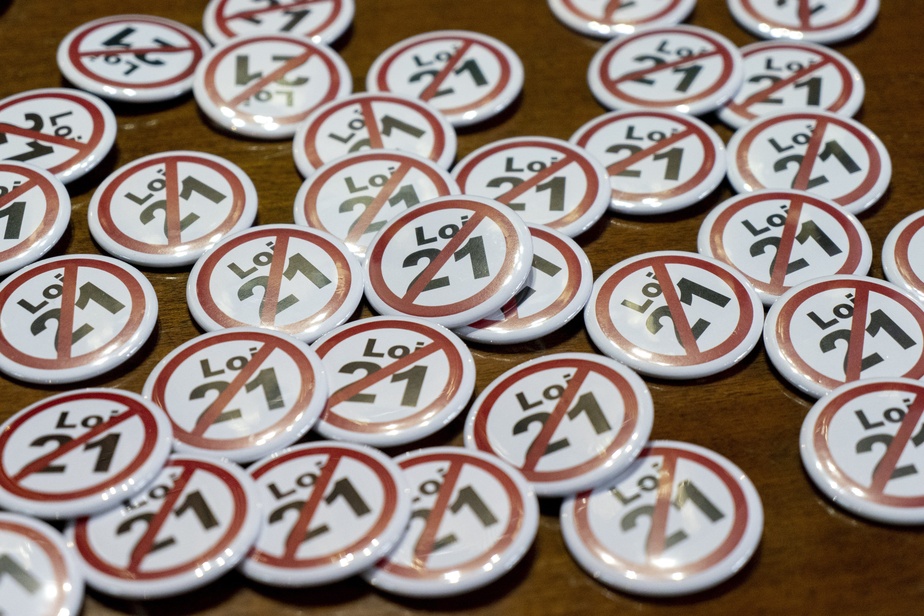
Les membres du groupe de citoyens invitent les Québécois à porter les macarons qu’ils ont fait produire en grande quantité et qu’ils distribuent librement. Sur ceux-ci, on peut voir les mots « Loi 21 », barrés d’une ligne rouge. Porter le macaron montre publiquement son opposition à la mesure législative du gouvernement caquiste et le soutien à ceux « dont les droits sont niés par cette loi discriminatoire », font-ils valoir.

Leur but est de rassembler d’ici le 6 octobre quelque 50 000 personnes portant le macaron et le signe religieux de leur choix, qui participeront ce jour-là à une journée d’action publique. Ils veulent aussi générer une discussion sur la loi et changer l’avis de ceux qui la soutiennent.

Lors du lancement jeudi, des représentants de différentes communautés religieuses étaient présents.

La Loi sur la laïcité de l’État a été adoptée en juin dernier par l’Assemblée nationale.

Ce fut un jour très triste, selon Manjit Singh, de confession sikhe, qui a été dans le passé l’aumônier de l’Université McGill à Montréal.

« Nous sommes venus ici légalement, et soudainement, parce que nous avons quelque chose sur la tête, ce n’est plus acceptable désormais », a-t-il déploré.

Et cela ruine la vie des gens, a ajouté l’homme.

Leur opposition civile à la loi se fait de façon parallèle à la contestation judiciaire qui est en cours, ont-ils affirmé.

À la mi-juillet, un juge de la Cour supérieure a rejeté la demande de groupes de défense des libertés civiles et religieuses qui réclamaient la suspension de la Loi sur la laïcité de l’État. Le juge Michel Yergeau avait alors tranché que la loi continuerait de s’appliquer jusqu’à ce qu’un tribunal se prononce sur le fond de l’affaire. Car le but ultime de ces groupes est de faire invalider cette mesure législative. En août, la Cour d’appel du Québec a accepté de se pencher sur la demande d’injonction.

Source: Laïcité: une campagne contre la loi 21 est lancée

Elizabeth May says there’s ‘no room’ for racism in Green Party after NDP defector’s comments

Let’s not kid ourselves by denying that racist attitudes don’t exist and that the comments by Richardson were more in that line than himself endorsing those views.

The question is more whether the “undertone” is more on the discomfort side or more xenophobic and racist.

Green Party Leader Elizabeth May issued a statement Wednesday saying “there is no room for any kind of racism” in her party after a recent convert made comments about NDP Leader Jagmeet Singh.

On Tuesday, more than a dozen former New Brunswick NDP candidates threw their support behind the provincial and federal Greens. One of the defectors — Jonathan Richardson, the former federal NDP executive member for Atlantic Canada — said racism was one of the reasons for the party’s lack of success in finding candidates with an election call imminent.

He said he travelled around the province to meet NDP members and found there’s “a bit of racism undertone,” particularly in the northern part of the province.

“From when I was up in the [Acadian] peninsula, I would say that a lot of that region that most people would be a bit worried about somebody who wasn’t, you know, wasn’t Caucasian, and that’s going to take some time to show people that, you know, Canadians come in all cultures and diversities,” he said. “But for right now I think that that racism still exists.”

Singh is a practising Sikh and wears a turban.

Singh said all national party leaders should be celebrating Canadian diversity and that May needs to explain why she has let the former New Democrats into her party.

“She’s taking in candidates that have kind of openly expressed their concern around someone looking differently and that being a challenge,” Singh said in Toronto on Wednesday evening. “If she is accepting people that are suggesting things that are not accepting of people’s diversity, then the Green Party has a lot to answer for.”

“I think our political leaders should embrace the diversity of our country and should be willing to say you can look like whatever you are as long as you share the values and beliefs that are going to make peoples’ lives better.”

NDP MP Charlie Angus tweeted that “the fact that some N.B. NDP jumped ship because they wouldn’t run under a progressive leader who comes from another religion is sickening.”

Karl Belanger, a former national director of the NDP, also weighed in, tweeting that it’s “not a good look, New Greens.”

May issued a statement Wednesday saying Richardson’s comments “were taken out of context and have led to accusations of racism against the party.”

“One of the core values of Greens around the world is respect for diversity and human rights,” she said.

“There is absolutely no room for any form of discrimination in the Green Party. We have zero tolerance for sexism, Islamophobia, misogyny, homophobia or hate speech of any kind. Canada’s strength lies in its diversity.”

New Brunswick Green Party Leader David Coon said he hasn’t had a chance to speak to Richardson since he made the comments, but he contends they’ve been “overblown” and “exploited” by people trying to “blunt the impact” of 14 NDP candidates joining the Greens all at once.

“What I heard him say basically was he ran into some people who had ignorant attitudes and held prejudices against people of colour or people of different religions,” he said.

“It’s not a news flash racism and prejudice exists in Canada, and it’s abhorrent and we need to work to stand up to it and stamp it out.”

Coon said he travels the province regularly and, in his experience, “most” New Brunswickers are “very accepting.”

The NDP hasn’t held a seat in the New Brunswick legislature since 2005. Its last MP in the province was Acadie-Bathurst’s Yvon Godin, who retired in 2015.

Richardson told CBC News Tuesday there are other factors behind NDP’s diminished standing in New Brunswick — including the fact that Singh hasn’t set foot in the province since winning the leadership in 2017, the election planning committee’s focus on “urban areas that are diverse,” and a lack of staffing.

Coon said he doesn’t believe racism has played a role in the NDP’s troubles in the province. He contends the NDP has been struggling in New Brunswick since Elizabeth Weir stepped down as provincial party leader in the mid-2000s.

“So it’s been a long process where they’ve found significant challenges in resonating with the people of our province. And so I think that it’s not just one issue,” he said.

New Brunswick Liberal Leader Kevin Vickers said he “couldn’t disagree more” with Richardson’s comments, which he said imply that New Brunswickers are “inherently racist.”

“The New Brunswick I know welcomes and embraces people of all backgrounds,” he said in a statement.

“These comments are wrong, embarrassing for the province and should be embarrassing for Green Party Leader David Coon.”

Coon, whose Green Party is enjoying a boom in support, securing three seats in the 2018 provincial election, said Richardson will have to take responsibility for his words. “It’s his point of view and he’s the one who’s going to have to defend that.”

Late Wednesday, Richardson posted the text of his speech on Facebook, “for those out there who are wondering and asking questions.”

Richardson said he will not be answering questions from the general public or media, but would be “happy to have a conversation” with any of his friends.

Source: Elizabeth May says there’s ‘no room’ for racism in Green Party after NDP defector’s comments

Glavin: Beijing casts shadow of fear across Canada

Terry Glavin and Ian Young have valid points along with a good thought experiment to underline them. The distinction between “Canada’s Chinese community” and Chinese Canadians is an important one:

Serving mainly the city’s ethnic Chinese community, Vancouver’s Tenth Church, in the Mount Pleasant neighbourhood, has been a venerable Vancouver institution, a refuge for the poor and the marginalized, since the 1930s. During a prayer service on Sunday, Aug. 19, a braying, flag-waving mob gathered outside. It took 20 officers from the Vancouver Police Department to guard the church doors, block passing traffic, and escort the frightened parishioners, at the conclusion of the service, through a gathered crowd of more than 100 people.

That same weekend, in Montreal, another crowd of shouting flag-wavers crashed the Pride parade after bullying organizers into barring a group of LGBTQ Chinese-Canadians from participating in the parade. Leading up to the event, on social media, the bullies had talked about following members of the ethnic Chinese group after the parade, to beat them up. The bullies went on to march alongside the annual Montreal parade in their own column, belting out a fiercely nationalistic song in a disruption of the conventional moment of silence honouring the gay community’s dead from homophobic murders, and from the time of the AIDS crisis.

In the case of the Vancouver incident, the mob was made up of people who had showed up earlier in the day, waving Chinese flags, to disrupt a rally in support of Hong Kong’s pro-democracy movement that had assembled outside the Vancouver consulate of the People’s Republic of China. The flag wavers heard about the prayer service, which was devoted to Hong Kong’s protesters, and followed the church-goers from the rally.

At the time, a thought occurred to me. Why wasn’t this a Canada-wide, above-the-fold national news story? That little puzzle is easily solved. Most of the churchgoers were not white people, and neither was the mob. They were all mostly ethnic Chinese. If the mob had been made up of preposterously nationalistic, flag-waving white people, it would have been a shocking story about a horrible, racist incident in Vancouver. But if the Christians had been mostly white people, and the mob mostly ethnic Chinese, the incident would have been lurid grist for racist teeth-grinding mills and radio hotline shouters from coast to coast.

In the case of the Montreal Pride incident, a similar thought occurred to the South China Morning Post’s Ian Young, who has developed a habit of breaking big stories overlooked by Canada’s mainstream news media. Based in Vancouver, Young ended up reporting the most complete story about what had happened in Montreal, and his thought experiment went like this: What if a mob of flag-waving American right-wingers had threatened violence and bullied the Pride organizers into expelling an ethnic Chinese group that wanted to honour Hong Kong’s LGBT community? What if the right-wingers had then crashed the parade with their own marchers, and the song they belted out during the solemn moment of silence was the Star-Spangled Banner?

You can probably imagine how widely and thoroughly a story like that would have been reported, and the sorts of stirring speeches our politicians would have made about it. But the bullies in Montreal were from the same pro-Beijing cohort as the bullies in Vancouver, and the song they sang was March of the Volunteers, the anthem of the People’s Republic of China.

You can’t say that the event in Montreal was racist, or even necessarily homophobic, exactly, just as it can’t be said that what happened in Vancouver was categorically racist, or even a straightforward case of religious bigotry. But it is exceedingly difficult to argue that something kindred to racism is not at least involved to some degree, in the way the news media fails to pay attention to the phenomenon of Beijing’s bullying and influence-peddling in Canada. And in the way our politicians, from all the political parties, if only most egregiously the Liberal Party, pander and placate in these matters.

It may not be exactly racist to resort to the term “Canada’s Chinese community,” but it will get you off on the wrong foot, and if you’re not careful, whatever your intentions, you may end up at least serving a fundamentally racist purpose.

There at nearly 2 million people of Chinese descent in Canada, but until very recently, owing to migration facilitated mainly by the scandal-plagued and now-shuttered federal Immigrant Investor Program, Canada’s ethnic Chinese came almost exclusively from the five Cantonese-speaking communities at the mouth of the Pearl River and adjacent areas around Hong Kong. Among Canada’s immigrants classified as ethnic Chinese, there are at least hundreds of thousands of people that Beijing describes in the argot of Communist Party propaganda as the “five poisons”: Taiwanese, Tibetan and Uighur nationalists, followers of Falun Gong religious practices, and democrats.

Increasingly, these Canadians are living in fear. If they aren’t careful about what they say, their family members back in China will end up being badgered, blacklisted, or worse. This fear is particularly acute among Canada’s Uighurs, whose fellow Muslims in Xinjiang have been interned, as many as 2 million of them, in re-education camps.

The fear is spreading in Canada, now that Hong Kong is in turmoil. It is restraining Canadians from exercising their rights to free speech and freedom of assembly in the Chinese-language news media — now controlled almost entirely by wealthy pro-Beijing interests — and in their decisions about whether to risk raising their voices or attending rallies in support of pro-democracy Hongkongers. It is spreading on university campuses — Beijing closely monitors the activities of Canada’s nearly 80,000 Chinese student-visa holders — and Beijing’s United Front Works Department now effectively controls hundreds of Chinese community and business associations, big and small, across Canada.

In these ways, Beijing is asserting its international reach to undermine the inviolable human rights of hundreds of thousands of Canadian citizens, and by the reckoning of the Geneva-based Human Rights Watch organization, the problem is getting worse. Earlier this year, Amnesty International and a coalition of diaspora groups presented the Canadian Security Intelligence Service with an exhaustive study that describes in detail the threats and harassment Beijing and its operatives in Canada are spreading.

“Definitely, people are afraid to speak out,” Ivy Li of the Canadian Friends of Hong Kong told me. “But it is a dilemma. People are also afraid of backlash, that Canadians in the mainstream will think all Chinese Canadians are involved in infiltration, or are working for Beijing, and will be suspect.”

Li, who emigrated from Hong Kong decades ago, said she has personally experienced hostility owing to perfectly well-justified concerns about Chinese money-laundering and the gross distortions created by Chinese capital investment in the real estate market. “But Canadians are very considerate, and we want our society to be more fair and just, and so this fear of being accused of racism, it is part of why mainstream society, especially the media, allows the pro-Beijing supporters to play the racism card.”

The role racism plays in these necessary debates is obviously complex, but even the most virtuous Canadian politicians have been happy to see Chinese immigrants as cash cows, and to regard Chinese Canadians as voting blocs, Li tells me, “and as Chinese diaspora first, rather than as Canadian citizens first.

“This allows Beijing to own at least part of us in Canada, and it means we are left to fend for ourselves against the Chinese government. And that is racist.”

Source: Glavin: Beijing casts shadow of fear across Canada

The Multicultural Myopia: More on marketing

Clever tagline but with some good perspective and analysis, particularly second and third generation Latinos and Asian Americans:

According to the official U.S. Census Bureau’s projections, next year, 2020, will be the year when the majority of our country’s population of 17-years-olds and under will come from a minority background, most of them from a Latino, African-American or Asian-American ethnicity.

Moreover, also according to the same projections, what starts with our younger population is a trend that will continue over the next two decades, age group by age group, culminating at some point between 2040 and 2050, when the entire nation will become a so-called minority-majority country.

Not surprisingly, driven by this significant demographic transformation, we have also been witnessing a backlash to the idea of a multicultural America with probably its most visible face being the attacks on the value immigrants bring to this country. This couldn’t be more ironic, given the fact that this country was shaped by immigration, whose values of resilience, hard work, perseverance, optimism, and the search for a better life to their families, permeates the fabric of our society for many centuries to come.

In my experience as a business leader and multicultural marketing expert, I am frequently asked how corporations should navigate the balance between catering to the new demographic changes in the marketplace while avoiding getting caught up in the heated political debate and the divisiveness we are experiencing in our society. My answer is that as business leaders, while we must pay attention to what’s happening in the short term, it is imperative that we look and plan for the next five, ten, twenty years and that the demographic changes we are experiencing today won’t change in the next two decades, no matter which political party is in power.

The demographic forces shaping the changes we are facing today are less driven by immigration policies, as they are more impacted by the organic population growth, mostly from Latinos and Asian-Americans residents. While we expect that the population growth rate from minority groups to slow down over the next few decades, their growth rate it will still be significantly higher than the white Caucasian population growth rate, which may even be facing negative population growth, following a pattern seen in some countries in Western Europe and in Japan.

In my opinion, not recognizing the transformational power of these demographic changes in almost every aspect of our society and, most importantly, the impact they will have on business is what I call “Multicultural Myopia,” to paraphrase an expression coined by Professor Theodore Levitt’s work to explain a short-sided approach to marketing that doesn’t focus on consumers.

Research has shown that multicultural consumers have demonstrated slightly different behaviors, preferences and attitudes towards brands and services in a vast array of industries, including consumer goods, healthcare and financial services, to name a few. These behaviors may offer opportunities for different products and services, changes in packaging, sales channels, customer services, distribution, pricing, to name a few.

Moreover, significant studies conducted by industry leaders like Nielsen, Kantar, Simmons have all confirmed that the new generation of multicultural consumers does not adhere to the old assumption of “natural assimilation,” fully adopting a monolithic Anglo culture as seen by many early 20th century immigrants. As a matter of fact, we are seeing signs of the opposite trend: not only younger, U.S.-born, multicultural consumers seek to retain important aspects of their cultural heritage like language and culture, but are also exerting a significant influence power into shaping America’s mainstream culture. This can be seen in their choices of food, music, fashion and sports, for instance. The number one music genre watched on YouTube? Latino Music.

Why is this discussion meaningful? Similar to changes in our business environment driven by technological advances, the changes we are witnessing – and will continue to observe at a faster rate in the years to come – will create a fertile environment for growth, innovation and, most importantly, changes in the current competitive positioning of several corporations and brands in America. In short, leading corporations and brands may see significant shifts in their market share positioning, and sales growth trajectory. These movements will be tracked closely by Wall Street, and analysts will start to assess a brand’s value based on their ability to navigate these new demographic changes.

How to prepare for this new multicultural marketplace? Leading companies have been successful by following a few useful strategies: getting alignment at the senior leadership level on a plan that addresses the opportunity; investing consistently over the years versus approaching the opportunity as a tactical short-term project, recognizing the need for a holistic approach that includes investing in consumers; having community engagement; and building a strong recruitment, retention and advancement program for minority employees and suppliers.

As a friend of mine, the author and business expert Rishad Tobaccowala, recently stated when discussing the topic of America’s demographic changes, “If you don’t like change, you may not like irrelevancy either.” The stakes are high, and this is the time for corporate America, and the time has come to consider multicultural marketing as a growth strategy has come. Victors will reap the benefits of a young, loyal and vibrant set of new consumers; the markets will penalize the losers. This is a long-overdue conversation that board of directors and C-suites across our country should have. Who’s taking the lead on the race for market leadership in the decades to come?

Source: The Multicultural Myopia

Ousted Liberal candidate says party was aware of his online comments for weeks

Widely covered and unclear exactly how his comments made it through the vetting process given that they were likely to be uncovered by B’nai Brith and others. And intriguing if Liberals were working on defensive media lines (which could be developed):

Ousted Liberal candidate Hassan Guillet admits to posting online about a Hamas-aligned activist, but says the party was well aware of his comments and were even working on a public relations plan before they withdrew his nomination.

Last week, the Liberal Party dumped Guillet as a candidate in Quebec after a Jewish human rights group accused him of making a number of anti-Semitic and anti-Israel statements.

In a statement posted to its website Friday, B’nai Brith Canada alleges Guillett congratulated a Hamas-aligned activist, Raed Salah, upon his release from a “prison of occupied Palestine” and prayed that he would one day succeed in liberating “all of Palestine.” The group said he described Salah as “frontier-fighter.”

The group also said it found a since-deleted Facebook post from 2016 in which Guillet allegedly wrote “the Zionists control American politics.”

The group said it reached out to the Liberal Party more than a week ago to make it aware of their allegations against him. The Conservative Party also called for his withdrawal.

Later that day, the Liberal Party said Guillet’s “insensitive comments” don’t align with the party’s values and revoked his candidacy in the riding of Saint-Léonard—Saint-Michel.

Guillet held a press conference in the riding on Wednesday, sitting shoulder-to-shoulder with supporters. He said the party was aware of the contents of his Facebook page since at least Aug. 8 and already had discussed an action plan that involved reaching out to the Jewish community.

Guillet, a member of the Council of Quebec Imams who gained national attention after delivering a speech in Quebec City honouring victims of the Quebec mosque shooting, said he did congratulate Salah after he was released from prison because he had protested the closure of a Jerusalem mosque, but insisted he wasn’t aware of his background.

Liberals say decision is final

“The party either knew or should have known what it contained. Why, then, if these words were so problematic, why was my candidacy … accepted?” he said. “One is entitled to ask the question, was it incompetence or bad faith?

“I am not anti-Semitic. On the contrary, I campaigned and I will always campaign against all forms of racism, including Islamophobia and anti-Semitism.”

Guillet said a member of the Liberal Party approached him Friday and said he could resign for personal reasons — or the party would withdraw its support.

The Liberal Party isn’t changing its mind.

“Following an internal review, the Liberal Party of Canada took the appropriate steps to remove Mr. Guillet as the Liberal candidate for the riding of  Saint-Léonard—Saint-Michel. That decision is final,” said party spokesperson Parker Lund in an email Wednesday.

Neither is B’nai Brith Canada.

“Today’s press conference only confirms our position that Hassan Guillet is not fit to carry the Liberal Party banner,” said Michael Mostyn, the group’s chief executive officer.

“We are satisfied with our role in exposing his anti-Semitic statements, and disappointed that he spurned an opportunity to retract them.”

Source: Ousted Liberal candidate says party was aware of his online comments for weeks

Ross Douthat: Four Things That Are Not White Nationalism

His list:

  1. It is not white nationalism to recognize limiting principles on liberal universalism, and a justifiable role for particularity — ethnic, cultural, religious — in many political arrangements.
  2. It is not white nationalism to believe that countries like the United States would be better off with more babies.
  3. It is not white nationalism to believe that growing ideological uniformity in the commanding heights of culture makes American politics more polarized.
  4. It’s also not white nationalism for conservatives to try to find ways to persuade and reel back people on the right who are tempted by bigoted ideas

As always, it is the specifics that indicate whether the beliefs and principles are inclusive or exclusive, positive or negative.

Useful reminder not to automatically label or dismiss:

The American right in the Trump era has a racism problem. It’s fed by a Republican president who race-baits, a media ecosystem whose guardrails have collapsed, the lure of far-right ideas after various center-right failures and the influence of toxic forms of internet community on impressionable minds.

At the same time, the American right in the Trump era faces a liberalism that’s eager to discover and condemn racism where it does not actually exist. Positions that any de-Trumpified conservatism would necessarily hold are conflated with white nationalism, figures who opposed Donald Trump are hammered as enablers of racism, and progressives indulge a political fantasy in which the racist infiltration of the mainstream right is an opportunity to delegitimize conservatism entirely.

The coexistence of these two realities was usefully illustrated in the last two weeks. If you want evidence that bigotry on the right is a bottom-up problem as well as a feature of the president’s birtherism and Twitter wars, just read last week’s SplinterNews exposé on the email group where a cluster of youthful and not-so-youthful right-wingers gathered to play at white nationalism while holding down normal jobs for conservative publications and institutions. What was reported in the piece I can confirm anecdotally: Every extended conversation I have with 20-something conservatives includes a discussion of how to deal with racist flirtations in their peer group.

But if you want evidence that unjust delegimitization is happening as well, consider that in the very same period that the email exposéappeared, a succession of mainstream media outlets served up bogus accusations of racism against prominent and not-so-prominent conservatives.