Tom Mulcair on Legault’s multiculturalism remarks

Of note:

The weather is getting better, the Canada Day long weekend is just around the corner and we could all use a break…so Francois Legault decided it’s the perfect time to attack multiculturalism!

Last weekend, the Quebec premier had this to say: “It’s important that we don’t put all cultures on the same level; that’s why we oppose multiculturalism…We prefer to concentrate on what we call interculturalism, where we have one culture, the Quebec culture…”

Legault, of course, is just repeating something that has become commonplace in Quebec: the notion that multiculturalism is a threat.

That’s one of the reasons why Legault has been fighting for full jurisdiction over the choice of immigrants to his province, especially the family-reunification category.

LANGUAGES SPOKEN AT HOME

Not content to just tell people what language they should speak at work, he’s taken to musing about the language people should speak at home. He apparently doesn’t want families reuniting if they are going to be speaking a language other than French in their own house!

For forty years, Canada has had constitutionally guaranteed official bilingualism within a framework of multiculturalism.

The old “two founding peoples” vision (English and French) was replaced by a view that Canada is enriched by the vibrant diversity of all cultures present, and that irrespective of national origin, certain rights to services in both official languages were to be protected.

Things like access to official language minority schools have been guaranteed. That means, in turn, that the English-speaking community of Quebec and the French-speaking minority of, say, Manitoba both have the constitutional right to control and manage the Boards that oversee the schools their kids can attend.

Other language rights are protected by the Canadian constitution. For example, English and French must be used at all steps of the legislative process in Quebec, Manitoba and New Brunswick (the only officially bilingual province) and the right to use both languages is guaranteed in pleadings before the courts of those provinces.

In order to change the constitution in a way that affects guaranteed language rights, the 1982 Constitution Act says explicitly that you need a joint resolution of the House of Commons and the Senate. That’s what Quebec did when it replaced religion-based school boards with language-based institutions. Lucien Bouchard was the premier, I was in the Liberal opposition and both parties worked together to modernize the system.

Resolutions were obtained in both houses of the Canadian Parliament authorizing the change and It has gone into effect and worked since. Problem is, Legault has also attacked (with Bill 40) the right of the English-speaking community to control and manage its own school boards. The courts have had to intervene to enforce the constitution and stop him.

Since that rebuke, Legault seems to have resolved to never again let the Canadian constitution interfere with his plans to remove minority language rights. With Bill 96, Legault is now claiming to have unilaterally changed the B.N.A. Act, the founding constitutional law from 1867, to remove language guarantees for equality of English and French in official legal documents and before the courts.

No resolution of Parliament was required, in his view, and neither Justin Trudeau nor his Justice Minister David Lametti have stood up to defend the Canadian constitution or the citizens whose rights are being removed.

Those rights have been reinforced through a series of Supreme Court decisions and the bilingual nature of the courts and legislation in Manitoba, Quebec and New Brunswick are constitutionally sacrosanct. Lametti seems to be unaware.

After Bill 96 was enacted at the end of the legislative session in Quebec City, anglophone Quebecers woke up to the fact that they could no longer get a marriage certificate in English and an English birth certificate from B.C. may as well have be from the other end of the world. You need to have both officially translated – at your own expense! Of course this flies in the face of the constitution. But Trudeau and Lametti don’t want to make waves in the province where they both get elected, so they do nothing.

I was working in the legislative branch of the Quebec Justice Department in the late ‘70s when the Supreme Court ruled that the failure to respect the B.N.A. Act’s bilingualism obligations meant that all Quebec legislation could be struck down. A mad scramble ensued and the legislation was all reenacted, in both official languages, the next day.

Manitoba stonewalled but was eventually compelled to produce a full bilingual version of all of its legislation and the forms that come with it. I also worked in Manitoba for a couple of years to oversee that translation.

Imagine for one second that a Manitoba government would claim to be able to unilaterally amend the Manitoba Act, that mandates this official bilingualism! That was in fact a key argument the Manitoba government has tried in the past and it was rejected conclusively by the Supreme Court. If it were tried again, the Federal government wouldn’t waste a second challenging it.

Why then won’t the feds lift their little finger to protect the same right to use English in the courts in Quebec?

WHY THIS INERTIA IN OTTAWA?

When the constitution allows for a difference for one province, it does so explicitly. For example, there is a different rule for access to English school in Quebec which is baked right into s. 23 of the 1982 constitution. There is, however, no difference allowed when it comes to the requirement to enact legislation, every step of the way, in both languages in Quebec. The use of both languages in legal documents before the courts is also guaranteed. So why this inertia in Ottawa?

To find an answer, it’s good to start with Bill 21, the Quebec law that openly discriminates against religious minorities generally and Muslim women in particular.

That law, like Bill 96, is so patently unconstitutional that Legault has preemptively used the notwithstanding clause to say that it applies despite the Charter of Rights.

Since that law was enacted, we’ve had various degrees of dithering from the different Federal parties, including Trudeau’s Liberals. But Trudeau is the Prime minister. Only he can refer these issues directly to the Supreme Court. Problem is, he won’t, because he’s terrified of Legault. As a result, the first time in our history, we have a federal government that refuses to defend the Canadian constitution.

In the meantime, religious and linguistic minorities are being left to fight the discriminatory and unconstitutional Bills 21 and 96 on their own. It’s a shameful abdication of responsibility by Trudeau and Lametti but such is the state of play when it comes to defending the rights of Canadians who happen to live in Quebec.

Against that backdrop, the Trudeau government has introduced language legislation to shore up the ageing Official Languages Act. Quebec has taken to sending in missives to the Feds telling them what changes have to be made to their law to harmonize it with Quebec’s language laws. This is very complex and detailed handiwork that appears to be beyond the grasp of the team Trudeau has tasked with shepherding the file through Parliament.

As a result, the fall session in Ottawa will no doubt see more than its fair share of debates on language.

For now, whether at the lake or in a local park, let’s just give ourselves that break and enjoy this weekend’s celebration of our fabulous country where, despite these ups and downs, we’re all so lucky to live together. Happy Canada Day!
Source: Tom Mulcair on Legault’s multiculturalism remarks

Census 2021 data shows Australians are less religious and more culturally diverse than ever

Canadian diversity data will be released this October. Religion will be included (10 year cycle in contrast to the standard 5 year cycle).

Some of the same trends occurring in Canada:

Australians are increasingly unlikely to worship a god and more likely to come from immigrant families.

The 2021 census has revealed a growing nation — more than 25 million people — that is more diverse than ever.

It also depicts a country undergoing significant cultural changes.

For the first time, fewer than half of Australians identified as Christian, though Christianity remained the nation’s most common religion (declared by 43.9 per cent of the population).

Meanwhile, the number of Australians who said they had no religion rose to 38.9 per cent (from 30.1 per cent in 2016).

The data also shows almost half of Australians had a parent born overseas, and more than a quarter were themselves born overseas.

The census — a national household questionnaire carried out every five years — took place in August last year amid the worsening COVID-19 pandemic.

The nation’s two largest cities, Sydney and Melbourne, were in lockdown and residents of regional New South Wales, Victoria and the ACT were about to join them.

Yet Australian Statistician David Gruen said the census was a success despite this challenge, with the household response rate rising to 96.1 per cent from 95.1 per cent five years earlier.

About four in five households submitted their answers online.

The Australian Bureau of Statistics (ABS) will begin publishing census results today and release more data in coming months.

The information helps governments improve their services, and helps researchers and businesses better understand the community.

Beliefs and family traditions are changing

Christianity was the stated religion of about 90 per cent of Australians until 1966, when its dominance began to wane.

The ABS says migration has affected the trends since, though much of the change is due to the growth of atheist and secular beliefs.

The fastest-growing religions, according to the latest census, are Hinduism (2.7 per cent of the population) and Islam (3.2 per cent), though these worshippers remain small minorities.

The 2021 census was also the first to collect data since same-sex marriages were allowed in Australia.

Almost 24,000 of these marriages were officially recorded.

However, marriage itself is becoming less prevalent.

A generation ago (in 1991), 56.1 per cent of Australians aged over 15 were in a registered marriage. That has now dropped to 46.5 per cent.

New Australians are increasingly from India

Australia has long been one of the world’s great immigration nations, accepting more people than most other countries.

Last year, almost half of the population (48.2 per cent) were first or second-generation migrants, having at least one parent born overseas. That compares with 41.1 per cent 30 years ago.

Of the 27.6 per cent of Australians who were themselves born overseas, the most common country of birth was England.

However, India has become the second-most-common source country, overtaking China and New Zealand.

The census also asked Australians to report their “ancestry”, as opposed to their country of birth or ethnicity.

The top responses were English (33 per cent), Australian (29.9 per cent), Irish (9.5 per cent) or Scottish (8.6 per cent), with another 5.5 per cent saying Chinese.

Source: Census 2021 data shows Australians are less religious and more culturally diverse than ever

Statement by the Prime Minister and other leaders on Canadian Multiculturalism Day

The Prime Minister, Justin Trudeau, today issued the following statement on Canadian Multiculturalism Day:

“Today, on Canadian Multiculturalism Day, I join people from coast to coast to coast to celebrate one of our country’s greatest strengths – our diversity. Cultural communities have always been integral to the fabric of Canada, and Canadians celebrate their diverse cultural heritage and identity with great pride.

“Our multiculturalism makes us who we are as Canadians, and many cultural communities have a long history of contributing to our country. As Canadians and partners, we acknowledge that First Nations, Inuit, and Métis have called these lands home for millennia.

“Canada’s proud and longstanding tradition of welcoming people from around the world with open arms continues to shape our country today. Last year, the Government of Canada welcomed over 405,000 new permanent residents into the country, the largest number of newcomers to Canada in a single year, surpassing the previous record from 1913. Canada was also the global leader in resettling refugees in 2021, helping them establish roots and start a new life here. All across the country, newcomers start businesses in their communities, volunteer to help those who need it, and contribute fully to our local economies. Canada is better for it.

“The government is building on Canada’s global reputation as an open and compassionate society. While we have much to celebrate, many Canadians still face systemic barriers and discrimination based on the colour of their skin, their background, or their faith, and we recognize there is still more work to do to achieve a truly equitable country. Through the Community Support, Multiculturalism, and Anti-Racism Initiatives Program, a renewed Anti-Racism Strategy, and a new National Action Plan on Combatting Hate, we are improving our understanding of the challenges faced by Indigenous Peoples, Black and racialized and religious minority communities and driving action to make Canada more inclusive for everyone.

“On behalf of the Government of Canada, I invite everyone to participate in Canadian Multiculturalism Day by taking part in activities and events across the country. Today and every day, let us celebrate the differences that make Canada one of the best places in the world to live.”

Source: Statement by the Prime Minister on Canadian Multiculturalism Day

NDP Leader Singh statement:

Jagmeet Singh, Leader of Canada’s NDP, issued the following statement:

“The celebration of multiculturalism in Canada is a pillar of our society that make this country truly welcoming – it’s a part of who we are and informs much of what we believe in.

The cohesion and coexistence of many cultures and traditions have made Canada into a vibrant and beautiful place to live, raise a family or start a business.

We must never take this diversity for granted – and we must also recognize that Canada hasn’t always been welcoming or inclusive to everybody, with many of these injustices continuing today.

From the treatment of Japanese Canadians during the second world war, or the Komagata Maru incident, to the systemic oppression faced by black and indigenous peoples in Canada’s criminal justice system today, we know that much more work needs to be done.

That is why we must recommit ourselves to challenging intolerance, discrimination and racism. We must acknowledge that these ills exist throughout society and do everything we can eliminate them.

It’s is our responsibility to put action behind our values of equality, inclusivity and compassion.

On behalf of all New Democrats on Multiculturalism Day, let us celebrate the many cultures that make us the vibrant and open country we all love, and recommit ourselves to protecting these values at all cost.”

Source: https://www.ndp.ca/news/ndp-statement-canadian-multiculturalism-day-2018

At time of writing, no statement from the Conservatives (the last one dates from 2020 under Andrew Scheer).

However, they did issue a statement for the Quebec’s Fête nationale (Saint-Jean Baptiste):

“Every year, on June 24, the pride of being a Quebecer goes up a notch. The National Holiday is a passionate, unifying and colourful celebration of Quebec. From Abitibi to Gaspésie, through Mauricie and Estrie, this pride is celebrated in many ways. Singers and musicians sing patriotic songs, and even farmers and breeders have creatively worked to reinvent themselves to promote Quebec products.

“This year, Quebecers have shown their courage and fighting spirit! You have shown that you are part of a nation that knows how to roll up its sleeves and meet unexpected challenges. You have shown solidarity with your family and friends, but also with entrepreneurs, restaurant owners and health care workers. Yes, the last two years have been difficult, but you never gave up! As always, the people of Quebec have been resilient, and have shown incredible tenacity through the ups and downs of the pandemic.

“For over 400 years, you have been persistent in defending yourselves. Your fight to protect your language and culture is a perfect example. In Quebec, it is important to be able to work, communicate and be served in French. I want you to know that the Conservative Party of Canada will fight every battle to protect French. 

On behalf of the Conservative Party of Canada, and the Conservative team in Quebec, I would like to wish you a Happy National Holiday.’’

Source: Statement by Conservative Leader Candice Bergen on Quebec’s National Holiday

Canada’s COVID-spurred immigration backlog is hurting its economic growth, survey suggests

Valid concern. But perhaps it would be more helpful to recommend reducing levels to focus on timely approval processes particularly for the economic class that IRCC can manage, and do not excessively strain housing, infrastructure, healthcare, the environment etc.

Programs highlighted by Business Council members: the global talent stream, federal skilled worker program and the Canadian experience class.

Immigration backlogs and processing delays have become a top barrier to Canadian employers seeking to attract talent and the situation is impeding economic growth and business investment, a new survey suggests.

The report by the Business Council of Canada found 80 per cent of surveyed employers were having trouble finding skilled workers, with labour shortages in every province and territory — with it being most pronounced in Ontario, Quebec and British Columbia.

Canada’s immigration system has been upended during the pandemic, with applications piling up while staff worked remotely in a restricted capacity. There’s not a single program without a backlog and processing times have gone off the roof, doubling or tripling what they were pre-COVID.

According to CIC News, an online immigration information website, Canada’s immigration backlog has grown to 2.4 million people, including 522,047 awaiting permanent residence; 1.47 million waiting for temporary residence on work and study permits; and almost 400,000 for citizenship.

Sixty-seven per cent of employers said they are being forced to cancel and/or delay projects; 60 per cent are suffering revenue loss; 30 per cent are relocating work outside of Canada; and 26 per cent are losing market share as a result, said the business council, whose member companies employ 1.7 million Canadians in 20 industries and generate $1.2 trillion revenues yearly.

Eighty of the council’s 170 members responded to the survey, including in sectors from agriculture to automotive, energy utilities, finance, high technology manufacturing, information technology, telecom/media and transportation.

Sixty-five per cent of the respondents said they recruit workers through the immigration system and the rest hire permanent residents already in Canada. More than 80 per cent of employers reported relying on immigration to address labour shortages and for global experience, knowledge and networks.

While two-thirds of those who use the system intend to increase their recruitment of immigrant talents, 67 per cent said processing delays have become the top barrier for employers to meet those needs, while 58 per cent of the companies expressed frustration with the complex administrative requirements.

“Given the growing immigration backlog has been identified as a major barrier to economic growth and business investment, it’s imperative Canada take an all-hands-on-deck approach to secure a competitive advantage and … modernize the immigration system,” said Goldy Hyder, president and CEO of the Business Council of Canada.

Of all economic immigration programs, employers said they relied most on the global talent stream, federal skilled worker program and the Canadian experience class, but the two latter programs have been suspended during the pandemic.

The survey found skills shortages are most common in fields such as computer science, engineering and information technology. There is also a huge demand for construction workers, plumbers, electricians, and other skilled trades.

Half of the employers said Canada should increase its annual intake of permanent residents and the rest support the government’s current three-year immigration plan to welcome 431,645 permanent residents in 2022; 447,055 in 2023; and 451,000 in 2024.

“Canada is in a global competition for talent, and we risk losing out to countries with more effective and efficient immigration systems,” Hyder said. “Nobody can afford to wait a year or more to have an application processed, not the deserving candidates themselves nor the companies hiring them.”

Source: Canada’s COVID-spurred immigration backlog is hurting its economic growth, survey suggests

Jolin-Barrette tend la main à la France pour défendre la langue française

The usual wilful or unwilful mischaracterization of multiculturalism as not being about integration in Canada:

Il y avait longtemps qu’un ministre du Québec n’avait pas prononcé un tel discours en France. À l’heure où les relations entre la France et le Québec se déclinent le plus souvent au rythme des échanges économiques, le ministre de la Justice et de la Langue française avait choisi de donner à sa communication un contenu nettement politique.

Pour Simon Jolin-Barrette, il est temps que la France et le Québec unissent leurs forces pour défendre le français non seulement dans leur pays respectif, mais partout dans le monde.

« Le Québec vous tend la main, a-t-il déclaré. Il vous convie à une union des forces entre nos deux nations, basée sur la certitude que le français n’est pas une cause du passé, mais un ferment d’avenir. Un moteur de résistance et de renaissance. »

Dans la grande salle des séances de l’Académie française, le ministre qui n’était pas venu à Paris depuis l’âge de ses 18 ans s’est adressé à une centaine de personnes, dont une douzaine d’académiciens. Visiblement ému de se retrouver en ce lieu fondé par Richelieu à l’époque où naissait la Nouvelle-France, il s’est présenté comme le « descendant de Jean Jolin, un modeste meunier ». C’est la gorge nouée qu’il a déclaré : « Je n’ai ni votre plume ni votre épée. Mais c’est inspiré par toute la fougue du peuple québécois que je prends la parole, en ces murs. »

Le « rouleau compresseur anglo-américain »

Comparant la loi 101 à l’ordonnance Villers-Cotterêt qui, en 1539, établit la primauté du français dans tous les actes publics du Royaume de France, il a brossé un tableau d’ensemble de l’histoire et de l’évolution du français au Québec. Sans oublier d’expliquer en détail les raisons de la nouvelle loi 96, destinée, a-t-il dit, à combattre les « nouveaux périls [qui] guettent la langue française ».

Devant une salle conquise, le ministre en a surtout appelé à « notre devoir de vigilance à l’égard de la langue française » ne manquant pas d’écorcher au détour « le multiculturalisme canadien […] qui combat, dit-il, les prétentions du Québec à se constituer en nation distincte ». Il n’a pas oublié non plus « la révolution numérique des GAFAM », ce « rouleau compresseur anglo-américain, qui bouscule l’écosystème de notre langue et de notre culture ».

Évoquant « des articles diffamatoires contre le Québec […] publiés […] dans des journaux américains et canadiens anglais », le ministre a rappelé avec aplomb que « la langue française n’a jamais été un fait ethnique. Elle a toujours été un fait de culture et de civilisation. »

Avec des mots qu’on n’avait pas entendus depuis longtemps à Paris, le ministre n’a pas hésité d’en appeler directement à la France. « Rien ne serait plus naturel, dit-il, que la France, dans ce monde nouveau, se fasse le porte-parole de la diversité des cultures et de la dignité des nations. Il ne s’agit pas, vous m’avez bien compris, de s’opposer à la révolution de notre temps, mais d’y participer pleinement en y faisant respecter ce que nous sommes. »

Cette invitation de l’Académie française s’inscrit dans le sursaut qui a récemment secoué les Immortels dans la défense de la langue française, nous a expliqué l’académicien et poète Michael Edwards. Depuis un an, l’Académie et son secrétaire perpétuel, Hélène Carrère d’Encausse, n’ont pas hésité à intervenir publiquement pour critiquer le bilinguisme qui a envahi certains milieux en France. Ils ont notamment demandé au gouvernement la suppression de la nouvelle carte d’identité entièrement bilingue (anglais-français). L’Académie a aussi publié un important rapport sur l’influence de l’anglais dans la communication institutionnelle. Elle y dénonce l’anglomanie qui s’est particulièrement répandue depuis l’élection d’Emmanuel Macron.

Une invitation « historique »

« Nous faisons cause commune. […] Merci de nous insuffler un peu de votre détermination », a déclaré le chancelier de l’Institut de France, Xavier Darcos. Présent à la séance, l’écrivain haïtien et québécois Dany Laferrière n’a pas hésité à qualifier d’« historique » cette invitation, puisque peu de représentants politiques québécois ont eu l’honneur de s’adresser ainsi directement aux Immortels.

« Je suis particulièrement sensible à la façon dont, au Québec comme en France, le français peut servir à cimenter l’adhésion des nouveaux arrivants », nous a déclaré l’académicien, romancier, diplomate et médecin Jean-Christophe Rufin. « Il n’y a pas d’opposition entre la tradition et l’ouverture. »

Jeudi, Simon Jolin-Barrette a aussi rencontré la toute nouvelle ministre française de la Culture, Rima Abdul Malak, à qui il a aussi fait valoir l’importance que le Québec et la France défendent leur langue en commun. Dans ses interventions, le ministre évoque aussi la solidarité qui unit la France et le Québec sur la question de la laïcité.

« J’ai reçu un accueil très positif de la part du gouvernement français et on m’a indiqué que le président Macron était très sensible à la question de la langue française, dit-il. […] pour nous il s’agit d’une main tendue afin de construire ensemble des alliances qui vont permettre d’être sensibilisé à la défense de la langue française. Si l’État français se mobilise aussi fort que le fait l’État québécois présentement, c’est une lutte qu’on va pouvoir mener ensemble. »

En ce 24 juin, Simon Jolin-Barrette participera aux célébrations de la Fête nationale à la Délégation générale du Québec à Paris. En terminant, le ministre a promis de ne pas attendre aussi longtemps que la dernière fois avant de revenir en France.

Source: Jolin-Barrette tend la main à la France pour défendre la langue française

Article in English, with Premier Legault comments:

In a rare speech before France’s Academie Française — the body charged with protecting the French language in its home country — one of Quebec’s top ministers said that Canadian multiculturalism is a thorn in Quebec’s side.

People are failing to see that Quebec’s controversial recent laws, both language law Bill 96 and even securalism law Bill 21, are themselves about protecting a fragile culture, said Minister Simon Jolin-Barrette.

We’re in a time when the “diversity of cultures is becoming just as threatened as the diversity of fauna and flora,” he said in the Thursday speech — referring to Quebec’s French-speaking culture.

Jolin-Barrette is Quebec’s minister of justice and also its minister for the French language, making him deeply involved in both pieces of legislation.In the lengthy speech, he went over the history of Quebec, from its founding as a French colony to the Quiet Revolution and beyond.

But one thing is a particular problem, he said: ensuring that newcomers to Quebec learn to live in French.

“One of our greatest challenges is to involve immigrants in our national project,” he said.

“We are the neighbours of a great power, the United States, and we operate within a federation with an anglophone majority. The continental and global linguistic dynamic favors English in every way.”

He heaped criticism on Canadian federal law that protects individual rights, calling this emphasis on the individual “nearly absolute,” to the detriment of Quebec’s collective rights.

“Although our project is thwarted by Canadian multiculturalism, which finds an equivalent in what you call communitarianism and which combats the claims of Quebec to constitute itself as a distinct nation,” Jolin-Barrette continued, “the French language must really become the language of use of all Quebecers.”

Despite earlier laws forcing all children of immigrants to attend school in French, he said it hasn’t been enough, leading the current government to clamp down on English in post-secondary colleges by stemming their growth with enrollment caps.

“Upon graduating from high school… an alarming proportion of students, especially those whose first language is neither English nor French, rush into the anglophone network to pursue their studies,” he said.

He also explicitly linked Bill 21 with the same struggle. Arguably the current government’s most controversial bill of their four years in power, it banned certain public servants, including teachers and police, from wearing religious symbols at work.

In practice, it affected female Muslim teachers most heavily, preventing school boards from hiring or promoting any hijab-wearing teachers. Challenges to it are still before the courts and are expected to end up at Canada’s Supreme Court.

“Law 96 on the French language does not come alone,” said Jolin-Barrette.

“It was adopted after Law 21 on secularism, which I also had the honor of piloting, always with the same idea of strengthening the autonomy and personality of the State of Quebec.”

LEGAULT SAYS ALL CULTURES NOT ‘ON THE SAME LEVEL’

When asked about Minister Jolin-Barrette’s comments in Paris today, Premier François Legault said he is opposed to putting “all cultures on the same level” and stressed the importance of having a “culture of integration” above all else.

“So that’s why we oppose multiculturalism. We prefer to concentrate on what we call ‘inter-culturalism’ where you have one culture, the Quebec culture, where we try to integrate the newcomers, but we want to add to this culture,” the premier said.

“I think new people coming to Quebec — they add to our culture. But it’s important to have a culture where we integrate, especially to our language.”

Legault also argued this is in direct opposition to the Canadian model of multiculturalism.

“I see that Mr. Trudeau is pushing for multiculturalism, so he doesn’t want us to have a culture and a language where we integrate newcomers,” the premier said.

MEDIA CRITIQUES OF BILL 96 ARE ‘LAZY,’ JOLIN-BARRETTE SAYS

In his speech, Jolin-Barrette addressed criticism that embracing English and bilingualism is a way of being open to the world, whether you see it as the language of Shakespeare or “Silicon Valley.”

But that’s a misplaced idea, the minister argued.

“What is presented as an openness to the world too often masks acculturation, which comes with a significant loss of memory and identity,” he said.

He said gone are the times when people can request to be served in English or French in Quebec, as in a “self-service business.”

And Jolin-Barrette made a special point of attacking English Canadian media’s coverage of Bill 96.

“Recently, defamatory articles against Quebec have been published with too much complacency in American and English Canadian newspapers,” he said.

“Lazy authors depict our fight from the most denigrating and insulting angle, trying to pass it off as a rearguard fight, a form of authoritarianism.”

“Our fight for the French language is just, it is a universal fight, that of a nation which has peacefully resisted the will to power of the strongest.”

For a large portion of the speech, Jolin-Barrette spoke of the time before the Quiet Revolution, when, he said, French itself was being lost in Quebec.

“A vulnerable proletariat was born, whose contaminated language quickly switched to Franglais,” he said.

“The English-speaking oligarchy, heir to British power, imposed its language and its imagination….in the 1950s, French-Canadians lived in towns where commercial signage was often in English.”

At another point, he called French the greatest of the Western languages, with the biggest literary influence.

In those decades, however, “French Canada was one of the very few places in the world where the French language was a sign of social inferiority,” he said.

Source: Quebec is ‘thwarted’ by Canadian multiculturalism, minister says in France speech

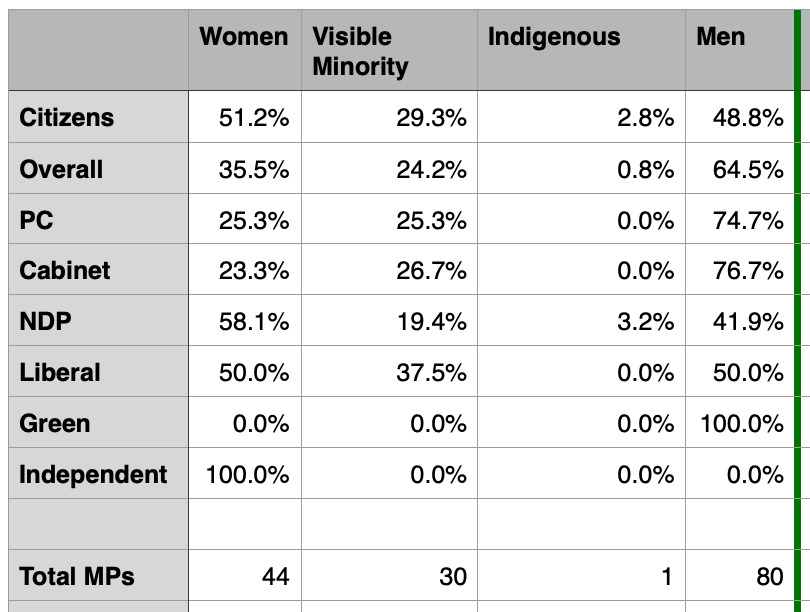
Ontario 2022 Election MPP Diversity

Had some time to do a quick review on the diversity of Ontario MPPs elected in 2022. Citizen percentages are from the 2016 census with the percentage of visible minorities likely to increase by a few percentage points in the 2021 census.

  • Percentage of women MPPs has declined from 39.5 percent
  • Percentage of visible minority MPPs has increased from 21 percent.
  • Percentage of Indigenous MPPs has from 7.5 percent.

The declines in the percentage of women and Indigenous peoples reflect the PCs picking up a number of NDP seats.

Beijing may have tried to discourage Canadians from voting Conservative: federal unit

Not surprising:

A federal research unit detected what might be a Chinese Communist Party information operation that aimed to discourage Canadians of Chinese heritage from voting for the Conservatives in the last federal election.

The Sept. 13, 2021, analysis by Rapid Response Mechanism Canada, which tracks foreign interference, says researchers observed Communist Party media accounts on Chinese social media platform Douyin widely sharing a narrative that the Conservatives would all but sever diplomatic relations with Beijing.

The report, obtained by The Canadian Press through the Access to Information Act, was prepared just a week before Canadians went to the polls.

Justin Trudeau’s Liberals emerged from the Sept. 20 national ballot with a renewed minority mandate, while the Conservatives, led by Erin O’Toole, formed the official Opposition.

O’Toole, who is no longer leader, claimed on a podcast recorded this month that the Conservatives lost eight or nine seats to foreign interference from China.

Rapid Response Mechanism Canada, based at Global Affairs Canada, produces open data analysis to chart trends, strategies and tactics in foreign interference.

Its work supports the G7 RRM, an initiative to strengthen co-ordination to identify and respond to threats to the major industrial democracies.

The analysis of messaging about the Conservative party was part of RRM Canada’s effort to monitor the digital information environment for signs of foreign state-sponsored information manipulation in the general election.

Conservative MP Michael Chong, the party’s foreign affairs critic, said in an interview the analysis is “another piece of evidence that the Communist leadership in Beijing interfered in the last general election by spreading disinformation.”

RRM Canada says it manually reviewed Chinese social media platforms including WeChat, Douyin, Weibo, Xigua and Bilibili, and conducted open-source forensic digital analysis using website archives, social listening tools, and cross-platform social media ranking tools.

The analysts first noticed the narrative about the Conservatives in two articles published Sept. 8 by the Global Times, a state-owned media tabloid.

RRM Canada believes the Global Times coverage was prompted by a story in the Ottawa-based Hill Times newspaper that examined Canadian parties’ positions on Canada-China relations. The analysis says it is likely that the Global Times was the first Chinese publication to pick up on the Ottawa publication’s content, with its two articles getting over 100,000 page views apiece.

RRM Canada notes the timing coincided with the first federal leaders’ debate and increasingly close poll numbers. Similar pieces published by major Canadian media outlets earlier in September, as well as the Conservative party platform released in August, elicited no response from state-controlled media in China, the analysis says.

Several popular Canada-focused WeChat news accounts began engaging with the Global Times narrative on Sept. 9, copying the content and form without crediting the publication, “obscuring the narrative’s point of origin,” the analysts found.

Accounts also added commentary about the Tories to the articles, such as “Chinese are frightened by the platform,” and questioned whether “Chinese compatriots should support the Conservatives if they use this rhetoric.”

“Unless otherwise credited, WeChat users would not know that the narrative about the Conservatives and O’Toole originated from the Global Times and would assume the articles were original reporting from the Canadian WeChat accounts.”

Many WeChat news accounts that serve Canadians are registered to people in China and despite being well-established news sources, “some may have unclear links” to Chinese Communist Party media groups, the analysis says.

The researchers were “unable to determine whether there is co-ordination between the CCP media that originally promoted the narrative and the popular WeChat news accounts that service Chinese-speaking Canadians that are now amplifying the narrative,” the Sept. 13 analysis cautions.

“RRM Canada is also unable to determine whether there was inauthentic activity that boosted user engagement with the narrative as Chinese social media platforms are completely non-transparent.”

However, Communist Party media accounts on Douyin, the Chinese version of TikTok, published videos that repeated a Sept. 8 Global Times headline, the analysis says. For instance, the Douyin account of Xinhua, China’s state press agency, shared a video saying the Conservative platform mentions China “31 times” and that an “expert” says the party “almost wants to break diplomatic relations with China.”

The Chinese Embassy in Ottawa did not respond to a request for comment on the RRM Canada analysis.

Among the Conservative platform planks in the election campaign were promises to stand up to Beijing on human rights issues, diversify supply chains to move them away from China, adopt a presumption against allowing Beijing’s state-owned entities to take over Canadian companies, and work toward less global reliance on critical minerals from China.

Chong says it’s clear that proxies were spreading disinformation on behalf of Beijing in the federal election.

“It’s hard to measure whether that was the reason for the loss of some Conservative MPs. But I think we can safely say that it was a contributing factor.”

If Beijing comes to the same conclusion, China “may very well be emboldened to do something much bigger in a future federal election, undermining our democratic process,” Chong said.

Under a federal protocol, there would be a public announcement if a panel of senior bureaucrats determined that an incident — or an accumulation of incidents — threatened Canada’s ability to have a free and fair election. There was no such announcement last year.

At a House of Commons committee meeting early this month, Bill Blair, public safety minister during the election campaign, said while “we’ve all heard anecdotes and various opinions,” he had not directly received “any information from our intelligence services” that provided evidence of foreign interference in the campaign.

Deputy minister Rob Stewart told the meeting there were, “as you would expect,” activities on social media that would constitute disinformation and attempts to influence votes. “There was no threat to the overall integrity of the election.”

The Canadian Election Misinformation Project, which brought together several academic researchers, found Chinese officials and state media commented on the election with an apparent aim to convince Canadians of Chinese origin to vote against the Conservative party in 2021.

“Misleading information and information critical of certain candidates circulated on Chinese-language social media platforms. However, we find no evidence that Chinese interference had a significant impact on the overall election.”

The Conservatives “could have done a better job” of countering such messaging, Chong said. “Clearly we didn’t, and that’s a lesson learned.”

Even so, the federal government needs to actively counter foreign disinformation between election campaigns, Chong said. During campaigns, the government should make analyses from the Rapid Response Mechanism immediately available to inform the public, he added.

Fen Hampson, a professor of international affairs at Carleton University who closely watches China, agrees that more transparency would be beneficial.

He argues for broadening the analytical process, perhaps through creation of a centre that includes non-governmental players, gathers information from various sources and regularly publishes reports about apparent foreign interference.

“That takes it out of the domestic political arena, which is always going to be highly charged.”

Source: Beijing may have tried to discourage Canadians from voting Conservative: federal unit

Senior public servants feel ill-equipped and fearful to provide fearless advice

More of a recap of the Top of Mind report than concrete suggestions on how to address the apparent decline in “fearless advice” beyond reexamining the Accountability Act of the Harper government:

Canada’s public servants have a noble and proud heritage of “answering the call” to serve their country and communities. Professional, non-partisan, and highly trained, they work within our public institutions to help elected leaders make our communities safer, cleaner, healthier, and more prosperous both today and for the future.

However, according to a recent report, Top of Mind, senior executive leaders today feel ill-equipped to provide “fearless advice” in a climate of divisive politics, polarization, and misinformation. “Fearless advice and loyal implementation” are the bedrock bonds between those elected and those who serve in the public service.

This foundation supports our democracy and how public services rise to meet the challenges of the day. At its core, “fearless advice” is about elected decision-makers knowing they have been given the best information and the broadest options available to address the issue of the day. Those elected to represent their communities get to decide what to do. Once the decision is taken, public servants move on to “loyally implement.”

In Top of Mind: Answering the Call, Adapting to Change Summary Report, recently released by the Institute on Governance and the Brian Mulroney Institute of Government at St. Francis Xavier University, senior public service leaders at the local, provincial, territorial, and federal levels of government were unanimous in their concern that fearless advice was more challenging to deliver than ever before.

One participant said, “I think there is a[n] [em]broiling of political perspective about the role of the bureaucracy and the work that it does and is challenged to do, and the independence of that in my view is no longer understood or seen by a lot of political bodies, parties, and individuals for what it is truly supposed to be.” Other participants remarked about the lack of “a safe space” to give alternative perspectives or views on a given issue. It’s a situation that, if left unattended, could be contributing to the erosion of trust in our public institutions.

The role of the senior public servant is unfamiliar to many Canadians. Often unseen, this cadre of professionals support decision-making and program delivery underpin the very quality of life that Canadians take pride in. Many successful partnerships between prime ministers and the heads of the public service have resulted in significant Canadian accomplishments.

Lester Pearson and Gordon Robertson teamed up to bring about our national safety net, our anthem, and our flag. Pierre Trudeau, Gordon Osbaldeston, and Michael Pitfield respectively delivered official bilingualism, international peace measures and the repatriation of the Constitution along with the establishment of the Charter of Rights and Freedoms. Brian Mulroney, Paul Tellier, and Glen Shortliffe helped to end apartheid in South Africa, brought in free trade and eliminated the manufacturing sales tax. Jean Chrétien, Jocelyne Bourgon, and Mel Cappe returned Canada to economic surplus, helped the country overcome the aftermath of 9/11 and said no to the war in Iraq. These teams understood the principle or ‘secret sauce’ of fearless advice and loyal implementation.

Michael Wernick, former clerk to the Privy Council, wrote that, “Open, honest, and two-way communication is key” between the minister and their deputy minister in his book, Governing Canada A Guide to the Tradecraft of Politics. Wernick’s advice to deputy ministers: “Your most important task is to secure and maintain the trust and confidence of the minister. That doesn’t mean telling ministers what they want to hear. On the contrary, you will want ministers to be confident that you will warn them of upcoming trouble and to trust you to give them the frank advice and full information.”

So, if fearless advice is on the decline, the question is why? Top of Mind does not explore the root causes. However, a brief examination of how the role of the deputy minister has changed over the years may be a good place to start. In 2006, the role of the deputy minister at the federal level was fundamentally changed along with changes to the Public Service Commission, the public service oath, and the executive leadership competencies for choosing those in charge of people; money and physical assets.

Sixteen years later, it is time to examine whether the changes introduced in 2006 have contributed to the erosion of the bedrock principle of “fearless advice and loyal implementation.” It may be proven that the reforms undertaken then have little to do with the situation today. However, in the absence of a thorough assessment or review, we will never know.

Clearly something is amiss within the public services of our country. Having an open discussion on the barriers to fearless advice is both urgently required and essential if Canada to restore trust in its public institutions and to serve Canadians effectively to meet the challenges of today and tomorrow.

Stephen Van Dine is senior vice-president of the Institute on Governance. Don Abelson is director of the Brian Mulroney Institute of Government at St. Francis Xavier University.

Source: Senior public servants feel ill-equipped and fearful to provide fearless advice

Glavin: Good news! Canada is not being overrun by racist zombie hordes

A bit overly dismissive of the Abacus poll IMO:

There are cranks among us. There are racists, loons, nutters, dingbats and weirdos among us and there are millions of them, according to a recent Abacus Data poll. I know this to be true because I read it in all the newspapers.

Here’s a National Post headline from last week: “Millions of Canadians believe in white replacement theory: poll.” Here’s the Toronto Star: “’Kind of terrifying’: Numbers show racist Great Replacement conspiracy theory has found audience in Canada.” Here’s Abacus Data’s own headline: “Millions believe in conspiracy theories in Canada.”

And then the story just seemed to disappear. If the story were true, why did it vanish after a couple of news cycles? Shouldn’t we all be taking this a lot more seriously?

If the story is true, millions of Canadians are afflicted with exactly the same fascist derangement that drove white supremacist Brenton Tarrant to massacre 51 Muslims in Christchurch, New Zealand three years ago. In a similarly live-streamed replication of the Christchurch atrocity only last month, the lunatic Payton Gendron slaughtered ten people in a Black neighbourhood in Buffalo, N.Y. with a weapon with the words “White replacement theory” written on it.

Surely it can’t be true that millions of Canadians are devoted to the same hideous “theory” that motivated Tarrant and Gendron, can it?

I’m happy to report that no, there’s no evidence to support the proposition, or contention, or if you like, this “theory” about millions of Canadians revealed by that Abacus poll, because the poll did not provide any evidence of the sort.

This is not to say that there weren’t some quite disturbing findings that the Abacus pollsters came up with. And the story didn’t quite vanish, either.

In an otherwise thoughtful contemplation of the degeneration of political discourse that appeared in Policy magazine last weekend, the outspoken New Democrat Charlie Angus contemplated the tendency to crazy thinking as a kind of orchard where Conservatives are happy to find low-hanging fruit, and perhaps it explains why “some Conservative leadership candidates have spent so much time promoting all manner of conspiracy claims.”

Angus wrote: “Maybe the Conservatives think they will be able to harness the tactical rage of this phenomenon to the faux outrage of political theatrics.”

And that may be so.

It’s certainly true that the populist Conservative leadership contender and bitcoin enthusiast Pierre Poilievre does sometimes give the impression of being an eccentric who wasted too much of his youth playing with Buzz Lightyear action figures in his room.

But it’s also true that among the poll respondents inclined to believe what is possibly the craziest proposition Abacus canvassed for — the notion that Microsoft uber-zillionaire Bill Gates has been using microchips to track people and their behaviour — New Democrats were only two percentage points behind Poilievre fanciers: 11 per cent as opposed to 13 per cent.

As for the white supremacist “Great Replacement” imbecility, the idea is that there’s a plot, often attributed to the Jews, to orchestrate immigration policies in such a way as to monkeywrench a country’s demographics in order to replace “white” people with Muslims, specifically, or with people of colour, generally.

The Abacus poll doesn’t provide all that much insight into how many poll respondents, let alone Canadians, actually believe this drivel. If you drill down below the way the poll findings have been reported and then dig below the way Abacus described its findings to the bedrock of the poll question itself, you might be relieved to discover that it isn’t quite time yet to head for the hills to build yourself a compound to defend yourself against millions of marauding racist zombies.

Abacus described its findings this way: Some 37 per cent of Canadians (11 million people) think “there is a group of people in this country who are trying to replace native-born Canadians with immigrants who agree with their political views. This is an articulation of what is commonly referred to as replacement theory.”

Set aside the fact that this isn’t so much an “articulation” of any theory, exactly, and the fact that the lunatic “replacement theory” doesn’t quite match the Abacus description of it. Last month, Statistic Canada reported this simple fact: “Canada is a low-fertility country, or below the no-migration population replacement level of 2.1 children per woman.” The Abacus poll didn’t ask about “white” people, but rather “native-born” Canadians. And native-born Canadians are retiring in huge numbers. Boomers are exiting the job market in droves.

It’s data of this kind that the Trudeau government has quite openly factored into its Immigration Levels Plan, which sets out the objective of drawing 430,000 newcomers to Canada each year. This is the highest level of immigration in Canadian history, and a higher immigration rate than any other G7 country. Only a small minority of those immigrants are coming from Europe, so they’re not, you know, “white” people. And anyone who hasn’t noticed that it has been a custom of the Liberal Party to jimmy with immigration so as to replenish its urban vote banks hasn’t been paying attention to the way things are done in Canada. The Conservatives do it too, but they’re just not very good at it.

The Abacus poll findings are perfectly consistent with a series of polls of its own and of other polling outfits that show Canadians are becoming deeply distrustful of politicians, government institutions and the news media. The world is in a state of upheaval to an extent unparalleled in decades. Overseas there’s war and looming famine in Central Asia and Africa, and here in Canada you have to be rich to be poor these days, especially when it comes to housing. Canada’s economy is a house of cards that’s increasingly dependent upon high immigration levels.

Canada’s “native-born” population can’t replace itself. Just one reason is that you have to be quite well-to-do to raise a family nowadays, and you can’t raise a family in a 600-square-foot, $600,000 condo. It’s no wonder that nostalgia is so commonplace. So is the sentiment that we’re all being dragged by forces we can’t control into a maelstrom of inhospitable, culturally fractured bedlam. People have every right to look at the rich and famous of the World Economic Forum, for instance — the object of quite a few silly conspiracy theories — with utter contempt.

But millions of Canadians are not setting out across the landscape in roaming hordes of racist zombies. That’s the good news.

These days, we should take the good news wherever we can find it.

Source: Glavin: Good news! Canada is not being overrun by racist zombie hordes

Canada’s racist social norms — and how we can change them

Significant survey along with some suggestions, learning from previous shifts such as attitudes on smoking and LGBTQ2+:

In a Facebook group, a white woman responds to a post about new government funding for clean water at an Indigenous reserve, complaining that Indigenous people already get too much support and should do a better job of looking after themselves.

At a bar, a man of European descent joins a discussion about police treatment of Black people and insists that racism and racial profiling happens in other countries, but not in Canada.

Why is it that some people make these kinds of perceivably racist and offensive remarks publicly even as others who might share the views hold their tongue? Whether someone makes such comments out of ignorance, prejudice or insensitivity, people tend to conduct themselves in accordance with what’s socially acceptable.

“Thirty years ago, smoking in public was acceptable. It was cool. It was just part of the framework. And there was an actual long-term public health campaign, if you will, in essence, to de-normalize smoking in public. It’s a complex intervention that, over time, was quite successful,” says Keith Neuman of the Environics Institute, author of the Canadian Social Norms and Racism study.

“That’s where we’d like to go with racism. Anti-racism initiatives may benefit by focusing more on social norms, which are more easily changed than ingrained attitudes and prejudices.”

Researchers did a national online survey and asked 6,601 participants to respond to a range of vignettes of racist or anti-racist actions directed at Indigenous or Black people. The data was weighted to ensure national representation by province, gender, age and education.

Each respondent was presented with a randomized selection of six of the 12 scenarios — three involving each community — that include responding to a white person who was: 

  • Speaking up when someone tells an insensitive joke;
  • Appropriating Indigenous or Black attire; 
  • Asking where an Indigenous or Black person came from;
  • Claiming racism doesn’t exist in Canada;
  • Intervening when an Indigenous or Black person is hassled in public;
  • Making a derogatory comment on Facebook; or
  • Making a racial gesture at a hockey game.

The respondents were then asked if they had witnessed such events or knew someone else who had; if they believed what the person did was right or wrong; how many people in their social circle would say what that person did was right or wrong; and how likely they thought it that others would intervene.

Many of the respondents said they have either personally seen or know someone who has seen the racist actions directed at Indigenous Peoples, with the most common witnessing someone claiming racism doesn’t exist against Indigenous Peoples (49 per cent); followed by derogatory comments on Facebook (38 per cent); telling insensitive jokes (35 per cent); others hassling an Indigenous person (22 per cent); and making a racial gesture like “a vigorous tomahawk gesture with a loud whooping cry” at a sports event (21 per cent).

In their response to the vignettes directed at Black racism, 79 per cent of participants have witnessed or know someone who has seen a Black person being asked where they came from; claiming racism doesn’t exist against Blacks (45 per cent); telling an insensitive joke (38 per cent); hassling a Black person (31 per cent); appropriating Black attire (30 per cent); and making derogatory comments on Facebook (21 per cent).

Based on participants’ responses, researchers came up with an index that represents how acceptable the specific demeanour or behaviour was in the general population.

The indexes range on a scale from zero to 100 — from the most to least socially acceptable. That means the behaviour with the low score has the greater consensus of social approval or disapproval.

The study found that social norms are somewhat stronger in situations where people witness someone stepping up and intervening when a person acts in a racist manner toward an Indigenous or Black person, such as telling an insensitive joke or harassing someone in public. 

Expressing racism through social media posts and claiming racism doesn’t exist in Canada were both deemed socially unacceptable, under the index, while appropriating Indigenous or Black attire was believed to be uncommon and not a big social transgression.

Neuman, director of the research project, said the study showed most respondents were aware that the conduct in these vignettes were wrong but uncertain what others would think or respond to the situation.

“There are unspoken rules how people behave with others. People know whether certain things are OK or not OK to do. When people choose to say a racist thing, it matters whether they think it’s OK or not OK with the people they are with,” Neuman explained.

“This is an important part of racism in society. This is the first time we look racism in Canada from the perspective of what is acceptable or not acceptable in your social circles. So lots of people think these racist actions are wrong, but they’re really not certain what the people around them think. So these norms are not very strong and that helps explain why this kind of behaviour is still so prevalent.”

Neuman hopes the findings of the study will serve as the benchmark to measure how the social norms of racism evolve as what’s tolerated and accepted in society does change with time, as in the cases of antismoking and the recognition of the LGBTQ2+ community after the Supreme Court 2004 ruling over gay marriage.

Government policies and social norms should go hand in hand in encouraging or hindering the manifestation of unacceptable behaviour, he added.

“The likelihood of encountering people who are smoking in public spaces is very low today. It’s not because there are laws and enforcement, but it’s because people who smoke picked up on the fact that it’s not OK to do that. It’s the way social norms work and there’s very strong norms against something like smoking,” he said.

“If you go back 20 years, the attitudes, treatments and norms around LGBTQ people have changed tremendously. Canadian opinions about gay marriage and LGBTQ people changed because there’s something legitimate about it by the state. It caused people to subsume their personal prejudice and discomfort.”

Neuman said similar successes could be found in developing social norms about what’s acceptable and what’s not with racism through modelling and trendsetting.

Advertising and educational campaigns that reinforce positive norms and denounce negative norms could help develop a collective sense of what’s acceptable, he added.

“What you’re trying to do is to communicate that some kinds of behaviours are OK and others aren’t. But you need to understand what the norms are to begin with, You have to do diagnosis to figure out what they are and how strong they are,” he said.

“It may be a situation where everybody has the same personal belief that something is wrong. By making everybody aware of how everybody thinks, it strengthens that norm.”

Source: Canada’s racist social norms — and how we can change them