USA: Board Diversity Is Sacrificed When Companies Underperform, Study Finds

Of note but not particularly surprising:

Companies that are underperforming in comparison to their competitors or to their goals are more likely to experience a decrease in racial and gender diversity rates on their boards, a newly released study has found.

Researchers at Imperial College Business School in London tracked data from more than 700 U.S. firms from 1996 to 2013 to make the assessment.

Dr. HeeJung Jung, Assistant Professor of Entrepreneurship at Imperial College Business School, and lead researcher of the study, tells TIME that this phenomenon is not deliberate, but rather a result of the pressure firms face to better adapt and begin performing well. Leaders search for a quick solution, but boards can become less inclusive as executives minimize their boards, or unconsciously seek directors that have similar ascriptive backgrounds.
[time-brightcove not-tgx=”true”]

“The board deliberately seeks new expertise and new perspectives among a variety of industries and backgrounds in the belief that it might rescue the company. But while this expertise came from a range of sectors, that’s as far as the diversity goes, in terms of race and gender,” Jung says.

Despite ongoing conversations about racial equity becoming more prevalent across the U.S., particularly after the murder of George Floyd in 2020, when companies made public pledges to better address racial inequality, Jung says that there is still a lot of fluctuation when looking at racial and gender diversity rates across corporate America.

In 2021, women comprised just 27% of board seats among the 3,000 largest publicly traded companies incorporated in the U.S., and only 6% of those seats were held by women of color, according to a report by the Women Business Collaborative. Men of color held 9% of board seats in the same year. Black board membership increased by nearly a third in 2021, but accounted for only 6.4% of directors overall.

Jung notes that companies will always experience periods of growth and decline, making more consistent strides for diversity and inclusion among the workforce difficult. The problem is, diversity is not a priority for companies when profits decrease, Jung says. “In their view, diversity efforts or DEI [diversity, equity and inclusion] matters last, it becomes a second matter or a second goal.”

Some countries in Europe have safeguards in place that would prevent progress on board diversity being rolled back. Gender diversity quotas are common in nations like France, Norway, Spain and Iceland, where women must make up at least 40% of boards at publicly traded companies, according to the Harvard Business Review.

While research about the benefits of gender-based diversity in the U.S. has shown mixed results, Jung says this may be because, despite great strides in female leadership, American corporate culture has not yet normalized it. One of the roadblocks to progress that female CEOs often face is pushback from teams, including constant cross-checking of their decisions to verify that they are acting “correctly,” Jung says.

“That causes an efficiency problem, and in a time of crisis where speed is important for any corporation, having this is a delay in decisions [and] makes directors [from underrepresented backgrounds] doubt their leadership too,” Jung told TIME.

Diversity efforts in corporate America

Currently, the U.S. has no federal policy that mandates inclusivity, though that has not stopped local governments from attempting to implement changes. States like Washington, for instance, require at least a quarter of a public company’s board to be women. In California, a law, passed in 2020, requiring public companies to have greater racial and gender diversity on their boards, was struck down in April, according to the New York Times, but the state still has a 2018 law in effect that forces companies to have at least one woman on their board.

In some cases, business leaders have created their own solutions. Last year, Nasdaq secured regulatory approval for plans to require listed companies to share diversity data about their boards of directors. Companies without at least two diverse directors, including one who self-identifies as a woman and one who identifies as an underrepresented minority or LGBTQ+, are required to explain their lack of diversity.

Having executives from underrepresented backgrounds in positions of leadership helps too. Jung’s study found that when board member chairs come from underrepresented groups, they are less likely to sacrifice the gender and racial diversity of their board in response to a downturn.

But, as Jung states, retaining diverse talent requires companies to take the important first step of creating corporate norms that recognize the value of having diverse teams. “It’s not only about bringing [diverse candidates] in but also making them play an important role in the board and change the norms,” she says. “There’s a lot of positive benefits and corporations have to be very sensitive about and must pay attention to make a better strategy for their boardroom structures and who they are going to appoint.”

Source: Board Diversity Is Sacrificed When Companies Underperform, Study Finds

La publicité de HEC Montréal provoque une nouvelle réaction

Sigh… The usual over-reaction over what should be a non-issue:

Une publicité de HEC Montréal montrant une femme qui porte le hidjab et dénoncée par l’ex-politicien Jean-François Lisée a continué de susciter de nombreuses réactions mardi.

Alors que deux avocates de confession musulmane témoignaient dans nos pages de leur désaccord avec la position de M. Lisée, qui considère que la publicité présente un « signe religieux misogyne », la présidente du Rassemblement pour la laïcité, Nadia El-Mabrouk, abonde plutôt dans le sens de l’ex-politicien et dénonce la publicité.

[Montrer le voile dans la publicité], c’est un point de vue favorable à l’islam intégriste, c’est mettre de l’avant des pratiques intégristes

« Ce n’est pas neutre de faire ça. Ça vient avec une vision de la diversité et de la représentativité des signes religieux », plaide-t-elle en entrevue téléphonique. La Québécoise d’origine tunisienne, qui est aussi professeure au Département d’informatique et de recherche opérationnelle à l’Université de Montréal, croit qu’« on n’a pas à représenter toutes les idées » dans des campagnes publicitaires. « [Montrer le voile dans la publicité], c’est un point de vue favorable à l’islam intégriste, c’est mettre de l’avant des pratiques intégristes, assène-t-elle. Quand les femmes disent “c’est mon choix” [de porter le voile], ça ne répond pas à la question “pourquoi c’est mon choix ?” »

En entrevue avec Le Devoir la veille, l’avocate de formation et autrice Dania Suleman a soutenu que « certaines femmes portent le hidjab par choix, et ça leur permet de se sentir beaucoup plus libres ». Elle a également estimé la position de M. Lisée « désolante », jugeant qu’elle « continue à aliéner les femmes qui portent le voile ».

Mme El-Mabrouk, autrice du livre Notre laïcité, paru en 2019, est fortement en désaccord. « On ne peut pas prendre un symbole clair de l’islamisme et prétendre que ça dit exactement le contraire », soutient-elle.

Sur les réseaux sociaux

De nombreux citoyens se sont indignés du tweet de Jean-François Lisée, tandis que plusieurs lui ont apporté leur appui, dont notamment Ensaf Haidar, ex-candidate du Bloc québécois dans Sherbrooke et femme du blogueur Raif Badawi. « En tant que musulmane pacifique, j’insiste sur le fait que le voile ne vient pas de l’Islam et qu’il est un symbole de l’esclavage et de l’oppression des femmes. Arrêtez d’abuser des femmes avec des publicités aussi stupides », a-t-elle écrit sur Twitter.

Le député néodémocrate de Rosemont–La Petite-Patrie, Alexandre Boulerice, s’est néanmoins montré très critique de la position de M. Lisée. « Donc science et islam seraient incompatibles ? Alors que science et pas de signe religieux apparent de christianisme serait correct ? » a-t-il questionné. M. Lisée a répondu : « Tu crois que le Coran est fondé sur la science? La Bible? La Torah? Qu’une institution de haut savoir scientifique doit promouvoir leurs symboles ? »

Par courriel, la conseillère principale en relation avec les médias de HEC Montréal, Émilie Novales, a confirmé que la femme dans la publicité est une « étudiante au parcours international » et que l’institution accueille « un nombre croissant d’étudiants internationaux » chaque année. « Nous tenons à ce que tous les membres de notre communauté étudiante puissent être mis en valeur sur nos plateformes, reflétant toute notre diversité », ajoute-t-elle.

Source: La publicité de HEC Montréal provoque une nouvelle réaction

Shafiq: Getting more immigrants to run for political office means paving the way for active citizenship

Of interest:

Kristyn Wong-Tam just made history. They became the first Asian-Canadian, queer and non-binary person elected to Ontario’s legislature, significantly expanding the vision of what a politician looks like in this country. 

Wong-Tam joins other recent Canadian political “firsts,” including Bhutila Karpoche, the first elected official in North America of Tibetan descent, and Doly Begum, the first Bangladeshi-Canadian woman to be elected in the country.

These leaders share a similar journey that first began with meaningful participation in civic engagement and community work, increasing political engagement, culminating in the decision to run for elected office.

Why does the political engagement of people like Wong-Tam, Karpoche and Begum matter so much?

Seeing a visibly powerful immigrant woman or non-binary person in an elected, decision-making role in the political arena empowers others to do the same. Emerging research shows that visibility and role modelling increases political participation and results in a stronger democracy from more diversified representation.

Higher engagement from traditionally under-represented groups strengthens our social and political fabric, creating more trust in our institutions. This is particularly important now when our democracy is threatened by the rise of misinformation, low voter turnout and a growing distrust of authorities and institutions.

So how can we support civic engagement for future trailblazers like Wong-Tam? In our recent academic and community-based research on civic participation of immigrants and refugees in Canada at the Journeys to Active Citizenship project, we found that the journey starts first with community involvement.

We found newcomers often become involved in local community-based activities before engaging in formal political activities like voting and running for office.

Unsurprisingly, voter turnout amongst immigrants is higher the longer someone has been in Canada. Elections Canada even acknowledges that language can be a barrier to voting for new Canadians, alongside a lack of knowledge of the election process, less awareness of early voting opportunities and a lack of trust in the Canadian political process. However, once immigrants and refugees overcome settlement challenges, they are more likely to vote.

Immigrant women in the past have been less likely to participate in formal political processes, however, they are much more likely to participate in informal civic activities, which often act as a critical stepping-stone to formal participation through actions like voting, writing to your elected representative or running for office.

So how can we bolster opportunities for formal and informal civic participation for immigrants, and particularly immigrant women?

Building social networks has been proven to strengthen integration and belonging and is critical to help immigrants establish trust with fellow Canadians. Enabling community engagement is another key piece of the puzzle.

Creating and strengthening civic education and engagement that is tailored to newcomers, particularly women, would be important to build the skills, knowledge, capacity and confidence that would enable newcomers to engage more fully in Canada’s democracy.

In our interviews and group sessions with immigrants and refugees over the last two years, we found three recurring sources of community: religious spaces, community-based organizations and post-secondary institutions. 

Academic literature also tells us that community-based organizations may act as mobilizing agents for civic participation. Delivering programs through these places of community important to newcomers in their early years would be critical for success.

Supporting programs that bolster opportunities for newcomers to engage in a wide range of community initiatives, such as volunteering, participating in local community events, or joining social clubs, will help foster a sense of trust and belonging in our political processes and institutions, and ultimately lead to an increase in formal political participation.

Canada already benefits greatly from the labour of immigrant women — something that has been highlighted throughout the pandemic. It’s time we included their voices, expertise and experiences in the political process. 

Source: Getting more immigrants to run for political office means paving the way for active citizenship

For campaigns looking to turn support into seats in Parliament, not all ‘ethnic communities’ are created equal

Good overview, particularly the comments by Erin Tolley. Looking forward to the October Census release that will allow for updating of riding demographics in terms of ethnicity, visible and religious minorities:

The conventional wisdom around the potential for so-called “ethnic voting blocs” to swing elections is often overstated, but “parties make a big mistake when they perceive of immigrant and racialized voters as a passive voting bloc,” says political science professor Erin Tolley.

“These are groups that are very politically savvy, and they understand their power and they understand the influence that they can have,” said Tolley, the Canada Research Chair in gender, race, and inclusive politics at Carleton University. “And when parties don’t repay that support by listening to their preferences or by acting to advance their interests, they take that power and they put it elsewhere.”

As communities like Italian Canadians, Sikh Canadians, and Tamil Canadians have each become more established in the country, Tolley said they have “flexed their political muscles” in order to get what they wanted from political parties, and to enter the political arena themselves.

Political commentator Seher Shafiq, a co-founder of the non-profit group Canadian Muslim Vote, said when Canadian Muslims became more organized and dramatically increased their voter engagement levels in the 2015 elections, “all of a sudden we had politicians engaging way more than before.”

“There’s a definite change of tone that wasn’t there before 2015,” said Shafiq, referring to how politicians “at all levels” now pay attention to hate crimes against Muslims, and even to Muslim holidays. Shafiq credits the grassroots organizing of several groups, including the National Council of Canadian Muslims, with increasing community engagement and with grabbing the attention of political parties.

“There’s something to discuss and maybe something to study about how a community that wasn’t organized in the way that the Sikh community or the Ismaili community is, became organized, and how that coincided with a dramatic shift in tone from government, and even to some extent action,” said Shafiq.

Sherry Yu, an associate professor at the University of Toronto who studies multiculturalism, media, and social integration, emphasized the role that so-called ethnic media play in helping new immigrants learn about the Canadian political process, and in boosting civic participation among older immigrants who have been more passive.

Yu told The Hill Times that many communities, especially those that are more concentrated in particular regions, have media outlets and community organizations that reinforce each other, with so-called ethnic newspapers being distributed at local shops and grocery stores.

The Conservatives and the Liberals each had periods during the 20th century where one or the other seemed to have the upper hand in terms of support from immigrants, with John Diefenbaker’s and Pierre Trudeau’s governments each assembling different coalitions of support over the decades. With the Conservatives in the midst of a leadership race, supporters have debated whether the party is doing enough to appeal to a broader voter base and which leadership hopeful can lead the way on that front, with the now-booted Patrick Brown regarded as the candidate who had the strongest ties to cultural and religious minorities.

Tolley said the idea of appealing to immigrant and racialized voters “is not a new idea. It didn’t start with Patrick Brown, it didn’t start with Jason Kenney.”

Under prime minister Stephen Harper and then-immigration minister Jason Kenney, the Conservative Party of Canada made a concerted effort to appeal to communities that had previously been assumed to be steadfastly Liberal out of gratitude for Pierre Trudeau’s policies on immigration and multiculturalism.

The strategy was reportedly born out of a conversation between Harper and Kenney over a pint at the Royal Oak Pub on Bank Street in Ottawa in 1994, when Kenney tried to convince the future prime minister that Canada’s conservative movement should seek out immigrants who shared its values.

Kenney’s packed schedule of visits to temples, gurdwaras, festivals, and other community events, which began during the party’s first mandate when he was secretary of state for multiculturalism and Canadian identity, earned him the moniker of “secretary of state for curry in a hurry.”

But Tolley warned against giving too much credence to sweeping narratives about so-called ethnic voting blocs. “Immigrant and ethnic and racialized Canadians have policy preferences just like other Canadians,” she said, “and they vote for a variety of reasons. Their ethnic or immigrant background is not the only reason and it’s often not even the most important one.”

“Community by community, some parties and some leaders have had success, but when you look in the aggregate, what they gain from appealing to one community, they often lose from a separate community.”

Tolley said there is “a bit of urban lore” that tends to oversimplify the Harper Conservatives’ success at reaching out to immigrant and racialized voters. She said the Conservatives saw a boost in their vote share from particular communities, mostly non-racialized communities such as Ukrainian Canadians, Italian Canadians, and Jewish Canadians, but that they saw very little support from other groups, such as Muslim Canadians.

“And in the aggregate it didn’t really budge the vote share one way or the other when you compare with other parties.”

Drilling down further into the data, Tolley pointed out that the Conservatives under Harper “were quite successful with Cantonese-speaking Chinese Canadians, but less so with Mandarin-speaking Chinese Canadians.”

Political campaigns looking for cohesiveness and geographical concentration

Carleton University political science professor Erin Tolley says former prime minister Stephen Harper used Senate appointments to boost his party’s connection with immigrant communities. Photograph courtesy of Erin Tolley

For political campaigns looking for the most efficient way to turn community support into seats in Parliament, not all immigrant or racialized communities are created equal. Political organizers are focused on winning ridings, said Tolley, more so than they are interested in expending finite resources on driving up their party’s overall vote count. 

“Groups that are larger in number and are cohesive, and who reside together in a district, that’s the kind of group that a party is going to find very attractive,” said Tolley, “because that is how elections are won and lost.”

“I think that’s why you see parties tapping into Ismaili Muslims or Punjabi Sikhs,” said Tolley, “rather than courting the Black vote.”

“One reason that I think parties have largely ignored Black Canadians is that they don’t know how to tap into that community because it is such a diverse community. It is geographically spread out. And that stands in the way of parties figuring out how to effectively organize within that community.”

Shafiq concurred, saying that the fact that much of the Muslim Canadian community is concentrated in key swing ridings in the Greater Toronto Area contributed to creating a perception among political parties “that this is a community they need to engage.”

Sikh Canadians have been elected in ridings where the community forms a substantial segment of the local population, such as Vancouver and Surrey in British Columbia and Brampton and Mississauga in Ontario, with growing populations around Edmonton and Calgary also electing Sikh MPs.

After the 2015 election, The Globe and Mail reported there were 17 Sikh Canadians elected to Parliament–16 for the Liberals, including several who made it in cabinet, like International Development Minister Harjit Sajjan (Vancouver-South, B.C.)–making Punjabi the third-most spoken language in the House of Commons.

The fact that multiple political parties have sent Sikh Canadians to Parliament means those MPs can serve as a pool of knowledge within their community, and an avenue through which the parties can make further connections within the Sikh community. The first waves of Ukrainian Canadian MPs and Italian Canadian MPs filled the same functions in previous decades.

But getting that first generation of leaders elected to Parliament remains a challenge for communities that are less established on the Canadian politician landscape. In these cases, said Tolley, political parties look to other elected bodies, such as school boards, to identify up-and-coming leaders.

As prime minister, Harper also used Senate appointments as a way “to cultivate leadership within the party,” said Tolley, appointing community leaders to generate goodwill and to make inroads into communities that did not yet have representation in the House of Commons.

For all the complaints that Harper’s government shut out the press during its time in power, it actively sought out and tracked political coverage in the so-called ethnic press. In 2012, Kenney told Alec Castonguay, then chief political reporter for L’actualité, that he made it a habit to read translated versions of the ethnic press every morning, before reading the mainstream national papers.

When Kenney was immigration minister, The Canadian Press reported that the department of citizenship and immigration spent $745,050 between March 2009 and May 2012 tracking media coverage by so-called ethnic or multicultural outlets, including assessments of campaign events and perceptions of Kenney.
Yu, whose research includes comparisons of the Vancouver Sun and the Vancouver Province with two local Korean community newspapers, said this media monitoring was an acknowledgement of the significance of ethnic media, but said she was concerned that the information gathered was not shared with the public.
“Until the release of these documents, we did not know that monitoring was done,” said Yu.

Maturation of a community leads to new demands

As communities become more established in Canada, however, they may no longer be satisfied by a meet and greet with a prominent politician or with a promise that a party will consider a particular policy proposal, said Tolley. “There is definitely evidence of a transformation in political behaviour among community members. Some refer to it as a maturation of one’s political involvement.”

The Tamil community has had several decades to establish itself in the political landscape. It has elected MPs from different parties in ridings in Scarborough, Ont., including Liberal MP Gary Anandasangaree (Scarborough-Rouge Park, Ont.), a three-term MP first elected in 2015 who has served as president of the Canadian Tamils’ Chamber of Commerce. Many Tamil Canadians arrived in Canada in the 1980s, during the civil war in Sri Lanka.

Ken Kandeepan, a member of the advisory board for the non-partisan Canadian Tamil Congress (CTC), told The Hill Times that “many people in the Tamil community are actively involved in politics” and that community members have provided “considerable support” to various parties at the federal level.

But, he added, it was “a pet peeve” of his that once the elections are over, “the quid pro quo is somewhat absent.” As an example, Kandeepan mentioned appointments to directorships for government corporations.

“It is unfortunate that once the elections are over, these kinds of outreach are not made to the Tamil community. In asking them for appropriate candidates and individuals to be appointed to these positions, at least to the best of the knowledge of the CTC.”

“So the attitude seems to be ‘please help us,’ and ‘thank you for your help, and we’ll see you at the next election.’” 

Tolley said Kandeepan’s comments are an example of a case where members of a particular community “don’t want to be seen as just a set of votes.”

“They want to be taken seriously, they want to have a voice. They want to be able to run and be successful as candidates supported by parties. And when they are successful, they would like to see themselves in positions of influence. Parties that don’t take that seriously learn pretty quickly that, sure these are potential voting blocs in one’s favour, but they can also shift alliances.”

Source: For campaigns looking to turn support into seats in Parliament, not all ‘ethnic communities’ are created equal

Alberta UCP government’s anti-racism action plan met with criticism, questions

Of note:
Some advocates and the Opposition NDP say the Alberta government’s anti-racism action plan avoids taking important action.
Released on July 18, the Alberta government’s 20-page anti-racism action plan, presented as a “living document” that will change based on feedback, outlines three years’ worth of initiatives, including some the government has already done or begun to work on.Irfan Chaudhry, director of MacEwan University’s office of human rights, diversity and equity, said in an interview with Postmedia Wednesday the plan offers some constructive initiatives, but he doesn’t have much hope in it achieving its goals.

“I think it’s really weak,” he said

The action plan comes more than a year-and-a-half after the Alberta Anti-Racism Advisory Council, whose membership has since shifted, submitted a report to the government in January 2021. The public report with 48 recommendations was released last June, after the government had already announced action, including creating a hate crime liaison, a Hate Crimes Coordination Unit and the rollout of a grant program for religious and ethnic organizations to boost security against potential hate crimes.

Some recommendations of the council, however, including to mandate the collection of race-based data across government departments and police services, appear to have been either rejected, or relegated to another day.Over the next three years, the latest plan commits to developing data standards, and commissioning an expert report to guide the potential collection and use of race-based data

“There’s likely zero to no commitment from this government to any collection of race-based data … to me that just sounds like kicking the can down the road,” said Chaudhry.

In April, a UCP-led committee rejected a bill from NDP MLA David Shepherd that would have required the collection of race-based databy government.

Roy Dallmann, press secretary to Labour and Immigration Minister Kaycee Madu, said the government wants to get the collection of race-based data right, citing the historic misuse of such information.Alberta NDP multiculturalism critic Jasvir Deol said in a statement he was “deeply disappointed” the government sat on the recommendations of the council for a year and a half, and then failed to deliver a comprehensive action plan, including avoiding committing to data collection

“The UCP has not carefully or mindfully consulted with community members on the actions that would improve the lives of racialized Albertans,” said Deol.

The plan promises to tackle public education and cultural awareness, enable skills training for racialized and Indigenous peoples, create new grant and recognition programs for racialized and newcomer Albertans, and help remove barriers to cultural organizations applying for grants.

Bukola Salami, an associate professor in the faculty of nursing at the University of Alberta whose research focuses on health and immigration policies, said in an interview with Postmedia there are good elements, including promised grant funding.“It’s basic, it’s general, but at least it’s better than nothing,” she said, adding there is much to still be addressed in terms of accountability measures, including protection from backlash for those reporting injustices.

“The question is will it push the needle? Will it make any much difference, without having an accountability piece?” she said.

Chaudhry said helping cultural organizations apply for grants is a critical step that can help address systemic bias. However, he said he finds it disingenuous for the government to commit to new grants,since in 2019 the UCP removed the Human Rights and Multiculturalism Grants program.

“I have a hard time buying what’s being sold on this one, because there has been a patterned, sustained removal of a commitment to anti-racism from this specific government,” he said.While the plan promises to act to ensure “inclusion and diversity training” for law enforcement officers, it does not make clear whether that training might be mandatory, and for whom.

The government said it’s currently reviewing the Police Act to modernize policing, including officer training requirements, but it referred specific questions about recruiting and in-service training to police services.

Chaudhry said a focus on further discussion with community groups can put off taking action.

“I don’t think communities want more talking or discussion, I think they’ve already ‘been there, done that,’ so to speak, and that’s where I think a lot of this is going to fall flat.”

While the government’s release noted that the actions “build on” the work of the council, Postmedia did not receive a response to an email to the current advisory council asking for comment on how the action plan relates to its work.Madu said in the news release announcing the plan that his government has shown a proven track record in dealing with racism, discrimination and systemic racism, but there is more to be done.

“This action plan serves as a road map for our province to confront and take steps to eliminate racism to ensure Alberta is a free, fair and prosperous place for everyone,” Madu said. In the document, Madu acknowledges the effort of the council, and of Associate Minister of Immigration and Multiculturalism Muhammad Yaseen, who did the work developing the plan

Heather Campbell, a former co-chair of the advisory council, said in a Twitter thread shortly after the plan’s release that it’s “terrible and offensive.”

“There is so much ugly ‘collect information’ and ‘do nothing with the information’ in the document,” she wrote.

Dallmann said that kind of reaction to the first such anti-racism plan from any Alberta government is “unfortunate” because it downplays the importance of steps being undertaken.

“Given that this plan is rooted in the recommendations from the former (council) chair, we’re surprised she doesn’t recognize that this is a huge step forward to set Alberta up for increasingly successful diversity, inclusion, and equity efforts in the future,” Dallmann said.

Source: Alberta UCP government’s anti-racism action plan met with criticism, questions

Police-reported hate-motivated crime rises sharply for second year in a row

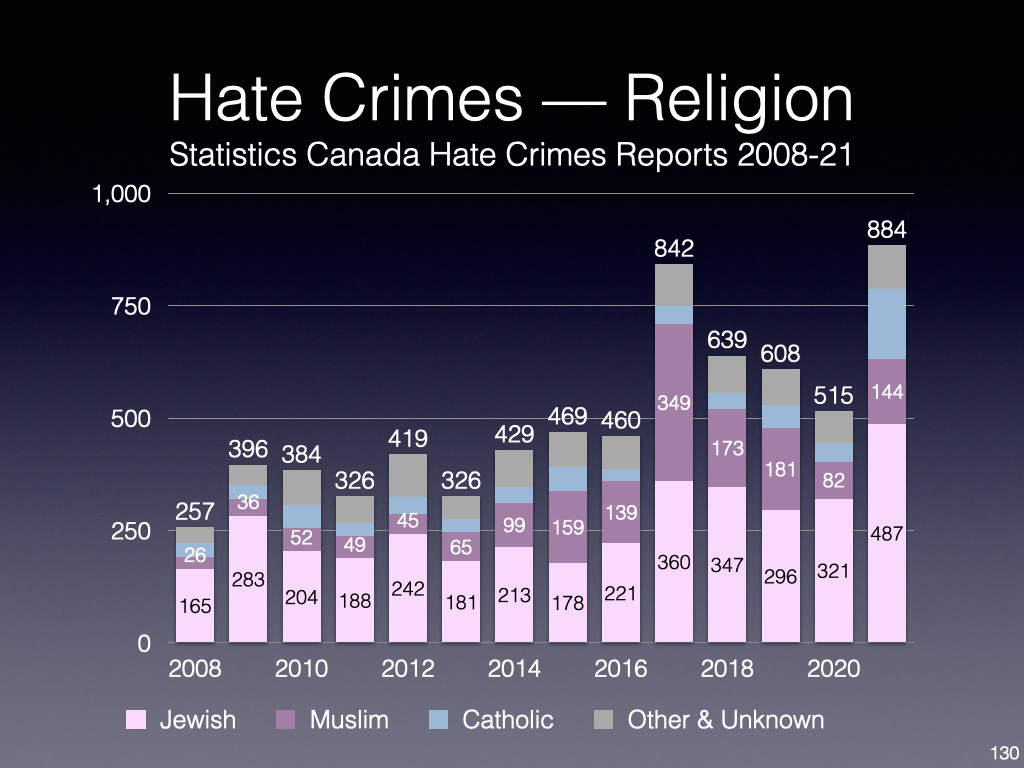
Latest numbers by StatsCan, showing particularly high increase in 2021 of religiously motivated hate crimes, with biggest relative increase for Catholics, likely due to the discovery of unmarked graves. In terms of ethnicity motivated, the rise of anti East and SE Asian hate crimes during pandemic stands out:

The number of police-reported hate-motivated crimes in Canada increased by 27%, up from 2,646 incidents in 2020 to 3,360 in 2021. This follows a 36% increase in 2020. In total, the number of police-reported hate crimes rose 72% from 2019 to 2021. Higher numbers of hate-motivated crimes targeting religion (+67%; 884 incidents), sexual orientation (+64%; 423 incidents) and race or ethnicity (+6%; 1,723 incidents) accounted for the majority of the increase. All provinces and territories reported increases in the number of hate crimes in 2021, except for Yukon, where it remained the same.

Police data on hate crimes reflect only those incidents that come to the attention of police and that are subsequently classified as hate crimes. As a result, fluctuations in the number of reported incidents may be attributable to a true change in the volume of hate crimes, but they might also reflect changes in reporting by the public because of increased community outreach by police or heightened sensitivity after high-profile events. Reporting may also be influenced by language barriers, issues of trust or confidence in the police, or fear of further victimization or stigma.

Source: Police-reported hate-motivated crime rises sharply for second year in a row

Reactions:

The head of the Canadian Race Relations Foundation is calling for action to combat hate and more federal help for victims, as new statistics show that hate crimes in Canada rose by 27 per cent last year. 

Executive director Mohammed Hashim warned that unless action is taken to combat hate-motivated abuse, including online, it will continue to spread.

He said the “slew of hate” online is so prevalent it risks becoming normalized and those affected are changing their behaviour to deal with it, including by not reading social media comments.

“It is a firehose of hate that is growing, honestly, like a wildfire,” he said. “And unmitigated it will grow even further to a point where we will normalize being in a wildfire.

“That is because we have left this environment unchecked.”

Statistics Canada reported a dramatic increase in hate crimes in 2021. Last year, the number of hate-motivated crimes reported to the police rose to 3,360 incidents from 2,646 in 2020. This followed a 36 per cent rise in 2020. 

In total, the number of hate-motivated crimes recorded by the police has gone up 72 per cent since 2019, according to the agency. 

Four Muslim Canadians from the same family were killed in June last year when a man rammed a truck into them in London, Ont. Police have said the attack was motivated by Islamophobia.

Public Safety Minister Marco Mendicino said the figures are “further evidence of the alarming and unacceptable rise of hate that marginalized communities have experienced in recent years.”

Mendicino said the federal government is taking action on a variety of fronts, led by new legislation to tackle the rise of hate speech and hate crimes.

“We will not rest until all Canadians feel safe in their communities,” he added. 

A report by the race relations foundation, published Tuesday, calls for greater federal help for victims of hate, many of whom do not qualify for financial compensation because their abuse does not count as a crime.

Hashim warned that “not supporting victims and leaving hate to proliferate freely disintegrates Canadian multiculturalism as a whole and a sense of collective belonging to this nation.”

Hate-motivated crimes targeting a person’s religious affiliation were up 67 per cent last year, according to Statistics Canada. Crimes based on a victim’s sexual orientation were up 64 per cent year over year. Another 1,723 recorded incidents targeted a person’s race or ethnicity, a six per cent increase, and together these categories made up the majority of the overall rise.

Marvin Rotrand of B’nai Brith Canada said Jews were the No. 1 target of hate crimes aimed at religious minorities. 

“All Canadians should be worried about the alarming explosion of hate crimes witnessed in 2021,” Rotrand said. “Our community comprises 1.25 per cent of the Canadian population but were the victims of 56 per cent of hate crimes aimed at religious minorities. That is more than all other religious groups combined.”

Shimon Koffler Fogel, president and CEO of the Centre for Israel and Jewish Affairs, said incidents targeting the Jewish community have risen by 47 per cent since 2020.

“Statistically, Canadian Jews were more than 10 times more likely than any other Canadian religious minority to report being the target of a hate crime,” he said.

All provinces and territories reported increases in the number of hate crimes in 2021, except for Yukon, where the numbers remained the same.

Hashim, who regularly tours the country speaking to victims of hate as well as community groups and police forces, said more focus must be put on victims. He said young women are facing huge amounts of abuse online, particularly young Black women. 

“Right now we talk a lot about hate crime statistics, how police are dealing with it or not dealing with it, being reported or not being reported,” he said. “What we are constantly missing is what is the effect on victims.”

The Department of Canadian Heritage is working on drafting an online hate bill to set up a framework to combat abuse online.

A previous anti-hate bill, introduced at the tail end of the last Parliament, died when the election was called. 

Heritage Minister Pablo Rodriguez appointed an expert panel to make suggestions for a future bill, including faster takedown obligations on platforms, in particular over child pornography.

During a consultation by the federal government last year, some minority groups raised concerns about directly involving the police to combat hate speech online.

Hashim warned against “digital carding” and a mass trawl of content online. He acknowledged there is concern about whether police should be able to access all takedown materials for investigative purposes.

“I don’t think that is the proper way of doing online safety. There need to be checks and balances between how much information is accessible to the police. That is why we have warrants,” he said.

“Just creating open access for all police, for all takedown data, for all social media platforms is overkill in my opinion.” 

The report commissioned by the Canadian Race Relations Foundation, and written by PricewaterhouseCoopers, said 80 per cent of hate crimes go unreported each year.

The report recommends Canada mirror Germany’s model for supporting victims of hate with millions of dollars of funding for community groups, which people who encounter hate “instinctively” reach out to, as well as a further victims fund. 

It says the government’s current compensation schemes exclude many victims of hate because few hate-motivated acts are designated as criminal.

The report also suggests the government establish an emergency response fund for communities hit by hate attacks on a large scale, as well as a central national support hub for victims.

Source: Race relations foundation urges more help for victims as hate crimes rise further

Ray: Critical Race Theory’s Merchants of Doubt

Important context:

Protests over George Floyd’s 2020 murder were the largest civil rights demonstrations in American history. The brutal footage of officer Derek Chauvin’s suffocating knee on George Floyd’s neck led many white Americans to, at least briefly, acknowledge the reality of structural racism in policing. In response, corporations questioned their diversity policies, “defund the police” became an activist rallying cry, and books on anti-racism became unexpected bestsellers. A narrative arose that America experienced a “racial reckoning” that challenged white racism’s worst excesses.

Conservative media and think tanks, fearing a lost battle in the war of ideas over racism in American life, counter-mobilized. Morality plays need villains, and conservative activists conjured a caricature of critical race theory—a forty-year-old academic framework–as an ominous and pervasive evil. Conservative groups claimed their villain was everywhere—from the federal bureaucracy to elementary schools—and fomented a moral panic over anti-racist education. Pundits credited Virginia Governor Greg Youngkin’s win to his scaring white parents into thinking their children might learn about the nation’s history of white supremacy. Conservative lawmakers have exploited the panic, attempting to remake the educational landscape with banning so-called “divisive concepts” that might make white kids uncomfortable. Propaganda victories are victories, nonetheless. And killing the messenger can destroy the message (if you can’t beat them, ban them). “Facts don’t care about your feelings” has become a conservative rallying cry. But critical race theory’s merchants of doubt, by legislating against accurate teaching of America’s racial history, put their feelings over empirical facts.
[time-brightcove not-tgx=”true”]

But victories aside, propaganda exposes its proponents’ intellectual bankruptcy. Conservative caricatures of critical race theory are unrecognizable to scholars familiar with the idea. According to the Washington Post, Christopher Rufo, the principal architect of the anti-critical race theory of moral panic admitted his crusade distorted the meaning of critical race theory when he tweeted:

“We have successfully frozen their brand—’critical race theory—into the public conversation and are steadily driving up negative perceptions. We will eventually turn it toxic, as we put all of the various cultural insanities under that brand category. The goal is to have the public read something crazy in the newspaper and immediately think ‘critical race theory.’ We have decodified the term and will recodify it to annex the entire range of cultural constructions that are unpopular with Americans.”

Incoherence and confusion are virtues for opponents of anti-racist teaching. And Rufo and his fellow travelers are simply updating the misinformation campaigns targeting accepted scholarship that elements of the right have trafficked in for decades. Heedless of both the actual content of critical race theory and the human cost of their panic, conservatives turned to propaganda because the weight of empirical evidence undermines their ideological preferences.

In their classic book Merchants of Doubt: How a Handful of Scientists Obscured the Truth on Issues from Tobacco Smoke to Global Warming, the historians of science Naomi Oreskes and Erik Conway outline a series of propaganda campaigns designed to undermine the scientific consensus on many of our most pressing collective problems. Conservative scientists, politicians, and think tanks sowed confusion over the link between cancer and smoking, acid rain’s environmental impact, and civilizational threats over global warming. Conspirators exploited the structure of scientific inquiry—which contains inherent uncertainties—to cast doubt on settled facts. Conspirators also played the media, manipulating the false objectivityof both-sides framing to claim equal time for scientific consensus and quackery. The strategy of sowing confusion works not because anti-empirical claims are correct but because manufactured uncertainty is often enough to bring political action to a halt.

Anti-scientific campaigns, whether focused on acid rain or climate change, often relied upon a close-knit cabal of think tanks, funders, and individual scientists (who sometimes lacked subject area expertise). Corporate profits and individual livelihoods were at risk if facts about the harms of smoking or environmental crisis were acknowledged and regulated. For short-term financial or political gain, anti-science propagandists made progress on long-term collective problems difficult, if not impossible, to achieve. In the meantime, these propagandists profited as the harms from industries they were protecting were passed onto an unsuspecting and credulous public.

Critical race theory’s merchants of doubt use strategies similar to those of previous anti-intellectual propaganda campaigns. And like these prior movements, the moral panic over critical race theory rests on a weak intellectual foundation.

No serious analyst doubts that American society is rife with racial inequality. Yes, there is debate among social scientists about the cause of racial inequality. But the consensus among honest scholars is that racial inequality is a long-standing, complex, intractable, and pressing social problem. The empirical evidence on structural racism and the inequality it produces is massive, overwhelming, and hard to contest. From unemployment to life expectancy, it is difficult to find a domain of American life where Black people aren’t worse off. Critical race theorists developed a flexible set of tenets that showed how often seemingly neutral social processes reproduce racial inequality. And these tenets were so useful they’ve been adopted by scholars of education, public policy, and sociology. Critical race theory’s main principles—that race is a social construction and racial progress is fragile and easily overturned—have substantial empirical support.

Intellectual weakness on race matters doesn’t make the anti-critical race theory campaign any less dangerous. Desperation and ruthlessness born of knowing facts aren’t on their side may make the campaigns more treacherous. Accuracy isn’t necessary to terrify teachers into changing lesson plans and avoiding basic truths about the American past (and present) or mangling lectures to make understanding difficult. Teachers are worried that clear explanations of slavery and Native American genocide may run afoul of the law and have received physical threats for vowing to teach the truth about American history.

I’m hardly the first analyst to connect attacks on critical race theory and prior ignorance promoting campaigns. Several historians have shown the similarities between the Scopes Money Trial—perhaps the paradigmatic case of anti-intellectual campaigns in U.S. history—and the moral panic surrounding critical race theory. Adam R. Shapiro notes that “Darwinism had been around for about half a century,” when it became the object of conservative ire. Shapiro claims that it wasn’t Darwin’s theory, per se, that led to opposition. The scientific consensus around Darwinism was representative of larger cultural trends that worried conservatives. Evolution stood in for a broad swath of economic, cultural, and political changes. The backlash to critical race theory is driven by a similar set of fears of lost white prerogative amidst cultural and demographic change.

Historical connections between the Scopes Monkey Trial and the current moral panic aren’t simply analogies. Christopher Rufo, who has been credited with taking the moral panic mainstream, is a former employee of the anti-evolution Discovery Institute. Perhaps better described as an anti-think tank, the Discovery Institute promotes misinformation around evolutionary theory, arguing that in place of the scientific consensus, schools should “teach the controversy.” Of course, there is little controversy among biologists aside from what the Discovery Institute itself foments. Claiming there is a scientific controversy where none exists muddies the waters, allowing unscrupulous actors to push their political agenda. Conspiracy theories travel in packs, and the Discovery Institute also promotes climate change denial and raises questions about the legitimacy of the 2020 election.

Ideas from critical race theory can help explain moral panic. Moral panics are immoral exercises, designed to create group cohesion, target ideological or political enemies, and shape norms. Critical race theorists draw attention to structural racism to find solutions to racial inequality. Critical Race Theorists maintain that structural racism is a profitable political system for the system’s beneficiaries. Finding solutions to climate change and tobacco addition threaten those who benefit from emissions and smoking. And finding solutions to racial inequality threatens those who benefit from structural racism. 2020’s protests put these beneficiaries on notice, so it’s no surprise they responded to defend their interests. Banning teaching about racism is a justification of existing racial inequality and a prelude to producing more. Barring teaching about diversity distorts basic facts about American life and creates the idea that difference is strange or dangerous.

Legislators claim they want to stop divisive teaching and are worried about lessons that demonize white people. But what is more divisive than outlawing basic descriptive facts about American history? Critical race theory doesn’t demonize white people. But by blocking teaching about America’s segregationists, eugenicists, and white citizen councilors, legislators may end up demonizing themselves. Dr. King warned about the dangers of this racial ignorance when he said, “Whites, it must frankly be said, are not putting in a similar mass effort to reeducate themselves out of their racial ignorance. It is an aspect of their sense of superiority that the white people of America believe they have so little to learn.”

Academic knowledge production depends upon good faith and verifiable fact. And when facts about structural racism make their way into the schools, they ban books and threaten teachers. It makes collective problems harder to solve.

Source: Critical Race Theory’s Merchants of Doubt

Former MP calls on Parliament Hill security to stop racial profiling

Of note:

A former MP who says she was racially profiled by parliamentary security last month is calling on the service to address racism within its ranks.

Celina Caesar-Chavannes said she was questioned by the Parliamentary Protective Service members in June when she tried to access the precinct wearing her parliamentary pin.

The pin, worn by current and former MPs, is meant to grant the wearer access to any building on the parliamentary precinct without having their bags and person searched, she said. But she said security services asked her where she got the pin and tried to do a search anyway.

Caesar-Chavannes was elected as a Liberal MP in 2015 for the riding of Whitby, Ont., but left the caucus in March 2019 and sat as an Independent member until the election that fall.

After she was questioned, Caesar-Chavannes said former New Democrat MP Peggy Nash was able to walk through security without incident.

“Peggy left politics long before I did,” said Caesar-Chavannes. “Nobody’s expecting them to recognize us, but the pin is universal. Security knows what that is.”

Nash was an MP for the Parkdale-High Park riding in Toronto from 2006 to 2008, and regained her seat in 2011 until 2015.

Source: Former MP calls on Parliament Hill security to stop racial profiling

‘A specific form of anti-Black racism:’ Scholars want Canadian apology for slavery

Not unexpected given the growing number of apologies. But as Senator Bernard notes “apology is empty without action.”

The federal government has shifted resources and initiatives towards anti-black racism, both inside and outside government, as have some provinces and parts of the business sector (e.g., BlackNorth Initiative). Legitimate to press for more and faster, based upon an assessment of which approaches are likely to be more effective:

More than a year after Canada proclaimed Aug. 1 as Emancipation Day, Black leaders and scholars are renewing their calls for Ottawa to make a formal apology for the country’s history of slavery and its intergenerational harms.

Author Elise Harding-Davis said Sunday that the federal government’s vote last March to recognize Emancipation Day shows Canadian leaders know that the country’s history of slavery has caused generations of harm to Black people.

To ignore years of calls for a proper apology is “shameful,” she said.

“An apology would mean recognition of the fact that we were enslaved in this country,” Harding-Davis said in an interview. “It would also be an amelioration of the harsh treatment Black people have received and the validation that we have honestly contributed not only to this country, but to the making of this country.”

Emancipation Day recognizes the day in 1834 that the Slavery Abolition Act came into force, thus ending slavery in most British colonies including Canada, and freeing over 800,000 people. Thousands of slaves from Africa were brought against their will to Nova Scotia, New Brunswick, Prince Edward Island and Newfoundland, as well as to Lower Canada and Upper Canada, which is now Ontario.

In the colony of New France — which became British territory in the 1760s — the majority of slaves were Indigenous, historians say.

The Slavery Abolition Act freed all enslaved people, including Indigenous people, Harding-Davis said, adding: “A determination to free Black people helped free all people, and that’s huge.”

She said she doesn’t feel most Canadians are even aware of the country’s history of slavery.

“It’s just been sidelined and brushed under the rug as much as possible,” she said. “This anti-racism movement that has happened … in the last10 years, but more focused since George Floyd’s death in the United States, has only highlighted that there’s a small awareness that there’s anything wrong with the treatment of Black people in Canada.”

Dalhousie University history professor Afua Cooper said Sunday that she first asked Ottawa in 2007 to apologize for slavery and its harms. The principal investigator for the Black People’s History of Canada project noted that in the meantime, other groups have received apologies for historical harms.

“There can’t be any other explanation except that this is a specific form of anti-Black racism,” Cooper said in an interview. “Black people are not seen as fully-fledged citizens and it’s the federal government’s way of saying, ‘Too bad.'”

Some will argue that an apology isn’t warranted, she said, since Canada was formed in 1867, more than three decades after slavery ended. But Cooper said that reasoning doesn’t hold up, adding that the country formed in 1867 was built from what it was in the years before.

“And OK, how about apologizing to the Black community for things that happened after 1967?” she asked, pointing to examples including segregation, and a 1911 proposal in government that sought to ban Black immigrants from entering the country.

The last segregated school in Canada — in Lincolnville, N.S. — didn’t close until 1983.

Harding-Davis also doesn’t buy that argument. Black people have been subject to marginalization because of laws and practices that allowed and came from slavery, she said.

“The mindset, the beliefs have been left in place,” she said. “We continue to face prejudice and discrimination and longtime disparities, and the government has really done little to nothing to change that.”

Nova Scotia Sen. Wanda Thomas Bernard said Sunday that it is “absolutely” time for a federal apology for the country’s practice of enslaving Black people and its lasting harms, but she said an apology is empty without action.

The question she is asking Canada after last year’s recognition of Emancipation Day is, “What’s next?”

“There’s such a significant need for education, there is such a significant need for us to create greater awareness, but there’s also a need for us to engage in actions,” she said in an interview.

“We really need more engagement from everyone to move forward to walk this path in a more positive way. We need allies to be more impactful, more committed as they go forward, and not just performing allyship.”

The federal Department of Housing, Diversity and Inclusion did not immediately provide a comment upon request.

Source: ‘A specific form of anti-Black racism:’ Scholars want Canadian apology for slavery

Photos That Helped to Document the Holocaust Were Taken by a Nazi

Of interest, and the importance of what is “outside the frame” and context to understanding these and other photographs:

On June 20, 1943, bewildered and terrified families, laden with baggage and branded with yellow stars, were forced into Olympiaplein, one of this city’s most recognizable public squares. Few knew where they were going, or for how long, so they wore their winter coats despite the blazing sun as they registered with the Nazi authorities.

A Dutch photographer, Herman Heukels, moved through the crowd, taking pictures of people who would soon be deported to concentration camps. His images would be the final portraits of many of these people, who were among 5,500 sent that day from Amsterdam to Westerbork transit camp, and then on to “the east.” The vast majority would never return.

Heukels’s photos are some of the strongest visual evidence used by historians to illustrate the Holocaust in the Netherlands, which took the lives of more than 102,000 of the estimated 140,000 Jewish civilians who lived in the country before World War II.

Yet despite their ubiquity in books and films, few people outside of scholarly circles know that these images were actually taken by a Dutch Nazi. He intended to depict Jews in a demeaning light. Instead, he ended up paying stark witness to the atrocities of the Third Reich.

“These are very famous photos, some of the most requested photos in our archive from across the whole world,” said René Kok, a researcher at the NIOD Institute for War, Holocaust and Genocide Studies in Amsterdam. The institute holds an archive of about 30 original Heukels photos from the Dutch Ministry of Justice, which confiscated them as part of his postwar collaboration trial.

In recent months, a deeper sense of Heukels’s beliefs and motivations has emerged from a biography published in Dutch this spring that reveals how an ordinary young man from Zwolle became radicalized as a member of the Dutch Nazi party. The book, by Machlien Vlasblom, a Dutch World War II historian, provides new insights into how Heukels betrayed Jewish people from his town, looted their businesses and property, and recorded their history as a press photographer for the Dutch S.S.

“He captured them at their weakest moments,” Vlasblom said in an interview, “and the way he acted there was rude and brutal. Of course, he put the Nazi ideology into these images.”

How does this new information change the way we might look at these photos? Or how historians might use them, or contextualize them in the future?

The photos are “quite exceptional,” said a NIOD researcher, Kees Ribbens, a professor of Popular Historical Culture and Mass Violence at Erasmus University Rotterdam, because they “show the Holocaust taking place in a very well-known place in the center of Amsterdam. They show how the whole bureaucracy of deportation worked.”

Yet, these are “not innocent images,” said the Amsterdam-based Israeli artist Ram Katzir, who recently used one of Heukels’s pictures as the foundation for a memorial he created for the site of deportations. The artwork, “Shadows,” unveiled on the 79th anniversary of the raid in June, reproduced the shadows of the deportees from the photos, in the exact locations on Olympiaplein where they were last documented alive.

“We had no names of any of the victims,” said Katzir, so he deliberated a lot about whether to include Heukels’s name on the information plaque. In the end, he decided to do so. “It’s a double-edged image; and if you hide that, you hide the role of the collaborator.”

Katzir added, “When you look at the information plaque, you’re standing exactly where the photographer stood.”

In fact, a majority of the surviving images of Jewish persecution in the Netherlands were “made from the point of view of the persecutor,” Ribbens said. These include those by Bart de Kok, a member of the Dutch Nazi Party, known as N.S.B., and a German press photographer, Franz Anton Stapf, who captured some of the last images of Amsterdam’s Jewish community before it was decimated.

Janina Struk, author of the 2005 book “Photographing the Holocaust: Interpretations of the Evidence,” said that in the postwar period, photos taken by bystanders, perpetrators and victims were “all kind of mixed together,” and hardly anyone asked who had shot the photos or for what purposes.

“Until quite recently, historians have not really been so concerned about who took the pictures, and why they took them and what they were for,” she said. “It’s been rather historians using pictures as illustrations of a text, rather than being a text themselves.”

In recent years, she added, there has been a greater emphasis on contextualizing the images, explaining how they were made, so that viewers have a better understanding of what they’re looking at — and so people can make better ethical choices about how to present them.

Ribbens said that in learning that Heukels’s aim was to publish his photos in Storm S.S., a Dutch Nazi propaganda weekly (they were never published there), we can think about what he chose to leave out of the frame. In his series, he said, we don’t see the Nazi officials or the Dutch police who were forcibly rounding up civilians.

It doesn’t automatically raise the question: Who organized this, who is responsible for this persecution?” he said. “People show up, and it’s not clear what kind of stress they’re under, why they’re sent here, what choice did they have in leaving their homes, why they didn’t find a hiding place? What was so threatening about it?”

The official policy of the German occupiers was that no images of Jewish people could be published in the “legal” Dutch press, explained NIOD researcher and photography expert Erik Somers. Propaganda newspapers, however, could print such images alongside articles with expressly antisemitic content.

As a result, a high proportion of Holocaust images, both in the Netherlands and elsewhere, were taken by Nazi-endorsed propaganda photographers who had explicit permission to carry cameras, Struk said. Other images came from German soldiers who specifically sought out “souvenir” images of Jews who they thought fit a physical stereotype.

“We know that the Germans used photography as a weapon, and they invested a great deal in propaganda photography,” said Sheryl Silver Ochayon, program director for Echoes & Reflections, an educational arm of Yad Vashem World Holocaust Remembrance Center in Israel.

“Photographs never killed anyone,” she added, “but what photographs can do is they can justify an ideology. If you present your victims as low or passive, or like vermin, you can justify a genocidal plan of action, as the Germans did.”

Vlasblom began her research when a friend from church, Gerard Visser, asked her to look at a box of family letters he had inherited. Although he knew the papers concerned his two great-uncles, Herman Heukels and Jan Heukels, who was also a Nazi collaborator, he said in an interview, “I didn’t really know the family structure, so I didn’t know who sent what to whom or why.”

Not everyone in Visser’s family is pleased that Vlasblom’s book, “We waren supermannen (We Were Supermen),” which also includes information about Jan Heukels, called attention to these two ancestors who were collaborators.

“You hear all the heroic resistance stories from Holland,” Visser said, “but there are people like the Heukels, who really did bad things. I felt that part of a country’s history should also be told.”

Does knowing more about Herman Heukels’s personal biography imply that historians should use these photographs in a different way — or even use them less often?

Somers from the NIOD, the Dutch archive, said these images continue to be a valuable historical source, but the Heukelses’ story underscores the importance of providing context to pictures.

“You have to find out from the beginning the elements of those photos,” he said, “who made the photo and for what purpose, and in what context?”

Struk added, “We need to move away from the idea that a photograph is just a window on the world. It isn’t. It’s a very edited version of what the photographer chose to photograph.”

Source: Photos That Helped to Document the Holocaust Were Taken by a Nazi