Naheed Nenshi: A moment that changed the fabric of this country forever

Good person piece by former mayor Nenshi. For the back end of how the refugees were brought to Canada, the Canadian Immigration History Society’s current bulletin has a wealth of information and anecdotes from former immigration officers:

I turned 50 earlier this year. I always know how old I am because I coincide with two major events in Canada’s history: the Summit Series and Paul Henderson’s goal, and another moment that changed the fabric of this country forever. For arguably the first time, Canada extended its hand to refugees who looked different, who worshipped differently than most Canadians, but who needed help.

And nothing was ever the same again.

First some history. In the early part of the last century, as Europeans flocked to North America and particularly to the Canadian west in search of a better future for their families, a similar migration was happening on the other side of the world. British subjects in India, largely members of minority religious communities, were encouraged by the British to migrate to a land of opportunity and help the British settle the place. In this case it was Africa, and thousands of men flocked to work on the railroads, to start small businesses and to grow their families. They moved across the continent, with many (like Gandhi himself) in South Africa, some in places like Mozambique, where their families learned Portuguese, some in Congo, where they operated in French, and many in the nations of East Africa where they continued a very English life.

(An aside. In the 1930s, two sisters both boarded ships in Western India, bound for Africa, to marry men they didn’t know. One was 12, one was 14. One ended up in Tanzania and learned a little English, the other in Mozambique where she learned a little Portuguese. They stayed in touch through letters as they both had many children and raised them through a lot of turmoil. And that’s why my mother has cousins in Lisbon today.)

In the 1960s, as these African nations won their hard-earned independence, resentment towards the Asian communities grew. They were wealthier than the African communities, by and large, and were seen as coddled by the British, and life became a bit more difficult.

My parents, hotel staff in Tanzania, had met some Canadian aid workers and managed to immigrate to Canada in July 1971. Just before they left, my mother discovered she was pregnant but they made the journey anyway.

BUILDING A COMMUNITY IN CANADA

To this day, my sister believes I am the first Ismaili Muslim born in Canada. I don’t know if that’s true, but I do know my parents came to a country with very few Indians. No one knew what a mango was. But they found a few people with familiar-sounding names in the phone book (people under 40, ask your parents what that is) and built a tiny community that tried to figure out this new land together.

Just a few months later, the world shifted. A year to the day before I was born, an insane megalomaniac called Idi Amin had come to power in Uganda. On his way to killing anywhere from 100,000 to 500,000 of his own people, he received a message from God, or so he claimed, saying he needed all the Asians to get out. Suddenly, tens of thousands of people who had lived in Uganda for generations found themselves stateless, including a particular young woman studying in England.

The Canadian government of the time, having just declared Canada to be a multicultural nation, had a dilemma. Most of these asylum seekers spoke English, and they were largely professionals and entrepreneurs, but they were, well, different.

The Aga Khan, spiritual leader of the Ismaili Muslims, prevailed on Prime Minister Pierre Trudeau to accept these people, many of whom were Ismailis, and 6,000 of them came to Canada all at once.

My parents and their friends, just figuring out the Canadian system, suddenly found themselves looking after thousands of others, as they struggled to create new lives.

And struggle there was, combined with sacrifice, service, and ultimately success. Refugees from Uganda and their families have achieved success in business, in politics, in academia, in the arts and social services, and in media. They even read us the evening news.

This week, members of the Aga Khan’s family are travelling across Canada to commemorate this 50th anniversary and inaugurate a number of projects: a new Diwan, or pavilion, at the magnificent Aga Khan Gardens outside of Edmonton, and groundbreaking on multi-generational community hubs including seniors housing in Toronto and Vancouver, to match the incredible Generations facility that opened in Calgary three years ago. They are also signing a new agreement with the Province of British Columbia focused on combating climate change and receiving a great honour from the City of Toronto.

Oh, and that stateless young woman who was studying in England? She gets to officially greet the family in her role as Lieutenant Governor, the King’s representative in Alberta.

HOW CANADIANS THINK ABOUT PLURALISM

But for me, the greatest legacy of that decision to bring in the Asian Ugandans is how it has changed the way we Canadians think about pluralism. Just a few years later, we welcomed more than 100,000 refugees from Vietnam (Calgary’s civic dish is bánh mì, feel free to fight me on this!) and have been a place of safety and hope for people from every corner of this broken world.

We are far from perfect, and we have a long way to go to create a truly anti-racist society, but it’s worth noting that even in our increasingly brittle public discourse, there is little to no anti-immigrant rhetoric.

In Québec, politicians are still defining the acceptable and flirting with xenophobia. Premier François Legault is the author of the disgusting Bill 21, and implied that immigration was linked with violence but then quickly called immigration “a source of wealth” while promising to cap the number of immigrants.

But in the rest of the country, mainstream politicians do not trade in that kind of language. Even the recent Conservative Party of Canada and United Conservative Party leadership race in Alberta, which have both seen the parties seemingly shift sharply to the right, candidates have avoided the kind of anti-immigrant language similar parties have used across Europe and in the United States, despite the electoral success of such policies in places such as Hungary, Sweden, and Italy.

I like to think that’s because we have come to a consensus after these 50 years, that a pluralistic Canada is a stronger Canada, that a welcoming Canada is a better Canada. It’s not easy, and we have to fight for it every day, but it’s a fight worth having.

Source: Naheed Nenshi: A moment that changed the fabric of this country forever
Black civil servants file discrimination complaint against federal government with United Nations

More a media strategy than substantive given the court case will be definitive. As I have noted previously, overall EE numbers provide a more nuanced picture in relation to other visible minority groups.

With disaggregated data now routinely published in employment equity reports and public service employee surveys, Amnesty arguments that Blacks are “invisible” in the visible minority group no longer applies:

Black civil servants are ramping up their pressure on the federal government by filing a complaint with the United Nations alleging Ottawa violated their civil rights.

The complaint by the Black Class Action Secretariat is being sent to the UN Commission for Human Rights Special Rapporteur on racism, racial discrimination, xenophobia and related intolerance.

It follows a class action lawsuit the same group filed against the federal government accusing it of systemic racism, discrimination and employee exclusion.

“This complaint details systemic and anti-Black racism in hiring and promotions within Canada’s federal public service,” said Nicholas Marcus Thompson, executive director of the Black Class Action Secretariat.

“With this complaint, we are elevating Canada’s past failures and failure to act in the present to an international body.”

Thompson told a news conference in Ottawa Wednesday that the secretariat hopes the UN special rapporteur investigates its claims and calls on Canada to meet its international obligations to Black employees by establishing a plan to increase opportunities for Black women in the government and develop specific targets for hiring and promoting Black workers.

Current and former Black civil servants have filed a suit against the federal government alleging discrimination that led to poor treatment and being overlooked for promotion.

Amnesty International threw its weight behind the complaint, noting that 70 per cent of the 1,500 employees who have joined the class action are Black women.

“This is contrary to the feminist commitments made by the Canadian government,” said Ketty Nivyabandi, secretary general of Amnesty International Canada.

In addition to supporting the complaint, Nivyabandi also called on the government to establish a designated category under the Employment Equity Act for Black employees. Canada has launched a task force to review this legislation.

The stated purpose of the Employment Equity Act is to “correct the conditions of disadvantage in employment experienced by women, Aboriginal peoples, persons with disabilities and members of visible minorities.””

Nivyabandi said grouping all visible minorities together makes the unique forms of discrimination Black employees face “invisible.”

NDP Leader Jagmeet Singh and New Democrat MP Matthew Green were at Wednesday’s news conference on Parliament Hill to offer their support.

“On behalf of all New Democrats, as leader of the party, I want to express my full solidarity,” Singh said. “Their call for justice, in this case, their call for equity … is something that we fully support.”

Mona Fortier, president of the Treasury Board, is set to meet with Thompson this week. She said that far too many Black Canadians still face discrimination and hate.

“The government is actively working to address harms and to create a diverse and inclusive public service free from harassment and discrimination. We passed legislation, created support and development programs, and published disaggregated data — but know there is still more to do,” Fortier said in a media statement.

The lawsuit filed in Federal Court alleges that, going back to the 1970s, roughly 30,000 Black civil servants have lost out on “opportunities and benefits afforded to others based on their race.”

The statement of claim says the lawsuit is seeking damages to compensate Black public servants for their mental and economic hardships. Plaintiffs are also asking for a plan to finally diversify the federal labour force and eliminate barriers that even employment equity laws have been unable to remove.

Source: Black civil servants file discrimination complaint against federal government with United Nations

Where are the Black musicians in the country’s largest orchestras?

Of note. Likely Canadian numbers comparable:

In 2014, the League of American Orchestras, a service organization representing professional and amateur symphony orchestras around the United States, published a study on diversity and found that only 1.4% of orchestra musicians were Black.

In 2022, it’s hard to say if that figure has gotten better or worse, said Jennifer Arnold, a co-founder of the Black Orchestral Network. Arnold spent 15 seasons playing viola with the Oregon Symphony and now is director of artistic planning and operations for the Richmond Symphony.

“There’s a real need to actually be transparent about what’s happening in the industry, in terms of Black people,” Arnold said. “We do not know how many Black people are in orchestras. And I say that as a representative of Black Orchestral Network. One of our calls is, let’s start collecting data. Let’s find out, have we done better than the 1.4% number that is going out there? That 1.4% is kind of based on well, “I see a Black person on that stage in that orchestra.” That’s not data.”

In harpist Ann Hobson Pilot’s experience, Black musicians in orchestras can feel isolated. She told a podcast produced by the Black Orchestral Network that when she joined the Boston Symphony Orchestra in 1969, she was its very first Black musician.

“When I looked around the orchestra, I didn’t see anyone in there that looked like me,” she said. “And it was another 20 years before another Black player was hired, which is Owen Young, the wonderful cellist. And when I left 20 years later, Owen Young became the only black player in the BSO.” He still is.

The Black Orchestral Network arose out of ad hoc Zoom gatherings during the pandemic and after the George Floyd and Black Lives Matter protests. But the participants decided to make it a formal organization. Alex Laing, who plays clarinet with the Phoenix Symphony, said they wanted to become “an advocacy group, a group to speak to the experience of what it is to orchestra — the verb — as a Black person and how to support that in all of the places that it’s happening, not just professional ranks.”

One of the first things they did was send out a call to action in an open letter titled, “Dear American Orchestras.” The website lists 60 Black orchestral musicians from around the country who signed it. “We took inspiration from what we’d seen from the theater world and the dance world,” said Laing. “We wanted to articulate a point of view and speak to our experience and then also articulate a vision for the future.”

Simon Woods, president and CEO of the League of American Orchestras, a lobbying group and the organization that commissioned the 2014 study, said that orchestras in the United States have “traditionally been a pretty white space.”

The League has been looking at equity, diversity and inclusion in its ranks. “There is deep urgency in our field for change,” Wood said. He added that the League is currently working on an update to their earlier study.

Still, change comes with challenges. For one, the “blind” audition process, meant to avoid bias by having musicians play behind screens, is integral to the creation of gender parity in orchestras, but has not lead to an increase in Black musicians. The Black Orchestral Network’s Arnold said that’s because who is hired depends on who is invited to audition.

“A lot of orchestras aren’t transparent about the fact that they don’t have fully blind auditions,” she said. In other words, plenty of those who audition are able to bypass the screen.

The other roadblock to change is a tenure system, which means that job openings are often few and far between. Shea Scruggs, an administrator at the Curtis Institute of Music who formerly played oboe with the Baltimore Symphony Orchestra, said there’s no shortage of qualified Black musicians for orchestral jobs, even though many people frame the lack of representation as a problem with the pipeline

“To say we need youth music programs, or it’s happening at the conservatory level; basically, to frame challenges around diversity in a way that absolves orchestras from being part of the problem” is an issue, he said.

Because there is a pipeline. The Sphinx Organization, based in Detroit, supports young Black and Latinx musicians, the Gateways Music Festival in Rochester features musicians of color from around the country, and the Baltimore Symphony Orchestra recently appointed Jonathon Heyward, a 29-year-old conductor of color, to take over as music director in the fall of 2023.

Mark Hanson, president and CEO of the Baltimore Symphony Orchestra said that’s an excellent step, but the organization needs to better reflect its community: “Not just the orchestra itself, but the staff,” he said, “the board, our donors, our partners, and ultimately our audience.”

Meanwhile, the Boston Symphony Orchestra is addressing its lack of diversity by creating a Resident Fellowship program for two early career Black musicians this fall. Gail Samuel, the BSO’s president and CEO, said she believes diverse voices are essential for the survival of orchestras: “We need to commit ourselves and our organizations to changing the systems, and the structures, and the policies that have excluded Black musicians for far too long.”

Black Orchestral Network co-founder Laing said he hopes the questions they’ve raised will lead to a real change in mindset. “Who is this space for?” Laing asked. “Who is it designed to make comfortable? And whose presence in there upsets that? So, these are the conversations that we’re interested in having.”

Source: Where are the Black musicians in the country’s largest orchestras?

Legault says accepting more than 50,000 immigrants in Quebec per year would be ‘a bit suicidal’

Unlikely to have any impact in the election but another in a series of dog whistle politics, unlike the immigration minister who states his positions clearly (before having to apologize and retract – see Le Devoir article following this one for the factual analysis. You would of course like to think that a minister responsible for immigration would have the basic facts right):
The Coalition Avenir Québec is once again coming under fire for comments about immigration, including party leader François Legault saying that welcoming more than 50,000 immigrants per year would be “a bit suicidal.” Legault made that statement on Monday at the Montreal Chamber of Commerce while alluding to the need to protect the French language. Although his words drew criticism from his opponents, Legault also reprimanded one of his ministers on Monday for making his own controversial remarks about immigration. During a local debate on Radio-Canada last week, Jean Boulet — who serves as both the province’s labour and immigration minister —  said “80 per cent of immigrants go to Montreal, don’t work, don’t speak French or don’t adhere to the values of Quebec society.” Boulet then touted his party’s efforts to better welcome newcomers and get them speaking French. Shortly after Radio-Canada reached out to Boulet’s team today, he issued an apology on Twitter, saying he misspoke and the statement about immigrants not working and not speaking French “does not reflect what I think.” “I am sorry for having poorly expressed my thoughts,” said Boulet, who is seeking re-election in the Trois-Rivières riding. “We must continue to focus on the reception … and integration of immigrants, who are a source of wealth for Quebec.” Despite the apology, his words appeared to have cost him his immigration portfolio, if the CAQ is re-elected. Legault described Boulet’s statement as “unacceptable.” He was also asked if Boulet could remain as immigration minister if the CAQ is re-elected. “Unfortunately, I don’t think so,” he told Radio-Canada, adding that it’s a “question of image, perception and trust.” The CAQ campaign has been marred by controversial comments on immigration. Three weeks ago, Legault apologized for citing the threat of “extremism” and “violence” as well as the need to preserve Quebec’s way of life as reasons to limit the number of immigrants to the province.
That same week, he said non-French speaking immigration, if not limited in number, could pose a threat to social cohesion in the province.

Opponents blast Legault’s party for ‘divisive’ message

Opponents of the CAQ blasted the comments made by Legault and Boulet. During a news conference on Monday, Gabriel Nadeau-Dubois, the co-spokesperson for Québec Solidaire said Legault’s comments about welcoming more than 50,000 newcomers per year were “hurtful” and “irresponsible.” Reporters also played him audio of Boulet’s comments. Nadeau-Dubois accused Legault of setting the tone within his party when it came to talking about immigration. “Since the beginning of the campaign, what Mr. Legault has done is send the signal that when you talk about immigration, you talk about it in a negative way, a divisive way,” he said.
When Mr. Legault sets the tone like that and says that immigration is dangerous for Quebec, it’s not only hurting people, it’s, I think, deeply not representative of what Quebecers actually think.” During her own news conference, Liberal Leader Dominique Anglade described Boulet’s comments as “mind-boggling.” “It’s dividing Quebecers. It’s dividing the population,” she said. Anglade called on Quebecers to put an end to the CAQ’s “politics of division.” “There are two options on the table. There’s this one option where we’ve already hit a wall and we keep dividing Quebecers…. And there’s another route: the route of the Liberal party where we say we need to unite.” She also said Legault’s reference to suicide showed a “flagrant lack of empathy.”
Source: Legault says accepting more than 50,000 immigrants in Quebec per year would be ‘a bit suicidal’
« 80 % des immigrants s’en vont à Montréal, ne travaillent pas, ne parlent pas français ou n’adhèrent pas aux valeurs de la société québécoise. La clé, c’est la régionalisation et la francisation. » Cette citation du ministre sortant de l’Immigration, Jean Boulet, a lancé un pavé dans la mare des débats sur l’immigration au Québec. Qu’en est-il réellement ? Vérification en trois graphiques. La part de nouveaux arrivants qui s’installent à Montréal décline au Québec depuis 2018. Pas plus de 70 % d’entre eux préféraient la métropole l’an dernier, selon l’Institut de la statistique du Québec. Par contre, si l’on entend par « Montréal », « Montréal et ses banlieues », Jean Boulet n’a pas tort. Année après année, plus de 80 % des Néo-Québécois s’établissent soit sur l’île de Montréal, soit à Laval ou en Montérégie. Au-delà de la dichotomie entre Montréal et les régions, notons que la ville de Québec attire de plus en plus d’immigrants depuis quelques années, passant de 5 % en 2018 à 8 % en 2021. Ces données ne concernent que les « destinations projetées » des candidats admis à l’immigration. Leur destination finale peut donc différer, et leur destination déclarée ne signifie pas qu’ils y resteront toute leur vie. La « francisation » Les nouveaux arrivants ne parlent-ils pas français ? En effet, il y a quatre ou cinq ans, la moitié d’entre eux ne possédaient aucune connaissance du français. La part d’immigrants qui ne pouvait s’exprimer qu’en anglais dépassait alors la proportion de ceux qui ne pouvaient s’exprimer qu’en français. Depuis, la tendance s’est inversée, et c’est plutôt le bilinguisme qui domine sur la langue des nouveaux Québécois. Nous pouvons même parler de multilinguisme, car environ 70 % des nouveaux arrivants possèdent une langue maternelle qui n’est ni le français ni l’anglais. Statistique Canada recense environ 150 langues maternelles différentes parlées dans les chaumières du Québec. Au boulot Les immigrants sont-ils majoritairement sans emploi ? Il est vrai que les Néo-Québécois, surtout ceux qui viennent tout juste d’arriver, peinent davantage à trouver de l’emploi. L’écart entre le taux de chômage de Québécois nés ici et ceux nés ailleurs s’explique surtout par la difficulté à faire reconnaître les compétences, observait une récente étude du Comité consultatif personnes immigrantes. Même s’il est en baisse, le taux de chômage des immigrants n’a pas retrouvé les seuils d’avant la pandémie. Cependant, la statistique inverse, le taux d’emploi, démontre que les nouveaux arrivants veulent travailler plus que jamais. En 2021, le nombre de personnes immigrantes en emploi au Québec s’élevait à 818 700, un sommet depuis 2006, soit la première année où ces données ont été compilées. Cette croissance s’observe autant chez les personnes immigrantes arrivées au pays récemment que chez celles établies de longue date. Le Québec a même rattrapé l’Ontario en matière d’emploi chez les immigrants dans la force de l’âge. Près de 82 % des Néo-Québécois entre 25 et 54 ans sont occupés par le boulot, comparativement à 81 % dans la province voisine, selon le dernier rapport de l’Institut du Québec.
Source: Les propos de Jean Boulet à l’épreuve des faits

BIPOC realtors find clients refuse to work with them because of their identity: OREA

Interesting and disturbing:

New research from the Ontario Real Estate Association (OREA) shows realtors and their clients are facing racism and discrimination during the home buying and selling process, but there are no efficient ways for consumers to report such incidents.

The Fighting for Fair Housing report released by the provincial real estate body Tuesday says more than one-third of realtors have experienced discrimination or racism and one in four BIPOC say a client has refused to work with them because of their identity.

Two in 10 consumers say they’ve been treated unfairly because of their identity, with those who are Black, Indigenous or of colour and LGBTQ2S+ individuals more likely to report such treatment.

The data has encouraged OREA to push for a process where complaints about racism and discrimination in the sector can easily be registered, investigated and result in stronger penalties.

It also wants the equal treatment of all individuals mandated in the Condominium Act because 43 per cent of realtors say they’ve seen a rental deal fall through because of discrimination.

They’d also like to make home ownership more accessible for all by reducing government-imposed costs on new rental projects and building 99,000 community housing units over the next 10 years.

Source: BIPOC realtors find clients refuse to work with them because of their identity: OREA

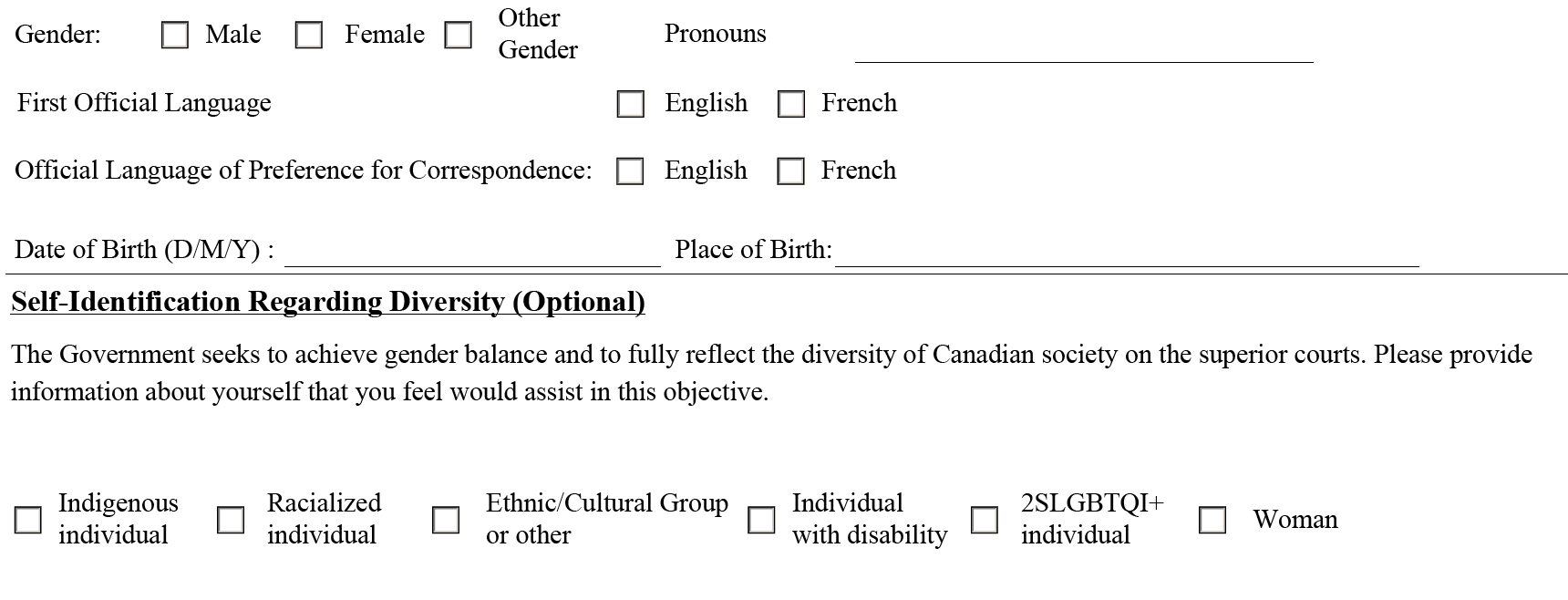
Seeking diversity, feds add inclusive language to application process for judges

Appears the main change is with respect to pronouns and some additional diversity indicators. Screen capture below (kind of interesting that “woman” is now last on the list, likely reflecting the progress that has been made):

Overall, the Liberal government has dramatically increased the diversity of judicial appointments compared to the previous Conservative government:

The Canadian government is making changes to the questionnaire prospective judges must fill out before applying for a federal judicial appointment.

The change is intended make the questionnaire more respectful by adding inclusive language for people to “self-identify diversity characteristics.”

Critics have argued Canada’s judiciary lacks diversity.

The questionnaires are a primary tool used by judicial advisory committees across the country to review candidates for the bench and submit recommendations to the minister of Justice.

Former Justice minister Jody Wilson-Raybould announced a process to increase transparency, accountability and diversity in the courts in 2016, with an emphasis on selecting women and visible minorities.

The changes were made in consultation with the Canadian Bar Association, the Canadian Judicial Council and the Office of the Commissioner for Federal Judicial Affairs.

Source: Seeking diversity, feds add inclusive language to application process for judges

Questionnaire link: https://www.fja-cmf.gc.ca/appointments-nominations/forms-formulaires/cq-qc/index-eng.html

Switzerland: Calls grow to ban Nazi symbols and salutes

Of note:

At a rally protesting against anti-Covid measures in September 2021, a demonstrator made a Nazi salute – right in the middle of Bern’s Old Town. The public prosecutor’s office consequently issued the demonstrator with a penalty order for improper behaviour. However, the man successfully contested the notice. There was no legal basis for a conviction, a local court ruled.

A neo-Nazi who made the same salute in 2010 on Rütli Meadow in the canton of Uri also ended up being acquitted. The Swiss Federal Court ruled in 2013 that the man had been expressing his own convictions among like-minded people, and that this was not a criminal offence. Had he been making the salute to spread Nazi ideology on the other hand, he would have been punished under Swiss anti-racism laws.

These examples show that Switzerland has a certain tolerance threshold when it comes to making Nazi symbols and gestures. Nazi salutes, swastikas, etc. are banned only when used for propaganda purposes. Political efforts to scrap this distinction have been ongoing since 2003. Majorities in the Federal Council [Swiss government] and parliament have so far judged freedom of expression to be more important, but the perception seems to be shifting now. Three motions on the issue have been submitted in parliament – one from the centre right and two from the left.

Spate of incidents during the pandemic

Parliamentarian for The Centre, Marianne Binder, set the ball rolling in winter. Binder wants a complete ban on Nazi gestures, flags and symbols, both in the real world and online. Explaining her motion, she said: “Anti-Semitic incidents have increased and took on a new dimension during the pandemic.”

The Swiss Federation of Jewish Communities (SIG) and the Foundation against Racism and Anti-Semitism (GRA) confirm this. According to their Report on Anti-Semitism, 2021 saw a proliferation of anti-Semitic incidents in Switzerland. There were 806 reports of online anti-Semitic content including anti-Semitic conspiracy theories – a more than 60% increase on the previous year.

There were 53 real-world anti-Semitic incidents, which included verbal abuse, public statements and offensive graffiti on synagogues. Anti-vaccine protesters wore Stars of David inscribed with the word “unvaccinated”. And in a Zurich suburb, they graffitied “Impfen [vaccination] macht frei” – a play on words on the infamous gate at Auschwitz – next to a swastika. People argue that the protesters need not have had anti-Semitic motives, says Binder. “You can plead stupidity, but how blind to history can you be?” she asks, adding that it constitutes an intolerable trivialisation of the Holocaust.

Binder deliberately restricted the motion to focusing on symbols and gestures related to Nazism and the Holocaust, whereas previous motions had targeted symbols and gestures encouraging racism and violence in general. Otherwise, it would have been difficult to list every single possible infraction. But Nazi symbols and salutes are unambiguous. “They certainly do not come under freedom of expression.”

Parliamentarians Gabriela Suter and Angelo Barrile, both from the Social Democratic Party, doubled down with similar parliamentary initiatives. The SIG endorsed the motions in January 2022, the first time it has explicitly put its weight behind initiatives of this type. Far-right extremists at protest rallies and concerts were specifically taking advantage of Switzerland’s legal loophole, it said. “This is particularly hurtful and bewildering for the minorities affected.”

The Council of the Swiss Abroad, which represents the interests of the “Fifth Switzerland” via-à-vis the authorities and the general public, also expressed support in March for criminalising all use of Nazi symbols and gestures in public. On behalf of the delegation from Israel, Ralph Steigrad noted that Switzerland had been debating the issue for almost 20 years: “It now needs to act and follow the examples of other countries.” This did not mean stopping symbols from being shown in teaching material for purely educational purposes, he stressed.

However, the Federal Council initially wanted to leave things as they were for the time being and rejected Marianne Binder’s motion. Even though Nazi symbols and salutes were “shocking”, they had to be tolerated as an exercise of freedom of expression, it wrote in reply. Educating people was better than enacting a ban.

Experts are divided

Legal and extremism experts are divided over the issue. Some say that far-right extremists might even feel vindicated if criminal proceedings were brought against them, and that a sweeping ban potentially moves us to a kind of penal law focused on punishing offenders’ attitudes or belief systems instead of the act itself.

Others argue that Nazi symbols pose a threat to peaceful, democratic society and are unacceptable in any country governed by the rule of law. And lo and behold, the Federal Council appears to have overcome its initial hesitancy amid reports that Justice Minister Karin Keller-Sutter is looking into the matter after all. She said her ministry would now see what legal options are available.

Keller-Sutter also wrote a reply to the Organisation of the Swiss Abroad (OSA) – via which the Council of the Swiss Abroad had expressed its concerns to the Federal Council –assuring it that the government was well aware of the increase in anti-Semitic incidents in Switzerland.

By all means you can prevent anti-Semitism and ban Nazi symbols at the same time, says Binder. It is necessary to do both. Building a Holocaust memorial (see box) while continuing to allow Nazi symbols and salutes defeats the object. Parliament is set to debate Binder’s motion in its summer session.

Source: Calls grow to ban Nazi symbols and salutes

Burton: Why are Chinese police operating in Canada, while our own government and security services apparently look the other way?

Good questions:

In China, the high-profile TV drama In The Name Of The People has become a smash hit. In that show, Chinese agents enter the U.S. posing as businessmen so they can repatriate a factory manager who had fled abroad with huge ill-gotten wealth.

But a new study by the European non-governmental agency Safeguard Defenders suggests that there might be some truth to the fiction. According to the NGO, the Fuzhou Public Security Bureau has established more than 50 “overseas police service centres” in cities around the world – including three publicly documented ones in Toronto, home to Canada’s largest Chinese diaspora.

This is an outrage. Chinese police setting up offices in Canada, then “persuading” alleged criminals to return to the motherland to face “justice” – while our own government and security services apparently choose to look the other way – represents a gross violation of Canada’s national sovereignty, international law and the norms of diplomacy. China is extending the grip of its Orwellian police state into this country, with seemingly no worry about being confronted by our own national security agencies.

The RCMP and politicians of all stripes routinely condemn Chinese state harassment of people in Canada, but what action has been taken? There have been no arrests or any expulsion of any Chinese diplomats who might be co-ordinating this kind of thuggery.

Beijing describes these global police outposts as administrative centres to help Chinese nationals renew driver’s licences and other domestic banalities back home. But the Safeguard Defenders study found that they also hunt down political dissidents, corrupt officials or rogue Chinese alleged criminals and urge them to return home.

The summary says some of these operatives are given cover by being formally attached to local Chinese Overseas Home Associations (which have themselves largely become co-opted by the Chinese Communist Party’s United Front Work operations and run out of China’s embassy and consulates).

This bold strategy is consistent with China’s propensity for routinely flouting international laws, including those that require any other country’s police wishing to gather evidence in Canada to work through the RCMP.

In the case of these “police service centres,” Safeguard Defenders reports that agents press their targets to return home, including by offering vague promises of leniency or even urging families back home to encourage them to do so. The officers have taken aim at these alleged (and unproven) criminals by seizing their families’ assets, denying children in China access to schools, and terminating family members’ employment, all in violation of due process.

In Canada, this has been a reality for years. In 2001, during refugee hearings in Vancouver for Lai Changxing – a businessman wanted by Beijing over accusations of corruption and smuggling – Chinese police admitted to entering Canada using fake documents, and even to spiriting in Mr. Lai’s brother in an attempt to convince him to return home. Canadian authorities effectively smiled benignly at this serious breach of criminal and immigration law; Mr. Lai was eventually deported back to China.

Canada is becoming China’s chew toy. Consider Beijing’s alleged disinformation campaign which helped “unfriendly” Conservative MPs of Chinese ethnicity, including Kenny Chiu, lose their seats in the 2021 federal election.

Ottawa wants Canadian businesses to be able to tap into the world’s largest market. But the price of this access appears to be ignoring Beijing’s Canadian agenda, from military and industrial espionage to harassing Canadian Uyghurs, Tibetans, Falun Gong practitioners and ethnic Chinese and Taiwanese people who reject Beijing’s hectoring that they should be loyal to China instead of to Canada.

Does Canada have no security capabilities on the issue? Our police and security agencies must surely know what is going on, but for some reason prefer to simply curate their information rather than act on it. When asked by The Globe and Mail about the police service centres, an RCMP spokesperson said the force would not comment on “uncorroborated media reports or statements.” And most of the information we receive about China’s illegal and “grey zone” activities in Canada typically comes from the U.S. government and well-funded security and intelligence-focused think tanks in Australia and Europe.

The more we ignore reports of China’s growing presence in Canada – including its interference in our electoral process, its potential espionage in our universities and research institutes, and so on – the more emboldened and manipulative Chinese agents become. With no sign that it will be held accountable, China will only increase the size and threat of its operations, because it can.

With its seeming indifference toward China’s blatant contempt for our laws and security, Ottawa is playing an extremely dangerous game with Canada’s sovereignty.

Source: Why are Chinese police operating in Canada, while our own government and security services apparently look the other way?

Toronto celebrates 50 years of Ismaili Muslim community in the city

One of the more successful communities in Canada, integrated while preserving their culture and identity:

She has been a lawyer, a manager of philanthropic foundations and a diplomat in Afghanistan, but Sheherazade Hirji has not forgotten that late afternoon nearly 50 years ago when she was a teenager with her family, making their way through menacing military checkpoints.

“There were lots of checkpoints and people were robbed and they would look into people’s bodies, women’s bodies under their saris, they would look everywhere,” she recalled.

Ms. Hirji and her family were heading for the airport in Kampala, Uganda’s capital. They were among the last to leave, part of the 80,000 residents of South Asian descent in the African country who were suddenly expelled in 1972 by the dictator Idi Amin.

More than 6,000 of them, members of the Ismaili Shia Muslim community, were able to resettle quickly in Canada, after their spiritual leader, the Aga Khan, called on his friend, then-prime minister Pierre Trudeau, to provide them with a haven.

Half a century later, standing by the landscaped lawn of Toronto’s Ismaili Centre, Ms. Hirji could contemplate the journey that led her community to become one of Canada’s great refugee success stories.

In the early days, she said, having few possessions and no place to practise their faith, newly arrived Ismailis in Canada would gather in basements, bringing sheets, so they could pray together. Later, they were able to rent school halls.

And now, on Sunday, prominent members of the community had been invited to a bright, spacious atrium at the Ismaili Centre, to hear Mayor John Tory announce that he had bestowed a Key to the City to the Aga Khan and renamed the street outside after the Ismaili imam.

The Ismailis, the mayor said, were part of a lineage of newcomers who had successfully built a new life in Canada, such as the Vietnamese, the Tamils and more recently Ukrainian refugees.

The honours for the Ismaili imam was “the least we could do,” Mr. Tory told the gathering, citing the extensive charities, schools and other philanthropic endeavours supported by the Aga Khan. He said he had been travelling in Pakistan in the wake of the 2013 earthquake and found that the Aga Khan’s humanitarian organizations were helping in the most remote villages.

The appreciation for the Aga Khan mirrored the goodwill accrued by the diligent, hard-working way the Ismailis had integrated into Canadian society. In 1972, the message from the imam to his faithfuls was to “make Canada your home and enrich Canada for the benefit of all Canadians,” Karim Thomas, vice-president of the Ismaili Council for Canada, said in an interview.

“We’ve been received by Canada and by Canadians with extraordinary warmth and with openness. … We’re very grateful for the opportunities that Canada has given us.

Behind the success story of the Ismaili refugees lay also the pain of their sudden expropriation and expulsion in Uganda, said Mahmoud Eboo, the Aga Khan Development Network representative to Canada.

“What people don’t appreciate is the shock and trauma that one undergoes when you suddenly hear overnight that all your possessions are gone. The businesses that you may have worked all your life for your family and your children are taken, your home that you’ve lived in is gone. … You have absolutely no idea what tomorrow will bring for you.”

South Asians had settled in Uganda and other British colonies in Africa since the 19th century. Ms. Hirji’s grandparents had moved from India, so she and her parents were born in Uganda. “I was the second generation born in Africa and so for us Uganda had always been home. It was the only home I ever knew.”

But the community’s prosperity also made it a scapegoat after Idi Amin took power in a coup d’état and ordered their expulsion.

Bringing only what they could carry in a suitcase, Ms. Hirji’s family landed first in Britain. They moved to social housing in Newcastle and her mother took a job in a factory manufacturing silverware.

She and her husband eventually settled in Canada, appreciating the country’s attitude toward diversity.

Canada’s diversity remains a crucial quality in the current circumstances, said Prince Amyn Aga Khan, the Ismaili’s leader’s younger brother, who represented the imam at the ceremony.

“His highness has looked at Canada as a model of pluralism,” he said, “one that is ever more critically, more urgently needed in our increasingly divisive and fragmented world.”

Source: Toronto celebrates 50 years of Ismaili Muslim community in the city

PEN Canada standing up for Salman Rushdie 30 years after ambitious plan to condemn Iran’s state-sanctioned act of terror against him

Good reminder of just how courageous Canadian political leaders, particularly Bob Rae then Premier of Ontario, were. British PM Thatcher was equally principle in providing Rushdie with protection despite his harsh criticism of her policies and reference to her as Mrs. Torture in Satanic Verses.

As noted before, I was posted to Tehran when the fatwa was issued and we were concerned that the Toronto event might impact our safety but fortunately it didn’t.

Proud of the Canadian leaders who stood up for free speech when many did not. Sharp contrast to some of the shallow and tendentious invocations of freedom and free speech that are all too common today:

Thirty years ago, PEN Canada, a non-partisan organization that supports freedom of expression in Canada and writers endangered around the world, staged an extraordinary coup in Toronto. Held in support of award-winning English novelist Salman Rushdie, it went on to have international ramifications – with this country at the root of it.

In 1992, Rushdie was in his fourth year of hiding, under constant police protection for fear of his life. Three years earlier, Ayatollah Khomeini of Iran had issued a fatwa calling for his murder, and the murder of those associated with his novel, The Satanic Verses. Khomeini claimed the novel insulted Islam, though his son admitted later that he never read it.

Internationally, political will to stand up to such an astonishing public threat against a private citizen of another country was sadly lacking. But no country was willing to act alone. Louise Dennys, then president of PEN Canada, told the head of the International Salman Rushdie Defence Committee that she believed Canada could break the impasse.

A handful of PEN members – Louise, with Ric Young, John Ralston Saul, Adrienne Clarkson, Marian Botsford-Fraser and Clayton Ruby – hatched an ambitious plan to persuade the Canadian government to condemn Iran’s state-sanctioned act of terrorism against Rushdie. The strategy: to use the annual PEN Canada Benefit to showcase public support for Rushdie in the country and galvanize the government in Ottawa to take the issue to the United Nations. They needed to bring Rushdie to Canada and draw intense media coverage.

This was no easy matter. It required absolute secrecy, the support of MI6 in Britain alongside CSIS and the RCMP in Canada, and a frantic last-minute search for means – ultimately, a private jet offered by an anonymous donor – to bring Rushdie across the Atlantic when the initial flight plan fell through.

Miraculously, they managed it. On Dec. 7, 1992, Rushdie appeared as a surprise guest on stage at the Winter Garden Theatre before an astonished audience of a thousand people. There was a collective gasp as the crowd rose to its feet in applause, even as they suddenly became aware of the 60-some security personnel present in the theatre, talking into their sleeves.

And then Bob Rae, premier of Ontario at the time, came on stage and embraced Rushdie, the first head of government anywhere to publicly stand with him. Rae called upon all governments to “do the right thing.”

It did not end there. The small delegation flew straight to Ottawa. Overnight, a morning press conference was convened. A few hours later, Barbara McDougall became the first secretary of state of any country to meet with Rushdie. Jean Chrétien, then the leader of the Official Opposition, walked him over to the House of Commons where he testified before the Parliamentary Sub-Committee on Development and Human Rights.

The result was electrifying. Within 48 hours, Canada became the first country in the world to pass a unanimous, all-party resolution condemning the Iranian government for its shameful record on human rights, demanding the withdrawal of the fatwa. Three months later, at the instigation of the Canadian government, the United Nations Commission on Human Rights in Geneva passed a resolution condemning Iran’s actions and calling for sanctions.

Remarkably – and sadly, given the cause – a full generation after the epochal 1992 benefit, the organization is again holding an event to stand with Rushdie after the horrific attack on him in August at the Chautauqua Institute, in upper New York State. Together with the Toronto International Festival of Authors, Penguin Random House Canada and the Writers Trust, PEN Canada will hold a reading of Rushdie’s works on Sept. 27.

Thirty years ago, PEN Canada, a non-partisan organization that supports freedom of expression in Canada and writers endangered around the world, staged an extraordinary coup in Toronto. Held in support of award-winning English novelist Salman Rushdie, it went on to have international ramifications – with this country at the root of it.

In 1992, Rushdie was in his fourth year of hiding, under constant police protection for fear of his life. Three years earlier, Ayatollah Khomeini of Iran had issued a fatwa calling for his murder, and the murder of those associated with his novel, The Satanic Verses. Khomeini claimed the novel insulted Islam, though his son admitted later that he never read it.

Internationally, political will to stand up to such an astonishing public threat against a private citizen of another country was sadly lacking. But no country was willing to act alone. Louise Dennys, then president of PEN Canada, told the head of the International Salman Rushdie Defence Committee that she believed Canada could break the impasse.

A handful of PEN members – Louise, with Ric Young, John Ralston Saul, Adrienne Clarkson, Marian Botsford-Fraser and Clayton Ruby – hatched an ambitious plan to persuade the Canadian government to condemn Iran’s state-sanctioned act of terrorism against Rushdie. The strategy: to use the annual PEN Canada Benefit to showcase public support for Rushdie in the country and galvanize the government in Ottawa to take the issue to the United Nations. They needed to bring Rushdie to Canada and draw intense media coverage.

This was no easy matter. It required absolute secrecy, the support of MI6 in Britain alongside CSIS and the RCMP in Canada, and a frantic last-minute search for means – ultimately, a private jet offered by an anonymous donor – to bring Rushdie across the Atlantic when the initial flight plan fell through.

Miraculously, they managed it. On Dec. 7, 1992, Rushdie appeared as a surprise guest on stage at the Winter Garden Theatre before an astonished audience of a thousand people. There was a collective gasp as the crowd rose to its feet in applause, even as they suddenly became aware of the 60-some security personnel present in the theatre, talking into their sleeves.

And then Bob Rae, premier of Ontario at the time, came on stage and embraced Rushdie, the first head of government anywhere to publicly stand with him. Rae called upon all governments to “do the right thing.”

It did not end there. The small delegation flew straight to Ottawa. Overnight, a morning press conference was convened. A few hours later, Barbara McDougall became the first secretary of state of any country to meet with Rushdie. Jean Chrétien, then the leader of the Official Opposition, walked him over to the House of Commons where he testified before the Parliamentary Sub-Committee on Development and Human Rights.

The result was electrifying. Within 48 hours, Canada became the first country in the world to pass a unanimous, all-party resolution condemning the Iranian government for its shameful record on human rights, demanding the withdrawal of the fatwa. Three months later, at the instigation of the Canadian government, the United Nations Commission on Human Rights in Geneva passed a resolution condemning Iran’s actions and calling for sanctions.

Remarkably – and sadly, given the cause – a full generation after the epochal 1992 benefit, the organization is again holding an event to stand with Rushdie after the horrific attack on him in August at the Chautauqua Institute, in upper New York State. Together with the Toronto International Festival of Authors, Penguin Random House Canada and the Writers Trust, PEN Canada will hold a reading of Rushdie’s works on Sept. 27.

Source: PEN Canada standing up for Salman Rushdie 30 years after ambitious plan to condemn Iran’s state-sanctioned act of terror against him