Immigrants’ Sense of Belonging to Canada: The Role of Source-Country Gender Inequality

Interesting findings:

“A growing body of literature uses country-level indicators to examine the impact of immigrants’ source-country conditions on the home and work lives of immigrants after arrival. One measure that has attracted increased attention is gender inequality in immigrants’ countries of origin. However, little is known about the degree to which the transition from high to low gender inequality countries affects the development of connections with the receiving country and whether immigrant women and men are impacted differently. This article examines the association between source-country gender inequality and immigrants’ sense of belonging to Canada. Our regression analysis of data from the 2013 and 2020 General Social Surveys suggests a higher level of source-country gender inequality is associated with a stronger sense of belonging to Canada for both immigrant men and women. Despite concerns from some conservative critics that gender inequality in source countries hinders immigrant integration, the results show that immigrants from cultures different from Canada develop a strong sense of belonging to Canada. Our findings suggest that cultural distance does not necessarily have a negative impact on immigrant men’s and women’s self-perceived integration into their host country.”

Source: Immigrants’ Sense of Belonging to Canada: The Role of Source-Country Gender Inequality

Rioux | Le sexe des anges [arguing #s more important for integration than approaches]

Rioux is consistent in the sources he cites and the positions he takes. Numbers are important, as recent Canadian and other experiences attest, but policies and approaches all matter too:

…C’est d’ailleurs tout le drame de l’immigration. Malgré certaines expériences individuelles positives qu’on aura beau brandir comme un étendard, dans l’immense majorité des cas, elle est d’abord une souffrance pour ces individus à qui l’on demande de faire table rase de leur famille, de leur langue et de leur culture pour être ballottés comme de simples produits au gré des besoins du marché. Ensuite, indépendamment des individus, cette immigration massive devient vite un problème. Cela se vérifie partout. On ne transplante pas impunément des populations entières dans n’importe quelle communauté sans ébranler la cohésion sociale et créer inévitablement des réactions de rejet. Réactions que les bonnes âmes auront beau condamner, mais que l’anthropologue Claude Lévi-Strauss jugeait « normales, légitimes même, et en tout cas inévitables ». Une réalité devant laquelle les discours soporifiques sur l’ouverture à l’Autre seront toujours impuissants.

C’est ce que disait Rémy Girard dans Le déclin de l’empire américain : « Il y a trois choses importantes en histoire : premièrement le nombre, deuxièmement le nombre et troisièmement le nombre ». Cette citation que l’on prête à l’historien Michel Brunet est encore plus vraie en matière d’immigration. Et Rémy Girard d’ajouter que « l’histoire n’est pas une science morale. Le bon droit, la compassion, la justice sont des notions étrangères à l’histoire ». Ce qui peut avoir du sens pour l’accueil d’un petit nombre d’individus n’en a plus guère dès lors que l’on parle d’un phénomène de masse. En France, même le premier ministre centriste François Bayrou, qui penche généralement à gauche, a dû se résoudre à parler de « submersion migratoire ». Les chiffres les plus récents étant d’ailleurs là pour le prouver.

Si le nombre est de loin le critère déterminant, d’autres comme la proximité culturelle et la volonté de s’intégrer jouent un rôle. C’est toute la difficulté que connaît la France aujourd’hui dans ses banlieues ethniques. L’intégration de populations de culture musulmane est évidemment plus difficile que celle, hier, des Italiens ou des Portugais. Cette intégration est d’autant plus ardue que des idéologies comme l’islamisme la combattent ouvertement. En 2015, le président Recep Tayyip Erdoğan était venu à Strasbourg présenter la Turquie comme le seul défenseur de la « vraie civilisation » et soutenir que l’assimilation était « un crime contre l’humanité ». Des organismes comme l’Organisation du monde islamique pour l’éducation, les sciences et la culture (ICESCO) incitent ouvertement les immigrants musulmans à ne pas acquérir les valeurs de leur pays d’accueil.

Mais encore faut-il aussi que pour intégrer, on ait confiance dans sa propre culture. Les efforts destinés à favoriser l’intégration sont évidemment louables. Mais ils ne pourront jamais rien contre le nombre. De grâce, cessons de traiter un problème démographique qui est en train de devenir la grande affaire politique du siècle comme une banale question de compassion et de bonne volonté.

Source: Chronique | Le sexe des anges

International student graduates earn much less than Canadian peers, study shows

Of concern, particularly at masters and PhD levels:

International students earn substantially less than their Canadian counterparts upon graduation, and a larger proportion of them end up in sales and service jobs, new research from Statistics Canada shows.

The data – part of a report by the agency examining the labour-market outcomes of university and college graduates in Canada – capture the inequity in wages and types of jobs that international students eventually obtain compared with Canadian graduates.

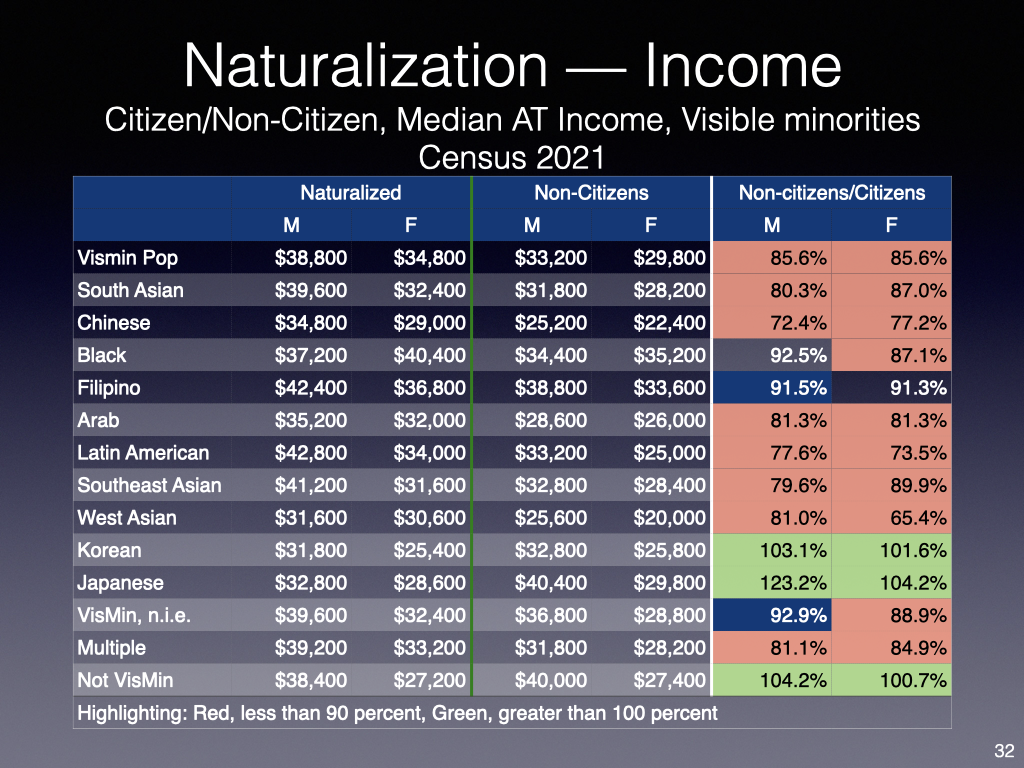
Over all, international student graduates earned 19.6 per cent less than Canadian graduates three years after graduating, the report found. Moreover, their annual incomes were lower than Canadian graduates at all levels of study, regardless of if they earned a diploma or a doctorate degree.

The report used data from a 2023 national survey of graduates conducted by Statscan, and focused on the graduating class of 2020.

Foreign students with a bachelor’s degree, for example, earned a median annual income of $52,000, compared with Canadian graduates at $65,200. At the master’s level, international students earned 16.6 per cent less than Canadians – $70,000 compared with $83,900, annually.

A critical difference in the employment outcomes for foreign students compared to Canadian graduates can be seen in the proportion of international students who work in sales and service occupations. Across all education levels, approximately 28 per cent of international student graduates worked in sales and service jobs, compared with roughly 12 per cent of Canadian graduates.

Some examples of sales and service occupations, according to the National Occupation Classification system, include retail and restaurant workers, door-to-door salespeople and call-centre operators. These jobs tend to pay lower wages than, for example, management occupations or jobs in business and finance.

Brittany Etmanski, the report’s author, suggested that one reason for the significant earnings differential between foreign graduates and Canadian graduates was because more of the former group tended to be college and bachelor’s degree holders employed in the low-wage sales and service sectors.

“However, this does not explain the difference in income at the masters and doctoral levels,” she wrote….

Source: International student graduates earn much less than Canadian peers, study shows

Le Devoir editorial: Gare aux contradictions 

More on Quebec’s CAQ identity and integration policies:

Nouvelle année, nouvelle offensive nationaliste caquiste. François Legault avait prévenu qu’il mettrait le cap sur le dossier de l’identité. Ce fut chose faite dès les premiers jours de la rentrée parlementaire à Québec, avec le dépôt de son projet de loi-cadre enchâssant le modèle choisi de l’interculturalisme comme meilleur rempart pour assurer la vitalité et la pérennité de la langue française et de la culture francophone.

Le projet de « loi sur l’intégration nationale » énonce les grands principes auxquels adhère la société québécoise — être démocratique, laïque, guidée par sa Charte des droits et libertés et l’égalité hommes-femmes, et évoluer dans une langue commune, le français. L’affirmation nationale de consensus établis au Québec, qui guideront au travers de l’appareil de l’État québécois l’intégration de nouveaux arrivants dans un esprit de mixité.

Sur papier, la proposition caquiste s’en tient aux terrains d’entente et aux doctrines orthodoxes du modèle d’intégration québécois à une société et à une culture communes. L’adhésion et la participation de tous, la contribution de chacun.

Une nouvelle proposition législative qui se veut consensuelle, afin d’apporter une nouvelle pierre à l’édification d’un cadre constitutionnel proprement québécois. De grands pans de la mise en œuvre de cette loi-cadre restent toutefois à définir.

Une politique nationale viendra régir son champ d’application dans l’appareil gouvernemental et parapublic 18 mois après son adoption. Un règlement balisera par ailleurs les nouvelles règles de financement d’activités et d’organismes soutenus par l’État, qui devront à l’avenir respecter ce nouveau cadre d’intégration, dans les deux années suivant sa promulgation.

Le ministre de l’Immigration, de la Francisation et de l’Intégration, Jean-François Roberge, a laissé entendre, à la suite du dépôt de son projet de loi jeudi, que son gouvernement pourrait ainsi forcer un pressant ménage dans l’attribution de places dans les garderies subventionnées, où le religieux s’est immiscé. Il a en outre laissé planer la possibilité que le financement public versé aux écoles à vocation religieuse puisse être revu à son tour. Un revirement pour le gouvernement, qui choisirait alors judicieusement la voie de la cohérence.

Bien qu’il prépare sa loi depuis 18 mois, le ministre Roberge s’est montré tout aussi vague quant aux nouvelles balises qui encadreront le financement étatique d’événements communautaires ou d’activités culturelles. Au-delà de la microgestion du moindre rassemblement, l’adoption d’une culture commune passe par la découverte d’artistes et d’œuvres du Québec. Et pas seulement forcée.

Pour un gouvernement qui souhaite rassembler tous les Québécois autour d’une culture commune,dont les acteurs crient leur détresse, la fin de la gratuité universelle dans les musées le premier dimanche du mois est difficile à expliquer.

Tout comme la fermeture de classes de francisation. Le ministre et son gouvernement ont beau nier les « coupures budgétaires » en prétextant plutôt « le respect budgétaire », le résultat est le même. Les immigrants, de qui il exige une maîtrise du français pour en assurer la vitalité devant la menace, sont privés des cours espérés.

Prétendre que la demande rejoindra l’offre en francisation puisque le gouvernement resserre l’accueil d’immigrants temporaires relève de l’illusion. L’arriéré de nouveaux arrivants désireux d’apprendre la langue commune du Québec (bien qu’il découle d’abord de l’accueil pléthorique fédéral) ne disparaîtra pas pour autant. Et ceux qui fuient la guerre, les dérèglements climatiques ou la dureté du président américain, Donald Trump, ne seront pas moins nombreux.

Les contradictions du gouvernement de François Legault ne s’expliqueront pas aussi facilement.

D’autant que son propre projet de loi-cadre prône une nécessaire approche de réciprocité des responsabilités partagées entre l’État québécois et les nouveaux arrivants.

Il est attendu que ces derniers apprennent le français et participent ainsi à la vitalité de la culture québécoise. Encore faut-il leur donner les moyens de respecter ce contrat social qui leur est présenté.

Le gouvernement s’engage, noir sur blanc, à prendre des mesures pour contribuer à leur intégration, « par exemple en créant et en maintenant les conditions favorisant l’apprentissage du français ». De même qu’à « facilite[r] l’accès aux œuvres et aux contenus culturels ». Les échos sur le terrain — qu’ils découlent d’une rigueur ou d’une responsabilité budgétaires — laissent croire que le gouvernement n’y met pas tout à fait les ressources prescrites.

François Legault mise sur la carte de l’identité pour faire oublier les défis auxquels il fait face. Au-delà des intentions, c’est sur les résultats concrets qu’il sera jugé.

Source: Gare aux contradictions

New year, new Caquist nationalist offensive. François Legault had warned that he would set course for the identity file. This was done in the first days of the parliamentary return to school in Quebec City, with the tabled of its draft framework law enshrining the chosen model of interculturalism as the best bulwark to ensure the vitality and sustainability of the French language and Francophone culture.

The draft “law on national integration” sets out the main principles to which Quebec society adheres – to be democratic, secular, guided by its Charter of Rights and Freedoms and gender equality, and to evolve in a common language, French. The national affirmation of consensus established in Quebec, which will guide through the apparatus of the Quebec State the integration of newcomers in a spirit of diversity.

On paper, the Caquist proposal sticks to the common grounds and orthodox doctrines of the Quebec model of integration into a common society and culture. The support and participation of all, the contribution of each.

A new legislative proposal that aims to be consensual, in order to bring a new stone to the construction of a properly Quebec constitutional framework. However, major parts of the implementation of this framework law remain to be defined.

A national policy will govern its scope in the government and parapublic apparatus 18 months after its adoption. A regulation will also set out the new rules for financing activities and organizations supported by the State, which will have to comply with this new integration framework in the future, within two years of its promulgation.

The Minister of Immigration, Francisation and Integration, Jean-François Roberge, suggested, following the tabling of his bill on Thursday, that his government could thus force a pressing budget in the allocation of places in subsidized daycare centers, where the religious have interfered. He also left it possible that public funding for religious schools could be reviewed in turn. A turnaround for the government, which would then wisely choose the path of coherence.

Although he has been preparing his law for 18 months, Minister Roberge has been equally vague about the new beacons that will govern the state financing of community events or cultural activities. Beyond the micromanagement of the slightest gathering, the adoption of a common culture requires the discovery of Quebec artists and works. And not just forced.

For a government that wants to bring together all Quebecers around a common culture, whose actors shout their distress, the end of universal gratuity in museums on the first Sunday of the month is difficult to explain.

Just like the closure of francization classes. The minister and his government may deny “budget cuts” on the pretext of “budgetary respect”, the result is the same. Immigrants, from whom he requires a mastery of French to ensure their vitality in the face of the threat, are deprived of the hoped-for courses.

To claim that demand will join the supply in francization since the government is tightening the reception of temporary immigrants is a matter of illusion. The backlog of newcomers wishing to learn the common language of Quebec (although it first stems from the federal full reception) will not disappear. And those fleeing war, climate change or the harshness of American President Donald Trump will not be less numerous.

The contradictions of François Legault’s government will not be so easily explained.

Especially since his own draft framework law advocates a necessary approach to reciprocity of shared responsibilities between the Quebec State and newcomers.

They are expected to learn French and thus participate in the vitality of Quebec culture. They must still be given the means to respect this social contract that is presented to them.

The government undertakes, in black and white, to take measures to contribute to their integration, “for example by creating and maintaining conditions conducive to learning French”. As well as “facilitates access to cultural works and content”. The echoes on the ground — whether they stem from budgetary rigour or responsibility — suggest that the government is not quite putting the prescribed resources into it.

François Legault relies on the identity card to make people forget the challenges he faces. Beyond the intentions, it is on the concrete results that he will be judged.

Quebec’s CAQ government tables ‘integration’ bill for new immigrants

Here we go…:

Immigration Minister Jean-François Roberge tabled Thursday a bill meant to distinguish the province’s approach to newcomers from what Roberge called Canada’s “vicious” multiculturalism.

Bill 84, laid out in a 12-page document called “An Act respecting national integration,” includes a list of expectations for the Quebec state, Quebecers and new immigrants to Quebec. It aims to establish the province’s integration model, which is inspired by the concept of interculturalism.

Roberge said Tuesday that the difference between interculturalism and multiculturalism is that the former creates “relations between people,” whereas the latter “doesn’t define a common culture.”

The bill calls on new immigrants to learn French upon arrival in Quebec and to respect a set of values, including those enumerated in the Canadian Charter of Rights and Freedoms.

“This law reiterates that Quebec is a nation in its own right with a strong culture,” Roberge told journalists Thursday. “As a nationalist government, we are therefore taking our responsibilities and making a strong gesture to protect our social cohesion, our way of living together, our identity.”

The document defines Quebec culture as “characterized in particular by the French language, the civil law tradition, specific institutions, distinct social values, a specific history, and the importance given to equality between women and men, to the laicity of the State and to the protection of Quebec’s only official and common language.”

The bill commits Quebec to “foster the learning of French as well as the learning of democratic values,” but does not specifically say the province has to provide French courses.

The bill also says the government would ensure organizations helping immigrants follow the bill and could remove funding to those that do not, although Roberge admitted to journalists Thursday there were not yet clear guidelines on how the province would enforce the bill.

In recent months, the province has cancelled hundreds of French courses due to funding issues. After Roberge announced on Tuesday that he would be tabling the bill this week, opposition parties were reluctant to show support given the province’s struggle to meet francization demands.

Veronica Islas, who runs Carrefour de ressources en intercultuel, an organization helping immigrants in Montreal, said the proposed legislation’s lack of clarity on how it would be implemented and why it was being created left her fearing it would have the adverse effect of alienating or “othering” people.

“Words have meaning and there’s a difference between integration and inclusion,” Islas said.

Roberge also defended himself on Tuesday from the idea that he was once again using nationalism to win back voting intentions.

“During our first mandate, we took the step of adopting Bill 21 when we were leading in the polls — and by a long, long shot — [and] we did the same thing with Bill 96,” he said. “We are taking strong, identity-based actions to ensure the Quebec model, regardless of the polls.”

The bill also says Quebec must facilitate “access to Quebec works, cultural content and heritage property, [enhance] them and fosters their discoverability.”

The government recently announced a series of financial cutbacks at several cultural institutions, including the end of free entry to a number of museums on Sundays. A group called the Common Front for the Arts of Quebec has held protests amid calls for increased funding of arts and culture activities in the province. It has emphasized the importance of Quebec’s national identity.

Source: Quebec’s CAQ government tables ‘integration’ bill for new immigrants

Le Devoir Éditorial | Intolérance, stupeur et consternation [racism among health care workers]

Timing could not be worse as CAQ government prepares its model of integration for Quebec. Reminder that reciprocal obligations apply to the host population as well:

C’est une histoire à faire hurler, sise aux frontières de nos espoirs d’intégration des immigrants et de la plate réalité du terrain, encore raviné par des poches d’intolérance et de discrimination. Les allégations de racisme au cégep et au CISSS de l’Abitibi-Témiscamingue, subi par des hommes et des femmes venus d’Afrique pour devenir infirmiers ici, ont tout pour ébranler le gouvernement Legault, lui qui doit dévoiler jeudi un projet de loi-cadre destiné à redéfinir le modèle québécois d’intégration des immigrants. Quelle ironie !

Il y a de ces hasards de calendrier qui font réfléchir. Le Devoir révélait mardi, sous la plume de sa journaliste Lisa-Marie Gervais, que des étudiants venus d’Afrique à l’invitation du gouvernement du Québec pour prêter main-forte en soins infirmiers avaient subi ce qui a toutes les allures du racisme. Dans un rapport obtenu par notre reporter et relatant les humiliations sévères infligées aux étudiants, ce passage ne peut que faire frémir : « Il paraît qu’en Afrique, vous êtes tous des animaux. C’est pour ça qu’au Rwanda, les gens se sont entretués. » Cette phrase indigne aurait été prononcée par une enseignante qui devait accompagner et former ces personnes, tous déjà des infirmiers dans leur pays natal.

L’origine de cette affaire compte pour beaucoup dans l’horreur qu’elle inspire. C’est dans le cadre d’un de ces programmes idylliques lancés par le Québec pour suppléer à une pénurie de main-d’œuvre au sein du personnel infirmier que ces étudiants ont foulé le sol québécois. Partis de leur continent africain avec une solide formation infirmière, ils étudiaient et subsistaient grâce à un programme du ministère de l’Immigration, de la Francisation et de l’Intégration (MIFI) décliné en quatre phases, et visant à terme la formation aux normes du Québec de 1500 infirmiers francophones. Le tout dans le cadre du Plan d’action ministériel pour la reconnaissance des personnes immigrantes.

L’ensemble de l’œuvre bénéficie du soutien des ministères de la Santé et des Services sociaux et de l’Enseignement supérieur. Ces détails non négligeables viennent ajouter une couche d’opprobre à l’affaire : ce fiasco est survenu sous la gouverne d’autant d’instances responsables vantant les mérites de ce parfait entrecroisement de l’offre et de la demande.

Le drame des étudiants humiliés s’est joué à plusieurs chapitres. D’abord, il y a eu les insultes racistes et les actes de dénigrement venus d’enseignantes et de responsables, tant du cégep de l’Abitibi-Témiscamingue que du CISSS où les étudiants effectuaient des stages et du travail à temps partiel comme préposés aux bénéficiaires, le tout en totale conformité avec le programme gouvernemental. Ensuite, l’échec scolaire. Ce sont des taux d’échec anormalement élevés le printemps dernier qui ont sonné la première alarme, car ainsi recalés, les candidats ont vu le sol se dérober sous leurs pieds : perte instantanée de l’allocation versée par le MIFI, impossibilité de travailler, retrait de l’assurance médicale. Certains ont pu effectuer une reprise, d’autres, non. Une infirmière ayant soutenu les victimes en dénonçant le traitement subi a été congédiée du CIUSSS où elle travaillait.

Un consortium indépendant dépêché en Abitibi-Témiscamingue pour résorber la crise a témoigné dans un rapport accablant de la nature des opérations de dénigrement constantes subies par les étudiants. Mais, comble de l’injure, ledit rapport ne s’est pas rendu aux autorités concernées, comme si on avait voulu cacher l’inénarrable. Une demande d’accès à l’information et une démarche journalistique ont permis de découvrir de quel traitement « dégueulasse » — le mot du ministre responsable de la Lutte contre le racisme, Christopher Skeete, en réaction à notre reportage — les étudiants avaient été victimes.

Interrogé sur cet événement malheureux, le directeur à la formation continue du cégep, Julien Pierre Arsenault, a parlé d’une question de « perceptions ». Dans d’autres médias, mardi, il dénonçait avec plus de vigueur les allégations de racisme.

Tout cela survient alors que le ministre de l’Immigration, de la Francisation et de l’Intégration, Jean-François Roberge, doit dévoiler jeudi un projet de loi-cadre dictant les termes d’un nouveau modèle d’intégration au Québec. Le ministre, qui dénonce haut et fort toute forme de xénophobie ou de racisme comme celle transpirant de notre reportage, affirme que son intention n’est pas seulement de dicter les exigences attendues des nouveaux arrivants, mais de déterminer aussi quels sont les devoirs et responsabilités de la société d’accueil, au nom d’un « principe de réciprocité ».

Les récits racontant des manifestations claires de racisme systémique dans les univers de l’éducation et de la santé ont malheureusement été suffisamment nombreux pour qu’on s’en inquiète. Bien que ce gouvernement résiste encore à nommer ce racisme installé dans certaines de nos organisations, il devrait comprendre qu’en repoussant les évidences, il contribue en quelque sorte à gangrener les préjugés. C’est le premier signe d’une volonté d’intégration de façade.

Source: Éditorial | Intolérance, stupeur et consternation

It is a story to scream, located on the borders of our hopes for the integration of immigrants and the flat reality of the field, still ravined by pockets of intolerance and discrimination. The allegations of racism at the CEGEP and the CISSS of Abitibi-Témiscamingue, suffered by men and women who came from Africa to become nurses here, have everything to shake the Legault government, which is due to unveil on Thursday a framework bill to redefine the Quebec model of immigrant integration. What an irony!

There are those calendar coincidences that make you think. Le Devoir revealed on Tuesday, under the pen of its journalist Lisa-Marie Gervais, that students who came from Africa at the invitation of the Quebec government to lend a hand in nursing care had suffered what has all the appearance of racism. In a report obtained by our reporter and reporting the severe humiliations inflicted on students, this passage can only make you shudder: “It seems that in Africa, you are all animals. That’s why in Rwanda, people have been king each other. This unworthy sentence would have been pronounced by a teacher who had to accompany and train these people, all already nurses in their native country.

The origin of this case counts for a lot in the horror it inspires. It was as part of one of these idyllic programs launched by Quebec to make up for a shortage of nursing staff that these students set foot on Quebec soil. Starting from their African continent with a solid nursing training, they studied and subsisted thanks to a program of the Ministry of Immigration, Francisation and Integration (MIFI) declined in four phases, and eventually aimed at training 1500 French-speaking nurses to Quebec standards. All under the Ministerial Action Plan for the Recognition of Immigrants.

The entire work is supported by the Ministries of Health and Social Services and Higher Education. These significant details add a layer of reproach to the case: this fiasco occurred under the guidance of so many responsible bodies touting the merits of this perfect intertersection of supply and demand.

The drama of the humiliated students was played out in several chapters. First, there were racist insults and acts of denigration from teachers and managers, both from the Abitibi-Témiscamingue CEGEP and from the CISSS where students carried out internships and part-time work as beneficiaries’ attendants, all in full compliance with the government program. Then, school failure. It was abnormally high failure rates last spring that sounded the first alarm, because thus failed, the candidates saw the ground escape from under their feet: instant loss of the allowance paid by the MIFI, inability to work, withdrawal of medical insurance. Some were able to make a recovery, others were not. A nurse who supported the victims by denouncing the treatment suffered was dismissed from the CIUSSS where she worked.

An independent consortium dispatched to Abitibi-Témiscamingue to resolve the crisis testified in a damning report on the nature of the constant denigration operations suffered by students. But, to the height of the insult, the said report did not go to the authorities concerned, as if they had wanted to hide the unspeakable. A request for access to information and a journalistic approach made it possible to discover what “disgusting” treatment – the word of the minister responsible for the fight against racism, Christopher Skeete, in reaction to our report – the students had been victims.

Asked about this unfortunate event, the director of continuing education of the CEGEP, Julien Pierre Arsenault, spoke of a question of “perceptions”. In other media, on Tuesday, he more vigorously denounced allegations of racism.

All this comes as the Minister of Immigration, Francisation and Integration, Jean-François Roberge, is due to unveil on Thursday a draft framework law dictating the terms of a new integration model in Quebec. The minister, who loudly denounces any form of xenophobia or racism such as that transpiring from our report, says that his intention is not only to dictate the demands expected of newcomers, but also to determine what the duties and responsibilities of the host society are, in the name of a “principle of reciprocity”.

Unfortunately, there have been enough stories of clear manifestations of systemic racism in the worlds of education and health to be concerned. Although this government still resists naming this racism installed in some of our organizations, it should understand that by pushing back the evidence, it contributes in some way to gangrenous prejudice. This is the first sign of a desire to integrate the facade.

Multiculturalism is a bad fit for Quebec, immigration minister says

Here we go again. On the positive side, they will need to develop a definition that can be reviewed and assessed:

The minister responsible for immigration has justified the presentation of new legislation on the integration of immigrants by saying he wants to promote a common Quebec culture and less “ghettoization” of new arrivals.

Jean-François Roberge, the minister of immigration, francization and integration, said the legislation he will table Thursday will act as a counterweight to the Canadian concept of multiculturalism, which he said remains a bad fit for Quebec because it fails to clearly define a common culture with principles Quebecers believe in. Newcomers need to clearly understand Quebec is different from the rest of Canada when they arrive, Roberge said.

He said the proof of the need for a new bill, with a focus on the concept of interculturalism, lies in part in new data produced by Quebec’s French language commissioner showing the children of immigrants identify less with Quebec than their parents did.

“There is something broken,” Roberge told reporters at a news conference. “I don’t think we have, at this moment, a clearly defined social contract. We never outlined it. “We can’t criticize people who are not aware of something that has never been clearly defined.

“With our plan, with our bill, we will be pretty clear: We are a nation, we have a culture, we have democratic values, men and women are equal. People coming here must accept that.”

Roberge, however, was vague on how he plans to apply what is for now a statement of principles. The mechanics of how it will be applied will be included in the legislation, he said. He said the bill will revolve around the principle of reciprocity and a “moral obligation to adhere to Quebec culture in the larger sense.”

“We are a welcoming society; we remain open to the world. We want diversity on the Quebec territory, but we want a mix. We don’t want people living apart from one another. We think the ghettoization does not serve social cohesion.”

Roberge dismissed questions about whether the Coalition Avenir Québec government is again stirring up the identity issue as a way to shore up its sliding popularity. He said the CAQ government adopted other pieces of identity legislation, such as Bill 21 on state secularism and Bill 96 overhauling the Charter of the French Language, early in its mandate before the party fell from grace with voters.

“Our values don’t change based on the latest polls,” Roberge said. Roberge made the comments as the National Assembly resumed work Tuesday following the Christmas break.

Much of the focus of the session will be on the economy and the potential impact of U.S. tariffs. Premier François Legault made it clear at a caucus last week that other issues will be on the agenda, including those revolving around identity.

Roberge set the stage for the bill in a video Monday in which he said the new legislation will be a logical followup to Bills 21 and 96. “For the first time in our history, we will define who we are and how we want to continue to evolve as a nation,” Roberge said in the video. “With this bill, we propose a social contract uniting all Quebecers.”

But he was hit with questions about the government’s current inability to offer enough French courses to meet the demand from those arriving here. On the defensive, Roberge said Quebec is teaching the language to more people than ever — 80,000 in 2024 alone — and will improve the situation further in 2025. Waiting lists are long because too many immigrants have arrived in Quebec and he plans to reduce the total in the future, he said.

“Those who are here will be able to learn French and we will put the brakes on new arrivals, including temporary (immigrants), on our territory.”

Quebec’s opposition parties remained skeptical Tuesday about the government’s motives. Interim Liberal leader Marc Tanguay said his party is always open to discussing such issues as interculturalism, but warned the new bill has to respect fundamental rights. He said the government also has to put up the money to back its principles, which he said it has not done in the past.

“I think the first person who spoke of interculturalism was (former Liberal premier) Robert Bourassa in the ‘70s,” Tanguay said. “We are interculturalists and ready to work on this, but again the devil is in the details. We must not divide (Quebecers).”

Québec solidaire co-spokesperson Ruba Ghazal said there is an “incoherence” in Roberge’s message because he says immigrants need to integrate, yet the government keeps cutting French courses.

Parti Québécois Leader Paul St-Pierre Plamondon said that while he doesn’t believe everything in the new bill will be useless, the CAQ’s track record on immigration remains questionable because of its lack of results. “Let’s just say the CAQ has been good at window-dressing for the past seven years, so we’ll keep an eye on that,” St-Pierre Plamondon told reporters.

Source: Multiculturalism is a bad fit for Quebec, immigration minister says

Canada’s plan to reduce immigration levels leaves newcomer organizations scrambling with ‘off-the-cliff’ funding cuts

Reduced levels means reduced demand for services, so it should not come as a complete surprise to the settlement sector:

Newcomer Oleksandr Krestych and his wife Olena have been taking English classes full-time while working full-time since they arrived from Ukraine in 2022.

The couple — him an orthopedic surgeon and her a dermatologist — know learning the language is key to their success in Canada. They’ve made progress, moving from basic English courses that helped navigate day-to-day life to now focusing on language training for employment and professional communication. 

Every weekday, they attend classes at Enhanced English Skills for Employment in Winnipeg from 9 a.m. to 3 p.m. before heading to a 3:30-to-11:30 p.m. job assembling fibre-optic cables in a factory.

“It’s hard and tiring,” said Krestych, 50. “But it helps improve our English so we can get better jobs and improve our life.”

However, after their last class at the end of this month, the couple must find another school — if they can find one with available spots.

Enhanced English Skills for Employment has been informed its current Immigration Department funding agreement, worth $650,000 a year, will not be renewed when it ends on March 31.

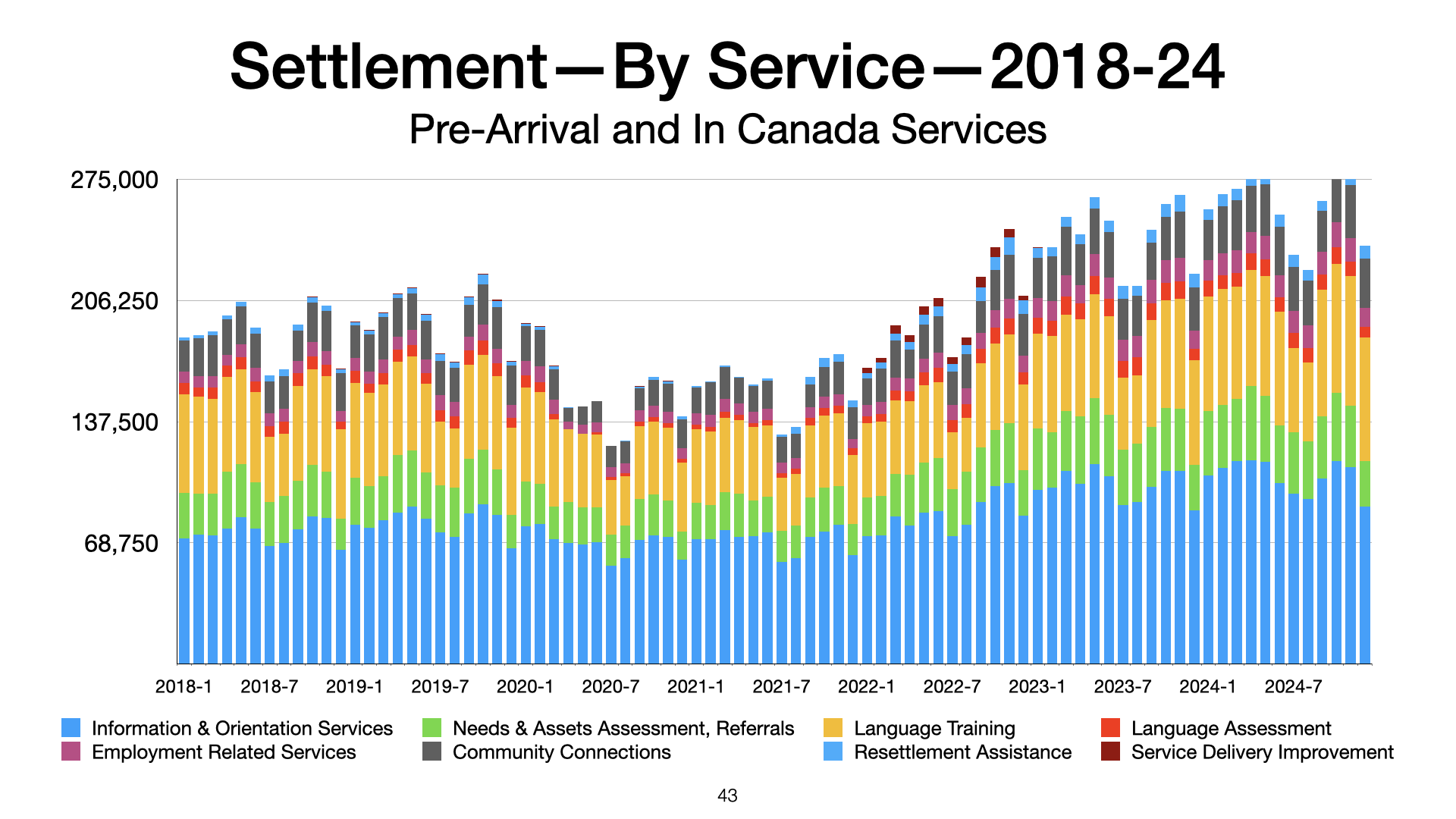
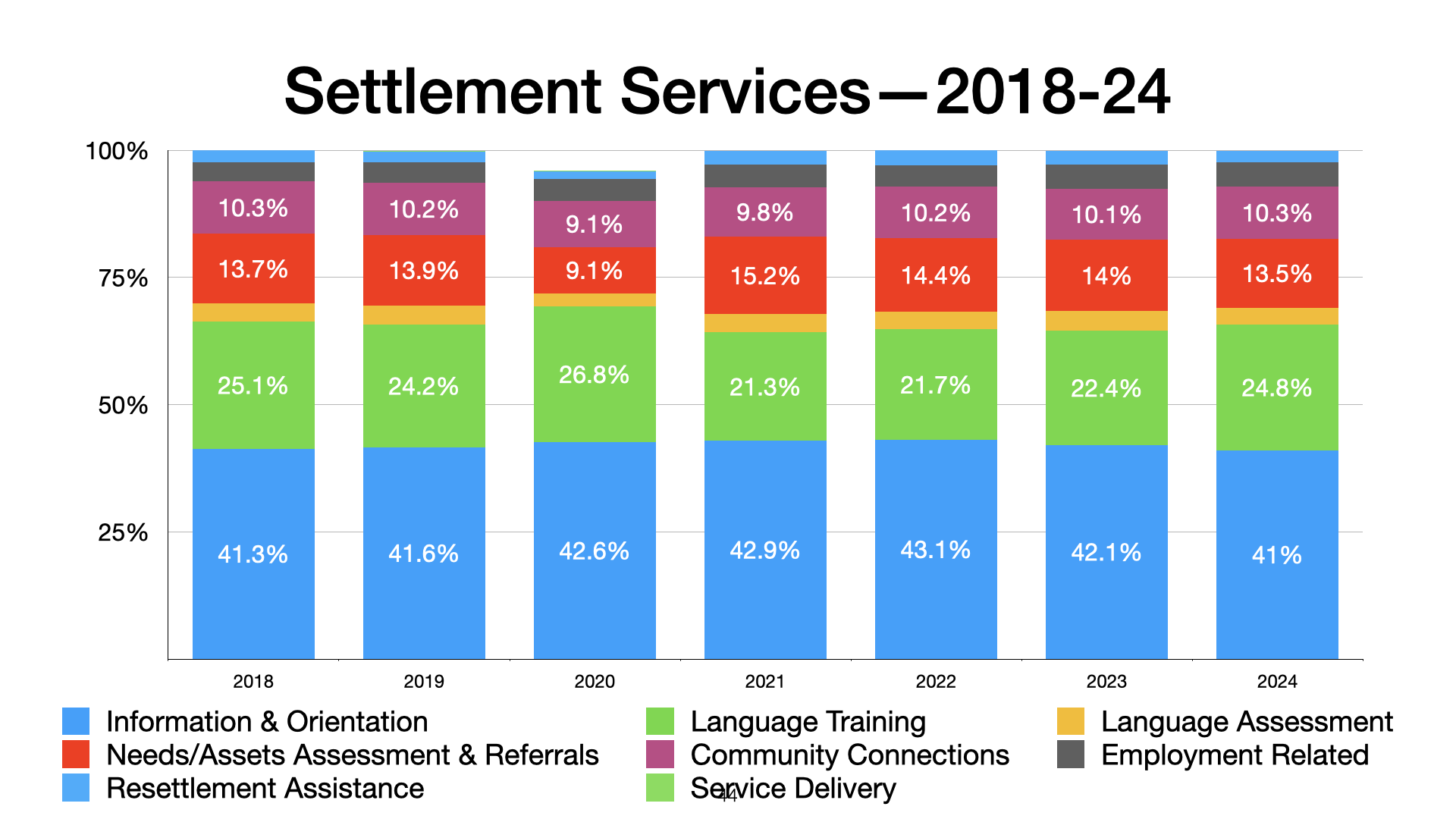
Across Canada, excluding Quebec, the Immigration Department is axing funding to organizations that assist newcomers with settlement and integration through employment-related services, language training and community support programs.

The cuts follow the reduction in immigration targets announced by Immigration Minister Marc Miller in October, which aims to welcome 395,000 new permanent residents in 2025, 380,000 in 2026 and 365,000 in 2027 — a 20 per cent drop from 485,000 last year.

The Immigration Department is also reducing the new funding cycle from five to three years, making long-term planning harder for funded agencies. Additionally, it will only continue funding English classes beyond level 4 of the Canadian Language Benchmark until September 2026.

“With funding being tied to the number of past arrivals and future admissions, the funding for settlement services has also been readjusted downward, at first by a small amount in 2025-26 and then further in the following fiscal years,” it told the Star in an email.

Funding allocated for settlement services outside of Quebec will drop from about $1.17B in 2024-25 and $1.12B in 2025-26, it said, adding that funding decisions are based on the number of newcomers expected, the needs for those accessing services, relationships with partner organizations and available resources.

The immigrant settlement sector said it’s been caught off guard by the “off-the-cliff” cuts that were made without consultation and enough time to wind down programs to minimize impacts on clients and staff, most of whom are immigrant women from racialized communities.

“While the funding cuts happened, the folks these agencies are seeing now are not going away,” said Debbie Douglas, executive director of the Ontario Council of Agencies Serving Immigrants, which has more than 240 member organizations.

“We don’t anticipate a reduction in service demand, but we certainly will see a reduction in services available.”

Kathryn Friesen, executive of the Alberta Association of Immigrant Serving Agencies, warns that recent cuts to settlement services funding will leave many newcomers vulnerable amid an economic slowdown and affordability crisis.

Douglas said her member organizations in Ontario are expected to see a modest one per cent reduction in federal settlement funding for 2025 and up to 20 per cent next year. However, the Toronto District School Board is set to lose a third of its federal funding for newcomer language training, closing five learning sites as of March 31 and reducing its program capacity from 2,485 to 1,800 learners. Its enhanced language training programs will be phased out over two years.

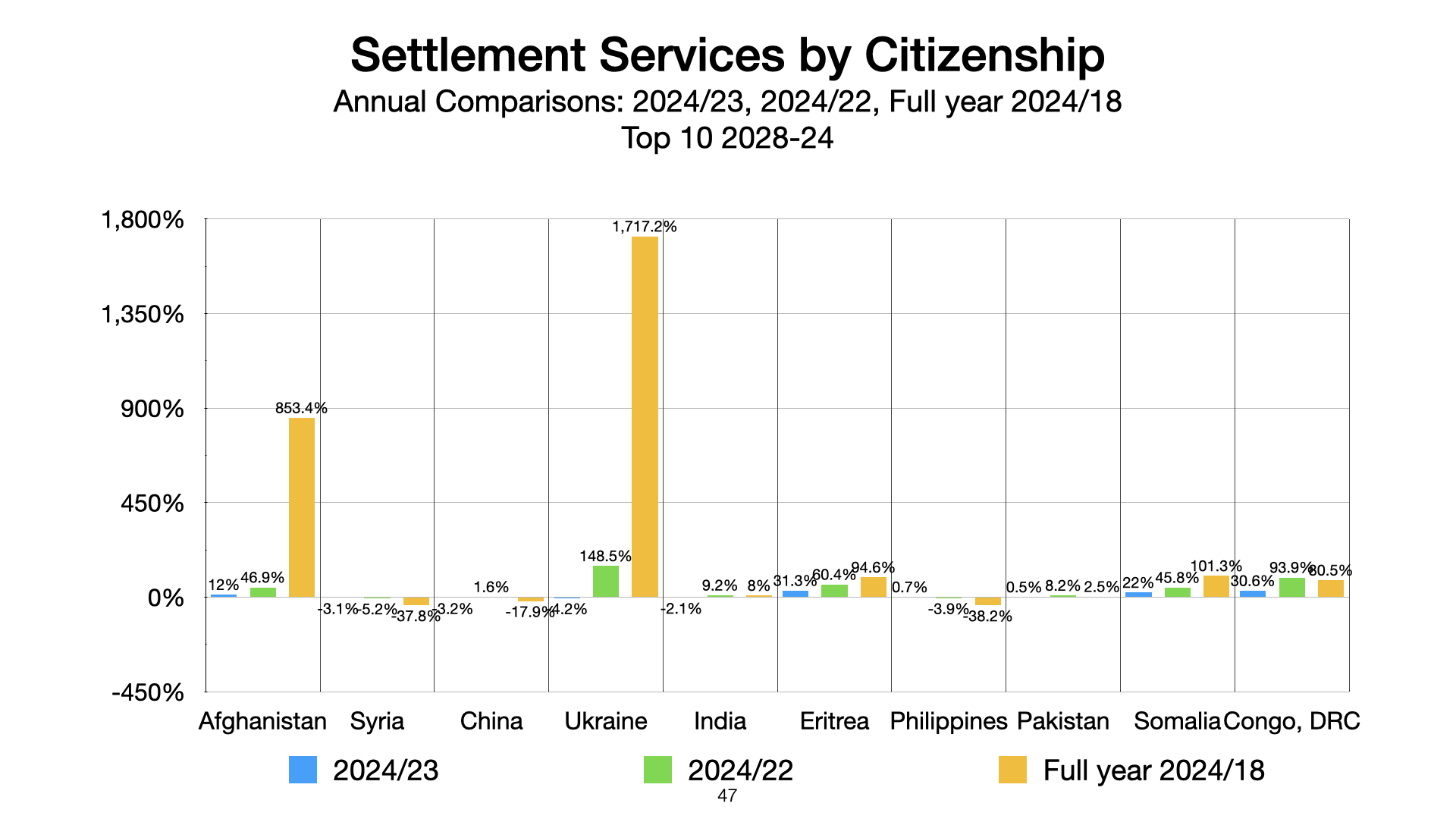
Due to the exponential immigration growth following the pandemic, including newcomers from Afghanistan and Ukraine, some service providers have already been struggling with waiting lists for programs, especially in language training.

The Star has learned that Western provinces are hardest hit, though provincial bodies representing the settlement sector are still trying to calculate the extent and impacts of the cuts. Some service providers are desperately trying to find alternative funding sources while making plans to move clients to unaffected agencies.  

In B.C., more than 20 organizations have been completely defunded, with others facing funding reduction ranging from 15 per cent to 75 per cent. In Alberta, some groups faced cuts as deep as 35 per cent. In Manitoba, at least 12 agencies have lost their entire funding.

Kathryn Friesen, executive director of the Alberta Association of Immigrant Serving Agencies, said the cuts could not have come at a worse time, as recent newcomers are the most vulnerable to the current affordability crisis, soft job market and economic slowdown.

“It’s a small investment to help people upon arrival reach success a lot sooner than if they’re having to go it alone to navigate so many of the systems that they have to navigate,” said Friesen, whose umbrella group has 60 organizational members.

And newcomers’ journeys are not linear, and they may access supports at different stages of their settlement. 

Karen Sawatzky, executive director of the Hecate Strait Employment Development Society, expresses frustration over losing funding after a decade of service, leaving her remote community in Prince Rupert without crucial settlement support.

“Settlement services continue to be essential to those already here,” said Katie Crocker, CEO of the Affiliations of Multicultural Societies and Service Agencies of BC, in a statement. The group is made up of 94 member organizations.

Newcomers “depend on settlement supports to integrate and thrive in their communities. The settlement and integration sector’s specialized and crucial support better equips immigrants to contribute to Canada’s social and economic growth, enriching communities across the country.”

Both large and small agencies are impacted by the cuts. In B.C., for example, the Vancouver Community College has lost its entire $4 million yearly funding for language training for 2,400 students; the Hecate Strait Employment Development Society will have its entire $150,000 support axed.

The latter serves newcomers in remote Prince Rupert, 1,500 kilometres north of Vancouver, and the agency will have to send clients to organizations in Terrace, which is at least 90 minutes away by car.

“We have yet to sit down with someone at immigration and have them tell me why they declined us funding after providing these services for 10 years,” said its executive director Karen Sawatzky.

“They have not given us a clear (transition) plan. I’ve been in touch informally with the other service providers to help each other.” 

At Winnipeg’s Enhanced Language Skills for Employment, its executive director Louise Giesbrecht has to let go of six language instructors and some administration staff. She is knocking on the doors of the province and charitable foundations to fill the impossible gap. 

While her biggest concern is where to send current students and the 400 on the waiting list, she is busy trying to find the money for staff’s accrued vacation pay and closing costs on things such as shedding documents to comply with client privacy terms, emptying offices and getting rid of furniture.

Source: Canada’s plan to reduce immigration levels leaves newcomer organizations scrambling with ‘off-the-cliff’ funding cuts

Banergee: International university grads speak about aspirations and barriers

Good qualitative research, setting the stage for access to settlement services and other supports (but relatively silent on priorities, trade-offs and numbers:

…Privileges and precarity

Some interviewees arrived in Canada with financial resources and family support, allowing them to manage the high costs of education and living expenses. Others, however, took on substantial debt to finance their studies, reflecting their willingness to invest in future opportunities despite economic risk. While privilege granted access to education, and the potential for permanent residency status, their success was often constrained by precarity, including financial instability, cultural adjustment challenges, legal uncertainties and discrimination.

While students’ advantages can foster success, barriers — including unpredictable immigration systems, lack of professional networks, limited opportunities to gain relevant Canadian work experience and discriminatory treatment — often undermine them. Recognizing this tension is essential to understanding the varied experiences of international students in Canada.

Collaboration needed

Solving these challenges requires collaboration across education, immigration and employment systems. Universities must provide better support, such as work-integrated learning opportunities that connect education to careers. Immigration policies must become more transparent and predictable. Employers need to recognize their role in addressing hiring barriers and creating pathways for international graduates to gain meaningful work experience. 

Finally, appropriate settlement services are key to helping international students build long-term futures in Canada. Many of our interviewees started their journeys excited to study, settle and eventually become part of Canadian society. 

But along the way, barriers like precarious work, limited career options and immigration challenges often left them disillusioned, even after getting permanent residency. With the right supports, these graduates could navigate those hurdles more easily and stay engaged in their goals — finding meaningful work, putting down roots and contributing to their communities for the long term.

This is a pivotal moment to rethink how Canada views and supports international students. Without adequate policies and services to support their long-term success, many are at risk of leaving Canada, taking their skills, education and potential economic contributions elsewhere. 

Ensuring that these graduates feel valued and supported is essential for retaining talent and strengthening Canada’s competitive position in the global race for skilled workers.

Source: International university grads speak about aspirations and barriers

I gave up a comfortable life to come to Canada – and my immigrant story is more common than you may think

I often think it is hardest for those like Syed who were professionals living in Gulf countries or equivalent and whose experience and knowledge is under recognized along with their position in society, and thus the contrast with expectations and reality are greatest (hopefully, some potential employers will reach out to him):

…After all those struggles over five-plus years, I realized a proper job would be almost impossible to get. I used my remaining savings to buy a few properties to ensure a small but regular rental income – smaller, in fact, than my expenses. But these were my only sources of income, until recently.

And then there are the unique challenges of coming to Canada as a Muslim. I eat only halal foods, for instance, and it is still difficult for me to decipher what is religiously permitted for Muslims and what is not; fortunately, my children are better at figuring this out. The rise of right-wing populism in Canada has also worried me ever since the deadly 2017 shooting at the Islamic Cultural Centre of Quebec City. I can vividly recall my apprehension in the Muslim fasting month of Ramadan, four months after six worshippers were killed, as I offered my traveeh prayer at my mosque after breaking the day’s fast. I found myself fearing that anyone could start spraying bullets, and that I could easily be one of the victims. The 2021 murder of four members of the Afzaal family in London, Ont., only helped consolidate my feeling that being a minority in Canada could threaten my life.

This is not just my story; I know that other immigrants have experienced similar things. I have seen people go into a shell during these difficult resettlement years. It is never easy to get out of that psychological trauma; it could take even more years. And yet, despite our contributions to society – from bringing our savings to Canada to increasing the labour force and ultimately becoming a taxpayer – some still view us as burdens on society. That hurts!

Being burdens – that is not our story. And I refuse to let that define me.

Source: I gave up a comfortable life to come to Canada – and my immigrant story is more common than you may think