Des examens de français mieux adaptés

Appears to have been a comprehensive and thoughtful revision:

Finis les corrections trop sévères et les thèmes trop vagues. Mieux adapté au candidat, l’examen de français obligatoire que les immigrants doivent réussir pour devenir membres d’un ordre professionnel vient d’être entièrement revu pour faciliter la réussite. Et déjouer les tricheurs.

« L’ancien examen n’était pas conçu pour évaluer la compétence langagière liée à la profession », reconnaît Danielle Turcotte, directrice générale des services linguistiques à l’Office québécois de la langue française (OQLF). « Alors que maintenant, tout est conçu pour que les candidats se sentent directement impliqués dans un processus lié à leur profession, à travers une étude de cas. »

Autre changement important : la grille d’évaluation sera plus souple pour la correction de la production écrite, la « bête noire » des candidats, a reconnu Mme Turcotte. Ainsi, on tolérera « de nombreuses erreurs liées à la qualité de la langue », pourvu qu’elles ne nuisent pas à la compréhension. « Les virgules et les accents, ça ne compte pas [comme des fautes] », a-t-elle souligné. Si un candidat écrit « malhreuse » au lieu de « malheureuse », on comprend ce qu’il veut dire, ajoute-t-elle. De la même façon, on ne pénalisera pas un candidat s’il met un article féminin devant un nom masculin. « On n’est plus au mot à mot ou au lettre à lettre. On est dans un contexte de langue seconde. » Cela ne veut pas dire qu’une personne peut se contenter de « baragouiner » le français, avertit-elle. « On vise la compréhension globale, qui assure que la communication se fait de façon à assurer la sécurité du client ou du public. »

Une longue attente

Cela faisait des années que les ordres professionnels réclamaient pour leurs futurs membres un examen qui tienne compte de leur contexte professionnel. En 2012, le comité d’examen de l’OQLF a décidé de répondre à la demande du milieu en créant un nouveau test en collaboration avec chacun des ordres, qui devaient déterminer eux-mêmes les compétences langagières à atteindre. Des experts en évaluation des apprentissages de l’Université de Montréal ont aussi été consultés. D’où le délai de cinq ans avant d’en arriver à cette nouvelle version de l’examen.

« Ça paraît long, mais ne perdez pas de vue la démarche qu’il a fallu faire avec les 46 ordres professionnels », a expliqué Mme Turcotte. Et l’approche par compétence, ici préconisée, demeure assez nouvelle, a-t-elle ajouté.

Ce qui change grosso modo ? Avant, le candidat avait notamment à écrire un texte d’environ 200 mots portant sur une situation en milieu de travail, mais sans nécessairement de lien direct avec le quotidien de sa profession. Par exemple, on pouvait lui demander d’écrire une lettre pour souligner le départ d’un collègue à la retraite ou pour répondre à la plainte d’un client.

Cette fois, l’examen, d’une durée d’au maximum 2 h 30, se fera d’une traite, les quatre étapes — compréhension écrite et orale, expression écrite et orale — étant préalables les unes aux autres et formant un tout. Le candidat reçoit d’abord une fiche avec des consignes qu’il doit comprendre avant de passer à la seconde étape, une discussion avec un maximum de sept autres candidats de sa propre profession. Il devra ensuite écrire un texte d’après ce qu’il aura compris de la discussion de groupe pour finalement terminer son examen par un entretien avec l’évaluateur. Certaines étapes sont filmées et enregistrées.

« Tous les examens ont leur limite, mais […] les scénarios qui mettent l’accent sur la capacité à communiquer dans un contexte de travail, c’est beaucoup plus réaliste », a affirmé Marion Weinspach, cofondatrice de l’entreprise Le français en partage, qui offre des cours de français à cette clientèle d’immigrants voulant intégrer un ordre professionnel.

Si le candidat échoue ne serait-ce qu’à une seule des quatre étapes, il devra recommencer l’examen en entier et être réévalué sur toutes les compétences. Et, comme c’était le cas auparavant, il pourra recommencer l’examen autant de fois qu’il le souhaite (dans les délais prescrits par son ordre professionnel). L’examen est gratuit et il est offert depuis la fin du mois de janvier.

Des inquiétudes

Une enseignante de français se dit très inquiète de la deuxième étape, celle de la discussion de groupe où les candidats devront parler et comprendre les autres qui, comme eux, ne maîtrisent pas le français. « Ils vont entendre parler des gens avec toutes sortes d’accent et ensuite mettre par écrit des informations qui vont avoir été dites de façon imparfaite », s’est inquiétée cette professeure de plus de 20 ans d’expérience qui souhaite garder l’anonymat. L’OQLF rétorque qu’une personne animant la discussion s’assurera du bon déroulement de l’activité.

Et s’il sera plus difficile de préparer les étudiants spécifiquement pour cet examen, au moins la tricherie sera éliminée. « Avant, ils connaissaient les grands thèmes et pouvaient apprendre par coeur des textes qu’ils réécrivaient. »

L’assouplissement des critères d’évaluation pour le français écrit est « un couteau à double tranchant », croit Marion Weinspach. « L’écrit est devenu un petit peu moins exigeant, mais d’un autre côté, c’est au niveau de l’expression orale, où il y a un vocabulaire très spécifique à connaître, que ça devient plus exigeant. Être capable de lire un certificat de localisation pour un courtier ou de verbaliser un bilan pour un comptable, c’est plus difficile mais c’est plus réaliste. Et c’est ce que les ordres avaient demandé. »

La présidente du Conseil interprofessionnel du Québec, Gyslaine Desrosiers, salue la nouvelle version de l’examen, mais rappelle que tout le poids de l’intégration en français des travailleurs immigrants ne doit pas reposer sur l’OQLF. « L’examen, c’est un seul élément de la trajectoire. Il faut qu’il y ait des efforts faits en amont, par l’individu lui-même et son employeur. Le MIDI [ministère de l’Immigration, de la Diversité et de l’Inclusion] doit aider en dégageant des budgets. » Elle met toutefois en garde contre une baisse des exigences. « Dans un contexte de mondialisation, il y a énormément de pression pour ça, […] mais la protection du public exige un minimum de fonctionnement dans la langue. Dans ce sens, l’OQLF a fait son travail et revu son examen. »
via Des examens de français mieux adaptés | Le Devoir

L’internet joue un rôle crucial dans l’intégration des immigrants, selon une étude

Not much new here but nevertheless useful to have the study. Recommendations relate to reduced cost of internet (considered expensive) and more public access points (I had thought that libraries were filling that gap):

L’internet joue un rôle crucial dans l’intégration des immigrants au pays, autant pour se trouver un emploi que pour comprendre la culture de leur terre d’accueil, révèle une étude.

Celle-ci a été entreprise par des chercheurs de l’Université du Québec à Montréal (UQAM), qui voulaient comprendre si et comment l’internet favorisait l’intégration.

Rien ou quasiment rien n’existait sur le sujet, a expliqué en entrevue téléphonique l’un des auteurs, le professeur Christian Agbobli, du département des communications sociales et publiques. L’étude a aussi été rédigée par Magda Fusaro, professeure au Département de management et technologie de l’UQAM et titulaire de la Chaire de l’UNESCO en communication et technologies pour le développement.

Leur conclusion? L’internet joue un rôle majeur pour les immigrants.

«Ils nous ont dit: “on a besoin d’internet” et “on ne peut pas fonctionner ici sans internet”», rapporte le professeur Agbobli, aussi cotitulaire de la Chaire de l’UNESCO.

Ils s’en servent même plus depuis leur arrivée au Canada que dans leur pays d’origine, a fait remarquer M. Agbobli.

Plus de la moitié des répondants ont inscrit que leur consommation d’internet avait augmenté de plus de 51% depuis qu’ils ont posé leurs valises au Canada.

Et cela parce que leurs réseaux existants dans leur ancien pays les aidaient à se trouver un emploi, par exemple, alors qu’ici, dépourvus de contacts, ils se fient beaucoup à l’internet pour la recherche d’un boulot. C’est le cas pour plus de 75% d’entre eux, est-il indiqué dans l’étude.

Les immigrants qui ont participé à l’étude résident au Canada depuis moins de 10 ans, et un sous-groupe évalué y était depuis moins de trois ans.

Les immigrants du Canada avaient presque tous (70,9 %) une connexion internet à leur maison et le téléphone cellulaire intelligent est l’équipement qu’ils utilisent le plus pour naviguer sur la toile.

Ils s’en servent aussi pour obtenir une foule de services, comme ouvrir un compte bancaire, se trouver un logement, des ressources dans leur quartier, et aussi pour comprendre les coutumes locales, comme savoir comment les gens se saluent. Ils vont aussi y lire les journaux canadiens, ajoute le professeur.

«Ça m’a beaucoup aidée, a déclaré une répondante. Vous pouvez trouver de l’information sur les sites internet du gouvernement et trouver les bénéfices pour enfants, et actuellement j’applique pour la citoyenneté et vous pouvez y trouver toute l’information.»

L’un des sites internet les plus sollicités par ces nouveaux arrivants est Google map, a souligné M. Agbobli.

Beaucoup de femmes immigrantes ont indiqué que cela les aidait à se déplacer d’elles-mêmes et ainsi être plus autonomes sans craindre de se perdre dans la ville.

«Par exemple, si mon mari prend la voiture, je peux facilement me déplacer parce que j’ai l’internet et je peux vérifier quel autobus passe près de ma maison, alors je ne suis pas tout le temps dépendante de mon mari, pour qu’il m’amène d’une place à l’autre. C’est l’une des choses les plus importantes pour moi», a relaté une autre répondante, dont le témoignage est retranscrit dans l’étude.

L’internet brise l’isolement, a fait valoir le professeur. «Et il devient »un lieu«, un »mode de vie«».

Évidemment, les immigrants se servent aussi de l’internet pour rester en contact avec leur famille et leurs amis dans leur pays d’origine.

La plus grande majorité des répondants étaient âgés de 30 à 39 ans, plus de 65% ont un diplôme universitaire et près de 80% d’entre eux sont des femmes. «Ce qui crée un biais dans l’interprétation des données, mais répond au biais qui avait été généré par la recherche elle-même», peut-on y lire. Car les femmes faisaient partie de l’un des trois groupes (avec les jeunes et les nouveaux arrivants) sur lesquels la recherche voulait plus spécifiquement se pencher. «Car les femmes sont souvent plus vulnérables dans le processus migratoire», fait valoir le professeur.

Les auteurs de la recherche formulent aussi des recommandations. D’abord, ils suggèrent au gouvernement de rendre l’internet plus accessible: les coûts sont élevés au Canada, ont constaté bon nombre d’immigrants. Un plus grand accès au wifi dans des lieux publics serait apprécié, disent-ils.

Aux organismes d’aide aux immigrants, ils suggèrent des cours sur l’usage d’internet, pour mieux les outiller et qu’ils puissent en faire un usage plus précis et efficace.

La collecte de données de l’étude a été faite en 2016. L’équipe a choisi de mener cette recherche dans les quatre provinces qui accueillent le plus d’immigration, soit l’Ontario, le Québec, l’Alberta et la Colombie-Britannique. Elle a été menée à l’aide d’entretiens en personne et de questionnaires.

via L’internet joue un rôle crucial dans l’intégration des immigrants, selon une étude | Stéphanie Marin | National

Quebec: Ministère de l’Immigration: la VG dénonce de graves lacunes de gestion

Some of these issues not unique to Quebec:

Le Québec a accueilli plus de 500 Syriens l’an dernier, et près de 8000 demandeurs d’asile ont frappé à la porte à la frontière depuis six mois. Au même moment, le ministère de l’Immigration présente de graves lacunes de gestion. La francisation des nouveaux arrivants et leur intégration ne sont pas soumises à des contrôles rigoureux.

Près de 8000 demandeurs d’asile ont frappé à la porte à la frontière depuis six mois.

Dur verdict de la vérificatrice générale, Guylaine Leclerc, qui dépose son rapport de l’automne aujourd’hui à l’Assemblée nationale. Ses observations sur la vente de trois immeubles de la Société immobilière du Québec, en 2007, mobiliseront l’attention des médias. La mission est délicate pour Mme Leclerc qui, comme juricomptable, avait déjà audité le même dossier, avec un mandat de la Société québécoise des infrastructures. Au surplus, l’Unité permanente anticorruption fait déjà enquête dans ce dossier qui touche des responsables du financement du Parti libéral du Québec, William Bartlett et Franco Fava. Mais l’appréciation de la vérificatrice à l’égard des pratiques du ministère de l’Immigration, de la Diversité et de l’Inclusion (MIDI) nécessitera des correctifs de la part du gouvernement.

Selon les sources de La Presse, la vérificatrice mettra en lumière l’absence de reddition de comptes dans deux volets importants des activités du Ministère, soit l’intégration et la francisation. Le MIDI accorde 16 millions pour l’intégration des nouveaux arrivants, sommes qui transitent par des organismes communautaires.

La reddition de comptes est défaillante en matière d’intégration. Le Ministère négocie avec un organisme parapluie et n’a aucune idée de ce qui se passe sur le terrain.

D’autre part, le Ministère paie la note auprès des établissements d’enseignement pour la francisation des immigrés. Or, dans ces deux volets, le Ministère n’a pas de moyen d’apprécier l’efficacité de ses efforts, il ne peut évaluer la qualité des services rendus ni l’amélioration des compétences en français. Chez Emploi Québec, on relance les prestataires au téléphone trois mois après l’intervention du Ministère pour évaluer son succès. Rien de tel pour les interventions du MIDI, explique-t-on. Il y a déjà eu des visites des fonctionnaires de l’Immigration pour vérifier les activités d’intégration, mais cette pratique est disparue depuis belle lurette.

Sans contact avec leur clientèle, les fonctionnaires du MIDI atteignent des sommets de démotivation, indique-t-on en coulisse – les demandes de mutation des fonctionnaires du MIDI sont nombreuses, situation surprenante puisqu’il s’agit de l’un des rares ministères concentrés à Montréal.

Le gouvernement Couillard, à l’approche des élections, a retrouvé plus d’argent et s’apprête à infirmer deux décisions qui avaient été prises sous Kathleen Weil, à la fin de l’époque Charest. On envisage de rouvrir les bureaux régionaux, fermés en 2013 et 2014, au grand dam des syndicats de fonctionnaires. En outre, on redéploiera des effectifs à l’étranger – on parle d’une trentaine de personnes pour revamper une représentation réduite à sa plus simple expression au cours des dernières années.

via Ministère de l’Immigration: la VG dénonce de graves lacunes de gestion | Denis Lessard | Politique québécoise

In the era of extreme immigration vetting, Canada remains a noble outlier: John Ivison

Ivison’s take on my MPI article Building a Mosaic: The Evolution of Canada’s Approach to Immigrant Integration):

While Donald Trump used Tuesday’s deadly attack in New York to promote immigration restrictions, a remarkable consensus continues to hold in Canada, evident in the response to the government’s announcement that nearly 1 million newcomers will be welcomed over the next three years.

Immigration minister Ahmed Hussen said late Wednesday 310,000 new entrants will arrive next year, 330,000 in 2019 and 340,000 in 2020.

In response, Conservative immigration critic Michelle Rempel complained about the Liberals over-promising and under-delivering on the immigration file, pointing to a backlog at the Immigration and Refugee Board, a lack of mental health services for Yazidi women, wait times for permanent residency for caregivers, and an uneven spread of immigrants across the country. But crucially, those complaints were about management of the system by the Liberals, not the significant uptick in numbers.

In a world where the U.S. president is pushing to step up “extreme vetting,” where even countries like Germany and Denmark with a reputation for being havens are turning against immigrants, Canada is a notable, noble outlier.

As Andrew Griffith, a former senior bureaucrat at the department of Citizenship and Immigration, notes in a new paper for the Washington-based Migration Policy Institute, Canada’s successful immigration policy has its roots in the country’s history and geography.

“The ongoing creative tension between groups (English, French and Indigenous peoples) produced a culture of accommodation central to Canada’s ability to absorb and integrate newcomers. Further, the widely held perception among Canadians that immigrants are an economic boon and cultural asset to the country has made public opinion on the subject generally resilient, even as sharp backlashes have unfolded in the United States and Europe,” he wrote.

The polling bears that out. In fact, fewer people are concerned about immigrants not adopting “Canadian values” than at any time in the past 20 years, according to a major study carried out last year by the Environics Institute.

The study said 58 per cent of Canadians disagree with the statement that immigration levels are too high, compared with 37 per cent who agree. Views on the issue in Quebec reflected the national average.

It said 80 per cent believe the economic impact of immigration is positive, compared to just 16 per cent who disagree.

And it found 65 per cent think immigration controls are effective in keeping out criminals, up from just 39 per cent in 2008.

Since the major liberalization of immigration in the 1960s, when Canada abandoned race-based selection criteria and paved the way for the country’s current diversity, there has been a consistency about the broad parameters of immigration policy, regardless of which party has been in power.

Since 1995, immigrants admitted under economic preferences have consistently accounted for half or more of newly arrived immigrants.

The OECD’s migration outlook survey suggests the Canadian system is successful at attracting some of the world’s best and brightest. In 2014, 260,400 permanent residents were admitted, and more than half of the 25-to-64 year olds in that group had completed post-secondary degrees. The employment rate for foreign-born men was higher than for native-born men.

None of that is to suggest that the system is not used as a source of electoral fodder — particularly by the Liberal Party.

While the Conservatives reduced family-class immigration and increased economic immigration when they were in power, new programs introduced by the Liberals threaten to reverse some of that progress.

In the last election, the Liberals campaigned on prioritizing family reunification, granting points under the Express Entry system to applicants with siblings in Canada and doubling the number of applications allowed for parents and grandparents.

There was plenty more political pandering — watering down language requirements, lifting Mexican visa requirements and reducing the residency requirement for citizenship from four years to three.

The Trudeau Liberals’ emphasis on rights over the responsibilities promoted by the Harper government — and the prioritization of diversity over Harper’s insistence on shared Canadian values and history — paid electoral dividends, shifting the allegiance of a number of visible minority communities toward the Liberals.

Yet the changes were at the margins.

Both governments adhered to the distinctly Canadian model of integration, based on broad agreement about the way immigrants are selected, settled and melded into society.

The demographics defy partisanship and both Conservatives and Liberals have tried to offset the effect of an ageing population, where the working age to retired ratio is set to fall from 6.6:1 in 1971 to 2:1 by 2036.

Beyond the economics, there is a common approach to integration.

Griffiths notes that as far back as 1959 in Statistics Canada’s Canada Year Book, integration was defined as being clearly distinct from assimilation — it provided for the retention of cultural identity.

The niqab ban in Quebec suggests the debate on accommodation is not resolved.

But it is easy to lose sight of the fact that Canadians are broadly at ease with mass immigration to this country, even as it has resulted in a country with one of the largest foreign-born populations in the world.

Source: John Ivison: In the era of extreme immigration vetting, Canada remains a noble outlier | National Post

Building a Mosaic: The Evolution of Canada’s Approach to Immigrant Integration | migrationpolicy.org

My overview piece for the Washington-based Migration Policy Institute on how the Canadian approach to immigration, settlement, citizenship and multiculturalism works to further integration.

I am working with the Canadian Immigration Historical Society on a more comprehensive version, scheduled for next year.

Source: Building a Mosaic: The Evolution of Canada’s Approach to Immigrant Integration | migrationpolicy.org

Political typology: Race and discrimination, opinions about immigrants and Islam | Pew Research Center

As always, Pew’s findings, broken down by political leaning, are of interest and highlight just how divided the United States is on these issues:

Views of immigrants and nation’s ‘openness’

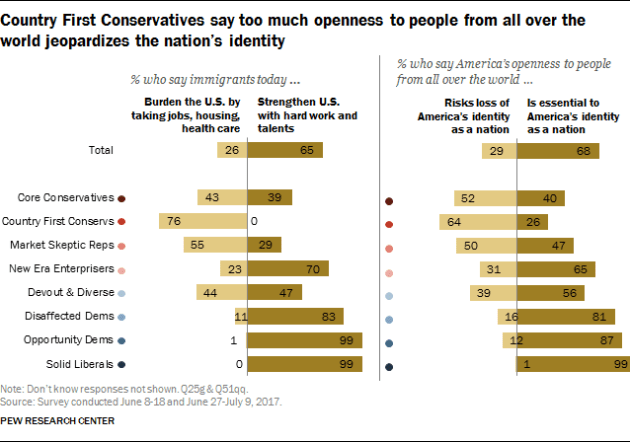
When it comes to attitudes about immigration, Democratic-leaning groups hold almost universally positive attitudes toward immigrants and support the idea of America being open to people from all over the world. Virtually all Solid Liberals say that immigrants strengthen the society and that openness is “essential” to America’s identity as a nation (99% each).

The only group on the political left that holds ambivalent views of immigrants is Devout and Diverse, a group that is racially and ethnically diverse and also has the lowest family incomes and levels of educational attainment of any typology group.

The Republican-leaning groups are sharply divided in views of immigrants and the nation’s openness to people from around the world. About three-quarters of Country First Conservatives (76%) say immigrants are a burden on the country – the largest share of any typology group. Country First Conservatives also are most likely to say that the U.S. risks losing its identity as a nation if it is too open to people from around the world (64% say this).

Compared with Country First Conservatives, Core Conservatives and Market Skeptic Republicans have more divided views of immigrants and whether too much openness risks the nation’s identity. New Era Enterprisers have the most positive views among Republican-leaning groups: 70% view immigrants as a strength and 65% say America’s openness is “essential to who we are as a nation.”

Islam and violence

A large majority of Core Conservatives (79%) say Islam is more likely than other religions to encourage violence among its followers.

And roughly the same percentage of Solid Liberals (83%) say Islam does not encourage violence more than other religions.

The views of other typology groups divide along partisan lines, with one exception. As with views of immigration, Devout and Diverse differ from other Democratic-leaning groups in their views of Islam and violence.

Devout and Diverse are divided – 47% say Islam is more likely to encourage violence, 44% say it is not – while sizable majorities in other Democratic groups say Islam does not encourage violence more than other religions.

New to Canada, struggling to find work: Integration programs

Role of the community colleges in integration:

It is no coincidence that Canadian colleges go to great lengths to welcome and prepare immigrant students for school and work.

Immigration is key in helping soften the effects on the labour force of the aging population, an important element of long-term economic growth, according to the Conference Board of Canada’s report, A long-term view of Canada’s demographics, released in October, 2016.

Bridging, pre-arrival, and other programs and services are particularly important for immigrant students, who, compared with international students (those in the country on study permits but who also may apply to immigrate to Canada), tend to be older, have more extensive education and work backgrounds, and are also permanent residents, notes Alex Irwin, director of George Brown’s School of Immigrant and Transitional Education (SITE).

Along with the one-year college teachers training program that Ms. Shokry and Mr. Kabir have completed, SITE offers bridging programs in nursing and construction management.

Among other Canadian colleges with prominent immigrant programs and services is Red River College, which has campuses in Winnipeg and other areas of Manitoba, and this year has nearly 1,360 immigrant students who are permanent residents.

“Our goal is to support immigrants to Manitoba with a holistic approach throughout their entire student life cycle, and we have a large suite of programs and services across different departments and areas to work toward this goal,” Nora Sobel, manager of diversity and intercultural services at Red River, said in an e-mail interview.

Red River recruits students from other countries to aid in boosting Manitoba’s skilled labour shortages, the school’s website says. In the spring, for instance, the college launched a pathway program to construction skills, starting with 20 students from countries such as Syria, Sudan and the Democratic Republic of Congo. Also on campus, Red River’s Diversity and Intercultural Services department helps organize the annual welcome party for immigrant and international students, and offers services, including financial aid information sessions.

Many programs don’t just delve into the fine points of the jobs themselves; they also give immigrant students insight into the “cultural norms and social cues in the workplace,” notes Mr. Irwin.

He gives this example: “The Canadian workplace can be seen as more casual, but there are a lot of social clues we take for granted that have to be learned if you’re new to the country, like what to call your boss. Calling someone ‘sir’ may not be appropriate in Canada.”

Prominent among pre-arrival programs is a one-day orientation and information session called Planning for Canada, which is offered free, both online and in person, in countries including India, China and the Philippines.

The federally funded program was launched in October, 2015, and is jointly run by the Canadian Immigrant Integration Program (CIIP, a program of Colleges and Institutes Canada) and Canadian Orientation Abroad (a program of the International Organization for Migration).

Planning for Canada has teamed with dozens of organizations (including the YMCA, the Immigrant Access Fund, and employment, tourism and nursing interests) as well as colleges that help students to plan their journeys to Canada.

Partner colleges include Red River, George Brown, Bow Valley College in Calgary, Vancouver Community College, and Parkland College, with campuses in Saskatchewan.

One goal of Planning for Canada is to “dispel any misunderstanding or misconceptions earlier in the [immigration] process,” says CIIP director Holly Skelton.

She says a bulk of immigrants are chosen to come to Canada based on their high levels of academic achievement, yet one common misunderstanding is that credentials earned in another country will be recognized fully in Canada.

“We’re there to provide a reality check and provide information they need to take action right away, before they come, so they can hit the ground running and don’t waste time,” says Ms. Skelton.

Source: New to Canada, struggling to find work – The Globe and Mail

Migrants: Ottawa doit payer pour les «invités de Trudeau», selon Lisée

A bit rich given that Quebec currently receives a block grant of $345 million for its role in immigrant selection and settlement, over double the budget of their Ministère de l’immigration, diversité et inclusion of $150 million:

Le Québec n’a pas à payer pour les «invités de Justin Trudeau», les milliers de demandeurs d’asile en provenance des États-Unis, a déclaré le chef péquiste Jean-François Lisée lundi.

Il a réclamé qu’Ottawa assume tous les coûts de cet afflux de migrants d’origine haïtienne aux frontières. Actuellement, le Québec paie pour les héberger, les nourrir, en plus de distribuer des chèques d’aide sociale.

En conférence de presse en matinée à Saint-Augustin, en banlieue de Québec, M. Lisée a rappelé que le premier ministre fédéral avait souhaité «welcome to Canada» (bienvenue au Canada) aux personnes persécutées de par le monde.

Donc, selon le chef péquiste, la situation actuelle est «le résultat des déclarations irresponsables» de Justin Trudeau.

«Il faut qu’ils (ces demandeurs d’asile) soient bien traités, ça c’est certain. Mais la question, c’est: combien ça va coûter et qui va payer? a demandé M. Lisée. Depuis quelques jours on essaie de savoir quelle sera la compensation fédérale pour ces invités de Justin Trudeau.»

Le chef de l’opposition officielle a également rappelé que le Québec accueille bon an mal an 3000 à 4000 demandeurs d’asile, mais qu’au-delà de ce seuil normal, Ottawa devrait payer la facture, les coûts d’hébergement temporaire, d’aide sociale, d’éducation, etc.

«Si j’étais premier ministre (du Québec), je commencerais à faire mes comptes (…), c’est au fédéral de payer ce que ça va coûter en plus et je n’entends pas M. Couillard dire ça.»

M. Lisée estime qu’il brise «un tabou» en soulevant cette question que beaucoup de gens se posent, selon lui: «L’argent qu’on va mettre là, on va le prendre où? Ça ne pousse pas dans les arbres, on vient de vivre trois ans d’austérité libérale très sévère.»

Réaction de Philippe Couillard

Le premier ministre Philippe Couillard a réagi depuis Charlottetown à l’Île-du-Prince-Édouard, où il assistait à la Conférence annuelle des gouverneurs de la Nouvelle-Angleterre et des premiers ministres de l’Est du Canada.

Il a jugé que les termes «invités de Justin Trudeau» étaient «assez malheureux», en ajoutant que «tout le monde travaille ensemble, avec ses responsabilités et ses outils».

Appelée à préciser la répartition actuelle des responsabilités financières, la porte-parole de la ministre de l’Immigration Kathleen Weil, Émilie Tremblay-Potvin, a évoqué dans une entrevue les ententes qui existent déjà entre Québec et Ottawa sur les services sociaux et la santé, sans pouvoir donner de chiffres précis.

Elle a toutefois indiqué qu’une «comptabilisation est faite pour l’instant», qui pourrait servir à faire des «représentations» ultérieurement à Ottawa.

Source: Migrants: Ottawa doit payer pour les «invités de Trudeau», selon Lisée | Patrice Bergeron | Politique québécoise

Douglas Todd: Canada struggling to ‘absorb’ immigrants, report says

Good account by Douglas Todd on one of the more thoughtful CIC policy decks  (possibly part of pre-2015 election transition planning given the date of June 2014). Lexbase was kind enough to provide me with a copy.

While some of the issues identified – housing, healthcare, public transit – affect both immigrants and non-immigrants, the deck provides a good overview of the main issues, identifies data gaps particularly at the local and municipal level and proposes an absorptive capacity index to help inform future levels planning (unclear whether this is being pursued):

Immigration, Refugees and Citizenship Canada officials are digesting a significant report that defines absorptive capacity as “a two-way process that encourages adjustment on the part of both the newcomer and the receiving society.”

Indeed, the internal report, obtained under an access to information request, shows that immigration analysts are worried that the “absorptive capacity” of Canada is going down.

“Declining outcomes of recent immigrants have shown that integration is not automatic,” says the report, which surveys emerging problems with immigration flows and the pressure it’s putting on Canadian sectors.

While some Canadians behave as if it’s xenophobic to question immigration policy, immigration rates and their results, the sweeping in-house government report, titled Evidence-Based Levels and Mix: Absorptive Capacity, does exactly that.

The report, obtained by Vancouver lawyer Richard Kurland, shows integration of immigrants into Canada, despite relative success here compared to most countries, is faltering ­– in regards to housing, jobs, health care, education, religious tensions, ethnic enclaves and transit.

With Canada now accepting 300,000 immigrants a year, in addition to accommodating 700,000 international students and temporary foreign workers, the 2014 report, which has no listed author, recognizes real problems. It wants policy makers to adapt.

Assimilation has been largely superseded by the word “integration” [always has been integration].And now Canadian government immigration officials are talking about a new concept: “absorptive capacity.”

Some pivotal points:

Immigrants are struggling with housing
Like millions of Canadian-born residents, immigrants are battling to afford adequate housing, especially in major cities. They face particular barriers because of their larger household sizes.

Many immigrants, however, do well in housing after a decade, though with risk.

Immigrant “home ownership rates rise significantly with time spent in Canada and surpass that of the native-born after 10 years in Canada, (but) newcomers tend to risk more capital and spend more of their income on housing costs, making them more vulnerable to market fluctuations.”

Language gaps are expanding

Despite language requirements for immigrants and the availability of free language classes in Canada, many may not be learning English or French nor passing it onto their young children.

The study found that in one large school district in Metro Toronto [Peel], three out of 10 children needing ESL training were born in Canada.

Language limitations also create obstacles in Canadian workplaces. “Skilled immigrants face labor market integration challenges such as limited language proficiency.”

Immigrants have difficulties getting health care

“Waiting for care is the number one barrier to access, although this problem is not specific to the immigrant community, as Canadians also mention long wait times as a critical problem,” says the report.

Immigrants are not dispersing across the country

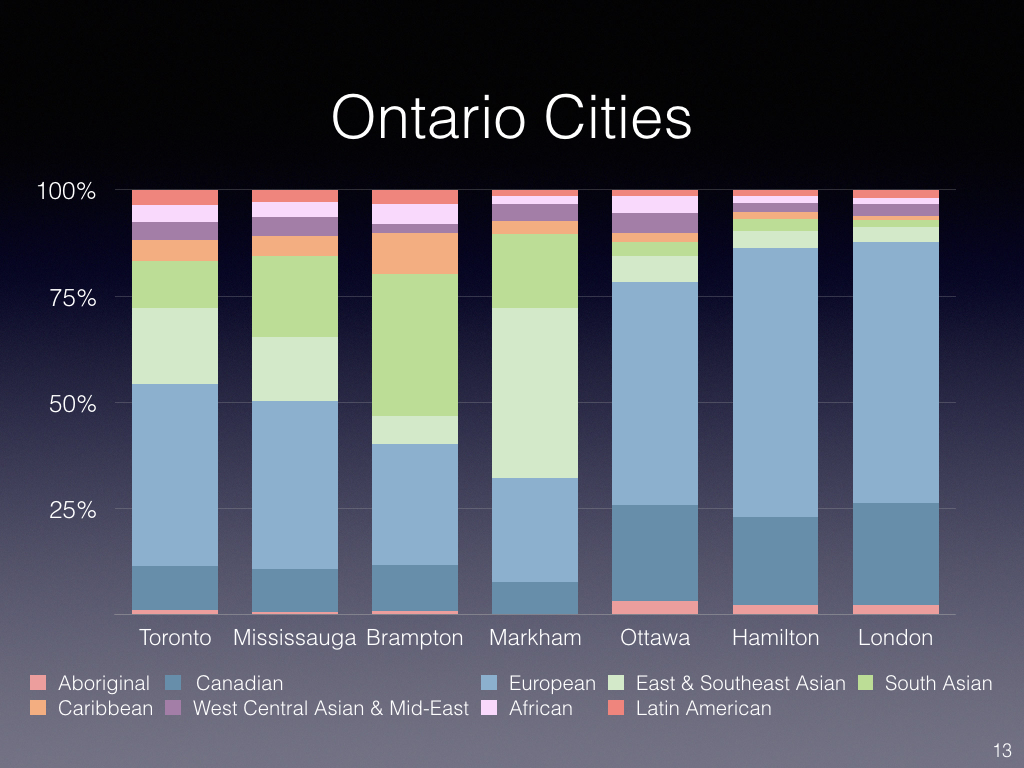
Two out of three immigrants move to Toronto, Montreal or Vancouver.

That means immigrants are almost 2.5 times more concentrated in Canada’s three largest cities than is the total population (only 27 per cent of whom live in these cities).

Despite a phrase often heard in discussion of immigration — “Canada is a large country” — the study makes clear “absorptive capacity” is being tested almost entirely in our large cities. And virtually no city-by-city data exists on how that’s working out.

Ethnic enclaves are expanding

There is a strong tendency for newcomers to settle with members of their own ethnicity in the core of cities and, more recently, their suburbs.

“Residential concentrations of newcomers is a growing concern,” the report says, suggesting self-chosen ethnic isolation can create further barriers to full integration. [Todd somewhat overstates the deck’s observations as the analysis is more nuanced.]

Tensions exist over religious differences

Religious and cultural accommodation continues to be an issue regarding practices that are deemed in conflict with Canada’s institutions,” the report says, naming “forced marriages” and “family violence issues.” [may reflect the then Conservative government focus as these are not accommodation but criminal issues – more common ones being related to religious accommodation such as worship space, food requirements etc].

Transit hassles abound for immigrants

With Metro Vancouver residents debating whether to build a bridge or tunnel on the south arm of the Fraser River, the report shows public transit is a much bigger worry for Canada’s urban and suburban immigrants.

Although transit hassles are significant for all residents of cities such as Metro Vancouver, they’re worse in the suburbs, where many immigrants are moving.

“Recent immigrants are twice as likely to use public transit as their Canadian-born counterparts.”

What’s the way forward?

Despite trying to be frank about Canada’s immigration difficulties, the report notes the country is recognized as “a world leader in creating an environment than enables newcomers to settle and become active, productive and connected citizens.”

Canada is ranked third out of the 31 countries that welcome immigrants. The Migration Integration Policy Index rates only Sweden and Portugal as doing better at absorbing newcomers.

For obvious reasons, the index doesn’t bother comparing Canada to the majority of the world’s countries, like most of those in Africa and Asia, which either deny entry to any immigrants or allow in a trivial number.

Despite Canada’s strong ranking, the Immigration department’s report notes another disturbing finding, which could have long-term repercussions.

Second-generation visible minority immigrants, compared to first-generation immigrants, are more likely to “perceive” they’ve been subject to discrimination.

Poll results suggesting 43 per cent of Canada’s second-generation visible minority citizens are convinced they’re being treated unfairly may point to an expanding crack in the dream of cultural integration.

As for coming up with better policies, the report makes it clear Immigration officials are often in a fog about the overall effects of large-scale immigration on Canada, not to mention the impact of international students and temporary foreign workers.

There is “no comprehensive stock-taking on how Canadian institutions and cities are adapting” to immigrants and other foreign nationals, says the report. The knowledge vacuum exists across housing, health care, the regional job market, transit and more.

Source: Douglas Todd: Canada struggling to ‘absorb’ immigrants, report says | Vancouver Sun

Canadian exceptionalism: Joseph Heath | In Due Course

Joseph Heath, of UofT’s department of philosophy, in a recent post paints an overly simplistic picture of “Canadian exceptionalism.”

While many of his points are valid, there is a surprising lack of a historical perspective in his treatment of integration and limitations to his analysis of the numbers and politics.

Historical perspective: Heath seems to anchor his post on the shift towards greater support for immigration in the mid-1990s – the inflection point when more people supported immigration than opposed.

But this ignores the longer term factors that are central to Canada’s relative success. First among them is a “culture of accommodation” that, however imperfect, reflects an early accommodation between settlers and First Nations (e.g., Royal Proclamation of 1763) and between French and English settlers (e.g., Quebec Act of 1774). While more observed in the breach than the observance for most of our early history, it nevertheless provided a way of thinking that underlies Canadian discourse.

The emphasis on integration, as distinct from assimilation, emerged in 1959 as Canadian citizenship articulated that integration was a voluntary process, respect for cultural traditions was compatible with loyalty to Canada, and that the host society was ultimately responsible for newcomer acceptance. The “Other groups” chapter of the Bi and Bi Commission provided further elaboration of the integration process.

The “other groups,” such as Ukrainian Canadians, pressed for multiculturalism in order to recognize their distinct identity and contribution to the building of Canada. The end result was the multiculturalism policy of 1971 and Act of 1988.

It was not merely “inadvertently” that Canada ended up being more successful in newcomer integration, but a series of earlier actions and policy choices – immigration, settlement, citizenship and multiculturalism – that enabled us to do so.

Numbers: While Canada does have more diverse newcomers than most other countries at the national level, the same cannot be said at the regional or municipal levels. The various controversies that emerge from time-to-time in places such as Brampton, Surrey or Richmond illustrate that.

Political system:

Similarly, his treatment of how Canada’s political system lacks understanding of the numbers of new Canadian voters and their relative concentration in ridings.

The more fundamental reality is that no political party can win a majority (and would be hard placed to win a strong minority) without the support of new Canadian voters, particularly those in the suburban areas of Toronto (the 905) and Vancouver.

Moreover, he overstates the impact of the first-past-the-post system on the far right given that UKIP, at least in the 2015 election, was able to attract almost 13 percent (but less than two percent in 2017).

Personally, I find Keith Banting’s recent analysis of “Canadian exceptionalism” at a “Big Thinking” Parliament Hill event more convincing (see Big Thinking video).

The five factors of Heath:

1. Very little illegal immigration

2. Bringing people in from all over

3. A political system that encourages moderation

4. Immigrants are part of larger nation-building project

5. Protection of majority culture clear from the start

Source: Canadian exceptionalism | In Due Course