Temporary residents in Canada rise to 2.8 million ahead of government restrictions

Highlights the challenges the government has in reversing growth that it encouraged and enabled:

The number of temporary residents in Canada swelled to 2.8 million in the first quarter, underscoring the challenge facing a federal government that is looking to restrict migration to the country.

Temporary residents – a group that includes international students, people here on work permits and asylum claimants – now comprise 6.8 per cent of the total population, up from 3.5 per cent two years ago, Statistics Canada reported on Wednesday.

Over all, the population grew by roughly 243,000 or 0.6 per cent during the first quarter, bringing the total to more than 41 million.

Canada is experiencing some of its fastest population growth in decades, fuelled almost entirely by immigration. The number of temporary residents has more than doubled over the past two years, raising concerns about Canada’s ability to welcome so many people, particularly in housing markets with low supply.

Source: Temporary residents in Canada rise to 2.8 million ahead of government restrictions

J.J. McCullough: How you’re supposed to talk about immigration in Canada—and how Poilievre is poised to capitalize 

Another late to the party commentary.

I agree, however, that the Conservatives have greater licence to engage in immigration policy, not only because of the various commentary noting the need for a more measured approach but also because the Liberal government has largely accepted (or ceded) the arguments and is walking back some of its more ill-advised policies.

And even the Century Initiative appears to be flailing around, trying to remain relevant, when their fundamental premises are largely discredited:

…All this puts the Conservatives under Pierre Poilievre in an interesting position. The Canadian press, and thinky class more generally, has created a permission structure for him to run for prime minister on a platform of reducing immigration without fear of being characterized as a racist fearmonger. Polls suggest over 60 percent of Canadians both want and expect him to do this. Yet Poilievree himself has so far avoided articulating the extent to which he agrees; at his tightly scripted rallies he has no standard immigration-related applause line.

It’s possible his party is still captive to the legends of the Harper years—that they believe immigrant voters are “their” constituency to lose, and Conservatives must therefore tread lightly on rhetoric that could be seen as anti-immigrant. Despite a clearly changing tone in media coverage, the party might also simply not trust the press to accurately characterize a restrictionist Conservative immigration plan, and thus feel there’s no PR incentive to spend much time talking about the issue when they’re already enjoying such a solid lead in the polls.

Or, and perhaps most likely, Poilievre simply wants a restrictionist immigration agenda to be something he can roll out at a more politically opportune time—closer to the official fall 2025 election campaign when Canadians will be paying the most attention, and will be most aware of his promises.

Yesterday’s political taboo could be tomorrow’s ace in the hole.

Source: J.J. McCullough: How you’re supposed to talk about immigration in Canada—and how Poilievre is poised to capitalize

What struck my attention when away

Immigration

Century Initiative’s 100 million population goal by year 2100 was meant to be provocative – and isn’t a target – CEO says

Appears to be flailing around given that their fundamental arguments appear to have failed:

Ms. Lalande said the 100 million population goal for 2100 “was meant to be provocative and bold” and to “spark an economic recharge.” The ultimate objective isn’t to see a specific population number by 2100, she said, but for Canada to be strategic and thoughtful in planning for growth.

“We don’t believe that growth should happen at all costs,” she said, saying the 100 million figure “was meant to galvanize the conversation and to spark debate and discussion of what the country could be and how we need to get there.”

But she warned against curtailing immigration, saying “that approach would result in an aging, less-skilled work force, less foreign investment, less diversity and less influence” globally.

Source: Century Initiative’s 100 million population goal by year 2100 was meant to be provocative – and isn’t a target – CEO says

Government criticized for limiting immigration sponsorships to four-year-old list

Never possible to satisfy demand:

Immigrants who came to Canada with the hope that their parents or grandparents could one day join them say they feel cheated after the federal government opened a sponsorship lottery this month drawing from a four-year-old list of applicants.

They are upset because Ottawa decided to allow around 30,000 sponsorships this year, but excluded applicants from joining the program if they had not registered an interest in 2020.

Some told The Globe and Mail that if they can’t successfully sponsor their relatives at some point, they may have to leave this country themselves to take care of them.

Immigration, Refugees and Citizenship Canada (IRCC) is sending out 35,700 randomly selected invitations to Canadian citizens and permanent residents to apply for the Parents and Grandparents Program (PGP).

The invitations are drawn from a list of 200,000 people who expressed an interest in sponsoring their relatives in 2020.

Not everyone who receives an invitation to apply will submit a PGP application; however, IRCC said it ultimately expects around 32,000 grandparents and parents to qualify for permanent residence….

Source: Government criticized for limiting immigration sponsorships to four-year-old list

Caregivers from abroad to be given permanent residence on arrival under new pilot programs

Of note, addressing some past concerns:

The pilots, which are enhanced versions of two programs set to expire on June 17, will put qualified nannies, child-care and home-support workers on a fast track to settling in Canada.

Caregivers working for organizations that provide temporary or part-time care for people who are semi-independent or recovering from an injury or illness will also qualify under the new programs, which Immigration, Refugees and Citizenship Canada (IRCC) said will later become permanent.

Canada will admit more than 15,000 caregivers as permanent residents in the next two years, as part of Canada’s overall immigration targets, according to IRCC.

“Caregivers play a critical role in supporting Canadian families, and our programs need to reflect their invaluable contributions,” Mr. Miller said in a statement….

Source: Caregivers from abroad to be given permanent residence on arrival under new pilot programs

Canada needs an Immigrant Bill of Rights

Hard to see how adding another layer will necessarily improve processing and client service compared to addressing systemic issues:

This is why in a new report entitled Let’s Clean Up Our Act, the Canadian Immigration Lawyers Association (CILA) encourages the federal government to introduce an Immigrant Bill of Rights to provide newcomers with greater protection and an enhanced experience. 

We also believe the Immigrant Bill of Rights should be complemented by introducing an Ombudsperson for Immigration, Refugees, and Citizenship Canada (IRCC), and the Canada Border Services Agency (CBSA). 

These recommendations are far from novel or controversial.  

Numerous federal departments and agencies already have a bill of rights and/or ombudspersons.  

Source: Canada needs an Immigrant Bill of Rights

Tasha Kheiriddin: Brace for a possible tsunami of illegal migrants if Trump is re-elected

So almost a dedicated stream and pathway to citizenship? But that would require Canadian residency for at least three years, not “just being on our side:”

So what can Canada do that is positive? Apart from planning for these specific eventualities, Heyman suggests that we process as many Americans as possible for the equivalent of an American H1 Visa to Canada — not necessarily to live here, but to have a Canadian passport in their pocket and advocate for our country south of the border. “You’ve got a generational opportunity to get the top talent, people with means and skills, on your side — and possibly into your country,” Heyman said. A silver lining, perhaps, but the tsunami still looms.

Source: Tasha Kheiriddin: Brace for a possible tsunami of illegal migrants if Trump is re-elected

Rioux | «It’s the immigration, stupid!»

On the results and aftermath of the European Parliament elections and the political shakeout in France:

Son coup de tête a déjà provoqué le rassemblement de la gauche autour de son aile la plus radicale (La France insoumise) qui se complaît dans une forme de romantisme révolutionnaire flirtant avec l’antisémitisme et les appels à la violence. À droite, il a accéléré l’éclatement des Républicains, dont les jours étaient comptés, au profit d’un RN portant certes des revendications partagées par la majorité des Français, mais sans expérience ni cadres chevronnés et dont le programme économique est pour le moins boiteux.

Derrière l’apparence du combat des extrêmes, ne serions-nous pas en train de découvrir le nouveau visage de ce que sont tout simplement devenues, après une période d’effacement, la gauche et la droite ? Pour le dire simplement, la nouvelle gauche est aujourd’hui plutôt multiculturelle, wokiste et décoloniale. La nouvelle droite, plutôt nationaliste, souverainiste et conservatrice.

Dans la fureur et le chaos, nous assistons non seulement au retour de l’opposition entre droite et gauche, mais peut-être aussi de l’alternance sans laquelle aucune démocratie ne saurait survivre.

Source: Chronique | «It’s the immigration, stupid!»

Antisemitism, Israel Hamas war

Abella: What happened to the legacy of Nuremberg and the liberal democratic values we fought the Second World War to protect?

Well worth reading:

To paraphrase Martin Luther King, the arc of the moral universe may be long, but it does not always bend towards justice. And that means that too many children will never get to grow up, period – let alone in a moral universe that bends toward justice and the just rule of law.

I used to see the arc of my own life bending assertively from Nuremberg to ever-widening spheres of justice, but in this unrelenting climate of hate, I feel the hopeful arc turning into a menacing circle.

We need to stop yelling at each other and start listening, so that we can reclaim ownership of the compassionate liberal democratic values we fought the Second World War to protect, and to put humanity back in charge by replacing global hate with global hope.

My life started in a country where there had been no democracy, no rights, no justice. It instilled a passionate belief in me that those of us lucky enough to be alive and free have a particular duty to our children to do everything possible to make the world safer for them than it was for their parents and grandparents, so that all children, regardless of race, religion or gender, can wear their identities with pride, in dignity, and in peace.

Source: What happened to the legacy of Nuremberg and the liberal democratic values we fought the Second World War to protect?

Regg Cohn: Doug Ford isn’t the only one who has fumbled on antisemitism

Also well worth reading by those who have no answers to these questions:

To be sure, critics of Israel — of which I am one — are not necessarily anti-Israeli (or anti-Jewish). But a good many are so adamantly opposed to the existence of the state of Israel, for reasons of history or bigotry, that you have to ask:

Where would those millions of Jews go? Back to Poland, as some like to taunt? Here to Canada, where they feel increasingly besieged? Stay where they are in a single state where “Palestine shall be free, from the river to the sea,” subsuming and consuming the Jewish state?

Israel is guilty of many sins during its long decades of occupation, although neither side is blameless about missed opportunities. After the Oct. 7 Hamas massacre of more than 1,200 Jews and the taking of hostages, Israel’s overreaction and overreach transformed a just war of defence into a war without justifiable limits.

Source: Doug Ford isn’t the only one who has fumbled on antisemitism

Lederman: The banning of an Israeli-American graphic novelist shows how some arts organizations are rushing to judgment

Exclusion is not the answer except in extreme cases where it crosses into hate speech:

With Israel and Hamas at war, there has been so much screaming at one another, across a widening divide. What could be accomplished by having actual conversations?

This isn’t the only instance of selective targeting of Israeli, Jewish or Palestinian artists by arts organizations. With festival and awards season approaching in the fall, there is reason to fear more exclusions to come.

Source: The banning of an Israeli-American graphic novelist shows how some arts organizations are rushing to judgment

Citizenship

Mansour: Citizenship in the Multicultural State

Interesting evolution by Mansour compared to his earlier writings:

In conclusion, it might be said that the generation of 1968 was a pioneer generation in the making of a new political agenda that goes beyond the attachment to the state of which a citizen is a member. Canada has contributed to this agenda, internationalist and multicultural, through the social changes that have occurred in the years since its centenary anniversary. As a result, Canadians are in the midst of emerging new sensibilities that are more open to the world, more receptive of other cultures, more inclined to accepting international law and adjusting domestic statutes to that requirement. These changes render older political arrangements less meaningful in the twenty-first century.

Source: Citizenship in the Multicultural State

Foreign interference

Three article of interest of foreign interference and the shameful “witting” involvement of some MPs

‘Witting’ involvement changes the nature of foreign interference

NSICOP doesn’t name the parliamentarians who are witting participants in foreign interference. It raises a question about parliamentarians. It calls on the government to brief MPs about interference – and warns MPs to “reduce their vulnerabilities.”

And once again, it is another report telling the public that the Canadian government has not done enough to counter the threat of foreign interference. If anything, those warnings have grown louder.

This time, what a committee of parliamentarians has told us in clearer terms than ever is that the threat of interference from abroad includes participants here in Canada, inside Parliament, who have something to gain from dealing with foreign actors.

Source: ‘Witting’ involvement changes the nature of foreign interference

Coyne: We need to know the names of the traitor MPs, but don’t count on any of the parties to give them up

The Liberals’ tactic of deny, delay and deflect – first denying the allegations, then, when they can no longer be denied, denying they matter – has proved largely successful. Polls show that foreign interference ranks low on the public’s list of important issues. The Opposition is likely to take the hint. It was to their advantage to demand a public inquiry, so long as the government refused – and so long as they could be assured its findings would only stick to the government. But now? What’s in it for them?

For that matter, the same might apply to certain sections of the media: The report refers to Chinese officials “interfering with Canadian media content via direct engagement with Canadian media executives and journalists,” while a redacted passage cites “examples of the PRC paying to publish media articles without attribution.”

So if none of the parties is keen on turning over this rock, if law enforcement are unwilling and the media nervous – Mr. Dong’s lawsuit against Global News will have had a useful chilling effect – then the betting proposition has to be that nothing will happen. None of the MPs involved will be prosecuted, or named, or face consequences of any kind. And the public will shrug. Experience has taught them that, in this country, nobody ever faces consequences for this kind of thing.

Unless … unless a lone MP stands up in the House and names the names.

Source: We need to know the names of the traitor MPs, but don’t count on any of the parties to give them up

Yakabuski | L’ingérence étrangère et l’indifférence libérale

Tout au plus, la vice-première ministre, Chrystia Freeland, a-t-elle promis que les libéraux effectueraient « un suivi interne » dans la foulée du rapport. Comme son collègue à la Sécurité publique, elle n’a pas semblé désireuse d’aller au fond des choses. Est-ce parce que le caucus libéral compte beaucoup de députés issus des communautés culturelles qui entretiennent des relations étroites avec les représentants au Canada des gouvernements de leurs pays d’origine ? Certains de ces députés craignent, avec ou sans raison, une chasse aux sorcières dans la foulée du rapport McGuinty.

« La garantie que je peux donner aux Canadiens est que notre gouvernement prend très, très au sérieux l’ingérence étrangère », a réitéré cette semaine Mme Freeland. Or, la réaction du gouvernement au dernier rapport laisse, encore une fois, une impression contraire.

Source: Chronique | L’ingérence étrangère et l’indifférence libérale

Other

Hindutva ideology proved costly for India’s Narendra Modi

Of note:

The decade-long entrenchment of far-right ideologies in India, an over-focus on dividing Hindus and Muslims and on wealth generation for the rich eroded the country’s human rights record, judicial autonomy and press freedom.

That people with the least individual power were able to collectively push back against plans of the most powerful has rekindled the flame of democracy domestically and fanned hopes of resistance against tyranny globally.

Source: Hindutva ideology proved costly for India’s Narendra Modi

A Plea for Depth Over Dismissal

Agree:

To be clear, this article is not a plea for a return to scorecard history. Scorecard history is not a sound approach either. For, in the end, history is a qualitative discipline. Ranking prime ministers, or anyone else for that matter, is a silly exercise. Good deeds and bad deeds cannot be weighted and tallied up so that some final score can be determined. For that matter, categorizing deeds as good or bad in the first place flattens a great deal of complexity, like intentionality or unforeseen consequences, and it is precisely in that great universe of gray that real insights can be found. Insights into continuities between past and present, into how politics work in practice, and into the most accurate assessments of legacy. For the legacy of most leaders, much like the legacy of the policy of multiculturalism, will be neither entirely beneficial nor detrimental. But through a rigorous, nuanced, and deep examination of the lives and legacies of politicians and their policies, we stand to learn much about our country’s past – and its present too.

Daniel R. Meister is a Banting Postdoctoral Fellow in the Department of Political Science at the University of New Brunswick. He is the author of The Racial Mosaic (MQUP 2021).

Source: A Plea for Depth Over Dismissal

Départ difficile pour l’embauche de demandeurs d’asile dans l’industrie du tourisme

A noter. Much less interest than expected:

Québec a lancé en mai 2023 un projet pilote pour trouver un emploi dans l’industrie du tourisme à 3000 demandeurs d’asile. Un an après le début de l’initiative, seulement une cinquantaine de personnes ont été embauchées.

Le plan, accompagné d’une enveloppe de 10 millions de dollars, vise l’embauche de 1000 personnes chaque année durant trois ans. Le projet pilote a été lancé par Québec au printemps, mais il fallut attendre l’automne avant que le tout ne prenne son envol, ce qui explique en partie le bilan provisoire de 50, bien inférieur au millier d’embauches espéré pour cette première année.

« Ça ne correspond pas aux attentes qu’on s’était données. La mise en place du projet a été longue », admet Xavier Gret, le directeur général du Conseil québécois des ressources humaines en tourisme (CQRHT), qui chapeaute le projet pilote.

« Qui dit projet pilote dit essais-erreurs. Ça fait quatre fois qu’on change [les façons de faire]. Ça demande un exercice important, d’intégrer ces personnes-là. »

Ce ne sont pourtant pas les volontaires qui manquent. Environ 3200 demandeurs d’asile se sont inscrits sur la plateforme du CQRHT, dont 68 % de francophones, selon les chiffres de l’organisme. Une formation obligatoire longue de plusieurs mois ralentit l’insertion en emploi, explique par ailleurs Xavier Gret. « On les suit. C’est assez lourd. Je préfère en avoir 50 et que ça se passe bien. […] On ne veut pas vivre les histoires d’horreur d’autres endroits sur les questions d’intégration. »

Des critères ont aussi été ajoutés « au fur et à mesure » pour assurer la rétention des employés. Plusieurs demandeurs d’asile ont fini par jeter la serviette puisqu’ils ne voulaient pas travailler les soirs ou les fins de semaine ou encore devoir quitter Montréal. « Au début, on avait des emplois à Brossard pour des gens à Montréal, mais ils ne voulaient pas aller à Brossard », précise le représentant du CQRHT.

Les trois quarts de ces demandeurs d’asile ont trouvé leur place en région, notamment parce que Laval et Montréal ont retrouvé un niveau d’emploi comparable à celui d’avant la pandémie, note le CQRHT. Quelque 22 000 postes vacants demeurent tout de même à pourvoir dans l’industrie québécoise du tourisme.

« Si c’est 50, c’est 50 de plus », soutient Véronyque Tremblay, p.-d.g. de l’Association Hôtellerie du Québec, qui dit avoir toujours confiance en l’importance de ce plan. De ce nombre, 35 ont trouvé un emploi dans l’hébergement, souligne-t-elle, souvent dans « des postes pas évidents à combler ».

« C’est la première année [d’un projet pilote de trois ans]. On y croit toujours », renchérit Martin Vézina, de l’Association Restauration Québec. « Pour le moment, on retient le chiffre de 50. Mais il y en a 300, dans le pipeline, qui s’en viennent. Faut nous laisser démarrer. »

Kateri Champagne Jourdain, ministre de l’Emploi et initiatrice du projet pilote, souhaite attendre davantage avant de tirer des conclusions. « L’été marque la haute saison touristique, et les organismes chargés du déploiement nous assurent qu’il y aura plus d’embauches dans les prochains mois. Nous serons alors plus à même de constater si l’initiative porte fruit », a répondu son cabinet par écrit.

Logement, productivité et paradoxe

Dans bien des endroits, le « filtre » du logement freine l’embauche de ces demandeurs d’asile, observe Jean-Philippe Chartrand, directeur du développement et du tourisme durable chez Tourisme Gaspésie. Une « minorité » d’entreprises en tourisme possèdent le luxe d’une chambre destinée à loger des employés. « Ça ne marche pas de dire : “Je t’offre un emploi ; tu te trouveras une place où dormir.” C’est pratiquement l’inverse aujourd’hui. »

Ensuite, « on n’a pas vu beaucoup de gens passer à l’acte ». Une quinzaine d’entreprises se sont montrées intéressées en Gaspésie, par exemple, mais une seule est finalement venue à la réunion d’information.

La pénurie de main-d’oeuvre cause un « paradoxe » chez les gestionnaires, ajoute Jean-Philippe Chartrand. « Nos chefs d’entreprise sont débordés à cause de la pénurie de main-d’oeuvre, au point où ils n’ont plus le temps de venir aux réunions pour parler de solutions à la pénurie. »

Devant ces difficultés, ils misent de plus en plus sur l’amélioration de la productivité afin de fonctionner « avec moins de main-d’oeuvre », avance-t-il, car ce virage offrirait plus de garanties sur le long terme.

Demandeurs d’asile contre travailleurs temporaires

Les employeurs se tournent toujours davantage vers les travailleurs temporaires pour pourvoir leurs postes. Or, les demandeurs d’asile qui se trouvent déjà au pays devraient être privilégiés, a fait valoir le gouvernement fédéral un peu plus tôt ce printemps.

Depuis le 1er mai, les employeurs doivent évaluer toutes leurs options avant de recruter des travailleurs temporaires, « y compris le recrutement auprès des demandeurs d’asile ayant un permis de travail valide au Canada », indique le règlement fédéral.

Ces personnes au passé parfois difficile doivent s’adapter au marché du travail québécois, mais leur embauche ne coûte rien aux entreprises. Engager un travailleur temporaire, en revanche, peut coûter des milliers de dollars en frais d’immigration

Source: Départ difficile pour l’embauche de demandeurs d’asile dans l’industrie du tourisme

Emigration to the U.S. hits a 10-year high as tens of thousands of Canadians head south

The ration of emigration to the USA to immigration has, however, remained relatively constant: under 30 percent. So while concerning, the rate of churn does not appear to have changed significantly. The respective percentages of born in Canada, born in USA or born elsewhere (the immigrant/emigrant churn) do not appear to have changed significantly even has the overall numbers grew in 2022:

Tens of thousands of Canadians are emigrating to the United States and the number of people packing up and moving south has hit a level not seen in 10 years or more, according to data compiled by CBC News.

There’s nothing new about Canadians moving south of the 49th parallel for love, work or warmer weather, but the latest figures from the American Community Survey (ACS) suggest it’s now happening at a much higher rate than the historical average.

The ACS, which is conducted by the U.S. Census Bureau, says the number of people moving from Canada to the U.S. hit 126,340 in 2022. That’s an increase of nearly 70 per cent over the 75,752 people who made the move in 2012.

Of the 126,340 who emigrated from Canada to the U.S. that year, 53,311 were born in Canada, 42,595 were Americans who left here for their native land, and 30,434 were foreign-born immigrants to Canada who decided to move to the U.S. instead.

That Canadian-born figure is notably higher now than it has been in the past. It’s up roughly 50 per cent over the average number of Canadians born in Canada who left for the U.S. in the pre-COVID period.

United Nations data compiled by Statistics Canada and shared with CBC News shows the U.S. is by far the most common destination for Canadian emigrants.

There were about 800,000 Canadians living in the U.S. as of 2020, eight times more than the 100,000 who live in the U.K., according to the latest UN figures.

A number of Facebook groups have popped up to help Canadians make the move. Recent arrivals use them to share tips on how to secure a visa or green card, where to live and what to do about health insurance.

One group called “Canadians Moving to Florida & USA” has more than 55,000 members and is adding dozens of new members every week.

The real estate agents and immigration lawyers who help Canadians make the move say the surge is being driven partly by a desire for a more affordable life.

But there are also people who say they have lost faith in Canada under Prime Minister Justin Trudeau’s leadership and want to pursue the American dream instead, these agents and lawyers said.

Marco Terminesi is a former professional soccer player who grew up in Woodbridge, Ont. and now works as a real estate agent in Florida’s Palm Beach County with a busy practice that caters to Canadian expats.

‘I hate the politics here’

Terminesi said his phone has been ringing off the hook for the last 18 months with calls from Canadians wanting to move to sunny Florida.

“‘With Trudeau, I have to get out of here,’ that’s what people tell me. They say to me, ‘Marco, who do I have to talk to to get out of here?'” Terminesi told CBC News.

“There’s a lot of hatred, a lot of pissed-off calls. It was really shocking for me to hear all of this.

“And I’m not sure all of these people are moving for the right reason. People are saying, ‘I hate the politics here, I’m uprooting my whole family and moving down,’ and I say, ‘Well, that problem could be solved in a year or two.'”…

Source: Emigration to the U.S. hits a 10-year high as tens of thousands of Canadians head south

Locked out by Canada’s family reunification program: These immigrants can’t even get into the queue to sponsor parents and grandparents

No easy way to manage given that demand always exceeds levels (various governments have tried different approaches) and P&Gs exacerbate aging demographics:

…Canada has a lottery system that rations a limited number of sponsorship spots for parents and grandparents. Canadian citizens and permanent residents must submit an expression of interest to enter the pool each year; only those who are randomly drawn are “invited” to apply. Officials will then screen them for eligibility based on criteria such as a sponsor’s income level. 

However, during the pandemic, the Immigration Department delayed the opening of the program in 2020 for other priorities amid lockdowns and border closures. Despite promising to reopen the program the following year, it has remained closed to new expressions of interest.

Potential sponsors were outraged earlier this month when the Immigration Department again announced it was sticking to the same 2020 candidate pool.

“Starting May 21, we will invite 35,700 potential sponsors from the pool of remaining interest to sponsor forms submitted in 2020 to sponsor parents and grandparents,” the department said in a post on X, formerly Twitter.

“We will send out invitations over the course of approximately two weeks. If you submitted an interest to sponsor form in 2020, please check the email address you used at that time.”…

Source: Locked out by Canada’s family reunification program: These immigrants can’t even get into the queue to sponsor parents and grandparents

Keller: The latest unintended consequence of Liberal immigration policy

The latest from Keller, raising legitimate fears on the possible impact on public support for immigration. No win for the government as any measures they take will be opposed by activists on the left and conservatives on the right:

….The Liberals are under pressure from left-wing groups to offer many of them citizenship. But doing so would set a precedent, and open a Pandora’s Box of consequences.

It would encourage aspiring immigrants who do not qualify for the limited number of permanent residency spots to simply ignore the expiry of their work or student visas and remain in the country, pending amnesty. Ditto failed refugee claimants. Ditto people who overstay a tourist visa.

It would reinforce the growing impression, which student and worker recruiters around the world are selling, that crossing the Canadian border, by whatever means, is a smooth road to Canadian citizenship.

But for the Trudeau government, the most compelling reason to tread carefully in this area may be political. Canadian citizenship as a reward for flouting immigration law is going to tick off a lot of Canadians. I suspect the most hardboiled and unapologetic will be those people who queued up, followed the rules and entered during daylight hours: immigrants.

Source: The latest unintended consequence of Liberal immigration policy

Éditorial | La CAQ en quête de renforts

Le Devoir’s take of Canada-Quebec discussions on immigration and the related political considerations:

Le disque caquiste sur la trame de l’immigration temporaire et de la capacité d’accueil du Québec a si souvent tourné que François Legault se cherche de nouveaux auditeurs, contraint d’admettre qu’il n’a toujours pas réussi à influencer son principal interlocuteur fédéral. En implorant maintenant les Québécois de l’épauler enfin dans cette mission de persuasion contre Ottawa, le premier ministre du Québec devrait prendre garde de ne pas frôler ainsi dangereusement l’aveu d’échec.

La redondance était telle que les courriéristes parlementaires qui s’étaient déplacés au conseil général de la Coalition avenir Québec (CAQ), cette fin de semaine, ne se sont même pas donné la peine, ou presque, de faire état de cette énième sortie de François Legault contre le refus d’Ottawa de freiner l’arrivée croissante d’immigrants temporaires en sol québécois.

« Le problème, c’est leur nombre », a-t-il répété. Lequel « affecte les services que l’on donne à l’ensemble des Québécois » et « met de la pression sur la langue française ». « L’heure est grave pour notre nation », a-t-il renchéri, en se dédouanant par la même occasion des manques de services en santé et en éducation ou de l’offre insuffisante de logements.

« C’est le gouvernement fédéral qui a créé ce problème. C’est à lui de le régler rapidement », a-t-il plutôt ordonné. « Mais pour y arriver, j’ai besoin de l’appui des Québécois. Il faut que les Québécois convainquent le gouvernement fédéral d’agir rapidement », a-t-il supplié, dans son discours de clôture du rassemblement partisan.

Le jovialisme exposé par le premier ministre du Québec à l’issue de sa rencontre avec son homologue fédéral ce printemps était donc de toute évidence utopique. Là où François Legault avait choisi de voir de l’« ouverture » de la part de Justin Trudeau ne se cachait finalement qu’une banale et spécieuse politesse, à en croire le dépit qu’il affiche aujourd’hui.

L’octroi de visas n’a pas encore été resserré, malgré la demande du gouvernement québécois. L’exigence possible d’une maîtrise du français pour les travailleurs temporaires arrivant par le biais du Programme de mobilité internationale, qui relève d’Ottawa, n’avancerait pas non plus selon le camp québécois. Sa demande de remboursement de 1 milliard de dollars pour l’accueil de demandeurs d’asile risque quant à elle de n’être qu’en partie enfin accueillie.

Ne s’en remettre qu’à l’espoir d’un rapport de force avec le gouvernement fédéral, avec l’aide de la population québécoise cette fois-ci puisque celle d’une majorité parlementaire n’a pas suffi, semble mince comme stratégie. Rien n’indique que Justin Trudeau et ses ministres tendront soudainement l’oreille aux défis pourtant réels vécus sur le terrain au Québec. Leur obstination chronique indique tout le contraire. Or, le coffre à outils qu’avait laissé miroiter ce printemps le gouvernement caquiste pour forcer la main d’Ottawa semble finalement dégarni.

Quant à l’idée d’un référendum sectoriel, qu’il avait lui-même ravivée, François Legault rétorque que l’issue en est déjà connue, puisque la moitié des Québécois et les deux tiers des électeurs décidés ont confié à la firme Léger souhaiter le rapatriement des pouvoirs en immigration. Évacuer désormais cette possibilité lui évite surtout l’obligation de résultat, hasardeuse, qui s’ensuivrait.

Son gouvernement a donc préféré lancer de nouvelles propositions dans un tout autre champ d’action : la tenue d’une commission parlementaire spéciale et transpartisane sur les effets des écrans et des réseaux sociaux sur les jeunes Québécois. Si cette étude va de l’avant, il ne faudra pas moins en surveiller les recommandations, et surtout la probabilité qu’elles soient respectées, puisque les initiatives qui ont à l’étranger tenté tant bien que mal d’encadrer l’utilisation de plateformes Web ou de réseaux sociaux ont, en règle générale, échoué.

Alors que tous les yeux étaient rivés sur l’autre conseil national de la fin de semaine, celui de Québec solidaire (QS) à Jonquière, les caquistes auront été soulagés d’y voir émerger un possible début de trêve. Cette accalmie dans la guerre intestine qui guettait QS leur permet d’espérer que le débat politique perdurera également sur un axe idéologique politique plutôt qu’un retour à l’axe strictement indépendantiste, ce qui aurait menacé d’écarteler leur coalition. François Legault préférera de loin se colletailler avec l’adversaire de gauche solidaire.

Ce qui n’évacuera pas pour autant l’indéniable popularité bien installée du Parti québécois et de Paul St-Pierre Plamondon. Si la population ne répond pas à l’ultime appel de François Legault, et si le gouvernement de Justin Trudeau persiste à lui faire la sourde oreille, la CAQ aura-t-elle autre chose à proposer pour faire aboutir ses demandes en immigration ? Si la Coalition avenir Québec est alors forcée de s’avouer à court de solutions face au mur fédéraliste, c’est le Parti québécois, nourri de nouvelles munitions, qui s’en réjouira.

Source: Éditorial | La CAQ en quête de renforts

Mason and MacKenzie: Now is not the time to lose faith in immigration because Canada cannot prosper without it

Platitudes rather than substance. And what do the authors mean by “throw off the institutional shackles that resist change?”

Countries worldwide have long envied Canada’s ability to attract and integrate immigrants. Yet just as our aging demography is beginning to bite, we risk losing the long-standing public consensus that immigration is good for Canada.

To boot, our GDP per capita is declining at a faster rate than that of many other advanced countries. Productivity is abysmal and Canadians are looking for solutions. 

Though Canadian support for continued growth in immigration numbers is dropping, the need for new immigrants to address our demography cannot be wished away. With more Canadians leaving the workforce than entering it each year and our total fertility rate dropping to a historic low of 1.33 in 2023, immigration is the only way to maintain the living standards and levels of services we have come to expect.

If we were to freeze Canada’s population, we would go from around 30 people over 65 per 100 working-age Canadians to over 60 per 100 in the year 2071 — an unfathomable increase in very much loved, but costly, dependants supported by each working Canadian. We must address our demography at the same time as we improve our living standards.

As Carolyn Rogers at the Bank of Canada has cried out, productivity growth is key, where our lagging measures predate current increased immigration levels by a few decades. 

Some lay blame on newcomers for decreasing businesses’ willingness to invest in equipment and technology. Why invest when you can just hire another person? This criticism is short-sighted because to overcome demography we need both more workers and more capital investment. It would be foolish to put the country into population decline. 

Immigrants can help solve the productivity problem over time. A recent Statistics Canada study showed that so-called “two-step” immigrants, who gain education or experience in Canada before becoming permanent residents, broadly earn more (reflecting higher productivity) than permanent residents without Canadian education or experience. Many of our most successful entrepreneurs are immigrants too, for example Tobias Lütke of Shopify.

Immigration is not on its own an economic silver bullet for every problem, but Canada cannot grow without newcomers’ skills and ambition. We should all welcome a renewed dialogue about our national economic, social, and humanitarian goals, since the case for improving our immigration system is strong.

The time is now to ensure the selection of immigrants selected for the economic impact are aligned with labour market needs. In its recent strategic review, Immigration, Refugees, and Citizenship Canada committed to hiring a Chief Talent Officer. We are ready to support this work through our connections to employers from coast to coast.

Immigration is of course an interconnected issue, not just an economic one. Newcomers alleviate workforce and demographic pressures but also create their own demand for housing, health care, and transportation. Concentrated in major cities, this demand can expand on the other factors driving the housing crisis — the foundations of which we laid long ago.

The recent cap on international students shows that the government is taking the issue seriously and increasingly considering the multiple factors that lead to success, like housing availability and “wraparound” support for newcomers. This is good. Prospective immigrants must be able to see a complete future here, not just a job. If they do not, more will leave for better opportunities, as Parisa Mahboubi and William Robson from the C.D. Howe Institute recently argued, or forgo coming to Canada entirely. To let this happen would be to squander our global advantage.

Our system has been the envy of the world, but as other countries compete to attract the best, we should update our policy-making to incorporate data from across the economy, with tailored thinking that nimbly responds to labour market demand. It was encouraging to attend the Better Evidence Conference this February and see rooms full of people discussing new ideas for exactly that. Better data will help Canada avoid surprises, match social infrastructure to immigration levels, and respond to changes.

It is vital that Canadians see immigration as part of our future and keep supporting it. Approval is still high, but that will only continue with successful outcomes. To achieve these, it is time to adjust course, adopt more data-driven decision making, and throw off the institutional shackles that resist change within our system.

Gillian Mason is the CEO of the Toronto Region Immigrant Employment Council. Patrick MacKenzie is CEO of the Immigrant Employment Council of British Columbia.

Source: Now is not the time to lose faith in immigration because Canada cannot prosper without it

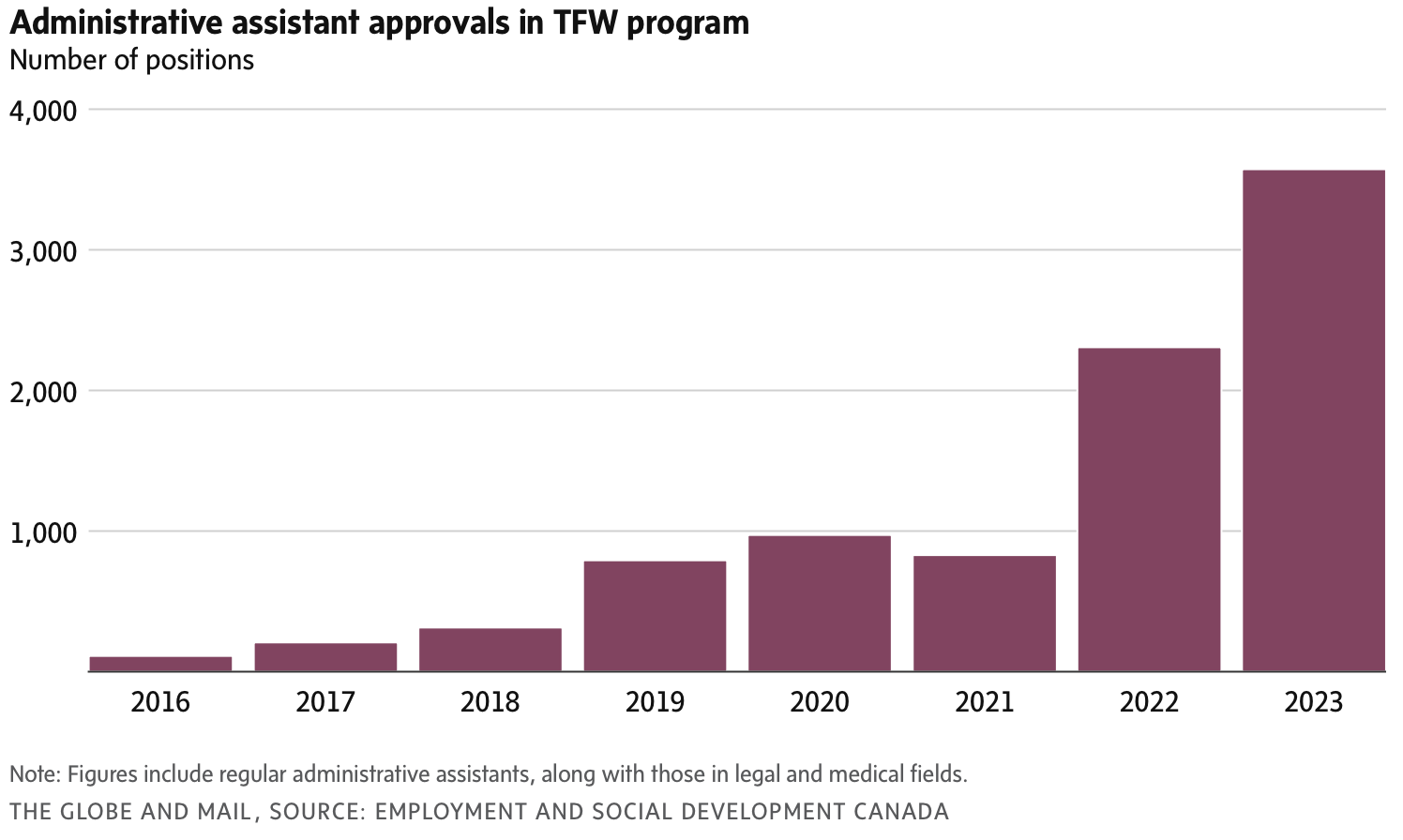
Canada’s temporary foreign worker program is archaic. Here’s how the Senate wants to change it

A start:

The federal government must modernize its archaic temporary foreign worker program by allowing migrant workers to change employers within their industry and overhauling the complicated enforcement system, says a Senate report.

To better support both workers and employers, a Migrant Work Commission should be established to oversee the program, advocate for migrant workers in Canada and serve as a single point of contact for reports of abuse and mistreatment as part of its mandate, says the study released on Tuesday.

“With so many cooks in the kitchen, it is only logical to have a head chef,” Ontario Sen. Ratna Omidvar, chair of the Senate social affairs, science and technology committee, told a news conference.

“This commission would serve as a one-stop shop for migrants who need help in asserting their rights and for employers seeking support in navigating the labyrinth of red tape, and even for government departments seeking to make their operations more efficient.”

The recommendations, however, have received a cold reception by advocates, who criticized the Senate for failing to address the structural issues of the temporary worker program.

“The fundamental power imbalance is the temporary migration system itself,” said Syed Hussan of Migrant Workers Alliance for Change. “So long we have a system of temporariness, there’s going to be inequality, injustice, abuse and exploitation.”

The Senate launched the study in late 2022 into Canada’s temporary foreign work program, which was introduced in 1973 as a stopgap measure to address the country’s labour shortages but has since grown to be an indispensable part of the Canadian labour market….

Source: Canada’s temporary foreign worker program is archaic. Here’s how the Senate wants to change it