Des milliers de cours en francisation compromis

A noter (despite the Canada-Quebec accord generous funding):

De nouvelles règles budgétaires sèment la consternation auprès des organismes en francisation. Alors que les besoins ont grimpé en flèche dans les dernières années, ils disent ne plus pouvoir accueillir de nouveaux étudiants l’automne prochain. « Un problème créé par le fédéral », selon Québec.

« C’est beaucoup de personnes qu’on ne sera pas capables de franciser l’année prochaine », déplore Carl Ouellet, le président de l’Association québécoise du personnel de direction des écoles (AQPDE). Ce dernier évalue que « des milliers » d’étudiants en francisation seront touchés.

Interpellé par Le Devoir, le gouvernement se défend en invoquant « la pression exercée par l’immigration temporaire sur les services publics ».

« On consacre déjà plusieurs ressources de notre réseau de l’éducation afin de franciser les nouveaux arrivants, et ces ressources ont augmenté de façon très importante », a indiqué par écrit le cabinet du ministre de l’Éducation, Bernard Drainville.

De 2019 à 2024, le budget de la francisation est passé de 69 à 104 millions de dollars, et le gouvernement a décidé que la hausse allait s’arrêter là, explique-t-on. « On reconnaît tous que c’est important […], mais on doit aussi respecter notre capacité de payer. Les demandeurs d’asile ne sont évidemment pas à blâmer, c’est un problème créé par le fédéral », signale le cabinet.

Or selon Carl Ouellet de l’AQPDE, en plus de priver les immigrants de cours, la décision du gouvernement fait en sorte que les centres de services scolaires (CSS) qui font de la francisation ne seront pas payés pour des cours qu’ils ont déjà donnés depuis deux ans.

Au Québec, 40 % des cours de francisation sont prodigués par les CSS par l’entremise de ce qu’on appelle la formation aux adultes. Près de 21 000 personnes y étaient inscrites ce printemps à temps plein ou à temps partiel. Le reste des cours sont offerts dans des universités, des cégeps ou des organismes communautaires.

Moins de places

Les CSS reçoivent chaque année des subventions en fonction du nombre d’étudiants des années précédentes. Or le ministère de l’Éducation du Québec a revu sa méthode de calcul des subventions, ce qui crée un trou majeur dans leurs budgets.

« Je ne vais pas pouvoir prendre de nouveaux étudiants à la rentrée », se désole le directeur d’un centre de francisation qui a demandé l’anonymat pour ménager ses relations avec le ministère. Dans son CSS, la coupe correspond à plus de 10 % du budget et à une baisse de 25 % du nombre de places disponibles pour les étudiants. « Je vais engager moins d’enseignants et je vais diminuer la cadence », dit-il.

Pour l’Association montréalaise des directions d’établissement scolaire, c’est tout simplement illogique. « C’est renversant ! Ça va complètement dans l’autre sens que [celui du] discours politique qu’on entend », avance sa présidente, Kathleen Legault.

Le gouvernement du Québec table en bonne partie sur une meilleure offre en francisation pour contrer le déclin du français au Québec. Son plan d’action présenté en avril prévoyait des investissements de 320 millions de dollars afin d’améliorer l’usage du français chez les travailleurs étrangers.

Des risques pour le reste de la formation aux adultes ?

Dans ses échanges avec les CSS ces derniers jours, le ministère de l’Éducation du Québec montre du doigt le ministère de l’Immigration, de la Francisation et de l’Intégration (MIFI). Il avance que le MIFI ne lui a pas transféré suffisamment de fonds cette année pour compenser la hausse des demandes.

« Le maintien de l’enveloppe financière est en fonction de celle transférée par le MIFI pour la francisation », écrit-il dans une communication écrite aux responsables de la francisation des CSS dont Le Devoir a obtenu copie.

Le ministère invite ensuite les CSS à prendre moins d’étudiants pour régler leur problème budgétaire. « En limitant [le] nombre d’ETP [étudiants en équivalence au temps plein] lié à la francisation, ceci laissera une marge de manoeuvre… »

Kathleen Legault craint que d’autres étudiants des CSS écopent étant donné « la pression très grande en francisation ». « Est-ce que ça va mettre en péril le financement de la formation des jeunes adultes en retard d’apprentissage ? Parce que c’est offert dans les mêmes centres. C’est ça, le danger. »

Cette situation survient dans un contexte où la gestion de la francisation au Québec connaît des ratés. L’an dernier, le gouvernement avait créé l’organisme Francisation Québec pour mieux coordonner l’offre de cours. Or la moitié des demandes sont toujours en attente, selon un rapport déposé à la fin mai par le commissaire à la langue française Benoît Dubreuil.

Dans le même rapport, M. Dubreuil a relevé que le nombre total d’heures de formation offertes en 2023-2024 correspond à « environ 2 % de celui qui aurait été nécessaire pour que l’ensemble des personnes domiciliées au Québec qui ne connaissaient pas le français puissent terminer les niveaux débutants et intermédiaires ».

Source: Des milliers de cours en francisation compromis

Javdani: Canada at a crossroads: Understanding the shifting sands of immigration attitudes

Trying to understand what his recommendation actually means in terms of concrete policies and programs: “An effective response requires a holistic strategy that integrates policy initiatives with efforts to shift political and societal narratives toward more inclusive and accurate representations of immigration and its myriad contributions to society.

Good luck trying to articulate, manage and implement that:

Canada stands at a crossroads as its 157th birthday approaches. It’s navigating shifting immigration attitudes amid global and domestic challenges. 

The ongoing politicization and polarization around immigrationin Canada underscores a critical juncture for a country celebrated for its diversity. As Canadians grapple with economic insecurity, housing crises, health-care shortages and social tensions, the immigration debate tests the nation’s values and future direction.

Recent research I conducted with two colleagues, drawing from more than three decades of data, sheds light on evolving Canadian attitudes toward immigration. Between 1988 and 2008, there was a notable 41 per cent decline in Canadians who favoured reducing immigration numbers. Yet, post-2008, this trend shifted, with Canadians who wanted reduced immigration levels rising to 40 per cent by 2019.

Changes in attitudes toward immigration in Canada, 1988 to 2019
Canadian Election Study data, calculations by authors of study on shifting immigration attitudes.

This development signals more than just changing preferences; there are deeper socio-psychological and political dynamics shaping views on immigration.

Judgments on who merits inclusion

But let’s simplify that socio-psychological jargon. Imagine society as a bustling potluck gathering. You arrive with your dish — packed with your beliefs, values and biases. Looking around, you’re judging everyone’s contributions and figuring out where you fit in. 

Social identity theory suggests it’s natural to categorize ourselves into “us” versus “them” using familiar facets of our identity, such as religion and ethnicity. Driven by our need for a positive self-image and convinced that what we have to offer is the best, we sometimes snub outsiders. 

This dynamic suggests the immigration debate delves into deeper territories of social identity. It’s about who we believe merits inclusion in our society, not just as an economic question.

Our findings suggest that economic concerns often cited in the immigration debate are just the tip of the iceberg. Beneath the surface, Canadians’ opinions on immigration are deeply influenced by aspects like religion, ethnicity, personal and familial immigration history and political leanings.

Our research finds, for example, that Christians show the least support for immigration. In contrast, Muslims — the second-largest religious group in Canada after Christians — are the most supportive of immigration. Jewish Canadians, atheists and agnostics also show strong support.

Ethnicity and immigration history also play pivotal roles in shaping our social identity. Our research indicates white people born in Canada exhibit a significantly stronger preference towards decreased immigration compared to white immigrants and ethnic minorities. 

In terms of geography, it found that Nova Scotians have the most favourable sentiments about immigration, whereas Alberta and Ontario exhibit the most negative sentiments in Canada.

This suggests a varying landscape of belonging and acceptance. Immigrants and ethnic minorities show greater openness to new immigration, likely mirroring their journeys of settling and integrating into Canadian society.

The politics of immigration

One of our most striking findings is the increasing political polarization over immigration. Our research has found that since 2006, political party identification has emerged as the foremost factor in explaining Canadians’ differing views on immigration. 

This polarization highlights that immigration is not just a social issue, but also a political tool. It is often framed and politicized seemingly to galvanize party bases rather than address the complexities of immigration and integration. 

Political parties link immigration to pressures on public finances or housing shortages during difficult periods. This amplifies anti-immigration sentiments, even if there’s no direct causation. This tactic also elevates immigration as a focal issue, intertwining it with prevailing concerns and magnifying its perceived negative impact on society.

Our study underscores the complexity of the debate. It’s not just about numbers or economics, but about deeper socio-psychological currents and political strategies. 

So, what’s the takeaway for Canada? Firstly, our findings are a wakeup call for political leaders, policymakers and the wider community. The rise in negative sentiments about immigration, especially amid challenging conditions, could have far-reaching consequences for Canada’s social harmony and economic prosperity.

Addressing anti-immigration sentiments requires engaging deeply with the socio-psychological factors that mounting evidence suggests are critical. Education is key, as studies consistently show. 

Effective response

Our vision of education, however, extends beyond traditional classrooms and involves the gradual development of an appreciation for diverse perspectives, openness and tolerance for change and diversity.

The significance of media and political parties in shaping public opinions cannot be overlooked. The way immigration is politicized through narratives of national security, economic risks and cultural identity influences both policy decisions and the public’s understanding of these policies. That means this conversation is as much a political issue as a policy challenge. 

An effective response requires a holistic strategy that integrates policy initiatives with efforts to shift political and societal narratives toward more inclusive and accurate representations of immigration and its myriad contributions to society.

Our reaction to immigration should elevate above the narrow, self-serving question of “what’s in it for us?” This perspective narrowly views immigrants as mere economic assets, neglecting their wide-ranging contributions to society. 

This viewpoint becomes particularly problematic when acknowledging that the lands currently known as Canada were first inhabited by Indigenous Peoples. As non-Indigenous people living in Canada, we all share the status of settlers, inheriting a responsibility from our colonial past. This history obliges us to extend a welcome embodying generosity and respect while looking toward our collective future.

Source: Canada at a crossroads: Understanding the shifting sands of immigration attitudes

Ottawa split on plan to let undocumented migrants apply to stay in Canada, Immigration Minister Miller says

Of note:

…Mr. Miller said there hasn’t yet been agreement within government on the program and it could take months to introduce.

He said what is causing him to pause are “views that I respect, people that care about these issues that are radically opposed and diametrically opposed, and not necessarily from people that [you] would necessarily think would have that thought process.”

Under the plan, migrants without documents, including people with Canadian children who have lived here for several years, would be able to apply for permanent residence.

The Prime Minister issued a mandate to former immigration minister Sean Fraser in 2021 that asked him to “further explore ways of regularizing status for undocumented workers who are contributing to Canadian communities.” A decision by cabinet was expected this spring.

But Mr. Miller said the program “is not something that is going to get rolled out soon” adding that polling is showing that Canadians are divided on the issue.

“If there is a clear conclusion, I will be quite clear to Canadians about it, but there isn’t one right now,” he said. “What I do know is that given the ongoing discussions, and they are ongoing – they have not come to an end – it isn’t something that I have any confidence will be rolled out in the short term.”…

Source: Ottawa split on plan to let undocumented migrants apply to stay in Canada, Immigration Minister Miller says

From fast food to construction, employers turn more and more to temporary foreign workers

Yet another example of how the government has mishandled immigration:

…Taking orders and flipping burgers

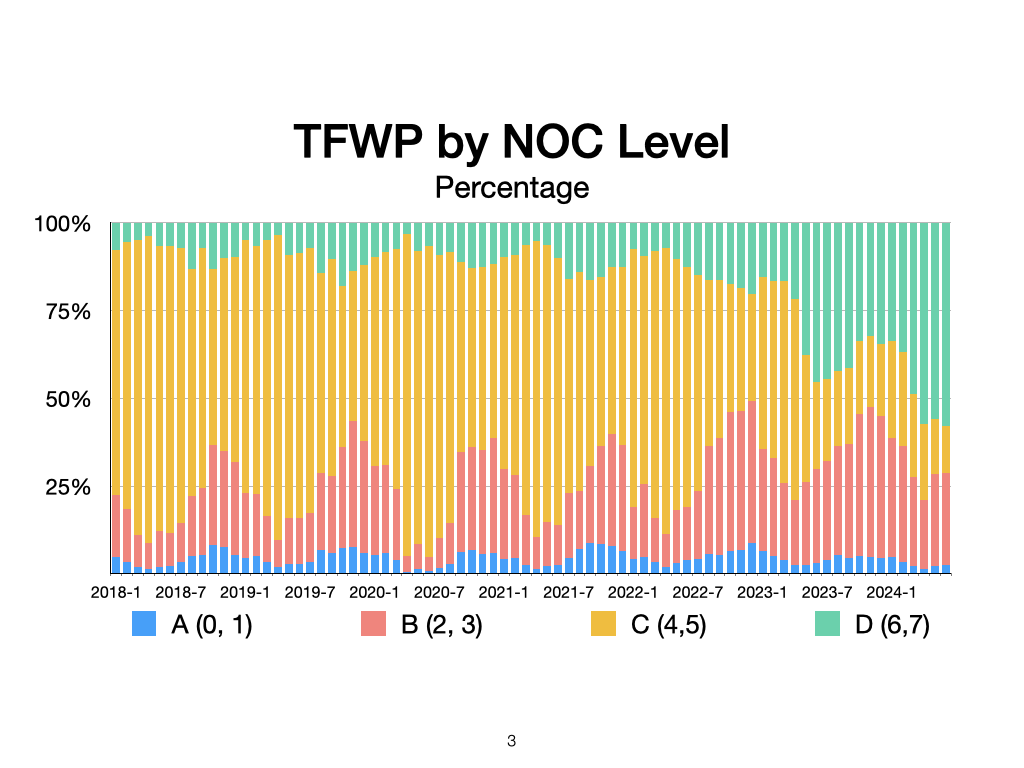
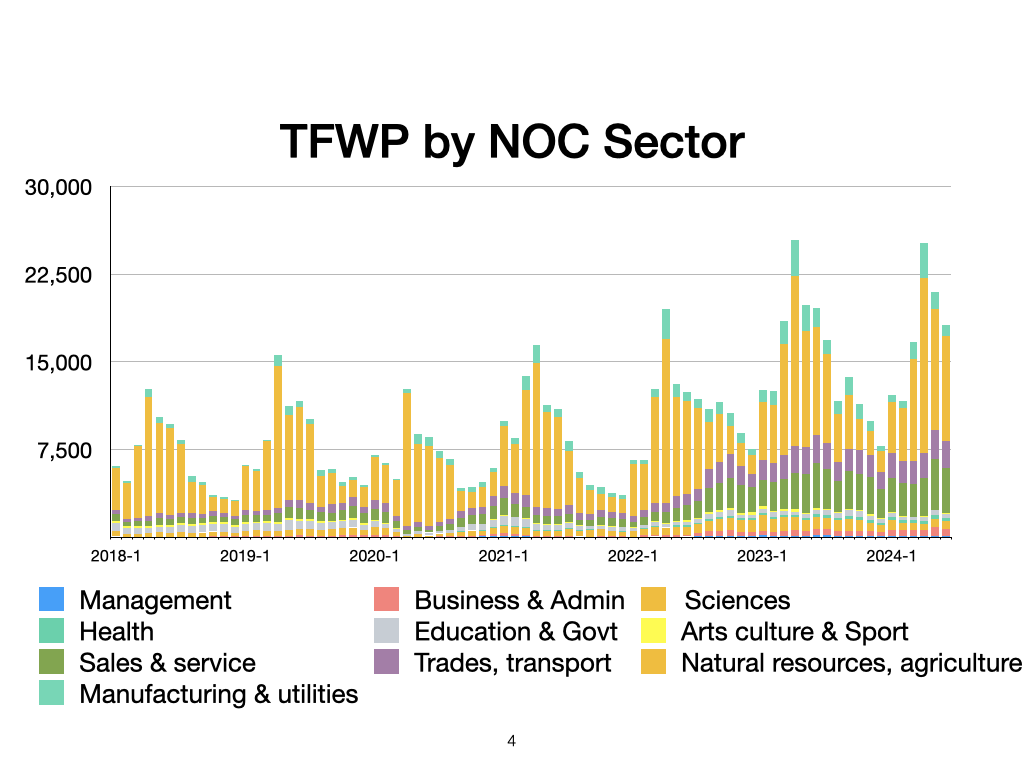
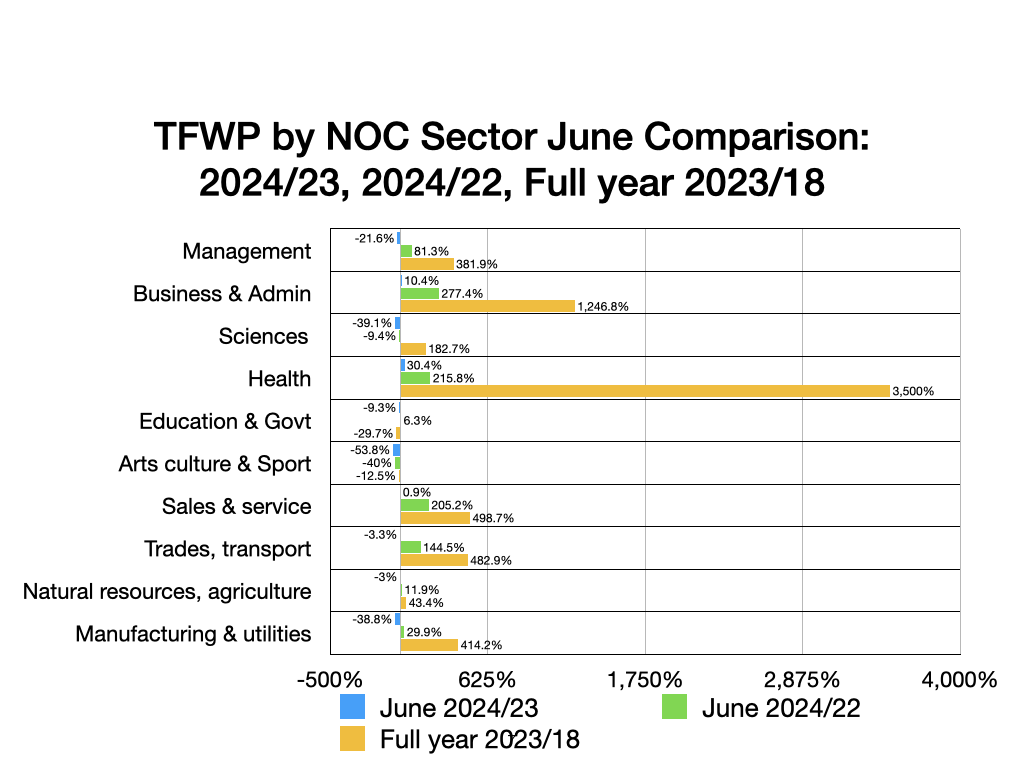
Fast food chains and restaurants are a major source of demand for temporary foreign workers. After farm and greenhouse workers, the roles with the most approvals last year were cooks, food service supervisors, food counter attendants and kitchen helpers.

Food counter attendants, in particular, increased from 170 jobs in 2018 to 8,333 in 2023. The top 10 employers cleared to hire the highest number of them last year were all fast food operators.

The relationship between the food service industry and the temporary foreign worker program has at times been fraught. Roughly a decade ago, controversy around the industry’s use of the program led the federal government to impose a temporary moratorium on that sector.

But times have changed along with labour markets. 

Citing significant labour shortages, in 2022 the federal government doubled the proportion of low-wage workers businesses could hire through the program, from 10 per cent of their workforce to 20 per cent. 

Certain sectors hit particularly hard by the pandemic, including food service, were greenlighted to hire as much as 30 per cent of low-wage staff through the program.

For businesses, a major benefit is stability, as the workers’ permits are tied to their employer, meaning they can’t easily quit to work for a rival business down the street. 

“It guarantees a worker will stay employed with them for the term of the agreement,” says the Canadian Franchise Association on its website

CBC News reached out to 14 restaurants and franchise groups cleared to hire the most cooks, food service supervisors and food counter attendants last year. 

None agreed to an interview, although a spokesperson for Franchise Management Inc., which operates Pizza Hut, KFC and Taco Bell franchises, said the program has allowed it to keep operating in rural and northern areas.

“Unfortunately, some of these communities often lack the population base to meet the demand for labour,” said Dana Myshrall in an emailed statement.

The company was cleared to hire 140 food counter attendants last year, though Myshrall said it expects to hire far fewer this year….

Source: From fast food to construction, employers turn more and more to temporary foreign workers

Canada opens its doors for Israelis due to northern escalation

Of note (published data does not include Israel as not in the top 30 countries so hard to confirm assertions by Harel):

After the Canadian government opened its doors in February due to the Israel-Hamas war by allowing Israelis to apply for a work visa until June, the country has decided to extend the immigration initiative for another year due to Israel’s escalation with Hezbollah in the North.

The work visa option for Israelis will be available until July 31, 2025.  The extension for the visa application was believed to be done after political pressure was exerted by Canada’s Jewish community as tensions in Israel continued to rise during the Israel-Hamas war.

Israeli citizens must meet two conditions in order to receive the visa.

The first requirement is that they have a tourist visa in their possession, regardless of their arrival date. The second requirement is that the Israeli citizen must have relatives who are Canadian citizens or holders of permanent residency. 

Michal Harel, who moved to Canada in 2019, established the non-profit website ovrimtocanada.com with her husband.

According to Harel, thousands of Israelis have moved to Canada since the start of the immigration initiative, and following the announcement of its extension, hundreds more families are expected to move to make the move as well. “According to our estimates, thousands of Israelis have arrived. Thousands of people have contacted us, and surely some have arrived even without contacting us,” she said.

“Since moving to Canada in 2019 we’ve been helping Israelis make the big move up north,” the website says.

Source: Canada opens its doors for Israelis due to northern escalation

Globe editorial: The right question to ask about international students and housing

Great summary:

…Ultimately, Ottawa must act to fix the incentive structure that has contributed to the lack of affordable housing. As we’ve argued before, students should be limited to on-campus work. Ottawa should not guarantee permanent residency for international students, although they should be able to apply. Decisive action, which to date has been lacking, will eliminate the incentives that have distorted Canada’s international student system.

That action starts with asking the right question: how can Ottawa fix the mess it has made?

Source: The right question to ask about international students and housing

Krikorian: Donald Trump, Immigration Expansionist

From the US right wing largely anti-immigration crowd. Comments on how this approach would “would turn every university (and community college!) into a citizenship-selling machine.” Sounds somewhat familiar to some of our education institutions and provincial ministries?

In a podcast this week with several tech investors, Donald Trump said he wants to give green cards to any foreign student who graduates from a U.S. institution. (The full interview is here; the immigration comments start at about 43:40.)

It’s true that his staff has subsequently tried to walk some of this back, but his comments shouldn’t surprise anyone.

While Trump’s explicit endorsement of this specific “staple a green card to every diploma” scheme is new, he’s always made clear, even during his first campaign, that he favored increased immigration. I’ve written in these pages about Trump’s support for expanded immigration here and here. And here. And here.

That said, this week’s comments by Trump really were more preposterous than usual. While he cited “people who are No. 1 in their class in top colleges,” he specifically added that foreign students getting a two-year degree from “junior colleges” should also automatically get green cards. Even lobbyists for higher ed and the tech industry aren’t this brazen. They exploit the appeal of keeping the “best and brightest” among foreign students as a means of protecting broader cheap-labor schemes, but I’ve never heard one seriously argue for giving green cards to graduates of community colleges.

If a foreign student completes a PhD in a hard science from one of the top research universities in the country, I will personally deliver a green card to their home. But someone who got an associate’s degree in communications? It’s laughable.

Trump promised the tech guys that the current situation would “end on Day One,” which is more nonsense, since any staple-a-green-card ploy would require legislation. But since this gimmick has been floating around for years, it’s worth thinking through what it would mean.

It would turn every university (and community college!) into a citizenship-selling machine. There are no numerical limits on the admission of foreign students — who number about 1 million now — and foreign students are already a major profit center for schools large and small.

But if any degree from any school would guarantee a green card (and thus U.S. citizenship, access to welfare, and the ability to bring your relatives), applications would soar at every kind of school, and new schools would pop up like mushrooms. Any residual connection that taxpayer-subsidized U.S. institutions of higher education (which is all of them, public or private) still have to the interests of the United States would be washed away by the gusher of easy foreign money. Good luck getting your kid into Hofstra, let alone Harvard.

Not to mention that elite higher education has become a hive of anti-American villainy — why reward them with a firehose of foreign cash?

In Australia the connection between foreign-student visas and permanent residence is closer to what Trump proposes, though still not automatic. The result is that foreign students account for more than 40 percent of all college enrollment and total close to 3 percent of the entire nation’s population. It’s gotten so bad there — remember, even without the automatic provision of a green card that Trump wants — that even the center-left Labour government is cracking down on foreign-student admissions.

The silver lining might be that we can start a conversation about our whole system of admitting foreign students. What’s the rationale for it? Why take any foreign students at all? Why is there no numerical limit? Why no percentage cap for any individual school? Shouldn’t the American people have a say in who moves here, rather than just university-admissions officers? Why is the hiring of foreign graduates (masquerading as students) subsidized through the Optional Practical Training program? And why is ICE so lackadaisical (even under Trump) in its oversight of foreign students, through the sleepy Student and Exchange Visitor Program?

Ceterum censeo academiam delendam esse. (The academy must be destroyed)

Source: Donald Trump, Immigration Expansionist

Trump proposes green cards for foreign grads of US colleges, departing from anti-immigrant rhetoric

Always hard to judge his thoughts as to the degree of seriousness in following through if elected. More likely that his harder line immigration views will prevail given the nature of organizations and possible senior appointments but essentially a version of PGWP:

Former President Donald Trump said in an interview posted Thursday he wants to give automatic green cards to foreign students who graduate from U.S. colleges, a sharp departure from the anti-immigrant rhetoriche typically uses on the campaign trail.

Trump was asked about plans for companies to be able to import the “best and brightest” in a podcast taped Wednesday with venture capitalists and tech investors called the “All-In.”

“What I want to do and what I will do is you graduate from a college, I think you should get automatically as part of your diploma a green card to be able to stay in this country. And that includes junior colleges too, anybody graduates from a college. You go there for two years or four years,” he said, vowing to address this concern on day one.

Immigration has been Trump’s signature issue during his 2024 bid to return to the White House. His suggestion that he would offer green cards — documents that confer a pathway to U.S. citizenship — to potentially hundreds of thousands of foreign graduates would represent a sweeping expansion of America’s immigration system that sharply diverges from his most common messages on foreigners.

Source: Trump proposes green cards for foreign grads of US colleges, departing from anti-immigrant rhetoric

Ibbitson: Canada may need to brace for influx of undocumented immigrants if Trump becomes president

Quite astounding that Ibbitson would essentially advocate an open door policy for the American undocumented that would likely seek coming to Canada. Such a wholesale approach, in the context of already excessive levels of permanent and temporary migration, would undermine further any pretence of a managed immigration system, not to mention the increased burden on healthcare, housing and infrastructure.

Since many of the undocumented are lower skilled, such an approach would further weaken Canada’s productivity.

In terms of the academics quoted, Macklin is correct regarding the practical difficulties of effectively expelling over 10 million people but may be discounting that a Trump 2 administration will be more ideological and is actively looking at how to effect such policy.

Somewhat puzzled by Lieu’s comment dismissing the importance of numbers on public confidence. While true that it may depend more on “proper supervision,” rapid growth in numbers becomes a proxy for lack of proper supervision, as Roxham Road and previous irregular arrivals attest, not to mention IRCC’s many issues and challenges in managing current flows.

In any case, Mr. Trump might welcome the departure of undocumented immigrants across the northern border and scrap the agreement himself.

In the event of a Trump victory, Canada should be ready to welcome as many new arrivals from the United States as possible, regardless of their immigration or citizenship status.

They would represent a silver lining to the very dark thundercloud of a second Trump presidency.

Source: Canada may need to brace for influx of undocumented immigrants if Trump becomes president

With dipping study permit approval rates for international students, Canada may not meet its reduced target

Classic case of how planned and needed changes/corrections can either under or over shoot planned targets:

Canada’s processing of new study permits has fallen by half since rules were changed to rein in the number of international students, and the decline is so steep that it may not even meet its reduced 2024 target, according to the latest immigration data.

The free fall is the result of a considerable drop in Indian students’ applications and the rising overall refusal rate for study permits, says an analysis of the first-quarter data from the Immigration Department.

“The Canadian international education landscape has evolved considerably over the past six months,” said the insight report released on Wednesday by ApplyBoard, an online marketplace for learning institutions and international students.

“The data is starting to illustrate the effects of these updated policies.”

Since January, Ottawa made a number of changes to slow the intake of international students, with the aim of reducing the new study permits issued by 28 per cent to 291,914 from last year’s 404,668. To reach that target, immigration officials will have to process a total of 552,095 applications, based on a projected 40 per cent refusal rate….

Source: With dipping study permit approval rates for international students, Canada may not meet its reduced target