Urback: The chilling case of Mahmoud Khalil should enrage anyone who purports to support freedom

Agree (writing this from LA):

…We’d also be foolish to assume that what starts with Mr. Khalil will end with him. There could be a genuine risk to Canadian visitors in the United States when the government will so willingly forfeit due process rights for non-citizens. (The plight of Canadian Jasmine Mooney, who was sent to a detention centre for nearly two weeks after trying to renew her visa, is evidence of that.) The administration could very well move from targeting green-card-holders to citizens, similarly relying on obscure legal provisions. Or they could ignore the law altogether, which Mr. Trump has recently signalled he has few qualms about doing.

In short, Mr. Khalil’s case is a chilling sign of U.S.’s slide into autocracy. Those on all sides of the Israel-Palestine debate should resist it.

Source: The chilling case of Mahmoud Khalil should enrage anyone who purports to support freedom

LoP: Immigration Detention in Canada 

Another useful primer by the Library of Parliament:

Canada’s immigration detention system is governed by the Immigration and Refugee Protection Act (IRPA), the Immigration and Refugee Protection Regulations(the Regulations) and the international human rights treaties ratified by the government. The Canadian Border Services Agency (CBSA) is responsible for managing the detention process of foreign nationals and permanent residents, while the Immigration Division of the Immigration and Refugee Board of Canada reviews immigration detention decisions.

Canadian legal framework for immigration detention

The reasons for which a foreign national or permanent resident may be detained in Canada are set out in the IRPA, and include detention:

  • upon entry into Canada, to complete an examination and confirm identity;
  • for suspected inadmissibility on grounds of security, human rights violations or serious crimes;
  • based on a reasonable belief that the person is a danger to the public; and
  • based on doubt that they will appear for an examination, an admissibility hearing or a related legal proceeding.

The Regulations set out further factors to be considered when determining whether to detain an individual, including any past criminal convictions, links to organized crime, organized human smuggling or trafficking, or unwillingness to cooperate with government officials to establish their identity.

According to the CBSA’s recent data on persons detained, by ground for detention, most individuals are held for administrative reasons and pose no risk to the public.

When a person is detained, the Immigration Division reviews the grounds for detention within 48 hours and again within the next 7 days, then every subsequent period of 30 days. The Canadian Charter of Rights and Freedoms requires that a person subject to the IRPA’s detention review process has access to a meaningful and robust review that considers the context and circumstances of their individual case. Every person must have a real opportunity to challenge their detention. During the detention review, the Minister of Public Safety and Emergency Preparedness, through designated officials, must demonstrate that there are reasons that continue to warrant detention. The Immigration Division may order the release of a foreign national and impose any conditions it deems necessary.

There is no limit to the period for which a person can be held in immigration detention. As shown in Table 1, in 2023–2024, a person held for immigration purposes was detained, on average, for 19 days. However, the median shows that, between 2012–2013 and 2023–2024, one half of immigration detainees were held for three days or less….

Source: Immigration Detention in Canada

Discovery of secret list of alleged Nazi war criminals in Canada raises questions about government secrecy

Of note (embarrassing to various Canadian governments that refused their release):

U.S. researchers have found what they say is a late draft of a secret list of more than 700 suspected Nazi war criminals believed to have settled in Canada after the Second World War, prompting fresh calls for the federal government to finally unseal and release the full list.

A research team led by UCLA historian Jared McBride, an expert on war crimes in the Second World War, has unearthed what he concludes is an annotated version of the list of alleged war criminals in this country examined by a 1986 Commission of Inquiry led by retired Superior Court of Quebec judge Jules Deschênes.

Anonymized descriptions of such individuals living here were published in Part 1 of the Deschênes inquiry report. But the second half of the report, naming them, has been kept secret for decades, despite calls to release it, including from historians, Jewish groups and the Canadian Polish Congress.

Last year, the government rejected an access to information request from The Globe and Mail to make it public. The Globe has seen the list of names, and accompanying notes on their investigation, unearthed by the UCLA team.

Jaime Kirzner-Roberts, senior director of policy and advocacy at the Friends of Simon Wiesenthal Center, said “there is no longer any rationale for the government to continue to keep these documents secret.”

“The government must immediately release the full case files and once and for all reckon with the truth instead of preserving the shameful cover-up that has shielded war criminals for so many years,” she said.

Prof. McBride found the partly redacted ledger, which includes notes on identity checks, in a batch of documents collated by the RCMP in the Canadian government’s archives….

Source: Discovery of secret list of alleged Nazi war criminals in Canada raises questions about government secrecy

Immigration matters in health care

Good communications initiative by IRCC, applied across different sectors. Of course, only emphasizes the positive and not the extra demand that a larger population creates but still useful reference for those covering immigration and other sectors:

More than 1.9 million people work in Canada’s health care sector and many more will be needed in the coming years to ensure continued access to high-quality care.

Over 420,000 workers in the health care sector are over the age of 55, and most of these will be retiring in the next decade or so. In addition, there are existing recruitment challenges from everywhere in Canada for nurses, residential care staff and home health care staff. There’s a clear opportunity for immigrants to play an important role in ensuring there are enough people working in the health care sector.

The sustainability and effectiveness of the Canadian health care system depends on an integrated and diverse workforce. We value the important contribution of immigrants to our health care system and welcome them to Canada!

Claire Betker, RN, MN, PhD, CCHN(C), Former President of the Canadian Nurses Association

Impact of immigration

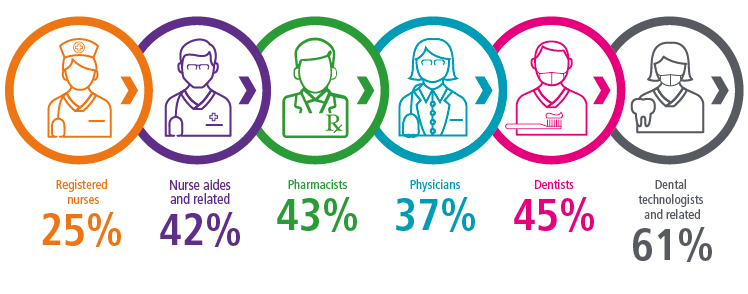
  • Immigrants account for 1 in 4 health care sector workers.
  • In Canada, immigrants make up
    • 25% of registered nurses
    • 42% of nurse aides and related occupations
    • 43% of pharmacists
    • 37% of physicians
    • 45% of dentists
    • 61% of dental technologists and related occupations
  • More than 40% of newcomers to Canada between 2016 and 2021 who were working in the health care sector were employed in the important areas of nursing and residential care facilities, as well as home health care services.

Unless otherwise noted, all statistics are from the Statistics Canada 2021 Census.

Source: Immigration matters in health care

Mooney: I’m the Canadian who was detained by Ice for two weeks. It felt like I had been kidnapped

Horrific example of bureaucracy at work, implementing the cruel and flawed policies of the Trump administration:

There was no explanation, no warning. One minute, I was in an immigration office talking to an officer about my work visa, which had been approved months before and allowed me, a Canadian, to work in the US. The next, I was told to put my hands against the wall, and patted down like a criminal before being sent to an Ice detention center without the chance to talk to a lawyer….

And that’s when I made a decision: I would never allow myself to feel sorry for my situation again. No matter how hard this was, I had to be grateful. Because every woman I met was in an even more difficult position than mine.

There were around 140 of us in our unit. Many women had lived and worked in the US legally for years but had overstayed their visas – often after reapplying and being denied. They had all been detained without warning.

If someone is a criminal, I agree they should be taken off the streets. But not one of these women had a criminal record. These women acknowledged that they shouldn’t have overstayed and took responsibility for their actions. But their frustration wasn’t about being held accountable; it was about the endless, bureaucratic limbo they had been trapped in.

The real issue was how long it took to get out of the system, with no clear answers, no timeline and no way to move forward. Once deported, many have no choice but to abandon everything they own because the cost of shipping their belongings back is too high.

I met a woman who had been on a road trip with her husband. She said they had 10-year work visas. While driving near the San Diego border, they mistakenly got into a lane leading to Mexico. They stopped and told the agent they didn’t have their passports on them, expecting to be redirected. Instead, they were detained. They are both pastors.

I met a family of three who had been living in the US for 11 years with work authorizations. They paid taxes and were waiting for their green cards. Every year, the mother had to undergo a background check, but this time, she was told to bring her whole family. When they arrived, they were taken into custody and told their status would now be processed from within the detention center.

Another woman from Canada had been living in the US with her husband who was detained after a traffic stop. She admitted she had overstayed her visa and accepted that she would be deported. But she had been stuck in the system for almost six weeks because she hadn’t had her passport. Who runs casual errands with their passport?

One woman had a 10-year visa. When it expired, she moved back to her home country, Venezuela. She admitted she had overstayed by one month before leaving. Later, she returned for a vacation and entered the US without issue. But when she took a domestic flight from Miami to Los Angeles, she was picked up by Ice and detained. She couldn’t be deported because Venezuela wasn’t accepting deportees. She didn’t know when she was getting out.

There was a girl from India who had overstayed her student visa for three days before heading back home. She then came back to the US on a new, valid visa to finish her master’s degree and was handed over to Ice due to the three days she had overstayed on her previous visa.

There were women who had been picked up off the street, from outside their workplaces, from their homes. All of these women told me that they had been detained for time spans ranging from a few weeks to 10 months. One woman’s daughter was outside the detention center protesting for her release….

The reality became clear: Ice detention isn’t just a bureaucratic nightmare. It’s a business. These facilities are privately owned and run for profit.

Companies like CoreCivic and GEO Group receive government funding based on the number of people they detain, which is why they lobby for stricter immigration policies. It’s a lucrative business: CoreCivic made over $560m from Ice contracts in a single year. In 2024, GEO Group made more than $763m from Ice contracts.

The more detainees, the more money they make. It stands to reason that these companies have no incentive to release people quickly. What I had experienced was finally starting to make sense.

This is not just my story. It is the story of thousands and thousands of people still trapped in a system that profits from their suffering. I am writing in the hope that someone out there – someone with the power to change any of this – can help do something.

The strength I witnessed in those women, the love they gave despite their suffering, is what gives me faith. Faith that no matter how flawed the system, how cruel the circumstances, humanity will always shine through.

Even in the darkest places, within the most broken systems, humanity persists. Sometimes, it reveals itself in the smallest, most unexpected acts of kindness: a shared meal, a whispered prayer, a hand reaching out in the dark. We are defined by the love we extend, the courage we summon and the truths we are willing to tell.
Source: I’m the Canadian who was detained by Ice for two weeks. It felt like I had been kidnapped

Canada’s temporary resident population declines for the first time in 3 years

Corrective action working, although Skuterud notes not enough:

The number of temporary residents in Canada has declined for the first time in three years, in the wake of a series of policy changes introduced by Ottawa last year to reduce immigration levels.

New data from Statistics Canada shows that there were roughly 30,000 fewer non-permanent residents in the country as of Jan. 1, 2025, compared to Oct. 1, 2024.

The total number of non-permanent residents stood at just over three million people, or 7.3 per cent of the population, down from 7.4 per cent the previous quarter.

The decrease in the number of temporary residents is causing overall population growth to slow. In the fourth quarter of 2024, the population grew by 0.2 per cent to roughly 41.5 million people, the slowest rate of growth since late 2020, when many border restrictions were in place because of the pandemic.

Canada’s population is still increasing, just not at the rate it did in 2022 and 2023….

Achieving Ottawa’s 5-per-cent non-permanent resident target is less realistic now than a year ago, according to Mikal Skuterud, an economist at the University of Waterloo. Prof. Skuterud estimates that in order to meet the target, the number of temporary residents will have to decline by almost 32 per cent in two years.

If that happens, the Canadian population will subsequently decline by 0.4 per cent over two years, Prof. Skuterud’s calculations show….

Source: Canada’s temporary resident population declines for the first time in 3 years

Présence illégale au Canada: Record d’expulsions de ressortissants étrangers l’an dernier

Of interest:

Selon les statistiques publiées le 25 février dernier par l’Agence des services frontaliers du Canada (ASFC) compilant pour la première fois l’ensemble de l’année 2024, le Canada a effectué en un an 16 860 renvois de ressortissants étrangers. Et la tendance à la hausse se poursuivra dans les prochaines années, annonce par courriel un porte-parole de l’ASFC, puisque l’organisme fédéral souhaite atteindre les 20 000 renvois par année d’ici 2027.Plus de 80 % des ordres de renvoi ont visé des demandeurs d’asile. On reproche à ces 13 527 personnes de ne pas avoir, de façon plutôt vague, respecté la Loi sur l’immigration et la protection des réfugiés.

Aucune précision n’est cependant apportée quant à la nature exacte de ces infractions. On sait toutefois qu’il ne s’agit pas de criminalité ou de fausses déclarations, des critères d’inadmissibilité qui font l’objet d’un décompte distinct et pour lesquels on rapporte respectivement 860 et 145 cas en 2024.

Avant Trump

Pour la première fois depuis 2019, c’est le Québec plutôt que l’Ontario qui a renvoyé le plus de personnes en 2024, soit 6832. Il s’agit encore ici d’un record alors qu’en 2023, lors du précédent sommet, on avait rapporté 6021 renvois.

Source: Présence illégale au Canada Record d’expulsions de ressortissants étrangers l’an dernier

HESA: Nobody is Coming to Save Us, But

Sensible and ambitious, with potential medium and long-term benefits:

…Now, there just happens to be one kind of change that is suddenly going very cheap, and that is the ability to add top-class academic talent. The carnage down south, with the National Institutes of Health NIH being at least partially dismantled and entire universities being threatened with loss of hundreds of millions of dollars unless they submit to an unspecified number of random administrative fiats from the trump administration, is about to start hemorrhaging talent. It’s not just foreign scholars who are going to leave; top American talent is suddenly footloose, too, because it has become apparent that the damage being done to American science is unlikely to be fully reversible. And even if it could be reversed, you’d never be more than 4 years away from another group of anti-Enlightenment jackals coming and taking another wrecking ball to the whole system. The age of American Science is over, and it’s not coming back any time soon. The opportunity exists, therefore, for ambitious universities to scoop up a fair bit of top new talent.

But wait a minute, you say. Talent requires salaries, and salaries are under pressure, and Big Philanthropy doesn’t cover that. Well, actually, it can, but only if you package it and structure it correctly.

It would indeed be hard for a university to get a philanthropist to pick up the tab in order to grab a new talent across a range of disciplines. There’s nothing “new” about hiring additional profs to plug holes or provide upgrades to an institution’s existing staff. But some philanthropists probably could be persuaded to cover the costs if a university presented a structured package of targeted hires. That is, a set of hires that built on a set of existing strengths and moved the institution closer to world-class status in a specific discipline (e.g., Hegelian Philosophy, Dentistry) or cluster of related disciplines (Human and Animal Health/Vaccines, Water protection, etc.). 

Basically what you would want to do is create a package that encompassed: i) a half-dozen or so fully-funded named chairs, some of which could go to existing staff, others to new star hires, which would mean no net charges to the operating budget ii) money for whatever new space, laboratory or otherwise, was required to house these new scholars and their work, iii) funding for a reasonable number of graduate students, iv) at least some funds for ongoing innovative activities and v) some kind of collective identity. Wrap the whole thing in a bow, name it the [Philanthropist name here] Centre for [Discipline/Grand Challenge name here], hire ambitiously from across the United States to create a cluster of excellence on a level that can really make a mark on a global scale. Normally, this kind of thing would not be possible. But with chaos south of the border, I think right now, it is. And it could be game-changing for a few universities if they could pull it off….

Source: Nobody is Coming to Save Us, But

How Trump’s Targeting of Immigrants With Legal Status Departs From the Norm

Of note (as does virtually everything the Trump administration does):

…Mahmoud Khalil, a 30-year-old green card holder who was detained last week and transferred from New York to a facility in Louisiana, is one of the most high-profile immigration detainees in custody. President Trump said in social media this week that Khalil’s detention is related to his involvement in pro-Palestinian protests at Columbia University, where he earned a master’s degree last year.

Khalil’s legal team has described his arrest — as a permanent legal resident — as unprecedented, while some legal bloggers and journalists have placed it in a larger context of what they describe as politically-motivated enforcement targeting pro-Palestinian activists. Immigration researcher and Syracuse University professor Austin Kocher explained this week that both understandings are, in fact, correct.

On the one hand, “green card holders and even U.S. citizens are arrested and detained by immigration authorities more often than most people are aware,” and a number of those arrests have involved Palestinian activists. On the other hand, Kocher writes, use of “the specific law that might allow the U.S. to deport Mahmoud is extraordinarily rare in recent history.”

The law that Kocher is referring to is an element of the Immigration and Nationality Act, which was last used in 1995, according to The New York Times. The Trump administration has argued the provision allows the Secretary of State to deport permanent legal residents if they represent a threat to national security. Secretary of State Marco Rubio shared a Department of Homeland Security statement claiming that Khalil satisfied that criteria by having “led activities aligned to Hamas,” during the protests. The White House cited unreleased “intelligence” to defend the claim, the New York Post reported.

Some legal scholars have argued this law was struck down as unconstitutional in 1996 by a federal district court after the Clinton administration targeted a Mexican national for deportation. That decision was later reversed by an appeals court on procedural grounds, without weighing in on the merits of the case.

In a twist of irony, the judge behind that district court decision was Maryanne Trump Barry — the president’s late older sister.

“The issue,” Barry wrote, “is whether an alien who is in this country legally can, merely because he is here, have his liberty restrained and be forcibly removed to a specific country in the unfettered discretion of the Secretary of State and without any meaningful opportunity to be heard. The answer is a ringing ‘no.’”

Source: How Trump’s Targeting of Immigrants With Legal Status Departs From the Norm

How a Columbia Student Fled to Canada After ICE Came Looking for Her

Another example of over-reach and where legal system will be tested (Canadian woman who was detained in U.S. immigration jails returns to Vancouver provides another example of over-reach and stupid or incompetent administration):

…Unlike Mr. Khalil, Ms. Srinivasan said she was not an activist or a member of any group that organized demonstrations on campus.

Ms. Srinivasan said she was an architect who came to the United States from India as part of the Fulbright program in 2016 and that she enrolled at Columbia in 2020. She said she was in the fifth year of an urban planning doctoral program at the Graduate School of Architecture, Planning and Preservation, and was supposed to graduate in May.

She said that her activity on social media had been mostly limited to liking or sharing posts that highlighted “human rights violations” in the war in Gaza. And she said that she had signed several open letters related to the war, including one by architecture scholars that called for “Palestinian liberation.”

“I’m just surprised that I’m a person of interest,” she said. “I’m kind of a rando, like, absolute rando,” she said, using slang for random.

It was March 5 when she received an email from the U.S. Consulate in Chennai, India, indicating that her visa had been revoked. The notice did not provide a reason, saying only that “information has come to light” that may make her ineligible for a visa….

Source: How a Columbia Student Fled to Canada After ICE Came Looking for Her